


 |
市場調查報告書
商品編碼
2099925
乳牛飼料添加劑:市場佔有率分析、產業趨勢與統計及成長預測(2026-2031 年)Dairy Cattle Feed Additives - Market Share Analysis, Industry Trends & Statistics, Growth Forecasts (2026 - 2031) |
||||||

※ 本網頁內容可能與最新版本有所差異。詳細情況請與我們聯繫。
根據 Mordor Intelligence 預測,乳牛飼料添加劑市場規模預計將在 2025 年達到 110 億美元,2026 年達到 115.3 億美元,2031 年達到 145.8 億美元,2026 年至 2031 年的複合年成長率為 4.8%。
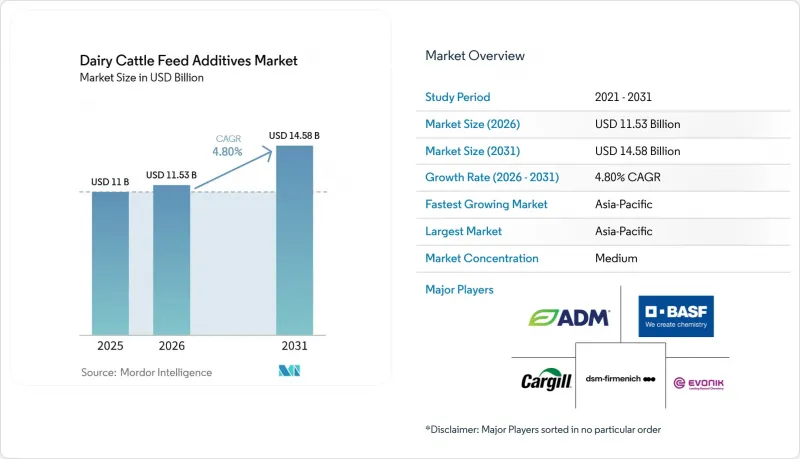
本報告按添加劑類型(酸味劑、胺基酸、抗生素、抗氧化劑、粘合劑、酵素、調味劑/甜味劑、礦物質、黴菌毒素解毒劑等)和地區(北美、南美、歐洲、亞太、中東和非洲)進行細分。市場預測以價值(美元)和數量(公噸)表示。
全球乳牛飼料添加劑市場趨勢及洞察
對提高牛奶產量和飼料轉換率的需求日益成長
商業性酪農越來越注重在降低飼料成本的同時提高產量,這導致對提高飼料轉換率和畜牧生產力的技術需求日益成長。根據Novones A/S公司2026年4月發布的報告,飼料成本佔商業酪農總產奶成本的60%至70%,凸顯了即使生產力略有提高也值得使用飼料添加劑的原因。對於採用高能量全混合日糧(TMR)的集約化乳牛場而言,這一點尤其重要,因為瘤胃活化產品有助於在粗飼料品質和飼料原料成本波動的情況下維持生產力。因此,能夠顯著提高產乳量、飼料轉換率或牛奶成分的添加劑在酪農飼養方案中變得越來越重要。如果供應商能夠提供技術支援、田間試驗數據以及在商業農場條件下獲得的經驗數據,而不僅僅是依賴實驗室結果,那麼這些產品的競爭力將進一步增強。
擴大管腔健康最佳化解決方案的應用
高產量乳牛群在飼料中可發酵能量過高時,尤其容易出現瘤胃失衡,因此,人們越來越關注能夠提高消化效率和維護動物健康的營養策略。因此,飼料添加劑方案越來越強調基於活性酵母、益生菌和酵素技術的日常預防方法,而不僅僅依賴糾正措施。據 Lallemand Animal Nutrition 公司稱,該公司於 2025 年 10 月在美國推出了 LEVUCELL Trivantage,多成分解決方案,結合了活性瘤胃酵母、基於芽孢桿菌的下腸道成分和酵母細胞壁衍生的後生元。該產品的推出反映了更廣泛的趨勢,即採用綜合添加劑平台來同時改善畜牧業生產力的多個方面。此類方法簡化了配方和監測,同時支持對產奶量、飼料穩定性和腸道健康進行更全面的管理。因此,能夠證明其產品在多個生產力指標上均具有持續有效性的供應商,並有望增強其在乳牛飼料添加劑市場的競爭力。
中小酪農的價格敏感性
當生產者無法透過提高牛奶收入或提升牛生產力來彌補不斷上漲的飼料成本時,飼料添加劑的採用往往會落後。這項挑戰在小規模規模酪農系統中尤為突出,因為這些地區的牛奶定價結構通常限制了生產者改善牛奶成分、動物健康或飼料轉換率的獎勵。因此,障礙不僅包括投資意願不足,還包括高品質產品的供應與商業化酪農系統現金流現實之間的不匹配。在這些市場,如果加工商的獎勵、牛奶品質溢價和合作採購機制沒有充分建立,即使是技術上有效的添加劑,其採用速度也可能很慢。因此,在許多新興市場,每頭乳牛實際使用的飼料添加劑量往往落後於酪農的整體成長潛力。
細分市場分析
到2025年,胺基酸將佔乳牛飼料添加劑市場佔有率的18%,成為最大的添加劑類別,其中瘤胃保護劑甲硫胺酸和離胺酸仍然是商業性乳牛飼料配方中的核心成分。礦物質是第二大支出領域,這主要得益於它們在牛奶合成和電解質平衡中的作用。另一方面,螯合微量元素在歐洲飼料添加劑限制的背景下獲得了更大的市場佔有率。酵素和維生素在商業性酪農系統中也繼續發揮至關重要的作用,它們能夠提高消化率、磷利用效率、過渡期健康和繁殖性能。酸化劑透過添加到青貯飼料和混合飼料中,能夠保存飼料並調節瘤胃pH值,因此在乳牛飼料添加劑市場中保持穩定的地位。
益生菌領域是成長最快的類別,隨著減少抗生素使用的努力推動微生物製劑的普及,預計2026年至2031年,乳牛飼料添加劑市場中的益生菌市場將以9.1%的複合年成長率成長。黴菌毒素解毒是重點領域,2026年第一季的監測數據也印證了這一點,因為變壓器解決方案的出現可以有效控制傳統黏土基產品無法有效控制的鐮刀菌毒素。植物性益生菌、益生元和酵母菌也商業性受到重視,因為生產者正在尋求更有效的方法來改善腸道健康、增強免疫力和調節微生物群。同時,由於獸醫部門加強監管,並在監管嚴格的地區限制抗生素的使用,乳牛飼料添加劑市場中的抗生素部分正面臨結構性壓力。
區域分析
到2025年,亞太地區將佔全球銷售額的28%,成為乳牛飼料添加劑市場最大的區域貢獻者。此外,預計該地區在2026年至2031年間將以7.6%的複合年成長率(CAGR)實現最高成長。 2025年發表於《徐慕手藝雜誌》的一項研究表明,0.2%的複合酶製劑能夠改善產前和產後乳牛的瘤胃發酵參數和微生物多樣性,凸顯了該地區對先進飼料添加劑日益成長的科學支持。 2026年2月,嘉吉公司在印度旁遮普邦瓦吉拉巴德投資3,600萬美元運作了第二家牛飼料廠,並稱其為南亞最大的牛飼料廠。據帝斯曼-芬美意公司稱,日本已於2024年11月批准Bovaer用於牛和牛,這是其「綠色戰略」(MIDORI strategy)的一部分。這表明,受監管的亞洲市場正在擴大,其需求已不再局限於基本維生素和礦物質。
歐洲和北美仍然是人均飼料支出最高的地區之一,這得益於其成熟的精準營養管理實踐、飼料廠、諮詢網路和合規系統。在北美,農場將配方設計與牛監測和生產力管理軟體相結合,推動了對胺基酸、瘤胃穩定劑、微量元素和更廣泛的多添加劑方案的持續需求。即使其他地區的成長速度可能更快,這些地區仍可能繼續成為高價值添加劑策略的關鍵試驗場。
南美洲、中東和非洲雖然市場規模較小,但由於其獨特的需求模式,仍佔有重要的戰略地位。在南美洲,以穀物為主的飼養系統和高溫高濕的儲存條件增加了污染風險,從而推動了對毒素防護措施和飼料保護產品的強勁需求。在非洲,儘管小規模養殖正逐步向商業商業性酪農系統轉型,但價格敏感度仍然限制了高級產品的廣泛應用。 2025年發表在《應用科學發現》(Discover Applied Sciences)上的一項研究發現,埃塞俄比亞奶牛飼料中存在黃麴毒素B1污染,凸顯了粘合劑產品和飼料安全解決方案在非洲市場的重要性。在中東,需求主要來自技術密集型酪農系統,這些系統優先考慮產品品質和食品安全。這些地區蘊藏著巨大的長期發展機遇,但產品普及的速度仍將取決於價格承受能力、本地示範推廣以及供應鏈的發展。
其他好處:
- Excel格式的市場預測(ME)表
- 3個月的分析師支持
目錄
第1章:引言
- 研究假設和市場定義
- 調查範圍
第2章:調查方法
第3章執行摘要
第4章 市場狀況
- 市場概覽
- 市場促進因素
- 對提高牛奶產量和飼料轉換率的需求日益成長
- 擴大管腔健康最佳化解決方案的應用
- 擴大精準營養技術在商業酪農的應用
- 目前,減少酪農牛管理中抗生素使用的趨勢十分明顯。
- 儲存飼料原料中黴菌毒素風險管理的需求日益成長
- 以減少殘留物和潔淨標示。
- 市場限制因素
- 中小酪農的價格敏感性
- 農場層級每種添加劑的投資報酬率證明都存在差異。
- 對功能性聲稱和微生物衍生成分的監管
- 飼料配方的複雜性取決於飼料品質、品種和泌乳階段。
- 監理情勢
- 技術展望
- 波特五力分析
第5章 市場規模與成長預測
- 添加劑
- 酸味劑
- 添加劑
- 富馬酸
- 乳酸
- 丙酸
- 其他酸味劑
- 添加劑
- 胺基酸
- 按添加劑類型
- 離胺酸
- 甲硫胺酸
- 蘇胺酸
- 色氨酸
- 其他胺基酸
- 按添加劑類型
- 抗生素
- 按添加劑類型
- 巴氏桿菌
- 青黴素類
- 四環黴素
- 泰樂菌素
- 其他抗生素
- 按添加劑類型
- 抗氧化劑
- 按添加劑類型
- 丁基Hydroxyanisole(BHA)
- 二丁基羥基甲苯(BHT)
- 檸檬酸
- 乙氧喹
- 沒食子酸丙酯
- 生育酚
- 其他抗氧化劑
- 按添加劑類型
- 活頁夾
- 透過輔助添加劑
- 天然黏合劑
- 合成黏合劑
- 透過輔助添加劑
- 酵素
- 按添加劑類型
- 碳水化合物消化酶
- 植酸酶
- 其他酵素
- 按添加劑類型
- 調味劑和甜味劑
- 添加劑
- 香味
- 甜味劑
- 添加劑
- 礦物
- 按添加劑類型
- 主要礦物
- 微量元素
- 按添加劑類型
- 黴菌毒素解毒劑
- 按添加劑類型
- 粘合劑
- 生物轉化劑
- 按添加劑類型
- 植物源
- 按添加劑類型
- 精油
- 香草和香辛料
- 其他植物源性物質
- 按添加劑類型
- 顏料
- 按添加劑類型
- 類胡蘿蔔素
- 薑黃素和螺旋藻
- 按添加劑類型
- 益生元
- 按添加劑類型
- 果寡糖
- 半乳寡糖
- 菊糖
- 乳果糖
- 甘露聚醣
- 木寡糖
- 其他益生元
- 按添加劑類型
- 益生菌
- 按添加劑類型
- 雙歧桿菌
- 腸球菌
- 乳酸菌
- 片球菌
- 鏈球菌
- 其他益生菌
- 按添加劑類型
- 維他命
- 按添加劑類型
- 維生素A
- 維生素B
- 維生素C
- 維生素E
- 其他維生素
- 按添加劑類型
- 東方
- 添加劑
- 新鮮酵母
- 硒酵母
- 用過的酵母
- 托魯拉乾酵母
- 乳清酵母
- 酵母衍生成分
- 添加劑
- 酸味劑
- 按地區
- 北美洲
- 美國
- 加拿大
- 其他北美國家
- 南美洲
- 巴西
- 阿根廷
- 其他南美國家
- 歐洲
- 德國
- 法國
- 英國
- 義大利
- 西班牙
- 俄羅斯
- 其他歐洲國家
- 亞太地區
- 中國
- 印度
- 日本
- 澳洲
- 紐西蘭
- 其他亞太國家
- 中東
- 沙烏地阿拉伯
- 阿拉伯聯合大公國
- 土耳其
- 其他中東國家
- 非洲
- 南非
- 埃及
- 肯亞
- 其他非洲國家
- 北美洲
第6章 競爭情勢
- 市場集中度
- 策略趨勢
- 市佔率分析
- 公司簡介
- Cargill, Incorporated
- Archer Daniels Midland Company
- dsm-firmenich AG
- BASF SE
- Evonik Industries AG
- Alltech, Inc.
- Kemin Industries, Inc.
- Adisseo
- Nutreco NV
- Phibro Animal Health Corporation
- Novus International, Inc.
- Elanco Animal Health Incorporated
- Novonesis A/S
- Lallemand Inc.
- AB Vista Ltd.
- Denkavit Feed Ingredients
第7章 市場機會與未來展望
According to Mordor Intelligence, the dairy cattle feed additives market size is USD 11 billion in 2025 and projected to reach USD 11.53 billion in 2026, expanding to USD 14.58 billion by 2031, registering a CAGR of 4.8% during 2026-2031.
This report is Segmented by Additive (Acidifiers, Amino Acids, Antibiotics, Antioxidants, Binders, Enzymes, Flavors and Sweeteners, Minerals, Mycotoxin Detoxifiers, and More), and by Geography (North America, South America, Europe, Asia-Pacific, Middle East, and Africa). The Market Forecasts are Provided in Terms of Value (USD) and Volume (Metric Tons)
Global Dairy Cattle Feed Additives Market Trends and Insights
Rising Demand for Higher Milk Yield and Feed Efficiency
Commercial dairy farms are increasingly focused on improving milk output per cow while controlling feed costs, creating stronger demand for technologies that enhance feed efficiency and animal performance. According to Novonesis A/S in April 2026, feed costs account for 60% to 70% of total milk production expenses in commercial dairy systems, highlighting why even modest improvements in productivity can justify the use of feed additives. This is particularly relevant in intensive herds using high-energy total mixed rations, where rumen-active products can help maintain performance when forage quality or feed ingredient costs fluctuate. As a result, additives that deliver measurable improvements in milk yield, feed conversion, or milk composition are becoming increasingly important within dairy feeding programs. The competitive value of these products is further strengthened when suppliers provide technical support, local trial data, and evidence generated under commercial farm conditions rather than relying solely on laboratory results.
Expanding Use of Rumen Health Optimization Solutions
High-yielding dairy herds are particularly vulnerable to rumen instability when diets contain elevated levels of fermentable energy, which has increased interest in nutritional strategies that support digestive efficiency and animal health. As a result, feed additive programs are increasingly emphasizing daily preventive approaches based on live yeast, probiotics, and enzyme technologies rather than relying solely on corrective interventions. According to Lallemand Animal Nutrition, in October 2025, the company launched LEVUCELL Trivantage in the United States, a multi-component solution combining live rumen yeast, a Bacillus-based lower-gut component, and a yeast cell wall postbiotic. The introduction reflects the broader trend toward integrated additive platforms designed to address multiple aspects of animal performance simultaneously. Such approaches simplify inclusion and monitoring while supporting more comprehensive management of milk production, feed intake stability, and gut health. Consequently, suppliers capable of demonstrating consistent benefits across several performance parameters are likely to strengthen their competitive position in the dairy cattle feed additives market.
Price Sensitivity Among Small and Mid-Sized Dairy Farms
The adoption of feed additives tends to be slower when producers are unable to recover higher feed costs through improved milk revenue or stronger herd performance. This challenge is particularly evident in smallholder and mid-scale dairy systems, where milk pricing structures often provide limited incentives for improvements in composition, animal health, or feed efficiency. As a result, the barrier is not solely a reluctance to invest, but also a mismatch between premium product offerings and the cash flow realities of developing commercial dairy systems. In these markets, even technically effective additives may experience slower adoption when processor incentives, milk quality premiums, and cooperative purchasing mechanisms are underdeveloped. Consequently, actual feed additive usage per cow often lags behind the broader growth potential of the dairy sector in many emerging markets.
Other drivers and restraints analyzed in the detailed report include:
- Growing Adoption of Precision Nutrition in Commercial Dairy Farms
- Strong Shift Toward Antibiotic Reduction in Dairy Herd Management
- Uneven Farm-Level Proof of Return on Investment Across Additive Classes
For complete list of drivers and restraints, kindly check the Table Of Contents.
Segment Analysis
Amino acids held 18% of the dairy cattle feed additives market share in 2025, making them the largest additive category as rumen-protected methionine and lysine remained central to commercial dairy ration programs. Minerals formed the next major spending block, supported by their roles in milk synthesis and electrolyte balance, while chelated trace minerals gained ground under European feed inclusion limits. Enzymes and vitamins also remained important because they improved digestibility, phosphorus efficiency, transition health, and reproductive outcomes in commercial dairy systems. Acidifiers continued to hold a steady role in the dairy cattle feed additives market through feed preservation and rumen pH management across silage and in-ration use.
The probiotics segment is the fastest-growing category, and the dairy cattle feed additives market size for probiotics is projected to expand at 9.1% CAGR from 2026 to 2031 as antibiotic reduction efforts support wider microbial adoption. Mycotoxin detoxifiers have become a priority area because biotransformer solutions address Fusarium toxins that traditional clay-based products cannot effectively control, supported by Q1 2026 monitoring data. Phytogenics, prebiotics, and yeast are also gaining commercial relevance as producers look for stronger gut health, immune support, and microbiota management tools. At the same time, the antibiotics segment faces structural pressure in the dairy cattle feed additives market as its use narrows under tighter veterinary oversight in regulated regions.
Complete Report Scope:
- By Additive
- Acidifiers
- By Sub Additive
- Fumaric Acid
- Lactic Acid
- Propionic Acid
- Other Acidifiers
- By Sub Additive
- Amino Acids
- By Sub Additive
- Lysine
- Methionine
- Threonine
- Tryptophan
- Other Amino Acids
- By Sub Additive
- Antibiotics
- By Sub Additive
- Bacitracin
- Penicillins
- Tetracyclines
- Tylosin
- Other Antibiotics
- By Sub Additive
- Antioxidants
- By Sub Additive
- Butylated Hydroxyanisole (BHA)
- Butylated Hydroxytoluene (BHT)
- Citric Acid
- Ethoxyquin
- Propyl Gallate
- Tocopherols
- Other Antioxidants
- By Sub Additive
- Binders
- By Sub Additive
- Natural Binders
- Synthetic Binders
- By Sub Additive
- Enzymes
- By Sub Additive
- Carbohydrases
- Phytases
- Other Enzymes
- By Sub Additive
- Flavors and Sweeteners
- By Sub Additive
- Flavors
- Sweeteners
- By Sub Additive
- Minerals
- By Sub Additive
- Macrominerals
- Microminerals
- By Sub Additive
- Mycotoxin Detoxifiers
- By Sub Additive
- Binders
- Biotransformers
- By Sub Additive
- Phytogenics
- By Sub Additive
- Essential Oil
- Herbs and Spices
- Other Phytogenics
- By Sub Additive
- Pigments
- By Sub Additive
- Carotenoids
- Curcumin and Spirulina
- By Sub Additive
- Prebiotics
- By Sub Additive
- Fructo Oligosaccharides
- Galacto Oligosaccharides
- Inulin
- Lactulose
- Mannan Oligosaccharides
- Xylo Oligosaccharides
- Other Prebiotics
- By Sub Additive
- Probiotics
- By Sub Additive
- Bifidobacteria
- Enterococcus
- Lactobacilli
- Pediococcus
- Streptococcus
- Other Probiotics
- By Sub Additive
- Vitamins
- By Sub Additive
- Vitamin A
- Vitamin B
- Vitamin C
- Vitamin E
- Other Vitamins
- By Sub Additive
- Yeast
- By Sub Additive
- Live Yeast
- Selenium Yeast
- Spent Yeast
- Torula Dried Yeast
- Whey Yeast
- Yeast Derivatives
- By Sub Additive
- Acidifiers
- By Geography
- North America
- United States
- Canada
- Rest of North America
- South America
- Brazil
- Argentina
- Rest of South America
- Europe
- Germany
- France
- United Kingdom
- Italy
- Spain
- Russia
- Rest of Europe
- Asia-Pacific
- China
- India
- Japan
- Australia
- New Zealand
- Rest of Asia-Pacific
- Middle East
- Saudi Arabia
- United Arab Emirates
- Turkey
- Rest of Middle East
- Africa
- South Africa
- Egypt
- Kenya
- Rest of Africa
- North America
Geography Analysis
Asia-Pacific held 28% of global revenue in 2025, making it the largest regional contributor to the dairy cattle feed additives market. The region is also projected to register the fastest CAGR of 7.6% during 2026-2031. According to a 2025 study published in Xu Mu Shou Yi Za Zhi, compound enzyme preparations included at 0.2% improved rumen fermentation parameters and microbial diversity in periparturient dairy cows, highlighting growing scientific support for advanced feed additives in the region. In February 2026, Cargill, Incorporated commissioned its second dairy feed plant in Wazirabad, Punjab, India, with an investment of USD 36 million and described it as the largest dairy feed plant in South Asia. According to dsm-firmenich AG, Japan authorized Bovaer for dairy and beef cattle under the MIDORI strategy in November 2024, demonstrating that regulated Asian markets are expanding beyond basic vitamin and mineral demand.
Europe and North America remain among the highest-spending regions per cow, supported by established precision nutrition practices, feed mills, advisory networks, and compliance systems. In North America, farms are increasingly linking ration formulation with herd monitoring and productivity software, supporting sustained demand for amino acids, rumen stabilizers, trace minerals, and broader multi-additive programs. These regions are likely to remain the principal test beds for high-value additive strategies even as faster percentage growth emerges elsewhere.
South America, the Middle East, and Africa are smaller in market size but remain strategically important due to their distinct demand patterns. South America exhibits strong demand for toxin control and feed protection, with grain-based feeding systems and warm storage conditions increasing contamination risks. Africa is gradually transitioning from smallholder production toward more commercial dairy systems, although price sensitivity continues to limit widespread adoption of premium products. According to a 2025 study published in Discover Applied Sciences, aflatoxin B1 contamination was identified in dairy feeds in Ethiopia, highlighting the continued importance of binder products and feed safety solutions in African markets. The Middle East supports demand from technology-intensive dairy systems focused on output quality and food security. These regions offer significant long-term opportunities, although the pace of adoption will continue to depend on affordability, local validation, and supply chain development.
- Cargill, Incorporated
- Archer Daniels Midland Company
- dsm-firmenich AG
- BASF SE
- Evonik Industries AG
- Alltech, Inc.
- Kemin Industries, Inc.
- Adisseo
- Nutreco N.V.
- Phibro Animal Health Corporation
- Novus International, Inc.
- Elanco Animal Health Incorporated
- Novonesis A/S
- Lallemand Inc.
- AB Vista Ltd.
- Denkavit Feed Ingredients
Additional Benefits:
- The market estimate (ME) sheet in Excel format
- 3 months of analyst support
TABLE OF CONTENTS
1 INTRODUCTION
- 1.1 Study Assumptions and Market Definition
- 1.2 Scope of the Study
2 RESEARCH METHODOLOGY
3 EXECUTIVE SUMMARY
4 MARKET LANDSCAPE
- 4.1 Market Overview
- 4.2 Market Drivers
- 4.2.1 Rising Demand for Higher Milk Yield and Feed Efficiency
- 4.2.2 Expanding Use of Rumen Health Optimization Solutions
- 4.2.3 Growing Adoption of Precision Nutrition in Commercial Dairy Farms
- 4.2.4 Strong Shift Toward Antibiotic Reduction in Dairy Herd Management
- 4.2.5 Higher Need for Mycotoxin Risk Control in Stored Feed Ingredients
- 4.2.6 Rising Demand for Residue-Conscious and Clean Label Dairy Production
- 4.3 Market Restraints
- 4.3.1 Price Sensitivity Among Small and Mid-Sized Dairy Farms
- 4.3.2 Uneven Farm-Level Proof of Return on Investment Across Additive Classes
- 4.3.3 Regulatory Scrutiny on Functional Claims and Microbial Ingredients
- 4.3.4 Formulation Complexity Across Forage Quality, Breed, and Lactation Stage
- 4.4 Regulatory Landscape
- 4.5 Technological Outlook
- 4.6 Porter's Five Forces Analysis
- 4.6.1 Threat of New Entrants
- 4.6.2 Bargaining Power of Suppliers
- 4.6.3 Bargaining Power of Buyers
- 4.6.4 Threat of Substitutes
- 4.6.5 Intensity of Competitive Rivalry
5 MARKET SIZE AND GROWTH FORECASTS (VALUE AND VOLUME)
- 5.1 By Additive
- 5.1.1 Acidifiers
- 5.1.1.1 By Sub Additive
- 5.1.1.1.1 Fumaric Acid
- 5.1.1.1.2 Lactic Acid
- 5.1.1.1.3 Propionic Acid
- 5.1.1.1.4 Other Acidifiers
- 5.1.1.1 By Sub Additive
- 5.1.2 Amino Acids
- 5.1.2.1 By Sub Additive
- 5.1.2.1.1 Lysine
- 5.1.2.1.2 Methionine
- 5.1.2.1.3 Threonine
- 5.1.2.1.4 Tryptophan
- 5.1.2.1.5 Other Amino Acids
- 5.1.2.1 By Sub Additive
- 5.1.3 Antibiotics
- 5.1.3.1 By Sub Additive
- 5.1.3.1.1 Bacitracin
- 5.1.3.1.2 Penicillins
- 5.1.3.1.3 Tetracyclines
- 5.1.3.1.4 Tylosin
- 5.1.3.1.5 Other Antibiotics
- 5.1.3.1 By Sub Additive
- 5.1.4 Antioxidants
- 5.1.4.1 By Sub Additive
- 5.1.4.1.1 Butylated Hydroxyanisole (BHA)
- 5.1.4.1.2 Butylated Hydroxytoluene (BHT)
- 5.1.4.1.3 Citric Acid
- 5.1.4.1.4 Ethoxyquin
- 5.1.4.1.5 Propyl Gallate
- 5.1.4.1.6 Tocopherols
- 5.1.4.1.7 Other Antioxidants
- 5.1.4.1 By Sub Additive
- 5.1.5 Binders
- 5.1.5.1 By Sub Additive
- 5.1.5.1.1 Natural Binders
- 5.1.5.1.2 Synthetic Binders
- 5.1.5.1 By Sub Additive
- 5.1.6 Enzymes
- 5.1.6.1 By Sub Additive
- 5.1.6.1.1 Carbohydrases
- 5.1.6.1.2 Phytases
- 5.1.6.1.3 Other Enzymes
- 5.1.6.1 By Sub Additive
- 5.1.7 Flavors and Sweeteners
- 5.1.7.1 By Sub Additive
- 5.1.7.1.1 Flavors
- 5.1.7.1.2 Sweeteners
- 5.1.7.1 By Sub Additive
- 5.1.8 Minerals
- 5.1.8.1 By Sub Additive
- 5.1.8.1.1 Macrominerals
- 5.1.8.1.2 Microminerals
- 5.1.8.1 By Sub Additive
- 5.1.9 Mycotoxin Detoxifiers
- 5.1.9.1 By Sub Additive
- 5.1.9.1.1 Binders
- 5.1.9.1.2 Biotransformers
- 5.1.9.1 By Sub Additive
- 5.1.10 Phytogenics
- 5.1.10.1 By Sub Additive
- 5.1.10.1.1 Essential Oil
- 5.1.10.1.2 Herbs and Spices
- 5.1.10.1.3 Other Phytogenics
- 5.1.10.1 By Sub Additive
- 5.1.11 Pigments
- 5.1.11.1 By Sub Additive
- 5.1.11.1.1 Carotenoids
- 5.1.11.1.2 Curcumin and Spirulina
- 5.1.11.1 By Sub Additive
- 5.1.12 Prebiotics
- 5.1.12.1 By Sub Additive
- 5.1.12.1.1 Fructo Oligosaccharides
- 5.1.12.1.2 Galacto Oligosaccharides
- 5.1.12.1.3 Inulin
- 5.1.12.1.4 Lactulose
- 5.1.12.1.5 Mannan Oligosaccharides
- 5.1.12.1.6 Xylo Oligosaccharides
- 5.1.12.1.7 Other Prebiotics
- 5.1.12.1 By Sub Additive
- 5.1.13 Probiotics
- 5.1.13.1 By Sub Additive
- 5.1.13.1.1 Bifidobacteria
- 5.1.13.1.2 Enterococcus
- 5.1.13.1.3 Lactobacilli
- 5.1.13.1.4 Pediococcus
- 5.1.13.1.5 Streptococcus
- 5.1.13.1.6 Other Probiotics
- 5.1.13.1 By Sub Additive
- 5.1.14 Vitamins
- 5.1.14.1 By Sub Additive
- 5.1.14.1.1 Vitamin A
- 5.1.14.1.2 Vitamin B
- 5.1.14.1.3 Vitamin C
- 5.1.14.1.4 Vitamin E
- 5.1.14.1.5 Other Vitamins
- 5.1.14.1 By Sub Additive
- 5.1.15 Yeast
- 5.1.15.1 By Sub Additive
- 5.1.15.1.1 Live Yeast
- 5.1.15.1.2 Selenium Yeast
- 5.1.15.1.3 Spent Yeast
- 5.1.15.1.4 Torula Dried Yeast
- 5.1.15.1.5 Whey Yeast
- 5.1.15.1.6 Yeast Derivatives
- 5.1.15.1 By Sub Additive
- 5.1.1 Acidifiers
- 5.2 By Geography
- 5.2.1 North America
- 5.2.1.1 United States
- 5.2.1.2 Canada
- 5.2.1.3 Rest of North America
- 5.2.2 South America
- 5.2.2.1 Brazil
- 5.2.2.2 Argentina
- 5.2.2.3 Rest of South America
- 5.2.3 Europe
- 5.2.3.1 Germany
- 5.2.3.2 France
- 5.2.3.3 United Kingdom
- 5.2.3.4 Italy
- 5.2.3.5 Spain
- 5.2.3.6 Russia
- 5.2.3.7 Rest of Europe
- 5.2.4 Asia-Pacific
- 5.2.4.1 China
- 5.2.4.2 India
- 5.2.4.3 Japan
- 5.2.4.4 Australia
- 5.2.4.5 New Zealand
- 5.2.4.6 Rest of Asia-Pacific
- 5.2.5 Middle East
- 5.2.5.1 Saudi Arabia
- 5.2.5.2 United Arab Emirates
- 5.2.5.3 Turkey
- 5.2.5.4 Rest of Middle East
- 5.2.6 Africa
- 5.2.6.1 South Africa
- 5.2.6.2 Egypt
- 5.2.6.3 Kenya
- 5.2.6.4 Rest of Africa
- 5.2.1 North America
6 COMPETITIVE LANDSCAPE
- 6.1 Market Concentration
- 6.2 Strategic Moves
- 6.3 Market Share Analysis
- 6.4 Company Profiles (Includes Global Level Overview, Market Level Overview, Core Segments, Financials as Available, Strategic Information, Market Rank/Share, Products and Services, Recent Developments)
- 6.4.1 Cargill, Incorporated
- 6.4.2 Archer Daniels Midland Company
- 6.4.3 dsm-firmenich AG
- 6.4.4 BASF SE
- 6.4.5 Evonik Industries AG
- 6.4.6 Alltech, Inc.
- 6.4.7 Kemin Industries, Inc.
- 6.4.8 Adisseo
- 6.4.9 Nutreco N.V.
- 6.4.10 Phibro Animal Health Corporation
- 6.4.11 Novus International, Inc.
- 6.4.12 Elanco Animal Health Incorporated
- 6.4.13 Novonesis A/S
- 6.4.14 Lallemand Inc.
- 6.4.15 AB Vista Ltd.
- 6.4.16 Denkavit Feed Ingredients
7 MARKET OPPORTUNITIES AND FUTURE OUTLOOK

 2026-2030年全球牛飼料市場
 牛飼料:市場佔有率分析、產業趨勢與統計、成長預測(2026-2031)肉牛飼料添加劑:市場佔有率分析、產業趨勢與統計及成長預測(2026-2031)肉牛飼料:市場佔有率分析、產業趨勢與統計、成長預測(2026-2031)乳牛飼料:市場佔有率分析、產業趨勢和統計數據、成長預測(2026-2031)
 全球牛飼料及飼料添加劑市場規模、佔有率、趨勢及成長分析報告:2026-2034年
 牛飼料市場規模、佔有率及成長分析(按來源、通路、應用及地區分類)-2026-2033年產業預測
 乳牛飼料市場至2032年的預測:按產品類型、牛類型、產地、形態、最終用戶和地區的全球分析