


 |
市場調查報告書
商品編碼
2063369
肉牛飼料:市場佔有率分析、產業趨勢與統計、成長預測(2026-2031)Beef Cattle Feed - Market Share Analysis, Industry Trends & Statistics, Growth Forecasts (2026 - 2031) |
||||||

※ 本網頁內容可能與最新版本有所差異。詳細情況請與我們聯繫。
根據 Mordor Intelligence 預測,肉牛飼料市場規模將從 2025 年的 680 億美元成長到 2026 年的 709 億美元,到 2031 年達到 870 億美元,預測期(2026-2031 年)的複合年成長率為 4.2%。
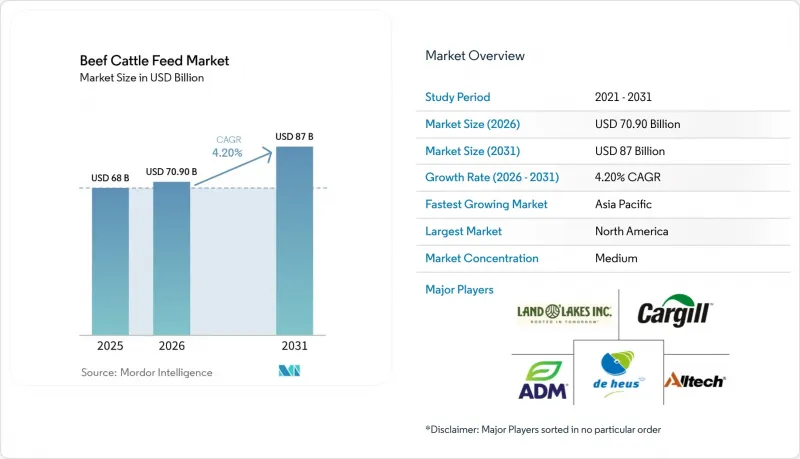
本報告按原料(玉米、大豆粕、油籽粕及其他)、形態(顆粒、碎粒及其他)、飼料類型(全價飼料、濃縮飼料及其他)、功能性添加劑(氨基酸、維生素和礦物質及其他)以及地區(北美、歐洲、亞太、南美及其他)進行分類。市場預測以美元計價。
全球肉牛飼料市場趨勢與洞察
高蛋白牛肉的需求正在推動商業飼料的採用。
全球對牛肉蛋白的需求持續推動肉牛飼料市場的成長。根據經合組織和聯合國糧農組織的預測,到2033年,全球肉品消費量預計將增加12%,其中南亞和東南亞將成為主要需求中心,這主要得益於收入成長和飲食習慣的改變。不斷成長的需求不僅導致某些國家牛群數量的增加,也促使生產商追求更高的屠宰重量和更穩定的胴體性能。因此,高能量飼料的重要性日益凸顯,玉米、油籽粕和提高生產力的補充品在肉牛飼料市場的使用量不斷擴大,逐漸取代了傳統的低投入飼料系統。即使在牛數量下降的地區,這一趨勢也十分明顯,因為加強育肥管理正在彌補牛群數量的減少。根據Alltech公司的報告顯示,儘管北美和歐洲的牛數量有所下降,但2024-2025年全球肉牛飼料銷量仍成長了0.5%。這一趨勢表明,商業飼料在肉牛飼料市場中得到了廣泛應用,這表明生產力的提高不僅取決於牛的數量增加,還取決於育肥效率和飼料品質的提高。
無抗生素牛肉的優質化正在加速對特殊添加劑的需求。
在北美、歐洲、亞太地區,尤其是日本,無抗生素和「終身無抗生素」方案正逐漸成為主要零售和餐飲服務業鏈的標準。這推動了肉牛飼料市場對益生菌、直接給藥的微生物製劑、酵母培養物、有機酸和植物性添加劑的需求成長,這些產品無需使用藥物生長促進劑即可支持腸道健康和提高生產力。買家也越來越重視可追溯性、成分識別和配方一致性,並傾向於選擇專用成分而非通用產品。因此,擁有經證實功效和可靠文件的供應商在肉牛飼料市場的重要性日益凸顯。例如,2024年5月,Alltech在北美推出了Agolin Luminan,這是一款獲得碳信託認證的甲烷減排飼料添加劑。該產品支持潔淨標示畜牧業項目,並增強了生產者和買家檢驗的永續性聲明。隨著優質牛肉分銷管道的拓展,已證實有效的專業營養產品預計將比可追溯性有限的通用添加劑更為重要。
玉米和大豆粕價格波動給飼料利潤帶來壓力。
原物料價格波動仍是肉牛飼料市場盈利面臨的主要挑戰。玉米和大豆粕佔育肥飼料成本的55%至65%,即使價格小幅上漲也可能擠壓生產商的利潤空間,並抑制其在優質營養產品上的支出。 2026年3月,中東地緣政治緊張局勢進一步加劇了飼料經濟的壓力,柴油、電力和運輸成本不斷上漲。此外,該協會指出,歐盟95%以上的離胺酸供應和60%至70%的維生素供應依賴進口,這使得生產商極易受到亞洲供應鏈中斷的影響。投入成本的上漲已經對全球肉類價格產生影響。聯合國糧食及農業組織(糧農組織)牛肉物價指數在2025年10月創下歷史新高,較2024年1月上漲28%。由於飼料成本飆升,肉牛飼料市場的買家往往會推遲採用專門的營養解決方案,而專注於保持複合飼料的價格可負擔性,這使得穀物和油籽價格的波動對全球永續利潤率構成風險。
細分市場分析
2025年,玉米佔肉牛飼料市場的42.5%,憑藉其高能量密度和在北美和南美育肥系統中的廣泛應用,繼續保持主導在育肥飼料領域的領先地位。豆粕仍是高產育肥計畫的主要蛋白質來源,並輔以傳統油籽。同時,2025年德國的監測結果表明,菜籽粕無需大豆即可完全滿足高產牛飼料的需求,這支持了市場對符合非基因改造和防止森林砍伐標準的飼料的需求。小麥和油籽餅粕也繼續發揮著重要的能源來源和蛋白質來源的作用,其中油籽餅粕尤其在低碳飼料策略中備受關注。
預計到2031年,昆蟲蛋白粉將以14.2%的複合年成長率成長,成為肉牛飼料市場中成長最快的原料細分市場。 《2025-2026年中國飼料產業報告》強調,為減少對豆粕的依賴,人們越來越關注昆蟲和單細胞蛋白。然而,昆蟲蛋白粉的廣泛應用仍取決於歐盟、日本和韓國的監管批准。尿素、蒸餾殘渣和農產品等其他原料在成本敏感的市場中仍佔據重要地位,原料組合也不斷多樣化,儘管玉米仍保持著主導地位。
至2025年,複合飼料將佔肉牛飼料市場(按飼料類型分類)的52.0%。這反映了大規模商業育肥場對承包飼餵解決方案的高需求。其主導地位得益於大型育肥作業中勞動投入的減少和波動性的降低。濃縮飼料在育肥前和育肥階段仍發揮重要作用,生產者通常將其與農場自產穀物結合使用;而補充飼料則繼續廣泛應用於需要特定營養管理的放牧和牛牛育肥作業中。
預計到2031年,預混合料和特殊添加劑的複合年成長率將達到6.8%,超過肉牛飼料市場的整體成長率。這一趨勢表明,營養系統正逐步朝著更模組化和客製化的方向發展,儘管複合飼料仍佔據主導地位。大規模養殖戶擴大採用高性能預混合料平台,並自行研發最終配方,而不是在每個階段都依賴成品飼料。這種方法使育肥場能夠更有效地利用穀物,同時也為肉牛飼料市場的添加劑和預混合料供應商拓展了直接銷售機會。
區域分析
北美是全球肉牛飼料市場的主導力量,預計2025年將佔全球銷售額的33%,成為最大的區域市場佔有率。美國佔據該地區的大部分銷售額,並憑藉大規模的育肥農場系統和一體化的飼料管理,繼續保持需求基礎。在美國,牛牛育肥牛總數的12%至15%,凸顯了針對新生牛和育肥階段的特殊營養方案的必要性。加拿大仍然是該地區的第二大市場,這得益於亞伯達以育肥為中心、以出口為導向的牛肉生產體系。預計在2025年美國因螺旋蠅疫情關閉邊境後,墨西哥市場將出現供應緊張,因為超過一百萬頭被預留的牛隻將增加國內飼料需求,並加劇成本壓力。
亞太地區預計將成為肉牛飼料市場成長最快的地區,到2031年複合年成長率將達到5.4%。 2025年,中國是領先的生產國之一,同期反芻動物飼料產量增加了1.8%。印度預計將成為該地區成長最快的國家市場,這主要得益於品牌複合飼料的日益普及。澳洲和紐西蘭受益於出口導向牛肉生產體系和先進的飼養技術,但其相對較小的市場規模限制了它們全部區域的貢獻。
土耳其是市場成長的主要驅動力,而南非、沙烏地阿拉伯和埃及正崛起為快速成長的各國市場,這得益於商業飼料的普及和對區域新產能的投資。歐洲肉牛飼料市場的成長主要受「從農場到餐桌」環保計劃的推動,這些計劃提倡使用減少甲烷排放的添加劑,並加強動物福利標準。西歐國家正在製定飼料檢測規程,並引入低蛋白飼料以達到氮排放目標。東歐仍然是一個重要的成長區域,因為生產商正在實現營運現代化並融入歐盟供應鏈。同時,英國脫歐後的監管差異增加了合規的複雜性,但也促進了原料採購和配方柔軟性的創新。
其他好處
- Excel格式的市場預測(ME)表
- 3個月的分析師支持
目錄
第1章:引言
- 研究假設和市場定義
- 調查範圍
第2章:調查方法
第3章執行摘要
第4章 市場狀況
- 市場概覽
- 市場促進因素
- 高蛋白牛肉的需求推動了市售飼料的普及。
- 無抗生素牛肉溢價的上漲正在加速對特殊添加劑的需求。
- 甲烷排放法規正在推動對功能性飼料解決方案的需求。
- 精心配製的飼料,可提高飼料轉換率和增重效果。
- 碳權貨幣化正在促進低排放飼料項目的發展。
- 高穀物育肥系統中後腸和瘤胃穩定性的要求
- 市場限制因素
- 玉米和大豆粕價格波動給飼料利潤帶來壓力。
- 添加劑核准和抗生素使用限制正在推遲產品推出。
- 對培養肉的投資會影響牛肉的長期需求規劃。
- 儲存和處理方式的差異會降低特種飼料的表現。
- 監理情勢
- 技術展望
- 波特五力分析
第5章 市場規模與成長預測
- 按原料
- 玉米
- 大豆粕
- 小麥
- 油籽粕
- 昆蟲蛋白粉
- 其他
- 按形式
- 顆粒
- 搗碎
- 崩潰
- 液體補充劑
- 按飼料類型
- 全價飼料
- 濃縮飼料
- 補充
- 預混合料和特殊添加劑
- 透過功能添加劑
- 胺基酸
- 維生素和礦物質
- 益生菌和酵母
- 有機酸和酶
- 其他功能性添加劑
- 按地區
- 北美洲
- 美國
- 加拿大
- 墨西哥
- 其他北美國家
- 南美洲
- 巴西
- 阿根廷
- 其他南美國家
- 歐洲
- 德國
- 法國
- 英國
- 義大利
- 西班牙
- 俄羅斯
- 其他歐洲國家
- 亞太地區
- 中國
- 印度
- 日本
- 澳洲
- 紐西蘭
- 其他亞太國家
- 中東
- 沙烏地阿拉伯
- 土耳其
- 阿拉伯聯合大公國
- 其他中東國家
- 非洲
- 南非
- 埃及
- 其他非洲地區
- 北美洲
第6章 競爭情勢
- 市場集中度
- 策略趨勢
- 市佔率分析
- 公司簡介
- Cargill, Incorporated
- Archer Daniels Midland
- Land O'Lakes(Purina Animal Nutrition)
- Alltech Inc
- De Heus Animal Nutrition BV
- Nutreco NV(SHV Holdings)
- Charoen Pokphand Foods PCL
- ForFarmers NV
- Kent Nutrition Group(Kent Corporation)
- Elanco Animal Health Incorporated(Eli Lilly and Company)
- Kalmbach Feeds Inc
第7章 市場機會與未來展望
According to Mordor Intelligence, the beef cattle feed market size is projected to increase from USD 68.0 billion in 2025 to USD 70.9 billion in 2026 and is forecast to reach USD 87.0 billion by 2031 at 4.2% CAGR over the forecast period (2026-2031).
This report is Segmented by Ingredient (Corn, Soybean Meal, Oilseed Cakes, and More ), by Form (Pellets, Crumbles, and More), by Feed Type (complete Feed, Concentrates, and More), by Functional Additive (Amino Acids, Vitamins and Minerals, Amino Acids, and More), and by Geography (North America, Europe, Asia-Pacific, South America, and More). The Market Forecasts are Provided in Terms of Value (USD).
Global Beef Cattle Feed Market Trends and Insights
Protein-Dense Beef Demand Supporting Commercial Feed Adoption
Global demand for beef protein continues to drive volume growth in the beef cattle feed market. According to OECD-FAO projections, global meat consumption is estimated to increase by 12% by 2033, with South and Southeast Asia as key demand centers driven by rising incomes and changing dietary preferences. This growing demand is not only leading to an increase in animal numbers in certain countries but is also encouraging producers to aim for heavier slaughter weights and more consistent carcass performance. As a result, higher-energy rations are becoming increasingly important, boosting the use of corn, oilseed cakes, and performance supplements over traditional low-input forage systems in the beef cattle feed market. This trend is evident even in regions where cattle inventories are under pressure, as intensified finishing practices have compensated for herd reductions. Alltech, Inc. reported that global beef feed tonnage increased by 0.5% from 2024 to 2025, despite declining cattle inventories in North America and Europe. This pattern highlights the resilience of commercial feed adoption in the beef cattle feed market, as production gains are increasingly driven by finishing efficiency and ration quality rather than herd expansion alone.
Antibiotic-Free Beef Premiums Accelerating Specialty Additive Demand
Antibiotic-free and no-antibiotics-ever programs are becoming standard across major retail and foodservice supply chains in North America, Europe, and Asia-Pacific, especially Japan. This has increased demand for probiotics, direct-fed microbials, yeast cultures, organic acids, and phytogenics in the beef cattle feed market that support gut health and performance without medicated growth promoters. Buyers also prioritize traceability, ingredient identity, and formulation consistency, increasing preference for specialty inputs over generic products. As a result, suppliers offering proven efficacy and strong documentation are gaining importance in the beef cattle feed market. For example, in May 2024, Alltech, Inc. began North American distribution of Agolin Ruminant, a Carbon Trust-certified feed additive for methane reduction. The product supported cleaner-label livestock programs and strengthened verified sustainability claims for producers and buyers. As premium beef channels expand, documented specialty nutrition is anticipated to gain further importance over generic additives with limited traceability.
Corn and Soybean Meal Price Volatility Pressuring Feed Margins
Raw material price volatility remains a significant challenge to profitability in the beef cattle feed market. Corn and soybean meal constitute 55% to 65% of finishing ration costs, meaning even slight price increases can erode producer margins and constrain spending on premium nutrition products. In March 2026, the geopolitical tensions in the Middle East led to higher diesel, electricity, and shipping costs, further straining feed economics. Additionally, the association noted that the European Union relies on imports for over 95% of its lysine supply and 60% to 70% of its vitamin supply, leaving producers vulnerable to disruptions in Asian supply chains. Rising input costs are already impacting global meat prices. The Food and Agriculture Organization (FAO) beef price index reached a record high in October 2025, up 28% from January 2024 levels. As feed costs escalate, buyers in the beef cattle feed market often delay adopting specialty nutrition solutions and focus on maintaining ration affordability, making grain and oilseed price volatility a persistent margin risk globally.
Other drivers and restraints analyzed in the detailed report include:
- Methane-Reduction Compliance Increasing Demand for Functional Feed Solutions
- Precision Ration Formulation Improving Feed Efficiency and Weight Gain
- Additive Approval and Antibiotic-Use Restrictions Slowing Product Rollouts
For complete list of drivers and restraints, kindly check the Table Of Contents.
Segment Analysis
Corn accounted for 42.5% of the beef cattle feed market size in 2025, maintaining its leading position in finishing rations due to its high energy density and broad availability across North American and South American feedlot systems. Soybean meal remained the primary protein source for high-performance finishing programs using conventional oilseed supplementation. At the same time, Germany's 2025 monitoring results showed that rapeseed extraction meal could fully support high-performance cattle rations without soy, supporting demand for GMO-free and deforestation-compliant feed options. Wheat and oilseed cakes also continue to serve as important energy and protein inputs, with oilseed cakes gaining attention for lower-carbon ration strategies.
Insect protein meal is projected to grow at a 14.2% CAGR through 2031, making it the fastest-growing ingredient segment in the beef cattle feed market. China's 2025-2026 feed industry commentary highlighted an increasing focus on insect and single-cell proteins to reduce dependence on soybean meal. However, wider adoption still depends on regulatory approvals in the European Union, Japan, and South Korea. Other ingredients, including urea, distillers' grains, and agricultural by-products, remain important in cost-sensitive markets, broadening the ingredient mix even as corn retains its dominant position.
Complete feed accounted for 52.0% of the beef cattle feed market share by feed type in 2025, reflecting strong demand for turnkey feeding solutions in large commercial feedlots. Its dominance is driven by lower labor requirements and reduced variability in high-volume finishing operations. Concentrates continue to play an important role in stocker and backgrounding systems, where producers combine them with farm grain, while supplements remain widely used in pasture-based and cow-calf operations that require targeted nutrition.
Premixes and specialty additives are projected to grow at a 6.8% CAGR through 2031, outpacing the overall beef cattle feed market. This trend indicates a gradual shift toward more modular and customized nutrition systems, even as complete feed remains the dominant format. An increasing number of larger operators are acquiring high-performance premix platforms and formulating final rations internally, instead of relying on fully finished feed for every stage. This approach enables feedlots to utilize their own grain more efficiently while expanding direct sales opportunities for additive and premix suppliers in the beef cattle feed market.
Geography Analysis
North America led the global beef cattle feed market, accounting for 33% of revenue in 2025 and the largest share among regions. The United States accounted for significant regional revenue and continued to anchor demand through large feedlot systems and integrated ration management. Beef-on-dairy cattle accounted for 12% to 15% of total United States fed cattle slaughter, underscoring the need for specialized neonatal and finishing nutrition programs. Canada remained the second-largest market in the region, supported by feedlot-intensive finishing in Alberta and export-linked beef production systems. Mexico's market tightened after the 2025 United States border closure related to screwworm, because more than 1 million retained cattle increased domestic feed demand and lifted cost pressure.
Asia-Pacific is projected to be the fastest-growing region in the beef cattle feed market, with a 5.4% CAGR projected through 2031. In 2025, China was a major country, with its ruminant feed output increasing by 1.8% during the historical period. India is anticipated to be the fastest-growing country market in the region, driven by the increasing adoption of branded compound feeds. Australia and New Zealand benefit from export-oriented beef systems and advanced feeding practices; however, their smaller scale limits their overall contribution to regional revenue growth.
Turkey is a major contributor to market growth, while South Africa, Saudi Arabia, and Egypt are emerging as faster-growing country markets, supported by the adoption of commercial feed and investments in new regional production capacities. European growth in the beef cattle feed market is supported by Farm to Fork environmental policies that encourage methane-reducing additives and stronger animal welfare standards. Western European countries are advancing feed-testing protocols and adopting low-protein diets to meet nitrogen-emission targets. Eastern Europe remains a key growth area as producers modernize operations and integrate with European Union supply chains. Meanwhile, post-Brexit regulatory divergence has increased compliance complexity while also encouraging innovation in ingredient sourcing and formulation flexibility.
- Cargill, Incorporated
- Archer Daniels Midland
- Land O'Lakes (Purina Animal Nutrition)
- Alltech Inc
- De Heus Animal Nutrition B.V.
- Nutreco N.V. (SHV Holdings)
- Charoen Pokphand Foods PCL
- ForFarmers N.V.
- Kent Nutrition Group (Kent Corporation)
- Elanco Animal Health Incorporated (Eli Lilly and Company)
- Kalmbach Feeds Inc
Additional Benefits:
- The market estimate (ME) sheet in Excel format
- 3 months of analyst support
TABLE OF CONTENTS
1 Introduction
- 1.1 Study Assumptions and Market Definition
- 1.2 Scope of the Study
2 Research Methodology
3 Executive Summary
4 Market Landscape
- 4.1 Market Overview
- 4.2 Market Drivers
- 4.2.1 Protein-dense beef demand supporting commercial feed adoption
- 4.2.2 Antibiotic-free beef premiums accelerating specialty additive demand
- 4.2.3 Methane-reduction compliance increasing demand for functional feed solutions
- 4.2.4 Precision ration formulation improving feed efficiency and weight gain
- 4.2.5 Carbon-credit monetization encouraging low-emission feed programs
- 4.2.6 Hindgut and rumen stability needs in high-grain finishing systems
- 4.3 Market Restraints
- 4.3.1 Corn and soybean meal price volatility pressuring feed margins
- 4.3.2 Additive approval and antibiotic-use restrictions slowing product rollouts
- 4.3.3 Cultivated-meat investment affecting long-term beef demand planning
- 4.3.4 Storage and handling variability reducing specialty feed performance
- 4.4 Regulatory Landscape
- 4.5 Technological Outlook
- 4.6 Porter's Five Forces Analysis
- 4.6.1 Threat of New Entrants
- 4.6.2 Bargaining Power of Suppliers
- 4.6.3 Bargaining Power of Buyers
- 4.6.4 Threat of Substitutes
- 4.6.5 Intensity of Competitive Rivalry
5 Market Size and Growth Forecasts (Value in USD)
- 5.1 By Ingredient
- 5.1.1 Corn
- 5.1.2 Soybean Meal
- 5.1.3 Wheat
- 5.1.4 Oilseed Cakes
- 5.1.5 Insect Protein Meal
- 5.1.6 Others
- 5.2 By Form
- 5.2.1 Pellets
- 5.2.2 Mash
- 5.2.3 Crumbles
- 5.2.4 Liquid Supplements
- 5.3 By Feed Type
- 5.3.1 Complete Feed
- 5.3.2 Concentrates
- 5.3.3 Supplements
- 5.3.4 Premixes and Specialty Additives
- 5.4 By Functional Additive
- 5.4.1 Amino Acids
- 5.4.2 Vitamins and Minerals
- 5.4.3 Probiotics and Yeast
- 5.4.4 Organic Acids and Enzymes
- 5.4.5 Other Functional Additives
- 5.5 By Geography
- 5.5.1 North America
- 5.5.1.1 United States
- 5.5.1.2 Canada
- 5.5.1.3 Mexico
- 5.5.1.4 Rest of North America
- 5.5.2 South America
- 5.5.2.1 Brazil
- 5.5.2.2 Argentina
- 5.5.2.3 Rest of South America
- 5.5.3 Europe
- 5.5.3.1 Germany
- 5.5.3.2 France
- 5.5.3.3 United Kingdom
- 5.5.3.4 Italy
- 5.5.3.5 Spain
- 5.5.3.6 Russia
- 5.5.3.7 Rest of Europe
- 5.5.4 Asia-Pacific
- 5.5.4.1 China
- 5.5.4.2 India
- 5.5.4.3 Japan
- 5.5.4.4 Australia
- 5.5.4.5 New Zealand
- 5.5.4.6 Rest of Asia-Pacific
- 5.5.5 Middle East
- 5.5.5.1 Saudi Arabia
- 5.5.5.2 Turkey
- 5.5.5.3 United Arab Emirates
- 5.5.5.4 Rest of Middle East
- 5.5.6 Africa
- 5.5.6.1 South Africa
- 5.5.6.2 Egypt
- 5.5.6.3 Rest of Africa
- 5.5.1 North America
6 Competitive Landscape
- 6.1 Market Concentration
- 6.2 Strategic Moves
- 6.3 Market Share Analysis
- 6.4 Company Profiles (Includes Global Overview, Market Overview, Core Segments, Financials as Available, Strategic Information, Market Rank/Share, Products and Services, Recent Developments)
- 6.4.1 Cargill, Incorporated
- 6.4.2 Archer Daniels Midland
- 6.4.3 Land O'Lakes (Purina Animal Nutrition)
- 6.4.4 Alltech Inc
- 6.4.5 De Heus Animal Nutrition B.V.
- 6.4.6 Nutreco N.V. (SHV Holdings)
- 6.4.7 Charoen Pokphand Foods PCL
- 6.4.8 ForFarmers N.V.
- 6.4.9 Kent Nutrition Group (Kent Corporation)
- 6.4.10 Elanco Animal Health Incorporated (Eli Lilly and Company)
- 6.4.11 Kalmbach Feeds Inc
7 Market Opportunities and Future Outlook

 2026-2030年全球牛飼料市場
 牛飼料:市場佔有率分析、產業趨勢與統計、成長預測(2026-2031)乳牛飼料添加劑:市場佔有率分析、產業趨勢與統計及成長預測(2026-2031 年)肉牛飼料添加劑:市場佔有率分析、產業趨勢與統計及成長預測(2026-2031)乳牛飼料:市場佔有率分析、產業趨勢和統計數據、成長預測(2026-2031)
 全球牛飼料及飼料添加劑市場規模、佔有率、趨勢及成長分析報告:2026-2034年
 牛飼料市場規模、佔有率及成長分析(按來源、通路、應用及地區分類)-2026-2033年產業預測
 乳牛飼料市場至2032年的預測:按產品類型、牛類型、產地、形態、最終用戶和地區的全球分析