


 |
市場調查報告書
商品編碼
2063347
乳牛飼料:市場佔有率分析、產業趨勢和統計數據、成長預測(2026-2031)Dairy Cattle Feed - Market Share Analysis, Industry Trends & Statistics, Growth Forecasts (2026 - 2031) |
||||||

※ 本網頁內容可能與最新版本有所差異。詳細情況請與我們聯繫。
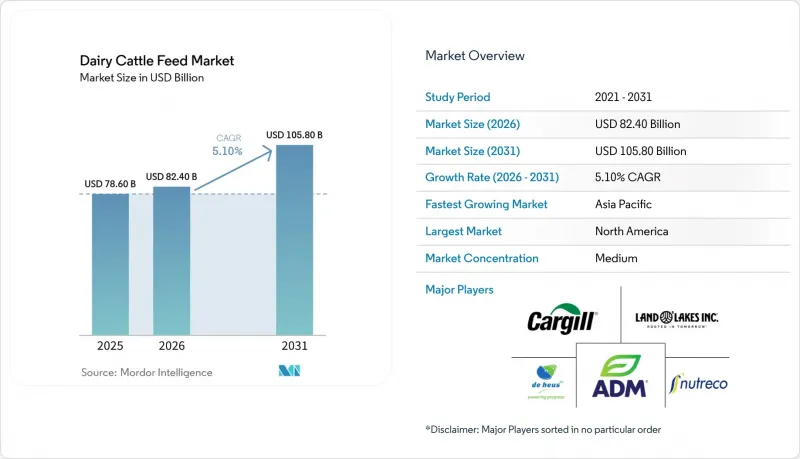
根據 Mordor Intelligence 預測,乳牛飼料市場規模將從 2025 年的 786 億美元成長到 2026 年的 824 億美元,到 2031 年將達到 1058 億美元,2026 年至 2031 年的複合年成長率為 5.1%。
本報告依飼料種類(能量飼料、蛋白質飼料、礦物質飼料、維生素飼料及其他)、形態(顆粒狀、碎粒狀、粉狀及其他)、原料(玉米、大豆粕、小麥及其他)、生命週期階段(牛教槽料、育肥牛及其他)及地區(北美、南美、歐洲及其他)進行分類。市場預測以美元計價。
全球乳牛飼料市場趨勢及洞察
新興國家酪農整合進展
印度乳牛的擴張,得益於牛生產力的提高和系統化飼養方式的推廣,帶動了對反芻動物飼料和複合牛飼料的需求。根據印度政府預測,2024-2025年度牛奶產量將達到2.4787億噸,較2023-2024年度的2.393億噸增加3.58%。這反映了規範化酪農體系的擴張和牛。這種成長表明,需要營養均衡的反芻動物飼料來維持生產力水準。隨著酪農向商業性化營運轉型,並採用更先進的飼料管理技術,預計複合牛飼料的使用量將會增加,從而支撐乳牛飼料市場的持續成長。
精密送料軟體和物聯網飼料感測器的介紹
根據美國國立衛生研究院 (NIH) 的研究,酪農的擴張和牛規模的擴大使得牲畜監測變得更加複雜,並帶來了與健康、福利和生產力相關的挑戰。該研究重點介紹了精準農業 (PLF) 如何利用感測器即時監測個別動物,從而改善牛管理並最佳化生產力。這些系統融合了物聯網技術,包括雲端運算和機器學習,使酪農養殖能夠進行數據驅動的決策。
飼料原料的植物檢疫進口障礙日益提高
日益嚴格的植物檢疫法規限制了全球飼料原料的貿易,對乳牛飼料市場的供應狀況造成了顯著影響。根據美國農業部報告顯示,歐盟提案的更嚴格的農藥殘留標準每年可能影響超過54億美元的農產品出口。這些監管措施增加了合規成本,並限制了出口商的市場進入。因此,飼料生產商正面臨供應中斷和定價挑戰,凸顯了採購管道多元化和靈活採購方式的重要性。
細分市場分析
到2025年,能量飼料將佔乳牛飼料市場佔有率的40%,成為最大的細分市場。然而,從2026年到2031年,功能性添加劑市場預計將以8.9%的複合年成長率快速成長。生產商越來越關注3-硝基氧丙醇,因為對這種添加劑的投資可以透過排碳權和與甲烷相關的乳製品課稅減免來抵消。能量飼料在規模上仍然主導著乳牛飼料市場,但隨著飼料生產商將預算分配給益生菌、活性酵母和保護性胺基酸,其市場佔有率正在逐漸下降。專注於瘤胃微生物組調控的新創公司正在進入一個先前由藥用顆粒劑主導的領域。
在實際配方設計中,酵素製劑和直接給藥的微生物製劑與包衣甲硫胺酸結合使用,以提高蛋白質的利用效率。如果監管機構接受處方箋的行銷策略,功能性添加劑有望獲得顯著的市場佔有率。能量飼料仍然是重要的組成部分,但預計一旦玉米價格達到出口水平,市場將轉向使用本地穀物產品。這一趨勢表明,乳牛飼料市場正從單純關注熱量含量轉向關注營養密度。
儘管顆粒飼料在2025年仍佔乳牛飼料市場46%的最大佔有率,但全混合飼料(TMR)市場預計將以最快的速度成長,2036年至2031年間的複合年成長率(CAGR)將達到9.7%。能夠精確地稱重、混合和分配飼料的機器人攪拌機正在推動乳牛飼料市場的進步。由於長期人手不足,大規模農場越來越依賴TMR機器人來應對人員配備的挑戰。因此,TMR組分的市場正在擴大,尤其是在那些提高能源效率有助於改善碳排放並吸引牛奶消費者關注的地區。
儘管對蛤蜊牛飼料和粉狀飼料的需求在犢牛和牛中保持穩定,但其成長有限。然而,先進的全混合日糧(TMR)飼料感測器的引入,能夠將中性清潔劑纖維(NDF)和澱粉含量等詳細數據傳輸到雲端控制面板,正在將飼料轉變為數據驅動型產品。能夠同時提供飼料配方和相關數據分析的飼料廠,預計將在這個不斷變化的市場中獲益匪淺。
區域分析
預計到2025年,北美將佔據全球乳牛飼料市場29%的佔有率。加州、威斯康辛州、愛達荷州和德克薩斯州等州是重要的需求中心,當地飼料生產商為全混合日糧(TMR)的推出和基於雲端的分析提供支援。加拿大的配額制度穩定了牛奶的支付,從而平衡了飼料預算。同時,墨西哥正利用其地理位置接近性美國剩餘原料的優勢,建構強大的跨境物流網路。 Archer Daniels Midland (ADM) 和 Alltech 於2026年2月成立的合資企業「Akralos」表明,該地區致力於擴大業務規模並整合技術服務。
預計亞太市場在2026年至2031年間將以7.4%的複合年成長率成長,成為成長最快的地區。政府支持低溫運輸基礎設施和基因分型的措施正在推動對飼料規格要求的需求。這些項目旨在提高飼料生產的效率和品質,並確保符合不斷發展的行業標準。儘管澳洲和日本被認為是成熟市場,但對飼料可追溯性和滿足消費者對永續性期望的功能性添加劑的需求仍然強勁,這反映出人們越來越重視透明度和環境責任。
在歐洲,農民面臨許多挑戰,例如牛奶產量停滯不前、氣候政策日益嚴格以及來自植物來源替代品的競爭。碳足跡問題和殘留物標準正在影響原料的選擇,促使農民使用本地穀物,並對不涉及森林砍伐的大豆進行認證。東歐仍然是一個充滿發展潛力的地區,ForFarmers近期在波蘭開展的活動證明了這一點。南美洲雖然享有以牧草為主的飼養系統的成本優勢,但為了抓住出口機遇,正在擴大封閉式飼料的採用。
其他好處
- Excel格式的市場預測(ME)表
- 3個月的分析師支持
目錄
第1章:引言
- 研究假設和市場定義
- 調查範圍
第2章:調查方法
第3章執行摘要
第4章 市場狀況
- 市場概覽
- 市場促進因素
- 新興國家酪農整合進展
- 精密送料軟體和物聯網飼料感測器的介紹
- 與A2型乳製品和無乳糖乳製品相比,功能性乳製品的需求激增。
- 飼料玉米和豆粕的波動率避險合約
- 排碳權計畫旨在鼓勵低甲烷排放的酪農
- 利用昆蟲將農場糞便生物轉化為高蛋白飼料
- 市場限制因素
- 加強對飼料原料的植物檢疫進口壁壘
- 抗生素使用的監管力道加大,導致含藥飼料的核准流程更加嚴格。
- 替代乳製品的普及給利潤率帶來了壓力。
- 非洲和南亞小規模農戶貸款的限制
- 監理情勢
- 技術展望
- 波特五力分析
第5章 市場規模與成長預測
- 按飼料類型
- 能量飼料
- 蛋白質飼料
- 礦物
- 維他命
- 功能性添加劑
- 其他
- 按形式
- 顆粒
- 崩潰
- 搗碎
- 全混合日糧(TMR)
- 其他
- 按原料
- 玉米
- 大豆粕
- 小麥
- 苜蓿
- 其他
- 依生命週期階段
- 牛開食料
- 用於育肥的乳牛
- 泌乳牛飼料
- 乾乳牛飼料
- 按地區
- 北美洲
- 美國
- 加拿大
- 墨西哥
- 其他北美國家
- 南美洲
- 巴西
- 阿根廷
- 其他南美國家
- 歐洲
- 德國
- 法國
- 俄羅斯
- 義大利
- 西班牙
- 英國
- 其他歐洲國家
- 亞太地區
- 中國
- 印度
- 澳洲
- 日本
- 其他亞太國家
- 中東
- 阿拉伯聯合大公國
- 沙烏地阿拉伯
- 其他中東國家
- 非洲
- 南非
- 埃及
- 其他非洲地區
- 北美洲
第6章 競爭情勢
- 市場集中度
- 策略趨勢
- 市佔率分析
- 公司簡介
- Cargill, Incorporated
- Archer-Daniels-Midland Company(ADM)
- Nutreco NV(SHV Holdings NV)
- Land O'Lakes, Inc.
- De Heus Voeders BV
- ForFarmers NV
- Lallemand Inc.
- Alltech, Inc.
- Evonik Industries AG
- BASF SE
- DSM-Firmenich AG
- Godrej Agrovet Limited
- Royal Agrifirm Group(Cooperatie Koninklijke Agrifirm UA)
- Kent Nutrition Group, Inc.(Kent Corporation)
- Ridley Corporation Limited
第7章 市場機會與未來展望
According to Mordor Intelligence, the dairy cattle feed market size is projected to grow from USD 78.6 billion in 2025 to USD 82.4 billion in 2026 and USD 105.8 billion by 2031, with a CAGR of 5.1% from 2026 to 2031.
This report is Segmented by Feed Type (Energy Feed, Protein Feed, Minerals, Vitamins, and More), by Form (Pellets, Crumbles, Mash, and More), by Ingredient Source (Corn, Soybean Meal, Wheat, and More), by Lifecycle Stage (Calf Starter, Heifer Grower, and More), and by Geography (North America, South America, Europe, and More). The Market Forecasts are Provided in Terms of Value (USD).
Global Dairy Cattle Feed Market Trends and Insights
Growing Intensification of Dairy Farms in Emerging Economies
The growth of dairy cattle farming in India is increasing the demand for ruminant and compound cattle feed, driven by rising herd productivity and structured feeding practices. According to the Government of India, milk production totaled 247.87 million metric tons in 2024-25, a 3.58% increase from 239.30 million metric tons in 2023-24, reflecting the expansion of organized dairy systems and larger herd sizes. This growth underscores the need for nutritionally balanced ruminant feed to maintain productivity levels. As dairy farms transition to commercial operations with enhanced feed management practices, the use of formulated cattle feed is projected to increase, supporting sustained growth in the dairy cattle feed market.
Adoption of Precision-Feeding Software and IoT Ration Sensors
According to a study by the National Institutes of Health, the growth of dairy farms and larger herd sizes have increased the complexity of animal monitoring, resulting in challenges related to health, welfare, and productivity. The study emphasizes that precision livestock farming (PLF) employs sensors to monitor individual animals in real time, facilitating improved herd management and performance optimization. These systems incorporate IoT technologies, including cloud computing and machine learning, to enable data-driven decision-making in dairy operations.
Escalating Phytosanitary Import Barriers on Feed Ingredients
Increasingly stringent phytosanitary regulations are restricting global trade in feed ingredients, significantly affecting the supply availability for the dairy cattle feed market. The United States Department of Agriculture reports that the European Union's proposed stricter pesticide residue limits could impact agricultural exports worth over USD 5.4 billion annually . These regulatory measures raise compliance costs and restrict market access for exporters. Consequently, feed manufacturers encounter supply disruptions and price challenges, emphasizing the importance of diversified sourcing strategies and flexible procurement practices.
Other drivers and restraints analyzed in the detailed report include:
- Surge in Functional Dairy Demand for A2 and Lactose-free Products
- Volatility-Hedging Contracts for Feed Corn and Soybean Meal
- Antibiotic-Use Scrutiny Tightening Medicated-Feed Approvals
For complete list of drivers and restraints, kindly check the Table Of Contents.
Segment Analysis
Energy feed led with the largest 40% of the dairy cattle feed market share in 2025, while the functional additives market size is advancing at the fastest 8.9% CAGR from 2026 to 2031. Producers are increasingly focusing on 3-nitrooxypropanol, as an investment in this additive can be offset through carbon credits and reduced methane-related milk levies. While energy feeds continue to dominate the dairy cattle feed market in terms of size, their share is gradually declining as feed mills allocate budgets toward probiotics, live yeast, and protected amino acids. Start-ups focusing on rumen microbiome modulation are entering a space previously dominated by medicated crumbles.
In practical ration formulation, enzymes and direct-fed microbials are combined with coated methionine to enhance protein efficiency. Functional additives could capture a significant market share if regulatory bodies accept prescription-like marketing strategies. Energy feeds will remain a key component, but are projected to shift toward local grain by-products when corn prices reach export-parity levels. This trend underscores the dairy cattle feed market's transition toward nutrient density over simple calorie content.
Pellets held the largest 46% of the dairy cattle feed market share in 2025, whereas the total mixed ration (TMR) market size is expanding at the fastest 9.7% CAGR from 2036 to 2031. Robotic mixers that weigh, blend, and deliver feed with high precision are driving advancements in the dairy cattle feed market. Large herds increasingly rely on Total Mixed Ration (TMR) robots to address staffing challenges caused by persistent labor shortages. As a result, the market for TMR components is expanding, particularly in regions where energy efficiency contributes to improved carbon scorecards, attracting interest from milk buyers.
While demand for crumble and mash feed remains steady in calf and heifer diets, its growth is limited. Conversely, the introduction of advanced TMR nutrient sensors, which transmit detailed data such as Neutral Detergent Fiber (NDF) and starch content to cloud-based dashboards, is transforming feed into a data-driven product. Feed mills capable of providing both the physical feed blend and accompanying data insights are positioned to benefit significantly in this evolving market.
Geography Analysis
North America is projected to account for 29% of the dairy cattle feed market share in 2025. States such as California, Wisconsin, Idaho, and Texas represent significant demand centers, supported by regional mills that provide Total Mixed Ration (TMR) startups and cloud-based analytics. Canada's quota system stabilizes milk payments, which in turn balances feed budgets. Meanwhile, Mexico leverages its proximity to surplus ingredients from the United States, fostering a strong cross-border logistics network. Archer-Daniels-Midland Company (ADM) and Alltech, Inc. Akralos venture, launched in February 2026, highlights the region's focus on scaling operations and integrating technical services.
The Asia-Pacific market is projected to grow at a 7.4% CAGR from 2026 to 2031, making it the fastest-growing region. Government initiatives supporting cold-chain infrastructure and genotyping are increasing the demand for higher feed specification requirements. These programs aim to enhance the efficiency and quality of feed production, ensuring compliance with evolving industry standards. Although Australia and Japan are regarded as mature markets, they maintain a strong demand for feed traceability and functional additives that meet consumer expectations for sustainability, reflecting a growing emphasis on transparency and environmental responsibility.
Europe is navigating challenges such as stagnant milk production, stringent climate policies, and competition from plant-based alternatives. Carbon footprint considerations and residue limits are influencing ingredient choices, encouraging the use of regional grains and deforestation-free soy certifications. Eastern Europe remains a promising area for expansion, as demonstrated by ForFarmers' recent activities in Poland. South America benefits from cost advantages associated with pasture-based systems but is increasingly adopting confinement diets to capture export opportunities.
- Cargill, Incorporated
- Archer-Daniels-Midland Company (ADM)
- Nutreco N.V. (SHV Holdings N.V.)
- Land O'Lakes, Inc.
- De Heus Voeders B.V.
- ForFarmers N.V.
- Lallemand Inc.
- Alltech, Inc.
- Evonik Industries AG
- BASF SE
- DSM-Firmenich AG
- Godrej Agrovet Limited
- Royal Agrifirm Group (Cooperatie Koninklijke Agrifirm U.A.)
- Kent Nutrition Group, Inc. (Kent Corporation)
- Ridley Corporation Limited
Additional Benefits:
- The market estimate (ME) sheet in Excel format
- 3 months of analyst support
TABLE OF CONTENTS
1 Introduction
- 1.1 Study Assumptions and Market Definition
- 1.2 Scope of the Study
2 Research Methodology
3 Executive Summary
4 Market Landscape
- 4.1 Market Overview
- 4.2 Market Drivers
- 4.2.1 Growing intensification of dairy farms in emerging economies
- 4.2.2 Adoption of precision-feeding software and IoT ration sensors
- 4.2.3 Surge in functional dairy demand for A2 and lactose-free products
- 4.2.4 Volatility-hedging contracts for feed corn and soybean meal
- 4.2.5 Carbon-credit programs rewarding low-methane dairy herds
- 4.2.6 On-farm insect bioconversion of manure into high-protein feed
- 4.3 Market Restraints
- 4.3.1 Escalating phytosanitary import barriers on feed ingredients
- 4.3.2 Antibiotic-use scrutiny tightening medicated-feed approvals
- 4.3.3 Margin squeeze from alternative milk uptake
- 4.3.4 Smallholder credit limitations in Africa and South Asia
- 4.4 Regulatory Landscape
- 4.5 Technological Outlook
- 4.6 Porters Five Forces Analysis
- 4.6.1 Intensity of Competitive Rivalry
- 4.6.2 Threat of New Entrants
- 4.6.3 Bargaining Power of Suppliers
- 4.6.4 Bargaining Power of Buyers
- 4.6.5 Threat of Substitutes
5 Market Size and Growth Forecasts (Value)
- 5.1 By Feed Type
- 5.1.1 Energy Feed
- 5.1.2 Protein Feed
- 5.1.3 Minerals
- 5.1.4 Vitamins
- 5.1.5 Functional Additives
- 5.1.6 Others
- 5.2 By Form
- 5.2.1 Pellets
- 5.2.2 Crumbles
- 5.2.3 Mash
- 5.2.4 Total Mixed Ration (TMR)
- 5.2.5 Others
- 5.3 By Ingredient Source
- 5.3.1 Corn
- 5.3.2 Soybean Meal
- 5.3.3 Wheat
- 5.3.4 Alfalfa
- 5.3.5 Others
- 5.4 By Lifecycle Stage
- 5.4.1 Calf Starter
- 5.4.2 Heifer Grower
- 5.4.3 Lactating Cow Ration
- 5.4.4 Dry Cow Ration
- 5.5 By Geography
- 5.5.1 North America
- 5.5.1.1 United States
- 5.5.1.2 Canada
- 5.5.1.3 Mexico
- 5.5.1.4 Rest of North America
- 5.5.2 South America
- 5.5.2.1 Brazil
- 5.5.2.2 Argentina
- 5.5.2.3 Rest of South America
- 5.5.3 Europe
- 5.5.3.1 Germany
- 5.5.3.2 France
- 5.5.3.3 Russia
- 5.5.3.4 Italy
- 5.5.3.5 Spain
- 5.5.3.6 United Kingdom
- 5.5.3.7 Rest of Europe
- 5.5.4 Asia-Pacific
- 5.5.4.1 China
- 5.5.4.2 India
- 5.5.4.3 Australia
- 5.5.4.4 Japan
- 5.5.4.5 Rest of Asia-Pacific
- 5.5.5 Middle East
- 5.5.5.1 United Arab Emirates
- 5.5.5.2 Saudi Arabia
- 5.5.5.3 Rest of Middle East
- 5.5.6 Africa
- 5.5.6.1 South Africa
- 5.5.6.2 Egypt
- 5.5.6.3 Rest of Africa
- 5.5.1 North America
6 Competitive Landscape
- 6.1 Market Concentration
- 6.2 Strategic Moves
- 6.3 Market Share Analysis
- 6.4 Company Profiles (Includes Global Level Overview, Market Level Overview, Core Segments, Financials as Available, Strategic Information, Market Rank/Share for Key Companies, Products and Services, and Recent Developments)
- 6.4.1 Cargill, Incorporated
- 6.4.2 Archer-Daniels-Midland Company (ADM)
- 6.4.3 Nutreco N.V. (SHV Holdings N.V.)
- 6.4.4 Land O'Lakes, Inc.
- 6.4.5 De Heus Voeders B.V.
- 6.4.6 ForFarmers N.V.
- 6.4.7 Lallemand Inc.
- 6.4.8 Alltech, Inc.
- 6.4.9 Evonik Industries AG
- 6.4.10 BASF SE
- 6.4.11 DSM-Firmenich AG
- 6.4.12 Godrej Agrovet Limited
- 6.4.13 Royal Agrifirm Group (Cooperatie Koninklijke Agrifirm U.A.)
- 6.4.14 Kent Nutrition Group, Inc. (Kent Corporation)
- 6.4.15 Ridley Corporation Limited
7 Market Opportunities and Future Outlook

 2026-2030年全球牛飼料市場
 牛飼料:市場佔有率分析、產業趨勢與統計、成長預測(2026-2031)乳牛飼料添加劑:市場佔有率分析、產業趨勢與統計及成長預測(2026-2031 年)肉牛飼料添加劑:市場佔有率分析、產業趨勢與統計及成長預測(2026-2031)肉牛飼料:市場佔有率分析、產業趨勢與統計、成長預測(2026-2031)
 全球牛飼料及飼料添加劑市場規模、佔有率、趨勢及成長分析報告:2026-2034年
 牛飼料市場規模、佔有率及成長分析(按來源、通路、應用及地區分類)-2026-2033年產業預測
 乳牛飼料市場至2032年的預測:按產品類型、牛類型、產地、形態、最終用戶和地區的全球分析