


 |
市場調查報告書
商品編碼
2099862
德國室內農業:市場佔有率分析、產業趨勢與統計及成長預測(2026-2031)Germany Indoor Farming - Market Share Analysis, Industry Trends & Statistics, Growth Forecasts (2026 - 2031) |
||||||

※ 本網頁內容可能與最新版本有所差異。詳細情況請與我們聯繫。
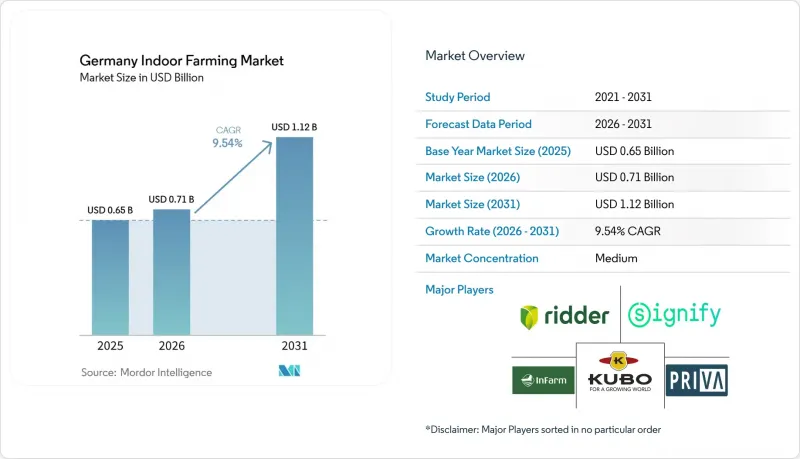
根據 Mordor Intelligence 預測,德國室內農業市場規模將從 2025 年的 6.5 億美元成長到 2026 年的 7.118 億美元,到 2031 年將達到 11.177 億美元,2026 年至 2031 年的複合年成長率為 9.54%。
本報告按栽培系統(氣耕、水耕、魚菜共生等)、設施類型(玻璃或聚碳酸酯溫室、室內垂直農場等)和作物類型(水果和蔬菜、香草和微型菜苗等)進行分類。市場預測以貨幣價值(美元)表示。
德國室內農業市場的趨勢與洞察
都市區對新鮮、無農藥農產品的需求
德國有機食品市場持續成長,顯示消費者對可追溯、潔淨標示食品的需求並非侷限於小眾高階市場。如今,折扣零售商佔據了有機食品銷售的相當大佔有率,這反映出有機食品已成為日常消費的普遍選擇,而非偶爾的高階消費。這項轉變對室內農業意義重大,因為室內種植的綠葉蔬菜、香草和草莓可以透過大規模超級市場的通路銷售,而新鮮度、保存期限和無農藥殘留是這些商品在商業性至關重要的因素。與折扣店簽訂的自有品牌協議也使生產商能夠確保穩定的銷售量,這在以前室內種植的農產品主要透過專賣店銷售時是難以實現的。因此,德國室內農業市場並非由狹隘的高階消費群支撐,而是由與主流零售相關的持續食品需求所驅動。
提高LED效率並降低氣候控制成本
2025年及2026年銷售的商用園藝LED照明燈具的光效均達到3.5 µmol/J或更高,在相同光照強度下可降低30%至40%的耗能。 2025年6月,Signify公司推出飛利浦GrowWise智慧頻譜演算法,進一步鞏固了這個趨勢。據該公司稱,該演算法可透過即時調節光照強度,將能耗降低或作物生長改善高達6%。 2026年,Lidder和Signify正式在「園藝照明協議」下達成整合,使種植者無需進行大規模客製化整合工作即可更直接地訪問互聯控制系統。此外,NLight的集中式直流架構據稱可將溫室照明專案的資本投資降低10%至20%,這在電力成本決定專案可行性的市場中意義重大。儘管這些進展並不能完全消除能源風險,但它們縮小了阻礙小規模室內農業設施發展的最大成本差距之一。因此,在德國室內農業市場,小規模、更具商業性可行性的都市區計畫的發展路徑正變得越來越清晰。
高資本投資和能源強度
對中型垂直農場的資本投資正穩定成長,在全封閉系統中,能源成本佔營運費用的40%至70%。因此,能源價格的波動對投資者信心產生了顯著影響。對於需要擴大生產規模才能協商更有利的採購條款或將管理費用分攤到更大產量上的新業務而言,這一負擔尤其沉重。一些部分解決方案正在湧現;例如,計劃於2026年3月開放的Schneebergerhof溫室將直接使用風能和太陽能供電。此外,Durr AG於2025年6月推出的「EcoY」系統採用「生長管」技術,可將用水量減少高達95%,並且僅在自然光不足時才使用LED輔助照明。然而,高昂的初始投資成本和高電力消耗量等挑戰可能會繼續阻礙德國室內農業市場的成長,直到低成本的工程技術和更強大的能源整合在商業項目中廣泛應用。
細分市場分析
到2025年,水耕技術將佔據德國室內農業市場47.8%的佔有率,為商業化生產奠定堅實的基礎。這項優勢源自於其優異的性價比、廣泛的設備供應基礎,以及操作人員對其易於理解和規模化生產且實施風險低的特性。雖然魚菜共生和土壤栽培系統仍然存在,但由於魚菜共生系統生物複雜性高以及土壤栽培系統產量效率低,它們的適用性受到限制。混合系統在作物柔軟性高的地區越來越受到關注,但由於大多數操作人員在當前的資金籌措週期中更傾向於選擇成熟的系統設計,因此其市場地位仍然有限。
預計氣耕將成為成長最快的種植系統,2026年至2031年的複合年成長率將達到15.8%,這反映了人們對性能期望的不斷變化。這一前景與精準噴霧技術的成熟以及人們對節水效率日益成長的興趣密切相關,尤其是在高價值香草、微型菜苗和特色草莓的種植領域。 2025年6月,Korber Technologies和Veganz Group AG宣布推出「OrbiFarm」平台,並表示弗勞恩霍夫研究所的試驗表明,該平台的產量比傳統種植方法高出36倍。這使得該系統在全面商業化部署之前就獲得了策略關注。封閉回路型水耕系統用水量僅傳統露天種植的5%,而氣耕還能進一步降低用水量。在德國室內農業市場,隨著買家越來越關注資源利用和供應穩定性,這種效率差異變得越來越重要。雖然水耕法預計在可預見的未來仍將佔據主導地位,但隨著商業性示範的進展,氣耕可能會在新高效項目中獲得更大的佔有率。
其他好處:
- Excel格式的市場預測(ME)表
- 3個月的分析師支持
目錄
第1章:引言
- 研究假設和市場定義
- 調查範圍
第2章:調查方法
第3章執行摘要
第4章 市場狀況
- 市場概覽
- 市場促進因素
- 都市區對新鮮、無農藥農產品的需求
- 提高LED效率並降低空調成本
- 耕地減少和氣候變遷
- 全年生產提高了糧食供應的穩定性。
- 閒置工業地產的再利用
- 將碳排放和能源效率貨幣化
- 市場限制因素
- 高資本投資和能源強度
- 園藝和自動化領域熟練人員短缺
- 由於企業經營者破產而導致的投資減少
- 都市區電網容量的限制
- 監理情勢
- 技術展望
- 波特五力分析
第5章 市場規模與成長預測
- 培訓系統
- 氣耕
- 水耕法
- 水耕法
- 土壤耕作
- 混合
- 依設施類型
- 玻璃或聚碳酸酯溫室
- 室內垂直農場
- 貨櫃農場
- 室內深水栽培系統
- 其他設施類型
- 按作物類型
- 水果和蔬菜
- 綠葉蔬菜
- 番茄
- 草莓
- 茄子
- 其他水果和蔬菜
- 香草和微型菜苗
- 羅勒
- 香艾菊
- 小麥草
- 其他香草和微型菜苗
- 花卉和觀賞植物
- 多年生植物
- 一年生草
- 觀賞植物
- 其他花卉和觀賞植物
- 其他作物類型
- 水果和蔬菜
第6章 競爭情勢
- 市場集中度
- 策略趨勢
- 市佔率分析
- 公司簡介
- Infarm Group GmbH
- Vertical Farm Systems GmbH
- Siemens AG
- Signify NV(Philips Horticulture LED Solutions)
- Priva Holding BV
- Ridder Holding BV
- KUBO Group BV
- Netafim Ltd.
- Grodan BV
- Valoya Oy
- Stulz GmbH
- Bosch Rexroth AG
- Yaskawa Electric Corporation
- Urban Crop Solutions
- Agrotonomy
第7章 市場機會與未來展望
According to Mordor Intelligence, the Germany indoor farming market is forecasted to grow from USD 650 million in 2025 to USD 711.8 million in 2026, reaching USD 1,117.7 million by 2031, at a CAGR of 9.54% over 2026-2031.
This report is Segmented by Growing System (Aeroponics, Hydroponics, Aquaponics, and More), by Facility Type (Glass or Poly Greenhouses, Indoor Vertical Farms, and More), and by Crop Type (Fruits and Vegetables, Herbs and Microgreens, and More). The Market Forecasts are Provided in Terms of Value (USD).
Germany Indoor Farming Market Trends and Insights
Urban Demand for Fresh, Pesticide-Free Produce
Germany's organic food market is growing, indicating that demand for traceable and clean-label food extends beyond a small premium niche. Discount retailers now account for a substantial share of organic purchases, reflecting broad everyday adoption rather than occasional premium buying. This shift is relevant to indoor farming because leafy greens, herbs, and strawberries grown indoors can be sold through large supermarket channels where freshness, shelf life, and pesticide-free positioning carry commercial weight. Private-label contracts through discounters also give growers access to stable volume that was previously difficult to secure when indoor produce was sold primarily through specialty retail. As a result, the Germany indoor farming market is supported by recurring food demand tied to mainstream retail rather than a narrow high-end consumer segment.
LED Efficiency and Climate Control Cost Declines
Commercial horticultural LED fixtures sold in 2025 and 2026 routinely exceeded 3.5 µmol/J efficacy, which was linked to a 30%-40% reduction in electricity use for the same light intensity. Signify reinforced this trend in June 2025 with the launch of the Philips GrowWise smart spectrum algorithm, which the company stated can reduce energy use or increase crop growth by up to 6% through real-time light adjustment. In 2026, Ridder and Signify formalized integration under the Horti Lighting Protocol, giving growers a more direct route to connected control without extensive custom integration work. Additionally, NLight's centralized DC architecture claims a 10%-20% capital expenditure reduction for greenhouse lighting projects, which is significant in a market where power costs can determine project viability. While these developments do not eliminate energy risk, they narrow one of the largest cost gaps that has constrained smaller facilities. As a result, the Germany indoor farming market is seeing a clearer path toward commercially viable projects at more modest scales and in more urban settings.
High Capital Expenditure and Energy Intensity
Capital expenditure for a medium-scale vertical farm is regularly increasing and energy costs account for 40%-70% of operating expenditure in fully enclosed systems, which explains why energy price volatility has had a strong effect on investor confidence. This burden is especially difficult for new operators that need to scale output before they can negotiate better procurement terms or spread overhead across larger volumes. Partial solutions are emerging, including Schneebergerhof's March 2026 greenhouse opening with direct wind and solar power supply. Durr AG's EcoY system, launched in June 2025, uses grow-tube technology that can reduce water use by up to 95% and applies supplemental LED lighting only where natural daylight is insufficient. Even so, high upfront capital requirements and power intensity will continue to slow the Germany indoor farming market until lower-cost engineering and stronger energy integration become more widespread across commercial projects.
Other drivers and restraints analyzed in the detailed report include:
- Shrinking Arable Land and Weather Volatility
- Year-Round Production Strengthens Grocery Supply Reliability
- Shortage of Skilled Horticulture and Automation Talent
For complete list of drivers and restraints, kindly check the Table Of Contents.
Segment Analysis
Hydroponics held 47.8% of the Germany indoor farming market in 2025, making it the clear operating base for commercial production. Its lead reflects a favorable cost-to-yield profile, a broader equipment supply base, and production methods that operators understand well enough to scale with lower execution risk. Aquaponics and soil-based systems remain present but are more limited in scope, as biological complexity is higher in aquaponics and yield intensity is lower in soil-based formats. Hybrid systems are drawing interest where crop flexibility matters, yet their market position remains modest as most operators prefer proven system designs during the current financing cycle.
Aeroponics is forecast to be the fastest-growing system between 2026 and 2031, at a CAGR of 15.8%, reflecting a shift in performance expectations. This outlook is linked to maturing precision misting technology and growing interest in water efficiency, particularly for high-value herbs, microgreens, and specialty strawberries. In June 2025, Korber Technologies and Veganz Group AG introduced the OrbiFarm platform, reporting trial yields up to 36 times higher than conventional cultivation in Fraunhofer testing, which has drawn strategic attention to the system even before broad commercial rollout. Closed-loop hydroponic systems use only 5% of the water required by conventional field cultivation, and aeroponics reduces water input further. In the Germany indoor farming market, this efficiency gap is increasingly relevant as buyers pay closer attention to resource use and supply stability. Hydroponics is anticipated to remain the dominant system in the near term, while aeroponics is likely to capture a larger share of new high-efficiency projects as commercial validation improves.
Complete Report Scope:
- By Growing System
- Aeroponics
- Hydroponics
- Aquaponics
- Soil-Based
- Hybrid
- By Facility Type
- Glass or Poly Greenhouses
- Indoor Vertical Farms
- Container Farms
- Indoor Deep-Water Culture Systems
- Other Facility Types
- By Crop Type
- Fruits and Vegetables
- Leafy Vegetables
- Tomato
- Strawberry
- Eggplant
- Other Fruits and Vegetables
- Herbs and Microgreens
- Basil
- Tarragon
- Wheatgrass
- Other Herbs and Microgreens
- Flowers and Ornamentals
- Perennials
- Annuals
- Ornamentals
- Other Flowers and Ornamentals
- Other Crop Types
- Fruits and Vegetables
List of Companies Covered in this Report:
- Infarm Group GmbH
- Vertical Farm Systems GmbH
- Siemens AG
- Signify N.V. (Philips Horticulture LED Solutions)
- Priva Holding B.V.
- Ridder Holding B.V.
- KUBO Group B.V.
- Netafim Ltd.
- Grodan B.V.
- Valoya Oy
- Stulz GmbH
- Bosch Rexroth AG
- Yaskawa Electric Corporation
- Urban Crop Solutions
- Agrotonomy
Additional Benefits:
- The market estimate (ME) sheet in Excel format
- 3 months of analyst support
TABLE OF CONTENTS
1 INTRODUCTION
- 1.1 Study Assumptions and Market Definition
- 1.2 Scope of the Study
2 RESEARCH METHODOLOGY
3 EXECUTIVE SUMMARY
4 MARKET LANDSCAPE
- 4.1 Market Overview
- 4.2 Market Drivers
- 4.2.1 Urban demand for fresh, pesticide-free produce
- 4.2.2 LED efficiency and climate control cost declines
- 4.2.3 Shrinking arable land and weather volatility
- 4.2.4 Year-round production strengthens grocery supply reliability
- 4.2.5 Repurposing vacant industrial real estate
- 4.2.6 Carbon and energy efficiency monetization
- 4.3 Market Restraints
- 4.3.1 High capital expenditure and energy intensity
- 4.3.2 Shortage of skilled horticulture and automation talent
- 4.3.3 Investment pullback after operator failures
- 4.3.4 Urban grid capacity constraints
- 4.4 Regulatory Landscape
- 4.5 Technological Outlook
- 4.6 Porter's Five Forces Analysis
- 4.6.1 Threat of New Entrants
- 4.6.2 Bargaining Power of Buyers
- 4.6.3 Bargaining Power of Suppliers
- 4.6.4 Threat of Substitutes
- 4.6.5 Intensity of Competitive Rivalry
5 MARKET SIZE AND GROWTH FORECASTS (VALUE)
- 5.1 By Growing System
- 5.1.1 Aeroponics
- 5.1.2 Hydroponics
- 5.1.3 Aquaponics
- 5.1.4 Soil-Based
- 5.1.5 Hybrid
- 5.2 By Facility Type
- 5.2.1 Glass or Poly Greenhouses
- 5.2.2 Indoor Vertical Farms
- 5.2.3 Container Farms
- 5.2.4 Indoor Deep-Water Culture Systems
- 5.2.5 Other Facility Types
- 5.3 By Crop Type
- 5.3.1 Fruits and Vegetables
- 5.3.1.1 Leafy Vegetables
- 5.3.1.2 Tomato
- 5.3.1.3 Strawberry
- 5.3.1.4 Eggplant
- 5.3.1.5 Other Fruits and Vegetables
- 5.3.2 Herbs and Microgreens
- 5.3.2.1 Basil
- 5.3.2.2 Tarragon
- 5.3.2.3 Wheatgrass
- 5.3.2.4 Other Herbs and Microgreens
- 5.3.3 Flowers and Ornamentals
- 5.3.3.1 Perennials
- 5.3.3.2 Annuals
- 5.3.3.3 Ornamentals
- 5.3.3.4 Other Flowers and Ornamentals
- 5.3.4 Other Crop Types
- 5.3.1 Fruits and Vegetables
6 COMPETITIVE LANDSCAPE
- 6.1 Market Concentration
- 6.2 Strategic Moves
- 6.3 Market Share Analysis
- 6.4 Company Profiles (includes Global Level Overview, Market Level Overview, Core Segments, Financials as available, Strategic Information, Market Rank/Share, Products and Services, Recent Developments)
- 6.4.1 Infarm Group GmbH
- 6.4.2 Vertical Farm Systems GmbH
- 6.4.3 Siemens AG
- 6.4.4 Signify N.V. (Philips Horticulture LED Solutions)
- 6.4.5 Priva Holding B.V.
- 6.4.6 Ridder Holding B.V.
- 6.4.7 KUBO Group B.V.
- 6.4.8 Netafim Ltd.
- 6.4.9 Grodan B.V.
- 6.4.10 Valoya Oy
- 6.4.11 Stulz GmbH
- 6.4.12 Bosch Rexroth AG
- 6.4.13 Yaskawa Electric Corporation
- 6.4.14 Urban Crop Solutions
- 6.4.15 Agrotonomy
7 MARKET OPPORTUNITIES AND FUTURE OUTLOOK

 創新室內農業系統市場分析與至2035年的預測:按類型、產品、服務、技術、組件、應用、最終用戶、安裝類型、設備和解決方案
 室內貨櫃農場市場規模、佔有率和成長分析:按作物類型、栽培技術、貨櫃尺寸、最終用戶、應用和地區分類-2026-2033年產業預測
 室內農業:市場佔有率分析、產業趨勢與統計、成長預測(2026-2031)
 室內農場技術市場:2026-2032年全球市場預測(依產品、作物類型、耕作方式、自動化程度及最終用戶分類)南美洲室內農業:市場佔有率分析、產業趨勢與統計及成長預測(2026-2031 年)美國室內農業:市場佔有率分析、產業趨勢與統計及成長預測(2026-2031 年)
 室內農業市場規模、佔有率、趨勢和預測:按設施類型、作物類型、組件、種植系統和地區分類,2026-2034 年中東和非洲室內農業:市場佔有率分析、行業趨勢和統計數據以及成長預測(2026-2031 年)
 室內農業市場-全球產業規模、佔有率、趨勢、機會、預測:種植技術、設施類型、組成部分、作物類型、地區及競爭格局,2021-2031年
 2026年全球室內農業市場報告