


 |
市場調查報告書
商品編碼
2099838
國防和戰場通訊網路光纖:市場佔有率分析、產業趨勢和統計數據以及成長預測(2026-2031 年)Fiber Optic For Defense and Battlefield Communication Networks - Market Share Analysis, Industry Trends & Statistics, Growth Forecasts (2026 - 2031) |
||||||

※ 本網頁內容可能與最新版本有所差異。詳細情況請與我們聯繫。
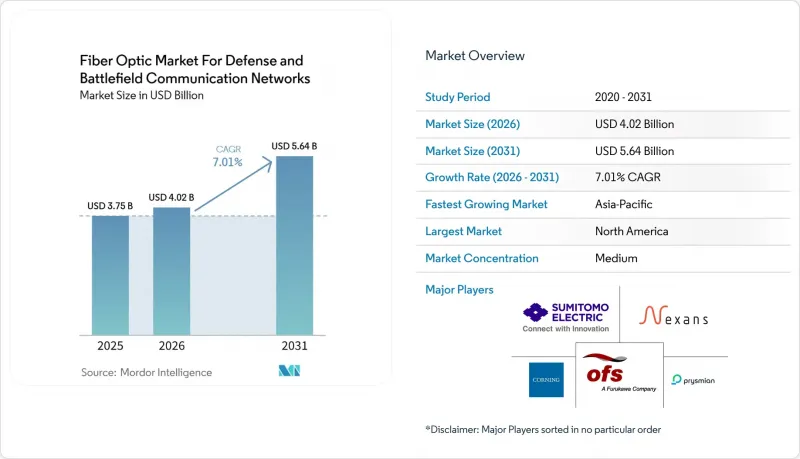
據 Mordor Intelligence 稱,國防和戰場通訊網路的光纖市場預計將從 2025 年的 37.5 億美元成長到 2026 年的 40.2 億美元,到 2031 年達到 56.4 億美元,2026 年至 2031 年的複合年成長率為 7.01%。
本報告按光纖類型(例如,單模光纖)、產品架構(例如,鎧裝光纜)、應用(例如,戰場通訊網路)、平台(例如,陸地平台)、最終用戶(例如,軍方)和地區(例如,北美)進行細分。市場預測以美元計價。
國防與戰場通訊網路光纖市場洞察與趨勢
國防網路對安全、低延遲通訊的需求日益成長。
隨著指揮控制系統在衝突地區對更快、更清晰的資料傳輸的需求日益成長,光纖傳輸正成為核心需求。國防和戰場通訊網路的光纖市場正受益於這一轉變,加密傳輸、低延遲和物理層監控不再被視為可選升級,而是任務必要條件。現代光纖系統採用高密度分波多工(DWDM) 技術,可在單一光纖上傳輸多個加密資料流,而分散式感測功能則有助於偵測線路上的物理干擾。正如原始資料所述,印太地區傳輸網路的發展現狀表明,推動骨幹網路採購的並非週期性的網路升級,而是策略性的區域因素。這一點至關重要,因為軍事專案需要強大的實體層,而商業規範無法完全滿足這一需求,因為感測器到砲手的環路對延遲性能的要求遠高於標準企業流量。這種差距使得國防和戰場通訊網路的光纖市場只能依靠自身採購管道,進入門檻高,認證週期長。
C4ISR骨幹基礎設施的現代化
C4ISR(指揮、控制、通訊、電腦、情報、監視與偵察)的現代化是推動市場強勁需求的關鍵因素,因為傳統的戰術架構無法應對當前軍事資料交換的規模和速度。美國陸軍在2027財政年度提出的下一代指揮與控制(NGC)和C2NOW(指揮、控制、網路與通訊)專案需求,標誌著與嚴重依賴銅纜和衛星回程傳輸的傳統WIN-T(網路與通訊網路)架構的顯著區別。根據相關文件,該專案意義重大,因為光纖電纜從一開始就被設計為整合到傳輸層中,而不是作為事後補救措施。此外,更廣泛的合規性要求也推動了國防和戰場通訊網路光纖市場的發展,因為在網路安全和供應鏈保障標準的約束下,對實體傳輸路徑的審查日益嚴格。這使得認證組件、連接器和電纜系統的範圍超越了傳統的「專案記錄」清單。擁有深厚認證經驗和跨多個專案年度長期穩定生產的供應商也更具優勢。
高耐久性、認證和生命週期成本
由於國防光纖組件必須滿足比商用電纜系統更嚴格的環境和性能標準,認證和生命週期成本仍然是重要的限制因素。文件顯示,MIL-STD-810H認證可能需要12到24個月,每套電纜配置的成本高達數百萬美元,這限制了能夠進入或繼續在經批准的國防管道運營的供應商數量。即使在獲得初步批准後,這種成本負擔仍然存在,因為材料和製造方法的變更可能需要新的檢驗流程。因此,即使更廣泛的競爭可以降低成本並縮短前置作業時間,買家通常也會選擇已經獲得認證的供應商。因此,國防和戰場通訊網路的光纖市場在技術核准耗時且長期運行平台價格居高不下的供應結構中不斷發展。這也解釋了為什麼該市場仍然保持著適度的集中度而非完全開放,因為認證的深度與製造規模同樣重要。
細分市場分析
到2025年,單模光纖解決方案將佔據65.43%的市場佔有率,成為國防和戰場通訊網路光纖市場的主導力量。這一主導地位反映了長距離傳輸的需求,例如基地間骨幹電路、艦載幹線電路以及指揮節點間的互連,在這些應用中,距離相關的衰減仍然是核心性能因素。現有基礎設施也是關鍵因素。北約標準的軍用光纖通訊標準歷來偏向單模規範,這意味著替換和升級需求受到現有技術選擇的限制。這種現有基礎設施對單模光纖需求的推動作用遠超簡單的成本比較所能預期的。這也解釋了為什麼買家在升級核心網路傳輸層時,仍然優先考慮相容性、認證資格和長期可靠性。
預計從2026年到2031年,多模光纖解決方案的複合年成長率將達到7.34%,成為光纖領域成長最快的細分市場。它們的主要應用場景是裝甲車輛、海軍作戰系統和雷達環境中的短距離平台內佈線,這些場景對距離的限制較小,但對頻寬的需求較高。 IEEE在2025年的一項研究中描述了一種混合光纖射頻通訊協定,該協議可增強無人機系統的抗干擾能力。研究說明了冗餘射頻鏈路如何在保持廣泛情境察覺的同時,由光纖接管關鍵的指揮路徑。這種架構將多模光纖的應用範圍從固定平台擴展到飛機和機器人系統,這些系統先前主要依賴射頻和銅纜。隨著軍事標準的演進,以適應更多短距離光纖通訊的應用場景,多模光纖的採用正獲得組織層面的支持,而不再只是商業性偏好的問題。這種組合為快速成長的平台中的應用案例開闢了新的空間,同時仍基於單模光纖,適用於國防和戰場通訊網路的光纖市場。
到2025年,鎧裝光纜將佔據54.67%的市場佔有率,並繼續成為國防領域現有設備中的主導產品架構。此地位與國防運輸的嚴苛環境密切相關。這些環境包括履帶式車輛、艦載電纜配線架、堅固的地下設施以及暴露的戰術路線,在這些環境中,擠壓、高溫、磨損和彈片等風險都是實際的設計考量。因此,在產品層面,鎧裝產品在國防和戰場通訊網路的光纖市場中佔據了相當大的佔有率。這是因為生存能力要求推高了單位成本和認證要求。與商用電纜市場相比,國內獲得軍用認證的供應商數量較少,這也導致了鎧裝產品的價格溢價。嚴苛的運作條件和認證供應商的供應限制共同確保了鎧裝光纜在當前部署和未來更換週期中繼續佔據核心地位。
預計到2031年,戰術現場光纖組件的複合年成長率將達到7.12%,成為產品架構細分市場中成長最快的領域。這一成長趨勢與鎧裝光纜的需求有所不同,因為戰術現場光纖組件用於戰場前線,其連接器的快速連接、輕量化設計和易於現場更換比長距離訊號衰減更為重要。報告也指出,連接器、熔接件和端接件構成了第三個產品系列,其規格日益提高,並符合高密度跳線和固定、高容量環境中的軍用連接器標準。這表明市場正在向預端接和工廠認證的組裝解決方案轉變,將安裝風險從現場轉移到可控的生產環境。這一趨勢意義重大,因為它符合採購部門的需求,即減少對技術人員的依賴、縮短部署時間以及在分散式專案中實現可預測的安裝結果。因此,國防和戰場通訊網路的光纖市場正逐漸轉向兼顧穩健性和戰術性邊緣部署簡化性的組裝形式。
區域分析
到2025年,北美將佔據36.78%的市場佔有率,成為國防和戰場通訊網路光纖領域最大的區域市場。這一區域主導地位源自於美國國防現代化的規模及其強大的認證國內供應鏈。取代傳統戰術網路架構、擴展潛艦通訊專案以及在指揮控制系統中開發光纖傳輸層,正在推動各軍種積極採購。國內採購需求進一步鞏固了這一地位,因為對於需要保密性和高可靠性的項目而言,已通過核准的美國國內製造通常是首選,甚至是強制性要求。如資料所述,印太地區的傳輸網路發展為需求增添了新的層次,因為它顯示了具有戰略意義的基礎設施,而不僅限於平台層面的整合。
歐洲則位居第二,這主要得益於德國、英國和法國為履行北約承諾而持續進行的多年國防現代化努力。該地區的需求不僅限於簡單的電纜更換,還包括用於安全、可部署通訊、互通性項目以及指揮控制系統的認證光纖背板。受衝突影響,戰場光纖無人機系留應用日益普及,也催生了該地區對耐環境光學元件和組件的獨特需求。這一趨勢意義重大,因為它為本已專注於可部署指揮控制系統和安全資訊系統的地區增添了新的無人應用場景。儘管北約小規模成員國的採購佔有率有限,但聯盟資助的互通性需求仍在不斷擴大該地區的需求基礎。
預計亞太地區在2026年至2031年間將以8.01%的複合年成長率成長,成為成長最快的地區。這一成長與中國的海軍現代化、印度不斷擴張的國防製造業、日本不斷增加的國防預算以及韓國的先進平台計劃密切相關。由於其區域特性,亞太地區在北美以外的國防和戰場通訊網路光纖市場中扮演著最重要的成長角色,這主要得益於不斷成長的採購需求以及建立本地供應鏈的意願。中東、非洲和南美洲雖然絕對規模仍然較小,但隨著各國推動海軍通訊現代化並建立自身的國防製造能力,這些地區正在展現出戰略性舉措。澳洲也作為次區域需求中心脫穎而出,參與的經認證的國防光纖計畫超出了其經濟規模所預期的水平。
其他好處:
- Excel格式的市場預測(ME)表
- 3個月的分析師支持
目錄
第1章:引言
- 研究假設和市場定義
- 調查範圍
第2章:調查方法
第3章執行摘要
第4章 市場狀況
- 市場概覽
- 市場促進因素
- 對安全、防攔截的戰場通訊鏈路的需求日益成長。
- 陸地、海軍和空中平台C4ISR核心系統的現代化改造。
- 在高干擾程度和多種干擾無線電波的環境中具有抗電磁干擾能力。
- 提高感測器融合、影像和邊緣分析的資料吞吐量。
- 分散式作戰和多域指揮的戰術網路發展
- 在車輛、船舶和基地台的主幹連接中採用耐環境光纖。
- 市場限制因素
- 高可靠性、認證和驗證的成本。
- 現場維修的複雜性以及對專業安裝技術的依賴程度。
- 特殊塗層、連接器和鎧裝電纜材料的供應鏈中的薄弱環節。
- 採購週期與國防預算和多年專案計畫掛鉤
- 價值鏈分析
- 監理情勢
- 技術展望
- 波特五力分析
第5章 市場規模與成長預測
- 纖維類型
- 單模光纖解決方案
- 多模光纖解決方案
- 依產品架構
- 鎧裝光纖電纜
- 戰術野戰光纖組件
- 連接器、接頭和端子套件
- 透過使用
- 戰場通訊網路
- 指揮控制系統
- 雷達和監視網路
- 電子戰系統
- 資訊、監視和偵察網路
- 按平台
- 陸上平台
- 海軍平台
- 飛機平台
- 天基防禦網路
- 最終用戶
- 軍隊
- 國防相關企業
- 國防安全保障與邊防安全局
- 按地區
- 北美洲
- 美國
- 加拿大
- 墨西哥
- 南美洲
- 巴西
- 阿根廷
- 其他南美國家
- 歐洲
- 德國
- 英國
- 法國
- 義大利
- 西班牙
- 俄羅斯
- 其他歐洲國家
- 亞太地區
- 中國
- 日本
- 印度
- 韓國
- 澳洲
- 新加坡
- 其他亞太國家
- 中東和非洲
- 中東
- 沙烏地阿拉伯
- 阿拉伯聯合大公國
- 土耳其
- 其他中東國家
- 非洲
- 南非
- 奈及利亞
- 埃及
- 其他非洲國家
- 中東
- 北美洲
第6章 競爭情勢
- 市場集中度
- 策略趨勢
- 市佔率分析
- 公司簡介
- Prysmian Group
- Nexans SA
- Corning Incorporated
- OFS Fitel, LLC
- Sumitomo Electric Industries, Ltd.
- Fujikura Ltd.
- Furukawa Electric Co., Ltd.
- TE Connectivity Ltd.
- Amphenol Corporation
- AFL
- CommScope Holding Company, Inc.
- HUBER+SUHNER AG
- Belden Inc.
- Leoni AG
- Optical Cable Corporation
- General Dynamics Mission Systems, Inc.
- L3Harris Technologies, Inc.
- Thales SA
- BAE Systems plc
- Leonardo SpA
第7章 市場機會與未來展望
According to Mordor Intelligence, the fiber optic market for defense and battlefield communication networks is expected to increase from USD 3.75 billion in 2025 to USD 4.02 billion in 2026 and reach USD 5.64 billion by 2031, growing at a CAGR of 7.01% over 2026-2031.
This report is Segmented by Fiber Type (Single-Mode Fiber and More), Product Architecture (Armored Fiber Optic Cables, and More), Application (Battlefield Communication Networks, and More), Platform (Land Platforms, and More), End User (Armed Forces, and More), and Geography (North America, and More). The Market Forecasts are Provided in Terms of Value (USD).
Insights and Trends of Fiber Optic Market For Defense and Battlefield Communication Networks
Rising Demand for Secure, Low-Latency Communication in Defense Networks
Secure optical transport is becoming a core requirement because command systems now depend on faster and cleaner data movement across contested operating areas. The fiber optic market for defense and battlefield communication networks benefits from this shift because encrypted transport, low latency, and physical layer monitoring are now treated as mission requirements rather than optional upgrades. Modern fiber systems can carry multiple encrypted data streams on a single strand through dense wavelength division multiplexing, and distributed sensing features can also help detect physical interference on the line. The Indo-Pacific transport buildout described in the source material also shows that strategic geography is driving backbone procurement, not just routine network refresh cycles. This matters because sensor-to-shooter loops demand stricter latency performance than standard enterprise traffic, so military programs need hardened physical layers that commercial specifications do not fully address. That gap keeps the fiber optic market for defense and battlefield communication networks tied to a distinct procurement channel with higher entry barriers and longer qualification cycles.
Modernization of C4ISR Backbone Infrastructure
C4ISR modernization is a strong demand driver because legacy tactical architectures were not built for the volume and speed of current military data exchange. The U.S. Army's FY2027 request for Next Generation Command and Control and the C2NOW program marks a clear move away from legacy WIN-T structures that relied more heavily on copper and satellite backhaul. In the source material, this program is important because optical distribution is being designed into the transport layer from the beginning rather than added later as a workaround. The fiber optic market for defense and battlefield communication networks is also supported by broader compliance requirements, as physical transmission pathways now face tighter scrutiny under cybersecurity and supply assurance standards. That expands the addressable space for certified assemblies, connectors, and cable systems beyond older program-of-record lists. It also favors suppliers that can combine qualification depth with long production consistency over multiple program years.
High Ruggedization, Qualification, and Lifecycle Costs
Qualification and lifecycle costs remain significant constraints because defense-grade fiber assemblies must meet stricter environmental and performance standards than commercial cable systems. The source material notes that MIL-STD-810H qualification can take 12 to 24 months and can cost several million dollars per cable configuration, which limits how many suppliers can enter or stay active in approved defense channels. That cost burden persists after initial approval because changes to materials or manufacturing methods can trigger another validation round. The practical effect is that buyers often stick with already-qualified vendors, even when wider competition could lower costs or shorten lead times. The fiber optic market for defense and battlefield communication networks, therefore, grows within a supply structure where technical approval is slow and where pricing remains elevated for long-service platforms. This also explains why the market remains only moderately consolidated rather than fully open, since qualification depth carries as much weight as manufacturing scale.
Other drivers and restraints analyzed in the detailed report include:
- Electromagnetic Interference Immunity in Contested Environments
- Higher Data Throughput for Sensor-Heavy Defense Platforms
- Field Repair Complexity and Skilled Technician Dependency
For complete list of drivers and restraints, kindly check the Table Of Contents.
Segment Analysis
Single-mode fiber optic solutions held 65.43% share in 2025, giving them the largest position in this part of the fiber optic market for defense and battlefield communication networks. That lead reflects the long-haul requirements of base-to-base backbone links, shipboard trunk routes, and command node interconnects where attenuation over distance remains a core performance factor. The installed base also matters because NATO-aligned military optical standards have historically leaned toward single-mode specifications, which keeps replacement and upgrade demand tied to existing technical choices. This installed base effect makes single-mode demand more durable than a simple cost comparison would suggest. It also helps explain why buyers continue to prioritize compatibility, qualification history, and long-term reliability when they update core network transport layers.
Multi-mode solutions are projected to grow at a 7.34% CAGR from 2026 to 2031, making them the fastest-growing sub-segment within fiber type. Their role is strongest in short-reach intra-platform wiring for armored vehicles, naval combat systems, and radar environments where distance limits are manageable, and bandwidth needs remain high. Research published in IEEE in 2025 described hybrid fiber-RF communication protocols for anti-jamming resilience in unmanned aerial vehicle systems, showing how fiber can take over critical command paths while redundant RF links preserve broader awareness. That architecture expands the case for multi-mode fiber beyond fixed platforms and into airborne and robotic systems that previously relied more heavily on radio-frequency or copper harnesses. As military standards evolve to accommodate more short-reach optical use cases, multi-mode adoption is gaining institutional support rather than depending only on commercial preference. This mix means the fiber optic market for defense and battlefield communication networks keeps its single-mode base while opening new room for faster-growing intra-platform use cases.
Armored fiber optic cables accounted for 54.67% share in 2025, so they remain the dominant product architecture across the installed defense base. Their position is tied to the harsh environments that define defense transport, including tracked vehicles, shipboard cable trays, underground hardened sites, and exposed tactical routes where crush, heat, abrasion, and fragment risk are all real design concerns. This makes armored products a significant part of the fiber optic market for defense and battlefield communication networks at the product level, because survivability requirements raise both unit value and qualification requirements. Their pricing premium is also reinforced by the fact that qualified domestic suppliers with military certification are fewer in number than in commercial cable markets. That combination of rugged use conditions and constrained qualified supply keeps armored cables central to both current deployments and future replacement cycles.
Tactical field fiber assemblies are expected to grow at a 7.12% CAGR through 2031, making them the fastest-growing product architecture sub-segment. Their growth profile is different from armored cable demand because they serve the battlefield edge, where rapid connectorization, lower weight, and easier field replacement matter more than long-haul attenuation. The source material also notes that connectors, splices, and terminations form a third product group that is increasingly specified under military connector standards for dense patching and fixed high-capacity environments. This signals a wider move toward pre-terminated and factory-qualified assembly solutions that shift installation risk away from the field and into controlled production settings. That trend matters because it reduces technician dependency, shortens deployment time, and fits with procurement offices that want predictable installation outcomes across distributed programs. As a result, the fiber optic market for defense and battlefield communication networks is gradually shifting toward assembly formats that balance ruggedness with simpler deployment at the tactical edge.
Complete Report Scope:
- By Fiber Type
- Single-Mode Fiber Optic Solutions
- Multi-Mode Fiber Optic Solutions
- By Product Architecture
- Armored Fiber Optic Cables
- Tactical Field Fiber Assemblies
- Connectors, Splices, And Termination Kits
- By Application
- Battlefield Communication Networks
- Command And Control Systems
- Radar And Surveillance Networks
- Electronic Warfare Systems
- Intelligence, Surveillance, And Reconnaissance Networks
- By Platform
- Land Platforms
- Naval Platforms
- Airborne Platforms
- Space-Enabled Defense Networks
- By End User
- Armed Forces
- Defense Contractors
- Homeland Security And Border Security Agencies
- By Geography
- North America
- United States
- Canada
- Mexico
- South America
- Brazil
- Argentina
- Rest of South America
- Europe
- Germany
- United Kingdom
- France
- Italy
- Spain
- Russia
- Rest of Europe
- Asia-Pacific
- China
- Japan
- India
- South Korea
- Australia
- Singapore
- Rest of Asia-Pacific
- Middle East and Africa
- Middle East
- Saudi Arabia
- United Arab Emirates
- Turkey
- Rest of Middle East
- Africa
- South Africa
- Nigeria
- Egypt
- Rest of Africa
- Middle East
- North America
Geography Analysis
North America held a 36.78% share in 2025, making it the largest regional market for fiber optic market for defense and battlefield communication networks. The region's lead is tied to the scale of U.S. defense modernization and the depth of its qualified domestic supply base. The replacement of legacy tactical network structures, the expansion of submarine communication programs, and the buildout of optical transport layers across command systems all keep procurement active across multiple branches. Domestic sourcing requirements also reinforce this position because classified and high-assurance programs often favor or require approved U.S.-based manufacturing. The Indo-Pacific transport buildout described in the source material adds another layer of demand by pointing to strategic-reach infrastructure, not just platform-level integration.
Europe held the second-largest position, supported by Germany, the United Kingdom, and France, as they continue multi-year defense modernization under NATO commitments. Demand in the region is shaped by secure deployable communications, interoperability programs, and certified optical backplanes for command systems rather than only by basic cable replacement. The conflict-driven rise of battlefield fiber-optic drone tether applications has also created a distinct regional pull for ruggedized optical components and assemblies. That pattern matters because it adds newer unmanned use cases to a region already focused on deployable command, control, and secure information systems. Smaller NATO members absorb a more limited share of procurement, but alliance-funded interoperability needs still broaden the regional base.
Asia-Pacific is projected to expand at an 8.01% CAGR from 2026 to 2031, making it the fastest-growing region. Growth is tied to naval modernization in China, defense manufacturing expansion in India, higher defense allocations in Japan, and advanced platform programs in South Korea. This regional profile gives Asia-Pacific the clearest growth role in the fiber optic market for defense and battlefield communication networks outside North America because demand is rising across both procurement volume and local supply chain ambition. Middle East and Africa and South America remain smaller in absolute terms, but they still show strategic activity as countries upgrade naval communications and build indigenous defense manufacturing capability. Australia also stands out as a sub-regional demand node because it participates in qualified defense fiber programs that exceed what its overall economic size might suggest.
- Prysmian Group
- Nexans S.A.
- Corning Incorporated
- OFS Fitel, LLC
- Sumitomo Electric Industries, Ltd.
- Fujikura Ltd.
- Furukawa Electric Co., Ltd.
- TE Connectivity Ltd.
- Amphenol Corporation
- AFL
- CommScope Holding Company, Inc.
- HUBER+SUHNER AG
- Belden Inc.
- Leoni AG
- Optical Cable Corporation
- General Dynamics Mission Systems, Inc.
- L3Harris Technologies, Inc.
- Thales S.A.
- BAE Systems plc
- Leonardo S.p.A.
Additional Benefits:
- The market estimate (ME) sheet in Excel format
- 3 months of analyst support
TABLE OF CONTENTS
1 INTRODUCTION
- 1.1 Study Assumptions and Market Definition
- 1.2 Scope of the Study
2 RESEARCH METHODOLOGY
3 EXECUTIVE SUMMARY
4 MARKET LANDSCAPE
- 4.1 Market Overview
- 4.2 Market Drivers
- 4.2.1 Rising Demand For Secure, Low-Probability-Of-Intercept Battlefield Links
- 4.2.2 Modernization Of C4ISR Backbones Across Land, Naval, And Air Platforms
- 4.2.3 Electromagnetic Interference Immunity In Contested And Jamming-Heavy Environments
- 4.2.4 Higher Data Throughput For Sensor Fusion, Video, And Edge Analytics
- 4.2.5 Growth In Tactical Networks For Distributed Operations And Multi-Domain Command
- 4.2.6 Adoption Of Ruggedized Fiber For Vehicle, Ship, And Base Intrabackbone Connectivity
- 4.3 Market Restraints
- 4.3.1 High Ruggedization, Qualification, And Certification Costs
- 4.3.2 Field Repair Complexity And Dependence On Specialized Installation Skills
- 4.3.3 Vulnerability Of Supply Chains For Specialty Coatings, Connectors, And Armored Cable Materials
- 4.3.4 Procurement Cycles Tied To Defense Budgets And Multi-Year Program Timing
- 4.4 Value Chain Analysis
- 4.5 Regulatory Landscape
- 4.6 Technological Outlook
- 4.7 Porter's Five Forces Analysis
- 4.7.1 Bargaining Power Of Suppliers
- 4.7.2 Bargaining Power Of Buyers
- 4.7.3 Threat Of New Entrants
- 4.7.4 Threat Of Substitutes
- 4.7.5 Competitive Rivalry
5 MARKET SIZE AND GROWTH FORECASTS (VALUE)
- 5.1 By Fiber Type
- 5.1.1 Single-Mode Fiber Optic Solutions
- 5.1.2 Multi-Mode Fiber Optic Solutions
- 5.2 By Product Architecture
- 5.2.1 Armored Fiber Optic Cables
- 5.2.2 Tactical Field Fiber Assemblies
- 5.2.3 Connectors, Splices, And Termination Kits
- 5.3 By Application
- 5.3.1 Battlefield Communication Networks
- 5.3.2 Command And Control Systems
- 5.3.3 Radar And Surveillance Networks
- 5.3.4 Electronic Warfare Systems
- 5.3.5 Intelligence, Surveillance, And Reconnaissance Networks
- 5.4 By Platform
- 5.4.1 Land Platforms
- 5.4.2 Naval Platforms
- 5.4.3 Airborne Platforms
- 5.4.4 Space-Enabled Defense Networks
- 5.5 By End User
- 5.5.1 Armed Forces
- 5.5.2 Defense Contractors
- 5.5.3 Homeland Security And Border Security Agencies
- 5.6 By Geography
- 5.6.1 North America
- 5.6.1.1 United States
- 5.6.1.2 Canada
- 5.6.1.3 Mexico
- 5.6.2 South America
- 5.6.2.1 Brazil
- 5.6.2.2 Argentina
- 5.6.2.3 Rest of South America
- 5.6.3 Europe
- 5.6.3.1 Germany
- 5.6.3.2 United Kingdom
- 5.6.3.3 France
- 5.6.3.4 Italy
- 5.6.3.5 Spain
- 5.6.3.6 Russia
- 5.6.3.7 Rest of Europe
- 5.6.4 Asia-Pacific
- 5.6.4.1 China
- 5.6.4.2 Japan
- 5.6.4.3 India
- 5.6.4.4 South Korea
- 5.6.4.5 Australia
- 5.6.4.6 Singapore
- 5.6.4.7 Rest of Asia-Pacific
- 5.6.5 Middle East and Africa
- 5.6.5.1 Middle East
- 5.6.5.1.1 Saudi Arabia
- 5.6.5.1.2 United Arab Emirates
- 5.6.5.1.3 Turkey
- 5.6.5.1.4 Rest of Middle East
- 5.6.5.2 Africa
- 5.6.5.2.1 South Africa
- 5.6.5.2.2 Nigeria
- 5.6.5.2.3 Egypt
- 5.6.5.2.4 Rest of Africa
- 5.6.5.1 Middle East
- 5.6.1 North America
6 COMPETITIVE LANDSCAPE
- 6.1 Market Concentration
- 6.2 Strategic Moves
- 6.3 Market Share Analysis
- 6.4 Company Profiles (includes Global Level Overview, Market Level Overview, Core Segments, Financials as available, Strategic Information, Market Rank/Share, Products and Services, Recent Developments)
- 6.4.1 Prysmian Group
- 6.4.2 Nexans S.A.
- 6.4.3 Corning Incorporated
- 6.4.4 OFS Fitel, LLC
- 6.4.5 Sumitomo Electric Industries, Ltd.
- 6.4.6 Fujikura Ltd.
- 6.4.7 Furukawa Electric Co., Ltd.
- 6.4.8 TE Connectivity Ltd.
- 6.4.9 Amphenol Corporation
- 6.4.10 AFL
- 6.4.11 CommScope Holding Company, Inc.
- 6.4.12 HUBER+SUHNER AG
- 6.4.13 Belden Inc.
- 6.4.14 Leoni AG
- 6.4.15 Optical Cable Corporation
- 6.4.16 General Dynamics Mission Systems, Inc.
- 6.4.17 L3Harris Technologies, Inc.
- 6.4.18 Thales S.A.
- 6.4.19 BAE Systems plc
- 6.4.20 Leonardo S.p.A.
7 MARKET OPPORTUNITIES AND FUTURE OUTLOOK
- 7.1 White-Space and Unmet-Need Assessment

 光纖冷鍵合市場規模、佔有率及成長分析:按鍵合類型、光纖類型、應用、最終用戶、安裝方法和地區分類-2026-2033年產業預測
 光纖市場規模、佔有率和成長分析:按光纖類型、產品類型、應用、安裝、最終用戶和地區分類-2026-2033年產業預測
 光纖測試市場-2026-2032年全球市場預測
 中空芯光纖骨幹網路:市場佔有率分析、產業趨勢與統計及成長預測(2026-2031)主權光纖骨幹基礎設施:市場佔有率分析、產業趨勢與統計及成長預測(2026-2031 年)高密度網路光纖骨幹:市場佔有率分析、產業趨勢與統計及成長預測(2026-2031 年)
 軍工和航太光纖市場報告:趨勢、預測和競爭分析(至2035年)
 光纖板市場:按類型、應用和地區分類
 光纖檢測設備市場:按產品類型、最終用戶和地區分類(2026-2034 年)光纖行動連接器市場報告:趨勢、預測和競爭分析(至2035年)