


 |
市場調查報告書
商品編碼
2099308
主權光纖骨幹基礎設施:市場佔有率分析、產業趨勢與統計及成長預測(2026-2031 年)Sovereign Fiber Backbone Infrastructure - Market Share Analysis, Industry Trends & Statistics, Growth Forecasts (2026 - 2031) |
||||||

※ 本網頁內容可能與最新版本有所差異。詳細情況請與我們聯繫。
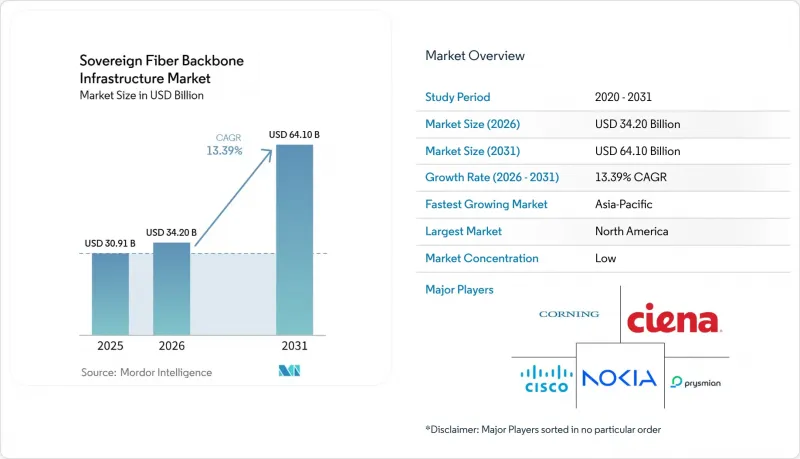
據 Mordor Intelligence 稱,2025 年美國主權光纖骨幹基礎設施市場價值為 309.1 億美元,預計到 2028 年將達到 342 億美元,到 2031 年將達到 641 億美元,2026 年至 2031 年的複合年成長率為 13.39%。
本報告按基礎設施類型(陸上、城際、城域、海底、跨境等)、部署架構(暗纖、光光纖等)、最終用戶(政府、通訊業者、雲端和超大規模雲端服務等)以及地區(北美、南美、歐洲、亞太、中東等)進行細分。市場預測以美元計價。
全球主權光纖骨幹基礎設施市場趨勢及洞察
《國家資料主權法》將加速國內資料基礎設施的發展。
在主權光纖骨幹網路基礎設施市場,一種從廣泛的本地化監管轉向採購主導的網路建設的趨勢正在發生顯著變化。在政府尋求加強對高度敏感流量登陸點和路由方式控制的地區,這種趨勢尤其明顯。這推動了對國家控制的骨幹網路資產的需求,而非依賴透過第三方管轄區的過境合約。在主權光纖骨幹網路基礎設施市場,這種轉變正在影響路由規劃,因為公共部門買家越來越傾向於選擇國內登陸的光纖和受控的骨幹網段來承載高度敏感的工作負載。這也造成了高安全性暗纖和專用路由容量的供不應求,推高了租賃價格,並使那些已持有本地許可證和通行權並獲得政府採購機構信任的營運商受益。同時,關於海底光纜容錯性和許可程序的國際合作正日益成為一個重要的政策議題,這推動了主權網路規劃更正式的法規環境的形成。
人工智慧和資料中心走廊的成長增加了對低延遲光纖骨幹網路的需求。
隨著分散式運算叢集對城域網路和城際走廊低延遲鏈路的需求遠超傳統企業流量模式,不斷成長的人工智慧工作負載正在重塑自主光纖骨幹網路基礎設施市場。康寧公司公佈,其光纖通訊部門2026年第一季營收年增36%,凸顯了人工智慧基礎設施部署所推動的光纖需求快速成長。 2026年1月,康寧還與Meta公司簽署了一份價值60億美元的人工智慧級光纖供應契約,反映出大規模人工智慧專案對骨幹網和互連的需求規模之大。在自主光纖骨幹網路基礎設施市場,電力限制促使人工智慧處理能力分散到更多區域園區,導致每個部署的互連路徑數量不減反增。這一趨勢推動了對低延遲長途路由、城域環網以及連接高密度運算叢集的整個網路的光纖升級的持續需求。
前期土木工程工作的複雜性和授權程序的繁瑣會延緩獲利時間。
主權光纖骨幹網路基礎設施市場持續面臨來自土木工程的沉重壓力。這是因為開挖、穿越工程、架設和線路核准仍然佔據專案成本和進度風險的很大一部分。當多個國家和地區的項目同時進行時,承包商的分配和行政審查機構的審查能力甚至在實際施工達到高峰之前就已成為瓶頸。 2026年6月,美國聯邦通訊委員會(FCC)提案將通行權核准申請的處理期限設定為120天,顯示監理機關將核准延誤視為結構性問題。在國有光纖骨幹網路基礎設施市場,核准延誤導致從資本投資到產生收入的等待時間延長,加劇了跨多個司法管轄區建設骨幹網路的資金籌措壓力。這項挑戰在長距離線路上尤為突出,即使一個未解決的許可證問題也可能導致整個路段的延誤,並可能迫使網路建設順序、承包商分配和客戶服務啟動發生變更。
細分市場分析
2025年,國內陸路骨幹網路將佔總收入的35.61%,成為主權光纖骨幹網路基礎設施市場中最大的基礎設施類型。這一主導地位反映了鐵路和公共工程走廊作為國家資助的寬頻項目、國內通訊業者網路升級以及經濟高效的骨幹網路部署通道的持續使用。主權光纖骨幹網路基礎設施市場仍然高度依賴陸路資產,因為這些資產能夠提供政府在公共服務、國防通訊和高優先數位流量方面所需的國內控制權。 2026年2月,NEC公司和諾基亞公司被選中將Electronet在巴西的光纖骨幹網路擴展8,000公里。這將使該系統覆蓋23個州,總長度達到25,000公里,每個光通道的容量高達1.2 Tb/s。
預計到2031年,海底和跨境骨幹網路產業將以14.76%的複合年成長率成長,成為主權光纖骨幹網路基礎設施市場中成長最快的類型。這一成長反映了各國政府和通訊業者尋求減少對擁擠或地緣政治敏感傳輸路線的依賴,從而推動了路由多元化的需求。這種轉變對主權光纖骨幹網路基礎設施產業意義重大,因為路由設計不再僅僅關乎容錯性,而是被視為對流量和登陸管轄權的策略控制。因此,如果新的光纖路線能夠避開特定的瓶頸和對政治風險走廊的依賴,主權買家願意接受更高的複雜性和成本。因此,投資海底和跨國路由的理由比以往任何時候都更加充分,遠超商業性收入模式的預測。
區域分析
2025年,北美地區佔全球銷售額的22.31%,成為主權光纖骨幹網路基礎設施市場最大的區域市場。這一地位反映了超大規模資料中心業者資料中心在該地區的資本投資集中、人工智慧走廊的建設以及戰略數位基礎設施安全國內路由的政策優先性。 2025年7月,Zayo完成了其北美核心網路100%的400G部署,並率先開發了新的長途人工智慧路由,包括建造一條連接芝加哥和哥倫布的385英里(約610公里)長的線路。此外,加拿大數位主權計劃、近岸外包、資料中心成長以及墨西哥作為跨境走廊在跨境流量需求方面的作用,也推動了北美主權光纖骨幹網路基礎設施市場的發展。
在南美洲,主權光纖骨幹基礎建設市場正進入新的投資階段。重點正從單純擴展連接轉向升級至人工智慧、資料中心互聯和高容量光纖通訊。巴西在這項轉型中表現突出,Electronet 與 NEC 和諾基亞合作,推進網路擴展,為滿足超大規模資料中心業者資料中心和大型資料中心需求的骨幹平台帶來規模、覆蓋範圍和更高的通道效能。歐洲也透過協調區域支援的骨幹網路和海底光纜連接項目,在主權光纖骨幹基礎設施市場中加速發展。這意義重大,因為泛歐資金籌措和政策協調優先考慮的是大規模平台而非孤立的國內部署。因此,主權連結的基礎得到加強,從而能夠同時提升區域間互通性和路徑彈性。
預計到2031年,亞太地區將以15.11%的複合年成長率成長,成為主權光纖骨幹基礎設施市場中成長最快的區域板塊。這一成長主要由多種因素驅動:印度數位基礎設施的進步、中國海底光纜系統的規模化建設以及東南亞地區日益成長的超大規模需求。 2026年6月,塔塔通訊承諾投資1.52億美元用於兩個印新海底光纜項目,包括MIST系統和CS項目,這將顯著提升孟買、清奈和新加坡之間的通訊能力。同樣在2026年5月,由中國電信主導的財團將亞洲連接光纜在香港登陸,進一步加強了連接香港和新加坡的國際走廊。中東和非洲在國家光纖骨幹基礎設施市場的重要性也日益凸顯,海灣國家正在投資建設陸路線路以取代紅海線路,而非洲國家也持續擴展國內骨幹系統和跨境連接。
其他好處:
- Excel格式的市場預測(ME)表
- 3個月的分析師支持
目錄
第1章:引言
- 研究假設和市場定義
- 調查範圍
第2章:調查方法
第3章執行摘要
第4章 市場狀況
- 市場概覽
- 市場促進因素
- 各國的數據主權法律正在加速國內數據基礎設施的發展。
- 國防、關鍵基礎設施和公共部門對受監管光纖線路的需求正在增加。
- 對超大規模資料中心業者和雲端互連的需求正在推動長途網路容量的擴張。
- 從地緣政治角度來看,避開關鍵戰略要點的路線多元化減少了對海外路線的依賴。
- 開放式骨幹網路政策提高了資產利用率,並支持了主要租戶的盈利。
- 人工智慧和資料中心走廊的成長正在推動對低延遲光纖骨幹網路的需求不斷增加。
- 市場限制因素
- 初期土木工程成本高昂,且授權程序複雜,導致獲利時間延遲。
- 跨境協調和取得登陸權的延誤增加了專案的風險。
- 光纖電纜斷裂、現場盜竊和人身安全風險正在推高營運成本。
- 政府採購法規可能會限制供應商的柔軟性,並推高生命週期成本。
- 供應鏈分析
- 監理情勢
- 技術展望
- 波特五力分析
第5章 市場規模與成長預測
- 依基礎設施類型
- 地面國內骨幹網
- 城際長途骨幹網
- 地鐵主幹環
- 水下和跨境骨幹網
- 公共產業及鐵路走廊的光纖骨幹網
- 依部署架構
- 暗纖
- 光纖服務
- 混合光纖和波服務
- 最終用戶
- 政府/國防
- 通訊業者
- 雲端和超大規模資料中心
- 公司和金融機構
- 公共產業和關鍵基礎設施營運商
- 按地區
- 北美洲
- 美國
- 加拿大
- 墨西哥
- 南美洲
- 巴西
- 阿根廷
- 其他南美國家
- 歐洲
- 德國
- 英國
- 法國
- 義大利
- 西班牙
- 俄羅斯
- 其他歐洲國家
- 亞太地區
- 中國
- 印度
- 日本
- 韓國
- 澳洲
- 其他亞太國家
- 中東和非洲
- 中東
- 土耳其
- 沙烏地阿拉伯
- 阿拉伯聯合大公國
- 卡達
- 其他中東國家
- 非洲
- 南非
- 肯亞
- 奈及利亞
- 其他非洲國家
- 中東
- 北美洲
第6章 競爭情勢
- 市場集中度
- 策略趨勢
- 市佔率分析
- 公司簡介
- Nokia Corporation
- Huawei Technologies Co., Ltd.
- Ciena Corporation
- Cisco Systems, Inc.
- Corning Incorporated
- Prysmian SpA
- Nexans SA
- Sterlite Technologies Limited
- Fujitsu Limited
- Infinera Corporation
- CommScope Holding Company, Inc.(Amphenol)
- ADVA Optical Networking SE
- Ribbon Communications Inc.
- ZTE Corporation
- Furukawa Electric Co., Ltd.
- SubCom, LLC
- NEC Corporation
- Alcatel Submarine Networks
- Telecom Egypt
- Telstra Group Limited
- Saudi Telecom Company
- Etisalat &(Emirates Telecommunications Company PJSC)
- Kenya Electricity Transmission Company Limited
- RailTel Corporation of India Limited
- Liquid Intelligent Technologies
第7章 市場機會與未來展望
According to Mordor Intelligence, the sovereign fiber backbone infrastructure market size was valued at USD 30.91 billion in 2025 and is expected to reach USD 34.20 billion by 2028, and USD 64.10 billion by 2031, registering a CAGR of 13.39% over 2026-2031.
This report is Segmented by Infrastructure Type (Terrestrial, Intercity, Metro, Subsea and Cross-Border, and More), Deployment Architecture (Dark Fiber, Lit Fiber, and More), End User (Government, Telecom, Cloud and Hyperscale, and More), and Geography (North America, South America, Europe, Asia-Pacific, Middle East, and More). The Market Forecasts are Provided in Terms of Value (USD).
Global Sovereign Fiber Backbone Infrastructure Market Trends and Insights
National Data Sovereignty Laws Accelerate Domestic Backbone Buildouts
The sovereign fiber backbone infrastructure market is seeing a direct shift from broad localization rules to procurement-led network buildouts, especially where governments want more control over where sensitive traffic lands and how it is routed. This is increasing demand for nationally controlled backbone assets rather than reliance on transit arrangements that pass through third-party jurisdictions. In the sovereign fiber backbone infrastructure market, this changes route planning because public buyers increasingly favor domestically landed fiber and controlled backbone segments for sensitive workloads. It also creates scarcity in high-security dark fiber and exclusive route capacity, which supports stronger lease pricing and favors operators that already hold local permits, rights-of-way, and trust with state buyers. At the same time, international coordination on cable resilience and permit processing has risen on the policy agenda, which supports a more formal regulatory backdrop for sovereign network planning.
AI And Data Center Corridor Growth Raise Demand For Low-Latency Fiber Backbones
The sovereign fiber backbone infrastructure market is being reshaped by AI workload growth, as distributed compute clusters require lower-latency links across metro and intercity corridors than older enterprise traffic patterns demanded. Corning reported 36% year-over-year growth in the Optical Communications segment revenue in Q1 2026, underscoring how quickly fiber demand has risen with AI infrastructure deployment.Corning also signed a USD 6 billion supply agreement with Meta in January 2026 for AI-grade optical fiber, which reflects the scale of backbone and interconnect requirements now attached to large AI programs. In the sovereign fiber backbone infrastructure market, power constraints are also spreading AI capacity across more regional campuses, which increases the number of interconnect paths needed per deployment rather than reducing them. That pattern supports sustained demand for low-latency long-haul routes, metro rings, and optical upgrades across the routes that link high-density compute clusters.
High Upfront Civil Works and Permitting Complexity Slow Time To Revenue
The sovereign fiber backbone infrastructure market continues to face pressure from the intensity of civil works, as trenching, crossings, attachments, and route approvals still account for a large share of project costs and schedule risk. When multiple national and regional programs move simultaneously, contractor availability and agency review capacity become bottlenecks even before physical construction reaches peak activity. The FCC proposed a 120-day deadline for processing right-of-way authorization requests in June 2026, indicating that regulatory bodies are treating approval delays as a structural issue. In the sovereign fiber backbone infrastructure market, the effect of slow approvals is a longer wait between capital commitment and revenue generation, which raises financing pressure on multi-jurisdiction backbone builds. That challenge is strongest on long-haul routes, where a single unresolved permit can delay entire segments and force changes to network sequencing, contractor deployment, and customer activation.
Other drivers and restraints analyzed in the detailed report include:
- Hyperscaler And Cloud Interconnect Needs Push Long-Haul Capacity Expansion
- Defense, Critical Infrastructure, And Public Sector Segmentation Increase Demand For Controlled Fiber Routes
- Cross-Border Coordination and Landing Rights Delays Increase Project Risk
For complete list of drivers and restraints, kindly check the Table Of Contents.
Segment Analysis
Terrestrial national backbone accounted for 35.61% of revenue in 2025, making it the largest infrastructure type in the sovereign fiber backbone market. This leading position reflects state-funded broadband programs, national carrier upgrades, and the continued use of railway and public utility corridors as cost-efficient backbone deployment rights-of-way. The sovereign fiber backbone infrastructure market still depends heavily on terrestrial assets because they provide the domestic control that governments want for public services, defense communications, and high-priority digital traffic. NEC Corporation and Nokia were selected in February 2026 to expand Eletronet's optical backbone across Brazil by 8,000 kilometers, taking the system to 25,000 kilometers across 23 states with up to 1.2 Tb/s per optical channel.
The subsea and cross-border backbone segment is projected to grow at a 14.76% CAGR through 2031, making it the fastest-growing infrastructure type in the sovereign fiber backbone market. This growth reflects the need for route diversity as governments and operators try to reduce exposure to congested or geopolitically sensitive transit paths. In the sovereign fiber backbone infrastructure industry, this shift is important because route design is no longer only a resilience question and is increasingly treated as a matter of strategic control over traffic movement and landing jurisdiction. That is why sovereign buyers are accepting higher complexity and cost when new cable paths help them avoid specific bottlenecks or reliance on politically exposed corridors. The result is a more durable investment case for subsea and cross-border routes than traditional commercial return models alone would suggest.
Complete Report Scope:
- By Infrastructure Type
- Terrestrial National Backbone
- Intercity Long-Haul Backbone
- Metro Backbone Rings
- Subsea and Cross-Border Backbone
- Utility and Rail Corridor Fiber Backbone
- By Deployment Architecture
- Dark Fiber
- Lit Fiber Services
- Hybrid Fiber and Wave Services
- By End User
- Government and Defense
- Telecom Operators
- Cloud and Hyperscale Data Centers
- Enterprises and Financial Institutions
- Utilities and Critical Infrastructure Operators
- By Geography
- North America
- United States
- Canada
- Mexico
- South America
- Brazil
- Argentina
- Rest of South America
- Europe
- Germany
- United Kingdom
- France
- Italy
- Spain
- Russia
- Rest of Europe
- Asia-Pacific
- China
- India
- Japan
- South Korea
- Australia
- Rest of Asia-Pacific
- Middle East and Africa
- Middle East
- Turkey
- Saudi Arabia
- United Arab Emirates
- Qatar
- Rest of Middle East
- Africa
- South Africa
- Kenya
- Nigeria
- Rest of Africa
- Middle East
- North America
Geography Analysis
North America accounted for 22.31% of revenue in 2025, making it the largest regional segment in the sovereign fiber backbone infrastructure market. This position reflects the region's concentration of hyperscaler capital spending, AI corridor development, and a stronger policy focus on secure domestic routing for strategic digital infrastructure. Zayo completed 100% 400G enablement of its North American core network in July 2025 and also advanced new long-haul AI routes, including a 385-mile Chicago-to-Columbus build. The sovereign fiber backbone infrastructure market in North America also benefits from Canada's digital sovereignty efforts and Mexico's role as a transboundary corridor for nearshoring, data center growth, and cross-border traffic demand.
South America is entering a new investment phase in the sovereign fiber backbone infrastructure market, as the focus shifts from simple connectivity expansion toward AI, data center interconnect, and high-capacity optical upgrades. Brazil stands out in this transition as Eletronet's network expansion with NEC Corporation and Nokia adds scale, reach, and higher channel performance to a backbone platform aimed at hyperscaler and data center demand. Europe is also building momentum in the sovereign fiber backbone infrastructure market through coordinated backbone and submarine connectivity programs backed at the regional level. This matters because pan-European funding and policy coordination favor larger platforms over isolated national deployments. The result is a stronger foundation for sovereign connectivity, enabling regional interoperability and route resilience to be improved simultaneously.
Asia-Pacific is projected to expand at a 15.11% CAGR through 2031, which makes it the fastest-growing regional segment in the sovereign fiber backbone infrastructure market. Growth in this region reflects the overlap of India's digital infrastructure push, China's cable system scale, and rising hyperscale demand across Southeast Asia. Tata Communications announced a USD 152 million commitment in June 2026 to 2 India-Singapore subsea cable projects, including the MIST system and Project CS, adding major capacity between Mumbai, Chennai, and Singapore. The Asia Link Cable also landed in Hong Kong in May 2026 through a China Telecom-led consortium, strengthening the Hong Kong-to-Singapore international corridor. The Middle East and Africa are also becoming more important in the sovereign fiber backbone infrastructure market as Gulf states invest in overland alternatives to Red Sea exposure and African markets continue to scale national backbone systems and cross-border links.
- Nokia Corporation
- Huawei Technologies Co., Ltd.
- Ciena Corporation
- Cisco Systems, Inc.
- Corning Incorporated
- Prysmian S.p.A.
- Nexans S.A.
- Sterlite Technologies Limited
- Fujitsu Limited
- Infinera Corporation
- CommScope Holding Company, Inc.(Amphenol)
- ADVA Optical Networking SE
- Ribbon Communications Inc.
- ZTE Corporation
- Furukawa Electric Co., Ltd.
- SubCom, LLC
- NEC Corporation
- Alcatel Submarine Networks
- Telecom Egypt
- Telstra Group Limited
- Saudi Telecom Company
- Etisalat & (Emirates Telecommunications Company PJSC)
- Kenya Electricity Transmission Company Limited
- RailTel Corporation of India Limited
- Liquid Intelligent Technologies
Additional Benefits:
- The market estimate (ME) sheet in Excel format
- 3 months of analyst support
TABLE OF CONTENTS
1 INTRODUCTION
- 1.1 Study Assumptions and Market Definition
- 1.2 Scope of the Study
2 RESEARCH METHODOLOGY
3 EXECUTIVE SUMMARY
4 MARKET LANDSCAPE
- 4.1 Market Overview
- 4.2 Market Drivers
- 4.2.1 National Data Sovereignty Laws Accelerate Domestic Backbone Buildouts
- 4.2.2 Defense, Critical Infrastructure, and Public Sector Segmentation Increase Demand for Controlled Fiber Routes
- 4.2.3 Hyperscaler and Cloud Interconnect Needs Push Long-Haul Capacity Expansion
- 4.2.4 Geopolitical Route Diversification Away From Chokepoints Reduces Reliance on Foreign Transit
- 4.2.5 Open-Access Backbone Policies Improve Asset Utilization and Anchor Tenant Economics
- 4.2.6 AI and Data Center Corridor Growth Raises Demand for Low-Latency Fiber Backbones
- 4.3 Market Restraints
- 4.3.1 High Upfront Civil Works and Permitting Complexity Slow Time to Revenue
- 4.3.2 Cross-Border Coordination and Landing Rights Delays Increase Project Risk
- 4.3.3 Fiber Cut Exposure, Right-of-Way Theft, and Physical Security Risks Raise Operating Cost
- 4.3.4 Sovereign Procurement Rules Can Limit Vendor Flexibility and Raise Lifecycle Cost
- 4.4 Supply Chain Analysis
- 4.5 Regulatory Landscape
- 4.6 Technological Outlook
- 4.7 Porter's Five Forces Analysis
- 4.7.1 Bargaining Power of Suppliers
- 4.7.2 Bargaining Power of Buyers
- 4.7.3 Threat of New Entrants
- 4.7.4 Threat of Substitutes
- 4.7.5 Industry Rivalry
5 MARKET SIZE AND GROWTH FORECASTS (VALUE)
- 5.1 By Infrastructure Type
- 5.1.1 Terrestrial National Backbone
- 5.1.2 Intercity Long-Haul Backbone
- 5.1.3 Metro Backbone Rings
- 5.1.4 Subsea and Cross-Border Backbone
- 5.1.5 Utility and Rail Corridor Fiber Backbone
- 5.2 By Deployment Architecture
- 5.2.1 Dark Fiber
- 5.2.2 Lit Fiber Services
- 5.2.3 Hybrid Fiber and Wave Services
- 5.3 By End User
- 5.3.1 Government and Defense
- 5.3.2 Telecom Operators
- 5.3.3 Cloud and Hyperscale Data Centers
- 5.3.4 Enterprises and Financial Institutions
- 5.3.5 Utilities and Critical Infrastructure Operators
- 5.4 By Geography
- 5.4.1 North America
- 5.4.1.1 United States
- 5.4.1.2 Canada
- 5.4.1.3 Mexico
- 5.4.2 South America
- 5.4.2.1 Brazil
- 5.4.2.2 Argentina
- 5.4.2.3 Rest of South America
- 5.4.3 Europe
- 5.4.3.1 Germany
- 5.4.3.2 United Kingdom
- 5.4.3.3 France
- 5.4.3.4 Italy
- 5.4.3.5 Spain
- 5.4.3.6 Russia
- 5.4.3.7 Rest of Europe
- 5.4.4 Asia-Pacific
- 5.4.4.1 China
- 5.4.4.2 India
- 5.4.4.3 Japan
- 5.4.4.4 South Korea
- 5.4.4.5 Australia
- 5.4.4.6 Rest of Asia-Pacific
- 5.4.5 Middle East and Africa
- 5.4.5.1 Middle East
- 5.4.5.1.1 Turkey
- 5.4.5.1.2 Saudi Arabia
- 5.4.5.1.3 United Arab Emirates
- 5.4.5.1.4 Qatar
- 5.4.5.1.5 Rest of Middle East
- 5.4.5.2 Africa
- 5.4.5.2.1 South Africa
- 5.4.5.2.2 Kenya
- 5.4.5.2.3 Nigeria
- 5.4.5.2.4 Rest of Africa
- 5.4.5.1 Middle East
- 5.4.1 North America
6 COMPETITIVE LANDSCAPE
- 6.1 Market Concentration
- 6.2 Strategic Moves
- 6.3 Market Share Analysis
- 6.4 Company Profiles (includes Global Level Overview, Market Level Overview, Core Segments, Financials as available, Strategic Information, Market Rank/Share, Products and Services, Recent Developments)
- 6.4.1 Nokia Corporation
- 6.4.2 Huawei Technologies Co., Ltd.
- 6.4.3 Ciena Corporation
- 6.4.4 Cisco Systems, Inc.
- 6.4.5 Corning Incorporated
- 6.4.6 Prysmian S.p.A.
- 6.4.7 Nexans S.A.
- 6.4.8 Sterlite Technologies Limited
- 6.4.9 Fujitsu Limited
- 6.4.10 Infinera Corporation
- 6.4.11 CommScope Holding Company, Inc.(Amphenol)
- 6.4.12 ADVA Optical Networking SE
- 6.4.13 Ribbon Communications Inc.
- 6.4.14 ZTE Corporation
- 6.4.15 Furukawa Electric Co., Ltd.
- 6.4.16 SubCom, LLC
- 6.4.17 NEC Corporation
- 6.4.18 Alcatel Submarine Networks
- 6.4.19 Telecom Egypt
- 6.4.20 Telstra Group Limited
- 6.4.21 Saudi Telecom Company
- 6.4.22 Etisalat & (Emirates Telecommunications Company PJSC)
- 6.4.23 Kenya Electricity Transmission Company Limited
- 6.4.24 RailTel Corporation of India Limited
- 6.4.25 Liquid Intelligent Technologies
7 MARKET OPPORTUNITIES AND FUTURE OUTLOOK
- 7.1 White-Space and Unmet-Need Assessment

 光纖冷鍵合市場規模、佔有率及成長分析:按鍵合類型、光纖類型、應用、最終用戶、安裝方法和地區分類-2026-2033年產業預測
 光纖市場規模、佔有率和成長分析:按光纖類型、產品類型、應用、安裝、最終用戶和地區分類-2026-2033年產業預測
 光纖測試市場-2026-2032年全球市場預測
 國防和戰場通訊網路光纖:市場佔有率分析、產業趨勢和統計數據以及成長預測(2026-2031 年)中空芯光纖骨幹網路:市場佔有率分析、產業趨勢與統計及成長預測(2026-2031)高密度網路光纖骨幹:市場佔有率分析、產業趨勢與統計及成長預測(2026-2031 年)
 軍工和航太光纖市場報告:趨勢、預測和競爭分析(至2035年)
 光纖板市場:按類型、應用和地區分類
 光纖檢測設備市場:按產品類型、最終用戶和地區分類(2026-2034 年)光纖行動連接器市場報告:趨勢、預測和競爭分析(至2035年)