


 |
市場調查報告書
商品編碼
2099463
中空芯光纖骨幹網路:市場佔有率分析、產業趨勢與統計及成長預測(2026-2031)Hollow-Core Fiber Backbone Network - Market Share Analysis, Industry Trends & Statistics, Growth Forecasts (2026 - 2031) |
||||||

※ 本網頁內容可能與最新版本有所差異。詳細情況請與我們聯繫。
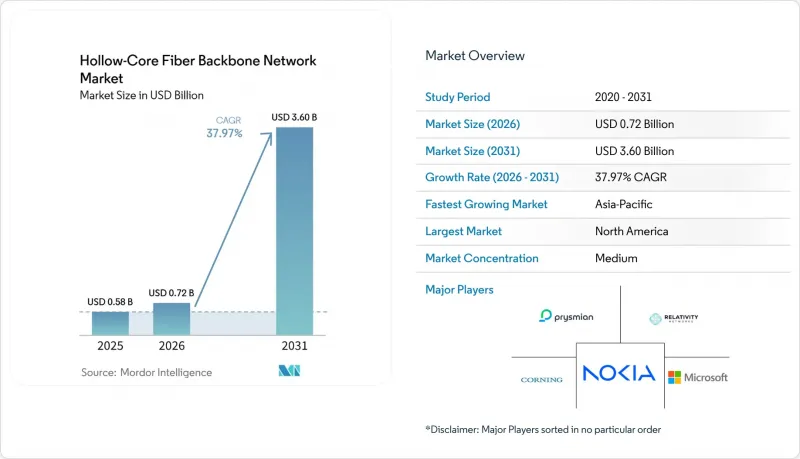
據 Mordor Intelligence 稱,中空芯光纖骨幹網路的市場規模預計將從 2025 年的 5.8 億美元成長到 2026 年的 7.2 億美元,到 2031 年達到 36 億美元,2026 年至 2031 年的複合年成長率為 37.97%。
本報告按光纖類型(反諧振中空光纖、光能帶中空光纖等)、應用(通訊骨幹網路、資料中心互連等)、終端用戶產業(通訊業者、超大規模資料中心業者和雲端服務供應商等)以及地區進行細分。市場預測以美元計價。
全球中空芯光纖骨幹網路市場趨勢及洞察
對骨幹網路和資料中心互連超低延遲的需求
超低延遲仍然是中空芯光纖骨幹網路市場短期內最顯著的促進因素。由於中空光纖允許光在空氣中而非固體玻璃中傳播,因此與標準單模光纖相比,它可以降低傳播延遲並提高時間性能。一篇發表於2025年的同行評審論文證實,在現代光纖網路的傳輸條件下,與傳統光纖相比,空芯光纖的延遲降低了28%至33%。此外,微軟在運作環境中不斷擴大部署規模,已在城域資料中心之間傳輸超過1,280公里的客戶流量,隨後宣布計畫將Azure的傳輸距離擴展至15,000公里,這些都使得這項技術的商業化勢頭毋庸置疑。隨著延遲不再只是網路的一個背景指標,而是成為一項影響定價的服務屬性,中空光纖骨幹網路市場在骨幹路由領域正蓬勃發展,即使是微小的時間效能提升也能為高階工作負載提供支援。
AI訓練叢集需要確定性的光纖延遲。
中空芯光纖骨幹網路市場的發展也得益於分散式人工智慧訓練對大規模加速器叢集上極高穩定性延遲的依賴。一篇發表於2025年的學術論文指出,中空芯傳輸可以規避影響石英光纖中高功率多波長傳輸的諸多非線性限制,即使在嚴苛的運作條件下也能實現更可預測的訊號行為。微軟在突破性的頻寬下實現了低於0.1 dB/km的衰減,這是另一個突破。這提高了無需重複光放大即可實現更長傳輸距離的可能性。這項性能至關重要,因為人工智慧網路營運商正致力於最佳化同步效率,而不僅僅是增加頻寬。在中空芯光纖骨幹網路市場,這一趨勢促使買家將光纖設計、製造管道和部署時間視為更廣泛的人工智慧基礎設施策略的一部分,而不僅僅是常規的佈線決策。
中空光纖製造和佈線高成本
高昂的製造成本仍然是中空芯光纖骨幹網路市場廣泛應用的最大障礙。近期科學研究表明,中空芯光纖的製造仍面臨許多挑戰,例如精確的形態要求、易受缺陷影響以及良率波動等。所有這些因素共同導致其產量低於主流光纖製造所需的經濟可行性水準。研究指出,儘管低衰減技術的進步意義重大,但整個商業提取過程的一致性與最佳性能記錄同樣重要。這種成本負擔限制了其應用範圍,使其僅限於那些低延遲和訊號品質能夠直接帶來經濟價值的鏈路,例如人工智慧互連、特定骨幹網路路由和高優先級科研網路。在製造良率提高和大規模生產普及之前,中空芯光纖骨幹網路市場很可能仍將集中在高階應用領域,而無法均勻地擴展到標準通訊業者網路建設。
細分市場分析
到2025年,反諧振中空光纖將佔據中空芯光纖骨幹網路市場48.61%的佔有率。這反映了其製造技術的高度成熟以及作為商用產品的廣泛應用。在許多初始部署專案中,反諧振光纖已成為首選,因為買家需要在效能提升、供貨可靠性和安裝中空之間取得平衡。微軟實現了低於0.1 dB/km的衰減率,這一里程碑式的成就進一步鞏固了反諧振光纖的地位,並得到了更廣泛供應鏈中商業性化進展的支持。在空芯光纖骨幹網路產業,這使得反諧振光纖成為資料中心連接和通訊骨幹網路專案(需要可靠的性能和穩定的供貨)的實用首選。
由於其卓越的抗模間干擾能力,嵌套式反諧振中空光纖預計將成為中空芯光纖骨幹網市場成長最快的產品,到2031年複合年成長率將達到42.31%。這項特性對於訊號純度要求極高且混合流量環境預計將不斷擴展的線路至關重要。發表在《npj Quantum Information》期刊上的一項研究表明,嵌套式反諧振中空光纖可以同時支援三個基於糾纏的量子通道和200 Gbps的經典DWDM流量。這凸顯了該設計在先進網路應用場景中備受關注的原因。雖然光能帶中空光纖目前仍屬於小眾產品,但慶應義塾大學在2025年的一次會議上證實,其在地下校園環境中能夠穩定運作一年,凸顯了其在受限部署環境中的作用。其他設計仍處於早期研發階段,缺乏全球統一的技術規格也持續阻礙通訊業者在中空芯光纖骨幹網路市場的廣泛採購。
區域分析
2025年,北美佔據中空芯光纖骨幹網路市場35.50%的佔有率,成為最大的區域市場佔有率。 2026年,該地區仍將維持商業中心地位,微軟基於Lumenisity的平台、高密度的超大規模資料中心業者以及康寧位於北卡羅來納州的製造地均集中於此。微軟部署實際運作並計劃擴建15,000公里,也顯示該地區正從測試環境過渡到生產網路。加拿大和墨西哥在該地區仍處於次要地位,更多地發揮支持跨境流量的作用,而非在其自身的光纖平台上扮演主導角色。
預計到2031年,亞太地區中空芯光纖骨幹網市佔率將以38.43%的複合年成長率成長,成為成長最快的地區。這一成長速度得益於政府主導的研究、國內光纖製造能力以及電信基礎設施升級計畫的共同推動。長飛光纖光纜(YOFC)宣布已實現商業規模生產,損耗低於0.1 dB/km,並在2026年巴塞隆納世界移動通訊大會(MWC Barcelona 2026)上展示了遍布亞洲、歐洲和美洲的10多個已投入運營的中空光纖項目,充分展現了該地區強大的執行能力。 2026年5月,日本Lightera Japan、OKI Electric Industries和慶應義塾大學成功展示了全球首個使用中空光纖的單纖雙向寬頻WDM傳輸,進一步鞏固了日本在該領域的領先地位。這進一步強化了亞太地區作為中空芯光纖骨幹網路市場主要成長引擎的地位,其中中國和日本在商業化和研究方面均發揮主導作用。
儘管歐洲在2025年並未佔最大佔有率,但由於其強大的生產和研發實力,在中空芯光纖骨幹網路市場仍具有重要的戰略地位。普睿司曼與Relativity Networks在埃因霍溫達成的協議以及隨後的投資,意味著該地區將在建立一個獨立超大規模資料中心業者專有結構之外的開放市場供應鏈方面發揮關鍵作用。南美洲在部署方面一直領先,但2025年,Lightera、Scala Data Centers和諾基亞在巴西完成了首個中空光纖演示,表明該技術已擴展到新的超大規模區域。在中東,政府主導的人工智慧和先進基礎設施項目已開始部署這項技術,但官方披露的資訊仍然有限。非洲由於超大規模資料中心業者密度和成本接受度仍然較低而落後,但在預測期後期,圍繞關鍵地面回程傳輸線路的特定應用可能會出現。
其他好處:
- Excel格式的市場預測(ME)表
- 3個月的分析師支持
目錄
第1章:引言
- 研究假設和市場定義
- 調查範圍
第2章:調查方法
第3章執行摘要
第4章 市場狀況
- 市場概覽
- 市場促進因素
- 對骨幹網路和資料中心互連超低延遲的需求
- AI訓練叢集需要確定性的光纖延遲。
- 5G和6G傳輸網路的升級週期
- 通訊業者和超大規模資料中心業者正朝著垂直整合的方向發展
- 城域網路和骨幹網路量子網路開發現況測試
- 工業自動化和邊緣運算領域對確定性網路效能的需求日益成長。
- 市場限制因素
- 製造中空光纖和鋪設光纜的高成本。
- 有限的拼接、連接器化與現場服務生態系統
- 部署的單位數量少、標準化程序滯後以及採購方面採取謹慎的態度。
- 中空光纖、光收發器和現有骨幹設備之間缺乏標準化的互通性,減緩了多廠商部署的進展。
- 產業價值鏈分析
- 監理情勢
- 技術展望
- 波特五力分析
- 宏觀經濟因素對市場的影響
第5章 市場規模與成長預測
- 纖維類型
- 反諧振中空光纖
- 光能帶中空光纖
- 嵌套式反諧振中空光纖
- 其他類型的中空纖維
- 透過使用
- 通訊骨幹網路
- 資料中心之間的互連
- 5G和6G傳輸網路
- 量子網路
- 其他用途
- 按最終用戶行業分類
- 通訊業者
- 超大規模資料中心業者和雲端服務供應商
- 研究和國防機構
- 公司和金融機構
- 其他終端用戶產業
- 按地區
- 北美洲
- 美國
- 加拿大
- 墨西哥
- 南美洲
- 巴西
- 阿根廷
- 其他南美國家
- 歐洲
- 德國
- 英國
- 法國
- 其他歐洲國家
- 亞太地區
- 中國
- 日本
- 印度
- 韓國
- 其他亞太國家
- 中東
- 沙烏地阿拉伯
- 阿拉伯聯合大公國
- 其他中東國家
- 非洲
- 南非
- 奈及利亞
- 其他非洲國家
- 北美洲
第6章 競爭情勢
- 市場集中度
- 策略趨勢
- 市佔率分析
- 公司簡介
- Microsoft Corporation
- Corning Incorporated
- Prysmian SpA
- Nokia Corporation
- Relativity Networks, Inc.
- Lightera LLC
- Furukawa Electric Co., Ltd.
- Fujikura Ltd.
- Sumitomo Electric Industries, Ltd.
- Yangtze Optical Fibre and Cable Joint Stock Limited Company
- Jiangsu Hengtong Optic-Electric Co., Ltd.
- Sterlite Technologies Limited
- OFS Fitel, LLC
- Coherent Corp.
- BT Group plc
- AFL Telecommunications LLC
- Heraeus Covantics
- Amazon Web Services, Inc.
- Google LLC
- Meta Platforms, Inc.
第7章 市場機會與未來展望
According to Mordor Intelligence, the hollow-Core fiber backbone network market size is expected to increase from USD 0.58 billion in 2025 to USD 0.72 billion in 2026 and reach USD 3.60 billion by 2031, growing at a CAGR of 37.97% over 2026-2031.
This report is Segmented by Fiber Type (Anti-Resonant Hollow-Core Fiber, Photonic Bandgap Hollow-Core Fiber, and More), Application (Telecom Backbone Networks, Data Center Interconnect, and More), End User Industry (Telecom Operators, Hyperscalers and Cloud Providers, and More), and Geography. The Market Forecasts are Provided in Value (USD).
Global Hollow-Core Fiber Backbone Network Market Trends and Insights
Ultra-Low Latency Demand in Backbone and Inter-Data-Center Links
Ultra-low latency remains the clearest near-term trigger for adoption in the hollow-core fiber backbone network market. Hollow-core fiber guides light through air rather than solid glass, reducing propagation delay and improving timing performance compared to standard single-mode fiber. Peer-reviewed work published in 2025 confirmed delay reductions in the 28-33% range relative to conventional fiber under transmission conditions relevant to modern optical networks. Commercial intent also became harder to ignore after Microsoft scaled live deployments and outlined a 15,000-km Azure expansion, following more than 1,280 km already carrying customer traffic between metro data center pairs. As latency becomes a priced service attribute rather than a background network metric, the hollow-core fiber backbone market is gaining traction on backbone routes, where even small timing gains can support premium workloads.
AI Training Clusters Need Deterministic Fiber Delay
The hollow-core fiber backbone network market is also being pulled forward by the way distributed AI training depends on highly stable delay across large accelerator clusters. Journal work published in 2025 showed that hollow-core transmission avoids many of the nonlinear limits that affect high-power, multi-wavelength transport in silica fiber, which supports more predictable signal behavior under demanding operating conditions. A second milestone came when Microsoft documented attenuation below 0.1 dB/km across record-wide bandwidth, which improves the case for longer spans without repeated optical amplification. That performance matters because AI network operators are now optimizing for synchronization efficiency rather than just raw bandwidth growth. In the hollow-core fiber backbone network market, this is pushing buyers to treat fiber design, manufacturing access, and deployment timing as part of a broader AI infrastructure strategy rather than as a routine cabling decision.
High Cost of Hollow-Core Fiber Manufacturing and Cabling
High manufacturing cost remains the most visible barrier to broader adoption in the hollow-core fiber backbone network market. Recent scientific reviews showed that hollow-core production still faces a difficult mix of precision-geometry requirements, defect sensitivity, and yield variability, all of which keep usable output below what mainstream fiber-manufacturing economics would require. The same review noted that progress on low attenuation has been meaningful, but consistency across commercial draw runs still matters as much as best-case record performance. This cost burden limits adoption to links where low latency or signal quality carries direct economic value, such as AI interconnects, select backbone routes, and high-priority research networks. Until manufacturing yields improve and scale becomes more routine, the hollow-core fiber backbone network market is likely to remain concentrated in premium applications rather than spread evenly across standard carrier builds.
Other drivers and restraints analyzed in the detailed report include:
- 5G and 6G Transport Upgrade Cycles
- Carrier and Hyperscaler Move to Vertical Integration
- Limited Splicing, Connectorization, and Field-Service Ecosystem
For complete list of drivers and restraints, kindly check the Table Of Contents.
Segment Analysis
Anti-resonant hollow-core fiber held 48.61% of the hollow-core fiber backbone network market share in 2025, reflecting its greater manufacturing maturity and wider commercial availability. It has become the default option for many early deployments because buyers are balancing performance gains with supply reliability and installation confidence. The design's position was reinforced by sub-0.1 dB/km attenuation milestones that were documented by Microsoft and echoed by commercial progress across the broader supply chain. In the hollow-core fiber backbone network industry, this has made anti-resonant fiber the practical first choice for data center interconnect and telecom backbone programs that need proven performance and stable sourcing.
The nested anti-resonant hollow-core fiber is projected to post the fastest growth in the hollow-core fiber backbone network market, with a 42.31% CAGR through 2031, supported by its stronger control of intermodal interference. That feature matters most in routes where signal purity is critical and mixed-traffic environments are expected to grow. Research published in npj Quantum Information showed that a nested anti-resonant hollow-core fiber supported three simultaneous entanglement-based quantum channels alongside 200 Gbps classical DWDM traffic, highlighting why this design is attracting attention in advanced network use cases. The photonic bandgap hollow-core fiber remained a niche, but 2025 conference work from Keio University confirmed stable underground campus performance over a full year, supporting its role in constrained deployments. Other designs were still in early development, and the lack of globally harmonized technical specifications continued to slow broader carrier procurement in the hollow-core fiber backbone network market.
Complete Report Scope:
- By Fiber Type
- Anti-Resonant Hollow-Core Fiber
- Photonic Bandgap Hollow-Core Fiber
- Nested Anti-Resonant Hollow-Core Fiber
- Other Hollow-Core Fiber Types
- By Application
- Telecom Backbone Networks
- Data Center Interconnect
- 5G and 6G Transport Networks
- Quantum Networks
- Other Applications
- By End User Industry
- Telecom Operators
- Hyperscalers and Cloud Providers
- Research and Defense Organizations
- Enterprises and Financial Institutions
- Other End User Industries
- By Geography
- North America
- United States
- Canada
- Mexico
- South America
- Brazil
- Argentina
- Rest of South America
- Europe
- Germany
- United Kingdom
- France
- Rest of Europe
- Asia-Pacific
- China
- Japan
- India
- South Korea
- Rest of Asia-Pacific
- Middle East
- Saudi Arabia
- United Arab Emirates
- Rest of the Middle East
- Africa
- South Africa
- Nigeria
- Rest of Africa
- North America
Geography Analysis
North America held 35.50% of the hollow-core fiber backbone network market in 2025, making it the leading regional contributor. The region remained the commercial center in 2026 because Microsoft's Lumenisity-based platform, large hyperscaler campus density, and Corning's North Carolina manufacturing support were all concentrated there. Microsoft's live traffic deployment and its 15,000-km expansion plan also showed that the region was moving beyond test environments into production networks. Canada and Mexico remained secondary within the region, with a larger role in cross-border traffic support than in independent fiber platform leadership.
Asia-Pacific is projected to record the fastest growth in hollow-core fiber backbone network market share, at a 38.43% CAGR through 2031. The region's pace is being supported by a combination of state-backed research, domestic fiber manufacturing capability, and telecom upgrade programs. YOFC reported commercial-scale production below 0.1 dB/km and described more than 10 live hollow-core fiber projects across Asia, Europe, and the Americas at MWC Barcelona 2026, which underlined the region's strong execution capacity. Japan added another layer of strength when Lightera Japan, OKI Electric Industry, and Keio University completed the first single-fiber bidirectional wideband WDM transmission demonstration on hollow-core fiber in May 2026. This left Asia-Pacific positioned as the main growth engine of the hollow-core fiber backbone network market, with China and Japan setting the tone for both commercial and research progress.
Europe remained strategically important in the hollow-core fiber backbone network market because it hosted major production and research assets, even though it did not lead in the 2025 share. Prysmian's Eindhoven agreement with Relativity Networks, followed by its equity investment, gave the region a critical role in building open-market supply outside captive hyperscaler structures. South America was earlier in adoption, but Lightera, Scala Data Centers, and Nokia completed the first hollow-core fiber proof of concept in Brazil in 2025, demonstrating that the deployment case is extending into new hyperscale regions. Middle East markets were beginning to absorb the technology through sovereign AI and advanced infrastructure programs, although public disclosure remained limited. Africa still lagged because hyperscaler density and cost tolerance remained lower, but niche use around key terrestrial backhaul routes could emerge later in the forecast period.
- Microsoft Corporation
- Corning Incorporated
- Prysmian S.p.A.
- Nokia Corporation
- Relativity Networks, Inc.
- Lightera LLC
- Furukawa Electric Co., Ltd.
- Fujikura Ltd.
- Sumitomo Electric Industries, Ltd.
- Yangtze Optical Fibre and Cable Joint Stock Limited Company
- Jiangsu Hengtong Optic-Electric Co., Ltd.
- Sterlite Technologies Limited
- OFS Fitel, LLC
- Coherent Corp.
- BT Group plc
- AFL Telecommunications LLC
- Heraeus Covantics
- Amazon Web Services, Inc.
- Google LLC
- Meta Platforms, Inc.
Additional Benefits:
- The market estimate (ME) sheet in Excel format
- 3 months of analyst support
TABLE OF CONTENTS
1 INTRODUCTION
- 1.1 Study Assumptions and Market Definition
- 1.2 Scope of the Study
2 RESEARCH METHODOLOGY
3 EXECUTIVE SUMMARY
4 MARKET LANDSCAPE
- 4.1 Market Overview
- 4.2 Market Drivers
- 4.2.1 Ultra-Low Latency Demand in Backbone and Inter-Data-Center Links
- 4.2.2 AI Training Clusters Need Deterministic Fiber Delay
- 4.2.3 5G and 6G Transport Upgrade Cycles
- 4.2.4 Carrier and Hyperscaler Move to Vertical Integration
- 4.2.5 Quantum Networking Readiness for Metro and Backbone Trials
- 4.2.6 Rising Demand for Deterministic Network Performance in Industrial Automation and Edge Computing
- 4.3 Market Restraints
- 4.3.1 High Cost of Hollow-Core Fiber Manufacturing and Cabling
- 4.3.2 Limited Splicing, Connectorization, and Field-Service Ecosystem
- 4.3.3 Low Installed Base, Slower Standards Convergence, and Procurement Caution
- 4.3.4 Lack of Standardized Interoperability Between Hollow-Core Fiber, Optical Transceivers, and Existing Backbone Equipment Slows Multi-Vendor Adoption
- 4.4 Industry Value-Chain Analysis
- 4.5 Regulatory Landscape
- 4.6 Technological Outlook
- 4.7 Porter's Five Forces Analysis
- 4.7.1 Threat of New Entrants
- 4.7.2 Bargaining Power of Suppliers
- 4.7.3 Bargaining Power of Buyers
- 4.7.4 Threat of Substitutes
- 4.7.5 Competitive Rivalry
- 4.8 Impact of Macroeconomic Factors on the Market
5 MARKET SIZE AND GROWTH FORECASTS (VALUE)
- 5.1 By Fiber Type
- 5.1.1 Anti-Resonant Hollow-Core Fiber
- 5.1.2 Photonic Bandgap Hollow-Core Fiber
- 5.1.3 Nested Anti-Resonant Hollow-Core Fiber
- 5.1.4 Other Hollow-Core Fiber Types
- 5.2 By Application
- 5.2.1 Telecom Backbone Networks
- 5.2.2 Data Center Interconnect
- 5.2.3 5G and 6G Transport Networks
- 5.2.4 Quantum Networks
- 5.2.5 Other Applications
- 5.3 By End User Industry
- 5.3.1 Telecom Operators
- 5.3.2 Hyperscalers and Cloud Providers
- 5.3.3 Research and Defense Organizations
- 5.3.4 Enterprises and Financial Institutions
- 5.3.5 Other End User Industries
- 5.4 By Geography
- 5.4.1 North America
- 5.4.1.1 United States
- 5.4.1.2 Canada
- 5.4.1.3 Mexico
- 5.4.2 South America
- 5.4.2.1 Brazil
- 5.4.2.2 Argentina
- 5.4.2.3 Rest of South America
- 5.4.3 Europe
- 5.4.3.1 Germany
- 5.4.3.2 United Kingdom
- 5.4.3.3 France
- 5.4.3.4 Rest of Europe
- 5.4.4 Asia-Pacific
- 5.4.4.1 China
- 5.4.4.2 Japan
- 5.4.4.3 India
- 5.4.4.4 South Korea
- 5.4.4.5 Rest of Asia-Pacific
- 5.4.5 Middle East
- 5.4.5.1 Saudi Arabia
- 5.4.5.2 United Arab Emirates
- 5.4.5.3 Rest of the Middle East
- 5.4.6 Africa
- 5.4.6.1 South Africa
- 5.4.6.2 Nigeria
- 5.4.6.3 Rest of Africa
- 5.4.1 North America
6 COMPETITIVE LANDSCAPE
- 6.1 Market Concentration
- 6.2 Strategic Moves
- 6.3 Market Share Analysis
- 6.4 Company Profiles (includes Global Level Overview, Market Level Overview, Core Segments, Financials as available, Strategic Information, Market Rank/Share, Products and Services, Recent Developments)
- 6.4.1 Microsoft Corporation
- 6.4.2 Corning Incorporated
- 6.4.3 Prysmian S.p.A.
- 6.4.4 Nokia Corporation
- 6.4.5 Relativity Networks, Inc.
- 6.4.6 Lightera LLC
- 6.4.7 Furukawa Electric Co., Ltd.
- 6.4.8 Fujikura Ltd.
- 6.4.9 Sumitomo Electric Industries, Ltd.
- 6.4.10 Yangtze Optical Fibre and Cable Joint Stock Limited Company
- 6.4.11 Jiangsu Hengtong Optic-Electric Co., Ltd.
- 6.4.12 Sterlite Technologies Limited
- 6.4.13 OFS Fitel, LLC
- 6.4.14 Coherent Corp.
- 6.4.15 BT Group plc
- 6.4.16 AFL Telecommunications LLC
- 6.4.17 Heraeus Covantics
- 6.4.18 Amazon Web Services, Inc.
- 6.4.19 Google LLC
- 6.4.20 Meta Platforms, Inc.
7 MARKET OPPORTUNITIES AND FUTURE OUTLOOK
- 7.1 White-Space and Unmet-Need Assessment

 光纖冷鍵合市場規模、佔有率及成長分析:按鍵合類型、光纖類型、應用、最終用戶、安裝方法和地區分類-2026-2033年產業預測
 光纖市場規模、佔有率和成長分析:按光纖類型、產品類型、應用、安裝、最終用戶和地區分類-2026-2033年產業預測
 光纖測試市場-2026-2032年全球市場預測
 國防和戰場通訊網路光纖:市場佔有率分析、產業趨勢和統計數據以及成長預測(2026-2031 年)主權光纖骨幹基礎設施:市場佔有率分析、產業趨勢與統計及成長預測(2026-2031 年)高密度網路光纖骨幹:市場佔有率分析、產業趨勢與統計及成長預測(2026-2031 年)
 軍工和航太光纖市場報告:趨勢、預測和競爭分析(至2035年)
 光纖板市場:按類型、應用和地區分類
 光纖檢測設備市場:按產品類型、最終用戶和地區分類(2026-2034 年)光纖行動連接器市場報告:趨勢、預測和競爭分析(至2035年)