


 |
市場調查報告書
商品編碼
2099837
智慧公路和自動駕駛基礎設施中的光纖電纜:市場佔有率分析、行業趨勢和統計數據以及成長預測(2026-2031 年)Fiber Optic Cable For Smart Highways and Autonomous Vehicle Infrastructure - Market Share Analysis, Industry Trends & Statistics, Growth Forecasts (2026 - 2031) |
||||||

※ 本網頁內容可能與最新版本有所差異。詳細情況請與我們聯繫。
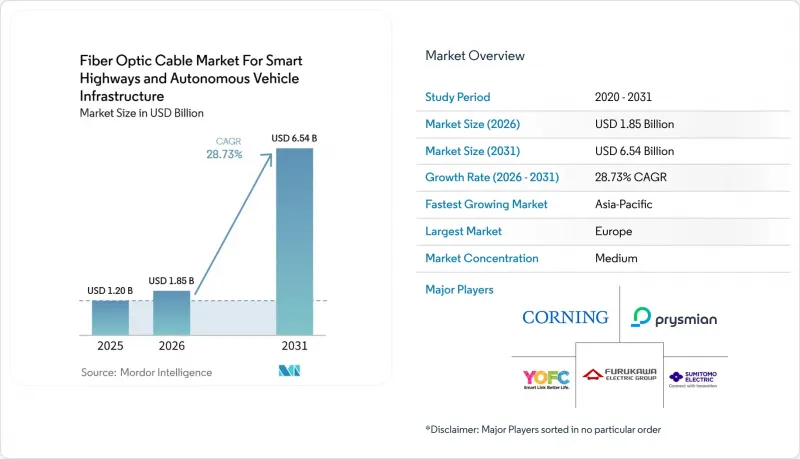
據 Mordor Intelligence 稱,智慧高速公路和自動駕駛基礎設施的光纖電纜市場預計將從 2025 年的 12 億美元成長到 2026 年的 18.5 億美元,到 2031 年達到 65.4 億美元,預計 2026 年至 2031 年的複合成長率為 28.73%。
本報告按電纜類型(例如,鎧裝電纜)、光纖模式(例如,單模光纖)、安裝方式(例如,地下/埋地)、應用領域(例如,路邊通訊)、最終用戶(例如,政府/交通管理部門)和地區進行分類。市場預測以美元計價。
智慧公路與自動駕駛基礎設施光纖電纜市場洞察與趨勢
加速智慧走廊發展計劃
政府支持的走廊項目正從更廣泛的交通政策階段過渡到實際採購階段,這一轉變進一步鞏固了智慧公路和自動駕駛基礎設施領域光纖電纜市場的短期訂單基礎。 2024年,美國國家公路交通安全管理局(NHTSA)向亞利桑那州、德克薩斯州、懷俄明州、密西根州和維吉尼亞撥款5,880萬美元用於V2X津貼。這些項目需要固定的回程傳輸電路來連接路側設備。美國國家部署計畫也設定了2031年實現50%的全國公路系統V2X覆蓋的目標,這使得走廊光纖的需求從隨意的預算項目轉變為更具體的基礎設施需求。隨著各機構在設計公路連接時假定高密度節點部署,每增加一個龍門架、機櫃和邊緣設備,可靠光纖線路和備用容量的需求就會增加。因此,智慧高速公路和自動駕駛基礎設施領域的光纖電纜市場不僅受益於專案數量的成長,也受益於每個已投資走廊內更高密度的建設規範。這一趨勢也有利於高度擴充性的電纜架構,因為營運商需要能夠適應未來升級而無需重複進行大規模土木工程專案的資產。
光纖是智慧高速公路通訊的首選介質
在高速公路網路中,感測器密度、延遲要求和持續資料傳輸都在同步成長,因此,僅採用無線回程傳輸變得越來越難以令人信服。 2025 年發表在《車輛通訊》(Vehicle Communications)期刊上的一項同行評審研究表明,在智慧型運輸系統(ITS)環境中,用於路側單元(ROU)連接的光纖網路解決方案的性能顯著優於無線方案。這對智慧高速公路和自動駕駛基礎設施的光纖電纜市場具有重大意義,因為道路營運商現在不再將光纖視為可選附加組件,而是將其視為設計要求。 IEEE 802.3cz 標準進一步推動了這一趨勢,該標準用於實現基於光纖的汽車多Gigabit光纖通訊,並在車輛系統和路側基礎設施的各種應用場景中得到越來越廣泛的應用。隨著LiDAR、雷達、氣象感測器、攝影機叢集和其他設備透過每個路側節點產生越來越多的資料負載,對不穩定或擁塞回程傳輸的接受度正在迅速降低。智慧高速公路和自動駕駛基礎設施的光纖電纜市場正受益於這種轉變,因為更高的性能要求通常會導致光纖電纜數量增加、衰減率降低以及更耐用的長距離走廊設計。
高速公路沿線的高昂土木工程成本和土地徵收成本
在智慧高速公路和自動駕駛基礎設施的光纖電纜市場中,挖掘和修復工作仍然是最大的結構性成本負擔。根據光纖寬頻協會與Cartesian公司聯合製作並於2026年1月發布的年度部署成本報告,2025年地下安裝成本中位數為每英尺18美元,較去年同期成長12%。報告指出,人事費用佔總建造成本的60%至80%,這意味著政府機構僅靠材料採購難以抵銷通膨的影響。 2026年1月的分析顯示,75%至90%的光纖鋪設成本都歸因於道路挖掘和修復工作,並得出結論:如果不實施在道路建設初期一次性挖掘並埋設管道的政策,成本可能會飆升十倍。 IEC TR 63431:2025標準正在推動向微導管系統的轉變,與明挖溝槽施工相比,微導管系統可將安裝成本降低50%至75%。然而,由於採購週期不會在一夜之間改變,實施仍然需要時間。因此,儘管需求依然強勁,但能否確保交付日期很大程度取決於專案業主能否縮減土木工程的規模。
細分市場分析
到2025年,非鎧裝光纜將在智慧高速公路和自動駕駛基礎設施的光纖電纜市場佔據31.72%的佔有率,成為智慧高速公路應用場景中的主導光纜類型。這一主導地位反映了這樣一個事實:在許多高速公路項目中,光纖是透過導管敷設的,而導管本身已經提供了長距離電路敷設所需的基本機械保護。在這種情況下,增加鎧裝會增加光纜重量、提高安裝成本,並使現場端接更加複雜,卻沒有帶來相應的運作優勢。預計到2031年,微管和吹入式光纖電纜的複合年成長率將達到28.45%。這是因為利害關係人正在尋求模組化系統,以便在無需重新挖掘整個線路的情況下,可以隨時添加光纜。智慧高速公路和自動駕駛基礎設施的光纖電纜市場正在滿足這些需求,因為生命週期柔軟性幾乎與初始安裝成本同等重要。
賓州收費公路工程意義重大,因為該工程透過鋪設500英里的微型管道,與傳統的明挖溝槽施工方法相比,成本降低了50%至75%。該專案也展現了微型管道備用容量的真正價值,尤其是在營運商需要同時支援交通系統和外部寬頻租賃需求時。在南美洲、中東和非洲等地區,由於管道並非總是預先安裝,鎧裝電纜在新建的待開發區項目中仍然至關重要。帶狀電纜在交通管理樞紐中仍然非常有用,因為在這些樞紐中,高頻連接效率比路徑柔軟性更為重要。在整個智慧公路和自動駕駛基礎設施的光纖電纜市場中,IEC TR 63431:2025 提供了一個有用的技術參考,為道路管理機構指定微型管道系統提供了更清晰的依據,同時降低了採購的不確定性。
截至2025年,單模光纖將佔據智慧高速公路和自動駕駛基礎設施光纖電纜市場53.34%的佔有率,預計到2031年將以27.63%的複合年成長率成長。這種規模和成長的結合源自於走廊網路的基本物理特性,因為城際道路的連接範圍通常遠遠超出多模系統能夠維持效率的範圍。連接交通樞紐、收費站和感測叢集的長距離高速公路路段需要低衰減和低再生需求。 2025年《車輛通訊》雜誌發布的「路側連接調查」也支持這一趨勢,展示了光纖網路解決方案在智慧交通環境中的性能優勢。因此,在智慧高速公路和自動駕駛基礎設施的光纖電纜市場中,單模系統的建設,而非短距離替代方案,仍是骨幹網路需求的基礎。
隨著互聯道路走廊中雷射雷達、雷達、成像和環境感測設備的負載不斷增加,這一趨勢愈發明顯。 IEEE 802.3cz 標準也推動了光纖在道路和車輛基礎設施相關的多Gigabit汽車通訊領域的應用。多模光纖在收費站、交通管理設施和維護基地等需要短鏈路和易於端接的場所仍然發揮著重要作用。塑膠光纖在狹窄的路邊機櫃和車載近距離鏈路中也佔據一席之地,在這些應用中,柔軟性比遠距離傳輸更為重要。因此,在智慧高速公路和自動駕駛基礎設施的整體光纖電纜市場中,儘管單模光纖仍然是性能的標桿,但走廊回程傳輸和設施級互連的需求正在不斷成長。
區域分析
到2025年,歐洲仍將是最大的區域貢獻者,佔據智慧高速公路和自動駕駛基礎設施光纖電纜市場32.67%的佔有率。這個區域主導地位體現了「連接歐洲設施」(CEF)數位框架下制定的互通性目標、積極的特許經營模式和走廊資金籌措結構。義大利那不勒斯環城公路將於2026年6月成為全國首條獲得認證的智慧公路,配備217個智慧攝影機、15個交通偵測龍門架、8個氣象站以及40個V2I和蜂巢V2X通訊天線。這個計畫意義重大,因為它為其他歐洲業者提供了一個切實可行的合規模式,而不僅僅是理論上的政策目標。隨著聯網汽車交通和即時分析需求的成長,德國、法國和英國仍然是最大的單一國家市場,因為這些國家需要不斷升級高速公路控制系統的容量。
北美仍然是智慧高速公路和自動駕駛基礎設施光纖電纜的第二大市場,這得益於美國V2X部署計劃和兩黨基礎設施法案下的走廊現代化資金支持。預計僅加州在2026年就將迎來大規模的業務活動,其中包括索諾瑪縣101號公路沿線一項價值1.5億美元的光纖基礎設施項目,以及50號美國國道中段走廊數據處理的積極推進。 2026年4月,Cavnue公司贏得了與維吉尼亞交通部的契約,將在里士滿地區的95號州際公路上部署其智慧道路平台,為車道級走廊運營數據提供管理服務模式。雖然預計加拿大和墨西哥的業務機會有限,但南美洲的業務活動規模較小,卻更為活躍,巴西和阿根廷的智慧高速公路試點計畫正在推進,儘管資金限制增加了計畫延期的風險。
預計到2031年,亞太地區將以28.76%的複合年成長率成長,並有望成為智慧高速公路和自動駕駛基礎設施光纖電纜市場成長最快的地區。印度仍然是該地區成長的主要驅動力,印度國家公路管理局(NHAI)的數位高速公路網路計畫已在主要試點路段實施,並基於全國路線網路。日本也正在檢驗行動通訊和光纖層如何協同工作,並計畫於2025年在新東名高速公路進行L4級自動駕駛測試,利用5G技術評估其選擇性互補性,而非完全取代專用道路光纖。中東和非洲地區正透過國家願景項目和對智慧城市基礎設施的投資取得進展,這些項目和投資將道路連接融入更廣泛的數位交通計劃中。土耳其是具體的區域標桿,其目標是鋪設 20,141 公里的高速公路光纖,到 2025 年將完成 7,931 公里,其餘路段的建設仍在進行中。
其他好處:
- Excel格式的市場預測(ME)表
- 3個月的分析師支持
目錄
第1章:引言
- 研究假設和市場定義
- 調查範圍
第2章:調查方法
第3章執行摘要
第4章 市場狀況
- 市場概覽
- 市場促進因素
- 智慧走廊加速發展及對V2X回程傳輸的需求
- 光纖作為一種低延遲路邊邊緣連接的最佳傳輸介質,正受到廣泛關注。
- 政府關於智慧型運輸系統(ITS)和高速公路數位化的政策。
- 自動駕駛車輛測試路段需要路由多樣性和容錯通訊。
- 透過互聯的路邊基礎設施實現走廊數據貨幣化
- 提高多用途公路公用設施走廊的光纖密度要求
- 市場限制因素
- 高昂的土木工程成本和土地徵用調整成本
- 公路、隧道和橋樑建設的許可證獲取周期過長。
- DSRC、C-V2X 和傳統公路系統之間的互通性挑戰
- 由於與其他交通基礎設施優先事項的預算衝突,項目延期。
- 價值鏈分析
- 監理情勢
- 技術展望
- 波特五力分析
第5章 市場規模與成長預測
- 按電纜類型
- 鎧裝電纜
- 非鎧裝電纜
- 帶狀電纜
- 微導管和吹入式光纖電纜
- 其他電纜類型
- 光纖模式
- 單模光纖
- 多模光纖
- 塑膠光纖
- 按安裝類型
- 地下和埋地類型
- 空中安裝和架空安裝
- 海底和水下
- 隧道和橋樑的綜合引入
- 透過使用
- 路側通訊和V2X回程傳輸
- 交通監控與事件管理
- 智慧收費和收入回收
- 相容於自動駕駛車輛的走廊
- 環境監測和氣象觀測
- 最終用戶
- 政府和交通運輸
- 私人公路營運商
- 物流和車輛營運公司
- 汽車製造商和旅行生態系統提供商
- 按地區
- 北美洲
- 美國
- 加拿大
- 墨西哥
- 南美洲
- 巴西
- 阿根廷
- 其他南美國家
- 歐洲
- 德國
- 英國
- 法國
- 義大利
- 西班牙
- 俄羅斯
- 其他歐洲國家
- 亞太地區
- 中國
- 日本
- 印度
- 韓國
- 澳洲
- 新加坡
- 其他亞太國家
- 中東和非洲
- 中東
- 沙烏地阿拉伯
- 阿拉伯聯合大公國
- 土耳其
- 其他中東國家
- 非洲
- 南非
- 奈及利亞
- 埃及
- 其他非洲國家
- 中東
- 北美洲
第6章 競爭情勢
- 市場集中度
- 策略趨勢
- 市佔率分析
- 公司簡介
- Prysmian Group
- Corning Incorporated
- Sumitomo Electric Industries, Ltd.
- Furukawa Electric Co., Ltd.
- Yangtze Optical Fibre and Cable Joint Stock Limited Company
- Fujikura Ltd.
- CommScope Holding Company, Inc.
- Nexans SA
- LS Cable and System Ltd.
- OFS Fitel, LLC
- Sterlite Technologies Limited
- Hengtong Optic-Electric Co., Ltd.
- ZTT Group
- Proterial, Ltd.
- Belden Inc.
- Hexatronic Group AB
- Finolex Cables Limited
- Taihan Fiberoptics Co., Ltd.
- Nokia Corporation
- Cisco Systems, Inc.
第7章 市場機會與未來展望
According to Mordor Intelligence, the fiber optic cable market size for smart highways and autonomous vehicle infrastructure industry is expected to increase from USD 1.2 billion in 2025 to USD 1.85 billion in 2026 and reach USD 6.54 billion by 2031, growing at a CAGR of 28.73% over 2026-2031.
This report is Segmented by Cable Type (Armored, and More), Fiber Mode (Single-Mode, and More), Installation (Underground and Buried, and More), Application (Roadside Communications, and More), End User (Government and Transport Authorities, and More), and Geography. The Market Forecasts are Provided in Terms of Value (USD).
Insights and Trends of Fiber Optic Cable Market For Smart Highways and Autonomous Vehicle Infrastructure
Accelerated Smart Corridor Build-Out Programs
State-backed corridor programs are moving from broad transport policy into live procurement schedules, and that shift is giving the fiber optic cable market for smart highways and autonomous vehicle infrastructure a stronger near-term order base. The Federal Highway Administration released USD 58.8 million in V2X grants in 2024 across Arizona, Texas, Wyoming, Michigan, and Virginia, and those projects required fixed backhaul links for roadside unit connectivity. The U.S. national deployment plan also set a target for V2X coverage across 50% of the National Highway System by 2031, which moves corridor fiber demand from a discretionary line item into a more visible infrastructure requirement. Once agencies design highway connectivity around dense node placement, every added gantry, cabinet, and edge device raises the need for reliable fiber paths and spare capacity. The fiber optic cable market for smart highways and autonomous vehicle infrastructure is therefore benefiting not only from higher project counts, but also from denser build specifications inside each funded corridor. This pattern also favors scalable cable architectures because operators want assets that can support later upgrades without repeating the heaviest civil works.
Fiber As The Preferred Medium For Intelligent Highway Communication
Wireless-only backhaul has become harder to justify on high-speed road networks where sensor density, latency demands, and continuous data movement all rise together. A 2025 peer-reviewed study in Vehicle Communications found that optical network solutions for roadside unit connectivity materially outperform wireless alternatives in intelligent transportation settings. This matters for the fiber optic cable market for smart highways and autonomous vehicle infrastructure because corridor operators are now treating fiber as a design requirement rather than an optional add-on. The move is reinforced by the IEEE 802.3cz standard for automotive multigigabit optical communications over glass fiber, which is being adopted for use cases spanning both vehicle systems and roadside infrastructure. As LiDAR, radar, weather sensing, and camera clusters push higher data loads through each roadside node, the tolerance for unstable or congested backhaul drops sharply. The fiber-optic cable market for smart highways and autonomous vehicle infrastructure benefits from this shift, as higher performance requirements often translate into higher fiber counts, lower attenuation specifications, and more durable long-haul corridor designs.
High Civil Works And Right-Of-Way Costs In Highway Corridors
Excavation and reinstatement remain the clearest structural cost burden in the fiber optic cable market for smart highways and autonomous vehicle infrastructure. The Fiber Broadband Association's annual deployment cost report, produced with Cartesian and released in January 2026, placed median underground installation costs at USD 18 per foot in 2025, up 12% year over year. The same report showed that labor accounted for 60-80% of total construction spending, leaving limited room for agencies to offset inflation through product purchasing alone. A January 2026 analysis tied 75-90% of fiber installation costs to road excavation and reinstatement, and concluded that missing dig-once policies can multiply costs by 10 times compared with placing conduit during original road construction. IEC TR 63431:2025 supports a move toward microduct systems that can reduce installation costs by 50-75% versus open trenching, but adoption still takes time because procurement cycles do not change overnight. The result is a market where demand stays strong, but delivery timing depends heavily on whether project owners can lower civil intensity.
Other drivers and restraints analyzed in the detailed report include:
- Government Mandates For Intelligent Transportation Systems
- Need For Route Diversity And Resilience In Highway Networks
- Long Permitting Cycles For Highway Infrastructure Projects
For complete list of drivers and restraints, kindly check the Table Of Contents.
Segment Analysis
Non-Armored Cable held 31.72% of the fiber optic cable market for smart highways and autonomous vehicle infrastructure share in 2025, making it the leading cable type across smart highway use cases. Its lead position reflects the fact that many highway projects route fiber through conduit, so the duct itself already provides the core mechanical protection required for long corridor runs. In those settings, added armoring can raise cable weight, increase installed cost, and complicate field termination without delivering proportional operating benefit. Microduct and Blown Fiber Cable are projected to grow at a 28.45% CAGR through 2031, as agencies seek modular systems that allow them to add strands later without reopening the entire route. The fiber optic cable market for smart highways autonomous vehicle infrastructure is responding to that preference as lifecycle flexibility now matters almost as much as first-pass installation cost.
The Pennsylvania Turnpike example remains important because its 500-mile microtrench conduit deployment demonstrated documented cost savings of 50-75% compared to conventional open-cut trenching. The same project also demonstrated why spare microduct capacity has real value when operators want to support both transport systems and external broadband leasing demand. Armored Cable still holds relevance in direct-buried greenfield projects across South America and Middle East and Africa, where conduit is less consistently pre-installed. Ribbon Cable remains useful at traffic management hubs where high-count splicing efficiency matters more than route flexibility. Across the fiber optic cable market for smart highways and autonomous vehicle infrastructure industry, IEC TR 63431:2025 has become a useful technical reference because it gives highway agencies a clearer basis for specifying microduct systems with less procurement uncertainty.
Single-Mode Fiber accounted for 53.34% of the fiber optic cable market for smart highways and autonomous vehicle infrastructure by fiber mode in 2025 and is projected to grow at a 27.63% CAGR through 2031. That combination of scale and growth reflects the basic physics of corridor networking, because inter-city road links often stretch far beyond the range where multimode systems stay efficient. Long highway paths between traffic centers, toll nodes, and sensing clusters favor lower attenuation and lower regeneration needs over distance. The 2025 roadside connectivity study in Vehicle Communications supports this direction, showing the performance advantage of optical network solutions in intelligent transportation environments. The fiber optic cable market for smart highways autonomous vehicle infrastructure, therefore, continues to anchor its backbone demand in single-mode builds rather than short-reach alternatives.
This preference is becoming more entrenched as LiDAR, radar, imaging, and environmental sensing loads climb on connected corridors. The IEEE 802.3cz standard has also strengthened the case for glass fiber in multigigabit automotive communications tied to road and vehicle infrastructure. Multimode Fiber still retains a practical role inside toll plazas, traffic management buildings, and maintenance depots where link lengths are short and easier termination is useful. Plastic Optical Fiber also keeps a small niche in tight roadside cabinets and in-vehicle proximity links where bend flexibility matters more than long-distance transmission. Across the fiber optic cable market for smart highways and autonomous vehicle infrastructure industry, demand is therefore widening across corridor backhaul and facility-level interconnects, even though single-mode remains the clear performance anchor.
Complete Report Scope:
- By Cable Type
- Armored Cable
- Non-Armored Cable
- Ribbon Cable
- Microduct and Blown Fiber Cable
- Other Cable Types
- By Fiber Mode
- Single-Mode Fiber
- Multimode Fiber
- Plastic Optical Fiber
- By Installation Type
- Underground and Buried
- Aerial and Overhead
- Submarine and Under-Water
- Tunnel and Bridge Integrated Deployments
- By Application
- Roadside Communications and V2X Backhaul
- Traffic Monitoring and Incident Management
- Smart Tolling and Revenue Collection
- Autonomous Vehicle Support Corridors
- Environmental Monitoring and Weather Sensing
- By End User
- Government and Transport Authorities
- Private Highway Operators
- Logistics and Fleet Operators
- Automotive OEMs and Mobility Ecosystem Providers
- By Geography
- North America
- United States
- Canada
- Mexico
- South America
- Brazil
- Argentina
- Rest of South America
- Europe
- Germany
- United Kingdom
- France
- Italy
- Spain
- Russia
- Rest of Europe
- Asia-Pacific
- China
- Japan
- India
- South Korea
- Australia
- Singapore
- Rest of Asia-Pacific
- Middle East and Africa
- Middle East
- Saudi Arabia
- United Arab Emirates
- Turkey
- Rest of Middle East
- Africa
- South Africa
- Nigeria
- Egypt
- Rest of Africa
- Middle East
- North America
Geography Analysis
Europe held 32.67% of the fiber optic cable market for smart highways and autonomous vehicle infrastructure share in 2025, which kept it as the largest regional contributor. The region's lead reflects binding interoperability goals, active concession models, and corridor funding structures under the Connecting Europe Facility Digital framework. Italy's Tangenziale di Napoli became the country's first certified Smart Road in June 2026, and the corridor deployed 217 intelligent cameras, 15 traffic detection gantries, 8 weather stations, and 40 V2I and Cellular V2X communication antennas. That project matters because it gives other European operators a practical compliance template rather than a theoretical policy target. Germany, France, and the United Kingdom remain the largest individual national markets because motorway control systems there continue to require steady capacity upgrades as connected vehicle traffic and real-time analytics loads increase.
North America remained the second-largest region in the fiber optic cable market for smart highways and autonomous vehicle infrastructure, supported by the U.S. V2X deployment plan and corridor modernization funding under the Bipartisan Infrastructure Law. California alone had major 2026 activity, including approximately USD 150 million of fiber optic infrastructure work along Highway 101 in Sonoma County and active middle-mile corridor processing on U.S. Highway 50. In April 2026, Cavnue won a Virginia Department of Transportation contract to deploy its Smart Road Platform on Interstate 95 in the Richmond region, which supports a managed service model for lane-level corridor operations data. Canada and Mexico offer moderate opportunities, while South America remains smaller but active, with Brazil and Argentina pursuing smart highway pilots even though fiscal constraints still create a higher risk of project deferral.
Asia Pacific is projected to grow at a 28.76% CAGR through 2031, making it the fastest-expanding region in the fiber optic cable market for smart highways and autonomous vehicle infrastructure industry. India remains a major regional growth anchor because NHAI's digital highway network plan is already active on flagship pilot corridors and is built around national-scale route coverage. Japan is also testing how mobile and fiber layers can work together, with a 2025 Level 4 autonomous driving trial on the Shin-Tomei Expressway using 5G to evaluate selective complementarity rather than full replacement of dedicated road fiber. Middle East and Africa is moving forward through national vision projects and smart city infrastructure spending, which is pulling road connectivity into broader digital transport programs. Turkey adds a concrete regional benchmark because it committed to a 20,141-kilometer highway fiber target, with 7,931 kilometers completed by 2025 and construction continuing on the rest.
- Prysmian Group
- Corning Incorporated
- Sumitomo Electric Industries, Ltd.
- Furukawa Electric Co., Ltd.
- Yangtze Optical Fibre and Cable Joint Stock Limited Company
- Fujikura Ltd.
- CommScope Holding Company, Inc.
- Nexans S.A.
- LS Cable and System Ltd.
- OFS Fitel, LLC
- Sterlite Technologies Limited
- Hengtong Optic-Electric Co., Ltd.
- ZTT Group
- Proterial, Ltd.
- Belden Inc.
- Hexatronic Group AB
- Finolex Cables Limited
- Taihan Fiberoptics Co., Ltd.
- Nokia Corporation
- Cisco Systems, Inc.
Additional Benefits:
- The market estimate (ME) sheet in Excel format
- 3 months of analyst support
TABLE OF CONTENTS
1 INTRODUCTION
- 1.1 Study Assumptions and Market Definition
- 1.2 Scope of the Study
2 RESEARCH METHODOLOGY
3 EXECUTIVE SUMMARY
4 MARKET LANDSCAPE
- 4.1 Market Overview
- 4.2 Market Drivers
- 4.2.1 Accelerated Smart Corridor Buildout and V2X Backhaul Demand
- 4.2.2 Fiber as the Preferred Medium for Low-Latency Roadside Edge Connectivity
- 4.2.3 Government Mandates for Intelligent Transportation Systems and Highway Digitalization
- 4.2.4 Need for Route Diversity and Resilient Communications in Autonomous Vehicle Test Corridors
- 4.2.5 Monetization of Corridor Data Through Connected Roadside Infrastructure
- 4.2.6 Increasing Fiber Density Requirements for Multi-Use Highway Utility Corridors
- 4.3 Market Restraints
- 4.3.1 High Civil Works and Right-of-Way Coordination Costs
- 4.3.2 Long Permitting Cycles for Highway, Tunnel, and Bridge Deployments
- 4.3.3 Interoperability Challenges Across DSRC, C-V2X, and Legacy Highway Systems
- 4.3.4 Project Deferrals from Budget Competition with Other Transportation Priorities
- 4.4 Value Chain Analysis
- 4.5 Regulatory Landscape
- 4.6 Technological Outlook
- 4.7 Porter's Five Forces Analysis
- 4.7.1 Bargaining Power of Suppliers
- 4.7.2 Bargaining Power of Buyers
- 4.7.3 Threat of New Entrants
- 4.7.4 Threat of Substitutes
- 4.7.5 Competitive Rivalry
5 MARKET SIZE AND GROWTH FORECASTS (VALUE)
- 5.1 By Cable Type
- 5.1.1 Armored Cable
- 5.1.2 Non-Armored Cable
- 5.1.3 Ribbon Cable
- 5.1.4 Microduct and Blown Fiber Cable
- 5.1.5 Other Cable Types
- 5.2 By Fiber Mode
- 5.2.1 Single-Mode Fiber
- 5.2.2 Multimode Fiber
- 5.2.3 Plastic Optical Fiber
- 5.3 By Installation Type
- 5.3.1 Underground and Buried
- 5.3.2 Aerial and Overhead
- 5.3.3 Submarine and Under-Water
- 5.3.4 Tunnel and Bridge Integrated Deployments
- 5.4 By Application
- 5.4.1 Roadside Communications and V2X Backhaul
- 5.4.2 Traffic Monitoring and Incident Management
- 5.4.3 Smart Tolling and Revenue Collection
- 5.4.4 Autonomous Vehicle Support Corridors
- 5.4.5 Environmental Monitoring and Weather Sensing
- 5.5 By End User
- 5.5.1 Government and Transport Authorities
- 5.5.2 Private Highway Operators
- 5.5.3 Logistics and Fleet Operators
- 5.5.4 Automotive OEMs and Mobility Ecosystem Providers
- 5.6 By Geography
- 5.6.1 North America
- 5.6.1.1 United States
- 5.6.1.2 Canada
- 5.6.1.3 Mexico
- 5.6.2 South America
- 5.6.2.1 Brazil
- 5.6.2.2 Argentina
- 5.6.2.3 Rest of South America
- 5.6.3 Europe
- 5.6.3.1 Germany
- 5.6.3.2 United Kingdom
- 5.6.3.3 France
- 5.6.3.4 Italy
- 5.6.3.5 Spain
- 5.6.3.6 Russia
- 5.6.3.7 Rest of Europe
- 5.6.4 Asia-Pacific
- 5.6.4.1 China
- 5.6.4.2 Japan
- 5.6.4.3 India
- 5.6.4.4 South Korea
- 5.6.4.5 Australia
- 5.6.4.6 Singapore
- 5.6.4.7 Rest of Asia-Pacific
- 5.6.5 Middle East and Africa
- 5.6.5.1 Middle East
- 5.6.5.1.1 Saudi Arabia
- 5.6.5.1.2 United Arab Emirates
- 5.6.5.1.3 Turkey
- 5.6.5.1.4 Rest of Middle East
- 5.6.5.2 Africa
- 5.6.5.2.1 South Africa
- 5.6.5.2.2 Nigeria
- 5.6.5.2.3 Egypt
- 5.6.5.2.4 Rest of Africa
- 5.6.5.1 Middle East
- 5.6.1 North America
6 COMPETITIVE LANDSCAPE
- 6.1 Market Concentration
- 6.2 Strategic Moves
- 6.3 Market Share Analysis
- 6.4 Company Profiles (includes Global Level Overview, Market Level Overview, Core Segments, Financials as available, Strategic Information, Market Rank/Share, Products and Services, Recent Developments)
- 6.4.1 Prysmian Group
- 6.4.2 Corning Incorporated
- 6.4.3 Sumitomo Electric Industries, Ltd.
- 6.4.4 Furukawa Electric Co., Ltd.
- 6.4.5 Yangtze Optical Fibre and Cable Joint Stock Limited Company
- 6.4.6 Fujikura Ltd.
- 6.4.7 CommScope Holding Company, Inc.
- 6.4.8 Nexans S.A.
- 6.4.9 LS Cable and System Ltd.
- 6.4.10 OFS Fitel, LLC
- 6.4.11 Sterlite Technologies Limited
- 6.4.12 Hengtong Optic-Electric Co., Ltd.
- 6.4.13 ZTT Group
- 6.4.14 Proterial, Ltd.
- 6.4.15 Belden Inc.
- 6.4.16 Hexatronic Group AB
- 6.4.17 Finolex Cables Limited
- 6.4.18 Taihan Fiberoptics Co., Ltd.
- 6.4.19 Nokia Corporation
- 6.4.20 Cisco Systems, Inc.
7 MARKET OPPORTUNITIES AND FUTURE OUTLOOK
- 7.1 White Space and Unmet Need Assessment

 特種光纖電纜市場-全球及區域分析:按應用、產品與國家分類-分析與預測,2026-2036年
 美國及歐洲光纖電纜:市場佔有率分析、產業趨勢與統計及成長預測(2026-2031 年)
 模式調節電纜市場規模、佔有率和成長分析:按電纜類型、連接器類型、應用、最終用戶和地區分類-2026年至2033年產業預測光纖電纜:市場佔有率分析、產業趨勢與統計、成長預測(2026-2031)美國光纖電纜:市場佔有率分析、行業趨勢和統計數據以及成長預測(2026-2031 年)
 光纖電纜市場-2026-2032年全球市場預測鐵路和地鐵基礎設施用光纖電纜:市場佔有率分析、行業趨勢和統計數據以及成長預測(2026-2031 年)
 2026-2030年全球軍用級光纖電纜市場
 光纖電纜市場商機、成長要素、產業趨勢分析及2026-2035年預測
 光纖電纜市場預測至2034年—按光纖類型、電纜類型、安裝類型、應用、最終用戶和地區分類的全球分析