

 |
市場調查報告書
商品編碼
2083344
光纖電纜市場商機、成長要素、產業趨勢分析及2026-2035年預測Fiber Optic Cable Market Opportunity, Growth Drivers, Industry Trend Analysis, and Forecast 2026 - 2035 |
||||||

全球光纖電纜市場預計到 2025 年將達到 146 億美元,年複合成長率為 9.5%,到 2035 年將達到 356 億美元。
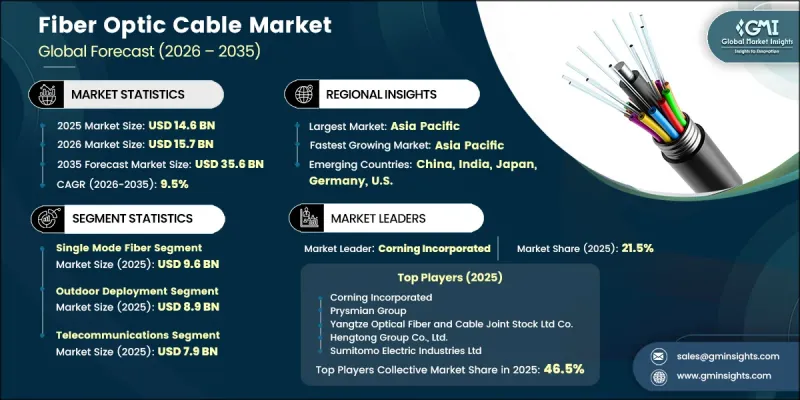
隨著全球通訊和數位基礎設施網路對高速資料傳輸的需求不斷成長,光纖電纜市場持續強勁擴張。對新一代寬頻連接的投資增加、先進行動通訊網路的快速部署以及超大規模資料中心的建設,為市場參與企業創造了持續的商機。此外,各行各業對雲端服務、人工智慧 (AI) 應用和數位轉型 (DX) 的日益普及,進一步推高了對高容量光纖網路的需求。同時,光纖連接在工業自動化、交通基礎設施、智慧城市項目和能源領域的不斷擴展,也持續拓寬了市場的潛在機會。對網路現代化建設的持續投資,以及對可靠、低延遲通訊基礎設施日益成長的需求,正在推動產業的長期成長。隨著各組織不斷升級其數位生態系統並擴展頻寬能力,光纖電纜的部署仍然是一項戰略重點,這支撐了整個預測期內強勁的市場前景。
| 市場範圍 | |
|---|---|
| 開始年份 | 2025 |
| 預測期 | 2026-2035 |
| 初始市場規模 | 146億美元 |
| 預測金額 | 356億美元 |
| 複合年成長率 | 9.5% |
光纖電纜市場持續受益於全球先進通訊基礎設施的不斷擴展。網路現代化投資的增加推動了對光纖部署的需求,以支援更快的資料傳輸、更低的延遲和更高的網路可靠性。同時,隨著企業不斷擴展雲端運算能力、人工智慧 (AI) 工作負載和大規模資料處理,對超大規模和託管資料中心設施的投資增加也為光纖連接創造了更多機會。光纖電纜仍然是現代數位基礎設施的重要組成部分,可在資料中心網路內部以及設施之間提供高頻寬、可靠的連接和高效的長距離資料傳輸。
預計到2025年,單模光纖市場規模將達96億美元。這一市場成長主要得益於高速寬頻的廣泛部署、對先進通訊基礎設施的持續投資以及全球資料中心建設的不斷增加。單模光纖因其能夠提供更高的頻寬、最小的訊號損耗和可靠的遠距離傳輸,仍然是長距離通訊應用的首選。該技術在寬頻網路、雲端基礎設施、通訊回程傳輸和先進通訊系統中的日益普及,進一步提升了其對整個光纖電纜市場的貢獻。
預計到2025年,通訊領域的市場規模將達到79億美元,繼續維持其作為主要應用類別的地位。該領域的成長主要得益於寬頻基礎設施的廣泛投資、光纖到府(FTTH)網路部署的擴展以及下一代通訊系統的持續發展。光纖電纜憑藉其卓越的頻寬容量、可靠的連接性、低訊號衰減和高資料傳輸速率,仍然是首選的傳輸介質。網路普及率的不斷提高、消費者對不間斷連接日益成長的需求以及對先進通訊基礎設施的持續投資,都進一步鞏固了該領域在全球市場的主導地位。
預計到2025年,北美光纖電纜市佔率將達到27%。該地區持續保持強勁的市場成長勢頭,這主要得益於寬頻網路的擴展、先進的通訊基礎設施、超大規模資料中心以及對下一代通訊網路投資的不斷增加。對高速網路服務日益成長的需求、不斷擴大的光纖連接以及跨行業的數位轉型舉措,都將繼續推動該地區的市場成長。有利的投資環境和持續的技術進步將在整個預測期進一步鞏固北美的主導地位。
目錄
第1章:調查方法和範圍
第2章執行摘要
第3章 行業洞察
- 產業生態系分析
- 供應商情況
- 利潤率
- 成本結構
- 每個階段增加的價值
- 影響價值鏈的因素
- 中斷
- 影響產業的因素
- 促進因素
- 5G網路基礎設施的擴展
- 高速寬頻連線的需求日益成長
- 資料中心和雲端運算的快速發展
- 政府對數位基礎設施的投資
- 在工業和智慧基礎設施領域擴大應用
- 產業潛在風險與挑戰
- 高昂的實施和部署成本
- 供應鏈中斷和原料供應受限
- 市場機遇
- 擴大光纖到府(FTTH)在家庭中的應用
- 促進因素
- 成長潛力分析
- 監理情勢
- 波特的分析
- PESTLE分析
- 技術與創新展望
- 最新科技趨勢
- 新興技術
- 價格趨勢
- 歷史價格分析(2022-2025)
- 影響價格趨勢的因素
- 區域價格波動
- 價格預測(2026-2035)
- 貿易數據分析
- 進出口量及進口額趨勢
- 主要貿易路線及關稅的影響
- 人工智慧和生成式人工智慧對市場的影響
- 利用人工智慧改造現有經營模式
- 按細分市場分類的生成式人工智慧用例和部署藍圖
- 風險、限制和監管考量
- 生產能力和生產情況
- 設備產能:按地區和主要生產商分類
- 運轉率和擴張計劃
第4章 競爭情勢
- 介紹
- 企業市佔率分析
- 按地區
- 市場集中度分析
- 主要市場公司的競爭分析
- 競爭定位矩陣
- 主要進展
- 併購
- 夥伴關係和聯盟
- 新產品發布
- 業務拓展計劃及資金籌措
- 按公司規模進行基準測試
- 排名分類標準與選擇標準
- 按收入、地區和創新能力分類的層級定位矩陣概述
第5章 市場估算與預測:依紡織品類型分類,2022-2035年
- 單模光纖
- 多模光纖
第6章 市場估價與預測:依電纜類型分類,2022-2035年
- 帶狀管
- 鬆管
- 緊緩衝
- 中央核心
- 其他
第7章 市場估計與預測:依發展階段分類,2022-2035年
- 室內的
- 戶外的
第8章 市場估計與預測:依地區分類,2022-2035年
- 北美洲
- 美國
- 加拿大
- 歐洲
- 德國
- 英國
- 法國
- 西班牙
- 義大利
- 其他歐洲國家
- 亞太地區
- 中國
- 印度
- 日本
- 澳洲
- 韓國
- 其他亞太國家
- 拉丁美洲
- 巴西
- 墨西哥
- 阿根廷
- 其他拉丁美洲國家
- 中東和非洲
- 南非
- 沙烏地阿拉伯
- UAE
- 其他中東和非洲國家
第9章:公司簡介
- 全球主要公司
- Corning Incorporated
- Prysmian Group
- Yangtze Optical Fiber and Cable Joint Stock Ltd Co.
- Hengtong Group Co.,Ltd.
- Sumitomo Electric Industries Ltd
- 本地公司
- 北美洲
- CommScope Holding Company Inc.
- Belden Inc.
- Encore Wire Corporation
- Coherent Corporation
- 歐洲
- Nexans SA
- Hexatronic Group AB
- 亞太地區
- Fujikura Ltd.
- Furukawa Electric
- LS Cable & System Ltd.
- Finolex Cables Limited
- Sterlite Technologies
- 北美洲
- 小眾玩家
- Proterial Cable America Inc.(Proterial Ltd.)
The Global Fiber Optic Cable Market was valued at USD 14.6 billion in 2025 and is estimated to grow at a CAGR of 9.5% to reach USD 35.6 billion by 2035.
The fiber optic cable market continues to witness robust expansion as demand for high-speed data transmission accelerates across communication and digital infrastructure networks worldwide. Growing investments in next-generation broadband connectivity, rapid deployment of advanced mobile communication networks, and increasing construction of hyperscale data centers are creating sustained opportunities for market participants. Rising adoption of cloud-based services, artificial intelligence applications, and digital transformation initiatives across multiple industries is further strengthening the requirement for high-capacity fiber networks. In addition, increasing implementation of fiber-based connectivity across industrial automation, transportation infrastructure, smart city projects, and energy applications continues to broaden the market's addressable opportunities. Continuous investments in network modernization, coupled with rising demand for dependable, low-latency communication infrastructure, are reinforcing long-term industry growth. As organizations continue upgrading digital ecosystems and expanding bandwidth capabilities, fiber optic cable deployment remains a strategic priority, supporting the market's strong outlook through the forecast period.
| Market Scope | |
|---|---|
| Start Year | 2025 |
| Forecast Year | 2026-2035 |
| Start Value | $14.6 Billion |
| Forecast Value | $35.6 Billion |
| CAGR | 9.5% |
The fiber optic cable market continues to benefit from the ongoing expansion of advanced telecommunications infrastructure worldwide. Increasing investments in network modernization are driving higher demand for fiber deployment to support faster data transmission, lower latency, and improved network reliability. At the same time, rising investments in hyperscale and colocation data center facilities are creating additional opportunities for fiber connectivity as organizations continue expanding cloud computing capabilities, artificial intelligence workloads, and large-scale data processing. Fiber optic cables remain an essential component of modern digital infrastructure because they provide high bandwidth, reliable connectivity, and efficient long-distance data transmission across both internal data center networks and interfacility connections.
The single-mode fiber segment is projected to generate USD 9.6 billion by 2025. Growth within this segment is supported by expanding high-speed broadband deployments, continuous investments in advanced telecommunications infrastructure, and increasing construction of data centers worldwide. Single-mode fiber continues to gain preference for long-distance communication applications due to its ability to deliver higher bandwidth, minimal signal loss, and reliable long-range transmission. Its growing adoption across broadband networks, cloud infrastructure, telecommunications backhaul, and advanced communication systems continues to strengthen the segment's contribution to the overall fiber optic cable market.
The telecommunications segment generated USD 7.9 billion in 2025, maintaining its position as the leading application category. The segment's growth is primarily driven by widespread investments in broadband infrastructure, increasing deployment of fiber-to-the-home networks, and continuous expansion of next-generation communication systems. Fiber optic cables remain the preferred transmission medium because they provide superior bandwidth capacity, dependable connectivity, lower signal attenuation, and faster data transfer speeds. Growing internet penetration, rising consumer demand for uninterrupted connectivity, and sustained investments in advanced communication infrastructure continue to reinforce the segment's dominant position within the global market.
North America Fiber Optic Cable Market accounted for 27% share in 2025. The region continues to maintain strong market momentum through increasing investments in broadband expansion, advanced telecommunications infrastructure, hyperscale data centers, and next-generation communication networks. Rising demand for high-speed internet services, growing adoption of fiber-based connectivity, and ongoing digital transformation initiatives across industries continue to support regional market growth. Favorable investment conditions and continuous technological advancements further strengthen North America's leadership position throughout the forecast period.
Major companies operating in the global fiber optic cable market include Belden Inc., Fujikura Ltd., Yangtze Optical Fiber and Cable Joint Stock Ltd Co., Sterlite Technologies, Sumitomo Electric Industries Ltd., Corning Incorporated, CommScope Holding Company Inc., Prysmian Group, Furukawa Electric, LS Cable & System Ltd., Finolex Cables Limited, Coherent Corporation, Nexans S.A., Hengtong Group Co., Ltd., Hexatronic Group AB, Proterial Cable America Inc. (Proterial Ltd), and Encore Wire Corporation. Leading companies in the fiber optic cable market are strengthening their competitive position by expanding manufacturing capacity, investing in advanced fiber technologies, and enhancing product performance to support growing bandwidth requirements. Businesses continue to prioritize research and development to improve transmission efficiency, durability, and installation flexibility while lowering deployment costs. Strategic partnerships with telecommunications providers, infrastructure developers, and data center operators are helping manufacturers secure long-term supply agreements. Companies are also broadening their geographic presence through regional expansion, acquisitions, and distribution partnerships to capture emerging market opportunities.
Table of Contents
Chapter 1 Methodology and Scope
- 1.1 Market scope and definition
- 1.2 Research design
- 1.2.1 Research approach
- 1.2.2 Data collection methods
- 1.3 Data mining sources
- 1.3.1 Global
- 1.3.2 Regional/Country
- 1.4 Base estimates and calculations
- 1.4.1 Base year calculation
- 1.4.2 Key trends for market estimation
- 1.5 Primary research and validation
- 1.5.1 Primary sources
- 1.6 Forecast model
- 1.7 Research assumptions and limitations
Chapter 2 Executive Summary
- 2.1 Industry 360° synopsis, 2022 - 2035
- 2.2 Key market trends
- 2.2.1 Fiber type trends
- 2.2.2 Cable type trends
- 2.2.3 Deployment trend
- 2.2.4 End-user industry trends
- 2.2.5 Regional trends
- 2.3 TAM Analysis, 2026-2035
- 2.4 CXO perspectives: Strategic imperatives
Chapter 3 Industry Insights
- 3.1 Industry ecosystem analysis
- 3.1.1 Supplier Landscape
- 3.1.2 Profit Margin
- 3.1.3 Cost structure
- 3.1.4 Value addition at each stage
- 3.1.5 Factor affecting the value chain
- 3.1.6 Disruptions
- 3.2 Industry impact forces
- 3.2.1 Growth drivers
- 3.2.1.1 Expansion of 5G network infrastructure
- 3.2.1.2 Rising demand for high-speed broadband connectivity
- 3.2.1.3 Rapid growth of data centers and cloud computing
- 3.2.1.4 Government investments in digital infrastructure
- 3.2.1.5 Increasing adoption across industrial and smart infrastructure applications
- 3.2.2 Industry pitfalls and challenges
- 3.2.2.1 High installation and deployment costs
- 3.2.2.2 Supply chain disruptions and raw material constraints
- 3.2.3 Market opportunities
- 3.2.3.1 Growing fiber-to-the-home (FTTH) adoption
- 3.2.1 Growth drivers
- 3.3 Growth potential analysis
- 3.4 Regulatory landscape
- 3.4.1 North America
- 3.4.2 Europe
- 3.4.3 Asia Pacific
- 3.4.4 Latin America
- 3.4.5 Middle East & Africa
- 3.5 Porter's analysis
- 3.6 PESTEL analysis
- 3.7 Technology and Innovation landscape
- 3.7.1 Current technological trends
- 3.7.2 Emerging technologies
- 3.8 Price trends (Based on paid Database)
- 3.8.1 Historical Price Analysis (2022-2025)
- 3.8.2 Price Trend Drivers
- 3.8.3 Regional Price Variations
- 3.8.4 Price Forecast (2026-2035)
- 3.9 Trade Data Analysis (Driven by Primary Research)
- 3.9.1 Import/Export Volume & Value Trends
- 3.9.2 Key Trade Corridors & Tariff Impact
- 3.10 Impact of AI & Generative AI on the Market
- 3.10.1 AI-Driven Disruption of Existing Business Models
- 3.10.2 GenAI Use Cases & Adoption Roadmap by Segment
- 3.10.3 Risks, Limitations & Regulatory Considerations
- 3.11 Capacity & Production Landscape (Driven by Primary Research)
- 3.11.1 Installed Capacity by Region & Key Producer
- 3.11.2 Capacity Utilization Rates & Expansion Pipelines
Chapter 4 Competitive Landscape, 2025
- 4.1 Introduction
- 4.2 Company market share analysis
- 4.2.1 By region
- 4.2.1.1 North America
- 4.2.1.2 Europe
- 4.2.1.3 Asia Pacific
- 4.2.1.4 Latin America
- 4.2.1.5 Middle East & Africa
- 4.2.1 By region
- 4.3 Market concentration analysis
- 4.4 Competitive analysis of major market players
- 4.5 Competitive positioning matrix
- 4.6 Key developments
- 4.6.1 Mergers & acquisitions
- 4.6.2 Partnerships & collaborations
- 4.6.3 New product launches
- 4.6.4 Expansion plans and funding
- 4.7 Company tier benchmarking
- 4.7.1 Tier classification criteria & qualifying thresholds
- 4.7.2 Tier positioning matrix by revenue, geography & innovation introduction
Chapter 5 Market Estimates and Forecast, By Fiber Type, 2022 - 2035 (USD Billion & Units)
- 5.1 Single-mode-fiber
- 5.2 Multi-mode fiber
Chapter 6 Market Estimates and Forecast, By Cable Type, 2022 - 2035 (USD Billion & Units)
- 6.1 Ribbon tube
- 6.2 Loose tube
- 6.3 Tight buffered
- 6.4 Central core
- 6.5 Others
Chapter 7 Market Estimates and Forecast, By Deployment, 2022 - 2035 (USD Billion & Units)
- 7.1 Indoor
- 7.2 Outdoor
Chapter 8 Market Estimates and Forecast, By Region, 2022 - 2035 (USD Billion & Units)
- 8.1 Key trends
- 8.2 North America
- 8.2.1 U.S.
- 8.2.2 Canada
- 8.3 Europe
- 8.3.1 Germany
- 8.3.2 UK
- 8.3.3 France
- 8.3.4 Spain
- 8.3.5 Italy
- 8.3.6 Rest of Europe
- 8.4 Asia Pacific
- 8.4.1 China
- 8.4.2 India
- 8.4.3 Japan
- 8.4.4 Australia
- 8.4.5 South Korea
- 8.4.6 Rest of Asia Pacific
- 8.5 Latin America
- 8.5.1 Brazil
- 8.5.2 Mexico
- 8.5.3 Argentina
- 8.5.4 Rest of Latin America
- 8.6 Middle East and Africa
- 8.6.1 South Africa
- 8.6.2 Saudi Arabia
- 8.6.3 UAE
- 8.6.4 Rest of MEA
Chapter 9 Company Profiles
- 9.1 Global Key Players
- 9.1.1 Corning Incorporated
- 9.1.2 Prysmian Group
- 9.1.3 Yangtze Optical Fiber and Cable Joint Stock Ltd Co.
- 9.1.4 Hengtong Group Co.,Ltd.
- 9.1.5 Sumitomo Electric Industries Ltd
- 9.2 Regional players
- 9.2.1 North America
- 9.2.1.1 CommScope Holding Company Inc.
- 9.2.1.2 Belden Inc.
- 9.2.1.3 Encore Wire Corporation
- 9.2.1.4 Coherent Corporation
- 9.2.2 Europe
- 9.2.2.1 Nexans S.A.
- 9.2.2.2 Hexatronic Group AB
- 9.2.3 Asia Pacific
- 9.2.3.1 Fujikura Ltd.
- 9.2.3.2 Furukawa Electric
- 9.2.3.3 LS Cable & System Ltd.
- 9.2.3.4 Finolex Cables Limited
- 9.2.3.5 Sterlite Technologies
- 9.2.1 North America
- 9.3 Niche players
- 9.3.1 Proterial Cable America Inc. (Proterial Ltd.)

 特種光纖電纜市場-全球及區域分析:按應用、產品與國家分類-分析與預測,2026-2036年
 美國及歐洲光纖電纜:市場佔有率分析、產業趨勢與統計及成長預測(2026-2031 年)
 模式調節電纜市場規模、佔有率和成長分析:按電纜類型、連接器類型、應用、最終用戶和地區分類-2026年至2033年產業預測光纖電纜:市場佔有率分析、產業趨勢與統計、成長預測(2026-2031)美國光纖電纜:市場佔有率分析、行業趨勢和統計數據以及成長預測(2026-2031 年)
 光纖電纜市場-2026-2032年全球市場預測智慧公路和自動駕駛基礎設施中的光纖電纜:市場佔有率分析、行業趨勢和統計數據以及成長預測(2026-2031 年)鐵路和地鐵基礎設施用光纖電纜:市場佔有率分析、行業趨勢和統計數據以及成長預測(2026-2031 年)
 2026-2030年全球軍用級光纖電纜市場
 光纖電纜市場預測至2034年—按光纖類型、電纜類型、安裝類型、應用、最終用戶和地區分類的全球分析