


 |
市場調查報告書
商品編碼
2099806
印度車床及機械市場:市場佔有率分析、產業趨勢及統計、成長預測(2026-2031)India Turning Machine and Equipment - Market Share Analysis, Industry Trends & Statistics, Growth Forecasts (2026 - 2031) |
||||||

※ 本網頁內容可能與最新版本有所差異。詳細情況請與我們聯繫。
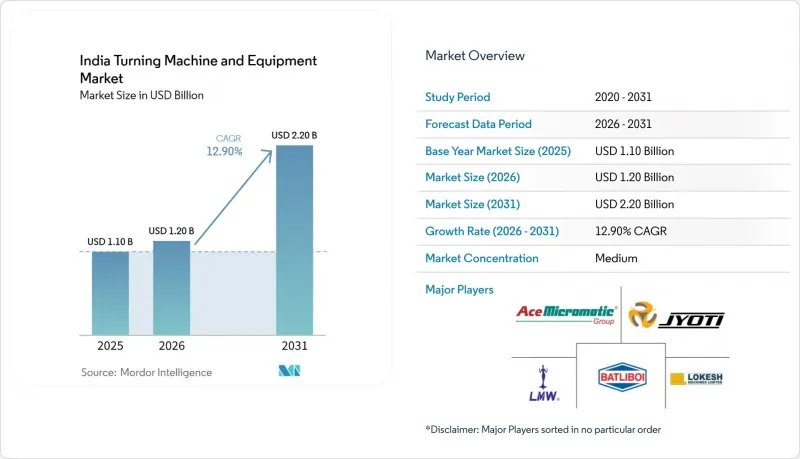
根據 Mordor Intelligence 預測,印度車床和機械市場規模將從 2025 年的 11 億美元成長到 2026 年的 12 億美元,然後在 2031 年達到 22 億美元,2026 年至 2031 年的複合年成長率為 12.90%。
本報告依產品類型(臥式、垂直、瑞士型等)、自動化類型(手動、半自動、全自動數控工具機)及終端用戶產業(汽車及商用車、航太及國防、醫療設備及手術器材、石油與天然氣及能源等)進行細分。市場預測以貨幣價值(美元)和數量(台)兩種形式呈現。
印度車床和工具機市場趨勢及洞察。
印度汽車零件製造地擴張
印度的汽車零件製造業已遠遠超越國內替換需求,如今已成為一個覆蓋國內和出口市場的綜合性製造平台。累計802億美元,較2020會計年度成長14%。這凸顯了引擎零件、變速箱系統、懸吊部件和轉向部件等產品產能的迫切需求。出口需求也是推動這一趨勢的重要因素,預計到2025會計年度,汽車零件出口額將成長8%至229億美元,其中對亞洲的出口額將成長15.1%。這意味著印度供應商需要在大規模批量生產中保持更嚴格的流程控制和更穩定的加工精度。此外,智慧工廠的普及應用正在將CNC車床從輔助設備提升為核心生產設備。 ACMA和BCG聯合發布的2025年調查報告顯示,超過三分之二的受訪企業已處於數位化工廠實施的試點、規模化或全面整合階段。這一轉變意義重大,因為儘管電動車生產的本地化正在改變內燃機相關零件的構成比,但對精密結構件和傳動系統部件的新需求依然存在,這些部件在製造過程中需要同等甚至更嚴格的公差。這一動能延續至2026年上半年,產業銷售額達到36億印度盧比(約400億美元),顯示汽車產業主導的資本投資週期在印度的車床和工具機市場依然活躍。
印度微企業(MSME) 加工生態系中數控技術的快速普及
在買家對供應商各層級的重複性、生產效率和合約履行能力日益成長的期望推動下,印度的微型和微企業企業(MSME)正穩步將其加工基礎設施從傳統車床轉向數控(CNC)平台。公共資金的投入推動了這一轉變,資本財行業第二階段計劃共累計120.7億印度盧比(約合1.343億美元),其中包括97.5億印度盧比的預算支持,降低了小規模加工企業進行技術升級的門檻。此外,生態系統措施也為此轉型提供了支持。印度微型和小型機械製造商協會(IMTMA)的2024-2025年度報告重點介紹了行業舉措,例如旨在改善北部叢集先進工具機能力的SAHAYOG舉措,以及關於共用測試基礎設施的討論。當微型和微企業首次採用CNC車床時,其商業模式通常會迅速改變。這是因為客戶對品質的要求、對工具機運轉率的預期以及折舊免稅額週期,使得添置新的數控設備比重新使用老舊設備更具吸引力。這一趨勢擴大了市場需求基礎,因為後續的設備採購通常來自那些最初謹慎升級,之後轉向更穩定的CNC設備的企業。因此,數控設備的應用正從組織嚴密的大規模採購商擴展到規模小規模的加工叢集,在這些企業中,即使是微小的生產力提升,也能在幾個合約週期內改變訂單資格和供應商的地位。
中小製造商對成本高度敏感
對於許多小規模機械加工車間而言,儘管CNC工具機實施帶來的生產效率提昇在理論上顯而易見,但資金成本仍是最大的採購障礙。這一點至關重要,因為印度車床和工具機市場在銷售方面嚴重依賴中小微型企業買家,而這些企業中的許多企業在做出採購決策時,更關注現金流前景、資金籌措便利性和短期訂單的確定性,而非機器的終身經濟效益。雖然政府推出了支持計畫來降低這一障礙,但這些計畫的存在本身也凸顯了價格差異對於尋求現代化車床的分包公司而言仍然是一個棘手的問題。當買家優先考慮標價而非運轉率、服務可用性和刀具壽命時,低成本進口產品便會受到青睞,而國內製造商僅憑售後服務品質難以維持價格。如果企業對人員配備或確保所購買機器的全面運作缺乏信心,這項挑戰將進一步加劇,因為低運轉率會延長投資回收期並推遲下一次更換週期。從這個意義上講,採購成本的負擔不僅僅是資金籌措問題。這是因為它直接關係到勞動力保障、運轉率以及中小企業從傳統設備過渡到全數控工作流程的意願。
細分市場分析
預計到2025年,臥式車床將佔印度車床及設備市場銷售額的65%,成為該市場最大的產品類型,遙遙領先其他產品。其主導地位源於臥式車床在汽車和通用機械行業的廣泛應用,在這些行業中,可靠的大批量車削性能對於曲軸、車軸、法蘭、閥體以及類似的同心部件至關重要。臥式車床久經考驗的市場表現也體現在買家對產品的熟悉程度上,許多工廠最初都是從成熟的臥式車床入手,然後再逐步擴展到更專業的配置。立式車床、瑞士型車床、多功能加工系統以及傳統車床和設備則根據工件形狀、公差要求和預算限制,滿足更具體的應用需求。在注重成本控制、公差適中且小批量生產的工廠中,傳統車床仍發揮著至關重要的作用,因為在這些工廠中,全面實施數控加工的經濟效益尚未完全顯現。
預計到2031年,多功能工具機將以15.2%的複合年成長率成長,成為印度車床和工具機市場成長最快的產品類型。這類系統將車削、銑削和鑽孔功能整合於一次裝夾中,減少了操作步驟,並提高了複雜零件的尺寸精度。這種功能在航太結構、外科植入和其他精密加工領域日益重要,因為這些領域需要在一次裝夾作業中同時滿足公差控制和可追溯性要求。瑞士型車床和工具機的銷售目前仍然小規模,但隨著醫療設備、電子產品小型化以及出口導向精密製造業在印度的擴張,它們的重要性日益凸顯。從長遠來看,這種構成比的轉變可能會導致印度車床和工具機平均售價的上漲。這是因為高階機型即使銷量低於主流的水平平台,其附加價值也會更高。因此,雖然臥式車床在銷售方面仍然佔據主導地位,但隨著更多專業類別的出現,印度車床和工具機市場的銷售構成比和規格標準正在改變。
其他好處:
- Excel格式的市場預測(ME)表
- 3個月的分析師支持
目錄
第1章:引言
- 研究假設和市場定義
- 調查範圍
第2章:調查方法
第3章執行摘要
第4章 市場狀況
- 市場概覽
- 市場促進因素
- 印度汽車零件製造地擴張
- 在印度微企業(MSME) 的整個加工生態系統中,數控技術正快速普及。
- 進口替代政策中的高精度製造業本地化
- 印度崛起成為新的全球製造地
- 工程產品出口的成長正在推動精密加工領域的投資。
- 鐵路和地鐵車輛製造的成長
- 市場限制因素
- 中小製造商對成本高度敏感
- 熟練的CNC編程人員和工具機員短缺
- 對進口控制設備和高精度零件的依賴
- 由於亞洲工具機進口,競爭異常激烈。
- 價值供應鏈分析
- 原料和零件供應商
- 車床及工具機製造商及系統整合商
- 分銷和銷售管道
- 終端用戶和工業應用
- 售後及生命週期服務
- 監理情勢
- 技術趨勢和當前創新投資狀況
- 自動化和智慧製造的融合
- 利用先進的CNC技術和人工智慧進行製程最佳化。
- 價格分析
- 主要市場參與企業的平均售價 (ASP) 基準
- 按產品類型分類的平均售價 (ASP) 分析
- 自動化系統對平均銷售價格 (ASP) 進行分析
- 採購標準與採購分析
- 車床和機械領域值得關注的新興成長點
- 五力分析:評估產業的吸引力
- 新進入者的威脅
- 供應商的議價能力
- 買方的議價能力
- 替代品的威脅
- 產業競爭
- 地緣政治事件對市場的影響
第5章 市場規模與成長預測
- 依產品類型
- 水平的
- 垂直的
- 瑞士型
- 多工處理
- 傳統的
- 按自動化類型
- 手動的
- 半自動
- 全自動CNC工具機
- 按最終用戶行業分類
- 汽車和商用車輛
- 航太/國防
- 醫療設備及手術器械
- 石油、天然氣和能源
- 電氣、電子和半導體製造設備
- 通用工業機械
- 其他(消費品、國防武器)
第6章 競爭情勢
- 市場集中度
- 策略趨勢
- 市佔率分析
- 公司簡介
- Ace Micromatic Group
- Jyoti CNC Automation Limited
- Lakshmi Machine Works Limited
- Lokesh Machines Limited
- Batliboi Limited
- HMT Machine Tools Limited
- DMG MORI
- Mazak Corporation
- Okuma Corporation
- DN Solutions
- Hyundai WIA Corporation
- INDEX-Werke GmbH
- EMAG GmbH & Co. KG
- Citizen Machinery Co. Ltd
- Tsugami Corporation
- Star Micronics Co. Ltd
- Nakamura-Tome Precision Industry Co. Ltd
- Nidec Machine Tool Corporation
- Tornos Group
- Haas Automation Inc.
第7章 市場機會與未來展望
According to Mordor Intelligence, the India turning machine and Equipment Market size is expected to grow from USD 1.10 billion in 2025 to USD 1.20 billion in 2026 and is forecast to reach USD 2.20 billion by 2031 at 12.90% CAGR over 2026-2031.
This report is Segmented by Product Type (Horizontal, Vertical, Swiss-Type, and More), by Automation Type (Manual, Semi-Automatic, and Fully Automatic CNC), and by End-User Industry (Automotive & Commercial Vehicles, Aerospace & Defense, Medical Devices & Surgical Instruments, Oil, Gas, & Energy, and More). The Market Forecasts are Provided in Terms of Value (USD) and Volume (Units).
India Turning Machine and Equipment Market Trends and Insights
Expansion of India's Auto Component Manufacturing Base
India's auto component base has moved well beyond domestic replacement demand and now serves as a broad manufacturing platform for both domestic and export programs. The sector generated USD 80.2 billion in FY2025 and grew by 14% between FY2020 and FY2025, underscoring the need to expand capacity for engine parts, transmission systems, suspension components, and steering components. Export demand has reinforced this pattern, as auto component exports rose 8% to USD 22.9 billion in FY2025, with Asia-bound shipments growing 15.1%. This means Indian suppliers need to sustain tighter process control and more repeatable machining output across large production runs. Smart factory adoption is also raising the role of CNC turning centers from a support asset to a core production asset, as an ACMA and BCG study released in 2025 showed that more than two-thirds of surveyed firms were already at the pilot, scale-up, or fully integrated stage of digital factory implementation. This shift matters because, even as electric vehicle localization changes the mix of combustion-linked parts, it still creates new demand for precision structural and drivetrain components that require comparable or tighter tolerances on the shop floor. H1 FY26 kept that momentum intact, as industry turnover reached INR 3.6 lakh crore (USD 40.0 billion), indicating that the auto-led capex cycle for the India turning machine and equipment market remains active.
Rapid CNC Penetration Across India's MSME Machining Ecosystem
India's MSME machining base is steadily shifting from conventional lathes toward CNC platforms as buyer expectations for repeatability, productivity, and contract compliance continue to rise across supplier tiers. This change is being supported by public funding, as the Capital Goods Sector Phase II program carries a total outlay of INR 12.07 billion (USD 134.3 million), including INR 9.75 billion in budgetary support, lowering technology-upgrade barriers for smaller machining units. The transition is also being reinforced by ecosystem support, as IMTMA's 2024-25 annual report highlighted industry efforts, such as the SAHAYOG initiative and discussions on shared testing infrastructure, aimed at improving access to advanced machine tool capabilities in northern clusters. Once an MSME installs its first CNC turning center, the operating model usually changes quickly because customer quality demands, machine utilization expectations, and depreciation cycles begin to favor additional CNC purchases over a return to conventional machine and equipment. That pattern widens the market's demand base because follow-on machine buying often comes from firms that started with one cautious upgrade and then moved toward a more stable CNC fleet. As a result, adoption is spreading from large organized buyers to smaller machining clusters, where even modest productivity gains can reshape order eligibility and supplier positioning over a few contract cycles.
High Cost Sensitivity Among MSME Manufacturers
Capital cost remains the biggest filter in buying behavior for many smaller workshops, even when productivity gains from CNC adoption are clear on paper. This matters because the India turning machine and equipment market depends heavily on MSME buyers by unit count, and many of those firms make purchase decisions based on cash flow visibility, financing access, and near-term order certainty rather than lifetime machine economics. Government support programs exist to lower that barrier, but their presence also underlines how real the affordability gap remains for sub-tier machining enterprises seeking modern turning capacity. When buyers place more weight on sticker price than on uptime, service response, or tooling life, lower-cost imported options gain traction, and domestic producers find it harder to defend pricing based solely on support quality. The challenge becomes sharper when firms are not confident that they can staff or fully utilize the machine they buy, because weak utilization stretches payback and delays the next replacement cycle. In that sense, affordability pressure is not only a financing issue, because it interacts directly with labor availability, utilization rates, and the willingness of smaller firms to move from conventional setups into full CNC workflows.
Other drivers and restraints analyzed in the detailed report include:
- Localization of High-Precision Manufacturing Under Import Substitution Initiatives
- Emergence of India as an Alternative Global Manufacturing Hub
- Shortage of Skilled CNC Programmers and Machinists
For complete list of drivers and restraints, kindly check the Table Of Contents.
Segment Analysis
The horizontal segment accounted for 65% of revenue in 2025, making it the largest product category in the India turning machine and equipment market by a wide margin. Their lead comes from deep use in automotive and general engineering, where crankshafts, axle shafts, flanges, valve bodies, and similar concentric parts still require reliable, high-volume turning performance. This installed-base advantage also reflects buyer familiarity, because many workshops expand first with a proven horizontal format before moving into more specialized configurations. Vertical machines, Swiss-type machines, multi-tasking systems, and conventional turning machines and equipment each serve narrower use cases that depend on workpiece geometry, tolerance requirements, and budget constraints. The conventional segment still has a role in cost-sensitive shops where moderate tolerances and lower batch sizes make full CNC economics less compelling for every operation.
The multi-tasking segment is projected to grow at a 15.2% CAGR through 2031, which makes it the fastest-growing product type in the India turning machine and equipment market. These systems combine turning, milling, and drilling in a single setup, reducing handling steps and improving dimensional consistency for complex parts. That capability is increasingly important in aerospace structures, surgical implants, and other precision jobs where one-clamp processing supports both tolerance control and traceability requirements. Swiss-type turning machines and equipment remain smaller in revenue terms, but they are gaining relevance as medical devices, electronics miniaturization, and export-oriented precision manufacturing expand in India. Over time, this mix shift is likely to push the India turning machine and equipment market toward a higher average selling price, as premium machines capture more value even when unit volumes remain smaller than those of mainstream horizontal platforms. The Indian turning machine and equipment market, therefore, keeps its volume base in horizontal machines, while more specialized categories are changing the revenue mix and the specification benchmark.
Complete Report Scope:
- By Product Type
- Horizontal
- Vertical
- Swiss-Type
- Multi-Tasking
- Conventional
- By Automation Type
- Manual
- Semi-Automatic
- Fully Automatic CNC
- By End-User Industry
- Automotive & Commercial Vehicles
- Aerospace & Defense
- Medical Devices & Surgical Instruments
- Oil, Gas, & Energy
- Electrical, Electronics & Semiconductor Equipment
- General Industrial Machinery
- Others (Consumer Goods, Defense Ordnance)
List of Companies Covered in this Report:
- Ace Micromatic Group
- Jyoti CNC Automation Limited
- Lakshmi Machine Works Limited
- Lokesh Machines Limited
- Batliboi Limited
- HMT Machine Tools Limited
- DMG MORI
- Mazak Corporation
- Okuma Corporation
- DN Solutions
- Hyundai WIA Corporation
- INDEX-Werke GmbH
- EMAG GmbH & Co. KG
- Citizen Machinery Co. Ltd
- Tsugami Corporation
- Star Micronics Co. Ltd
- Nakamura-Tome Precision Industry Co. Ltd
- Nidec Machine Tool Corporation
- Tornos Group
- Haas Automation Inc.
Additional Benefits:
- The market estimate (ME) sheet in Excel format
- 3 months of analyst support
TABLE OF CONTENTS
1 Introduction
- 1.1 Study Assumptions & Market Definition
- 1.2 Scope of the Study
2 Research Methodology
3 Executive Summary
4 Market Landscape
- 4.1 Market Overview
- 4.2 Market Drivers
- 4.2.1 Expansion of India's Auto Component Manufacturing Base
- 4.2.2 Rapid CNC Penetration Across India's MSME Machining Ecosystem
- 4.2.3 Localization of High-Precision Manufacturing Under Import Substitution Initiatives
- 4.2.4 Emergence of India as an Alternative Global Manufacturing Hub
- 4.2.5 Growth of Engineering Goods Exports Driving Investments in Precision Machining
- 4.2.6 Growth in Railway and Metro Rolling Stock Manufacturing
- 4.3 Market Restraints
- 4.3.1 High Cost Sensitivity Among MSME Manufacturers
- 4.3.2 Shortage of Skilled CNC Programmers and Machinists
- 4.3.3 Dependence on Imported CNC Controls and High-Precision Components
- 4.3.4 Intense Price Competition from Imported Asian Machine Tools
- 4.4 Value / Supply-Chain Analysis
- 4.4.1 Raw Material & Component Suppliers
- 4.4.2 Turning Machine & Equipment Manufacturers & System Integrators
- 4.4.3 Distribution & Sales Channels
- 4.4.4 End Users & Industry Applications
- 4.4.5 Aftermarket & Lifecycle Services
- 4.5 Regulatory Landscape
- 4.6 Technological Outlook & Innovation Investment Landscape
- 4.6.1 Automation & Smart Manufacturing Integration
- 4.6.2 Advanced CNC Control & AI-Enabled Process Optimization
- 4.7 Pricing Analysis
- 4.7.1 Average Selling Price (ASP) Benchmarking of Key Market Participants
- 4.7.2 Average Selling Price (ASP) Analysis, by Product Type
- 4.7.3 Average Selling Price (ASP) Analysis, by Automation
- 4.8 Buying Criteria & Procurement Analysis
- 4.9 Emerging Growth Hotspots for Turning Machine & Equipment
- 4.10 Porter's Five Forces Analysis - Industry Attractiveness Scoring
- 4.10.1 Threat of New Entrants
- 4.10.2 Bargaining Power of Suppliers
- 4.10.3 Bargaining Power of Buyers
- 4.10.4 Threat of Substitutes
- 4.10.5 Industry Rivalry
- 4.11 Impact of Geopolitical Events on the Market
5 Market Size & Growth Forecasts
- 5.1 By Product Type
- 5.1.1 Horizontal
- 5.1.2 Vertical
- 5.1.3 Swiss-Type
- 5.1.4 Multi-Tasking
- 5.1.5 Conventional
- 5.2 By Automation Type
- 5.2.1 Manual
- 5.2.2 Semi-Automatic
- 5.2.3 Fully Automatic CNC
- 5.3 By End-User Industry
- 5.3.1 Automotive & Commercial Vehicles
- 5.3.2 Aerospace & Defense
- 5.3.3 Medical Devices & Surgical Instruments
- 5.3.4 Oil, Gas, & Energy
- 5.3.5 Electrical, Electronics & Semiconductor Equipment
- 5.3.6 General Industrial Machinery
- 5.3.7 Others (Consumer Goods, Defense Ordnance)
6 Competitive Landscape
- 6.1 Market Concentration
- 6.2 Strategic Moves
- 6.3 Market Share Analysis
- 6.4 Company Profiles (Includes Global Level Overview, Market Level Overview, Core Segments, Financials as Available, Strategic Information, Products & Services, and Recent Developments)
- 6.4.1 Ace Micromatic Group
- 6.4.2 Jyoti CNC Automation Limited
- 6.4.3 Lakshmi Machine Works Limited
- 6.4.4 Lokesh Machines Limited
- 6.4.5 Batliboi Limited
- 6.4.6 HMT Machine Tools Limited
- 6.4.7 DMG MORI
- 6.4.8 Mazak Corporation
- 6.4.9 Okuma Corporation
- 6.4.10 DN Solutions
- 6.4.11 Hyundai WIA Corporation
- 6.4.12 INDEX-Werke GmbH
- 6.4.13 EMAG GmbH & Co. KG
- 6.4.14 Citizen Machinery Co. Ltd
- 6.4.15 Tsugami Corporation
- 6.4.16 Star Micronics Co. Ltd
- 6.4.17 Nakamura-Tome Precision Industry Co. Ltd
- 6.4.18 Nidec Machine Tool Corporation
- 6.4.19 Tornos Group
- 6.4.20 Haas Automation Inc.
7 Market Opportunities & Future Outlook
- 7.1 White-Space & Unmet-Need Assessment

 基於感測器的礦石分選市場:全球市場預測,2026-2032年分類機市場:全球預測,2026-2032年
 中國車床及機械市場:市場佔有率分析、產業趨勢與統計及成長預測(2026-2031年)德國車床和機械設備:市場佔有率分析、行業趨勢和統計數據以及成長預測(2026-2031 年)美國車床與機械:市場佔有率分析、產業趨勢與統計、成長預測(2026-2031 年)
 顏色分選機市場規模、佔有率和成長分析:按機器類型、技術、產品類型、最終用途產業、處理能力、分銷管道和地區分類-2026-2033年產業預測
 分類機市場規模、佔有率及成長分析(按產品類型、應用領域和地區分類):產業預測(2026-2033 年)
 自主分類系統市場預測至2034年-按系統類型、組件、分類機制、應用、最終使用者和地區分類的全球分析馬鈴薯片光學分分類機市場預測至2034年:按類型、技術和地區分類的全球分析
 分類評級機械市場機會、成長要素、產業趨勢分析及2026-2035年預測