


 |
市場調查報告書
商品編碼
2027616
分類評級機械市場機會、成長要素、產業趨勢分析及2026-2035年預測Sorting and Grading Machines Market Opportunity, Growth Drivers, Industry Trend Analysis, and Forecast 2026 - 2035 |
||||||

全球分類評級機械市場預計到 2025 年將價值 59 億美元,預計到 2035 年將以 7.2% 的複合年成長率成長至 118 億美元。
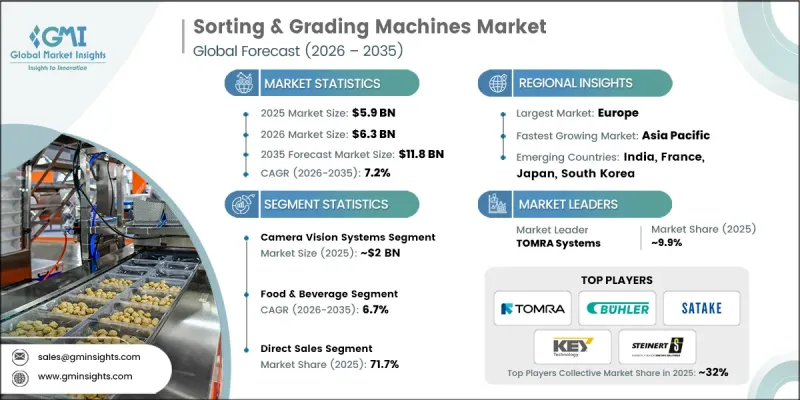
由於農業和食品加工行業對自動化需求的不斷成長,該市場正在擴張。生產商擴大採用自動化系統來提高營運效率、降低人事費用並維持產品品質的穩定性。這些機器不僅能夠對水果、蔬菜和穀物等農產品進行精確分揀,還有助於確保食品生產符合嚴格的監管標準。機械化分類最大限度地減少了人工操作帶來的誤差,並提高了整體生產效率。機械分類技術的進步使製造商能夠更輕鬆地加工各種各樣的產品。農業產量的增加和出口導向農業的擴張進一步促進了市場活躍度,因為生產商更加重視收穫後加工,以最大限度地減少損失並符合國際分級標準。
| 市場規模 | |
|---|---|
| 開始年份 | 2025 |
| 預測期 | 2026-2035 |
| 上市時的市場規模 | 59億美元 |
| 預計金額 | 118億美元 |
| 複合年成長率 | 7.2% |
預計到2025年,相機視覺系統市場規模將達到20億美元,並在2035年之前以8.4%的複合年成長率成長。這些系統透過實現快速、準確和自動化的檢測,推動了市場的發展。相機視覺系統利用先進的成像技術和基於演算法的分析,評估產品的尺寸、形狀、顏色和缺陷,從而確保產品的均勻性和品質。這種自動化提高了效率,同時減少了對人工的依賴。工業自動化和統一品管的日益普及,進一步鞏固了相機視覺系統在全球分類和評級機械市場中的地位。
預計到2025年,食品飲料產業將佔據35%的市場佔有率,並在2026年至2035年間以6.7%的複合年成長率成長。該行業佔據主導地位的原因在於水果、蔬菜、堅果、烘焙點心和包裝食品的品管至關重要。配備視覺偵測功能的自動化分類系統可確保產品尺寸均勻、色澤一致且無缺陷。消費者對高品質、外觀精美產品的需求不斷成長,加上日益嚴格的食品安全法規,正在推動該行業的應用。營運效率和產品一致性的結合鞏固了食品飲料行業的市場主導地位。
德國分類評級機械市場預計到2025年將達到5.214億美元,並在2026年至2035年間以5.9%的複合年成長率成長。這一成長主要得益於蓬勃發展的食品加工業和先進的製造業。水果、蔬菜、穀物和包裝食品加工企業依賴高精度分類系統來滿足品質標準和法規要求。光學分類、基於感測器的分級和人工智慧缺陷檢測技術的引入,在提高精度的同時,減少了人工干預。製造商正致力於自動化、提高能源效率以及與工業4.0的融合,以實現即時監控和數據驅動的最佳化。面向出口的食品加工企業正在投資高產能機械,以滿足全球品質標準。
目錄
第1章:調查方法和範圍
第2章執行摘要
第3章業界考察
- 生態系分析
- 供應商情況
- 利潤率
- 每個階段增加的價值
- 影響價值鏈的因素
- 影響產業的因素
- 促進因素
- 食品加工和農業領域對自動化的需求日益成長。
- 全球農業生產和出口成長
- 包裝和加工行業的擴張
- 陷阱與挑戰
- 在先進的分類和評級機械方面進行了大量前期投資。
- 複雜的操作以及對熟練技術人員的需求
- 機會
- 具備即時監控功能的智慧互聯分類系統的需求日益成長。
- 擴大食品安全法規與出口品質標準
- 促進因素
- 成長潛力分析
- 未來市場趨勢
- 科技與創新趨勢
- 當前技術趨勢
- 新興技術
- 監理情勢
- 標準和合規要求
- 區域法規結構
- 認證標準
- 波特五力分析
- PESTEL 分析
- 價格分析(基於初步調查)
- 對過去價格趨勢的分析(基於初步研究)
- 根據業務類型分類的定價策略(高階/價值/成本加成)(基於初步調查)
- 按技術類型分類的價格波動
- 機器產能導致的價格波動
- 區域價格基準
- 貿易數據分析(基於付費資料庫)
- 進出口量和進口額趨勢(基於付費資料庫)
- 主要貿易走廊和關稅的影響(基於付費資料庫)
- 主要出口國
- 主要進口國
- HS編碼分類及貿易流量分析
- 人工智慧和生成式人工智慧對市場的影響
- 利用人工智慧改造現有經營模式
- 按細分市場分類的生成式人工智慧用例和部署藍圖
- 預測性維護和診斷
- 最佳化即時品管
- 開發一種自動排序演算法
- 人工智慧分類解決方案的投資趨勢
- 生產能力和生產趨勢(基於初步調查)
- 按地區和主要生產商分類的運作產能(基於初步調查)
- 運轉率和擴張計劃(基於初步調查)
第4章 競爭情勢
- 介紹
- 企業市佔率分析
- 按地區
- 企業矩陣分析
- 主要市場公司的競爭分析
- 競爭定位矩陣
- 主要進展
- 併購
- 夥伴關係與合作
- 新產品發布
- 業務拓展計劃
第5章 市場估計與預測:依類型分類,2022-2035年
- 相機視覺系統
- 近紅外線系統(NIR)
- X光分類機
- 機械分類機
- 雷射分類機
- 其他
第6章 市場估價與預測:依機器類型分類,2022-2035年
- 品質缺陷檢測分類機
- 顏色分類機
- 尺寸分類機
- 重量分類機
- 形狀分類機
- 其他
第7章 市場估計與預測:依應用領域分類,2022-2035年
- 食品/飲料
- 農業
- 回收利用
- 礦業
- 製藥
- 其他
第8章 市場估算與預測:依機械產能分類,2022-2035年
- 小型
- 中號
- 大的
第9章 市場估價與預測:依銷售管道分類,2022-2035年
- 直銷
- 間接銷售
第10章 市場估價與預測:依地區分類,2022-2035年
- 北美洲
- 美國
- 加拿大
- 歐洲
- 德國
- 英國
- 法國
- 義大利
- 西班牙
- 亞太地區
- 中國
- 印度
- 日本
- 韓國
- 澳洲
- 拉丁美洲
- 巴西
- 墨西哥
- 阿根廷
- 中東和非洲(MEA)
- 沙烏地阿拉伯
- 阿拉伯聯合大公國
- 南非
第11章:公司簡介
- Advanced Sorting Machines
- BINDER
- Buhler AG
- Cimbria A/S
- Daewon GSI Co., Ltd.
- FOSS Analytical A/S
- GREEFA
- Key Technology, Inc.
- Meyer Optoelectronic
- Newtec A/S
- Raytec Vision SpA
- Satake Corporation
- Sesotec GmbH
- STEINERT
- TOMRA Systems
The Global Sorting and Grading Machines Market was valued at USD 5.9 billion in 2025 and is estimated to grow at a CAGR of 7.2% to reach USD 11.8 billion by 2035.
The market is expanding due to rising demand for automation across both agricultural and food processing sectors. Producers are increasingly adopting automated systems to enhance operational efficiency, reduce labor costs, and maintain consistent product quality. These machines allow precise categorization of agricultural produce, such as fruits, vegetables, and grains, while supporting compliance with strict regulatory standards in food manufacturing. Mechanized sorting minimizes errors linked to manual processes, boosting overall productivity. Advancements in mechanical sorting technology are making it easier for manufacturers to handle diverse products. Growth in agricultural output and export-oriented farming is further propelling market activity, as producers focus on post-harvest handling to minimize losses and adhere to international grading standards.
| Market Scope | |
|---|---|
| Start Year | 2025 |
| Forecast Year | 2026-2035 |
| Start Value | $5.9 Billion |
| Forecast Value | $11.8 Billion |
| CAGR | 7.2% |
In 2025, the camera vision systems segment generated USD 2 billion and is expected to grow at a CAGR of 8.4% through 2035. These systems dominate the market due to their ability to deliver high-speed, accurate, and automated inspections. Utilizing sophisticated imaging technology and algorithm-based analysis, camera vision systems assess size, shape, color, and defects, ensuring uniformity and quality. This automation reduces reliance on manual labor while improving efficiency. The rising trend toward industrial automation and consistent quality control further strengthens the position of camera vision systems within the global sorting and grading machines market.
The food & beverage segment held a 35% share in 2025 and is projected to grow at a CAGR of 6.7% from 2026 to 2035. This segment dominates because quality control is critical for fruits, vegetables, nuts, baked goods, and packaged items. Automated sorting systems equipped with vision-based inspection ensure uniform size, color consistency, and defect-free products. Increasing consumer demand for high-quality, visually appealing goods, along with stringent food safety regulations, drives adoption in this sector. Operational efficiency combined with product consistency reinforces the food and beverage segment's market leadership.
Germany Sorting and Grading Machines Market captured USD 521.4 million in 2025, and is expected to grow at a CAGR of 5.9% from 2026 to 2035. Growth is fueled by a robust food processing industry and an advanced manufacturing sector. Industries processing fruits, vegetables, grains, and packaged foods rely on precision sorting systems to meet quality standards and regulatory compliance. Adoption of optical sorting, sensor-based grading, and AI-powered defect detection enhances accuracy while reducing manual intervention. Manufacturers emphasize automation, energy efficiency, and Industry 4.0 integration for real-time monitoring and data-driven optimization. Export-focused food processors invest in high-capacity machines to satisfy global quality expectations.
Key players in the Global Sorting and Grading Machines Market include Advanced Sorting Machines, BINDER, Buhler AG, Cimbria A/S, Daewon GSI Co., Ltd., FOSS Analytical A/S, GREEFA, Key Technology, Inc., Meyer Optoelectronic, Newtec A/S, Raytec Vision S.p.A., Satake Corporation, Sesotec GmbH, STEINERT, and TOMRA Systems. Companies in the Sorting and Grading Machines Market strengthen their market presence through innovation in high-speed, AI-enabled vision systems and enhanced mechanical sorting technologies. Strategic partnerships with agricultural and food processing firms help expand customer reach. Manufacturers invest in product customization for diverse crop and produce types while focusing on energy-efficient, compact, and scalable solutions. Expanding after-sales service networks, providing remote diagnostics, and integrating Industry 4.0 monitoring systems enhance operational reliability for clients. Participation in global trade exhibitions, targeted marketing campaigns, and regional sales offices bolsters brand recognition and market penetration, while research and development investments ensure continuous technological advancement and competitiveness.
Table of Contents
Chapter 1 Methodology & Scope
- 1.1 Market scope and definition
- 1.2 Research design
- 1.2.1 Research approach
- 1.2.2 Data collection methods
- 1.3 Data mining sources
- 1.3.1 Global
- 1.3.2 Regional/Country
- 1.4 Base estimates and calculations
- 1.4.1 Base year calculation
- 1.4.2 Key trends for market estimation
- 1.5 Primary research and validation
- 1.5.1 Primary sources
- 1.6 Forecast model
- 1.7 Research assumptions and limitations
Chapter 2 Executive Summary
- 2.1 Industry 360° synopsis
- 2.2 Key market trends
- 2.2.1 Regional
- 2.2.2 By Type
- 2.2.3 By Machine Type
- 2.2.4 By Application
- 2.2.5 By Machine Capacity
- 2.2.6 Distribution channel
Chapter 3 Industry Insights
- 3.1 Industry ecosystem analysis
- 3.1.1 Supplier landscape
- 3.1.2 Profit margin
- 3.1.3 Value addition at each stage
- 3.1.4 Factor affecting the value chain
- 3.2 Industry impact forces
- 3.2.1 Growth drivers
- 3.2.1.1 Increasing demand for automation in food processing and agricultural industries
- 3.2.1.2 Growth of global agricultural production and exports
- 3.2.1.3 Expansion of packaging and processing industries
- 3.2.2 Pitfalls & Challenges
- 3.2.2.1 High initial investment in advanced sorting and grading machines
- 3.2.2.2 Complex operation and need for skilled technical workforce
- 3.2.3 Opportunities
- 3.2.3.1 Growing demand for smart and connected sorting systems with real-time monitoring
- 3.2.3.2 Expansion of food safety regulations and export quality standards
- 3.2.1 Growth drivers
- 3.3 Growth potential analysis
- 3.4 Future market trends
- 3.5 Technology and innovation landscape
- 3.5.1 Current technological trends
- 3.5.2 Emerging technologies
- 3.6 Regulatory landscape
- 3.6.1 Standards and compliance requirements
- 3.6.2 Regional regulatory frameworks
- 3.6.3 Certification standards
- 3.7 Porter's analysis
- 3.8 PESTEL analysis
- 3.9 Pricing analysis (driven by primary research)
- 3.9.1 Historical price trend analysis (driven by primary research)
- 3.9.2 Pricing strategy by player type (premium / value / cost-plus) (driven by primary research)
- 3.9.3 Price variation by technology type
- 3.9.4 Price variation by machine capacity
- 3.9.5 Regional price benchmarking
- 3.10 Trade data analysis (driven by paid database)
- 3.10.1 Import/export volume & value trends (driven by paid database)
- 3.10.2 Key trade corridors & tariff impact (driven by paid database)
- 3.10.3 Top exporting countries
- 3.10.4 Top importing countries
- 3.10.5 HS code classification & trade flow analysis
- 3.11 Impact of AI & generative AI on the market
- 3.11.1 AI-driven disruption of existing business models
- 3.11.2 GenAI use cases & adoption roadmap by segment
- 3.11.3 Predictive maintenance & diagnostics
- 3.11.4 Real-time quality control optimization
- 3.11.5 Automated sorting algorithm development
- 3.11.6 Investment trends in AI-enabled sorting solutions
- 3.12 Capacity & production landscape (driven by primary research)
- 3.12.1 Installed capacity by region & key producer (driven by primary research)
- 3.12.2 Capacity utilization rates & expansion pipelines (driven by primary research)
Chapter 4 Competitive Landscape, 2025
- 4.1 Introduction
- 4.2 Company market share analysis
- 4.2.1 By Region
- 4.2.1.1 North America
- 4.2.1.2 Europe
- 4.2.1.3 Asia Pacific
- 4.2.1.4 Latin America
- 4.2.1.5 Middle East & Africa
- 4.2.1 By Region
- 4.3 Company matrix analysis
- 4.4 Competitive analysis of major market players
- 4.5 Competitive positioning matrix
- 4.6 Key developments
- 4.6.1 Mergers & acquisitions
- 4.6.2 Partnerships & collaborations
- 4.6.3 New product launches
- 4.6.4 Expansion plans
Chapter 5 Market Estimates & Forecast, By Type, 2022 - 2035, (USD Billion) (Thousand Units)
- 5.1 Key trends
- 5.2 Camera vision systems
- 5.3 Near-infrared systems (NIR)
- 5.4 X-ray sorting machines
- 5.5 Mechanical sorting machines
- 5.6 Laser sorting machines
- 5.7 Others
Chapter 6 Market Estimates & Forecast, By Machine Type, 2022 - 2035, (USD Billion) (Thousand Units)
- 6.1 Key trends
- 6.2 Quality Defect Detection Sorters
- 6.3 Color Sorters
- 6.4 Size Sorters
- 6.5 Weight Sorters
- 6.6 Shape Sorters
- 6.7 Others
Chapter 7 Market Estimates & Forecast, By Application, 2022 - 2035, (USD Billion) (Thousand Units)
- 7.1 Key trends
- 7.2 Food & Beverage
- 7.3 Agriculture
- 7.4 Recycling
- 7.5 Mining
- 7.6 Pharmaceuticals
- 7.7 Others
Chapter 8 Market Estimates & Forecast, By Machine Capacity, 2022 - 2035, (USD Billion) (Thousand Units)
- 8.1 Key trends
- 8.2 Small
- 8.3 Medium
- 8.4 Large
Chapter 9 Market Estimates & Forecast, By Distribution Channel, 2022 - 2035, (USD Billion) (Thousand Units)
- 9.1 Key trends
- 9.2 Direct Sales
- 9.3 Indirect Sales
Chapter 10 Market Estimates & Forecast, By Region, 2022 - 2035, (USD Billion) (Thousand Units)
- 10.1 Key trends
- 10.2 North America
- 10.2.1 U.S.
- 10.2.2 Canada
- 10.3 Europe
- 10.3.1 Germany
- 10.3.2 UK
- 10.3.3 France
- 10.3.4 Italy
- 10.3.5 Spain
- 10.4 Asia Pacific
- 10.4.1 China
- 10.4.2 India
- 10.4.3 Japan
- 10.4.4 South Korea
- 10.4.5 Australia
- 10.5 Latin America
- 10.5.1 Brazil
- 10.5.2 Mexico
- 10.5.3 Argentina
- 10.6 MEA
- 10.6.1 Saudi Arabia
- 10.6.2 UAE
- 10.6.3 South Africa
Chapter 11 Company Profiles
- 11.1 Advanced Sorting Machines
- 11.2 BINDER
- 11.3 Buhler AG
- 11.4 Cimbria A/S
- 11.5 Daewon GSI Co., Ltd.
- 11.6 FOSS Analytical A/S
- 11.7 GREEFA
- 11.8 Key Technology, Inc.
- 11.9 Meyer Optoelectronic
- 11.10 Newtec A/S
- 11.11 Raytec Vision S.p.A.
- 11.12 Satake Corporation
- 11.13 Sesotec GmbH
- 11.14 STEINERT
- 11.15 TOMRA Systems

 基於感測器的礦石分選市場:全球市場預測,2026-2032年分類機市場:全球預測,2026-2032年
 印度車床及機械市場:市場佔有率分析、產業趨勢及統計、成長預測(2026-2031)中國車床及機械市場:市場佔有率分析、產業趨勢與統計及成長預測(2026-2031年)德國車床和機械設備:市場佔有率分析、行業趨勢和統計數據以及成長預測(2026-2031 年)美國車床與機械:市場佔有率分析、產業趨勢與統計、成長預測(2026-2031 年)
 顏色分選機市場規模、佔有率和成長分析:按機器類型、技術、產品類型、最終用途產業、處理能力、分銷管道和地區分類-2026-2033年產業預測
 分類機市場規模、佔有率及成長分析(按產品類型、應用領域和地區分類):產業預測(2026-2033 年)
 自主分類系統市場預測至2034年-按系統類型、組件、分類機制、應用、最終使用者和地區分類的全球分析馬鈴薯片光學分分類機市場預測至2034年:按類型、技術和地區分類的全球分析