


 |
市場調查報告書
商品編碼
2099776
德國車床和機械設備:市場佔有率分析、行業趨勢和統計數據以及成長預測(2026-2031 年)Germany Turning Machine and Equipment - Market Share Analysis, Industry Trends & Statistics, Growth Forecasts (2026 - 2031) |
||||||

※ 本網頁內容可能與最新版本有所差異。詳細情況請與我們聯繫。
根據 Mordor Intelligence 預測,德國車床和機械市場規模將從 2025 年的 6 億美元成長到 2026 年的 7 億美元,到 2031 年將達到 9 億美元,2026 年至 2031 年的複合年成長率為 5.20%。
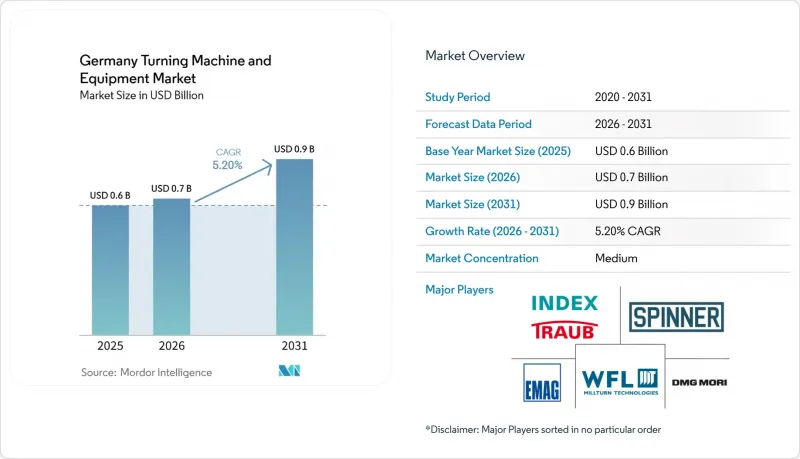
本報告依產品類型(臥式、垂直、瑞士型等)、自動化類型(手動、半自動、全自動數控工具機)及終端用戶產業(汽車及商用車、航太及國防、醫療設備及手術器材、石油與天然氣及能源等)進行細分。市場預測以價值(美元)和數量(台)兩種形式呈現。
德國車床和工具機市場的趨勢和洞察。
德國強大的工具機製造業基礎
德國擁有全球最先進、最一體化的精密工程生態系統之一,這項基礎使其在車床和工具機市場持續保持結構性優勢。德國擁有強大的本地工程能力,這得益於其在機械研發和創新生態系統方面的大量投資。航太、醫療技術和國防領域的買家仍然傾向於從國內採購,因為本地製造商能夠比遠距離供應商更快地提供應用工程、聯合開發和認證製程整合服務。巴登-符騰堡州和巴伐利亞州集中了大量的原始設備製造商 (OEM)、刀具製造商、自動化供應商和培訓機構,這促進了持續的投資,使製造商能夠更快地解決製程問題,並在最大限度減少營運中斷的情況下升級生產線。這些叢集效應有助於維持德國車床和工具機市場的需求,即使整體資本投資變得更加謹慎。
透過工業4.0實現機械現代化
在德國車床和工具機市場,數位化現代化不再是處於實驗階段的概念,而是實際存在的採購挑戰。德國工業技術協會(Bitkom)發布的《2025年報告》指出,80%的德國製造商計劃維持或增加其在工業4.0領域的投入,並將製程監控、自動化和機器互聯視為優先領域。根據機器的狀況和升級範圍,改裝投資可能占到新設備購買成本的很大一部分。德國工業聯合會(VDW)在《EMO 2025》報告中也指出,隨著使用者對連結性和資料視覺性的需求日益成長,即使是那些仍有機械壽命的機器,改裝活動也扮演著更重要的戰略角色。因此,德國老舊的CNC車床正在德國車床和工具機市場形成一個持續多年的替換需求,其驅動力既來自新設備的採購,也來自模組化升級包的需求。隨著客戶尋求降低整合風險並明確生產力提升方案,能夠將新平台與自動化單元、互聯軟體和改裝支援相結合的製造商正在獲得競爭優勢。
先進車床系統高成本
先進數控車床系統的成本仍然是德國車床和設備市場,尤其是中小型製造商廣泛採用的一大障礙。根據德國工業聯合會(VDW)的報告顯示,許多德國製造商推遲到2025年購買新工具機的主要原因是高成本和缺乏規劃確定性。此外,買家還必須應對能源成本、物流壓力和利潤率下降等問題,導致設備更換週期遠遠超出技術上的最佳週期,進一步加劇了這一負擔。在航太原型製造和國防相關專業工作等小批量生產環境中,這個問題尤其嚴重。在這些領域,機器運轉率不足,難以快速回收投資。合規性要求,例如CE認證和品管要求,增加了整體擁有成本,即使生產需求明確,也可能導致專案延期。因此,在德國車床和設備市場,客戶通常選擇分階段維修、部分自動化,甚至推遲購買,而不是進行全面的承包投資。
細分市場分析
2025年,臥式車床在德國車床及設備市場佔據47.8%的佔有率,繼續保持其在汽車、能源和一般工業應用中加工軸、套筒和圓盤的最大產品類型地位。這一規模反映了其強大的加工能力、成熟的刀俱生態系統以及與托盤搬運和機器人裝載系統的便利整合。儘管隨著數控技術的普及,傳統車床的作用正在逐漸減弱,但它仍然用於小批量合約加工和培訓環境。立式車床在加工大直徑、重型工件方面仍然發揮著至關重要的作用,因為高效的占地面積利用和穩定的工件支撐至關重要。瑞士型車床則繼續用於生產醫療設備、電子連接器和國防應用領域的小型精密零件。
預計多功能車削中心將以6.5%的複合年成長率(CAGR)實現最高成長率,從2026年到2031年。這一成長與一次裝夾加工密切相關,該加工方式集車削、銑削、鑽孔和研磨於一體,有助於縮短加工週期、簡化操作流程並減少夾具相關誤差。德國供應商正積極透過推出新產品和提高與自動化系統的兼容性來強化這一領域。製造商對無需添加多台獨立工具機即可實現全面加工能力的需求,也是推動該領域成長的因素之一。這將促使多功能系統在預測期內進一步應用。
其他好處:
- Excel格式的市場預測(ME)表
- 3個月的分析師支持
目錄
第1章:引言
- 研究假設和市場定義
- 調查範圍
第2章:調查方法
第3章執行摘要
第4章 市場狀況
- 市場概覽
- 市場促進因素
- 德國強大的工具機製造業基礎
- 透過工業4.0實現機械現代化
- 工業機械製造業的強勁需求
- 出口導向製造業的競爭力
- 歐洲供應鏈的區域化正在促進國內機械加工能力的擴張。
- 醫療技術製造業的成長
- 市場限制因素
- 先進車床系統成本高
- 熟練CNC技術人員短缺
- 與亞洲工具機供應商的競爭
- 製造業資本投資的周期性特徵
- 價值供應鏈分析
- 原料和零件供應商
- 車床及工具機製造商及系統整合商
- 分銷和銷售管道
- 終端用戶和工業應用
- 售後及生命週期服務
- 監理情勢
- 技術趨勢和當前創新投資狀況
- 自動化和智慧製造的融合
- 利用先進的CNC技術和人工智慧進行製程最佳化。
- 價格分析
- 主要市場參與企業的平均售價 (ASP) 基準
- 按產品類型分類的平均售價 (ASP) 分析
- 自動化系統對平均銷售價格 (ASP) 進行分析
- 採購標準與採購分析
- 車床和機械領域值得關注的新興成長點
- 五力分析-產業吸引力評估
- 新進入者的威脅
- 供應商的議價能力
- 買方的議價能力
- 替代品的威脅
- 產業競爭
- 地緣政治事件對市場的影響
第5章 市場規模與成長預測
- 依產品類型
- 水平的
- 垂直的
- 瑞士體系
- 多工處理
- 傳統的
- 按自動化類型
- 手動的
- 半自動
- 全自動CNC工具機
- 按最終用戶行業分類
- 汽車和商用車輛
- 航太/國防
- 醫療設備及手術器械
- 石油、天然氣和能源
- 電氣、電子和半導體製造設備
- 通用工業機械
- 其他(消費品、國防武器)
第6章 競爭情勢
- 市場集中度
- 策略趨勢
- 市佔率分析
- 競爭標竿分析
- 公司簡介
- DMG MORI
- INDEX-Werke
- EMAG GmbH & Co. KG
- Spinner
- WFL Millturn
- Mazak Corporation
- Okuma Corporation
- DN Solutions
- Citizen Machinery
- Tsugami Corporation
- Star Micronics Co., Ltd.
- Nakamura-Tome Precision Industry Co., Ltd
- Hyundai WIA
- Haas Automation
- Tornos Group
- Takisawa Machine Tool
- CMZ Machine Tool Manufacturer
- Biglia SpA
- Hwacheon Machinery
- SMEC Co., Ltd.
第7章 市場機會與未來展望
According to Mordor Intelligence, the Germany turning machine and Equipment Market size is expected to grow from USD 0.6 billion in 2025 to USD 0.7 billion in 2026 and is forecast to reach USD 0.9 billion by 2031 at 5.20% CAGR over 2026-2031.
This report is Segmented by Product Type (Horizontal, Vertical, Swiss-Type, and More), by Automation Type (Manual, Semi-Automatic, and Fully Automatic CNC), and by End-User Industry (Automotive & Commercial Vehicles, Aerospace & Defense, Medical Devices & Surgical Instruments, Oil, Gas, & Energy, and More). The Market Forecasts are Provided in Terms of Value (USD) and Volume (Units).
Germany Turning Machine and Equipment Market Trends and Insights
Germany's Strong Machine Tool Manufacturing Base
Germany maintains one of the world's most advanced and integrated precision-engineering ecosystems, and that foundation continues to give Germany a structural advantage in the turning machine and equipment market. Germany maintains strong domestic engineering capabilities, supported by significant investment in machinery R&D and innovation ecosystems. Buyers in aerospace, medical technology, and defense continue to value domestic sourcing because local builders can provide application engineering, co-development, and certified process integration with shorter response times than distant suppliers. The concentration of OEMs, tooling specialists, automation suppliers, and training institutions in Baden-Wurttemberg and Bavaria also supports repeat investment, as manufacturers can resolve process issues more quickly and upgrade production lines with less disruption. That cluster effect helps sustain demand in the Germany turning machine and equipment market even as broader capital spending becomes more selective.
Industry 4.0-Driven Machine Replacement
Digital modernization is now a practical purchasing issue rather than a pilot-stage concept in the Germany turning machine and equipment market. Bitkom reported in 2025 that 80% of German manufacturing companies planned to maintain or increase their Industry 4.0 spending, with process monitoring, automation, and machine connectivity named as priority areas. Depending on the machine condition and the scope of upgrades, retrofit investments can account for a significant share of the cost of a new machine. The VDW also stated during EMO 2025 that retrofit activity had moved into a more strategic role because users want connectivity and data visibility on machines that still have usable mechanical life. Germany's installed base of older CNC lathes, therefore, creates a multi-year renewal pipeline for the Germany turning machine and equipment market, with demand coming from both new machine purchases and modular upgrade packages. Builders that can pair new platforms with automation cells, connectivity software, and retrofit support are gaining an edge, as customers seek lower integration risk and clearer productivity gains.
High Cost of Advanced Turning Systems
The cost of advanced CNC turning systems continues to limit broader adoption in the Germany turning machine and equipment market, especially among small and medium-sized manufacturers. VDW reported that high costs and weak planning security were the main reasons many German manufacturers did not invest in new machine tools during 2025. This burden rises further when buyers also have to manage energy costs, logistics pressure, and tighter margins, which extends replacement cycles well beyond the technical optimum. The problem is more acute in lower-volume environments, such as aerospace prototyping or specialized defense work, where machine utilization may not be high enough to support rapid payback. Compliance demands such as CE conformity and quality management requirements add to the total ownership burden and can delay projects even when production needs are clear. As a result, the Germany turning machine and equipment market often sees customers choose staged retrofits, partial automation, or delayed purchases rather than full turnkey investments.
Other drivers and restraints analyzed in the detailed report include:
- Strong Demand from Industrial Machinery Manufacturing
- Export-Oriented Manufacturing Competitiveness
- Shortage of Skilled CNC Workforce
For complete list of drivers and restraints, kindly check the Table Of Contents.
Segment Analysis
The horizontal segment held 47.8% of the Germany turning machine and equipment market in 2025, which kept them as the largest product category across shaft, sleeve, and disc machining in automotive, energy, and general industrial applications. Their scale reflects a broad machining range, an established tooling ecosystem, and easier integration with pallet handling and robotic loading systems. The conventional segment continues to serve low-volume job shops and training environments, though its role is narrowing as CNC adoption deepens. The vertical segment remains relevant for large-diameter and heavy workpieces, where floor space efficiency and stable workpiece support are critical. Swiss-type machines continue to serve the production of small precision parts for medical devices, electronic connectors, and defense-related applications.
Multi-tasking turning centers are projected to record the fastest growth at a 6.5% CAGR from 2026 to 2031. Their expansion is tied to single-setup machining that combines turning, milling, drilling, and grinding, helping reduce cycle time, handling steps, and fixturing errors. German suppliers are actively strengthening this category through new product launches and broader compatibility with automation systems. The category is also gaining from demand among manufacturers that want complete machining capability without adding multiple standalone machines. This keeps multitasking systems well-positioned for further adoption through the forecast period.
Complete Report Scope:
- By Product Type
- Horizontal
- Vertical
- Swiss-Type
- Multi-Tasking
- Conventional
- By Automation Type
- Manual
- Semi-Automatic
- Fully Automatic CNC
- By End-User Industry
- Automotive & Commercial Vehicles
- Aerospace & Defense
- Medical Devices & Surgical Instruments
- Oil, Gas, & Energy
- Electrical, Electronics & Semiconductor Equipment
- General Industrial Machinery
- Others (Consumer Goods, Defense Ordnance)
List of Companies Covered in this Report:
- DMG MORI
- INDEX-Werke
- EMAG GmbH & Co. KG
- Spinner
- WFL Millturn
- Mazak Corporation
- Okuma Corporation
- DN Solutions
- Citizen Machinery
- Tsugami Corporation
- Star Micronics Co., Ltd.
- Nakamura-Tome Precision Industry Co., Ltd
- Hyundai WIA
- Haas Automation
- Tornos Group
- Takisawa Machine Tool
- CMZ Machine Tool Manufacturer
- Biglia S.p.A.
- Hwacheon Machinery
- SMEC Co., Ltd.
Additional Benefits:
- The market estimate (ME) sheet in Excel format
- 3 months of analyst support
TABLE OF CONTENTS
1 Introduction
- 1.1 Study Assumptions & Market Definition
- 1.2 Scope of the Study
2 Research Methodology
3 Executive Summary
4 Market Landscape
- 4.1 Market Overview
- 4.2 Market Drivers
- 4.2.1 Germany's Strong Machine Tool Manufacturing Base
- 4.2.2 Industry 4.0-Driven Machine Replacement
- 4.2.3 Strong Demand from Industrial Machinery Manufacturing
- 4.2.4 Export-Oriented Manufacturing Competitiveness
- 4.2.5 European Supply Chain Regionalization Supporting Domestic Machining Capacity Expansion
- 4.2.6 Growth in Medical Technology Manufacturing
- 4.3 Market Restraints
- 4.3.1 High Cost of Advanced Turning Systems
- 4.3.2 Shortage of Skilled CNC Workforce
- 4.3.3 Competition from Asian Machine Tool Suppliers
- 4.3.4 Cyclical Nature of Manufacturing Capital Expenditure
- 4.4 Value / Supply-Chain Analysis
- 4.4.1 Raw Material & Component Suppliers
- 4.4.2 Turning Machine & Equipment Manufacturers & System Integrators
- 4.4.3 Distribution & Sales Channels
- 4.4.4 End Users & Industry Applications
- 4.4.5 Aftermarket & Lifecycle Services
- 4.5 Regulatory Landscape
- 4.6 Technological Outlook & Innovation Investment Landscape
- 4.6.1 Automation & Smart Manufacturing Integration
- 4.6.2 Advanced CNC Control & AI-Enabled Process Optimization
- 4.7 Pricing Analysis
- 4.7.1 Average Selling Price (ASP) Benchmarking of Key Market Participants
- 4.7.2 Average Selling Price (ASP) Analysis, by Product Type
- 4.7.3 Average Selling Price (ASP) Analysis, by Automation
- 4.8 Buying Criteria & Procurement Analysis
- 4.9 Emerging Growth Hotspots for Turning Machine & Equipment
- 4.10 Porter's Five Forces Analysis - Industry Attractiveness Scoring
- 4.10.1 Threat of New Entrants
- 4.10.2 Bargaining Power of Suppliers
- 4.10.3 Bargaining Power of Buyers
- 4.10.4 Threat of Substitutes
- 4.10.5 Industry Rivalry
- 4.11 Impact of Geopolitical Events on the Market
5 Market Size & Growth Forecasts
- 5.1 By Product Type
- 5.1.1 Horizontal
- 5.1.2 Vertical
- 5.1.3 Swiss-Type
- 5.1.4 Multi-Tasking
- 5.1.5 Conventional
- 5.2 By Automation Type
- 5.2.1 Manual
- 5.2.2 Semi-Automatic
- 5.2.3 Fully Automatic CNC
- 5.3 By End-User Industry
- 5.3.1 Automotive & Commercial Vehicles
- 5.3.2 Aerospace & Defense
- 5.3.3 Medical Devices & Surgical Instruments
- 5.3.4 Oil, Gas, & Energy
- 5.3.5 Electrical, Electronics & Semiconductor Equipment
- 5.3.6 General Industrial Machinery
- 5.3.7 Others (Consumer Goods, Defense Ordnance)
6 Competitive Landscape
- 6.1 Market Concentration
- 6.2 Strategic Moves
- 6.3 Market Share Analysis
- 6.4 Competitive Benchmarking Analysis
- 6.5 Company Profiles (Includes Global Level Overview, Market Level Overview, Core Segments, Financials as Available, Strategic Information, Products & Services, and Recent Developments)
- 6.5.1 DMG MORI
- 6.5.2 INDEX-Werke
- 6.5.3 EMAG GmbH & Co. KG
- 6.5.4 Spinner
- 6.5.5 WFL Millturn
- 6.5.6 Mazak Corporation
- 6.5.7 Okuma Corporation
- 6.5.8 DN Solutions
- 6.5.9 Citizen Machinery
- 6.5.10 Tsugami Corporation
- 6.5.11 Star Micronics Co., Ltd.
- 6.5.12 Nakamura-Tome Precision Industry Co., Ltd
- 6.5.13 Hyundai WIA
- 6.5.14 Haas Automation
- 6.5.15 Tornos Group
- 6.5.16 Takisawa Machine Tool
- 6.5.17 CMZ Machine Tool Manufacturer
- 6.5.18 Biglia S.p.A.
- 6.5.19 Hwacheon Machinery
- 6.5.20 SMEC Co., Ltd.
7 Market Opportunities & Future Outlook
- 7.1 White-Space & Unmet-Need Assessment

 基於感測器的礦石分選市場:全球市場預測,2026-2032年分類機市場:全球預測,2026-2032年
 印度車床及機械市場:市場佔有率分析、產業趨勢及統計、成長預測(2026-2031)中國車床及機械市場:市場佔有率分析、產業趨勢與統計及成長預測(2026-2031年)美國車床與機械:市場佔有率分析、產業趨勢與統計、成長預測(2026-2031 年)
 顏色分選機市場規模、佔有率和成長分析:按機器類型、技術、產品類型、最終用途產業、處理能力、分銷管道和地區分類-2026-2033年產業預測
 分類機市場規模、佔有率及成長分析(按產品類型、應用領域和地區分類):產業預測(2026-2033 年)
 自主分類系統市場預測至2034年-按系統類型、組件、分類機制、應用、最終使用者和地區分類的全球分析馬鈴薯片光學分分類機市場預測至2034年:按類型、技術和地區分類的全球分析
 分類評級機械市場機會、成長要素、產業趨勢分析及2026-2035年預測