


 |
市場調查報告書
商品編碼
2099766
中國車床及機械市場:市場佔有率分析、產業趨勢與統計及成長預測(2026-2031年)China Turning Machine and Equipment - Market Share Analysis, Industry Trends & Statistics, Growth Forecasts (2026 - 2031) |
||||||

※ 本網頁內容可能與最新版本有所差異。詳細情況請與我們聯繫。
根據 Mordor Intelligence 預測,中國車床和機械市場規模將從 2025 年的 45 億美元成長到 2026 年的 48 億美元,然後在 2031 年達到 67 億美元,2026 年至 2031 年的複合年成長率為 6.90%。
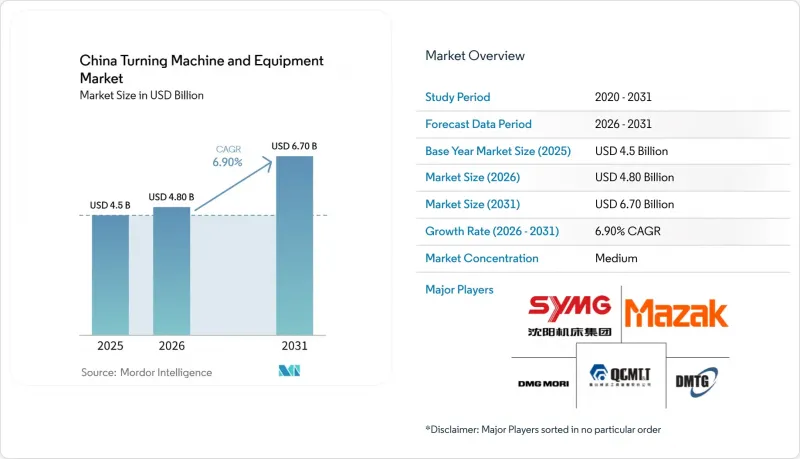
本報告依產品類型(臥式、垂直、傳統型等)、自動化類型(手動、半自動、全自動數控)及終端用戶產業(汽車及商用車、航太及國防、醫療設備及手術器材、石油天然氣及能源等)進行細分。市場預測以價值(美元)和數量(台)兩種形式呈現。
中國車床和工具機市場趨勢及洞察。
電動車產量的擴大帶動了對先進車床設備的需求。
中國向電動車的轉型正在改變中國車床和工具機市場的需求模式,使其與以往的汽車產業週期有所不同。根據中國工業和資訊化部(工信部)的報告,預計到2026年5月,新能源汽車產量將年增22.4%,達到155.4萬輛,而今年1月至5月的累計產量將達到584.1萬輛。電動車動力傳動系統的加工需求正轉向高精度零件,例如馬達軸、變速箱零件、電池溫度控管零件和輕量化結構零件。這種製程層面的設備需求轉變源自於供應商需要高重複性的CNC加工能力來處理更多關鍵零件。這也意味著許多電動車生產專案需要對電力驅動系統及相關零件的精密加工進行額外投資。因此,中國車床和工具機市場的訂單基礎正變得更加穩定,並貫穿整個汽車供應鏈。
「中國製造2025(MIC2025)」政策及後續計劃
先前的「MIC2025」框架正在向更具約束力的產業政策框架過渡,這將直接影響中國的車床和工具機市場。中國的「十五」規劃(2026-2030年)將工業工具工具機(被稱為「工業母機」)定位為國家能力建設的戰略核心技術。這項政策方向意義重大,因為它將工具機與更廣泛的目標連結起來,例如裝備自主化、先進製造業韌性以及更深層的本土供應鏈。此外,該政策也為國內買家提供了更強的動力,促使他們用符合新政策和技術標準的高精度數控系統取代老舊設備。類似的措施將促進國內零件的採購,並削弱長期依賴進口子系統進行標準應用的合理性。在中國的車床和工具機市場,這將比典型的資本投資週期更能預測需求的下限。
先進車床設備高額的購置成本
標準系統與先進系統之間的成本差距持續限制中國車床和工具機市場價值提升的速度。雖然入門級數控車床的價格已經相當低廉,但用於航太和電動車專案的五軸車銑中心單價通常在8萬美元到20萬美元以上,而整套生產單元的價格甚至可能超過50萬美元。考慮到2025年行業平均利潤率僅7.3%,許多二、三級供應商將難以承受如此高的支出。內陸地區的負擔更為沉重,因為與沿海地區相比,這些地區的服務基礎設施、備件供應和應用支援都較為不足。雖然補貼和貸款支援對大型企業有所幫助,但中小型採購企業仍需要在設備採購和營運資金需求與客戶的價格壓力之間尋求平衡。正因如此,即使在市場需求有利的情況下,中國車床和工具機市場的部分領域升級換代的速度仍然較為緩慢。
細分市場分析
預計到2025年,臥式車床將佔據中國車床和工具機市場63%的佔有率。這反映了臥式車床在汽車、通用機械和能源設備等行業以及出口型供應商網路中的標準化地位。臥式車床憑藉其高裝機量、廣泛的售後服務支援以及操作人員對該類型的熟悉程度,保持著市場主導地位。這些因素共同支撐著市場更新換代的需求,即使買家在選擇新計畫時變得更加挑剔。立式車床在加工大型零件方面仍然至關重要,例如軸承環、風力發電機輪轂以及大型船舶或壓縮機殼體,這些零件對工件尺寸和切屑處理的要求非常高。瑞士型車床雖然裝機量較少,但在醫療設備和半導體設備等對公差要求極高且重複性穩定的應用叢集仍不可或缺。
多功能工具機是成長最快的產品類型,預計2026年至2031年,中國車床和工具機市場在該領域的複合年成長率將達到8.4%。買家轉向這類系統是因為它們可以在一次裝夾中完成車削和銑削工序,從而減少操作次數,降低複雜零件尺寸誤差的風險。這對於電動汽車馬達外殼、航太結構以及其他需要更高精度和更短加工週期的零件尤其重要。傳統工具機市場仍然主要服務於小規模內陸車間和低規格應用。然而,隨著買家面臨日益嚴格的品質要求和現代化改造的壓力,其市場佔有率正在萎縮。在中國車床和工具機產業,產品結構正從簡單的等效替代品轉向能夠以更少的步驟完成複雜加工的設備。
其他好處:
- Excel格式的市場預測(ME)表
- 3個月的分析師支持
目錄
第1章:引言
- 研究假設和市場定義
- 調查範圍
第2章:調查方法
第3章執行摘要
第4章 市場狀況
- 市場概覽
- 市場促進因素
- 電動車產量的擴大帶動了對先進車床設備的需求。
- 「中國製造2025」/「中國製造2025」政策及後續計劃
- 工業自動化和智慧工廠的發展
- 高精度航太製造的擴張
- 精密零件生產的本地化進程正在推進。
- 擴大多品種、小批量生產
- 市場限制因素
- 先進車床設備高額的購置成本
- 熟練的CNC編程人員和工具機員短缺
- 國內工具機製造商之間的競爭非常激烈
- 工業投資的週期性模式
- 價值供應鏈分析
- 原料和零件供應商
- 車床及工具機製造商及系統整合商
- 分銷和銷售管道
- 終端用戶和工業應用
- 售後及生命週期服務
- 監理情勢
- 技術趨勢和當前創新投資狀況
- 自動化和智慧製造的融合
- 利用先進的CNC技術和人工智慧進行製程最佳化。
- 價格分析
- 主要市場參與企業平均售價(ASP)基準
- 按產品類型分類的平均售價 (ASP) 分析
- 自動化系統對平均銷售價格 (ASP) 進行分析
- 採購標準與採購分析
- 車床和機械領域值得關注的新興成長點
- 五力分析-產業吸引力評估
- 新進入者的威脅
- 供應商的議價能力
- 買方的議價能力
- 替代品的威脅
- 產業競爭
- 地緣政治事件對市場的影響
第5章 市場規模與成長預測
- 依產品類型
- 臥式車床
- 高架車床
- 瑞士型車床
- 多功能車床
- 傳統車床設備
- 按自動化類型
- 手動的
- 半自動
- 全自動CNC工具機
- 按最終用戶行業分類
- 汽車和商用車輛
- 航太/國防
- 醫療設備及手術器械
- 石油、天然氣和能源
- 電氣、電子和半導體製造設備
- 通用工業機械
- 其他(消費品、國防武器)
第6章 競爭情勢
- 市場集中度
- 策略趨勢
- 市佔率分析
- 競爭標竿分析
- 公司簡介
- Shenyang Machine Tool Co., Ltd.
- Mazak Corporation
- DMG MORI
- Dalian Machine Tool Group Corporation
- Qinchuan Machine Tool & Tool Group Co., Ltd.
- Okuma Corporation
- DN Solutions
- Ningbo Haitian Precision Machinery Co., Ltd.
- Baoji Machine Tool Group Co., Ltd.
- Hyundai WIA Corporation
- Guangzhou CNC Equipment Co., Ltd.
- INDEX-Werke GmbH
- EMAG GmbH & Co. KG
- JIER Machine Tool Group Co., Ltd.
- Zhejiang Headman Machinery Co., Ltd.
- Wuhan Heavy Duty Machine Tool Group Co., Ltd.
- Citizen Machinery Co., Ltd.
- Tsugami Corporation
- Zhejiang Kaida Machine Tool Co., Ltd.
- Nakamura-Tome Precision Industry Co., Ltd.
第7章 市場機會與未來展望
According to Mordor Intelligence, the China turning machine and Equipment Market size is expected to grow from USD 4.5 billion in 2025 to USD 4.80 billion in 2026 and is forecast to reach USD 6.70 billion by 2031 at 6.90% CAGR over 2026-2031.
This report is Segmented by Product Type (Horizontal, Vertical, Conventional, and More), by Automation Type (Manual, Semi-Automatic, and Fully Automatic CNC), and by End-User Industry (Automotive & Commercial Vehicles, Aerospace & Defense, Medical Devices & Surgical Instruments, Oil, Gas, & Energy, and More). The Market Forecasts are Provided in Terms of Value (USD) and Volume (Units).
China Turning Machine and Equipment Market Trends and Insights
Growth in Electric Vehicle Production Fueling Demand for Advanced Turning Equipment
China's shift toward electric mobility is creating a different demand pattern for the China turning machine and equipment market than in earlier automotive cycles. MIIT reported new energy vehicle production of 1.554 million units in May 2026, up 22.4% year over year, while cumulative output for January through May reached 5.841 million units. Electric vehicle powertrains are shifting machining demand toward high-precision components, including motor shafts, reduction gear components, battery thermal management parts, and lightweight structural components. These changes in equipment demand at the process level are driven by suppliers' need for repeatable CNC turning capability across a broader set of critical parts. It also means that many EV production programs require additional investment in precision machining for the electric drivetrain and associated components. The result is a steadier, more structural base order for the China turning machine and equipment market across automotive supply chains.
Made in China 2025 / MIC2025 Policy and Successor Programs
The earlier MIC2025 framework has now moved into more binding industrial policy channels that matter directly for the China turning machine and equipment market. China's 15th Five-Year Plan for 2026 to 2030 identifies industrial machine tools, described as industrial mother machines, as a strategic core technology area for national capability building. That policy direction matters because it links machine tools to broader goals of equipment independence, advanced manufacturing resilience, and deep local supply chains. It also gives domestic buyers stronger reasons to replace older equipment with higher-precision CNC systems that fit newer policy and technical standards. The same push supports domestic component sourcing and reduces the long-term case for relying on imported subsystems in standard applications. In the China turning machine and equipment market, this creates a more predictable demand floor than a typical capital-spending cycle would.
High Capital Cost of Advanced Turning Equipment
The cost gap between standard and advanced systems still limits how fast China's turning machine and equipment market can move up the value curve. Entry-level CNC lathes can be sourced at much lower prices, but 5-axis turn-mill compound centers used in aerospace and EV programs often range from USD 80,000 to more than USD 200,000 per unit, and a full production cell can exceed USD 500,000. That spending level is difficult for many Tier-2 and Tier-3 suppliers to absorb, given that average industry profit margins were only 7.3% in 2025. The burden is heavier in inland provinces where service depth, spare part availability, and application support are thinner than in the coastal belt. Subsidies and lending support help larger enterprises, but smaller buyers still have to weigh equipment purchases against working capital needs and customer price pressure. This keeps part of the China turning machine and equipment market on a slower upgrade path even when demand conditions are favorable.
Other drivers and restraints analyzed in the detailed report include:
- Growth of Industrial Automation and Smart Factories
- Expansion of High-Precision Aerospace Manufacturing
- Skilled CNC Programmer and Machinist Shortages
For complete list of drivers and restraints, kindly check the Table Of Contents.
Segment Analysis
The horizontal segment held 63% of the China turning machine and equipment market in 2025, reflecting its role as the standard configuration across automotive, general machinery, and energy equipment, as well as in export-oriented supplier networks. The segment keeps its lead because the installed base is large, service support is widely available, and operators are already familiar with the format. That combination supports replacement demand even when buyers become more selective of new projects. The vertical segment remains important for heavy parts such as bearing rings, wind turbine hubs, and large marine or compressor housings, where workpiece size and chip handling are critical. Swiss-type segment serves a smaller installed base, but it stays critical in medical device and semiconductor equipment clusters where very tight tolerances and stable repeatability are required.
The multi-tasking segment is the fastest-growing product category, with the China turning machine and equipment market for this segment expected to grow at an 8.4% CAGR from 2026 to 2031. Buyers are shifting toward these systems because a single setup can combine turning and milling steps, reduce handling, and cut the risk of dimensional error on complex parts. This is especially useful for EV motor housings, aerospace structures, and other components that need higher precision and shorter cycle times. Conventional segment still serves smaller inland workshops and lower-spec applications. Still, it is losing ground as buyers face tighter quality requirements and greater pressure to replace from modernization programs. Within the China turning machine and equipment industry, the product mix is moving away from simple like-for-like replacements toward equipment that supports more complex machining in fewer steps.
Complete Report Scope:
- By Product Type
- Horizontal Turning Equipment
- Vertical Turning Equipment
- Swiss-Type Turning Equipment
- Multi-Tasking Turning Equipment
- Conventional Turning Equipment
- By Automation Type
- Manual
- Semi-Automatic
- Fully Automatic CNC
- By End-User Industry
- Automotive & Commercial Vehicles
- Aerospace & Defense
- Medical Devices & Surgical Instruments
- Oil, Gas, & Energy
- Electrical, Electronics & Semiconductor Equipment
- General Industrial Machinery
- Others (Consumer Goods, Defense Ordnance)
List of Companies Covered in this Report:
- Shenyang Machine Tool Co., Ltd.
- Mazak Corporation
- DMG MORI
- Dalian Machine Tool Group Corporation
- Qinchuan Machine Tool & Tool Group Co., Ltd.
- Okuma Corporation
- DN Solutions
- Ningbo Haitian Precision Machinery Co., Ltd.
- Baoji Machine Tool Group Co., Ltd.
- Hyundai WIA Corporation
- Guangzhou CNC Equipment Co., Ltd.
- INDEX-Werke GmbH
- EMAG GmbH & Co. KG
- JIER Machine Tool Group Co., Ltd.
- Zhejiang Headman Machinery Co., Ltd.
- Wuhan Heavy Duty Machine Tool Group Co., Ltd.
- Citizen Machinery Co., Ltd.
- Tsugami Corporation
- Zhejiang Kaida Machine Tool Co., Ltd.
- Nakamura-Tome Precision Industry Co., Ltd.
Additional Benefits:
- The market estimate (ME) sheet in Excel format
- 3 months of analyst support
TABLE OF CONTENTS
1 Introduction
- 1.1 Study Assumptions & Market Definition
- 1.2 Scope of the Study
2 Research Methodology
3 Executive Summary
4 Market Landscape
- 4.1 Market Overview
- 4.2 Market Drivers
- 4.2.1 Growth in Electric Vehicle Production Fueling Demand for Advanced Turning Equipment
- 4.2.2 Made in China 2025 / MIC2025 policy and successor programs
- 4.2.3 Growth of Industrial Automation and Smart Factories
- 4.2.4 Expansion of High-Precision Aerospace Manufacturing
- 4.2.5 Increasing Localization of Precision Component Production
- 4.2.6 Growth in High-Mix, Low-Volume Manufacturing
- 4.3 Market Restraints
- 4.3.1 High Capital Cost of Advanced Turning Equipment
- 4.3.2 Skilled CNC Programmer and Machinist Shortages
- 4.3.3 Intense Price Competition Among Domestic Machine Tool Manufacturers
- 4.3.4 Cyclical Industrial Investment Patterns
- 4.4 Value / Supply-Chain Analysis
- 4.4.1 Raw Material & Component Suppliers
- 4.4.2 Turning Machine & Equipment Manufacturers & System Integrators
- 4.4.3 Distribution & Sales Channels
- 4.4.4 End Users & Industry Applications
- 4.4.5 Aftermarket & Lifecycle Services
- 4.5 Regulatory Landscape
- 4.6 Technological Outlook & Innovation Investment Landscape
- 4.6.1 Automation & Smart Manufacturing Integration
- 4.6.2 Advanced CNC Control & AI-Enabled Process Optimization
- 4.7 Pricing Analysis
- 4.7.1 Average Selling Price (ASP) Benchmarking of Key Market Participants
- 4.7.2 Average Selling Price (ASP) Analysis, by Product Type
- 4.7.3 Average Selling Price (ASP) Analysis, by Automation
- 4.8 Buying Criteria & Procurement Analysis
- 4.9 Emerging Growth Hotspots for Turning Machine & Equipment
- 4.10 Porter's Five Forces Analysis - Industry Attractiveness Scoring
- 4.10.1 Threat of New Entrants
- 4.10.2 Bargaining Power of Suppliers
- 4.10.3 Bargaining Power of Buyers
- 4.10.4 Threat of Substitutes
- 4.10.5 Industry Rivalry
- 4.11 Impact of Geopolitical Events on the Market
5 Market Size & Growth Forecasts
- 5.1 By Product Type
- 5.1.1 Horizontal Turning Equipment
- 5.1.2 Vertical Turning Equipment
- 5.1.3 Swiss-Type Turning Equipment
- 5.1.4 Multi-Tasking Turning Equipment
- 5.1.5 Conventional Turning Equipment
- 5.2 By Automation Type
- 5.2.1 Manual
- 5.2.2 Semi-Automatic
- 5.2.3 Fully Automatic CNC
- 5.3 By End-User Industry
- 5.3.1 Automotive & Commercial Vehicles
- 5.3.2 Aerospace & Defense
- 5.3.3 Medical Devices & Surgical Instruments
- 5.3.4 Oil, Gas, & Energy
- 5.3.5 Electrical, Electronics & Semiconductor Equipment
- 5.3.6 General Industrial Machinery
- 5.3.7 Others (Consumer Goods, Defense Ordnance)
6 Competitive Landscape
- 6.1 Market Concentration
- 6.2 Strategic Moves
- 6.3 Market Share Analysis
- 6.4 Competitive Benchmarking Analysis
- 6.5 Company Profiles (Includes Global Level Overview, Market Level Overview, Core Segments, Financials as Available, Strategic Information, Products & Services, and Recent Developments)
- 6.5.1 Shenyang Machine Tool Co., Ltd.
- 6.5.2 Mazak Corporation
- 6.5.3 DMG MORI
- 6.5.4 Dalian Machine Tool Group Corporation
- 6.5.5 Qinchuan Machine Tool & Tool Group Co., Ltd.
- 6.5.6 Okuma Corporation
- 6.5.7 DN Solutions
- 6.5.8 Ningbo Haitian Precision Machinery Co., Ltd.
- 6.5.9 Baoji Machine Tool Group Co., Ltd.
- 6.5.10 Hyundai WIA Corporation
- 6.5.11 Guangzhou CNC Equipment Co., Ltd.
- 6.5.12 INDEX-Werke GmbH
- 6.5.13 EMAG GmbH & Co. KG
- 6.5.14 JIER Machine Tool Group Co., Ltd.
- 6.5.15 Zhejiang Headman Machinery Co., Ltd.
- 6.5.16 Wuhan Heavy Duty Machine Tool Group Co., Ltd.
- 6.5.17 Citizen Machinery Co., Ltd.
- 6.5.18 Tsugami Corporation
- 6.5.19 Zhejiang Kaida Machine Tool Co., Ltd.
- 6.5.20 Nakamura-Tome Precision Industry Co., Ltd.
7 Market Opportunities & Future Outlook
- 7.1 White-Space & Unmet-Need Assessment

 基於感測器的礦石分選市場:全球市場預測,2026-2032年分類機市場:全球預測,2026-2032年
 印度車床及機械市場:市場佔有率分析、產業趨勢及統計、成長預測(2026-2031)德國車床和機械設備:市場佔有率分析、行業趨勢和統計數據以及成長預測(2026-2031 年)美國車床與機械:市場佔有率分析、產業趨勢與統計、成長預測(2026-2031 年)
 顏色分選機市場規模、佔有率和成長分析:按機器類型、技術、產品類型、最終用途產業、處理能力、分銷管道和地區分類-2026-2033年產業預測
 分類機市場規模、佔有率及成長分析(按產品類型、應用領域和地區分類):產業預測(2026-2033 年)
 自主分類系統市場預測至2034年-按系統類型、組件、分類機制、應用、最終使用者和地區分類的全球分析馬鈴薯片光學分分類機市場預測至2034年:按類型、技術和地區分類的全球分析
 分類評級機械市場機會、成長要素、產業趨勢分析及2026-2035年預測