


 |
市場調查報告書
商品編碼
2099768
美國車床與機械:市場佔有率分析、產業趨勢與統計、成長預測(2026-2031 年)United States Turning Machine and Equipment - Market Share Analysis, Industry Trends & Statistics, Growth Forecasts (2026 - 2031) |
||||||

※ 本網頁內容可能與最新版本有所差異。詳細情況請與我們聯繫。
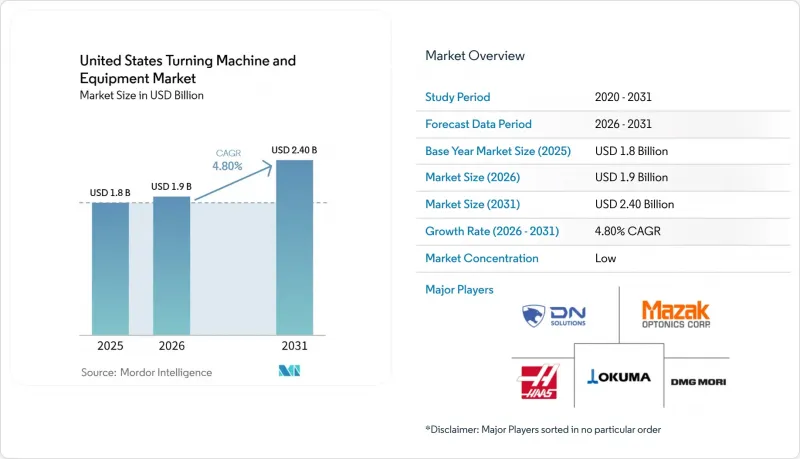
據 Mordor Intelligence 稱,2025 年美國車床和工具機市場價值 18 億美元,預計到 2031 年將達到 24 億美元,而 2026 年為 19 億美元,預測期(2026-2031 年)的複合年成長率為 4.80%。
本報告按產品類型(臥式、垂直、瑞士型、多功能、傳統型)、自動化類型(手動、半自動、全自動數控工具機)及終端用戶產業(汽車及商用車、航太及國防、醫療設備及手術器材等)進行細分。市場預測以價值(美元)和數量(台)兩種形式呈現。
美國車床和工具機市場的趨勢和洞察
對製造業回流和國內生產的投資正在提振對工具機。
聯邦政府政策仍然是美國設備需求的主要驅動力,塑造工具機和設備市場。 2024年,美國勞工部宣布,自2021年以來與製造業相關的立法將支持約2兆美元的投資,從而擴大對生產設施和勞動力的需求。這些舉措正在推動汽車、半導體和工業生產領域的新設施建設和設備升級,這些領域都需要精密加工能力,無論是在企業內部還是透過專業製造商。根據美國全國製造商協會(NAM)的一項調查,超過54.3%的製造商認為工業機械是其最重要的投入,這表明他們正在積極採購,而不是推遲購買。設備採購的稅收優惠也改善了小規模工廠的採購條件,NAM舉例說,一家機械加工廠在費用累計規則恢復後購買了價值超過110萬美元的設備。此外,與國內生產相關的聯邦採購法規正在提振涉及公共資金和戰略製造項目的領域的設備需求。
航太和國防製造業的擴張需要高精度加工。
航太和國防領域的活動正在為美國車床和工具機市場創造持續的需求。美國國防部已申請2026會計年度9,616億美元的預算,其中包括57億美元用於潛艇工業基礎建設,以及根據《國防生產法》第3章和《工業建築與自動化系統法案》(IBAS)撥款26億美元,用於提升鑄造、鍛造和機械加工能力。這些預算撥款將用於支援主要承包商、一級供應商以及加工鈦、鎳合金和高強度鋼的專業機械師採購工具機。這些零件的生產鏈需要高重複性、更短的設定週期和可靠的編程,因此,與更簡單的設備相比,CNC車床中心和多功能平台更具優勢。預計下一代國防飛機計畫將對高精度加工能力產生長期需求。 AS9100和ITAR等認證要求進一步縮小了供應商的選擇範圍,提升了已符合國防和航太標準的國內機械師的價值。
先進的車床和設備需要高額的資金投入。
在美國車床和設備市場,工具機價格仍然是一大障礙,尤其對於中小型製造商而言。入門級數控車床中心的起價約為 8 萬美元,多功能系統的價格可能超過 50 萬美元,而用於航太和能源行業的大型立式車床單價可能超過 100 萬美元。這給企業財務造成了壓力,並延緩了核准流程。根據美國全國製造商協會 (NAM) 第一季的調查,僅有 41.0% 的製造商預計在未來 12 個月內增加資本投資,而 16.2% 的製造商預計將減少投資。對鋼鐵、鋁製和機械零件徵收的關稅也推高了採購成本,NAM 在 2025 年警告稱,根據《美國聯邦貿易法典》第 232 條採取的措施可能會減緩對工廠和設備的投資。國防相關的合規要求也可能延長向航太和國防製造商供應產品的工具機供應商的認證流程。
細分市場分析
到2025年,臥式工具機將佔市場需求的59%。臥式工具機廣泛應用於汽車和工業領域,在美國車床和工具機市場中,其裝置數量位居榜首。預計到2031年,多功能工具機將以6.1%的複合年成長率成長,成為美國車床和工具機市場成長最快的產品類型。這種產品組合清晰地反映了兩種需求之間的差異:一種是使用標準水平平台的大規模生產型製造,另一種是需要將車削、銑削和鑽孔功能整合於一次裝夾中的高附加值機床。瑞士型車床在醫療設備和電子行業也獲得了越來越多的市場佔有率,因為在這些行業中,使用標準臥式車床難以控制細長零件和極高的公差。立式機床繼續承擔重型機械、發電和能源產業大直徑工件的加工任務,因為工件的擺放方向降低了裝夾的複雜性。傳統分段仍用於維修工作和訓練目的,但隨著數控功能成為標準要求,其在新設備採購中的作用不斷縮小。
從產品類型結構來看,我們可以看到,先進功能正日益普及到整個中階車床和設備平台。供應商現在甚至在標準水平和垂直數控工具機的設計中也加入了自動化相容性、動力刀具和更廣泛的軸功能,從而縮小了主流系統和高階系統之間的差距。這種轉變意義重大,因為許多買家希望擁有一台既能滿足當前生產需求,又能適應未來機器人工件裝載和無人操作的工具機。馬扎克在2025年發布了面向大批量生產的QRX-50MSY多軸車床,強調了這一發展方向,並專注於突出了自動化操作和減少人工干預的優勢。此外,馬扎克還在肯塔基州舉行的DISCOVER 2025展會上發布了整合棒料送料器和Ez LOADER的Ez系列車床,顯示自動化就緒型設計正擴展到更經濟實惠的產品。隨著這些功能集變得越來越普遍,美國車床和工具機市場佔有率的波動可能會有利於那些能夠提供柔軟性、服務支援和實際營運成本的供應商。
其他好處:
- Excel格式的市場預測(ME)表
- 3個月的分析師支持
目錄
第1章:引言
- 研究假設和市場定義
- 調查範圍
第2章:調查方法
第3章執行摘要
第4章 市場狀況
- 市場概覽
- 市場促進因素
- 製造業回流和對國內製造業的投資正在提振對工具機。
- 航太和國防工業製造業的擴張,需要高精度加工。
- 擴大國內先進製造業能力
- 自動化和無人化生產的廣泛應用。
- 瑞士型和精密車削技術的應用日益廣泛
- 對高精度、高公差加工的需求日益成長。
- 市場限制因素
- 先進的車床及相關設備需要大量的資金投入。
- 熟練的CNC操作員和程式設計人員長期短缺
- 製造業資本投資的周期性特徵
- 來自全球工具機供應商的激烈競爭壓力
- 價值供應鏈分析
- 原料和零件供應商
- 車床及工具機製造商及系統整合商
- 分銷和銷售管道
- 終端用戶和工業應用
- 售後及生命週期服務
- 監理情勢
- 技術趨勢和當前創新投資狀況
- 自動化和智慧製造的融合
- 利用先進的CNC技術和人工智慧進行製程最佳化。
- 價格分析
- 主要市場參與企業的平均售價 (ASP) 基準
- 按產品類型分類的平均售價 (ASP) 分析
- 自動化系統對平均銷售價格 (ASP) 進行分析
- 採購標準與採購分析
- 車床和機械領域值得關注的新興成長點
- 五力分析-產業吸引力評估
- 新進入者的威脅
- 供應商的議價能力
- 買方的議價能力
- 替代品的威脅
- 產業競爭
- 地緣政治事件對市場的影響
第5章 市場規模與成長預測
- 依產品類型
- 水平的
- 垂直
- 瑞士體系
- 多工處理
- 傳統的
- 按自動化類型
- 手動的
- 半自動
- 全自動CNC工具機
- 按最終用戶行業分類
- 汽車和商用車輛
- 航太/國防
- 醫療設備及手術器械
- 石油、天然氣和能源
- 電氣、電子和半導體製造設備
- 通用工業機械
- 其他(消費品、國防武器)
第6章 競爭情勢
- 市場集中度
- 策略趨勢
- 市佔率分析
- 競爭標竿分析
- 公司簡介
- Haas Automation Inc.
- Mazak Corporation
- DMG MORI
- Okuma Corporation
- DN Solutions
- Hardinge Inc.
- Hyundai WIA Corporation
- INDEX-Werke GmbH
- EMAG GmbH & Co. KG
- Citizen Machinery Co., Ltd.
- Tsugami Corporation
- Star Micronics Co., Ltd.
- Nakamura-Tome Precision Industry Co., Ltd.
- Muratec USA
- Hurco Companies, Inc.
- Takisawa Machine Tool Co., Ltd.
- Tornos Group
- JTEKT Machinery Corporation
- Hwacheon Machinery Co., Ltd.
- WFL Millturn Technologies GmbH
第7章 市場機會與未來展望
According to Mordor Intelligence, the United States turning machine and Equipment Market size was valued at USD 1.8 billion in 2025 and is estimated to grow from USD 1.9 billion in 2026 to reach USD 2.40 billion by 2031, at an CAGR of 4.80% during the forecast period (2026-2031).
This report is Segmented by Product Type (Horizontal, Vertical, Swiss-Type, Multi-Tasking, and Conventional), by Automation Type (Manual, Semi-Automatic, and Fully Automatic CNC), and by End-User Industry (Automotive & Commercial Vehicles, Aerospace & Defense, Medical Devices & Surgical Instruments, and More). The Market Forecasts are Provided in Terms of Value (USD) and Volume (Units).
United States Turning Machine and Equipment Market Trends and Insights
Reshoring and Domestic Manufacturing Investments Increasing Demand for Machine Tools
Federal policy remains the main driver of equipment demand in the United States, shaping the machine and equipment market. The Department of Labor stated in 2024 that manufacturing legislation since 2021 has supported nearly USD 2 trillion in investments, which is expanding both production sites and workforce needs. These commitments are creating new facilities and upgrades across automotive, semiconductor, and industrial production, and each facility requires precision-machining capability, either in-house or through specialized machining suppliers. The National Association of Manufacturers (NAM) in the United States found that more than 54.3% of manufacturers considered industrial machinery their most critical input, suggesting active procurement rather than delayed purchasing. Tax treatment for equipment purchases has also improved buying conditions for smaller shops, and NAM cited a 2026 example of a machine shop that purchased more than USD 1.1 million of equipment after expensing rules were restored. Federal procurement rules tied to domestic production are also reinforcing equipment demand where public funding and strategic manufacturing programs are involved.
Expansion of Aerospace and Defense Manufacturing Requiring High-Precision Machining
Aerospace and defense activity is adding a durable layer of demand to the United States turning machine and equipment market. The Department of Defense requested USD 961.6 billion for FY2026, including USD 5.7 billion for the submarine industrial base and USD 2.6 billion in IBAS and Defense Production Act Title III funding for casting, forging, and machining capacity. Those allocations support the purchase of machines at prime contractors, Tier 1 suppliers, and specialist shops that work with titanium, nickel alloys, and high-strength steel. The production chain for these parts depends on tight repeatability, fewer setups, and reliable programming, which favors CNC turning centers and multi-tasking platforms over simpler equipment. Next-generation defense aircraft programs are expected to create long-term demand for high-precision machining capacity. Qualification requirements such as AS9100 and ITAR further narrow the supplier pool, which increases the value of domestic shops that already meet defense and aerospace standards.
High Capital Investment Requirements for Advanced Turning Machine and Equipment
Machine prices remain a significant barrier in the United States turning machine and equipment market, particularly for smaller manufacturers. Entry-level CNC turning centers begin near USD 80,000, multi-tasking systems can exceed USD 500,000, and large vertical turning lathes for aerospace or energy work can surpass USD 1 million per installation, which stretches balance sheets and slows approvals. The NAM Q1 2026 survey found that only 41.0% of manufacturers expected to increase capital spending in the next 12 months, while 16.2% expected lower spending. Tariffs on steel, aluminum derivatives, and machine components also raise acquisition cost, and NAM warned in 2025 that Section 232 actions could slow plant and equipment investment. Defense-related compliance requirements can increase qualification time for machine suppliers serving aerospace and defense manufacturers.
Other drivers and restraints analyzed in the detailed report include:
- Expansion of Domestic Advanced Manufacturing Capacity
- Growing Adoption of Automation and Lights-Out Manufacturing
- Persistent Shortage of Skilled CNC Operators and Programmers
For complete list of drivers and restraints, kindly check the Table Of Contents.
Segment Analysis
Horizontal segment accounted for 59% of demand in 2025. It led the installed base across the United States turning machine and equipment market because it is widely used in automotive and industrial applications. The multi-tasking segment is projected to grow at a 6.1% CAGR through 2031, which makes it the fastest-rising product category in the United States turning machine and equipment market. This product mix reflects a clear split between volume-oriented production on standard horizontal platforms and higher-value demand for machines that combine turning, milling, and drilling in one setup. Swiss-type machines are also gaining ground in medical devices and electronics because long, slender parts and very tight tolerances are harder to control on standard horizontal lathes. The vertical segment continues to serve large-diameter workpieces in heavy machinery, power generation, and energy applications, where workpiece orientation reduces setup complexity. The conventional segment remains in use for repair work and training, but its role in new equipment procurement continues to narrow as CNC capability becomes the default requirement.
The product category mix shows how advanced features are becoming increasingly available across mid-range turning machine and equipment platforms. Suppliers are now designing even standard horizontal and vertical CNC models with greater automation compatibility, live tooling, and broader axis functionality, which is reducing the gap between mainstream and premium systems. That shift is important because many buyers now want one machine that can support current production as well as later robotic loading or unattended operation. Mazak highlighted this direction in 2025 when it introduced the QRX-50MSY multi-spindle turning center for high-volume production and placed strong emphasis on automatic operation and lower operator intervention. Mazak also presented Ez-series turning centers with bar feeder and Ez LOADER connectivity in Kentucky during DISCOVER 2025, which shows that automation-ready design is spreading into more accessible product tiers. As that feature set becomes common, share movement within the United States turning machine and equipment market is likely to favor suppliers that can combine flexibility, service support, and a practical operating cost profile.
Complete Report Scope:
- By Product Type
- Horizontal
- Vertical
- Swiss-Type
- Multi-Tasking
- Conventional
- By Automation Type
- Manual
- Semi-Automatic
- Fully Automatic CNC
- By End-User Industry
- Automotive & Commercial Vehicles
- Aerospace & Defense
- Medical Devices & Surgical Instruments
- Oil, Gas, & Energy
- Electrical, Electronics & Semiconductor Equipment
- General Industrial Machinery
- Others (Consumer Goods, Defense Ordnance)
List of Companies Covered in this Report:
- Haas Automation Inc.
- Mazak Corporation
- DMG MORI
- Okuma Corporation
- DN Solutions
- Hardinge Inc.
- Hyundai WIA Corporation
- INDEX-Werke GmbH
- EMAG GmbH & Co. KG
- Citizen Machinery Co., Ltd.
- Tsugami Corporation
- Star Micronics Co., Ltd.
- Nakamura-Tome Precision Industry Co., Ltd.
- Muratec USA
- Hurco Companies, Inc.
- Takisawa Machine Tool Co., Ltd.
- Tornos Group
- JTEKT Machinery Corporation
- Hwacheon Machinery Co., Ltd.
- WFL Millturn Technologies GmbH
Additional Benefits:
- The market estimate (ME) sheet in Excel format
- 3 months of analyst support
TABLE OF CONTENTS
1 Introduction
- 1.1 Study Assumptions & Market Definition
- 1.2 Scope of the Study
2 Research Methodology
3 Executive Summary
4 Market Landscape
- 4.1 Market Overview
- 4.2 Market Drivers
- 4.2.1 Reshoring and Domestic Manufacturing Investments Increasing Demand for Machine Tools
- 4.2.2 Expansion of Aerospace and Defense Manufacturing Requiring High-Precision Machining
- 4.2.3 Expansion of Domestic Advanced Manufacturing Capacity
- 4.2.4 Growing Adoption of Automation and Lights-Out Manufacturing
- 4.2.5 Growing Adoption of Swiss-Type and Precision Turning Technologies
- 4.2.6 Rising Demand for High-Precision and Tight-Tolerance Machining
- 4.3 Market Restraints
- 4.3.1 High Capital Investment Requirements for Advanced Turning Machine and Equipment
- 4.3.2 Persistent Shortage of Skilled CNC Operators and Programmers
- 4.3.3 Cyclical Nature of Manufacturing Capital Expenditure
- 4.3.4 Intense Competitive Pressure from Global Machine Tool Suppliers
- 4.4 Value / Supply-Chain Analysis
- 4.4.1 Raw Material & Component Suppliers
- 4.4.2 Turning Machine & Equipment Manufacturers & System Integrators
- 4.4.3 Distribution & Sales Channels
- 4.4.4 End Users & Industry Applications
- 4.4.5 Aftermarket & Lifecycle Services
- 4.5 Regulatory Landscape
- 4.6 Technological Outlook & Innovation Investment Landscape
- 4.6.1 Automation & Smart Manufacturing Integration
- 4.6.2 Advanced CNC Control & AI-Enabled Process Optimization
- 4.7 Pricing Analysis
- 4.7.1 Average Selling Price (ASP) Benchmarking of Key Market Participants
- 4.7.2 Average Selling Price (ASP) Analysis, by Product Type
- 4.7.3 Average Selling Price (ASP) Analysis, by Automation
- 4.8 Buying Criteria & Procurement Analysis
- 4.9 Emerging Growth Hotspots for Turning Machine & Equipment
- 4.10 Porter's Five Forces Analysis - Industry Attractiveness Scoring
- 4.10.1 Threat of New Entrants
- 4.10.2 Bargaining Power of Suppliers
- 4.10.3 Bargaining Power of Buyers
- 4.10.4 Threat of Substitutes
- 4.10.5 Industry Rivalry
- 4.11 Impact of Geopolitical Events on the Market
5 Market Size & Growth Forecasts
- 5.1 By Product Type
- 5.1.1 Horizontal
- 5.1.2 Vertical
- 5.1.3 Swiss-Type
- 5.1.4 Multi-Tasking
- 5.1.5 Conventional
- 5.2 By Automation Type
- 5.2.1 Manual
- 5.2.2 Semi-Automatic
- 5.2.3 Fully Automatic CNC
- 5.3 By End-User Industry
- 5.3.1 Automotive & Commercial Vehicles
- 5.3.2 Aerospace & Defense
- 5.3.3 Medical Devices & Surgical Instruments
- 5.3.4 Oil, Gas, & Energy
- 5.3.5 Electrical, Electronics & Semiconductor Equipment
- 5.3.6 General Industrial Machinery
- 5.3.7 Others (Consumer Goods, Defense Ordnance)
6 Competitive Landscape
- 6.1 Market Concentration
- 6.2 Strategic Moves
- 6.3 Market Share Analysis
- 6.4 Competitive Benchmarking Analysis
- 6.5 Company Profiles (Includes Global Level Overview, Market Level Overview, Core Segments, Financials as Available, Strategic Information, Products & Services, and Recent Developments)
- 6.5.1 Haas Automation Inc.
- 6.5.2 Mazak Corporation
- 6.5.3 DMG MORI
- 6.5.4 Okuma Corporation
- 6.5.5 DN Solutions
- 6.5.6 Hardinge Inc.
- 6.5.7 Hyundai WIA Corporation
- 6.5.8 INDEX-Werke GmbH
- 6.5.9 EMAG GmbH & Co. KG
- 6.5.10 Citizen Machinery Co., Ltd.
- 6.5.11 Tsugami Corporation
- 6.5.12 Star Micronics Co., Ltd.
- 6.5.13 Nakamura-Tome Precision Industry Co., Ltd.
- 6.5.14 Muratec USA
- 6.5.15 Hurco Companies, Inc.
- 6.5.16 Takisawa Machine Tool Co., Ltd.
- 6.5.17 Tornos Group
- 6.5.18 JTEKT Machinery Corporation
- 6.5.19 Hwacheon Machinery Co., Ltd.
- 6.5.20 WFL Millturn Technologies GmbH
7 Market Opportunities & Future Outlook
- 7.1 White-Space & Unmet-Need Assessment

 基於感測器的礦石分選市場:全球市場預測,2026-2032年分類機市場:全球預測,2026-2032年
 印度車床及機械市場:市場佔有率分析、產業趨勢及統計、成長預測(2026-2031)中國車床及機械市場:市場佔有率分析、產業趨勢與統計及成長預測(2026-2031年)德國車床和機械設備:市場佔有率分析、行業趨勢和統計數據以及成長預測(2026-2031 年)
 顏色分選機市場規模、佔有率和成長分析:按機器類型、技術、產品類型、最終用途產業、處理能力、分銷管道和地區分類-2026-2033年產業預測
 分類機市場規模、佔有率及成長分析(按產品類型、應用領域和地區分類):產業預測(2026-2033 年)
 自主分類系統市場預測至2034年-按系統類型、組件、分類機制、應用、最終使用者和地區分類的全球分析馬鈴薯片光學分分類機市場預測至2034年:按類型、技術和地區分類的全球分析
 分類評級機械市場機會、成長要素、產業趨勢分析及2026-2035年預測