


 |
市場調查報告書
商品編碼
2099456
人工智慧搜尋廣告:市場佔有率分析、產業趨勢與統計、成長預測(2026-2031)AI Search Advertising - Market Share Analysis, Industry Trends & Statistics, Growth Forecasts (2026 - 2031) |
||||||

※ 本網頁內容可能與最新版本有所差異。詳細情況請與我們聯繫。
根據 Mordor Intelligence 預測,人工智慧搜尋廣告市場規模將從 2025 年的 13.9 億美元成長到 2026 年的 32.5 億美元,然後在 2031 年達到 328.9 億美元,2026 年至 2031 年的複合年成長率為 58.87%。
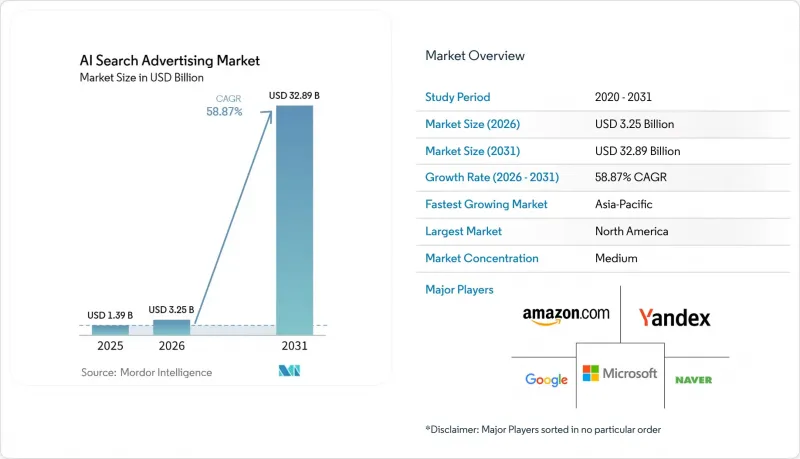
本報告按交付方式(平台軟體和託管服務)、廣告形式(搜尋結果中的贊助連結、對話式搜尋廣告等)、部署方式(雲端和本地部署)、公司規模(大型企業和中小企業)、最終用戶行業(零售和電子商務、銀行、金融服務和保險等)以及地區進行細分。市場預測以美元計價。
全球人工智慧搜尋廣告市場趨勢與洞察
增強搜尋和助理體驗中的人工智慧搜尋螢幕
隨著人工智慧搜尋介面從產品測試階段過渡到商業部署,並涵蓋整個搜尋和助理體驗,人工智慧搜尋廣告市場已進入一個新階段。谷歌透過「AI模式」和基於Gemini的新格式,擴大了廣告在人工智慧主導的搜尋過程中的可見度,將贊助內容更靠近答案生成和發現流程。谷歌還透過推出“對話式發現廣告”和“高亮答案”,增加了人工智慧搜尋體驗中可變現的廣告位數量。微軟報告稱,到2025年,人工智慧主導的會話數量將成長近三倍,基於代理商的瀏覽器流量也將激增。這表明,對廣告商至關重要的搜尋行為正在迅速轉向人工智慧介面。這一點至關重要,因為人工智慧搜尋介面不僅增加了曝光量,還改變了搜尋意圖的可視化位置以及贊助搜尋結果的顯示位置。隨著發現、比較和答案主導的搜尋流程向這個環境遷移,人工智慧搜尋廣告市場將獲得更大、更具商業性價值的廣告位基礎。
從僅關鍵字定位到基於使用者意圖的廣告投放。
人工智慧搜尋廣告市場的發展也受到從關鍵字配對轉向基於使用者意圖的廣告投放方式的推動。 Google宣布,AI Max for Search宣傳活動將於2026年4月結束測試階段,動態搜尋廣告也將於2026年9月升級至AI Max。這項變革使得意圖建模成為廣告主在整個人工智慧搜尋環境中廣泛涵蓋受眾的必要條件。谷歌表示,AI Max能夠將廣告與僅使用關鍵字設定無法捕捉到的更複雜的查詢行為相匹配,從而在保持同等效率的同時,帶來更高的轉換率。微軟的Copilot廣告投放也展現了更高的用戶參與度和轉換率,這進一步支持了預算應從傳統的精準定位邏輯轉向人工智慧主導的查詢解讀的觀點。因此,宣傳活動管理正在發生結構性變革,廣告主之間的競爭不再局限於關鍵字列表,而是擴展到意圖的全面性、訓練資料的品質和自動化應對力等方面。
AI驅動的摘要顯示和SERP壓縮導致每次點擊成本壓力增加和可見度降低。
人工智慧搜尋廣告市場面臨的一個短期限制因素是,人工智慧產生的搜尋佈局會壓縮展示空間並改變流量模式。隨著搜尋過程轉向人工智慧摘要、建議清單和引導式答案等形式,廣告主可能會發現頁面頂部顯著位置的展示機會減少。谷歌部署「人工智慧模式」廣告表明,這些展示區域仍能實現盈利,但同時,這也意味著廣告的可見性越來越依賴新的庫存規則和格式合格要求。此外,Google強制要求從“動態搜尋廣告”遷移到“AI Max”,這意味著廣告主需要更新宣傳活動結構才能在新環境中有效競爭。這可能會增加缺乏足夠自動化競標、數據回饋循環和內部最佳化資源的中小型廣告主的營運負擔。雖然預計這項限制因素會隨著時間的推移而緩解,但由於定價、展示行為和指標標準仍在製定中,它仍然是推廣應用的一大障礙。
細分市場分析
在2025年的AI搜尋廣告市場中,平台軟體將佔據78.98%的佔有率,這表明廣告主仍然高度依賴平台所有者管理的原生宣傳活動系統。這些環境對於廣告執行的品質和規模仍然至關重要,因為它們最接近競標數據、用戶意圖解讀和廣告格式合格。谷歌從「動態搜尋廣告」過渡到「AI Max」證實,最重要的產品變革發生在核心平台基礎設施內部,而不是工具堆疊的邊緣。微軟以搜尋為導向的「AI Max」公開試驗計畫也呈現類似的趨勢,顯示取得AI主導的廣告投放仍與平臺層本身緊密相關。從實際角度來看,平台軟體的主導地位意味著廣告主通常必須調整其工作流程,以適應少數平台所有者設定的規則、庫存邏輯和衡量系統。
預計到2031年,託管服務將以60.72%的複合年成長率成長,顯示人工智慧搜尋廣告產業存在明顯的營運缺口。雖然許多品牌可以購買人工智慧主導的廣告格式的使用權,但很少有品牌能夠在沒有外部幫助的情況下管理第一方資料饋送、遷移到AI Max、解讀查詢、修改創新以及重新設計歸因分析。隨著人工智慧搜尋宣傳活動不再局限於關鍵字主導,而是越來越依賴自動化、雲端交付和即時訊號管理,這種缺口正在擴大。因此,能夠將平台複雜性轉化為可複製營運模式的服務供應商在宣傳活動的設定、管治和效果調優方面發揮越來越重要的作用。正因如此,隨著廣告商努力跟上不斷發展的人工智慧搜尋工作流程,託管服務正在與平台軟體共同發展,而不是取而代之。
到2025年,搜尋結果中的贊助連結將佔市場佔有率的47.79%,這意味著傳統的文字主導廣告形式仍將佔據最大的收入佔有率。這一地位反映了其普及性、在Google搜尋和必應等搜尋引擎上的廣泛覆蓋,以及廣告商已為其建立的規劃和最佳化流程。就目前的廣告投放量而言,人工智慧搜尋廣告市場仍將依賴贊助鏈接,因為它們仍然深深植根於主流搜尋廣告購買行為。然而,這種廣告形式在規模上的優勢不再等同於其在發展動能上的優勢。新的廣告形式正在由更貼近人工智慧產生的答案、發現提示和引導式產品評價的廣告單元來建構。
預計到2031年,對話式搜尋廣告將以68.34%的複合年成長率成長,成為人工智慧搜尋廣告市場中成長最快的廣告形式。 2026年5月,Google推出了“對話式發現廣告”和“精選答案”,將贊助訊息直接整合到人工智慧模式的建議和答案環境中。谷歌也引用消費者研究,顯示人工智慧模式的使用者能夠更快、更自信地做出購買決策,這印證了「答案內廣告」在減少決策流程中的阻力方面的有效性。隨著平台利用人工智慧在搜尋查詢層面描述產品,而不僅僅是簡單地列出產品,產品列表廣告和其他以商業主導的廣告形式也正在蓬勃發展。雖然贊助連結的相關性在短期內仍將保持,但長期成長的重點將轉向更具對話性和情境感知性的廣告資源。
區域分析
2025年,北美佔據了人工智慧搜尋廣告市場37.78%的佔有率,在商業部署和平台主導地位方面均保持著該地區的主導地位。美國仍然是該領域的營運中心,Google、微軟和OpenAI都在各自的國內市場推廣人工智慧主導的廣告產品。 2026年,Google透過推出「AI模式」廣告投放並加入基於Gemini的新廣告格式,拓展了其在該地區的商業變現管道。微軟也透過進一步擴大「AI Max for Search」的可用性並將其擴展到Copilot和Bing AI平台,鞏固了其在該地區的商業優勢。這種早期獲取管道的優勢使北美廣告商在測試廣告格式、建立衡量系統和建立最佳實踐方面擁有了實際優勢,而許多國際競爭對手尚未獲得類似的廣告位。
亞太地區預計將成為人工智慧搜尋廣告市場規模成長最快的地區,到2031年複合年成長率將達到63.39%。中國展現出最強勁的規模成長勢頭,預計到2025年12月,生成式人工智慧用戶將達到6.02億,佔總人口的42.8%。儘管平台結構與西方市場有所不同,但如此龐大的用戶群為人工智慧主導的搜尋變現奠定了堅實的基礎。印度作為廣告技術工程和平台支援中心的重要性日益凸顯,該地區在營運和需求方面都扮演著越來越重要的角色。澳洲、韓國和東南亞也在推動該地區的擴張,廣告主正在以行動優先的數位環境中試行人工智慧廣告形式。
在歐洲,廣告商對某些對話式人工智慧廣告位的取得不如美國全面,因此預計這種限制在短期內仍將存在。英國、法國和德國在該地區引領人工智慧技術的應用,而義大利和西班牙仍處於應用和預算調整的早期階段。因此,歐洲許多地區不得不依賴已經達到營運規模的搜尋生態系統,這限制了定價的柔軟性,並減緩了多平台實驗的步伐。南美洲目前的規模較小,但主導網路的普及預計將推動其從低基數快速成長。中東的發展速度更快,政府支持的人工智慧專案正在提升數位基礎設施、平台準備度和企業應用水準。沙烏地阿拉伯和阿拉伯聯合大公國(阿拉伯聯合大公國)是這種加速發展的最佳例證,國家層級的人工智慧政策使該地區對商業部署更具吸引力。非洲仍然是最早應用人工智慧技術的地區,但南非仍然是該地區數位廣告和未來人工智慧搜尋貨幣化方面最發達的市場。
其他好處:
- Excel格式的市場預測(ME)表
- 3個月的分析師支持
目錄
第1章:引言
- 研究假設和市場定義
- 調查範圍
第2章:調查方法
第3章執行摘要
第4章 市場狀況
- 市場概覽
- 市場促進因素
- 利用人工智慧增強搜尋螢幕,提升搜尋和助理體驗
- 從基於關鍵字的定向到基於意圖的廣告投放。
- 透過搜尋宣傳活動自動化和廣泛匹配最佳化來提高轉換率。
- 在隱私受限的搜尋環境中,對第一方資料和閉合迴路測量的需求日益成長。
- 人工智慧搜尋之旅中對話式商務和產品發現的興起
- 平台營運商透過創建新的搜尋廣告位來實現盈利的努力。
- 市場限制因素
- 獨立人工智慧聊天機器人廣告庫存不足且效果不佳。
- 人工智慧驅動的摘要和搜尋結果壓縮正在增加每次點擊費用的壓力,並降低可見度。
- 由於隱藏查詢和零點擊搜尋行為,測量結果存在不確定性
- 品牌安全、致幻風險以及生成式搜尋廣告中的上下文匹配錯誤
- 產業價值鏈分析
- 監理情勢
- 技術展望
- 波特五力分析
- 宏觀經濟因素對市場的影響
第5章 市場規模與成長預測
- 報價
- 平台軟體
- 託管服務
- 廣告格式
- 搜尋結果中的贊助鏈接
- 對話式搜尋廣告
- AI搜尋體驗中的產品清單廣告
- 其他廣告形式(購物卡、商業卡等)
- 不同的發展
- 雲
- 現場
- 按公司規模
- 大公司
- 小型企業
- 按最終用戶行業分類
- 零售與電子商務
- BFSI
- 旅遊與飯店
- 醫療保健和生命科學
- 媒體與娛樂
- 資訊科技/通訊
- 車
- 教育
- 其他終端用戶產業
- 按地區
- 北美洲
- 美國
- 加拿大
- 南美洲
- 巴西
- 阿根廷
- 其他南美國家
- 歐洲
- 德國
- 英國
- 法國
- 義大利
- 西班牙
- 其他歐洲國家
- 亞太地區
- 中國
- 日本
- 印度
- 韓國
- 澳洲
- 其他亞太國家
- 中東和非洲
- 中東
- 沙烏地阿拉伯
- 阿拉伯聯合大公國
- 其他中東國家
- 非洲
- 南非
- 其他非洲國家
- 中東
- 北美洲
第6章 競爭情勢
- 市場集中度
- 策略趨勢
- 市佔率分析
- 公司簡介
- Google LLC
- Microsoft Corporation
- Amazon.com, Inc.
- Yandex NV
- Criteo SA
- NAVER Corporation
- Baidu, Inc.
- OpenAI, LLC
- Perplexity AI, Inc.
- Adobe Inc.
- DoubleVerify Holdings, Inc.
- Moloco, Inc.
- Verve Group
- Yahoo Inc.
- DuckDuckGo, Inc.
- The Trade Desk, Inc.
- Semrush Holdings, Inc.
- Skai, Inc.
- Optmyzr, Inc.
- Marin Software Incorporated
第7章 市場機會與未來展望
According to Mordor Intelligence, the AI search advertising market size is expected to grow from USD 1.39 billion in 2025 to USD 3.25 billion in 2026 and is forecast to reach USD 32.89 billion by 2031 at 58.87% CAGR over 2026-2031.
This report is Segmented by Offering (Platform Software and Managed Services), Ad Format (Sponsored Links in Search Results, Conversational Search Ads, and More), Deployment (Cloud and On-Premise), Enterprise Size (Large Enterprises, and Small and Medium Enterprises), End User Industry (Retail and E-Commerce, BFSI, and More), and Geography. The Market Forecasts are Provided in Terms of Value (USD).
Global AI Search Advertising Market Trends and Insights
Expansion of AI-Powered Search Surfaces Across Search and Assistant Experiences
The AI search advertising market entered a new phase when AI search surfaces shifted from product testing to commercial rollout across search and assistant experiences. Google expanded ad visibility within AI-led search journeys through AI Mode and newer Gemini-based formats that place sponsored content closer to answer-generation and discovery flows. Google also introduced Conversational Discovery Ads and Highlighted Answers, expanding the number of monetizable placements available within AI search experiences. Microsoft reported that AI-driven sessions nearly tripled in 2025 and that agentic browser traffic rose sharply, which shows how quickly advertiser-relevant search behavior is moving into AI interfaces. This matters because AI surfaces do not simply add more impressions; they also change where intent becomes visible and where sponsored results can appear. As more discovery, comparison, and answer-led journeys move into these environments, the AI search advertising market gains a larger and more commercially useful inventory base.
Shift From Keyword-Only Targeting to Intent-Aware Ad Delivery
The AI search advertising market is also being driven by the shift from keyword matching to intent-aware ad delivery. Google announced AI Max for Search campaigns left beta in April 2026 and confirmed that Dynamic Search Ads will be upgraded to AI Max from September 2026. That change makes intent modeling a practical requirement for advertisers seeking broad reach across AI-enabled search environments. Google stated that AI Max can deliver more conversions at similar efficiency by matching ads to more complex query behavior than keyword-only setups can capture. Microsoft also presented stronger engagement and conversion outcomes for Copilot ad placements, which supports the case for moving budgets toward AI-led query interpretation and away from narrower legacy targeting logic. The result is a structural change in campaign management, where advertisers increasingly compete on intent coverage, training data quality, and automation readiness rather than on keyword lists alone.
Rising CPC Pressure and Shrinking Visibility Due to AI Overviews and SERP Compression
A near-term constraint on the AI search advertising market is the way AI-generated search layouts can compress visible space and change traffic patterns. As search journeys shift toward AI summaries, recommendation lists, and guided-answer formats, advertisers may face fewer obvious placement opportunities at the top of the page. Google's rollout of ads in AI Mode confirms that monetization remains active inside these surfaces, but it also means visibility is increasingly tied to newer inventory rules and format eligibility requirements. Google's required migration from Dynamic Search Ads to AI Max further suggests that advertisers will need updated campaign structures to compete effectively inside these environments. This can increase operating pressure for smaller advertisers that lack automated bidding, data feedback loops, and in-house optimization resources. The restraint is likely to soften over time, but it remains a meaningful adoption barrier while pricing, placement behavior, and measurement standards are still settling.
Other drivers and restraints analyzed in the detailed report include:
- Higher Conversion Uplift From Search Campaign Automation and Broad Match Optimization
- Growing Demand for First-Party Data and Closed-Loop Measurement in Privacy-Constrained Search
- Limited Inventory and Weak Performance Proof in Standalone AI Chatbot Ads
For complete list of drivers and restraints, kindly check the Table Of Contents.
Segment Analysis
Platform software accounted for 78.98% of the AI search advertising market in 2025, which shows how strongly advertisers still rely on native campaign systems controlled by platform owners. These environments sit closest to auction data, intent interpretation, and format eligibility, so they remain central to execution quality and scale. Google's transition from Dynamic Search Ads to AI Max reinforces that the most important product shifts are happening inside core platform infrastructure rather than at the outer edge of the tool stack. Microsoft's open pilot for AI Max for Search also reflected the same pattern, where access to AI-led ad delivery remains tied to the platform layer itself. In practical terms, the dominant role of platform software means advertisers often need to adapt their workflows to the rules, inventory logic, and measurement systems set by a small group of platform owners.
Managed services are projected to expand at a 60.72% CAGR through 2031, indicating a clear execution gap within the AI search advertising industry. Many brands can buy access to AI-led formats, but fewer can manage first-party data feeds, migrate to AI Max, interpret queries, vary creative, and redesign attribution without outside help. That gap is widening as AI search campaigns become less keyword-led and more dependent on automation, cloud delivery, and real-time signal management. Service providers that can translate platform complexity into repeatable operating models are therefore gaining a larger role in campaign setup, governance, and performance tuning. This is why managed services are not displacing platform software, but are scaling alongside it as advertisers try to keep pace with changing AI search workflows.
Sponsored links in search results accounted for 47.79% of the market in 2025, indicating that traditional text-led formats still accounted for the largest share of revenue. That position reflected their familiarity, their broad reach across Google Search and Bing, and the fact that advertisers already had established planning and optimization processes around them. The AI search advertising market still depends on sponsored links for current volume because they remain embedded in mainstream search buying behavior. Even so, format leadership in scale is no longer the same as leadership in momentum. The newer format story is being written by ad units that sit closer to AI-generated answers, discovery prompts, and guided product evaluation.
Conversational search ads are projected to expand at a 68.34% CAGR through 2031, making them the fastest-growing ad format in the AI search advertising market. Google introduced Conversational Discovery Ads and Highlighted Answers in May 2026, which moved sponsored messaging directly into AI Mode recommendation and answer environments. Google also cited consumer research showing that AI Mode users made faster, more confident purchase decisions, which supports the case for in-answer placements that reduce friction along the decision path. Product listing ads and other commerce-led formats are also gaining traction as platforms use AI to explain products at the query level rather than just listing them. This keeps sponsored links relevant in the near term, but it shifts the long-term growth center toward more conversational, context-aware inventory.
Complete Report Scope:
- By offering
- Platform Software
- Managed Services
- By Ad Format
- Sponsored Links in Search Results
- Conversational Search Ads
- Product Listing Ads in AI Search Experiences
- Other Ad Formats (Shopping and Commerce Cards, etc.)
- By Deployment
- Cloud
- On-Premise
- By Enterprise Size
- Large Enterprises
- Small and Medium Enterprises
- By End User Industry
- Retail and E-Commerce
- BFSI
- Travel and Hospitality
- Healthcare and Life Sciences
- Media and Entertainment
- IT and Telecommunications
- Automotive
- Education
- Other End User Industry
- By Geography
- North America
- United States
- Canada
- South America
- Brazil
- Argentina
- Rest of South America
- Europe
- Germany
- United Kingdom
- France
- Italy
- Spain
- Rest of Europe
- Asia-Pacific
- China
- Japan
- India
- South Korea
- Australia
- Rest of Asia-Pacific
- Middle East and Africa
- Middle East
- Saudi Arabia
- United Arab Emirates
- Rest of Middle East
- Africa
- South Africa
- Rest of Africa
- Middle East
- North America
Geography Analysis
North America held 37.78% of the AI search advertising market share in 2025, maintaining the region's lead in both commercial rollout and platform control. The United States remained the operating center for the category because Google, Microsoft, and OpenAI all advanced AI-led ad products from their home-market base. Google made ads available in AI Mode and added new Gemini-based ad formats in 2026, widening monetization pathways in the region. Microsoft also opened AI Max for Search more broadly and extended its availability across Copilot and Bing AI surfaces, strengthening the region's lead in commercial availability. That early access gave North American advertisers a practical advantage in testing formats, building measurement systems, and shaping best practices before many international peers had comparable inventory.
Asia-Pacific is projected to expand at a 63.39% CAGR in the AI search advertising market size through 2031, making it the fastest-growing geography. China provided the strongest scale signal, with its generative AI user base reaching 602 million in December 2025, equal to 42.8% of the population. That user base provides a strong behavioral foundation for AI-led search monetization, even though platform structures differ from those in Western markets. India is becoming more relevant as an adtech engineering and platform support hub, giving the region a broader operational role than demand alone. Australia, South Korea, and Southeast Asia are also contributing to regional expansion as advertisers test AI-enabled formats in mobile-first digital environments.
Europe remains more constrained in the near term because advertiser access to some conversational AI inventory has been less complete than in the United States. The United Kingdom, France, and Germany are leading regional adoption, while Italy and Spain are still earlier in their rollouts and budget migrations. This leaves much of Europe dependent on search ecosystems that already have live scale, narrowing pricing flexibility and slowing multi-platform experimentation. South America remains smaller today, but mobile-led adoption creates room for faster future scaling from a lower base. The Middle East is developing more quickly, with government-backed AI programs supporting digital infrastructure, platform readiness, and enterprise adoption. Saudi Arabia and the UAE are the clearest examples of this acceleration, as national AI policies have made the region more attractive for commercial deployment. Africa remains the earliest-stage geography, with South Africa still the most developed regional market for digital advertising and future AI search monetization.
- Google LLC
- Microsoft Corporation
- Amazon.com, Inc.
- Yandex N.V.
- Criteo S.A.
- NAVER Corporation
- Baidu, Inc.
- OpenAI, L.L.C.
- Perplexity AI, Inc.
- Adobe Inc.
- DoubleVerify Holdings, Inc.
- Moloco, Inc.
- Verve Group
- Yahoo Inc.
- DuckDuckGo, Inc.
- The Trade Desk, Inc.
- Semrush Holdings, Inc.
- Skai, Inc.
- Optmyzr, Inc.
- Marin Software Incorporated
Additional Benefits:
- The market estimate (ME) sheet in Excel format
- 3 months of analyst support
TABLE OF CONTENTS
1 INTRODUCTION
- 1.1 Study Assumptions and Market Definition
- 1.2 Scope of the Study
2 RESEARCH METHODOLOGY
3 EXECUTIVE SUMMARY
4 MARKET LANDSCAPE
- 4.1 Market Overview
- 4.2 Market Drivers
- 4.2.1 Expansion of AI-Powered Search Surfaces Across Search and Assistant Experiences
- 4.2.2 Shift From Keyword-Only Targeting to Intent-Aware Ad Delivery
- 4.2.3 Higher Conversion Uplift From Search Campaign Automation and Broad Match Optimization
- 4.2.4 Growing Demand for First-Party Data and Closed-Loop Measurement in Privacy-Constrained Search
- 4.2.5 Rise of Conversational Commerce and Product Discovery Inside AI Search Journeys
- 4.2.6 Monetization Push By Platform Owners to Build New Search Ad Inventory
- 4.3 Market Restraints
- 4.3.1 Limited Inventory and Weak Performance Proof in Standalone AI Chatbot Ads
- 4.3.2 Rising CPC Pressure and Shrinking Visibility Due to AI Overviews and SERP Compression
- 4.3.3 Measurement Opacity From Hidden Queries and Zero-Click Search Behavior
- 4.3.4 Brand Safety, Hallucination Risk, and Inconsistent Context Matching in Generative Search Placements
- 4.4 Industry Value-Chain Analysis
- 4.5 Regulatory Landscape
- 4.6 Technological Outlook
- 4.7 Porter's Five Forces Analysis
- 4.7.1 Threat of New Entrants
- 4.7.2 Bargaining Power of Buyers
- 4.7.3 Bargaining Power of Suppliers
- 4.7.4 Threat of Substitutes
- 4.7.5 Competitive Rivalry
- 4.8 Impact of Macroeconomic Factors on the Market
5 MARKET SIZE AND GROWTH FORECASTS (VALUE)
- 5.1 By offering
- 5.1.1 Platform Software
- 5.1.2 Managed Services
- 5.2 By Ad Format
- 5.2.1 Sponsored Links in Search Results
- 5.2.2 Conversational Search Ads
- 5.2.3 Product Listing Ads in AI Search Experiences
- 5.2.4 Other Ad Formats (Shopping and Commerce Cards, etc.)
- 5.3 By Deployment
- 5.3.1 Cloud
- 5.3.2 On-Premise
- 5.4 By Enterprise Size
- 5.4.1 Large Enterprises
- 5.4.2 Small and Medium Enterprises
- 5.5 By End User Industry
- 5.5.1 Retail and E-Commerce
- 5.5.2 BFSI
- 5.5.3 Travel and Hospitality
- 5.5.4 Healthcare and Life Sciences
- 5.5.5 Media and Entertainment
- 5.5.6 IT and Telecommunications
- 5.5.7 Automotive
- 5.5.8 Education
- 5.5.9 Other End User Industry
- 5.6 By Geography
- 5.6.1 North America
- 5.6.1.1 United States
- 5.6.1.2 Canada
- 5.6.2 South America
- 5.6.2.1 Brazil
- 5.6.2.2 Argentina
- 5.6.2.3 Rest of South America
- 5.6.3 Europe
- 5.6.3.1 Germany
- 5.6.3.2 United Kingdom
- 5.6.3.3 France
- 5.6.3.4 Italy
- 5.6.3.5 Spain
- 5.6.3.6 Rest of Europe
- 5.6.4 Asia-Pacific
- 5.6.4.1 China
- 5.6.4.2 Japan
- 5.6.4.3 India
- 5.6.4.4 South Korea
- 5.6.4.5 Australia
- 5.6.4.6 Rest of Asia-Pacific
- 5.6.5 Middle East and Africa
- 5.6.5.1 Middle East
- 5.6.5.1.1 Saudi Arabia
- 5.6.5.1.2 United Arab Emirates
- 5.6.5.1.3 Rest of Middle East
- 5.6.5.2 Africa
- 5.6.5.2.1 South Africa
- 5.6.5.2.2 Rest of Africa
- 5.6.5.1 Middle East
- 5.6.1 North America
6 COMPETITIVE LANDSCAPE
- 6.1 Market Concentration
- 6.2 Strategic Moves
- 6.3 Market Share Analysis
- 6.4 Company Profiles (includes Global Level Overview, Market Level Overview, Core Segments, Financials as available, Strategic Information, Market Rank/Share, Products and Services, Recent Developments)
- 6.4.1 Google LLC
- 6.4.2 Microsoft Corporation
- 6.4.3 Amazon.com, Inc.
- 6.4.4 Yandex N.V.
- 6.4.5 Criteo S.A.
- 6.4.6 NAVER Corporation
- 6.4.7 Baidu, Inc.
- 6.4.8 OpenAI, L.L.C.
- 6.4.9 Perplexity AI, Inc.
- 6.4.10 Adobe Inc.
- 6.4.11 DoubleVerify Holdings, Inc.
- 6.4.12 Moloco, Inc.
- 6.4.13 Verve Group
- 6.4.14 Yahoo Inc.
- 6.4.15 DuckDuckGo, Inc.
- 6.4.16 The Trade Desk, Inc.
- 6.4.17 Semrush Holdings, Inc.
- 6.4.18 Skai, Inc.
- 6.4.19 Optmyzr, Inc.
- 6.4.20 Marin Software Incorporated
7 MARKET OPPORTUNITIES AND FUTURE OUTLOOK
- 7.1 White-Space and Unmet-Need Assessment

 人工智慧驅動的農場管理軟體市場預測至2034年:按部署類型、軟體模組、人工智慧技術、應用、最終用戶和地區分類的全球分析
 人工智慧專業服務市場:全球市場預測,2026-2032年神經包容性工作場所技術市場:預測至 2034 年 - 按解決方案、組件、技術、企業規模、最終用戶和地區分類的全球分析
 2026年全球繼任與領導規劃軟體市場報告
 人工智慧驅動的人才分析:市場佔有率分析、行業趨勢和統計數據、成長預測(2026-2031 年)勞動力智慧平台:市場佔有率分析、產業趨勢與統計、成長預測(2026-2031 年)員工技能評估與映射平台:市場佔有率分析、產業趨勢與統計、成長預測(2026-2031)繼任管理軟體:市佔率分析、產業趨勢與統計、成長預測(2026-2031)
 2026 年的發展趨勢:記憶體將滿足日益成長的人工智慧推理需求作物產量預測市場展望至2034年—按解決方案類型、組件、技術、應用、最終用戶和地區分類的全球分析