


 |
市場調查報告書
商品編碼
2073316
人工智慧驅動的人才分析:市場佔有率分析、行業趨勢和統計數據、成長預測(2026-2031 年)AI-Powered Talent Analytics - Market Share Analysis, Industry Trends & Statistics, Growth Forecasts (2026 - 2031) |
||||||

※ 本網頁內容可能與最新版本有所差異。詳細情況請與我們聯繫。
根據 Mordor Intelligence 預測,人工智慧驅動的人才分析市場預計將從 2025 年的 19.5 億美元成長到 2026 年的 21.9 億美元,然後在 2031 年達到 39.8 億美元,2026 年至 2031 年的複合年成長率為 12.71%。
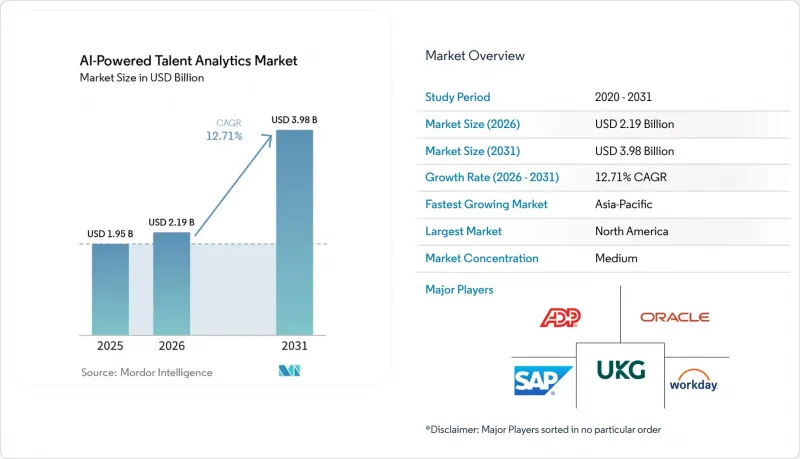
本報告按分析類型(說明分析、診斷性分析、預測性分析等)、部署模式(本地部署、雲端部署、混合部署)、組織規模(大型企業、中小企業)、最終用戶產業(IT與電信、製造業等)和地區進行細分。市場預測以美元計價。
全球人工智慧驅動的人才分析市場趨勢與洞察
將生成式人工智慧整合到技能映射中
生成式人工智慧正在從根本上改變企業對能力進行分類的方式,它能夠從專案文件、同行評審和學習記錄中提取技能,並在幾分鐘內將其與空缺職位進行匹配。 SAP 的 People Intelligence 於 2025 年 10 月發布,它利用大規模語言模型,在新技術進入市場後的幾週內更新內部技能圖譜,從而消除了手動更新分類系統通常需要的 12-18 個月的延遲。 Coursera 平台上與生成式人工智慧相關的課程註冊量在 2025 年激增了 234%,這表明新技術正在迅速滲透到勞動力市場中。試用這些工具的組織已將人力資源部門的手動工作量減少了約 40%,並且能夠更早發現人才短缺,從而將培訓預算集中在獲取最有價值的技能上。
基於雲端的人力資源套件的快速普及
整合式雲端平台消除了以往限制人才建模準確性的資料孤島。 Workday Data Cloud 於 2025 年 9 月推出,它連接了 Databricks、Snowflake 和 Salesforce,無需重複存儲,使人力資源團隊能夠在單一視圖中整合績效、財務和客戶資料。 Oracle Cloud HCM 透過儀錶板為管理人員提供員工流失風險和繼任準備的直接可見性,從而加快從洞察到行動的速度。中小企業可以透過 ADP DataCloud 取得與同業可比較的基準數據,該平台匯總了從數千家客戶收集的匿名化薪資和員工記錄。此外,頻繁的雲端更新可立即提供新的合規功能,使部署能夠保持合規性,而無需進行成本高昂的本地升級。
資料隱私和合規性的複雜性
由於各國的資料授權法規各不相同,供應商需要對資料進行在地化,並針對不同地區維護不同的產品版本。印度的《數位個人資料保護法》規定,濫用生物識別資料者將被處以最高 250 印度盧比(約 3,000 萬美元)的罰款。中國的《個人資料保護法》規定員工記錄必須在國內保存,跨境傳輸需要經過政府安全審查。歐盟《一般資料保護規則》(GDPR) 第 22 條限制了完全自動化的招募決策,並要求人工監督。為了遵守這些法規,像 InCountry 這樣的供應商會在特定國家的設施中託管 Oracle HCM 資料。
細分市場分析
處方工具正以14.67%的複合年成長率快速發展,超過了人工智慧驅動的人才分析市場的整體成長率。預計到2025年,預測平台將佔據55.41%的市場佔有率,顯示其在人員流動預測和勞動力需求規劃方面已日趨成熟。然而,隨著準確率的趨同,差異化因素將轉向引擎能否提案留任獎金、技能培訓或繼任計畫的建議。 IBM報告稱,透過處方建議,每年節省了3億美元的人員流動成本;聯合利華在實施面試順序最佳化工具後,招募時間縮短了75%。從合規角度來看,說明儀錶板仍然至關重要,但它們也正在成為更高價值層級的「乾淨資料來源」。診斷分析涵蓋了對員工敬業度下降和多元化差距的根本原因分析,彌合了觀點和前瞻性觀點之間的差距。
為了避免工具氾濫,企業正擴大將多種分析類型整合到單一訂閱服務中。隨著董事會要求可量化的投資報酬率,預計到2028年,人工智慧驅動的人才分析市場中,處方模組的市場規模將超過說明模組。無法添加建議引擎的供應商將面臨產品同質化的風險。同時,那些整合了情緒分析和網路分析的供應商正憑藉其揭示員工倦怠徵兆和具有非正式影響力的人員(這些往往被傳統人力資源指標所忽略)的能力而獲得優勢。
由於初始成本低且可無縫升級,雲端服務預計在2025年仍將維持66.78%的營收佔有率。然而,隨著企業擴大將敏感資料儲存在國內伺服器上,同時利用公共雲端運算資源處理繁重的分析工作負載,混合架構正以15.09%的複合年成長率快速成長。在數據本地化法規嚴格的地區,例如中國、俄羅斯和中東,基於混合解決方案的AI人才分析市場正在迅速擴張。 AWS的歐洲主權雲就是一個典型的例子,它透過物理隔離來滿足歐盟監管機構的要求。
混合型用戶願意承擔更高的基礎設施成本,以換取即時儀錶板的合規性和低延遲等優勢。服務提供者正與 InCountry 等專業機構合作,實現資料駐留,並將在地化功能整合到實施模板中。隨著越來越多的政府效仿印度以用戶同意為中心的系統和加州的員工資料權利,混合型模式的趨勢可能會進一步增強。
區域分析
預計到2025年,北美將佔據36.88%的市場佔有率,這主要得益於演算法的早期應用和強制性的勞動力資訊揭露。然而,諸如紐約市的「第144號地方法律」等帶有偏見的審計法律,在增加遵循成本的同時,也使規避風險的董事會對複雜的分析方法趨於認可。加拿大各省的隱私法以及墨西哥近岸外包的激增也在逐步提振市場需求,但由於技能匱乏和預算限制,全部區域的中小型企業仍落後於市場。
預計亞太地區將實現最快成長,到2031年複合年成長率將達到14.05%。根據IDC 2024年的一項調查,43%的公司計劃在未來一年將人工智慧預算增加20%以上。各主要行業29%至41%的技能缺口為診斷和處方平台提供了機會。印度的資料保護罰款和中國的本地化法規正促使許多買家轉向混合部署。日本正著力進行繼任分析以因應勞動力老化問題,而澳洲和韓國則根據新法規強調多元化報告。
歐洲面臨最嚴格的監管。 「人工智慧法」將招募工具歸類為「高風險」工具,並強制要求進行適任性評估。為了遵守該法對這類功能的全面禁令,供應商已在招募環境中禁用了情緒辨識功能。德國和法國正大力投資薪資差距儀錶板,以符合「商業永續性報告指令」。南美洲的成長並不均衡,巴西是其中的佼佼者。在巴西,跨國公司正在將雲端分析與區域資料中心結合。在中東,特別是沙烏地阿拉伯和阿拉伯聯合大公國,勞動力分析正被納入國家多元化政策。非洲仍在發展中,南非和奈及利亞是重點發展地區。在這些國家,跨國公司和主要本土銀行正在試行技能預測工具。
其他好處:
- Excel格式的市場預測(ME)表
- 3個月的分析師支持
目錄
第1章:引言
- 研究假設和市場定義
- 調查範圍
第2章:調查方法
第3章執行摘要
第4章 市場狀況
- 市場概覽
- 市場促進因素
- 基於雲端的人力資源管理套件的快速普及
- 人們越來越關注與勞動力多樣性相關的指標。
- 將生成式人工智慧整合到技能映射中
- 向數據驅動型技能再培訓計劃過渡
- 擴展採用「遠端優先」方法的模型
- 監管機構越來越關注人力資源領域中人工智慧的合理使用。
- 市場限制因素
- 資料隱私和合規性的複雜性
- 演算法偏差和審計要求
- 與傳統人力資源資訊系統整合面臨的挑戰
- 人力資源部門分析人才短缺
- 產業價值鏈分析
- 監理情勢
- 技術展望
- 波特五力分析
- 宏觀經濟因素對市場的影響
第5章 市場規模與成長預測
- 按分析類型
- 說明分析
- 診斷分析
- 預測分析
- 指示性分析
- 其他分析類型
- 按部署模式
- 現場
- 雲
- 混合
- 按組織規模
- 大公司
- 中小企業
- 按最終用途行業分類
- IT/通訊
- 銀行、金融服務和保險(BFSI)
- 醫療保健和生命科學
- 零售與電子商務
- 製造業
- 政府/公共部門
- 其他終端用戶產業
- 按地區
- 北美洲
- 美國
- 加拿大
- 墨西哥
- 其他北美國家
- 南美洲
- 巴西
- 阿根廷
- 其他南美國家
- 歐洲
- 德國
- 英國
- 法國
- 義大利
- 西班牙
- 俄羅斯
- 其他歐洲國家
- 亞太地區
- 中國
- 印度
- 日本
- 韓國
- 澳洲
- 其他亞太國家
- 中東
- 沙烏地阿拉伯
- 阿拉伯聯合大公國
- 土耳其
- 其他中東國家
- 非洲
- 南非
- 奈及利亞
- 其他非洲國家
- 北美洲
第6章 競爭情勢
- 市場集中度
- 策略趨勢
- 市佔率分析
- 公司簡介
- International Business Machines Corporation
- Microsoft Corporation
- SAP SE
- Oracle Corporation
- Workday Inc.
- Cornerstone OnDemand Inc.
- Automatic Data Processing Inc.
- Ceridian HCM Holding Inc.
- Visier Inc.
- Degreed Inc.
- Eightfold AI Inc.
- Gloat Inc.
- Beamery Inc.
- Phenom People Inc.
- HireVue Inc.
- Retrain.ai Inc.
- SeekOut Inc.
- Entelo Inc.
- Paylocity Holding Corporation
- UKG Inc.
第7章 市場機會與未來展望
According to Mordor Intelligence, the AI-powered talent analytics market size is expected to grow from USD 1.95 billion in 2025 to USD 2.19 billion in 2026 and is forecast to reach USD 3.98 billion by 2031 at 12.71% CAGR over 2026-2031.
This report is Segmented by Analytics Type (Descriptive Analytics, Diagnostic Analytics, Predictive Analytics, and More), Deployment Model (On-Premises, Cloud, and Hybrid), Organization Size (Large Enterprises, and Small and Medium Enterprises [SMEs]), End-Use Industry (IT and Telecommunications, Manufacturing, and More), and Geography. The Market Forecasts are Provided in Terms of Value (USD).
Global AI-Powered Talent Analytics Market Trends and Insights
Integration of Generative AI for Skills Mapping
Generative AI rewrites the way companies catalog competencies by extracting skills from project documents, peer reviews, and learning transcripts, then matching them to open roles in minutes. SAP's People Intelligence, launched in October 2025, uses large language models to refresh internal skills graphs weeks after new technologies enter the market, eliminating the 12- to 18-month lag typical of manual taxonomy updates. Coursera recorded a 234% jump in generative AI course enrollments during 2025, showing how quickly novel capabilities flow into the labor pool. Organizations that pilot these tools reduce manual HR workloads by roughly 40% and spot workforce gaps early, allowing learning budgets to target the highest-value skills.
Rapid Adoption of Cloud-Based HR Suites
Unified cloud platforms break the data silos that previously limited workforce modeling accuracy. Workday Data Cloud, introduced in September 2025, connects Databricks, Snowflake, and Salesforce without duplicating storage, enabling HR teams to blend performance, finance, and customer data in one view. Oracle Cloud HCM displays attrition risk and succession readiness directly inside manager dashboards, shrinking the insight-to-action window. Smaller companies access comparable benchmarks through ADP DataCloud, which aggregates anonymized payroll and workforce records from thousands of clients. Frequent cloud updates also push new regulatory features instantly, keeping deployments compliant without costly on-premises upgrades.
Data Privacy And Compliance Complexities
Divergent consent rules force vendors to localize data and maintain region-specific product variants. India's Digital Personal Data Protection Act can fine violators up to INR 250 crore (USD 30 million) for misuse of biometrics. China's Personal Information Protection Law requires domestic storage of employee records and government security reviews for cross-border transfers. European Union GDPR Article 22 restricts fully automated hiring decisions, obligating human oversight. Providers such as InCountry host Oracle HCM data in country-specific facilities to satisfy these statutes.
Other drivers and restraints analyzed in the detailed report include:
- Growing Emphasis on Workforce Diversity Metrics
- Shift Toward Data-Driven Reskilling Programs
- Algorithmic Bias And Audit Requirements
For complete list of drivers and restraints, kindly check the Table Of Contents.
Segment Analysis
Prescriptive tools are advancing at 14.67% CAGR, eclipsing overall AI-powered talent analytics market growth. Predictive platforms commanded 55.41% share in 2025, showing their maturity in churn forecasts and workforce demand planning. Yet once accuracy levels converge, the differentiator becomes whether the engine can suggest a retention bonus, an upskilling course, or a succession plan. IBM credits prescriptive recommendations for USD 300 million in annual turnover savings, and Unilever cut time-to-hire by 75% after adopting interview sequence optimizers. Descriptive dashboards remain vital for compliance but function as feeders that supply clean data to the higher-value layers. Diagnostic analytics span root-cause analysis of engagement dips and diversity gaps, forming the bridge between hindsight and foresight.
Enterprises increasingly bundle multiple analytics types within one subscription to avoid tool sprawl. The AI-powered talent analytics market size allocated to prescriptive modules is projected to outpace descriptive spend by 2028 as boardrooms demand quantified ROI. Vendors that fail to add recommendation engines risk relegation to commodity status. Those that integrate sentiment and network analysis gain an edge by surfacing burnout signals and informal influencers that traditional HR metrics miss.
Cloud delivery retained 66.78% revenue share in 2025 thanks to lower upfront costs and seamless upgrades. Even so, hybrid architectures are expanding at 15.09% CAGR as enterprises route sensitive data to in-country servers while using public-cloud compute for heavy analytics workloads. The AI-powered talent analytics market size attributed to hybrid solutions is accelerating in jurisdictions with strict data localization mandates such as China, Russia, and the Middle East. AWS European Sovereign Cloud exemplifies offerings that physically separate operations to satisfy EU regulators.
Hybrid users accept higher infrastructure spend in return for compliance assurance and latency benefits for real-time dashboards. Providers partner with specialists like InCountry for data residency, embedding localization into implementation templates. The balance may tilt further toward hybrid as more governments emulate India's consent-centric regime and California's employee data rights.
Complete Report Scope:
- By Analytics Type
- Descriptive Analytics
- Diagnostic Analytics
- Predictive Analytics
- Prescriptive Analytics
- Other Analytics Types
- By Deployment Model
- On-Premises
- Cloud
- Hybrid
- By Organization Size
- Large Enterprises
- Small and Medium Enterprises (SMEs)
- By End-Use Industry
- IT and Telecommunications
- Banking, Financial Services and Insurance (BFSI)
- Healthcare and Life Sciences
- Retail and E-commerce
- Manufacturing
- Government and Public Sector
- Other End-Use Industries
- By Geography
- North America
- United States
- Canada
- Mexico
- Rest of North America
- South America
- Brazil
- Argentina
- Rest of South America
- Europe
- Germany
- United Kingdom
- France
- Italy
- Spain
- Russia
- Rest of Europe
- Asia-Pacific
- China
- India
- Japan
- South Korea
- Australia
- Rest of Asia-Pacific
- Middle East
- Saudi Arabia
- United Arab Emirates
- Turkey
- Rest of Middle East
- Africa
- South Africa
- Nigeria
- Rest of Africa
- North America
Geography Analysis
North America commanded 36.88% share in 2025, sustained by early algorithmic hiring uptake and mandatory workforce disclosures. Bias audit laws such as New York City's Local Law 144 increase compliance spend but also legitimize advanced analytics among risk-averse boards. Canada's provincial privacy statutes and Mexico's nearshoring surge both add incremental demand, yet small businesses across the region still lag because of skills shortages and budget discipline.
Asia-Pacific is the fastest growing at 14.05% CAGR through 2031. A 2024 IDC survey found 43% of enterprises plan to raise AI budgets by over 20% during the next year. Skills gaps of 29-41% across major industries create fertile ground for diagnostic and prescriptive platforms. India's data-protection fines and China's localization rules push many buyers toward hybrid deployments. Japan focuses on succession analytics to counter aging workforces, while Australia and South Korea emphasize diversity reporting aligned with emerging legislation.
Europe grapples with the strictest rulebook. The AI Act labels recruitment tools high risk, compelling conformity assessments. Vendors disabled emotion recognition features to comply with the Act's outright ban in employment contexts. Germany and France invest heavily in pay-equity dashboards to align with the Corporate Sustainability Reporting Directive. South America grows unevenly, led by Brazil, where multinationals deploy cloud analytics bundled with regional data centers. The Middle East, notably Saudi Arabia and the United Arab Emirates, incorporates workforce analytics into national diversification agendas. Africa remains nascent, concentrated in South Africa and Nigeria where multinationals and large domestic banks pilot skills-forecasting tools.
- International Business Machines Corporation
- Microsoft Corporation
- SAP SE
- Oracle Corporation
- Workday Inc.
- Cornerstone OnDemand Inc.
- Automatic Data Processing Inc.
- Ceridian HCM Holding Inc.
- Visier Inc.
- Degreed Inc.
- Eightfold AI Inc.
- Gloat Inc.
- Beamery Inc.
- Phenom People Inc.
- HireVue Inc.
- Retrain.ai Inc.
- SeekOut Inc.
- Entelo Inc.
- Paylocity Holding Corporation
- UKG Inc.
Additional Benefits:
- The market estimate (ME) sheet in Excel format
- 3 months of analyst support
TABLE OF CONTENTS
1 INTRODUCTION
- 1.1 Study Assumptions and Market Definition
- 1.2 Scope of the Study
2 RESEARCH METHODOLOGY
3 EXECUTIVE SUMMARY
4 MARKET LANDSCAPE
- 4.1 Market Overview
- 4.2 Market Drivers
- 4.2.1 Rapid Adoption of Cloud-Based HR Suites
- 4.2.2 Growing Emphasis on Workforce Diversity Metrics
- 4.2.3 Integration of Generative AI for Skills Mapping
- 4.2.4 Shift Toward Data-Driven Reskilling Programs
- 4.2.5 Expansion of Remote-First Hiring Models
- 4.2.6 Increased Regulatory Focus on Fair-Use AI in HR
- 4.3 Market Restraints
- 4.3.1 Data Privacy and Compliance Complexities
- 4.3.2 Algorithmic Bias and Audit Requirements
- 4.3.3 Integration Challenges With Legacy HRIS
- 4.3.4 Limited Analytics Talent in HR Departments
- 4.4 Industry Value Chain Analysis
- 4.5 Regulatory Landscape
- 4.6 Technological Outlook
- 4.7 Porter's Five Forces Analysis
- 4.7.1 Threat of New Entrants
- 4.7.2 Bargaining Power of Suppliers
- 4.7.3 Bargaining Power of Buyers
- 4.7.4 Threat of Substitutes
- 4.7.5 Competitive Rivalry
- 4.8 Impact of Macroeconomic Factors on the Market
5 MARKET SIZE AND GROWTH FORECASTS (VALUE)
- 5.1 By Analytics Type
- 5.1.1 Descriptive Analytics
- 5.1.2 Diagnostic Analytics
- 5.1.3 Predictive Analytics
- 5.1.4 Prescriptive Analytics
- 5.1.5 Other Analytics Types
- 5.2 By Deployment Model
- 5.2.1 On-Premises
- 5.2.2 Cloud
- 5.2.3 Hybrid
- 5.3 By Organization Size
- 5.3.1 Large Enterprises
- 5.3.2 Small and Medium Enterprises (SMEs)
- 5.4 By End-Use Industry
- 5.4.1 IT and Telecommunications
- 5.4.2 Banking, Financial Services and Insurance (BFSI)
- 5.4.3 Healthcare and Life Sciences
- 5.4.4 Retail and E-commerce
- 5.4.5 Manufacturing
- 5.4.6 Government and Public Sector
- 5.4.7 Other End-Use Industries
- 5.5 By Geography
- 5.5.1 North America
- 5.5.1.1 United States
- 5.5.1.2 Canada
- 5.5.1.3 Mexico
- 5.5.1.4 Rest of North America
- 5.5.2 South America
- 5.5.2.1 Brazil
- 5.5.2.2 Argentina
- 5.5.2.3 Rest of South America
- 5.5.3 Europe
- 5.5.3.1 Germany
- 5.5.3.2 United Kingdom
- 5.5.3.3 France
- 5.5.3.4 Italy
- 5.5.3.5 Spain
- 5.5.3.6 Russia
- 5.5.3.7 Rest of Europe
- 5.5.4 Asia-Pacific
- 5.5.4.1 China
- 5.5.4.2 India
- 5.5.4.3 Japan
- 5.5.4.4 South Korea
- 5.5.4.5 Australia
- 5.5.4.6 Rest of Asia-Pacific
- 5.5.5 Middle East
- 5.5.5.1 Saudi Arabia
- 5.5.5.2 United Arab Emirates
- 5.5.5.3 Turkey
- 5.5.5.4 Rest of Middle East
- 5.5.6 Africa
- 5.5.6.1 South Africa
- 5.5.6.2 Nigeria
- 5.5.6.3 Rest of Africa
- 5.5.1 North America
6 COMPETITIVE LANDSCAPE
- 6.1 Market Concentration
- 6.2 Strategic Moves
- 6.3 Market Share Analysis
- 6.4 Company Profiles (includes Global Level Overview, Market Level Overview, Core Segments, Financials as available, Strategic Information, Market Rank/Share, Products and Services, Recent Developments)
- 6.4.1 International Business Machines Corporation
- 6.4.2 Microsoft Corporation
- 6.4.3 SAP SE
- 6.4.4 Oracle Corporation
- 6.4.5 Workday Inc.
- 6.4.6 Cornerstone OnDemand Inc.
- 6.4.7 Automatic Data Processing Inc.
- 6.4.8 Ceridian HCM Holding Inc.
- 6.4.9 Visier Inc.
- 6.4.10 Degreed Inc.
- 6.4.11 Eightfold AI Inc.
- 6.4.12 Gloat Inc.
- 6.4.13 Beamery Inc.
- 6.4.14 Phenom People Inc.
- 6.4.15 HireVue Inc.
- 6.4.16 Retrain.ai Inc.
- 6.4.17 SeekOut Inc.
- 6.4.18 Entelo Inc.
- 6.4.19 Paylocity Holding Corporation
- 6.4.20 UKG Inc.
7 MARKET OPPORTUNITIES AND FUTURE OUTLOOK
- 7.1 White-Space and Unmet-Need Assessment

 人工智慧驅動的農場管理軟體市場預測至2034年:按部署類型、軟體模組、人工智慧技術、應用、最終用戶和地區分類的全球分析
 人工智慧專業服務市場:全球市場預測,2026-2032年神經包容性工作場所技術市場:預測至 2034 年 - 按解決方案、組件、技術、企業規模、最終用戶和地區分類的全球分析
 人工智慧搜尋廣告:市場佔有率分析、產業趨勢與統計、成長預測(2026-2031)
 2026年全球繼任與領導規劃軟體市場報告勞動力智慧平台:市場佔有率分析、產業趨勢與統計、成長預測(2026-2031 年)員工技能評估與映射平台:市場佔有率分析、產業趨勢與統計、成長預測(2026-2031)繼任管理軟體:市佔率分析、產業趨勢與統計、成長預測(2026-2031)
 2026 年的發展趨勢:記憶體將滿足日益成長的人工智慧推理需求作物產量預測市場展望至2034年—按解決方案類型、組件、技術、應用、最終用戶和地區分類的全球分析