


 |
市場調查報告書
商品編碼
2073280
勞動力智慧平台:市場佔有率分析、產業趨勢與統計、成長預測(2026-2031 年)Workforce Intelligence Platform - Market Share Analysis, Industry Trends & Statistics, Growth Forecasts (2026 - 2031) |
||||||

※ 本網頁內容可能與最新版本有所差異。詳細情況請與我們聯繫。
根據 Mordor Intelligence 預測,勞動力智慧平台市場規模預計將在 2025 年達到 14.8 億美元,2026 年達到 17.2 億美元,到 2031 年達到 38.6 億美元,在預測期(2026-2031 年)內複合年成長率為 17.56%。
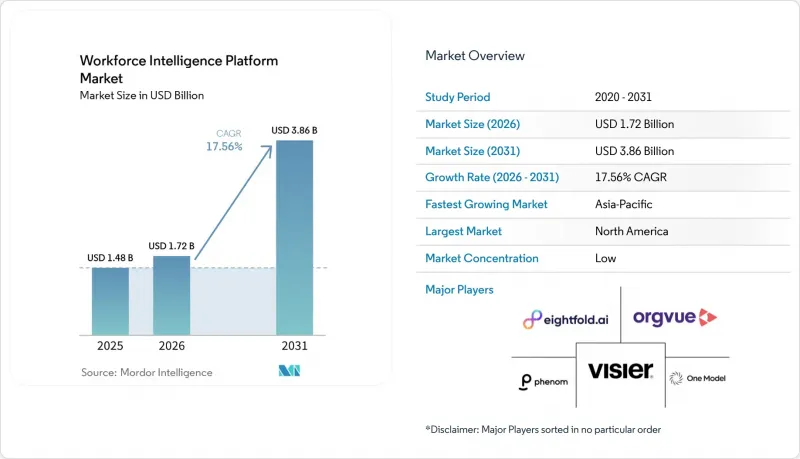
本報告按部署模式(雲端和本地部署)、功能(勞動力分析和報告、人才流動和技能情報、勞動力規劃和預測等)、組織規模(大型企業和中小企業)、最終用戶行業(IT和電信、銀行、金融服務和保險等)以及地區進行細分。市場預測以美元計價。
全球勞動力智慧平台市場趨勢與洞察
在核心人力資源工作流程中應用人工智慧驅動的預測性人才規劃
由於買家對超越簡單總結過往業績的前瞻性規劃工具的需求不斷成長,勞動力智慧平台市場正在發生變化。根據 Betterworks 2026 年 4 月發布的《人才智慧調查》,只有 16% 的企業使用真正具有預測性的人力資源系統,這為提供超越儀錶板報告解決方案的供應商帶來了龐大的商機。調查還發現,36% 的受訪者認為,利用人工智慧從營運和績效數據中推斷技能的能力是最有可能改善人才決策的功能,其重要性高於其他選項。 SAP SuccessFactors 2026 年上半年版本也將技能管治定位為核心資料領域,顯示預測功能正逐漸成為該平台的標配,而非可選的進階附加元件。這提高了勞動力智慧平台市場獨立供應商的門檻。因為隨著套件供應商不斷擴展其原生功能,保持價格競爭力需要更高的模型精度、更廣泛的整合以及對外部數據的更佳豐富。
基於技能的組織計劃需要一個動態的技能圖譜。
勞動力智慧平台市場也受益於從靜態工作架構向基於技能的營運模式的廣泛轉變。根據Skills-base的研究,有效率利用檢驗技能資料的組織,其技能庫中94.4%為硬技能,員工評估覆蓋率中位數為82%。這表明,如果沒有機器輔助推理,要保持技能資料的更新是多麼困難。隨著企業需要能夠跨分散式團隊、本地系統和不斷變化的角色結構進行推理、更新和協調員工能力的平台,勞動力智慧平台市場正從這個需求缺口中獲益。此外,在歐洲,隨著系統性人才發展的證據在與人力資本報告相關的揭露和管治流程中變得越來越重要,該平台的商業價值也不斷擴大。
對員工資料隱私和演算法偏見的審查
隨著員工監控、自動化決策和模型可解釋性受到更嚴格的審查,勞動力智慧平台市場正面臨採購的挑戰。歐盟《人工智慧法案》將於2024年8月生效,該法案禁止在職場使用基於生物識別資料推斷情緒的人工智慧系統,違者將面臨最高3,500萬歐元(3,960萬美元)或全球年銷售額7%的罰款。該法案指出,與行為監控和全自動人事決策相關的勞動力智慧系統可能屬於高風險類別,因此對文件記錄、人工監督和員工透明度提出了更嚴格的要求。偏見問題也是一大挑戰,因為從歷史人事記錄中學習到的模型可能會重現長期存在的薪酬、晉升和工作分配方面的不平等現象。因此,歐洲和英國的勞動力智慧平台市場面臨更重的舉證責任,而這項責任正日益影響買家對架構選擇、銷售週期和管治管理的要求。
細分市場分析
到2025年,雲端將佔據勞動力智慧平台市場69.84%的佔有率,這表明買家正在優先考慮支援人工智慧功能、連接器和合規性更新通用的多租戶交付模式。勞動力智慧平台市場向雲端遷移的驅動力在於,供應商無需等待客戶完成本地升級項目,即可跨部署系統更新模型。隨著企業環境中隱私要求、技能分類方案和整合標準的不斷變化,這種快速發布變得日益重要。雲端也是成長最快的部署模式,預計到2031年,雲端勞動力智慧平台的市場規模將以17.92%的複合年成長率成長。這一成長得益於亞太地區中小企業以及「雲端優先」組織的需求,這些企業正在採用這些平台,而無需將傳統的本地部署架構納入其引進週期。
在勞動力智慧平台產業,本地部署仍然扮演著重要角色,尤其是在政府機構、金融服務機構以及受嚴格主權和安全法規約束的大型企業。這些客戶通常會推遲全面遷移,因為原始人力資源記錄、薪資文件和存取控制要求仍然與傳統的內部系統綁定。供應商正在透過混合方法來解決這個問題,將分析和人工智慧層遷移到雲端,以確保規模和模型效能,同時將敏感資料保留在本地環境中。因此,ISO 27001 和 SOC 2 II 型認證不再只是雲端供應商的可選資格,而是標準的採購標準。在勞動力智慧平台市場,部署模式的選擇以及託管偏好反映了管治結構和整合準備。
到2025年,勞動力分析和報告功能將佔據勞動力智慧平台市場佔有率的29.42%。這反映出,在複雜的人力資源環境中,管理者對員工人數儀錶板、人員離職率追蹤和自助式分析的需求持續旺盛。這個細分市場仍然是勞動力智慧平台市場的基石,因為企業通常在添加規劃、流動性和績效管理等功能層之前,首先會採用這個類別。即使買家規劃未來擴展功能,報告工具仍然是許多組織切實可行的切入點,因為提高跨分散系統的可見度仍然至關重要。同時,預計到2031年,人才流動性和技能智慧將以20.18%的複合年成長率成長,成為勞動力智慧平台市場中成長最快的功能細分市場。這種快速成長表明,雇主越來越傾向於尋求能夠讓他們即時了解員工能力並採取相應行動的工具,而不是僅僅依賴歷史報告。
根據Skills-base的一份報告,積極且廣泛利用檢驗技能數據的組織,平均每個職位擁有89項技能,員工評估覆蓋率中位數達到82%,技能數據更新周期中位數為六個月。這些基準數據有助於解釋為什麼勞動力智慧平台產業正從靜態的個人資料資料庫轉向更複雜的技能引擎。隨著雇主需要在同一勞動力模型中同時考慮員工數量和人工智慧代理,勞動力規劃和預測的重要性也日益凸顯。 Eightfold AI於2026年5月發布的「勞動力準備」解決方案,為首席人力資源長(CHRO)提供員工對人工智慧工具的採納情況和生產力的即時可見性,表明供應商正在將其功能擴展到新的智慧領域。
區域分析
預計到2025年,北美將佔據全球勞動力智慧平台市場佔有率的40.74%,成為最大的區域貢獻者。該地區市場最為活躍,因為大型企業已擁有成熟的人力資源技術環境,並建立了將人才決策與財務績效掛鉤的成熟實踐。美國仍然是主要的需求中心,這得益於上市公司對人力資本資源的揭露要求,以及首席人力資源長和財務長對勞動力技術投資的大力支持。加拿大是第二大需求中心,溫哥華尤其突出,憑藉Visier等公司,成為人才分析創新的關鍵中心。買方成熟度、供應商實力以及大規模的合約規模,持續鞏固北美在勞動力智慧平台市場的主導地位。
在歐洲,勞動力智慧平台市場正採用更注重合規性的模式。 《企業永續性報告指令》(CSRD) 提高了對員工組成、技能發展和薪酬差距等資訊進行系統性揭露的需求,從而推動了對能夠正式管理這些資料流的平台的投資。另一方面,德國、法國、比利時和荷蘭強制要求與員工代表委員會進行磋商,這可能導致系統運作前需經過員工代表的審查,從而延遲實施。 Eversheds Sutherland 發布的 2026 年就業指南也強調了該地區買家保持謹慎的原因,因為在職場使用的人工智慧系統可能會根據歐盟人工智慧法引發高風險義務。北歐國家和英國仍是相對快速發展的細分市場,因為與歐洲大陸部分地區相比,這些地區的企業人力資源分析實務更為成熟,資料管治流程也更為完善。
預計到2031年,亞太地區將以19.64%的複合年成長率成長,成為勞動力智慧平台市場成長最快的地區。這一成長主要得益於政府主導的人工智慧專案、全球能力中心的擴張,以及眾多企業選擇直接遷移到主導架構而非繼續使用傳統人力資源系統。印度市場成長尤為迅猛,其IT和金融服務領域已開始應用生成式人工智慧進行勞動力規劃、人員流動預測和技能推論。日本仍然是亞太地區重要的SaaS市場,而澳洲和韓國則作為成熟的次市場,對數位化和合規性有著強烈的需求。 WTW的報告還指出,人工智慧正在幫助亞太地區的人力資源團隊建立統一的“單一數據源”,涵蓋職位、職級和技能,從而在單一運營模式下支撐薪酬管治和內部調動。南美、中東和非洲在勞動力智慧平台市場仍處於早期階段,目前主要用戶集中在跨國公司子公司、大型金融機構和政府機構。巴西和南非是推動區域需求的主要力量,而沙烏地阿拉伯和阿拉伯聯合大公國(阿拉伯聯合大公國)尤其值得關注,因為受勞動力在地化要求的驅動,兩國需要對勞動力組成與政策目標進行可審計的追蹤。
其他好處:
- Excel格式的市場預測(ME)表
- 3個月的分析師支持
目錄
第1章:引言
- 研究假設和市場定義
- 調查範圍
第2章:調查方法
第3章執行摘要
第4章 市場狀況
- 市場概覽
- 市場促進因素
- 將把人工智慧驅動的預測性勞動力規劃引入核心人力資源工作流程。
- 基於技能的組織計劃需要一個動態的技能圖譜。
- 內部人才市場正在將支出從外部招募轉移出去。
- 隨著勞動市場和人工智慧的變革,對策略性人才規劃的需求日益成長。
- 來自首席人力資源長和財務長的壓力,要求可視化員工隊伍的投資報酬率和產能。
- 人力資源、財務和薪資的整合已經成熟,這為收購提供了催化劑。
- 市場限制因素
- 對員工資料隱私和演算法偏見的審查
- 分散的人力資源、薪資和協作數據
- 歐盟人工智慧法案和僱員代表委員會審查的延誤
- 供應商服務減少會延長實現價值所需的時間。
- 宏觀經濟因素對市場的影響
- 產業價值鏈分析
- 監理情勢
- 技術展望
- 波特五力分析
第5章 市場規模與成長預測
- 按安裝模式
- 雲
- 現場
- 按功能
- 勞動力分析和報告編制
- 人才流動性和技能智慧
- 人員規劃與預測
- 員工體驗與績效智慧
- 其他函數類型
- 按組織規模
- 大公司
- 小型企業
- 按最終用戶行業分類
- IT/通訊
- BFSI
- 醫療保健和生命科學
- 製造業
- 零售與電子商務
- 政府/公共部門
- 其他終端用戶產業
- 按地區
- 北美洲
- 美國
- 加拿大
- 墨西哥
- 南美洲
- 巴西
- 阿根廷
- 智利
- 其他南美國家
- 歐洲
- 德國
- 英國
- 法國
- 義大利
- 西班牙
- 北歐的
- 俄羅斯
- 其他歐洲國家
- 亞太地區
- 中國
- 印度
- 日本
- 韓國
- 澳洲和紐西蘭
- 其他亞太國家
- 中東
- 沙烏地阿拉伯
- 阿拉伯聯合大公國
- 土耳其
- 其他中東國家
- 非洲
- 南非
- 埃及
- 奈及利亞
- 其他非洲國家
- 北美洲
第6章 競爭情勢
- 市場集中度
- 策略趨勢
- 市佔率分析
- 公司簡介
- Visier, Inc.
- Eightfold AI, Inc.
- Phenom People, Inc.
- One Model, Inc.
- OrgVue Limited
- Gloat Ltd.
- Crunchr BV
- TechWolf NV
- 365Talents SAS
- Beamery Inc.
- SeekOut, Inc.
- Lightcast, Inc.
- Reejig Pty Ltd.
- Retrain.ai Ltd.
- Humanyze, Inc.
- ChartHop, Inc.
- Lattice, Inc.
- Culture Amp Pty Ltd
- Syndio Solutions, Inc.
- Perceptyx, Inc.
- Betterworks Systems, Inc.
- Aquire, Inc.
- Draup Inc.
- iMocha Technologies Private Limited
- ProFinda Limited
第7章 市場機會與未來展望
According to Mordor Intelligence, the workforce intelligence platform market was valued at USD 1.48 billion in 2025 and estimated to grow from USD 1.72 billion in 2026 to reach USD 3.86 billion by 2031, at a CAGR of 17.56% during the forecast period (2026-2031).
This report is Segmented by Deployment Model (Cloud, and On-Premises), Functionality (Workforce Analytics and Reporting, Talent Mobility and Skills Intelligence, Workforce Planning and Forecasting, and More), Organization Size (Large Enterprises, and SMEs), End-User Industry (IT and Telecom, BFSI, and More), and Geography. The Market Forecasts are Provided in Terms of Value (USD).
Global Workforce Intelligence Platform Market Trends and Insights
AI-Enabled Predictive Workforce Planning in Core HR Workflows
The workforce intelligence platform market is being reshaped by buyer demand for planning tools that look ahead instead of only summarizing what has already happened. Betterworks' April 2026 Talent Intelligence Survey finds that only 16% of organizations operate with a truly predictive HR posture, which leaves a large opening for vendors that can move customers beyond dashboard-based reporting. The same survey shows that 36% of respondents identified AI-driven skills inference from work and performance data as the single capability most likely to improve workforce decision-making, ranking it ahead of other options. SAP SuccessFactors' 1H 2026 release also treats skills governance as a core data discipline, which indicates that predictive capabilities are becoming expected platform features rather than optional premium add-ons. For the workforce intelligence platform market, this raises the standard for standalone vendors, because they now need stronger model accuracy, broader integrations, and better external data enrichment to defend pricing as suite vendors expand their native functionality.
Skills-Based Organization Programs Need Dynamic Skills Graphs
The workforce intelligence platform market is also benefiting from the wider move away from static job architecture and toward skills-based operating models. Skills-base finds that high-functioning organizations using verified skills data at scale maintain skill libraries that are 94.4% hard skills and reach a median 82% workforce assessment coverage, which shows how difficult it is to keep skills data current without machine-assisted inference. The workforce intelligence platform market is gaining from this gap because enterprises need platforms that can infer, refresh, and connect employee capabilities across distributed teams, local systems, and changing role structures. The business case is also growing in Europe, where evidence on structured workforce development is becoming more relevant for disclosure and governance processes tied to human capital reporting.
Employee Data Privacy and Algorithmic Bias Scrutiny
The workforce intelligence platform market faces procurement friction where employee monitoring, automated decision-making, and model explainability sit under close review. The EU AI Act, in force since August 2024, prohibits AI systems that infer emotions from biometric data in workplace settings, with penalties reaching EUR 35 million (USD 39.6 million) or 7% of annual global turnover for prohibited-practice violations. The same guidance explains that workforce intelligence systems tied to behavioral monitoring or fully automated personnel decisions can fall under high-risk classification, which brings stricter requirements for documentation, human oversight, and employee transparency. Bias concerns add another layer because models trained on historical HR records can reproduce long-standing inequality in pay, promotion, and work allocation. The workforce intelligence platform market, therefore, has a higher burden of proof in Europe and the UK, and that burden is increasingly affecting architecture choices, sales cycles, and buyer demand for governance controls.
Other drivers and restraints analyzed in the detailed report include:
- Internal Talent Marketplaces Redirect Spend from External Hiring
- Rising Strategic Workforce Planning Needs Amid Labor and AI Disruption
- Fragmented HR, Payroll, and Collaboration Data
For complete list of drivers and restraints, kindly check the Table Of Contents.
Segment Analysis
Cloud accounted for 69.84% of the workforce intelligence platform market in 2025, underscoring that buyers are prioritizing multi-tenant delivery models that support a common release cycle for AI features, connectors, and compliance updates. The workforce intelligence platform market has leaned toward the cloud because vendors can refresh models across the installed base without waiting for customers to run local upgrade projects. That release speed matters more as privacy requirements, skills taxonomies, and integration standards keep changing across enterprise environments. Cloud is also the fastest-growing deployment model, with the workforce intelligence platform market size for cloud projected to rise at a 17.92% CAGR through 2031. This growth is being supported by SME demand and by cloud-first organizations in Asia-Pacific that are adopting these platforms without carrying legacy on-premises architecture into the implementation cycle.
On-premises deployments still hold a defined role in the workforce intelligence platform industry, especially in government bodies, financial services institutions, and large enterprises working under strict sovereignty or security rules. These customers often delay full migration because raw HR records, payroll files, and access control requirements remain tied to older internal systems. Vendors are addressing that gap with hybrid approaches that keep sensitive data in local environments while shifting analytics and AI layers into the cloud for scale and model performance. ISO 27001 and SOC 2 Type II certifications have therefore become standard procurement signals rather than optional credentials for cloud vendors. In the workforce intelligence platform market, deployment choice now says as much about governance posture and integration readiness as it does about hosting preference.
Workforce analytics and reporting held 29.42% of the workforce intelligence platform market share in 2025, which reflects the continued demand for headcount dashboards, attrition tracking, and manager self-service analytics across complex HR environments. This segment remains the anchor of the workforce intelligence platform market because it is often the first category that enterprises adopt before adding planning, mobility, and performance layers. Many organizations still need better visibility across fragmented systems, so reporting tools remain a practical entry point even when buyers plan to expand functionality later. At the same time, talent mobility and skills intelligence is projected to advance at a 20.18% CAGR through 2031, making it the fastest-growing functional segment in the workforce intelligence platform market. That faster growth shows that employers increasingly want tools that can map and act on workforce capability in real time instead of relying only on historical reporting.
Skills-base reports that organizations actively using verified skills data at scale maintain an average of 89 skills per role, achieve a median 82% workforce assessment coverage, and refresh skills data on a median 6-month cycle. Those benchmarks help explain why the workforce intelligence platform industry is moving toward richer skills engines and away from static profile databases. Workforce planning and forecasting is also gaining weight because employers need scenarios that include both headcount and AI agents inside the same workforce model. Eightfold AI's May 2026 launch of Workforce Readiness, which gives CHROs real-time visibility into employee AI tool adoption and productivity, shows how vendors are expanding functionality into new intelligence categories.
Complete Report Scope:
- By Deployment Model
- Cloud
- On-premises
- By Functionality
- Workforce Analytics and Reporting
- Talent Mobility and Skills Intelligence
- Workforce Planning and Forecasting
- Employee Experience and Performance Intelligence
- Other Functionality Types
- By Organization Size
- Large Enterprises
- SMEs
- By End-User Industry
- IT and Telecom
- BFSI
- Healthcare and Life Sciences
- Manufacturing
- Retail and E-commerce
- Government and Public Sector
- Other End-user Industries
- By Geography
- North America
- United States
- Canada
- Mexico
- South America
- Brazil
- Argentina
- Chile
- Rest of South America
- Europe
- Germany
- United Kingdom
- France
- Italy
- Spain
- Nordics
- Russia
- Rest of Europe
- Asia-Pacific
- China
- India
- Japan
- South Korea
- Australia and New Zealand
- Rest of Asia-Pacific
- Middle East
- Saudi Arabia
- United Arab Emirates
- Turkey
- Rest of Middle East
- Africa
- South Africa
- Egypt
- Nigeria
- Rest of Africa
- North America
Geography Analysis
North America held 40.74% of global workforce intelligence platform market share in 2025, making it the largest regional contributor. The workforce intelligence platform market is strongest in this region because large enterprises already operate mature HR technology estates and have more established practices for linking workforce decisions with financial performance. The United States remains the main demand center, supported by public company disclosure expectations around human capital resources and by stronger CHRO-CFO co-sponsorship of workforce technology spending. Canada adds a secondary center of demand, with Vancouver standing out as an important base for people analytics innovation through companies such as Visier. In the workforce intelligence platform market, that combination of buyer maturity, vendor presence, and larger contract scope continues to support North America's leading position.
Europe operates under a more compliance-driven model in the workforce intelligence platform market. The Corporate Sustainability Reporting Directive has increased the need for structured disclosure on workforce composition, skills development, and pay equity, which supports investment in platforms that can formalize those data flows. At the same time, works council consultation obligations in Germany, France, Belgium, and the Netherlands can slow deployments because employee representatives may need to review systems before activation. Eversheds Sutherland's 2026 employment guidance also shows why buyers in this region remain cautious, since AI systems used in workplace settings can trigger high-risk obligations under the EU AI Act. The Nordics and the UK remain relatively faster-moving sub-markets because enterprise HR analytics practices are more mature and data governance processes are more established than in some parts of continental Europe.
Asia-Pacific is projected to expand at a 19.64% CAGR through 2031, which makes it the fastest-growing region in the workforce intelligence platform market. Growth is being supported by government-backed AI programs, the expansion of Global Capability Centers, and the fact that many organizations are moving directly into cloud-led architectures instead of carrying older HR stacks forward. India stands out as a high-velocity market where generative AI is already being applied to workforce planning, attrition prediction, and skills inference in IT services and financial services environments. Japan remains a major regional SaaS market, while Australia and South Korea function as mature secondary markets with strong digitization and compliance needs. WTW also reports that AI is helping Asia-Pacific HR teams build a unified source of truth for jobs, levels, and skills, which supports both pay governance and internal mobility within the same operating model. South America, the Middle East, and Africa remain earlier-stage regions for the workforce intelligence platform market, with adoption concentrated in multinational subsidiaries, large financial institutions, and government-linked employers. Brazil and South Africa anchor regional demand, while Saudi Arabia and the UAE stand out because workforce nationalization mandates require auditable tracking of workforce composition against policy targets.
- Visier, Inc.
- Eightfold AI, Inc.
- Phenom People, Inc.
- One Model, Inc.
- OrgVue Limited
- Gloat Ltd.
- Crunchr B.V.
- TechWolf NV
- 365Talents SAS
- Beamery Inc.
- SeekOut, Inc.
- Lightcast, Inc.
- Reejig Pty Ltd.
- Retrain.ai Ltd.
- Humanyze, Inc.
- ChartHop, Inc.
- Lattice, Inc.
- Culture Amp Pty Ltd
- Syndio Solutions, Inc.
- Perceptyx, Inc.
- Betterworks Systems, Inc.
- Aquire, Inc.
- Draup Inc.
- iMocha Technologies Private Limited
- ProFinda Limited
Additional Benefits:
- The market estimate (ME) sheet in Excel format
- 3 months of analyst support
TABLE OF CONTENTS
1 INTRODUCTION
- 1.1 Study Assumptions and Market Definition
- 1.2 Scope of the Study
2 RESEARCH METHODOLOGY
3 EXECUTIVE SUMMARY
4 MARKET LANDSCAPE
- 4.1 Market Overview
- 4.2 Market Drivers
- 4.2.1 AI-Enabled Predictive Workforce Planning Enters Core HR Workflows
- 4.2.2 Skills-Based Organization Programs Need Dynamic Skills Graphs
- 4.2.3 Internal Talent Marketplaces Redirect Spend From External Hiring
- 4.2.4 Rising Strategic Workforce Planning Needs Amid Labor and AI Disruption
- 4.2.5 CHRO-CFO Pressure for Workforce ROI and Capacity Visibility
- 4.2.6 HR-Finance-Payroll Integration Matures Into a Buying Trigger
- 4.3 Market Restraints
- 4.3.1 Employee Data Privacy and Algorithmic Bias Scrutiny
- 4.3.2 Fragmented HR, Payroll, and Collaboration Data
- 4.3.3 EU AI Act and Works Council Review Delays
- 4.3.4 Vendor Service Pullback Extends Time to Value
- 4.4 Impact of Macroeconomic Factors on the Market
- 4.5 Industry Value Chain Analysis
- 4.6 Regulatory Landscape
- 4.7 Technological Outlook
- 4.8 Porter's Five Forces Analysis
- 4.8.1 Threat of New Entrants
- 4.8.2 Bargaining Power of Buyers
- 4.8.3 Bargaining Power of Suppliers
- 4.8.4 Threat of Substitutes
- 4.8.5 Intensity of Competitive Rivalry
5 MARKET SIZE AND GROWTH FORECASTS (VALUE)
- 5.1 By Deployment Model
- 5.1.1 Cloud
- 5.1.2 On-premises
- 5.2 By Functionality
- 5.2.1 Workforce Analytics and Reporting
- 5.2.2 Talent Mobility and Skills Intelligence
- 5.2.3 Workforce Planning and Forecasting
- 5.2.4 Employee Experience and Performance Intelligence
- 5.2.5 Other Functionality Types
- 5.3 By Organization Size
- 5.3.1 Large Enterprises
- 5.3.2 SMEs
- 5.4 By End-User Industry
- 5.4.1 IT and Telecom
- 5.4.2 BFSI
- 5.4.3 Healthcare and Life Sciences
- 5.4.4 Manufacturing
- 5.4.5 Retail and E-commerce
- 5.4.6 Government and Public Sector
- 5.4.7 Other End-user Industries
- 5.5 By Geography
- 5.5.1 North America
- 5.5.1.1 United States
- 5.5.1.2 Canada
- 5.5.1.3 Mexico
- 5.5.2 South America
- 5.5.2.1 Brazil
- 5.5.2.2 Argentina
- 5.5.2.3 Chile
- 5.5.2.4 Rest of South America
- 5.5.3 Europe
- 5.5.3.1 Germany
- 5.5.3.2 United Kingdom
- 5.5.3.3 France
- 5.5.3.4 Italy
- 5.5.3.5 Spain
- 5.5.3.6 Nordics
- 5.5.3.7 Russia
- 5.5.3.8 Rest of Europe
- 5.5.4 Asia-Pacific
- 5.5.4.1 China
- 5.5.4.2 India
- 5.5.4.3 Japan
- 5.5.4.4 South Korea
- 5.5.4.5 Australia and New Zealand
- 5.5.4.6 Rest of Asia-Pacific
- 5.5.5 Middle East
- 5.5.5.1 Saudi Arabia
- 5.5.5.2 United Arab Emirates
- 5.5.5.3 Turkey
- 5.5.5.4 Rest of Middle East
- 5.5.6 Africa
- 5.5.6.1 South Africa
- 5.5.6.2 Egypt
- 5.5.6.3 Nigeria
- 5.5.6.4 Rest of Africa
- 5.5.1 North America
6 COMPETITIVE LANDSCAPE
- 6.1 Market Concentration
- 6.2 Strategic Moves
- 6.3 Market Share Analysis
- 6.4 Company Profiles (includes Global Level Overview, Market Level Overview, Core Segments, Financials as available, Strategic Information, Market Rank/Share, Products and Services, Recent Developments)
- 6.4.1 Visier, Inc.
- 6.4.2 Eightfold AI, Inc.
- 6.4.3 Phenom People, Inc.
- 6.4.4 One Model, Inc.
- 6.4.5 OrgVue Limited
- 6.4.6 Gloat Ltd.
- 6.4.7 Crunchr B.V.
- 6.4.8 TechWolf NV
- 6.4.9 365Talents SAS
- 6.4.10 Beamery Inc.
- 6.4.11 SeekOut, Inc.
- 6.4.12 Lightcast, Inc.
- 6.4.13 Reejig Pty Ltd.
- 6.4.14 Retrain.ai Ltd.
- 6.4.15 Humanyze, Inc.
- 6.4.16 ChartHop, Inc.
- 6.4.17 Lattice, Inc.
- 6.4.18 Culture Amp Pty Ltd
- 6.4.19 Syndio Solutions, Inc.
- 6.4.20 Perceptyx, Inc.
- 6.4.21 Betterworks Systems, Inc.
- 6.4.22 Aquire, Inc.
- 6.4.23 Draup Inc.
- 6.4.24 iMocha Technologies Private Limited
- 6.4.25 ProFinda Limited
7 MARKET OPPORTUNITIES AND FUTURE OUTLOOK
- 7.1 White-space and Unmet-Need Assessment

 人工智慧驅動的農場管理軟體市場預測至2034年:按部署類型、軟體模組、人工智慧技術、應用、最終用戶和地區分類的全球分析
 人工智慧專業服務市場:全球市場預測,2026-2032年神經包容性工作場所技術市場:預測至 2034 年 - 按解決方案、組件、技術、企業規模、最終用戶和地區分類的全球分析
 人工智慧搜尋廣告:市場佔有率分析、產業趨勢與統計、成長預測(2026-2031)
 2026年全球繼任與領導規劃軟體市場報告人工智慧驅動的人才分析:市場佔有率分析、行業趨勢和統計數據、成長預測(2026-2031 年)員工技能評估與映射平台:市場佔有率分析、產業趨勢與統計、成長預測(2026-2031)繼任管理軟體:市佔率分析、產業趨勢與統計、成長預測(2026-2031)
 2026 年的發展趨勢:記憶體將滿足日益成長的人工智慧推理需求作物產量預測市場展望至2034年—按解決方案類型、組件、技術、應用、最終用戶和地區分類的全球分析