


 |
市場調查報告書
商品編碼
2073314
員工技能評估與映射平台:市場佔有率分析、產業趨勢與統計、成長預測(2026-2031)Employee Skills Assessment and Mapping Platform - Market Share Analysis, Industry Trends & Statistics, Growth Forecasts (2026 - 2031) |
||||||

※ 本網頁內容可能與最新版本有所差異。詳細情況請與我們聯繫。
據 Mordor Intelligence 稱,員工技能評估和映射平台市場預計將在 2025 年達到 17.7 億美元,在 2026 年達到 19.2 億美元,在 2031 年達到 29.2 億美元,從 2026 年到 2031 年的複合年成長率為 8.72%。
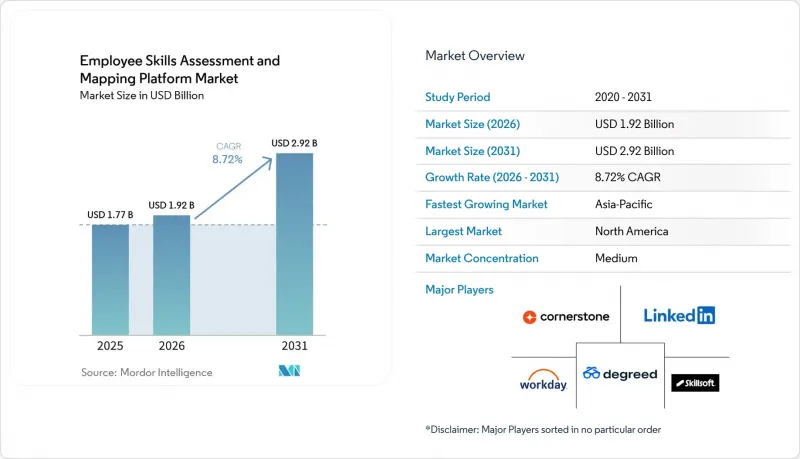
本報告按應用領域(學習與發展、績效管理、繼任計畫等)、部署方式(雲端、本地部署、混合部署)、企業規模(中小企業、大型企業)、產業(IT和電信等)以及地區進行細分。市場預測以美元計價。
全球員工技能評估與映射平台市場趨勢及洞察
學習和發展能力的快速數位轉型
企業學習團隊正從年度課程轉向基於即時技能儀錶板的持續性、個人化發展路徑。根據美世顧問公司2025年的一項調查,91%的公司正在圍繞人工智慧重構人才策略,並將技能映射平台定位為自適應學習的資料基礎。雲端原生學習體驗平台現在可以整合評估結果、專案管理交付成果和程式碼庫提交記錄,並根據員工完成的每項任務和獲得的認證更新其個人資料。這種整合使學習與發展(L&D)負責人能夠將預算集中在分析預測最具改進潛力的領域,從而有可能將關鍵職位的「勝任時間」縮短高達40%。技能數據回饋到內部人才市場,可以加快內部招募週期並降低外部招募成本。
敏捷人才規劃中對即時技能視覺化的需求日益成長。
在基於衝刺的交付模式下,人才規劃人員需要每天而非每季將人才與專案進行配對。與協作工具和版本控制系統整合的技能平台能夠捕捉團隊在實際工作中湧現的新能力。麥肯錫的分析表明,到2025年,利用即時技能情報的公司外部人才支出將減少18%。金融機構正在使用類似的工具向ISO 20022過渡。具體而言,他們正在將現有員工與新的通訊要求進行匹配,並設計短期、強化型的技能培訓,以保護組織的知識儲備。
員工畫像相關的資料隱私問題
根據《一般資料保護規範》(GDPR),詳細的技能檔案被歸類為個人數據,需要明確同意並受到使用限制。此外,歐盟《人工智慧法案》將許多人力資源分析工具列為高風險系統。 2025年發布的實施指南警告雇主,持續的行為監控可能會觸發《歐盟法》第22條規定的問責權。類似的法規,例如《加州消費者隱私法案》(CCPA),在美國也建立了類似的法規結構。雖然供應商正在透過細粒度的同意流程、匿名化管道和本地化資料儲存選項來應對,但這些措施會增加實施成本並降低演算法效能。
細分市場分析
預計到2031年,繼任計畫將以每年10.45%的速度成長,成為員工技能評估和映射平台市場中成長最快的應用情境。企業正從基於服務年限的晉升名單轉向“準備度儀錶板”,提前數月對內部人才進行排名,以應對領導層更迭。隨著高階主管職缺導致收入成長放緩並增加招募成本,這種轉變正在推動持續的投資。儘管「學習與發展」(預計到2025年將佔員工技能評估和映射平台市場的36.14%)仍然是需求的基礎,但企業現在不僅關注培訓管理,還關注如何將技能數據貨幣化,以輔助人才配置決策。
績效管理和招募流程正受益於技能整合的回饋機制和更嚴格的應徵者篩檢,從而縮短招募時間。合規管理日益重要,尤其是在醫療保健和製造業領域,監管機構要求企業獲得審計級別的認證。新興的內部人才市場正在將技能評估直接整合到零工專案平台中,在不增加員工數量的情況下彌合能力差距。這些變化共同鞏固了員工技能評估和映射平台市場作為數據驅動型人力資源策略基石的地位。
預計2026年至2031年間,混合架構將以11.12%的複合年成長率成長。這反映了企業在滿足資料居住法規要求的同時,努力維持對雲端分析的存取。雲端採用仍佔據主導地位,預計2025年將佔總營收的62.11%。這是因為雲端的彈性運算能力無需資本投資即可進行大規模評估。本地部署在政府和國防領域仍然佔據主導地位,但在創新速度方面卻落後於雲端。
現代供應商正朝著將個人識別資訊分離到小型資料庫,同時將匿名化的技能向量發送到雲端進行基準測試的方向發展。歐洲企業傾向採用這種設計,以符合GDPR的跨境資料傳輸法規,在嚴格監管的亞洲市場也出現了類似的趨勢。這種混合模式的興起表明,員工技能評估和映射平台市場正在調整其架構,而不是在部署時強制採用非此即彼的選擇。
區域分析
北美地區在科技、金融和醫療保健產業的早期應用推動下,預計到2025年將佔全球銷售額的37.21%。該地區的企業正在採用該平台,透過促進內部調動來緩解薪資上漲和人才短缺的問題。在加拿大,聯邦政府正在利用補貼計畫來補貼中型企業的平台費用;而在墨西哥,業務流程外包(BPO)產業正在採用評估工具,向跨國客戶展示其員工隊伍的品質。
預計到2031年,亞太地區將以年均10.78%的速度成長,並有望成為員工技能評估和映射平台市場成長最快的地區。新加坡的「技能創前程」(SkillsFuture)舉措已撥款40億新元(約30億美元)用於終身學習,並鼓勵企業遵守國家認證架構。印度國家技能發展公司(NSDC)正與供應商合作,為製造業和服務業的數百萬工人提供認證。中國正在投入公共資金發展數位技能,並建構大規模部署基地,以實現從一次性評估向持續監測的轉變。
在歐洲,嚴格的隱私法規與終身學習的公共投資之間取得了平衡。德國、英國和法國的機構正在「歐洲技能議程」框架下實施平台,以滿足自動化和永續性的需求。南歐國家正利用歐盟結構基金推進職業培訓現代化。在中東,沙烏地阿拉伯和阿拉伯聯合大公國的多元化舉措推動了成長。同時,南美和非洲仍處於起步階段,主導這一領域發展的主要是跨國公司,因為它們需要本地勞動力的標準化技能數據。
其他好處:
- Excel格式的市場預測(ME)表
- 3個月的分析師支持
目錄
第1章:引言
- 研究假設和市場定義
- 調查範圍
第2章:調查方法
第3章執行摘要
第4章 市場狀況
- 市場概覽
- 市場促進因素
- 學習與發展職能的快速數位轉型
- 敏捷人才規劃中對即時技能視覺化的需求日益成長。
- 加強對安全至關重要的產業的合規要求。
- 引入一種利用知識圖譜的動態技能分類系統
- 向基於技能的薪酬制度過渡
- 擴大職業中期專業人士的公私合營再培訓基金。
- 市場限制因素
- 員工畫像相關的資料隱私問題
- 與傳統人力資源資訊系統整合的複雜性
- AI驅動的技能推斷引擎中的演算法偏差
- 工會抵制持續評估的做法
- 產業價值鏈分析
- 監理情勢
- 技術展望
- 宏觀經濟因素對市場的影響
- 波特五力分析
第5章 市場規模與成長預測
- 透過使用
- 學習與技能發展
- 績效管理
- 繼任計劃
- 招聘與就業
- 合規管理
- 其他用途
- 不同的發展
- 雲
- 現場
- 混合
- 按組織規模
- 中小企業
- 大公司
- 按行業
- IT/通訊
- 銀行業、金融服務業及保險業
- 製造業
- 醫療保健和生命科學
- 零售與電子商務
- 政府
- 教育
- 其他工業部門
- 按地區
- 北美洲
- 美國
- 加拿大
- 墨西哥
- 南美洲
- 巴西
- 阿根廷
- 其他南美國家
- 歐洲
- 德國
- 英國
- 法國
- 義大利
- 西班牙
- 俄羅斯
- 其他歐洲國家
- 亞太地區
- 中國
- 印度
- 日本
- 韓國
- 澳洲和紐西蘭
- 其他亞太國家
- 中東
- 沙烏地阿拉伯
- 阿拉伯聯合大公國
- 土耳其
- 其他中東國家
- 非洲
- 南非
- 奈及利亞
- 其他非洲國家
- 北美洲
第6章 競爭情勢
- 市場集中度
- 策略趨勢
- 市佔率分析
- 公司簡介
- Cornerstone OnDemand, Inc.
- Workday, Inc.
- Degreed, Inc.
- Skillsoft Corporation
- Pluralsight, Inc.
- Udacity, Inc.
- Coursera Inc.
- LinkedIn Corporation
- SHL Group Ltd.
- Talview, Inc.
- Mercer LLC
- Pearson plc
- iMocha Inc.
- HackerRank, Inc.
- Harver BV
- Vervoe, Inc.
- Codility Ltd.
- Thomas International Ltd.
- Psytech International Ltd.
第7章 市場機會與未來展望
According to Mordor Intelligence, the employee skills assessment and mapping platform market size is expected to be USD 1.77 billion in 2025, USD 1.92 billion in 2026, and reach USD 2.92 billion by 2031, growing at a CAGR of 8.72% from 2026 to 2031.
This report is Segmented by Application (Learning and Development, Performance Management, Succession Planning, and More), Deployment (Cloud, On-Premises, and Hybrid), Organization Size (Small and Medium Enterprises [SMEs], and Large Enterprises), Industry Vertical (IT and Telecommunications, and More), and Geography. The Market Forecasts are Provided in Terms of Value (USD).
Global Employee Skills Assessment and Mapping Platform Market Trends and Insights
Rapid Digital Transformation of Learning and Development Functions
Corporate learning teams are abandoning annual curricula in favor of continuous, personalized development pathways that depend on live skills dashboards. A 2025 Mercer study found 91% of enterprises reshaping workforce strategies around AI, positioning skills-mapping platforms as the data backbone for adaptive learning. Cloud-native learning-experience platforms now ingest assessment results, project-management artifacts, and code-repository commits to refresh employee profiles after every task or certification. This integration lets L&D leaders target budgets where analytics predict the highest capability lift, cutting time-to-competency for critical roles by up to 40%. As skills data loop into internal talent marketplaces, internal hiring cycles accelerate and external recruiting spend falls.
Rising Need for Real-Time Skill Visibility in Agile Workforce Planning
Sprint-based delivery models require workforce planners to match talent to projects in days, not quarters. Skills platforms that connect with collaboration tools and version-control systems capture emergent capabilities as teams execute live work. McKinsey analysis reported 18% lower contractor spend at firms using real-time skills intelligence in 2025. Financial institutions are applying the same tools to navigate ISO 20022 migration by mapping current staff against new messaging requirements and designing micro-upskilling bursts that shield institutional knowledge.
Data Privacy Concerns Around Employee Profiling
GDPR classifies granular skill profiles as personal data that require clear consent and usage limits, and the EU AI Act designates many HR analytics tools as high-risk systems. Enforcement guidance issued in 2025 warns employers that continuous behavioral monitoring may trigger Article 22 rights to explanation. Parallel statutes such as the California Consumer Privacy Act are adding similar guardrails in the United States. Vendors are responding with granular consent workflows, anonymization pipelines, and localized data-storage options, but these steps inflate implementation cost and dampen algorithmic performance.
Other drivers and restraints analyzed in the detailed report include:
- Growing Compliance Mandates in Safety-Critical Industries
- Adoption of Dynamic Skills Taxonomies Powered by Knowledge Graphs
- Integration Complexities With Legacy Human Resource Information System Stacks
For complete list of drivers and restraints, kindly check the Table Of Contents.
Segment Analysis
Succession Planning is projected to grow at 10.45% through 2031, making it the fastest-expanding use case within the employee skills assessment and mapping platform market. Enterprises are shifting from tenure-based promotion lists to readiness dashboards that rank internal talent months before leadership transitions. This pivot drives sustained investment because executive roles left vacant reduce revenue momentum and increase recruitment costs. Learning and Development, which commanded 36.14% of the employee skills assessment and mapping platform market share in 2025, continues to anchor demand, but organizations now look beyond training administration and focus on monetizing skill data for workforce decisions.
Performance Management and Recruitment workflows benefit from skills-embedded feedback cycles and richer applicant screening, which shortens hiring timelines. Compliance Management grows where regulators demand audit-quality credentialing, especially in healthcare and manufacturing. Emerging internal talent marketplaces connect skills assessments directly to gig-style project boards, closing capability gaps without inflating headcount. Together these shifts reinforce the employee skills assessment and mapping platform market as a cornerstone of data-driven HR strategy.
Hybrid architectures are set to advance at an 11.12% CAGR between 2026 and 2031, reflecting enterprise attempts to satisfy data-residency rules while still accessing cloud analytics. Cloud deployments remain dominant at 62.11% of 2025 revenue because their elastic compute scales large-volume assessments with no capital outlay. On-premises installations persist in government and defense, yet they lag in innovation cadence.
Modern vendors now split personally identifiable data to local storage while pushing anonymized skill vectors to cloud engines for benchmarking. European organizations favor this design to comply with GDPR cross-border transfer restrictions, and similar patterns appear in highly regulated Asian markets. The hybrid surge signals that the employee skills assessment and mapping platform market is adapting architectures rather than forcing binary deployment choices.
Complete Report Scope:
- By Application
- Learning and Development
- Performance Management
- Succession Planning
- Recruitment and Hiring
- Compliance Management
- Other Applications
- By Deployment
- Cloud
- On-Premises
- Hybrid
- By Organization Size
- Small and Medium Enterprises (SMEs)
- Large Enterprises
- By Industry Vertical
- IT and Telecommunications
- Banking, Financial Services and Insurance
- Manufacturing
- Healthcare and Life Sciences
- Retail and E-Commerce
- Government
- Education
- Other Industry Verticals
- By Geography
- North America
- United States
- Canada
- Mexico
- South America
- Brazil
- Argentina
- Rest of South America
- Europe
- Germany
- United Kingdom
- France
- Italy
- Spain
- Russia
- Rest of Europe
- Asia-Pacific
- China
- India
- Japan
- South Korea
- Australia and New Zealand
- Rest of Asia-Pacific
- Middle East
- Saudi Arabia
- United Arab Emirates
- Turkey
- Rest of Middle East
- Africa
- South Africa
- Nigeria
- Rest of Africa
- North America
Geography Analysis
North America accounted for 37.21% of 2025 revenue, propelled by early adoption in technology, finance, and healthcare. Enterprises in the region deploy platforms to mitigate wage inflation and talent shortages by boosting internal mobility. Canada benefits from federal subsidies that offset platform costs for mid-sized employers, while Mexico's BPO sector deploys assessments to prove workforce quality to multinational clients.
Asia-Pacific is forecast to grow at 10.78% through 2031, the fastest regional rate in the employee skills assessment and mapping platform market. Singapore's SkillsFuture initiative allocates SGD 4 billion (USD 3 billion) for lifelong learning, encouraging firms to align with national credential frameworks. India's National Skill Development Corporation partners with platform vendors to certify millions of workers across manufacturing and services. China channels public funds into digital upskilling, creating large installed bases that move from one-time assessments to continuous monitoring.
Europe balances strict privacy regulation with public investment in lifelong learning. Organizations in Germany, the United Kingdom, and France adopt platforms to navigate automation and sustainability demands under the European Skills Agenda. Southern Europe leverages EU structural funds to modernize vocational training. The Middle East sees growth through diversification initiatives in Saudi Arabia and the United Arab Emirates, while South America and Africa remain early-stage, with uptake led by multinationals needing standardized skills data for local workforces.
- Cornerstone OnDemand, Inc.
- Workday, Inc.
- Degreed, Inc.
- Skillsoft Corporation
- Pluralsight, Inc.
- Udacity, Inc.
- Coursera Inc.
- LinkedIn Corporation
- SHL Group Ltd.
- Talview, Inc.
- Mercer LLC
- Pearson plc
- iMocha Inc.
- HackerRank, Inc.
- Harver B.V.
- Vervoe, Inc.
- Codility Ltd.
- Thomas International Ltd.
- Psytech International Ltd.
Additional Benefits:
- The market estimate (ME) sheet in Excel format
- 3 months of analyst support
TABLE OF CONTENTS
1 INTRODUCTION
- 1.1 Study Assumptions and Market Definition
- 1.2 Scope of the Study
2 RESEARCH METHODOLOGY
3 EXECUTIVE SUMMARY
4 MARKET LANDSCAPE
- 4.1 Market Overview
- 4.2 Market Drivers
- 4.2.1 Rapid Digital Transformation of L&D Functions
- 4.2.2 Rising Need for Real-Time Skill Visibility in Agile Workforce Planning
- 4.2.3 Growing Compliance Mandates in Safety-Critical Industries
- 4.2.4 Adoption of Dynamic Skills Taxonomies Powered by Knowledge Graphs
- 4.2.5 Shift Toward Skills-Based Pay Architectures
- 4.2.6 Expansion of Public-Private Reskilling Funds Targeting Mid-Career Workers
- 4.3 Market Restraints
- 4.3.1 Data Privacy Concerns Around Employee Profiling
- 4.3.2 Integration Complexities with Legacy HRIS Stacks
- 4.3.3 Algorithmic Bias in AI-Driven Skill Inference Engines
- 4.3.4 Resistance from Labor Unions over Continuous Assessment Practices
- 4.4 Industry Value Chain Analysis
- 4.5 Regulatory Landscape
- 4.6 Technological Outlook
- 4.7 Impact of Macroeconomic Factors on the Market
- 4.8 Porter's Five Forces Analysis
- 4.8.1 Threat of New Entrants
- 4.8.2 Bargaining Power of Suppliers
- 4.8.3 Bargaining Power of Buyers
- 4.8.4 Threat of Substitutes
- 4.8.5 Intensity of Competitive Rivalry
5 MARKET SIZE AND GROWTH FORECASTS (VALUE)
- 5.1 By Application
- 5.1.1 Learning and Development
- 5.1.2 Performance Management
- 5.1.3 Succession Planning
- 5.1.4 Recruitment and Hiring
- 5.1.5 Compliance Management
- 5.1.6 Other Applications
- 5.2 By Deployment
- 5.2.1 Cloud
- 5.2.2 On-Premises
- 5.2.3 Hybrid
- 5.3 By Organization Size
- 5.3.1 Small and Medium Enterprises (SMEs)
- 5.3.2 Large Enterprises
- 5.4 By Industry Vertical
- 5.4.1 IT and Telecommunications
- 5.4.2 Banking, Financial Services and Insurance
- 5.4.3 Manufacturing
- 5.4.4 Healthcare and Life Sciences
- 5.4.5 Retail and E-Commerce
- 5.4.6 Government
- 5.4.7 Education
- 5.4.8 Other Industry Verticals
- 5.5 By Geography
- 5.5.1 North America
- 5.5.1.1 United States
- 5.5.1.2 Canada
- 5.5.1.3 Mexico
- 5.5.2 South America
- 5.5.2.1 Brazil
- 5.5.2.2 Argentina
- 5.5.2.3 Rest of South America
- 5.5.3 Europe
- 5.5.3.1 Germany
- 5.5.3.2 United Kingdom
- 5.5.3.3 France
- 5.5.3.4 Italy
- 5.5.3.5 Spain
- 5.5.3.6 Russia
- 5.5.3.7 Rest of Europe
- 5.5.4 Asia-Pacific
- 5.5.4.1 China
- 5.5.4.2 India
- 5.5.4.3 Japan
- 5.5.4.4 South Korea
- 5.5.4.5 Australia and New Zealand
- 5.5.4.6 Rest of Asia-Pacific
- 5.5.5 Middle East
- 5.5.5.1 Saudi Arabia
- 5.5.5.2 United Arab Emirates
- 5.5.5.3 Turkey
- 5.5.5.4 Rest of Middle East
- 5.5.6 Africa
- 5.5.6.1 South Africa
- 5.5.6.2 Nigeria
- 5.5.6.3 Rest of Africa
- 5.5.1 North America
6 COMPETITIVE LANDSCAPE
- 6.1 Market Concentration
- 6.2 Strategic Moves
- 6.3 Market Share Analysis
- 6.4 Company Profiles (includes Global Level Overview, Market Level Overview, Core Segments, Financials as available, Strategic Information, Market Rank/Share, Products and Services, Recent Developments)
- 6.4.1 Cornerstone OnDemand, Inc.
- 6.4.2 Workday, Inc.
- 6.4.3 Degreed, Inc.
- 6.4.4 Skillsoft Corporation
- 6.4.5 Pluralsight, Inc.
- 6.4.6 Udacity, Inc.
- 6.4.7 Coursera Inc.
- 6.4.8 LinkedIn Corporation
- 6.4.9 SHL Group Ltd.
- 6.4.10 Talview, Inc.
- 6.4.11 Mercer LLC
- 6.4.12 Pearson plc
- 6.4.13 iMocha Inc.
- 6.4.14 HackerRank, Inc.
- 6.4.15 Harver B.V.
- 6.4.16 Vervoe, Inc.
- 6.4.17 Codility Ltd.
- 6.4.18 Thomas International Ltd.
- 6.4.19 Psytech International Ltd.
7 MARKET OPPORTUNITIES AND FUTURE OUTLOOK
- 7.1 White-Space and Unmet-Need Assessment

 人工智慧驅動的農場管理軟體市場預測至2034年:按部署類型、軟體模組、人工智慧技術、應用、最終用戶和地區分類的全球分析
 人工智慧專業服務市場:全球市場預測,2026-2032年神經包容性工作場所技術市場:預測至 2034 年 - 按解決方案、組件、技術、企業規模、最終用戶和地區分類的全球分析
 人工智慧搜尋廣告:市場佔有率分析、產業趨勢與統計、成長預測(2026-2031)
 2026年全球繼任與領導規劃軟體市場報告人工智慧驅動的人才分析:市場佔有率分析、行業趨勢和統計數據、成長預測(2026-2031 年)勞動力智慧平台:市場佔有率分析、產業趨勢與統計、成長預測(2026-2031 年)繼任管理軟體:市佔率分析、產業趨勢與統計、成長預測(2026-2031)
 2026 年的發展趨勢:記憶體將滿足日益成長的人工智慧推理需求作物產量預測市場展望至2034年—按解決方案類型、組件、技術、應用、最終用戶和地區分類的全球分析