


 |
市場調查報告書
商品編碼
2073306
繼任管理軟體:市佔率分析、產業趨勢與統計、成長預測(2026-2031)Succession Planning Software - Market Share Analysis, Industry Trends & Statistics, Growth Forecasts (2026 - 2031) |
||||||

※ 本網頁內容可能與最新版本有所差異。詳細情況請與我們聯繫。
據 Mordor Intelligence 稱,2025 年繼任管理軟體市場價值為 30.7 億美元,預計到 2031 年將從 2026 年的 35.3 億美元成長至 78.5 億美元,預測期(2026-2031 年)的複合年成長率為 17.37%。
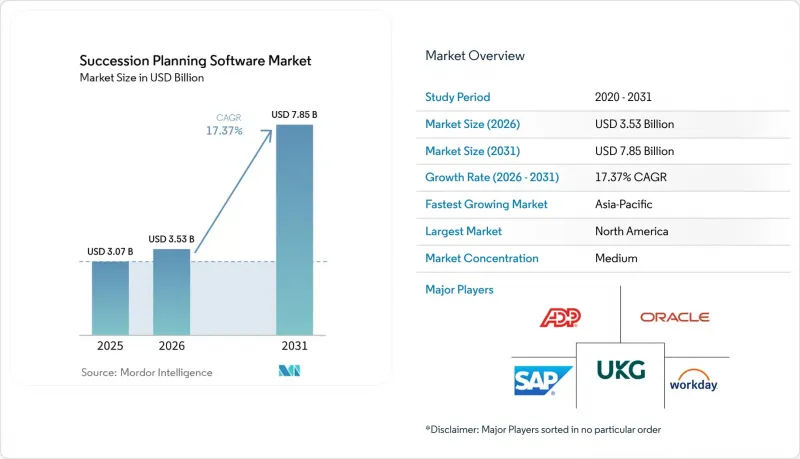
本報告按元件(軟體和服務)、部署模式(本地部署和雲端部署)、組織規模(中小企業和大型企業)、最終用戶產業(銀行、金融服務和保險、資訊科技和電信、教育及其他)以及地區進行細分。市場預測以美元計價。
全球繼任管理軟體市場趨勢及洞察
加速採用人工智慧驅動的人才分析技術。
人工智慧正在變革繼任計劃,將評估方式從零散的轉向持續的人才智慧。現代平台整合績效數據、技能評估和同儕回饋,產生即時繼任者熱力圖,提前數月揭示人員流失風險。這使得關鍵職位的招募時間縮短了30%,內部晉升率提高了18%。 SAP於2025年整合了“Joule AI Copilot”,使管理者能夠用簡單易懂的語言查詢繼任計劃方案,展現了對話式分析如何加速決策週期。這些功能在醫療保健和製造業等行業尤其重要,因為在這些行業,外部招聘以滿足特定技能需求可能極具挑戰性。
由於技能人才短缺,內部調動的需求日益增加。
由於勞動市場趨緊,內部調動已從單純的人才留任策略提升為企業策略。澳洲公共服務委員會的報告顯示,到2025年,88%的機構將面臨嚴重的技能缺口,這促使各機構迫切需要投資相關工具,以便在招聘資訊發佈到招聘網站之前識別內部候選人。 Fuel50於2026年3月發布的技能成長預測模型,能夠預測未來的技能需求,並提案個人化的學習路徑,幫助員工為未來幾年承擔領導角色做好準備。優先考慮內部調動的組織,其員工任期平均延長41%,員工敬業度平均提高25%,這印證了能夠自動化職涯發展路徑的繼任計畫平台在業務上的有效性。
人才檔案中的資料隱私和安全問題
繼任計畫工具儲存著高度敏感的員工數據,這些數據受到《一般資料保護規範》(GDPR) 和《加州消費者隱私法案》(CCPA) 嚴格的同意和保留規則的約束。 2024 年,監管機構對違反 GDPR 的行為處以 21 億歐元(23 億美元)的罰款。因此,34% 的人力資源主管暫停了平台部署,直到建立起管治結構。雖然供應商現在正在整合「隱私設計」功能,例如基於角色的存取控制和偽匿名化,但許多中小企業缺乏管理跨國合規架構所需的法律資源。
細分市場分析
預計到2025年,軟體仍將佔據繼任管理軟體市場66.45%的佔有率,平台授權仍是其主要收入來源。然而,實施過程中的挑戰導致企業與諮詢合作夥伴簽訂的合約數量增加,這些合約涉及人工智慧模型配置和遺留資料整合,這一轉變支撐了服務業19.23%的預期複合年成長率。面臨多供應商人才管理生態系統的企業通常透過全球系統整合商實施解決方案,這些解決方案現在除了技術工作外,還包括變革管理研討會。這些加值服務包有助於供應商在客戶實現人才工作流程現代化的過程中維持客戶留存率。
對於缺乏內部負責人的中型企業而言,託管服務極具吸引力,因為服務提供者可以監控資料完整性並提供季度領導力人才儲備報告。預計到2031年,繼任管理軟體市場中託管服務的市場規模將以兩位數的速度成長,這反映出市場對符合營運預算的訂閱式經營模式的需求。一些專業顧問公司正積極響應這一趨勢,提供固定價格的方案,將實施時間從數月縮短至數週,從而減少對正在進行的績效評估的干擾。隨著董事會要求更頻繁地了解繼任候選人的情況,這種由服務主導的成長勢頭預計將持續下去。
截至2025年,本地部署仍佔繼任管理軟體市場佔有率的60.21%。這是因為許多大型企業仍在使用傳統人才管理套件中的人才管理模組。然而,雲端訂閱正以20.01%的複合年成長率快速成長,這主要得益於混合辦公環境下員工所青睞的諸多優勢,例如自動更新、降低資本支出以及行動存取。擁有SOC 2 II型和ISO 27001認證的供應商已經消除了以往迫使其在本地伺服器上運行的安全隱患。因此,新買家現在很少再要求永久授權了。
預計到2031年,雲端平台繼任計畫軟體的市場規模將超過本地部署版本。推動這一轉變的主要因素是中小企業優先考慮快速部署。 API驅動的整合將使人力資源負責人能夠在幾天內(而非幾個月)將繼任計畫儀錶板整合到招募、培訓和薪酬管理系統中。在嚴格監管的行業中,將敏感個人資料保留在本地,同時將分析工作負載遷移到雲端的混合架構仍然是過渡模式。然而,分析師一致認為,雲端優先的採購要求現在已成為大多數提案書(RFP)的標準配置。
區域分析
北美地區在《薩班斯-奧克斯利法案》管治法規和強大的供應商生態系統的支持下,預計到2025年將以37.89%的市場佔有率引領繼任管理軟體市場。上市公司定期揭露董事會層級的人才儲備指標,這推動了各產業在平台方面的支出。加拿大也呈現類似的趨勢,其聯邦政策要求對關鍵職能部門制定業務連續性計畫。此外,墨西哥的外包中心正在採用標準化的人力資源框架來服務跨國客戶。這一基礎使區域供應商能夠維持較高的合約續約率。
亞太地區預計將以18.96%的複合年成長率成長,成為繼任管理軟體市場成長最快的地區。在印度和中國,雲端基礎設施成本的持續下降正在加速人力資源數位化轉型。與此同時,澳洲公共機構正積極尋求工具來應對全國範圍內的技能短缺問題。在日本,由於勞動力老化,知識轉移的需求日益成長,大型企業集團正在用基於分析的繼任計畫儀表板取代人工指導專案。遵守當地的薪資核算系統和勞動法仍然是進入市場的先決條件。能夠確保資料居住的供應商可以加快採購週期。
在歐洲,以德國、英國和法國為中心的ESG(環境、社會和治理)資訊揭露正穩步推進,尤其是在法國,由於《企業永續性報告指令》(CSRD)的實施,人力資源規劃已成為ESG資訊揭露的關鍵要素。南美洲的趨勢則是喜憂參半。巴西的銀行業正在穩步投資,但在其他地區,外匯波動可能會延遲專案核准。在中東和非洲,尤其是在阿拉伯聯合大公國和沙烏地阿拉伯,受政府經濟多元化政策的推動,出現了一些小眾需求。在區域資料保護框架成熟之前,混合託管模式可以作為過渡方案。
其他好處:
- Excel格式的市場預測(ME)表
- 3個月的分析師支持
目錄
第1章:引言
- 研究假設和市場定義
- 調查範圍
第2章:調查方法
第3章執行摘要
第4章 市場狀況
- 市場概覽
- 市場促進因素
- 加速採用人工智慧驅動的人才分析技術。
- 由於技能短缺,內部調動的需求不斷增加。
- 領導層延續計畫面臨越來越大的合規壓力
- 向雲端原生人力資源技術堆疊的轉型正在推進。
- 遠端和混合辦公模式的擴展需要一個數位化的繼任計畫流程。
- 將繼任計畫與更廣泛的人才管理體系結合
- 市場限制因素
- 人才檔案中的資料隱私和安全問題令人擔憂
- 傳統人事做法引發的變革阻力
- 缺乏能夠管理高級平台的熟練管理員。
- 經濟的不確定性正在減緩人力資源技術領域的支出。
- 產業價值鏈分析
- 監理情勢
- 技術展望
- 宏觀經濟因素對市場的影響
- 波特五力分析
第5章 市場規模與成長預測
- 按組件
- 軟體
- 人才招募和評估軟體
- 繼任計畫和角色映射軟體
- 職涯發展規劃與技能發展規劃軟體
- 領導力發展與準備支援軟體
- 勞動力分析與人才智慧軟體
- 其他軟體
- 服務
- 軟體
- 按部署模式
- 現場
- 基於雲端的
- 按組織規模
- 中小企業
- 大公司
- 按最終用戶行業分類
- 銀行、金融服務和保險(BFSI)
- 衛生保健
- IT/通訊
- 製造業
- 教育
- 政府
- 其他終端用戶產業
- 按地區
- 北美洲
- 美國
- 加拿大
- 墨西哥
- 南美洲
- 巴西
- 阿根廷
- 其他南美國家
- 歐洲
- 德國
- 英國
- 法國
- 義大利
- 西班牙
- 俄羅斯
- 其他歐洲國家
- 亞太地區
- 中國
- 日本
- 印度
- 韓國
- 澳洲和紐西蘭
- 其他亞太國家
- 中東
- 阿拉伯聯合大公國
- 沙烏地阿拉伯
- 土耳其
- 其他中東國家
- 非洲
- 南非
- 奈及利亞
- 其他非洲國家
- 北美洲
第6章 競爭情勢
- 市場集中度
- 策略趨勢
- 市佔率分析
- 公司簡介
- SAP SE
- Oracle Corporation
- Workday Inc.
- UKG Inc.
- Cornerstone OnDemand Inc.
- ADP Inc.
- Ceridian HCM Holding Inc.
- BambooHR LLC
- Gloat Ltd.
- Eightfold AI Inc.
- TalentGuard Inc.
- PeopleFluent Inc.
- SumTotal Systems LLC
- PageUp People Holdings Pty Ltd
- ClearCompany LLC
- Plum.io Inc.
- Lattice Holdings Inc.
- HiBob Ltd.
- Degreed Inc.
- Fuel50 Ltd.
第7章 市場機會與未來展望
According to Mordor Intelligence, the succession planning software market size was valued at USD 3.07 billion in 2025 and estimated to grow from USD 3.53 billion in 2026 to reach USD 7.85 billion by 2031, at a CAGR of 17.37% during the forecast period (2026-2031).
This report is Segmented by Component (Software, and Services), Deployment Model (On-Premises, and Cloud-Based), Organization Size (Small and Medium-Sized Enterprises [SMEs], and Large Enterprises), End-User Industry (Banking, Financial Services, and Insurance [BFSI], Information Technology and Telecom, Education, and More), and Geography. The Market Forecasts are Provided in Terms of Value (USD).
Global Succession Planning Software Market Trends and Insights
Accelerating Adoption of AI-Driven Talent Analytics
Artificial intelligence is transforming succession programs by converting episodic reviews into continuous talent intelligence. Modern platforms combine performance data, skills assessments, and peer feedback to create real-time succession heat maps that uncover flight risks months in advance, cutting time-to-fill for critical roles by 30% and boosting internal promotions by 18%. SAP embedded the Joule AI copilot in 2025 so managers can query succession scenarios in plain language, illustrating how conversational analytics hasten decision cycles. These capabilities carry particular weight in healthcare and manufacturing, where external hiring often struggles to match niche skill requirements.
Rising Demand for Internal Mobility Amid Skills Shortages
Tight labor markets have elevated internal mobility from a retention tactic to an enterprise strategy. The Australian Public Service Commission reported that 88% of agencies faced critical skills gaps in 2025, prompting urgent investment in tools that surface internal candidates before vacancies hit job boards. Fuel50's Skills Growth Predictive Model, launched in March 2026, forecasts future competency needs and recommends individual learning paths that prepare employees for leadership years in advance. Organizations emphasizing internal mobility record 41% longer tenure and 25% higher engagement scores, figures that strengthen the business case for succession platforms that automate career pathing.
Data Privacy and Security Concerns in Talent Profiles
Succession tools store sensitive employment data that triggers strict consent and retention rules under the GDPR and the California Consumer Privacy Act. Regulators issued EUR 2.1 billion (USD 2.3 billion) in GDPR fines during 2024, causing 34% of HR leaders to pause platform deployments until governance models mature. Vendors now embed privacy-by-design features such as role-based access controls and pseudonymization, yet many small enterprises lack the legal resources to navigate multi-country compliance regimes.
Other drivers and restraints analyzed in the detailed report include:
- Increasing Compliance Pressures for Leadership Continuity Planning
- Growing Shift Toward Cloud-Native HR Tech Stacks
- Resistance to Change From Traditional HR Practices
For complete list of drivers and restraints, kindly check the Table Of Contents.
Segment Analysis
Software retained 66.45% of the succession planning software market in 2025, confirming that platform licenses still form the revenue core. Implementation challenges, however, are steering more contracts toward advisory partners that configure AI models and integrate legacy data, a shift that explains the 19.23% CAGR forecast for services. Enterprises facing multivendor human capital ecosystems often route deployments through global systems integrators, which now bundle change-management workshops alongside technical tasks. These value-added packages help vendors defend account stickiness as customers modernize talent workflows.
Managed services appeal to mid-market firms that lack in-house analytics staff, allowing providers to monitor data hygiene and deliver quarterly leadership pipeline reports. The succession planning software market size for managed offerings is projected to rise at double-digit rates through 2031, reflecting demand for subscription economics aligned with operating budgets. Niche consultancies have responded with fixed-price playbooks that compress launch timelines from months to weeks, thereby reducing disruption to ongoing performance reviews. This service-led momentum should continue as boards request more frequent bench-strength updates.
On-premises deployment accounted for 60.21% succession planning software market share in 2025 because many large enterprises still run talent modules inside older human capital suites. Yet cloud subscriptions are scaling at a 20.01% CAGR thanks to automatic updates, lower capital expense, and mobile access, benefits that resonate with hybrid workforces. Vendors that achieve SOC 2 Type II and ISO 27001 certifications now ease security objections that once anchored workloads on local servers. As a result, new buyers rarely request perpetual licenses.
The succession planning software market size for cloud platforms is expected to surpass on-premises revenue before 2031, a crossover driven by small and medium-sized enterprises prioritizing rapid implementation. API-enabled integration lets HR leaders stitch succession dashboards into recruiting, learning, and compensation systems in days rather than months. Hybrid architectures remain a transitional model in heavily regulated industries, keeping sensitive personal data on-site while pushing analytics workloads to the cloud. However, analysts agree that cloud-first procurement language is now standard in most RFPs.
Complete Report Scope:
- By Component
- Software
- Talent Identification and Assessment Software
- Succession Planning and Role Mapping Software
- Career Pathing and Development Planning Software
- Leadership Development and Readiness Software
- Workforce Analytics and Talent Intelligence Software
- Other Software
- Services
- Software
- By Deployment Model
- On-Premises
- Cloud-Based
- By Organization Size
- Small and Medium-Sized Enterprises (SMEs)
- Large Enterprises
- By End-User Industry
- Banking, Financial Services, and Insurance (BFSI)
- Healthcare
- Information Technology and Telecom
- Manufacturing
- Education
- Government
- Other End-User Industry
- By Geography
- North America
- United States
- Canada
- Mexico
- South America
- Brazil
- Argentina
- Rest of South America
- Europe
- Germany
- United Kingdom
- France
- Italy
- Spain
- Russia
- Rest of Europe
- Asia-Pacific
- China
- Japan
- India
- South Korea
- Australia and New Zealand
- Rest of Asia-Pacific
- Middle East
- United Arab Emirates
- Saudi Arabia
- Turkey
- Rest of Middle East
- Africa
- South Africa
- Nigeria
- Rest of Africa
- North America
Geography Analysis
North America led the succession planning software market with a 37.89% share in 2025, supported by Sarbanes-Oxley governance rules and a dense vendor ecosystem. Public corporations routinely disclose board-level pipeline metrics, which normalizes platform spending across industries. Canada mirrors the trend as federal policies demand continuity plans for critical functions, and Mexico's outsourcing hubs adopt standardized HR frameworks to serve multinational clients. This foundation gives regional suppliers strong renewal rates.
Asia-Pacific is projected to post an 18.96% CAGR, making it the fastest-growing territory within the succession planning software market. Digital HR transformation across India and China is accelerating because cloud infrastructure costs keep falling, while Australia's public agencies actively seek tools that address nationwide skill shortages. Japan's aging workforce intensifies knowledge-transfer needs, prompting large conglomerates to replace manual mentorship schemes with analytics-driven succession dashboards. Local payroll and labor-law integrations remain table stakes for market entry. Vendors that secure data-residency assurances win faster procurement cycles.
Europe maintains steady uptake anchored in Germany, the United Kingdom, and France, where the Corporate Sustainability Reporting Directive elevates workforce planning to ESG disclosures. South America shows mixed momentum: Brazil's banks invest steadily, but currency swings can slow project approvals elsewhere. The Middle East and Africa contribute niche demand driven by government diversification agendas, particularly in the United Arab Emirates and Saudi Arabia. Hybrid hosting models offer a bridge until regional data-protection frameworks mature.
- SAP SE
- Oracle Corporation
- Workday Inc.
- UKG Inc.
- Cornerstone OnDemand Inc.
- ADP Inc.
- Ceridian HCM Holding Inc.
- BambooHR LLC
- Gloat Ltd.
- Eightfold AI Inc.
- TalentGuard Inc.
- PeopleFluent Inc.
- SumTotal Systems LLC
- PageUp People Holdings Pty Ltd
- ClearCompany LLC
- Plum.io Inc.
- Lattice Holdings Inc.
- HiBob Ltd.
- Degreed Inc.
- Fuel50 Ltd.
Additional Benefits:
- The market estimate (ME) sheet in Excel format
- 3 months of analyst support
TABLE OF CONTENTS
1 INTRODUCTION
- 1.1 Study Assumptions and Market Definition
- 1.2 Scope of the Study
2 RESEARCH METHODOLOGY
3 EXECUTIVE SUMMARY
4 MARKET LANDSCAPE
- 4.1 Market Overview
- 4.2 Market Drivers
- 4.2.1 Accelerating Adoption of AI-Driven Talent Analytics
- 4.2.2 Rising Demand for Internal Mobility Amid Skills Shortages
- 4.2.3 Increasing Compliance Pressures for Leadership Continuity Planning
- 4.2.4 Growing Shift Toward Cloud-Native HR Tech Stacks
- 4.2.5 Expansion of Remote and Hybrid Work Models Requiring Digital Succession Processes
- 4.2.6 Integration of Succession Planning With Broader Talent Management Suites
- 4.3 Market Restraints
- 4.3.1 Data Privacy and Security Concerns in Talent Profiles
- 4.3.2 Resistance to Change From Traditional HR Practices
- 4.3.3 Limited Skilled Administrators to Manage Advanced Platforms
- 4.3.4 Economic Uncertainty Causing HR Tech Spending Delays
- 4.4 Industry Value Chain Analysis
- 4.5 Regulatory Landscape
- 4.6 Technological Outlook
- 4.7 Impact of Macroeconomic Factors on the Market
- 4.8 Porter's Five Forces Analysis
- 4.8.1 Threat of New Entrants
- 4.8.2 Bargaining Power of Suppliers
- 4.8.3 Bargaining Power of Buyers
- 4.8.4 Threat of Substitute Products
- 4.8.5 Intensity of Competitive Rivalry
5 MARKET SIZE AND GROWTH FORECASTS (VALUE)
- 5.1 By Component
- 5.1.1 Software
- 5.1.1.1 Talent Identification and Assessment Software
- 5.1.1.2 Succession Planning and Role Mapping Software
- 5.1.1.3 Career Pathing and Development Planning Software
- 5.1.1.4 Leadership Development and Readiness Software
- 5.1.1.5 Workforce Analytics and Talent Intelligence Software
- 5.1.1.6 Other Software
- 5.1.2 Services
- 5.1.1 Software
- 5.2 By Deployment Model
- 5.2.1 On-Premises
- 5.2.2 Cloud-Based
- 5.3 By Organization Size
- 5.3.1 Small and Medium-Sized Enterprises (SMEs)
- 5.3.2 Large Enterprises
- 5.4 By End-User Industry
- 5.4.1 Banking, Financial Services, and Insurance (BFSI)
- 5.4.2 Healthcare
- 5.4.3 Information Technology and Telecom
- 5.4.4 Manufacturing
- 5.4.5 Education
- 5.4.6 Government
- 5.4.7 Other End-User Industry
- 5.5 By Geography
- 5.5.1 North America
- 5.5.1.1 United States
- 5.5.1.2 Canada
- 5.5.1.3 Mexico
- 5.5.2 South America
- 5.5.2.1 Brazil
- 5.5.2.2 Argentina
- 5.5.2.3 Rest of South America
- 5.5.3 Europe
- 5.5.3.1 Germany
- 5.5.3.2 United Kingdom
- 5.5.3.3 France
- 5.5.3.4 Italy
- 5.5.3.5 Spain
- 5.5.3.6 Russia
- 5.5.3.7 Rest of Europe
- 5.5.4 Asia-Pacific
- 5.5.4.1 China
- 5.5.4.2 Japan
- 5.5.4.3 India
- 5.5.4.4 South Korea
- 5.5.4.5 Australia and New Zealand
- 5.5.4.6 Rest of Asia-Pacific
- 5.5.5 Middle East
- 5.5.5.1 United Arab Emirates
- 5.5.5.2 Saudi Arabia
- 5.5.5.3 Turkey
- 5.5.5.4 Rest of Middle East
- 5.5.6 Africa
- 5.5.6.1 South Africa
- 5.5.6.2 Nigeria
- 5.5.6.3 Rest of Africa
- 5.5.1 North America
6 COMPETITIVE LANDSCAPE
- 6.1 Market Concentration
- 6.2 Strategic Moves
- 6.3 Market Share Analysis
- 6.4 Company Profiles (includes Global Level Overview, Market Level Overview, Core Segments, Financials as available, Strategic Information, Market Rank/Share, Products and Services, Recent Developments)
- 6.4.1 SAP SE
- 6.4.2 Oracle Corporation
- 6.4.3 Workday Inc.
- 6.4.4 UKG Inc.
- 6.4.5 Cornerstone OnDemand Inc.
- 6.4.6 ADP Inc.
- 6.4.7 Ceridian HCM Holding Inc.
- 6.4.8 BambooHR LLC
- 6.4.9 Gloat Ltd.
- 6.4.10 Eightfold AI Inc.
- 6.4.11 TalentGuard Inc.
- 6.4.12 PeopleFluent Inc.
- 6.4.13 SumTotal Systems LLC
- 6.4.14 PageUp People Holdings Pty Ltd
- 6.4.15 ClearCompany LLC
- 6.4.16 Plum.io Inc.
- 6.4.17 Lattice Holdings Inc.
- 6.4.18 HiBob Ltd.
- 6.4.19 Degreed Inc.
- 6.4.20 Fuel50 Ltd.
7 MARKET OPPORTUNITIES AND FUTURE OUTLOOK
- 7.1 White-space and Unmet-Need Assessment

 人工智慧驅動的農場管理軟體市場預測至2034年:按部署類型、軟體模組、人工智慧技術、應用、最終用戶和地區分類的全球分析
 人工智慧專業服務市場:全球市場預測,2026-2032年神經包容性工作場所技術市場:預測至 2034 年 - 按解決方案、組件、技術、企業規模、最終用戶和地區分類的全球分析
 人工智慧搜尋廣告:市場佔有率分析、產業趨勢與統計、成長預測(2026-2031)
 2026年全球繼任與領導規劃軟體市場報告人工智慧驅動的人才分析:市場佔有率分析、行業趨勢和統計數據、成長預測(2026-2031 年)勞動力智慧平台:市場佔有率分析、產業趨勢與統計、成長預測(2026-2031 年)員工技能評估與映射平台:市場佔有率分析、產業趨勢與統計、成長預測(2026-2031)
 2026 年的發展趨勢:記憶體將滿足日益成長的人工智慧推理需求作物產量預測市場展望至2034年—按解決方案類型、組件、技術、應用、最終用戶和地區分類的全球分析