


 |
市場調查報告書
商品編碼
2099270
HBM4:市場佔有率分析、產業趨勢與統計、成長預測(2026-2031)HBM4 - Market Share Analysis, Industry Trends & Statistics, Growth Forecasts (2026 - 2031) |
||||||

※ 本網頁內容可能與最新版本有所差異。詳細情況請與我們聯繫。
根據 Mordor Intelligence 預測,HBM4 市場預計將從 2025 年的 1.5 億美元成長到 2026 年的 2.8 億美元,到 2031 年達到 61.7 億美元,2026 年至 2031 年的複合年成長率預計為 85.80%。
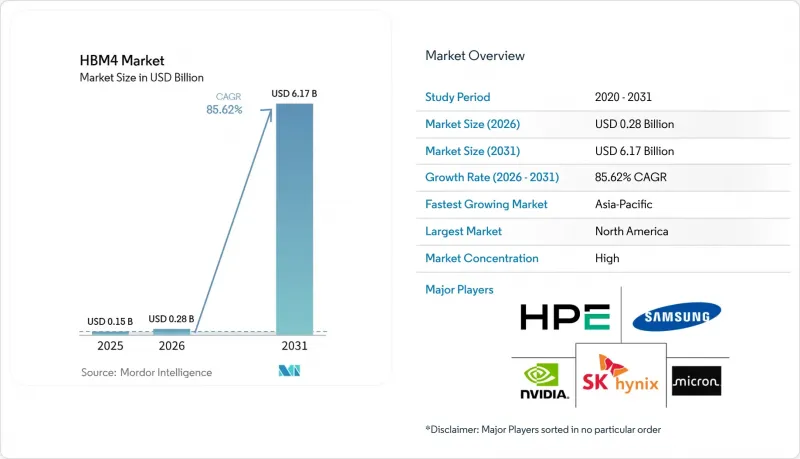
本報告按每堆疊記憶體容量(16 GB、24 GB、32 GB 和 64 GB 或更大)、處理器介面(GPU、CPU、AI 加速器和 ASIC、FPGA 等)、應用(AI 訓練伺服器、AI 推理伺服器、高效能運算 (HPC) 伺服器等)、最終用戶產業(雲端服務供應商、企業 IT 等)和地區伺服器進行區隔。市場預測以美元 (USD) 為單位。
全球 HBM4 市場趨勢與洞察
人工智慧加速器對頻寬的需求日益成長
HBM4市場的發展主要受人工智慧模型規模成長的驅動。目前,市場對記憶體頻寬的需求遠超過前幾代產品,同時還需控制在合理的功耗範圍內。 2026年2月,三星發表了一款商用HBM4產品,其處理速度高達11.7 Gbps,單頻寬最高可達3.3 TB/s。這相比HBM3E實現了顯著的效能提升,為系統設計人員提供了建構更高密度人工智慧記憶體子系統的直接途徑。美光也推出了一款處理速度超過11.0 Gbps的HBM4產品,採用2048腳總線,單堆疊頻寬超過2.8 TB/s。這顯示HBM4市場正圍繞著通用的頻寬目標而發展,而非僅依賴各個廠商的宣傳。 2025年4月,JEDEC正式將2048位元介面和每堆疊32個獨立通道的標準化。這在標準層面上鞏固了頻寬,降低了開發週期較長的平台開發人員的不確定性。這一點至關重要。這是因為訓練叢集、長上下文推理和混合專家(MOE)工作負載對記憶體頻寬的利用率較高,這意味著HBM4市場受益於與架構緊密相關的效能需求,而非產品週期短。因此,買家不再將HBM4視為可選的高階組件,而是將其視為需要大規模、持續吞吐量的頂級AI系統的必備組件。
HBM4認證與下一代GPU的發布週期密切相關。
HBM4市場就像是同步上市的生態系統,因為認證狀態決定了供應商能否進入下一代加速器的量產階段。在2025年的認證週期中,當平台要求超過11Gbps時,供應商被迫重新提交樣品並調整生產計畫。這清楚地表明,單一的規格變更就能重置整個HBM4市場的商業化進程。三星達到了更高的11.7Gbps量產標準,而美光目前的HBM4產品也超過了11.0Gbps,這使得競爭格局縮小到那些能夠按時滿足更嚴格平台要求的供應商。 SK海力士於2025年9月完成了HBM4的研發,其性能超過了JEDEC的8Gbps基準值,從而獲得了早期認證,並鞏固了其在首輪配額分配中的地位。因此,在HBM4市場,能夠儘早獲得認證的供應商更受青睞。這是因為獲得認證意味著,在其他供應商達到類似的良率和速度水準之前,供應商就能確保未來幾年的收入預期。這也意味著客戶越來越傾向於根據平台里程碑來規劃記憶體採購,而不是將其視為後期組件的選擇。
先進的包裝能力有限
HBM4市場面臨的最直接限制因素是確保先進封裝的產能,特別是CoWoS級中介層整合和混合鍵結。台積電本身的文件顯示,CoWoS對於高效能封裝至關重要,而這份草案也揭示了加速器計畫的等候名單已經遠遠超出正常的規劃週期。這套頸部意義重大,因為HBM4市場的擴張並非僅依靠儲存晶圓的產量;基礎晶片、矽中介層、鍵結設備、後端組裝和最終測試都需要同步擴展。美光於2026年3月收購了PSMC的桐洛工廠,這正是為了增加製造基礎設施並加強其在台灣的生產基地。然而,這些改進通常需要時間才能轉化為可用的產能。換句話說,短期客戶需求可能持續超過供應鏈將晶片轉化為可用HBM4堆疊的能力。因此,即使最終應用很有吸引力且已準備好商業化,擁有小規模人工智慧晶片的客戶在整合方面也面臨延誤。
細分市場分析
2025年,32GB級產品佔據了所謂的HBM4市場44.31%的佔有率,成為預測期初最大的商用容量細分市場。這一地位反映了實際良率、頻寬提升和上市時機之間的平衡,因為12層堆疊結構無需等待16層堆疊結構的良率穩定,即可實現早期商用部署。三星於2026年2月首次推出基於其1c DRAM製程的24GB-36GB配置的商用HBM4產品,證實了HBM4市場以專注於已準備好進行量產認證的容量範圍的產品拉開帷幕。美光針對當前平台需求推出的HBM4產品也採用了36GB 12層堆疊結構,這進一步表明,在HBM4市場初期,相比更高堆疊結構,生產學習成本較低的配置更受青睞。因此,這個產能範圍是當前收入的基礎,因為它接近性能的尖端水平,能夠確保人工智慧的分配,也屬於供應商能夠大規模支援的製造範圍。
預計到2031年,64GB以上容量的市場將以86.78%的複合年成長率成長,此成長速度與16層堆疊結構的商用成熟度直接相關。儘管JEDEC支援16層級構造中單層最高64GB的容量,並且已製定了藍圖,但HBM4市場仍需依靠晶片減薄和更嚴格的製程控制,才能將該藍圖轉化為廣泛的出貨量。 SK海力士宣布將於2026年初推出48GB 16層HBM4裝置,將48GB等級定位為目前12層產品量產擴張與未來更高密度產品之間的「橋樑」。低容量的16GB和24GB產品將繼續在網路、通訊和邊緣AI工作負載中發揮重要作用,這些應用對頻寬的需求較低,而成本控制更為關鍵。儘管 64GB 等級 HBM4 晶片仍在努力實現穩定的商業性良率,但隨著製造工具的多樣化以及客戶對單封裝更高記憶體容量的需求,48GB 等級 HBM4 晶片有望從中受益。這在 HBM4 市場中形成了一個清晰的密度層級結構:當前收入主要由實際推出容量驅動,而未來的成長潛力則在於那些良率仍在穩步提升的高容量封裝。
到2025年,基於GPU的產品將佔處理器介面銷售額的76.83%,這意味著GPU將從HBM4上市之初就成為該市場的主導介面。這一佔有率反映了現有加速器生態系統的規模,以及人工智慧運算平台遷移的趨勢,這種趨勢推動記憶體需求集中化和大規模採購。 HBM4市場仍與GPU專案緊密相關,因為商業認證、分配優先順序和系統層級設計都始於量產最廣泛的加速器平台。同時,介面配置已經表明,記憶體供應商已做好準備應對比純粹GPU主導模式更廣泛的需求結構。基於CPU的產品將繼續滿足科學模擬和高效能運算工作負載的需求,而FPGA在專用訊號處理和路由環境中的需求仍然十分顯著。
預計到2031年,AI加速器和ASIC將以86.71%的複合年成長率成長,成為HBM4市場中成長最快的處理器介面細分領域。這一成長反映了超大規模資料中心業者大規模資料中心營運商為降低對標準GPU定價的依賴,並更有效地最佳化推理經濟性所做的努力。這種轉變使得HBM4市場在策略上更加複雜,因為客製化ASIC專案需要在設計週期的早期階段確保基礎晶片與控制器的一致性,而標準GPU專案則需要這樣做。 2026年4月,西門子EDA宣布HBM4控制器架構將不再向下相容於HBM3和HBM3E。這意味著非GPU開發商將被迫徹底重新設計其控制器,而不是簡單地進行升級。這將延長設計實現的前置作業時間,但也會提升能夠支援早期技術合作和更精細的記憶體整合的供應商的價值。從長遠來看,即使GPU仍然是短期收入的主要來源,HBM4市場對單一介面的依賴性也可能降低。
區域分析
到2025年,北美將佔據HBM4市場48.33%的佔有率,成為預測期初最大的區域收入來源。這一地位反映了超大規模雲端服務供應商的集中度、美國加速器平台的核心地位,以及該地區對整個HBM4市場分配優先順序的影響力。該地區也正在影響貿易趨勢,因為美國商務部工業安全局(BIS)於2024年12月根據出口管制分類編號(ECCN)3A090實施的出口限制,將先進的HBM產品置於更嚴格的合規框架之下。 2026年5月,BIS發布了進一步的執法指南,明確規定許可要求將基於營業單位總部所在地,而非交易地點。加拿大也透過對雲端運算和人工智慧基礎設施的投資,推動了區域需求的成長,並將北美的需求擴展到美國以外的地區。
預計到2031年,亞太地區將以86.79%的複合年成長率成長,成為HBM4市場成長最快的地區。該地區的獨特之處在於,它既是最大的供應基地,又擁有強勁的國內需求,尤其是在韓國和台灣地區。韓國擁有SK海力士和三星電子等公司,而台灣則透過台積電在先進封裝技術領域扮演核心角色,美光收購桐洛進一步鞏固了其市場地位。韓國的大規模人工智慧資料中心計畫也進一步推動了該地區的需求,因為主要生產國正準備在國內吸收更多基於HBM4的運算資源。這種雙重角色使得亞太地區在HBM4市場結構上與其他地區有所不同,因為同一區域內的供應擴張和消費成長相互促進。
儘管歐洲在2025年起步時僅建造了小規模的基礎設施,但隨著各國主導的人工智慧專案進入全面部署階段,HBM4市場的戰略重要性日益凸顯。德國電信在慕尼黑的人工智慧工廠和Softbank Group在法國的1GW計畫表明,大規模人工智慧基礎設施的建設如今已獲得有組織、有戰略的支持。在南美洲,2025年至2026年間,HBM4的應用仍處於早期階段,但中東和非洲由於政府主導的人工智慧投資和大規模資料中心建設計畫,進展更為迅速。因此,目前的HBM4市場在地理上較為集中,但未來預期需求分佈將更加廣泛,不僅受到商業雲擴張的影響,也受到政策主導的運算項目的影響。
其他好處:
- Excel格式的市場預測(ME)表
- 3個月的分析師支持
目錄
第1章:引言
- 研究假設和市場定義
- 調查範圍
第2章:調查方法
第3章執行摘要
第4章 市場狀況
- 市場概覽
- 市場促進因素
- 人工智慧加速器對頻寬的需求日益成長
- HBM4認證與下一代GPU的發布週期密切相關。
- 擴大混合鍵結和先進封裝的規模
- 政府營運的人工智慧資料中心記憶體使用量增加
- 國防和高可靠性運算的部署
- 與 GDDR 和 HBM3E 相比,具有更高的散熱和電源效率
- 市場限制因素
- 缺乏先進的包裝生產能力
- 高堆疊層數下的TSV產量與堆疊複雜性
- 認證風險和設計實施延誤
- 出口限制和供應鏈中斷
- 產業價值鏈分析
- 技術展望
- 宏觀經濟因素對市場的影響
- 波特五力分析
第5章 市場規模與成長預測
- 每個堆疊的記憶體容量
- 16 GB
- 24 GB
- 32 GB
- 48 GB
- 64 GB 或更多
- 透過處理器介面
- GPU
- CPU
- AI加速器和ASIC
- FPGA
- 其他處理器介面
- 透過使用
- AI訓練伺服器
- 人工智慧推理伺服器
- 高效能運算 (HPC) 伺服器
- 網路與通訊
- 汽車和邊緣人工智慧
- 其他用途
- 按最終用途行業分類
- 雲端服務供應商
- 企業IT
- 電訊
- 車
- 航太/國防
- 其他終端用戶產業
- 按地區
- 北美洲
- 美國
- 加拿大
- 墨西哥
- 歐洲
- 德國
- 英國
- 法國
- 義大利
- 其他歐洲國家
- 亞太地區
- 中國
- 日本
- 韓國
- 台灣
- 印度
- 其他亞太國家
- 南美洲
- 中東和非洲
- 北美洲
第6章 競爭情勢
- 市場集中度
- 策略趨勢
- Vendor Positioning Analysis
- 公司簡介
- Hewlett Packard Enterprise Company
- Samsung Electronics Co., Ltd.
- SK hynix Inc.
- Micron Technology, Inc.
- NVIDIA Corporation
- Advanced Micro Devices, Inc.
- Taiwan Semiconductor Manufacturing Company Limited
- Amkor Technology, Inc.
- ASE Technology Holding Co., Ltd.
- Intel Corporation
- Broadcom Inc.
- Marvell Technology, Inc.
- Rambus Inc.
- Cadence Design Systems, Inc.
- Synopsys, Inc.
- Hanmi Semiconductor Co., Ltd.
- JCET Group Co., Ltd.
- Advantest Corporation
- Tokyo Electron Limited
- Lam Research Corporation
第7章 市場機會與未來展望
According to Mordor Intelligence, the HBM4 market size is expected to increase from USD 0.15 billion in 2025 to USD 0.28 billion in 2026 and reach USD 6.17 billion by 2031, growing at a CAGR of 85.80% over 2026-2031.
This report is Segmented by Memory Capacity Per Stack (16 GB, 24 GB, 32 GB, and 64 GB and Above), Processor Interface (GPU, CPU, AI Accelerator and ASIC, FPGA, and More), Application (AI Training Servers, AI Inference Servers, High-Performance Computing (HPC) Servers, and More), End Use Industry (Cloud Service Providers, Enterprise IT, and More), and Geography. The Market Forecasts are Provided in Terms of Value (USD).
Global HBM4 Market Trends and Insights
Accelerating AI Accelerator Bandwidth Demand
The HBM4 market is being driven by AI model scaling, which now requires far more memory bandwidth within a practical power envelope than prior generations could deliver. Samsung shipped commercial HBM4 in February 2026 with a processing speed of 11.7 Gbps and up to 3.3 TB/s of bandwidth per stack, marking a major performance step over HBM3E and giving system designers a direct path to denser AI memory subsystems. Micron also positioned HBM4 above 11.0 Gbps with a 2,048-pin bus and more than 2.8 TB/s per stack, indicating that the HBM4 market is scaling around a shared bandwidth target rather than isolated vendor claims. JEDEC formalized the 2,048-bit interface and 32 independent channels per stack in April 2025, which made the bandwidth jump durable at the standards level and reduced uncertainty for long-cycle platform developers. That matters because training clusters, long-context inference, and mixture-of-experts workloads are using memory bandwidth more aggressively, so the HBM4 market is benefiting from a performance need that sits closer to the architecture than to a short product cycle. As a result, buyers are not treating HBM4 as an optional premium part, but as a practical requirement for top-tier AI systems that need sustained throughput at scale.
HBM4 Qualification Tied to Next-Gen GPU Launch Cycles
The HBM4 market behaves like a launch-synchronized ecosystem, because qualification status determines whether a supplier can participate in a new accelerator generation at volume. When platform requirements exceeded 11 Gbps during the 2025 qualification cycle, suppliers had to resubmit samples and adjust their timelines, underscoring how a single specification change could reset commercial windows across the HBM4 market. Samsung met that higher threshold in mass production at 11.7 Gbps, while Micron's current HBM4 product also exceeded 11.0 Gbps, narrowing the field to suppliers that could meet stricter platform demands on schedule. SK hynix completed HBM4 development in September 2025, achieving performance above JEDEC's 8 Gbps baseline, giving it an early qualification position and strengthening its role in first-wave allocation. The HBM4 market, therefore, rewards suppliers that secure qualification early, because qualification can lock in multi-year revenue visibility before the broader supply base reaches the same yield and speed levels. It also means customers increasingly plan memory procurement alongside platform milestones, rather than treating memory sourcing as a later-stage component decision.
Limited Advanced Packaging Capacity
The HBM4 market is most directly constrained by the availability of advanced packaging, especially CoWoS-class interposer integration and hybrid bonding capacity. TSMC's own materials show how central CoWoS has become to high-performance packaging, and the draft makes clear that booking queues have stretched well beyond normal planning windows for accelerator programs. That bottleneck matters because the HBM4 market does not scale through memory wafer starts alone, since base dies, silicon interposers, bonding tools, backend assembly, and final test all have to expand together. Micron's March 2026 acquisition of PSMC's Tongluo site was one direct response, because it added manufacturing infrastructure and strengthened its production footprint in Taiwan. Even so, additions at this stage usually take time to influence usable throughput, which means near-term customer demand can still outrun the part of the chain that converts dies into deployable HBM4 stacks. The result is that smaller AI chip customers face delayed integration windows even when their end applications remain attractive and commercially ready.
Other drivers and restraints analyzed in the detailed report include:
- Hybrid Bonding And Advanced Packaging Upscaling
- Rising Memory Intensity in Sovereign AI Data Centers
- TSV Yield and Stacking Complexity at Higher Layer Counts
For complete list of drivers and restraints, kindly check the Table Of Contents.
Segment Analysis
The 32 GB tier accounted for 44.31% of the HBM4 market in 2025, making it the largest commercial capacity segment at the start of the forecast period. Its position reflected the balance between usable yield, bandwidth gains, and launch timing, since 12-high stacks offered a practical path into early commercial deployment without waiting for 16-high yield stability. Samsung's first commercial HBM4 shipments in February 2026 were built around 24 GB to 36 GB configurations on its 1c DRAM process, confirming that the HBM4 market opened with products concentrated around capacity points ready for high-volume qualification. Micron's HBM4 product for current platform demand also ships as a 36 GB 12-high stack, which further shows that the initial HBM4 market favors configurations with a lower production learning burden than taller stacks. This capacity band, therefore, anchors current revenue because it is close enough to the performance frontier to win AI allocations, while still fitting the manufacturing envelope suppliers can support at scale.
The 64 GB and above segment is projected to grow at an 86.78% CAGR through 2031, and that pace is tied directly to the commercial readiness of 16-high stacking. JEDEC supports up to 64 GB per stack in a 16-high structure, which means the roadmap is defined, but the HBM4 market still depends on thinner dies and tighter process control before that roadmap translates into broad shipment volume. SK hynix presented a 48 GB 16-layer HBM4 device in early 2026, which places the 48 GB tier in a bridge position between current 12-high volume ramps and higher-density future products. Smaller 16 GB and 24 GB offerings remain relevant for networking, telecom, and edge AI workloads where bandwidth needs are lower and cost discipline matters more. The 48 GB tier is likely to benefit as tooling broadens and customers want more memory per package before the full 64 GB class reaches steady commercial yield. That leaves the HBM4 market with a clear density ladder, where current revenue is led by practical launch capacities and future upside sits in taller stacks that are still moving through the yield curve.
GPU-attached products accounted for 76.83% of processor interface revenue in 2025, making GPU the dominant interface in the HBM4 market at launch. That share reflected the scale of the existing accelerator ecosystem and the way platform transitions in AI compute pull memory demand into concentrated, high-volume procurement waves. The HBM4 market remains tied closely to GPU programs because commercial qualification, allocation priority, and system-level design all begin with the highest-volume accelerator platforms. At the same time, the interface mix already shows that memory suppliers are preparing for a broader demand structure than a pure GPU-led model. CPU-attached products continue to serve scientific simulation and high-performance compute workloads, while FPGA demand remains relevant in specialized signal processing and routing environments.
AI Accelerator and ASIC are projected to grow at an 86.71% CAGR through 2031, making it the fastest-growing processor interface segment in the HBM4 market. This rise reflects hyperscaler efforts to use custom silicon to reduce dependence on standard GPU pricing and to tune systems more closely to inference economics. The HBM4 market becomes more strategically complex under this shift, as custom ASIC programs require base-die and controller alignment earlier in the design cycle than standard GPU programs typically do. Siemens EDA stated in April 2026 that HBM4 controller architecture breaks backward compatibility with HBM3 and HBM3E, so non-GPU developers face full controller redesign rather than a simple upgrade path. That extends design-in timelines, but it also increases the value of suppliers that can support earlier technical engagement and more tailored memory integration. Over time, this will make the HBM4 market less dependent on one interface even if GPU remains the near-term revenue anchor.
Complete Report Scope:
- By Memory Capacity Per Stack
- 16 GB
- 24 GB
- 32 GB
- 48 GB
- 64 GB and Above
- By Processor Interface
- GPU
- CPU
- AI Accelerator and ASIC
- FPGA
- Other Processor Interfaces
- By Application
- AI Training Servers
- AI Inference Servers
- High-Performance Computing (HPC) Servers
- Networking and Telecom
- Automotive and Edge AI
- Other Applications
- By End Use Industry
- Cloud Service Providers
- Enterprise IT
- Telecommunications
- Automotive
- Aerospace and Defense
- Other End Use Industries
- By Geography
- North America
- United States
- Canada
- Mexico
- Europe
- Germany
- United Kingdom
- France
- Italy
- Rest of Europe
- Asia-Pacific
- China
- Japan
- South Korea
- Taiwan
- India
- Rest of Asia-Pacific
- South America
- Middle East and Africa
- North America
Geography Analysis
North America accounted for 48.33% of the HBM4 market in 2025, making it the largest regional revenue contributor at the start of the forecast period. That position reflected the concentration of hyperscale cloud operators, the central role of U.S. accelerator platforms, and the region's influence on allocation priorities across the HBM4 market. The region also shapes trade behavior, because BIS export controls introduced under ECCN 3A090 in December 2024 brought advanced HBM products into a tighter compliance framework. BIS issued further enforcement guidance in May 2026, which clarified that license requirements also apply based on the headquarters status of certain entities, regardless of transaction location. Canada is also adding support to the regional demand base through investments in cloud and AI infrastructure, which helps broaden North American pull beyond the United States.
Asia-Pacific is projected to expand at a 86.79% CAGR through 2031, making it the fastest-growing geography in the HBM4 market. The region is unique because it combines the largest supply role with rising domestic demand, especially in South Korea and Taiwan. South Korea hosts SK hynix and Samsung Electronics, while Taiwan anchors advanced packaging through TSMC and now also carries added importance through Micron's Tongluo acquisition. South Korea's large AI data center plans strengthen the region's demand profile, because a major producer is also preparing to absorb more HBM4-equipped compute domestically. This dual role gives Asia-Pacific a structurally different position in the HBM4 market than other regions, since supply expansion and consumption growth are reinforcing each other within the same geography.
Europe started from a smaller base in 2025, but the HBM4 market is gaining strategic weight there as sovereign AI programs move into active deployment. Deutsche Telekom's Munich AI factory and SoftBank Group's 1 GW project in France show that large-scale AI infrastructure is now being built with institutional and strategic backing. South America remained early in adoption during 2025 and 2026, while the Middle East and Africa moved faster through sovereign AI investment and large planned data center capacity. That leaves the HBM4 market geographically concentrated today, but with a wider future demand map that is being shaped by policy-led compute programs and not only commercial cloud expansion.
- Hewlett Packard Enterprise Company
- Samsung Electronics Co., Ltd.
- SK hynix Inc.
- Micron Technology, Inc.
- NVIDIA Corporation
- Advanced Micro Devices, Inc.
- Taiwan Semiconductor Manufacturing Company Limited
- Amkor Technology, Inc.
- ASE Technology Holding Co., Ltd.
- Intel Corporation
- Broadcom Inc.
- Marvell Technology, Inc.
- Rambus Inc.
- Cadence Design Systems, Inc.
- Synopsys, Inc.
- Hanmi Semiconductor Co., Ltd.
- JCET Group Co., Ltd.
- Advantest Corporation
- Tokyo Electron Limited
- Lam Research Corporation
Additional Benefits:
- The market estimate (ME) sheet in Excel format
- 3 months of analyst support
TABLE OF CONTENTS
1 INTRODUCTION
- 1.1 Study Assumptions and Market Definition
- 1.2 Scope of the Study
2 RESEARCH METHODOLOGY
3 EXECUTIVE SUMMARY
4 MARKET LANDSCAPE
- 4.1 Market Overview
- 4.2 Market Drivers
- 4.2.1 Accelerating AI Accelerator Bandwidth Demand
- 4.2.2 HBM4 Qualification Tied To Next-Gen GPU Launch Cycles
- 4.2.3 Hybrid Bonding And Advanced Packaging Upscaling
- 4.2.4 Rising Memory Intensity In Sovereign AI Data Centers
- 4.2.5 Defense And High-Reliability Compute Adoption
- 4.2.6 Thermal And Power-Efficiency Advantage Versus GDDR And HBM3E
- 4.3 Market Restraints
- 4.3.1 Limited Advanced Packaging Capacity
- 4.3.2 TSV Yield And Stacking Complexity At Higher Layer Counts
- 4.3.3 Qualification Risk And Design-In Delays
- 4.3.4 Export Controls And Supply Chain Fragmentation
- 4.4 Industry Value Chain Analysis
- 4.5 Technological Outlook
- 4.6 Impact of Macroeconomic Factors on the Market
- 4.7 Porter's Five Forces Analysis
- 4.7.1 Bargaining Power of Suppliers
- 4.7.2 Bargaining Power of Buyers
- 4.7.3 Threat of New Entrants
- 4.7.4 Threat of Substitutes
- 4.7.5 Industry Rivalry
5 MARKET SIZE AND GROWTH FORECASTS (VALUE)
- 5.1 By Memory Capacity Per Stack
- 5.1.1 16 GB
- 5.1.2 24 GB
- 5.1.3 32 GB
- 5.1.4 48 GB
- 5.1.5 64 GB and Above
- 5.2 By Processor Interface
- 5.2.1 GPU
- 5.2.2 CPU
- 5.2.3 AI Accelerator and ASIC
- 5.2.4 FPGA
- 5.2.5 Other Processor Interfaces
- 5.3 By Application
- 5.3.1 AI Training Servers
- 5.3.2 AI Inference Servers
- 5.3.3 High-Performance Computing (HPC) Servers
- 5.3.4 Networking and Telecom
- 5.3.5 Automotive and Edge AI
- 5.3.6 Other Applications
- 5.4 By End Use Industry
- 5.4.1 Cloud Service Providers
- 5.4.2 Enterprise IT
- 5.4.3 Telecommunications
- 5.4.4 Automotive
- 5.4.5 Aerospace and Defense
- 5.4.6 Other End Use Industries
- 5.5 By Geography
- 5.5.1 North America
- 5.5.1.1 United States
- 5.5.1.2 Canada
- 5.5.1.3 Mexico
- 5.5.2 Europe
- 5.5.2.1 Germany
- 5.5.2.2 United Kingdom
- 5.5.2.3 France
- 5.5.2.4 Italy
- 5.5.2.5 Rest of Europe
- 5.5.3 Asia-Pacific
- 5.5.3.1 China
- 5.5.3.2 Japan
- 5.5.3.3 South Korea
- 5.5.3.4 Taiwan
- 5.5.3.5 India
- 5.5.3.6 Rest of Asia-Pacific
- 5.5.4 South America
- 5.5.5 Middle East and Africa
- 5.5.1 North America
6 COMPETITIVE LANDSCAPE
- 6.1 Market Concentration
- 6.2 Strategic Moves
- 6.3 Vendor Positioning Analysis
- 6.4 Company Profiles (includes Global Level Overview, Market Level Overview, Core Segments, Financials as available, Strategic Information, Market Rank/Share, Products and Services, Recent Developments)
- 6.4.1 Hewlett Packard Enterprise Company
- 6.4.2 Samsung Electronics Co., Ltd.
- 6.4.3 SK hynix Inc.
- 6.4.4 Micron Technology, Inc.
- 6.4.5 NVIDIA Corporation
- 6.4.6 Advanced Micro Devices, Inc.
- 6.4.7 Taiwan Semiconductor Manufacturing Company Limited
- 6.4.8 Amkor Technology, Inc.
- 6.4.9 ASE Technology Holding Co., Ltd.
- 6.4.10 Intel Corporation
- 6.4.11 Broadcom Inc.
- 6.4.12 Marvell Technology, Inc.
- 6.4.13 Rambus Inc.
- 6.4.14 Cadence Design Systems, Inc.
- 6.4.15 Synopsys, Inc.
- 6.4.16 Hanmi Semiconductor Co., Ltd.
- 6.4.17 JCET Group Co., Ltd.
- 6.4.18 Advantest Corporation
- 6.4.19 Tokyo Electron Limited
- 6.4.20 Lam Research Corporation
7 MARKET OPPORTUNITIES AND FUTURE OUTLOOK
- 7.1 White-Space and Unmet-Need Assessment
- 7.2 Gradual Transition Toward HBM4E and Future HBM5 Platforms

 數位記憶體增強平台市場預測(2034 年)—按平台類型、技術、應用、目標記憶體區域、最終用戶和地區分類的全球分析
 LPDDR:市場佔有率分析、產業趨勢與統計、成長預測(2026-2031)邏輯裝置用矽晶圓:市場佔有率分析、產業趨勢與統計資料以及成長預測(2026-2031 年)記憶體處理單元 (MPU) 市場預測至 2034 年—按架構類型、記憶體技術、組件、應用、最終用戶和地區分類的全球分析
 2026年全球軍工和航太應用記憶體和處理器市場報告2026年全球儲存層級記憶體市場報告用於儲存設備的矽晶圓:市場佔有率分析、行業趨勢和統計數據以及成長預測(2026-2031 年)
 數位射頻記憶體市場:依產品類型、容量、應用和最終用戶分類-2026-2032年全球預測
 HBM全球市場預測(2026):AI主導的需求與HBM4生產趨勢
 數位射頻記憶體市場-全球產業規模、佔有率、趨勢、機會、預測:架構、應用、平台、區域及競爭格局(2021-2031年)