


 |
市場調查報告書
商品編碼
2097471
LPDDR:市場佔有率分析、產業趨勢與統計、成長預測(2026-2031)LPDDR - Market Share Analysis, Industry Trends & Statistics, Growth Forecasts (2026 - 2031) |
||||||

※ 本網頁內容可能與最新版本有所差異。詳細情況請與我們聯繫。
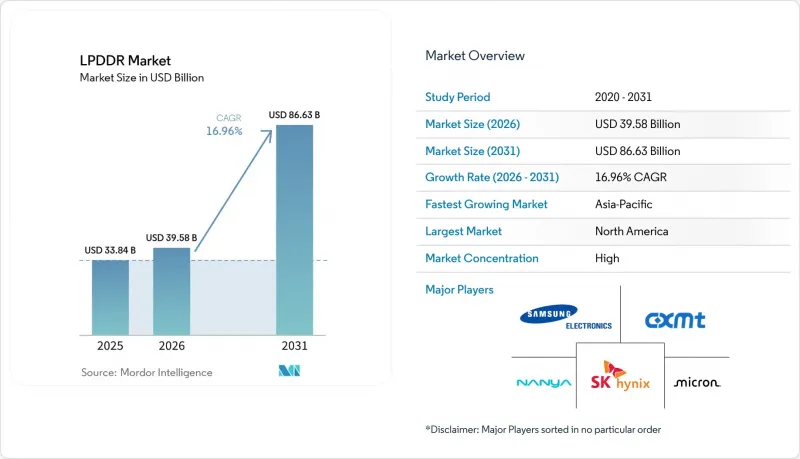
根據 Mordor Intelligence 預測,LPDDR 市場預計將從 2025 年的 338.4 億美元成長到 2026 年的 395.8 億美元,到 2031 年達到 866.3 億美元,2026 年至 2031 年的複合年成長率為 17%。
本報告按以下類別細分:LPDDR4/4X、LPDDR5/5X 及其他、封裝容量(4GB 以下、4GB-8GB、8GB-16GB 及其他)、封裝結構(獨立 LPDDR 封裝、PoP 封裝、多晶片封裝、系統級封裝等)、應用領域(家用電子電器及區域 AI 設備及地區。市場預測以美元計價。
全球LPDDR市場趨勢與洞察
人工智慧智慧型手機正在增加每台裝置所包含的 LPDDR 內存量。
LPDDR市場正受益於設備內AI的興起,改變了高階智慧型手機的最低記憶體需求。 AI助理、本地推理、影像生成和始終線上運作功能都更加重視記憶體頻寬和能源效率,這意味著裝置製造商不再將記憶體視為僅僅是後台元件。三星已將LPDDR6定位為針對高性能設備內AI最佳化的內存,這表明即使在全面商業部署之前,移動AI的需求也正在影響內存藍圖。三星也已開始量產用於行動AI設備的更薄LPDDR5X封裝,以滿足在緊湊外形尺寸下對更大記憶體的需求,同時又不影響熱穩定性。在LPDDR市場,這意味著每部智慧型手機的記憶體容量正在成為一項決定產品性能的規格,而不僅僅是一項成本支出。
將LPDDR擴展到AI伺服器和客戶端模組
此外,隨著低功耗DRAM在AI伺服器和客戶端模組設計的應用日益廣泛,LPDDR市場也不斷擴張。三星發布了AI資料中心的SOCAMM2模組,並宣布與NVIDIA達成技術合作。這顯示LPDDR不再只是一項偶然的實驗,而是主流加速器基礎設施規劃的一部分。 SK海力士正在為NVIDIA的Vera Rubin平台量產192GB SOCAMM2模組。據該公司稱,與傳統的RDIMM相比,這些模組的頻寬提升了一倍以上,能源效率提升超過75%。美光也已向客戶交付了256GB SOCAMM2的樣品,並表示該設計在提升長上下文推理的「首次令牌獲取時間(TTO)」的同時,也提高了每瓦性能。伺服器在LPDDR市場中佔據重要地位的原因在於,它帶來了持續的基礎設施需求,而這種需求並不依賴行動電話的出貨週期。
3-4家供應商的壟斷加劇了價格波動。
由於LPDDR記憶體供應集中在少數幾家廠商手中,其市場價格波動風險依然很高。這種結構雖然有助於大型廠商維持利潤率,但也迫使下游設備製造商對配額和合約條款的快速變化更加敏感。 CXMT的崛起帶來了一定的平衡,該公司於2025年開始為多家中國設備製造商量產LPDDR5X記憶體晶片。然而,出口限制仍限制先進製程節點新增產能填補供不應求的速度,迫使LPDDR市場繼續依賴少數現有供應商。因此,LPDDR市場容易受到價格驅動型需求收緊的影響,尤其是在對成本敏感的智慧型手機和其他低階設備領域。
細分市場分析
截至2025年,LPDDR5/5X將佔據LPDDR市場57.6%的佔有率,而LPDDR6預計到2031年將以18.9%的複合年成長率成長。 LPDDR5/5X的主導地位源自於其在眾多應用領域的廣泛採用,包括旗艦智慧型手機、高階中階裝置、AI PC以及第一代用於伺服器的SOCAMM2模組。這種廣泛的適用性對於LPDDR市場至關重要,因為單一的記憶體介面現在可以同時涵蓋行動裝置、客戶端和基礎設施等多種應用場景。 AMD表示,LPDDR5X將協助其提升伺服器的能源效率,這充分展現了該標準在遠超行動電話領域的效能。
LPDDR6有望成為LPDDR市場的下一個成長支柱,因為它能夠提升AI密集型設備的頻寬和能源效率。 SK海力士表示,其1c LPDDR6相比LPDDR5X的能源效率提升超過20%,並計劃在2026年下半年將其應用於AI智慧型手機和平板電腦。三星也將LPDDR6定位為提升設備端AI效能的關鍵驅動力,並指出這項轉變將首先在高階市場啟動,然後逐步擴展到更廣泛的市場。隨著供應商縮減對老一代製程節點的投入,傳統的LPDDR4和LPDDR4X正持續走向結構性衰退。此外,JEDEC發布的LPDDR6架構為LPDDR產業的未來合規性、電源管理和可靠性設定了更高的標準。
到2025年,8GB-16GB頻寬將佔LPDDR市場規模的40.7%,而16GB以上頻寬預計到2031年將以18.6%的複合年成長率成長。這種中等頻寬對LPDDR市場至關重要,因為它既能滿足高階智慧型手機和輕薄筆記型電腦的記憶體需求,又不會像最高規格配置那樣帶來過高的散熱和成本負擔。從實際應用角度來看,12GB和16GB的記憶體配置正逐漸成為需要本地AI功能、更強大的多任務處理能力以及更長軟體支援週期的裝置的標準配置。同時,高階智慧型手機和AI伺服器模組等其他需要更大記憶體容量的產品類別也在推動LPDDR市場的發展。
第二批產品賦予了16GB及以上容量的LPDDR記憶體卓越的穩定性。 SK海力士已開始量產192GB SOCAMM2模組,美光也提供了256GB設計的樣品。這表示超高容量LPDDR記憶體已開始應用於伺服器架構。雖然低容量產品仍供應給入門級設備和對成本要求較高的地區,但供應商正將重點轉向更高密度、更高利潤的產品。在LPDDR市場,這種供應趨勢凸顯了高容量產品的長期成長潛力,即使在低階設備需求波動的情況下也是如此。這一轉變也反映了LPDDR產業正在從單純提高產量轉向透過增加單件記憶體容量來提升附加價值。
區域分析
預計到2025年,亞太地區將佔據LPDDR市場51.8%的佔有率,並成為所有地區中成長最快的地區,到2031年複合年成長率將達到17.9%。該地區推動LPDDR市場成長的原因在於,韓國的產能、台灣的封裝技術以及中國的終端用戶需求正在緊密整合,形成一條相互關聯的供應鏈。韓國仍然是主要的供應基地,三星和SK海力士引領著向LPDDR6和伺服器級SOCAMM2產品的轉型。中國作為主要買家和新興生產商也至關重要,儘管仍面臨設備的限制,CXMT仍在進一步進軍先進的行動DRAM領域。亞太地區的LPDDR市場也呈現兩極化的趨勢:一方面,高級產品需求強勁;另一方面,隨著記憶體成本飆升,低階市場面臨壓力。
由於眾多大型人工智慧基礎設施買家的集中,北美在LPDDR市場中扮演著重要的策略角色。超大規模資料中心業者和平台開發人員的需求正推動LPDDR向伺服器架構轉型,使該地區的影響力超越了其晶圓產能佔有率。美光仍然是北美唯一的大型DRAM製造商,據該公司稱,到2026年中期,1-gamma節點預計將佔據DRAM位元產量的大部分。此外,AMD計劃在未來的伺服器平台中支援LPDDR5X,這也表明北美正在塑造將影響整個LPDDR市場的系統結構選擇。
在LPDDR市場,歐洲更像是需求中心而非生產基地,其戰略重要性很大程度源自於汽車和工業電子領域。德國、法國和英國扮演核心角色,這得益於汽車平台和工業控制系統對認證低功耗記憶體日益成長的需求。三星面向汽車應用的LPDDR5X已獲得ASIL D認證,進一步推動了歐洲ADAS(先進駕駛輔助系統)搭載率和車載運算集中化的趨勢。世界其他地區市場仍依賴家用電子電器的需求,而在LPDDR市場,由於記憶體成本在設備總成本中所佔比例較大,其成長更容易受到價格競爭的影響。
其他好處:
- Excel格式的市場預測(ME)表
- 3個月的分析師支持
目錄
第1章:引言
- 研究假設和市場定義
- 調查範圍
第2章:調查方法
第3章執行摘要
第4章 市場狀況
- 市場概覽
- 市場促進因素
- 人工智慧智慧型手機正在增加每台裝置安裝的LPDDR記憶體容量。
- 從 5G 高階產品過渡到中階產品,再到 LPDDR5/5X
- 由於車載導航系統(SDV)和高級駕駛輔助系統(ADAS)的普及,汽車記憶體的需求不斷成長。
- 焊接式 LPDDR 是人工智慧電腦和超薄筆記型電腦的首選記憶體類型。
- 將LPDDR部署到AI伺服器和客戶端模組
- LPDDR4X 的供不應求正在加速強制更新週期。
- 市場限制因素
- 3-4家供應商的權力集中加劇了價格波動。
- 先進節點的良率問題正在減緩 LPDDR6 成本曲線的下降速度。
- HBM 和 DDR5 的分配給行動裝置的 LPDDR 供應帶來了壓力。
- 由於汽車安全和熱認證要求更加嚴格,該設計得到了更廣泛的應用。
- 產業價值鏈分析
- 技術展望
- 監理情勢
- 波特五力分析
- 宏觀經濟因素對市場的影響
第5章 市場規模與成長預測
- 按世代
- LPDDR3
- LPDDR4/4X
- LPDDR5/5X
- LPDDR6
- 因此,按產能計算。
- 最高 4 GB
- 4 GB~8 GB
- 8 GB~16 GB
- 16 GB 或更多
- 軟體包配置
- 分立式LPDDR封裝
- 包裝上包裝(PoP)
- 多晶片封裝(MCP)
- 系統級封裝 (SiP)
- 透過使用
- 家用電子產品
- 智慧型手機和平板電腦
- 筆記型電腦
- 其他家用電子電器
- 汽車電子
- 工業和邊緣人工智慧設備
- 網路與嵌入式系統
- 伺服器和資料中心模組
- 其他用途
- 家用電子產品
- 按地區
- 北美洲
- 美國
- 加拿大
- 墨西哥
- 歐洲
- 德國
- 英國
- 法國
- 義大利
- 其他歐洲國家
- 亞太地區
- 中國
- 日本
- 韓國
- 台灣
- 印度
- 其他亞太國家
- 世界其他地區
- 北美洲
第6章 競爭情勢
- 市場集中度
- 策略趨勢
- 市佔率分析
- 公司簡介
- Samsung Electronics Co., Ltd.
- SK hynix Inc.
- Micron Technology, Inc.
- ChangXin Memory Technologies, Inc.
- Nanya Technology Corporation
- Winbond Electronics Corporation
- Integrated Silicon Solution, Inc.
- Elite Semiconductor Microelectronics Technology Inc.
- Alliance Memory, Inc.
- AP Memory Technology Corporation
- Etron Technology, Inc.
- Kingston Technology Company, Inc.
- ADATA Technology Co., Ltd.
- Longsys Electronics Co., Ltd.
- BIWIN Storage Technology Co., Ltd.
- Dosilicon Co., Ltd.
- Qualcomm Technologies, Inc.
- MediaTek Inc.
第7章 市場機會與未來展望
According to Mordor Intelligence, the LPDDR market size is expected to increase from USD 33.84 billion in 2025 to USD 39.58 billion in 2026 and reach USD 86.63 billion by 2031, growing at a CAGR of 17% over 2026-2031.
This report is Segmented by Generation (LPDDR4/4X, LPDDR5/5X, and More), Package Capacity (Up To 4 GB, 4GB To 8 GB, 8 GB To 16 GB, and More), Package Configuration (Discrete LPDDR Packages, Package-On-Package (PoP), Multichip Packages (MCP), System-In-Package, and More), Application (Consumer Electronics, Industrial and Edge AI Devices, and More), and Geography. The Market Forecasts are Provided in Terms of Value (USD).
Global LPDDR Market Trends and Insights
AI Smartphones Raising LPDDR Content Per Device
The LPDDR market is benefiting from the way on-device AI is changing the minimum memory requirement for premium smartphones. Device makers are no longer treating memory as a background component because AI assistants, local inference, image generation, and always-on language features all place more weight on memory bandwidth and power efficiency. Samsung is already positioning LPDDR6 as memory optimized for high-performing on-device AI, which shows that mobile AI demand is influencing memory road maps before the broad commercial rollout begins. Samsung also began mass production of thinner LPDDR5X packages for mobile AI devices, which supports the need for more memory in compact form factors without giving up thermal stability. In the LPDDR market, this means memory content per phone is becoming a product-defining specification rather than a background cost line.
LPDDR Expansion Into Ai Server And Client Modules
The LPDDR market is also expanding because low-power DRAM is now moving into AI server and client module designs. Samsung introduced its SOCAMM2 module for AI data centers and disclosed technical collaboration with NVIDIA, which confirms that LPDDR is now part of mainstream accelerator infrastructure planning rather than a side experiment. SK Hynix is in mass production of a 192 GB SOCAMM2 module for NVIDIA's Vera Rubin platform, and the company said the module offers more than double the bandwidth and over 75% better power efficiency than conventional RDIMM. Micron has also shipped customer samples of a 256 GB SOCAMM2 and said the design improves time-to-first-token for long-context inference while delivering stronger performance per watt. In the LPDDR market, server adoption matters because it adds a durable infrastructure demand stream that is not tied to handset shipment cycles.
Three-To-Four-Vendor Concentration Amplifying Pricing Swings
The LPDDR market remains exposed to pricing swings because supply is concentrated in a small number of producers. That structure helps leading vendors protect margins, but it also makes downstream device makers more sensitive to abrupt changes in allocation and contract terms. The rise of CXMT offers some counterweight, and the company began mass production of LPDDR5X memory chips in 2025 for several Chinese device makers. Even so, export controls continue to limit how quickly new capacity can close the gap at advanced nodes, which keeps the LPDDR market dependent on a narrow set of established suppliers. This leaves the LPDDR market vulnerable to price-driven demand stress in cost-sensitive smartphones and other lower-end devices.
Other drivers and restraints analyzed in the detailed report include:
- 5g Premium-To-Mid-Tier Migration Into Lpddr5/5x
- Sdv And Adas Memory Demand Scaling In Vehicles
- Advanced-Node Yield Pressure Delaying Lpddr6 Cost Curves
For complete list of drivers and restraints, kindly check the Table Of Contents.
Segment Analysis
LPDDR5/5X held 57.6% of the LPDDR market share in 2025, and LPDDR6 is projected to expand at an 18.9% CAGR through 2031. The leading position of LPDDR5/5X comes from its wide use across flagship phones, upper mid-range devices, AI PCs, and the first wave of server SOCAMM2 modules. In the LPDDR market, that breadth matters because one memory interface is now serving mobile, client, and infrastructure use cases at the same time. AMD said LPDDR5X will support its push for server energy efficiency, which shows that the standard is being validated well beyond handsets.
LPDDR6 is the next growth point in the LPDDR market because it raises both bandwidth and power efficiency for AI-heavy devices. SK Hynix said its 1c LPDDR6 improves power efficiency by more than 20% over LPDDR5X and targets AI-enabled smartphones and tablets in the second half of 2026. Samsung is also framing LPDDR6 around on-device AI performance, which suggests the transition will start at the premium end before moving into broader volume bands. Legacy LPDDR4 and LPDDR4X remain in structural decline as suppliers reduce commitment to older nodes, and JEDEC's published LPDDR6 architecture sets a higher baseline for future compliance, power management, and reliability in the LPDDR industry.
The 8 GB to 16 GB band captured 40.7% of the LPDDR market size in 2025, while the above-16 GB tier is set to grow at an 18.6% CAGR through 2031. This middle tier sits at the center of the LPDDR market because it matches the memory needs of premium smartphones and thin notebooks without creating the full thermal and cost burden of the highest configurations. In practical terms, 12 GB and 16 GB configurations are becoming the working floor for devices that need local AI features, stronger multitasking, and longer software support windows. The LPDDR market is then pulled upward by a different group of products, namely, premium phones and AI server modules that require much larger memory footprints.
That second group gives the above-16 GB tier unusual resilience inside the LPDDR market. SK Hynix is in mass production of a 192 GB SOCAMM2 module, and Micron has sampled a 256 GB design, which shows that very high-capacity LPDDR is already moving into deployed server architectures. Lower capacity bands still serve entry devices and cost-sensitive regions, but supplier focus is shifting toward denser, higher-margin products. In the LPDDR market, that supply preference strengthens the long-term case for high-capacity tiers even when low-end device demand remains uneven. The transition also reflects how the LPDDR industry is moving from pure volume growth to value growth driven by more memory per device.
Complete Report Scope:
- By Generation
- LPDDR3
- LPDDR4/4X
- LPDDR5/5X
- LPDDR6
- By Package Capacity
- Up to 4 GB
- 4 GB to 8 GB
- 8 GB to 16 GB
- Above 16 GB
- By Package Configuration
- Discrete LPDDR Packages
- Package-on-Package (PoP)
- Multichip Packages (MCP)
- System-in-Package (SiP)
- By Application
- Consumer Electronics
- Smartphones and Tablets
- Laptops
- Other Consumer Electronics
- Automotive Electronics
- Industrial and Edge AI Devices
- Networking and Embedded Systems
- Server and Data Center Modules
- Other Applications
- Consumer Electronics
- By Geography
- North America
- United States
- Canada
- Mexico
- Europe
- Germany
- United Kingdom
- France
- Italy
- Rest of Europe
- Asia-Pacific
- China
- Japan
- South Korea
- Taiwan
- India
- Rest of Asia-Pacific
- Rest of the World
- North America
Geography Analysis
Asia-Pacific held 51.8% of the LPDDR market share in 2025, and it is projected to record the fastest regional CAGR at 17.9% through 2031. The region leads the LPDDR market because it combines South Korean production strength, Taiwanese packaging depth, and Chinese end demand in one closely linked supply chain. South Korea remains the main supply anchor, with Samsung and SK Hynix driving the transition into LPDDR6 and server-class SOCAMM2 products. China is important both as a major buyer and as an emerging producer, with CXMT pushing deeper into advanced mobile DRAM while still facing equipment-related constraints. The LPDDR market in Asia-Pacific also reflects a split between strong premium demand and pressure at the lower end when memory costs rise too quickly.
North America holds a strategically important role in the LPDDR market because it concentrates many of the largest AI infrastructure buyers. Demand from hyperscalers and platform developers is now helping shift LPDDR into server architectures, and that gives the region influence beyond its share of direct wafer capacity. Micron remains the only large-scale North American DRAM producer, and the company said its 1-gamma node was on track to become the majority of its DRAM bit production by mid-2026. AMD's support for LPDDR5X in future server platforms also shows that North America is shaping system architecture choices that ripple across the LPDDR market.
Europe is more of a demand center than a production base in the LPDDR market, with automotive and industrial electronics driving most of its strategic importance. Germany, France, and the United Kingdom are central because vehicle platforms and industrial controls increasingly need qualified low-power memory. Samsung's automotive LPDDR5X reached ASIL D certification, which supports use in the European shift toward higher-content ADAS and centralized vehicle computing. Rest-of-the-World markets remain more dependent on consumer electronics demand, and in the LPDDR market their growth is more exposed to affordability pressure when memory becomes a larger part of total device cost.
- Samsung Electronics Co., Ltd.
- SK hynix Inc.
- Micron Technology, Inc.
- ChangXin Memory Technologies, Inc.
- Nanya Technology Corporation
- Winbond Electronics Corporation
- Integrated Silicon Solution, Inc.
- Elite Semiconductor Microelectronics Technology Inc.
- Alliance Memory, Inc.
- AP Memory Technology Corporation
- Etron Technology, Inc.
- Kingston Technology Company, Inc.
- ADATA Technology Co., Ltd.
- Longsys Electronics Co., Ltd.
- BIWIN Storage Technology Co., Ltd.
- Dosilicon Co., Ltd.
- Qualcomm Technologies, Inc.
- MediaTek Inc.
Additional Benefits:
- The market estimate (ME) sheet in Excel format
- 3 months of analyst support
TABLE OF CONTENTS
1 INTRODUCTION
- 1.1 Study Assumptions and Market Definition
- 1.2 Scope of the Study
2 RESEARCH METHODOLOGY
3 EXECUTIVE SUMMARY
4 MARKET LANDSCAPE
- 4.1 Market Overview
- 4.2 Market Drivers
- 4.2.1 AI Smartphones Raising LPDDR Content per Device
- 4.2.2 5G Premium-to-Mid-Tier Migration into LPDDR5/5X
- 4.2.3 SDV and ADAS Memory Demand Scaling in Vehicles
- 4.2.4 AI PCs and Ultra-Thin Notebooks Preferring Soldered LPDDR
- 4.2.5 LPDDR Expansion into AI Server and Client Modules
- 4.2.6 LPDDR4X Scarcity Accelerating Forced Refresh Cycles
- 4.3 Market Restraints
- 4.3.1 Three-to-Four-Vendor Concentration Amplifying Pricing Swings
- 4.3.2 Advanced-Node Yield Pressure Delaying LPDDR6 Cost Curves
- 4.3.3 HBM and DDR5 Allocation Crowding Out Mobile LPDDR Supply
- 4.3.4 Automotive Safety and Thermal Qualification Lengthening Design-Ins
- 4.4 Industry Value Chain Analysis
- 4.5 Technological Outlook
- 4.6 Regulatory Landscape
- 4.7 Porter's Five Forces Analysis
- 4.7.1 Bargaining Power of Suppliers
- 4.7.2 Bargaining Power of Buyers
- 4.7.3 Threat of New Entrants
- 4.7.4 Threat of Substitute Products
- 4.7.5 Intensity of Competitive Rivalry
- 4.8 Impact of Macroeconomic Factors on the Market
5 MARKET SIZE AND GROWTH FORECASTS (VALUE)
- 5.1 By Generation
- 5.1.1 LPDDR3
- 5.1.2 LPDDR4/4X
- 5.1.3 LPDDR5/5X
- 5.1.4 LPDDR6
- 5.2 By Package Capacity
- 5.2.1 Up to 4 GB
- 5.2.2 4 GB to 8 GB
- 5.2.3 8 GB to 16 GB
- 5.2.4 Above 16 GB
- 5.3 By Package Configuration
- 5.3.1 Discrete LPDDR Packages
- 5.3.2 Package-on-Package (PoP)
- 5.3.3 Multichip Packages (MCP)
- 5.3.4 System-in-Package (SiP)
- 5.4 By Application
- 5.4.1 Consumer Electronics
- 5.4.1.1 Smartphones and Tablets
- 5.4.1.2 Laptops
- 5.4.1.3 Other Consumer Electronics
- 5.4.2 Automotive Electronics
- 5.4.3 Industrial and Edge AI Devices
- 5.4.4 Networking and Embedded Systems
- 5.4.5 Server and Data Center Modules
- 5.4.6 Other Applications
- 5.4.1 Consumer Electronics
- 5.5 By Geography
- 5.5.1 North America
- 5.5.1.1 United States
- 5.5.1.2 Canada
- 5.5.1.3 Mexico
- 5.5.2 Europe
- 5.5.2.1 Germany
- 5.5.2.2 United Kingdom
- 5.5.2.3 France
- 5.5.2.4 Italy
- 5.5.2.5 Rest of Europe
- 5.5.3 Asia-Pacific
- 5.5.3.1 China
- 5.5.3.2 Japan
- 5.5.3.3 South Korea
- 5.5.3.4 Taiwan
- 5.5.3.5 India
- 5.5.3.6 Rest of Asia-Pacific
- 5.5.4 Rest of the World
- 5.5.1 North America
6 COMPETITIVE LANDSCAPE
- 6.1 Market Concentration
- 6.2 Strategic Moves
- 6.3 Market Share Analysis
- 6.4 Company Profiles (includes Global level Overview, Market level overview, Core Segments, Financials as available, Strategic Information, Market Rank/Share for key companies, Products and Services, and Recent Developments)
- 6.4.1 Samsung Electronics Co., Ltd.
- 6.4.2 SK hynix Inc.
- 6.4.3 Micron Technology, Inc.
- 6.4.4 ChangXin Memory Technologies, Inc.
- 6.4.5 Nanya Technology Corporation
- 6.4.6 Winbond Electronics Corporation
- 6.4.7 Integrated Silicon Solution, Inc.
- 6.4.8 Elite Semiconductor Microelectronics Technology Inc.
- 6.4.9 Alliance Memory, Inc.
- 6.4.10 AP Memory Technology Corporation
- 6.4.11 Etron Technology, Inc.
- 6.4.12 Kingston Technology Company, Inc.
- 6.4.13 ADATA Technology Co., Ltd.
- 6.4.14 Longsys Electronics Co., Ltd.
- 6.4.15 BIWIN Storage Technology Co., Ltd.
- 6.4.16 Dosilicon Co., Ltd.
- 6.4.17 Qualcomm Technologies, Inc.
- 6.4.18 MediaTek Inc.
7 MARKET OPPORTUNITIES AND FUTURE OUTLOOK
- 7.1 White-space and unmet-need assessment

 數位記憶體增強平台市場預測(2034 年)—按平台類型、技術、應用、目標記憶體區域、最終用戶和地區分類的全球分析
 HBM4:市場佔有率分析、產業趨勢與統計、成長預測(2026-2031)邏輯裝置用矽晶圓:市場佔有率分析、產業趨勢與統計資料以及成長預測(2026-2031 年)記憶體處理單元 (MPU) 市場預測至 2034 年—按架構類型、記憶體技術、組件、應用、最終用戶和地區分類的全球分析
 2026年全球軍工和航太應用記憶體和處理器市場報告2026年全球儲存層級記憶體市場報告用於儲存設備的矽晶圓:市場佔有率分析、行業趨勢和統計數據以及成長預測(2026-2031 年)
 數位射頻記憶體市場:依產品類型、容量、應用和最終用戶分類-2026-2032年全球預測
 HBM全球市場預測(2026):AI主導的需求與HBM4生產趨勢
 數位射頻記憶體市場-全球產業規模、佔有率、趨勢、機會、預測:架構、應用、平台、區域及競爭格局(2021-2031年)