


 |
市場調查報告書
商品編碼
2099173
印度模板工程:市場佔有率分析、產業趨勢與統計、成長預測(2026-2031)India Formwork - Market Share Analysis, Industry Trends & Statistics, Growth Forecasts (2026 - 2031) |
||||||

※ 本網頁內容可能與最新版本有所差異。詳細情況請與我們聯繫。
根據 Mordor Intelligence 預測,印度模板市場預計將從 2025 年的 5.3 億美元成長到 2026 年的 5.4 億美元,到 2031 年達到 7.8 億美元,2026 年至 2031 年的複合年成長率預計為 7.63%。
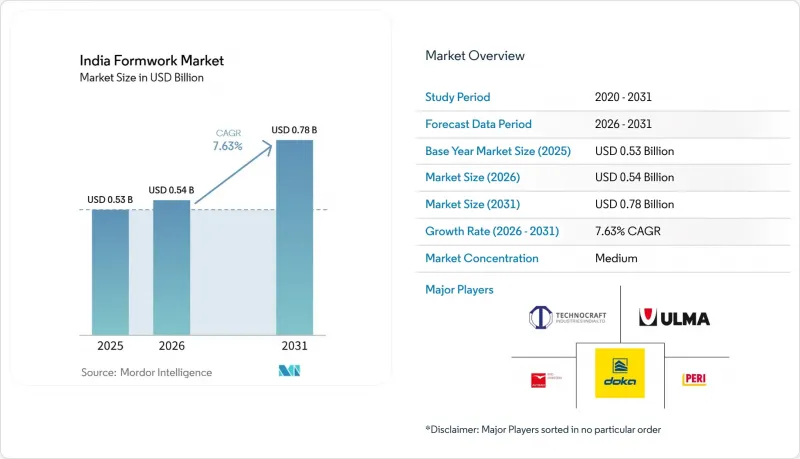
本報告按類型(傳統/常規模板和模組化/系統模板)、配置(靜態、爬升、滑模、隧道)、經營模式(銷售和租賃)、行業(住宅、商業、工業/物流、基礎設施)、材料(木材/膠合板等)和城市(孟買大都會圈等)進行分類。市場預測以美元計價。
印度模板市場的趨勢和洞察
住宅和商業建築數量增加
大規模混凝土建築專案需要在眾多平行塔樓中保持樓板、牆體和柱子的穩定施工週期,而住宅的交付進度正在刺激印度的模板市場。對於開工和交付期限嚴格的專案而言,這種影響尤其顯著,因為結構工程的任何重大延誤都是不可接受的。商業建築也支撐著印度的模板市場。人口密集都市區內的辦公大樓和綜合用途建築需要規範的樓板、核心筒牆、過渡結構以及重複的混凝土澆築工藝。這提升了能夠減少組裝差異並縮短澆築間隔的系統的價值。因此,對於服務高階住宅和商業區的供應商而言,如今的需求不僅取決於單位數量,還取決於工期的確定性、重複性工作的頻率以及在多個工地保持工人生產力的能力。
基礎設施和大型企劃的成長
大規模基礎設施項目正在擴大印度模板市場的需求範圍,使其不再局限於住宅建築。根據印度統計和計畫實施部 (MoSPI) 的數據,截至 2026 年 4 月,中央政府將啟動 1981 個基礎設施項目,修訂後的總營運成本為 427.8 兆盧比(約 5,130 億美元)。此外,2026 會計年度第四季新計畫激增,其中公路和高速公路項目佔據了新增營運成本的最大比例。這一構成比意義重大,因為橋面、高架橋、橋墩和交通結構所需的系統比普通樓板施工更為專業。 Dhoka 公司於 2025 年 7 月發布的一項關於孟買-普納高速公路「缺失路段」的案例研究表明,技術複雜的橋樑施工不僅需要簡單的模板,還需要爬升系統、大面積模板和基於設計的支撐結構。這確保了基礎設施建設仍然是印度模板市場最明確的長期需求支柱之一。
工程系統初始資本支出(CAPEX)較高
印度模板市場仍面臨巨大的准入壁壘。這是因為工程系統相比傳統的合板模板方法,前期投入成本更高。鋁製模板的成本通常為每平方公尺8000至9000印度盧比(約每平方公尺96至108美元),這使得中小開發商和承包商難以在沒有資金籌措的情況下承擔這筆初始投資。這種成本差異意味著,儘管模組化系統在重複施工中具有更好的長期經濟效益,但市場上的大多數企業仍然依賴傳統方法。此外,臨時結構設計和模板拆除的標準也增加了採用這些系統的難度,要求承包商要麼具備內部專業知識,要麼需要付費技術支援才能正確使用這些系統。在資金籌措和租賃方案更加普及之前,系統實施的高昂前期成本將繼續阻礙印度模板市場的全面轉型。
細分市場分析
到2025年,模組化/系統模板將佔印度模板市場55%的佔有率,預計到2031年將以每年8.20%的速度成長,超過整體市場成長率。這項領先優勢反映出,在那些優先考慮可重複性、品管和速度而非初始成本最小化的專案中,現場預製木模板的使用正在穩步減少。大型建築商和EPC(工程、採購和施工)公司是這項轉變的主要推動力,因為他們負責大規模項目,而標準化可以減少延誤和現場返工。因此,能夠提供跨多個專案週期設計的佈局、技術支援和可重複使用庫存的供應商,在印度模板市場更具優勢。同時,在建築高度較低且專案可重複性有限的地區,傳統模板仍扮演著重要角色。
在二、三線城市地區,這些傳統系統仍然佔據主導地位,因為承包商通常依賴當地的木工技能和低成本的現場施工方法。由於傳統方法仍然適用於客製化形狀、小規模結構或樓層數不足以收回模組化系統成本的項目,因此其替代過程是漸進的。然而,隨著客戶期望提前完成結構施工並獲得更光滑的混凝土飾面,這一領域的相對地位正在下降。一項於2025年進行的同儕審查對比研究發現,在高度可重複的高層建築中,模組化系統可以將施工時間縮短45%,並將專案總成本降低高達3%。這解釋了為什麼模組化系統越來越頻繁地被納入大規模住宅和住宅建設項目的施工計劃中。在印度模板市場,這意味著目前的模板類型構成不僅取決於對材料的熟悉程度,還取決於結構的可重複性、合規性的嚴格程度以及承包商規劃重複使用的能力。
預計到2025年,爬升式模板將佔據34%的最大市場佔有率,凸顯了垂直混凝地工程在印度模板市場的重要性。其地位與高層住宅、橋塔、大壩結構以及其他需要可控提升和穩定工作平台以持續提升高度的項目密切相關。這些系統還能降低起重機對適當位置的依賴程度,並在塔式起重機使用時間競爭激烈的場景下簡化流程。實際上,爬升式解決方案定位於高階市場,因為它們將設備、工程和現場施工方法支援整合到一個提案中。隨著多功能塔樓的興起和交通基礎設施技術複雜性的增加,其作用也不斷擴大。
隧道模板是成長最快的構件,預計到2031年複合年成長率將達到8.00%,其成長與循環式住宅計畫的實施密切相關。政府的「燈塔計畫」示範工程已將隧道系統從一種小眾施工方法提升為大規模住宅計畫中的重要標準。研究表明,在印度條件下,隧道系統可實現450-500次重複使用循環,遠超類似分析中鋁模板通常報告的200-250次循環。對於儲槽、筒倉和公用設施結構,由於需求較低且技術難度較高,靜態模板和滑模施工方法仍然普遍存在。因此,印度模板市場的構件選擇正從「一套系統適用於所有情況」的模式轉向根據每個項目的混凝土形狀和可重複性特徵進行選擇。
其他好處:
- Excel格式的市場預測(ME)表
- 3個月的分析師支持
目錄
第1章:引言
- 研究假設和市場定義
- 調查範圍
第2章:調查方法
第3章執行摘要
第4章 市場狀況
- 市場概覽
- 市場促進因素
- 住宅和商業建築增加
- 基礎設施和大型企劃的成長
- 該專案的快速實施正在加速工程模板的採用。
- 向可重複使用和模組化系統過渡
- 高層建築建設增加
- 勞動生產力和品質要求
- 市場限制因素
- 工程系統初始資本支出(CAPEX)較高
- 建設產業的價格敏感性
- 依賴熟練勞動力和安裝
- 項目相關需求波動
- 價值供應鏈分析
- 監理情勢
- 技術展望
- 成本結構分析
- 波特五力模型
- 地緣政治影響
- 原物料價格波動
- 供應鏈中斷和前置作業時間延長
- 能源和物流成本不斷上漲
- 基礎設施、能源安全和國防主導的需求
第5章 市場規模與成長預測
- 按類型
- 傳統型/傳統方法
- 模組化/系統模板
- 透過配置
- 靜止的
- 攀爬
- 滑模
- 隧道
- 按經營模式
- 銷售
- 租賃
- 按行業
- 住宅
- 商業的
- 工業與物流
- 基礎設施
- 材料
- 木材/合板
- 鋼
- 鋁
- 塑膠/玻璃纖維
- 其他
- 按城市
- 孟買大都會圈
- 新德里(NCR)
- 普納
- 班加羅爾
- 印度其他地區
第6章 競爭情勢
- 市場集中度
- 策略趨勢
- 市佔率分析
- 公司簡介
- PERI India Pvt. Ltd.
- Doka India Private Limited
- ULMA Formwork and Scaffolding Systems India Pvt. Ltd.
- RMD Kwikform India Private Limited
- Technocraft Industries(India)Ltd.
- MEVA Formwork Systems India Pvt. Ltd.
- PASCHAL Formwork India Pvt. Ltd.
- Acrow India Ltd.
- JRS Scaffoldings Pvt. Ltd.
- Finomax Scaffolding(I)Pvt. Ltd.
- Expee Engineering Private Limited
- Iron Ridge Scaffolding and Engineering(I)Pvt. Ltd.
- AMCO Exports
- Hindustan Scaffolding and Formwork Pvt. Ltd.
- Safeway Scaffolding and Formwork Pvt. Ltd.
- Nova Formworks Pvt. Ltd.
- Bharat Scaffolding Co.
- Waco India Pvt. Ltd.
- PeeKay Structural Equipments Pvt. Ltd.
- Ananta Formwork Pvt. Ltd.
第7章 市場機會與未來展望
According to Mordor Intelligence, the India formwork market size is expected to increase from USD 0.53 billion in 2025 to USD 0.54 billion in 2026 and reach USD 0.78 billion by 2031, growing at a CAGR of 7.63% over 2026-2031.
This report is Segmented by Type (Conventional / Traditional and Modular / System Formwork), Configuration (Static, Climbing, Slipform, and Tunnel), Business Model (Sales and Rental), Sector (Residential, Commercial, Industrial & Logistics and Infrastructure), Material (Timber / Plywood, and More), and City (Mumbai Metropolitan Region, and More). The Market Forecasts are Provided in Terms of Value (USD).
India Formwork Market Trends and Insights
Rising Residential and Commercial Construction
Housing delivery schedules are keeping the India formwork market active because large concrete programs need steady slab, wall, and column cycles across many parallel towers. The strongest effect is visible where completion discipline is stricter, since projects with fixed launch and handover commitments cannot absorb long delays in structure work. Commercial construction also supports the India formwork market, as office and mixed-use assets require regular floor plates, core walls, transfer structures, and repeated concrete sequencing in dense urban areas. This raises the value of systems that can reduce assembly variability and shorten the gap between pours. The result is that suppliers serving premium residential and commercial corridors are seeing demand shaped less by unit count alone and more by schedule certainty, repetition intensity, and the ability to keep crews productive across multiple active fronts.
Growth in Infrastructure and Mega Projects
Large infrastructure programs are widening the demand base of the India formwork market beyond residential towers. The Ministry of Statistics and Programme Implementation (MoSPI) tracked 1,981 central sector infrastructure projects with a revised cost of INR 42.78 lakh crore (USD 513 billion), as of April 2026, and project additions in the final quarter of FY2026 rose sharply, with roads and highways taking the largest share of added project cost. That mix matters because bridge decks, viaducts, pylons, and transport structures need more specialized systems than ordinary slab work. Doka's July 2025 deployment on the Mumbai-Pune Expressway Missing Link showed how technically demanding bridge packages require climbing systems, large-area formwork, and engineered support rather than simple shuttering supply. This keeps infrastructure as one of the clearest long-run demand anchors for the India formwork market.
High Initial CAPEX for Engineered Systems
The India formwork market still faces a significant entry barrier because engineered systems require higher upfront costs than conventional plywood-based approaches. Aluminum formwork typically costs INR 8,000-9,000 per square meter (USD 96-108 per square meter), making it difficult for smaller developers and contractors to absorb the upfront investment without financing. This cost gap keeps a large share of the volume base tied to traditional methods, even when modular systems offer better long-term economics for repetitive jobs. Standards for falsework design and stripping practice also increase the implementation burden, as contractors need either internal competence or paid technical support to use these systems properly. Until financing or leasing access improves more broadly, high upfront system cost will continue to slow full conversion in the India formwork market.
Other drivers and restraints analyzed in the detailed report include:
- Faster Project Execution Accelerates Engineered Formwork Adoption
- Shift Toward Reusable and Modular Systems
- Price Sensitivity across the Construction Sector
For complete list of drivers and restraints, kindly check the Table Of Contents.
Segment Analysis
Modular / system formwork held 55% of the India formwork market in 2025 and is forecast to grow at 8.20% through 2031, keeping it ahead of the overall market pace. This lead reflects the steady move away from jobsite-fabricated timber on projects where repetition, quality control, and speed matter more than the lowest initial spend. Organized contractors and Engineering, Procurement, and Construction (EPC) firms have been the main force behind this shift because they work on larger packages where standardization reduces delays and site rework. The India formwork market has therefore become more favorable to suppliers that can provide engineered layouts, technical support, and reusable inventory across several project cycles. Conventional / traditional formwork remains relevant where building heights are lower and project repetition is limited.
That continued role for traditional systems is strongest in Tier II and Tier III locations, where contractors often rely on local carpentry skills and lower-budget site practices. The replacement process is gradual because conventional methods still suit custom shapes, smaller structures, and projects with too few floors to recover the cost of a modular system. Even so, the relative position of this segment is weakening as customer expectations move toward faster shell completion and cleaner concrete finish. A 2025 peer-reviewed comparison found that modular systems reduced project time by 45% and cut total project costs by up to 3% for repetitive high-rise structures, which helps explain why large residential and housing programs are writing modular systems into execution plans more often. In the India formwork market, this means the type mix is now being shaped by structural repetition, compliance discipline, and contractor ability to plan reuse rather than by material familiarity alone.
Climbing formwork held the largest 34% share in 2025, underscoring the importance of vertical concrete work in the India formwork market. Its position is tied to high-rise residential cores, bridge pylons, dam structures, and other projects where continuous height progression requires controlled lifting and stable working platforms. These systems also reduce the crane's dependence on suitable sites, improving sequencing when tower crane time is heavily contested. In practice, climbing solutions sit at the premium end of the market because they combine equipment, engineering, and site-method support in a single offer. Their role has expanded with the rise of mixed-use towers and the increasingly technical nature of transport infrastructure.
Tunnel formwork is the fastest-growing configuration, with an 8.00% CAGR through 2031, and its growth is linked to the execution of repetitive housing projects. Government Light House Project demonstrations helped move tunnel systems from a niche method into a visible reference point for larger housing programs. Studies indicate that tunnel systems can achieve 450-500 reuse cycles under Indian conditions, far exceeding the 200-250 reuse cycles typically reported for aluminum formwork in comparable analyses. Static and slipform configurations remain in place in tanks, silos, and utility structures, where demand is lower but the work is technically challenging. As a result, configuration choices in the India formwork market increasingly reflect the concrete geometry and repetition profile of each job rather than a one-system-fits-all approach.
Complete Report Scope:
- By Type
- Conventional / Traditional
- Modular / System Formwork
- By Configuration
- Static
- Climbing
- Slipform
- Tunnel
- By Business Model
- Sales
- Rental
- By Sector
- Residential
- Commercial
- Industrial & Logistics
- Infrastructure
- By Material
- Timber / Plywood
- Steel
- Aluminum
- Plastic / Fiberglass
- Others
- By City
- Mumbai Metropolitan Region
- Delhi NCR
- Pune
- Bengaluru
- Rest of India
List of Companies Covered in this Report:
- PERI India Pvt. Ltd.
- Doka India Private Limited
- ULMA Formwork and Scaffolding Systems India Pvt. Ltd.
- RMD Kwikform India Private Limited
- Technocraft Industries (India) Ltd.
- MEVA Formwork Systems India Pvt. Ltd.
- PASCHAL Formwork India Pvt. Ltd.
- Acrow India Ltd.
- JRS Scaffoldings Pvt. Ltd.
- Finomax Scaffolding (I) Pvt. Ltd.
- Expee Engineering Private Limited
- Iron Ridge Scaffolding and Engineering (I) Pvt. Ltd.
- AMCO Exports
- Hindustan Scaffolding and Formwork Pvt. Ltd.
- Safeway Scaffolding and Formwork Pvt. Ltd.
- Nova Formworks Pvt. Ltd.
- Bharat Scaffolding Co.
- Waco India Pvt. Ltd.
- PeeKay Structural Equipments Pvt. Ltd.
- Ananta Formwork Pvt. Ltd.
Additional Benefits:
- The market estimate (ME) sheet in Excel format
- 3 months of analyst support
TABLE OF CONTENTS
1 Introduction
- 1.1 Study Assumptions & Market Definition
- 1.2 Scope of the Study
2 Research Methodology
3 Executive Summary
4 Market Landscape
- 4.1 Market Overview
- 4.2 Market Drivers
- 4.2.1 Rising Residential and Commercial Construction
- 4.2.2 Growth In Infrastructure and Mega Projects
- 4.2.3 Faster Project Execution Accelerates Engineered Formwork Adoption
- 4.2.4 Shift Toward Reusable and Modular Systems
- 4.2.5 Increasing High-Rise Construction
- 4.2.6 Labor Productivity and Quality Requirements
- 4.3 Market Restraints
- 4.3.1 High Initial CAPEX for Engineered Systems
- 4.3.2 Price Sensitivity across the Construction Sector
- 4.3.3 Skilled Labor and Installation Dependency
- 4.3.4 Project-Based Demand Volatility
- 4.4 Value / Supply-Chain Analysis
- 4.5 Regulatory Landscape
- 4.6 Technological Outlook
- 4.7 Cost Structure Analysis
- 4.8 Porter's Five Forces
- 4.8.1 Threat of New Entrants
- 4.8.2 Bargaining Power of Suppliers
- 4.8.3 Bargaining Power of Buyers
- 4.8.4 Threat of Substitutes
- 4.8.5 Intensity of Competitive Rivalry
- 4.9 Impact of Geopolitics
- 4.9.1 Raw Material Price Volatility
- 4.9.2 Supply Chain Disruptions and Longer Lead Times
- 4.9.3 Rising Energy and Logistics Costs
- 4.9.4 Infrastructure, Energy Security, and Defense-Led Demand
5 Market Size & Growth Forecasts (Value, USD)
- 5.1 By Type
- 5.1.1 Conventional / Traditional
- 5.1.2 Modular / System Formwork
- 5.2 By Configuration
- 5.2.1 Static
- 5.2.2 Climbing
- 5.2.3 Slipform
- 5.2.4 Tunnel
- 5.3 By Business Model
- 5.3.1 Sales
- 5.3.2 Rental
- 5.4 By Sector
- 5.4.1 Residential
- 5.4.2 Commercial
- 5.4.3 Industrial & Logistics
- 5.4.4 Infrastructure
- 5.5 By Material
- 5.5.1 Timber / Plywood
- 5.5.2 Steel
- 5.5.3 Aluminum
- 5.5.4 Plastic / Fiberglass
- 5.5.5 Others
- 5.6 By City
- 5.6.1 Mumbai Metropolitan Region
- 5.6.2 Delhi NCR
- 5.6.3 Pune
- 5.6.4 Bengaluru
- 5.6.5 Rest of India
6 Competitive Landscape
- 6.1 Market Concentration
- 6.2 Strategic Moves
- 6.3 Market Share Analysis
- 6.4 Company Profiles (Includes Global Level Overview, Market Level Overview, Core Segments, Financials as Available, Strategic Information, Products & Services, and Recent Developments)
- 6.4.1 PERI India Pvt. Ltd.
- 6.4.2 Doka India Private Limited
- 6.4.3 ULMA Formwork and Scaffolding Systems India Pvt. Ltd.
- 6.4.4 RMD Kwikform India Private Limited
- 6.4.5 Technocraft Industries (India) Ltd.
- 6.4.6 MEVA Formwork Systems India Pvt. Ltd.
- 6.4.7 PASCHAL Formwork India Pvt. Ltd.
- 6.4.8 Acrow India Ltd.
- 6.4.9 JRS Scaffoldings Pvt. Ltd.
- 6.4.10 Finomax Scaffolding (I) Pvt. Ltd.
- 6.4.11 Expee Engineering Private Limited
- 6.4.12 Iron Ridge Scaffolding and Engineering (I) Pvt. Ltd.
- 6.4.13 AMCO Exports
- 6.4.14 Hindustan Scaffolding and Formwork Pvt. Ltd.
- 6.4.15 Safeway Scaffolding and Formwork Pvt. Ltd.
- 6.4.16 Nova Formworks Pvt. Ltd.
- 6.4.17 Bharat Scaffolding Co.
- 6.4.18 Waco India Pvt. Ltd.
- 6.4.19 PeeKay Structural Equipments Pvt. Ltd.
- 6.4.20 Ananta Formwork Pvt. Ltd.
7 Market Opportunities & Future Outlook
- 7.1 White-Space & Unmet-Need Assessment

 模板系統市場分析及預測(至2035年):類型、技術、組件、應用、材料類型、製程、最終用戶、安裝方式、解決方案、階段
 北美模板工程:市場佔有率分析、產業趨勢與統計、成長預測(2026-2031)中國模板市場:市場佔有率分析、產業趨勢與統計、成長預測(2026-2031)印尼模板工程:市場佔有率分析、產業趨勢與統計、成長預測(2026-2031)德國模板產業:市場佔有率分析、產業趨勢與統計、成長預測(2026-2031)
 木製模板系統市場-全球產業規模、佔有率、趨勢、機會、預測:按滑軌類型、應用、地區和競爭格局分類,2021-2031年鋁模板系統市場-全球產業規模、佔有率、趨勢、機會、預測:按類型、應用、地區和競爭格局分類,2021-2031年
 2026年全球木模板系統市場報告2026年全球範本市場報告2026年全球範本系統市場報告