


 |
市場調查報告書
商品編碼
2099170
中國模板市場:市場佔有率分析、產業趨勢與統計、成長預測(2026-2031)China Formwork - Market Share Analysis, Industry Trends & Statistics, Growth Forecasts (2026 - 2031) |
||||||

※ 本網頁內容可能與最新版本有所差異。詳細情況請與我們聯繫。
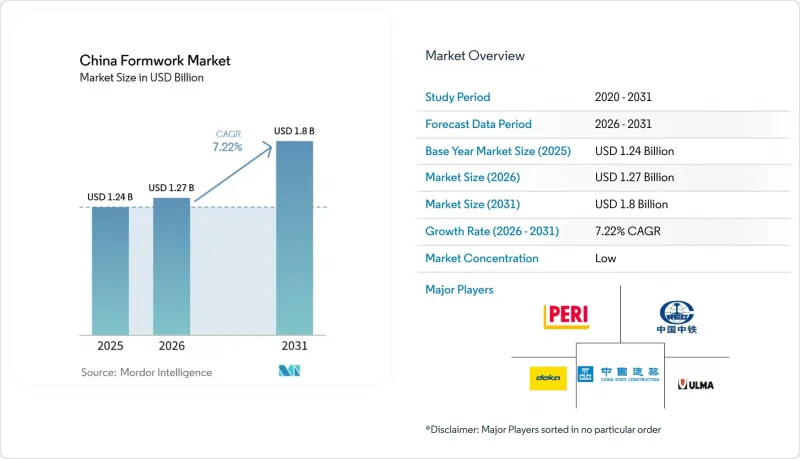
根據 Mordor Intelligence 預測,中國模板市場規模預計到 2025 年將達到 12.4 億美元,到 2026 年將達到 12.7 億美元,到 2031 年將達到 18 億美元,2026 年至 2031 年的複合年成長率為 7.22%。
本報告按類型(傳統/常規模板和模組化/系統模板)、配置(靜態、爬升、滑模、隧道)、經營模式(銷售和租賃)、行業(住宅、商業、工業/物流、基礎設施)、材料(木材/膠合板等)和地區(華北、華東等)進行分類。市場預測以美元計價。
中國模板市場趨勢與洞察
基礎設施現代化和城市更新正在推動對模板的需求。
建設產業的主要驅動力正從私人住宅高層建築轉向公共基礎設施項目,這一轉變提升了中國模板市場的需求品質。基礎設施項目通常需要比住宅項目中常見的簡單、大量使用膠合板的施工方式更耐用、更專業的系統,例如橋墩的爬升式鑽機、塔筒倉的滑模解決方案以及地鐵和高速公路隧道的模板。 2026-2030年的「十五」規劃承諾投資5兆元人民幣(1兆美元)用於維修77萬公里燃氣、供水、排水和供熱管道,另投資5兆元人民幣(1兆美元)用於擴建電網和跨省輸電走廊,這將導致各類項目持續活躍,大量混凝土的使用。 2026年1-2月基礎建設投資成長11.4%,2026年第一季成長8.9%,均高於整體固定資產投資。這使得模板供應商擁有比私人建築業更優的多年發展前景。城市改造也帶來了新的需求,因為在空間有限、對空間效率和可預測性組裝極高的場地(例如地下管道維修和「海綿城市」專案)中,可重複使用的模組化系統更受歡迎。
「達到碳排放高峰並實現碳中和」的目標正在加速採用可重複使用的模板系統。
碳政策正在改變專案層面的材料選擇,促使中國模板市場從單純追求低初始成本的產品轉向可重複使用的系統。到2024年,預製建築的在建面積將達到6.72億平方公尺,佔所有新建建築占地面積的30%以上,凸顯了工業化施工方法在建築體系中的深度滲透。業界標準T/CCIAT 0104-2025於2026年3月1日生效,該標準確立了建築工程中的碳減量程序,包括確定施工階段和模板使用周期內排放量的正式計算方法。此外,綠建築評估標準GB/T 50378-2024提高了高階專案的合規標準,要求達到三星認證的建築物至少使用70%的可重複使用模板,從而減少了一次性傳統膠合板在高階開發專案中的使用。在這些背景下,鋁製系統在法規遵循和生命週期經濟性方面都具有優勢。這是因為與木材相比,它們具有更高的再利用潛力,並且與標準化的專案實施結構更加相容。
房地產行業的低迷正在抑制私人住宅建設活動。
私人住宅仍是中國模板市場最大的拖累因素。這是因為房地產市場的調整將持續到2026年,嚴重影響新計畫開工量、承包商現金流以及對傳統樓板和牆體系統的需求。其中,大量使用木材和膠合板的應用領域承受的壓力最大,因為這些材料曾最常用於中高層和批量生產的住宅,而這些住宅建設在公共基礎設施擴張之前一直是模板市場最大的需求來源。這一點至關重要,因為預計到2025年,住宅仍將佔據模板市場最大的佔有率,即使私人住宅建設需求逐漸減弱,也會影響許多本地供應商的產能運轉率、補貨決策和設備部署。政府支持的經濟適用住宅、都市區改造以及公私混合用途的基礎設施建設在一定程度上抵消了這種影響。然而,這些措施並不能完全取代先前由私人高層建築開發所產生的需求組成和時間節點。因此,與政府資助計畫緊密聯繫的公司比那些實施記錄和客戶關係仍然集中在私人資助的住宅建設項目中的公司更具韌性。
細分市場分析
到2025年,模組化/系統模板將佔據中國模板市場55%的佔有率,預計該細分市場將以最快的速度成長,到2031年複合年成長率將達到8.60%。這一領先地位反映出承包商明顯偏好能夠縮短組裝時間、提高施工週期可預測性並減少重複性結構工作中人工依賴的工程系統。模組化/系統模板日益成長的吸引力源於這樣一個事實:與勞動力充足、住宅是市場主導因素的時代相比,如今專案業主和總承包商更加重視生產效率、更嚴格的品管和重複利用效率。在中國模板市場,這一趨勢使模組化平台在頻繁重複的基礎設施項目、大規模綜合用途項目以及受益於重複部署的標準化公共開發項目中具有結構優勢。同時,這也提升了能夠提供面板和配件、設計支援、快速現場回應和全面售後服務的供應商的競爭力。
即使到了2025年,傳統模板仍將占到需求的45%,這表明其悠久的歷史、本地化的採購方式以及承包商的熟悉程度,在全國範圍內仍然具有顯著的影響力。在木材資源豐富、工程範圍簡單且小規模專案難以承擔先進系統所需資金的城市和農村地區,傳統模板仍佔據著最重要的地位。然而,隨著綠色建築要求、建築業產業化政策以及預製建築方法的普及,這一趨勢正在發生變化,一次性解決方案在具有嚴格規範的項目中的應用範圍正在逐漸縮小。 2025年發布的一項調查顯示,預製化率的提高、政策執行力度的加強以及專利活動的活性化都與建築能效的提升密切相關,這凸顯了建築實踐進一步產業化的趨勢。這對中國模板市場而言,意味著的不是傳統需求的突然崩壞,而是從高階應用穩步轉向可重複使用的系統,以更好地適應勞動力、合規性和工業化優先事項。
預計到2025年,爬升系統將佔該細分市場30%的佔有率,並在2031年之前保持8.54%的年均最高成長率,使其成為中國模板市場中更為專業的領域。這一成長與高層建築、橋墩、大壩核心筒和其他垂直水泥建築物密切相關,在這些項目中,自動化爬升系統正在減少對起重機的依賴,並提高複雜工地的生產效率。一項針對200公尺以上高度建築的空中模板設備的調查顯示,整體輕型爬昇平台在摩天大樓工地上能夠提供卓越的工程性能和更高的施工效率。這與垂直基礎設施和高層建築核心筒的實際情況相符,因為這些結構需要的不僅僅是模板供應,它們還依賴於系統工程、現場安全協調以及在整個長期項目週期中可重複的吊裝性能。這也解釋了為什麼跨國專業公司和國內先進企業比標準化產品擁有更強的定價權。
靜態模板廣泛應用於各類傳統住宅及商業混凝土建築項目,涵蓋樓板、牆體及柱子。雖然滑模和隧道解決方案的市場佔有率仍然較小,但隨著能源設施、交通走廊和地下工程在公共投資項目的推動下不斷擴張,它們的重要性日益凸顯。這種配置方式的轉變意義重大,因為與標準靜態模板系統相比,專用配置通常能帶來更高的單次租賃和業務收益,尤其是在需要技術安裝和工程指導的情況下。隨著這些類別的成長,儘管整體銷售量成長仍然較為溫和,但中國模板市場的平均收入品質正在提升。這種轉變也凸顯了精密設備和技術支援系統的重要性,因為這些應用領域的客戶不僅需要硬體租賃,還需要可靠的施工服務。
其他好處:
- Excel格式的市場預測(ME)表
- 3個月的分析師支持
目錄
第1章:引言
- 研究假設和市場定義
- 調查範圍
第2章:調查方法
第3章執行摘要
第4章 市場狀況
- 市場概覽
- 市場促進因素
- 基礎設施現代化和城市更新正在推動對模板的需求。
- 「雙碳」目標正在加速採用可重複使用的模板系統。
- 人手不足和提高生產力的需求正在推動工程模板的使用。
- 數位化範本規劃和資產追蹤可提高專案效率。
- 區域城市的都市化支撐了重建需求。
- 「一帶一路」計劃正在擴大對模板系統的出口需求。
- 市場限制因素
- 房地產行業的低迷導致私人住宅建設活動萎縮。
- 鋁和鋼模板較高的初始成本阻礙了其廣泛應用。
- 租賃市場分散阻礙了全國範圍內的標準化。
- 鋼鐵和鋁價的波動給製造商的利潤率帶來了壓力。
- 價值和供應鏈分析
- 監理情勢
- 技術展望
- 成本結構分析
- 波特五力模型
- 地緣政治影響
- 原物料價格波動
- 供應鏈中斷和前置作業時間延長
- 能源和物流成本不斷上漲
- 基礎設施、能源安全和國防主導的需求
第5章 市場規模與成長預測
- 按類型
- 傳統型/傳統方法
- 模組化/系統模板
- 透過配置
- 靜止的
- 攀爬
- 滑模
- 隧道
- 按經營模式
- 銷售
- 租賃
- 按行業
- 住宅
- 商業的
- 工業與物流
- 基礎設施
- 材料
- 木材/合板
- 鋼
- 鋁
- 塑膠/玻璃纖維
- 其他材料
- 按地區
- 中國北方
- 中國東部
- 華南
- 華中地區
- 中國西南地區
- 中國西北地區
- 中國東北
第6章 競爭情勢
- 市場集中度
- 策略趨勢
- 市佔率分析
- 公司簡介
- Doka(China)Co., Ltd.
- PERI(China)Co., Ltd.
- ULMA Construction
- China State Construction Engineering Corporation
- China Railway Group Limited
- China Railway Construction Corporation
- Beijing Zulin Formwork and Scaffolding Co., Ltd.
- Zhejiang Jinggong Steel Building Group Co., Ltd.
- Zhejiang Zhongnan Construction Group Co., Ltd.
- Guangdong Jinma Aluminum Co., Ltd.
- Shandong Fangyuan Formwork Co., Ltd.
- Qingdao Alulite Formwork Scaffolding Co., Ltd.
- Shanghai Construction Group
- Zhejiang Yili Formwork Scaffolding Co., Ltd.
- Nanjing Dadi Engineering Technology Co., Ltd.
- Sichuan Huashi Group Co., Ltd.
- Guangzhou Kangtai Formwork and Scaffolding Co., Ltd.
- Suzhou TECON Construction Technology Co., Ltd.
- Zhongtian Construction Group Co., Ltd.
- Beijing Chengdong International Formwork Co., Ltd.
- Shenzhen Vanke New Materials Co., Ltd.
第7章 市場機會與未來展望
According to Mordor Intelligence, the China formwork market size is projected to be USD 1.24 billion in 2025, USD 1.27 billion in 2026, and reach USD 1.8 billion by 2031, growing at a CAGR of 7.22% from 2026 to 2031.
This report is Segmented by Type (Conventional / Traditional and Modular / System Formwork), Configuration (Static, Climbing, Slipform, and Tunnel), Business Model (Sales and Rental), Sector (Residential, Commercial, Industrial & Logistics and Infrastructure), Material (Timber / Plywood, and More), and Region (North China, East China, and More). The Market Forecasts are Provided in Terms of Value (USD).
China Formwork Market Trends and Insights
Infrastructure Modernization and Urban Renewal Drive Formwork Demand
The main construction engine has shifted from private residential towers to publicly funded infrastructure, and that change has improved the quality of demand in the China formwork market. Infrastructure jobs usually require more durable, specialized systems, including climbing rigs for bridge piers, slipform solutions for towers and silos, and tunnel formwork for metro and highway works, rather than the simpler, plywood-heavy setups common in housing projects. The 15th Five-Year Plan for 2026 to 2030 commits CNY 5 trillion (USD 1 trillion) to gas, water, drainage, and heating pipeline upgrades across 770,000 kilometers, and another CNY 5 trillion (USD 1 trillion) to power grid expansion and inter-provincial transmission corridors, which keeps concrete-intensive work elevated across several project categories. Infrastructure investment increased 11.4% in January and February 2026 and 8.9% in Q1 2026, outpacing broader fixed-asset investment and providing formwork suppliers with better multi-year visibility than the private building segment could offer. Urban renewal adds another layer of demand because underground pipeline rehabilitation and sponge-city works favor modular systems that can be cycled repeatedly in tight sites where space efficiency and predictable assembly matter.
Dual Carbon Goals Accelerate Adoption of Reusable Formwork Systems
Carbon policy is changing project-level material choices, pushing the China formwork market toward reusable systems rather than products chosen only for low initial cost. Prefabricated building construction reached 672 million square meters under construction in 2024, representing more than 30% of all new building floor area, underscoring how deeply industrialized building methods are now embedded in the construction system. The industry standard T/CCIAT 0104-2025, which took effect on March 1, 2026, set out carbon-reduction procedures for building engineering, including calculation methods for construction-phase emissions and the formal accounting of formwork use cycles. The green building evaluation standard GB/T 50378-2024 also raises the compliance threshold for premium projects, as three-star-certified buildings must use reusable formwork at a rate of at least 70%, thereby narrowing the role of single-use conventional plywood in high-grade developments. Within that setting, aluminum systems benefit from both regulatory alignment and lifecycle economics, as their reuse potential is materially higher than timber's and their fit with standardized project delivery is stronger.
Property Sector Weakness Reduces Private Residential Construction Activity
Private housing remains the main drag on the China formwork market because the property adjustment has continued into 2026 and continues to weigh on new project starts, contractor cash flow, and demand for conventional slab and wall systems. The heaviest pressure falls on timber and plywood-heavy applications, since those materials are most exposed in mid-rise and volume residential construction, which had been the largest historical outlet before public infrastructure gained share. This matters because residential work still represented the largest sectoral share in 2025, so even a gradual weakening in private builds affects equipment utilization, replenishment decisions, and fleet deployment across many local suppliers. Government-supported affordable housing, urban village renovation, and dual-use public infrastructure provide partial offsets. Still, they do not fully replace the mix or timing of demand previously generated by private high-rise development. Companies with stronger links to state-funded projects are therefore in a more resilient position than operators whose installed base and customer relationships remain concentrated in privately financed residential construction.
Other drivers and restraints analyzed in the detailed report include:
- Labor Shortages and Productivity Needs Boost Engineered Formwork Usage
- Digital Formwork Planning and Asset Tracking Improve Project Efficiency
- High Upfront Cost of Aluminum and Steel Formwork Limits Adoption
For complete list of drivers and restraints, kindly check the Table Of Contents.
Segment Analysis
Modular / system formwork held 55% of the China formwork market share in 2025, and this segment is also projected to expand at the fastest pace with an 8.60% CAGR through 2031. That lead reflects a clear contractor preference for engineered systems that shorten assembly time, improve cycle predictability, and reduce dependence on manual labor in repetitive structural work. Modular / system formwork has become more attractive because project owners and main contractors now place greater value on productivity, tighter quality control, and reuse efficiency than they did when labor was easier to source, and residential builds set the dominant pace. In the China formwork market, this gives modular platforms a structural edge in high-cycle infrastructure work, large mixed-use projects, and standardized public developments where the benefits of repeat deployment are easier to capture. It also strengthens the case for suppliers that can provide design support, faster site turnaround, and stronger after-sales service, rather than only panels and accessories.
Conventional / traditional formwork still accounted for 45% of demand in 2025, indicating that the installed base, local sourcing habits, and contractor familiarity built over many years still carry weight across broad parts of the country. This segment remains most relevant in lower-tier cities and rural projects where timber is accessible, work scopes are simpler, and the capital required for advanced systems can be hard to justify at a small project scale. Even so, the direction of travel is changing because green building requirements, construction industrialization policies, and the wider use of prefabricated methods are gradually reducing the practical space for single-use solutions in better-specified projects. Research published in 2025 found that higher prefabrication rates, stronger policy implementation, and greater patent activity are linked to better energy-efficiency outcomes in construction, which supports the broader move toward more industrialized building practices. The implication for the China formwork market is not a sudden collapse in conventional demand, but a steady shift away from premium applications toward reusable systems that better align with labor, compliance, and industrialization priorities.
Climbing systems held 30% of the segment share in 2025 and posted the fastest growth rate of 8.54% through 2031, placing them at the more specialized end of the China formwork market. Their expansion is tied to supertall buildings, bridge piers, dam cores, and other vertical concrete structures where self-climbing systems reduce crane dependence and improve productivity on difficult sites. Research on overall aerial building formwork equipment for structures above 200 meters found that integrated lightweight climbing platforms deliver strong engineering performance and better construction productivity in extreme-height applications. This aligns with the reality that vertical infrastructure and high-rise cores require more than simple panel supply, as they depend on system engineering, site safety coordination, and repeatable lifting performance across long project cycles. It also explains why multinational specialists and advanced domestic players have stronger pricing power in this configuration than in more standardized products.
Static formwork supports a broad range of conventional residential and commercial concrete applications across floors, walls, and columns. Slipform and tunnel solutions occupy smaller positions, but both are gaining relevance as energy facilities, transport corridors, and underground works expand under public investment programs. This mix shift matters because specialized configurations usually deliver higher rental rates and service revenue per cycle than standard static systems, especially when they require technical setup and engineering supervision. As those categories grow, average revenue quality in the China formwork market improves, even as headline volume growth remains measured. That shift also raises the importance of fleet sophistication and technical support capability, because customers in these applications are buying reliable execution as much as they are renting hardware.
Complete Report Scope:
- By Type
- Conventional / Traditional
- Modular / System Formwork
- By Configuration
- Static
- Climbing
- Slipform
- Tunnel
- By Business Model
- Sales
- Rental
- By Sector
- Residential
- Commercial
- Industrial and Logistics
- Infrastructure
- By Material
- Timber / Plywood
- Steel
- Aluminium
- Plastic / Fiberglass
- Other Materials
- By Region
- North China
- East China
- South China
- Central China
- Southwest China
- Northwest China
- Northeast China
List of Companies Covered in this Report:
- Doka (China) Co., Ltd.
- PERI (China) Co., Ltd.
- ULMA Construction
- China State Construction Engineering Corporation
- China Railway Group Limited
- China Railway Construction Corporation
- Beijing Zulin Formwork and Scaffolding Co., Ltd.
- Zhejiang Jinggong Steel Building Group Co., Ltd.
- Zhejiang Zhongnan Construction Group Co., Ltd.
- Guangdong Jinma Aluminum Co., Ltd.
- Shandong Fangyuan Formwork Co., Ltd.
- Qingdao Alulite Formwork Scaffolding Co., Ltd.
- Shanghai Construction Group
- Zhejiang Yili Formwork Scaffolding Co., Ltd.
- Nanjing Dadi Engineering Technology Co., Ltd.
- Sichuan Huashi Group Co., Ltd.
- Guangzhou Kangtai Formwork and Scaffolding Co., Ltd.
- Suzhou TECON Construction Technology Co., Ltd.
- Zhongtian Construction Group Co., Ltd.
- Beijing Chengdong International Formwork Co., Ltd.
- Shenzhen Vanke New Materials Co., Ltd.
Additional Benefits:
- The market estimate (ME) sheet in Excel format
- 3 months of analyst support
TABLE OF CONTENTS
1 Introduction
- 1.1 Study Assumptions and Market Definition
- 1.2 Scope of the Study
2 Research Methodology
3 Executive Summary
4 Market Landscape
- 4.1 Market Overview
- 4.2 Market Drivers
- 4.2.1 Infrastructure Modernization and Urban Renewal Drive Formwork Demand
- 4.2.2 Dual Carbon Goals Accelerate Adoption of Reusable Formwork Systems
- 4.2.3 Labor Shortages and Productivity Needs Boost Engineered Formwork Usage
- 4.2.4 Digital Formwork Planning and Asset Tracking Improve Project Efficiency
- 4.2.5 Urbanization in Lower-Tier Cities Supports Replacement Construction Demand
- 4.2.6 Belt and Road Projects Expand Export Demand for Formwork Systems
- 4.3 Market Restraints
- 4.3.1 Property Sector Weakness Reduces Private Residential Construction Activity
- 4.3.2 High Upfront Cost of Aluminum and Steel Formwork Limits Adoption
- 4.3.3 Fragmented Rental Market Restricts Nationwide Standardization
- 4.3.4 Steel and Aluminum Price Volatility Pressures Manufacturer Margins
- 4.4 Value and Supply-Chain Analysis
- 4.5 Regulatory Landscape
- 4.6 Technological Outlook
- 4.7 Cost Structure Analysis
- 4.8 Porter's Five Forces
- 4.8.1 Threat of New Entrants
- 4.8.2 Bargaining Power of Suppliers
- 4.8.3 Bargaining Power of Buyers
- 4.8.4 Threat of Substitutes
- 4.8.5 Intensity of Competitive Rivalry
- 4.9 Impact of Geopolitics
- 4.9.1 Raw Material Price Volatility
- 4.9.2 Supply Chain Disruptions and Longer Lead Times
- 4.9.3 Rising Energy and Logistics Costs
- 4.9.4 Infrastructure, Energy Security, and Defense-Led Demand
5 Market Size and Growth Forecasts (Value, USD)
- 5.1 By Type
- 5.1.1 Conventional / Traditional
- 5.1.2 Modular / System Formwork
- 5.2 By Configuration
- 5.2.1 Static
- 5.2.2 Climbing
- 5.2.3 Slipform
- 5.2.4 Tunnel
- 5.3 By Business Model
- 5.3.1 Sales
- 5.3.2 Rental
- 5.4 By Sector
- 5.4.1 Residential
- 5.4.2 Commercial
- 5.4.3 Industrial and Logistics
- 5.4.4 Infrastructure
- 5.5 By Material
- 5.5.1 Timber / Plywood
- 5.5.2 Steel
- 5.5.3 Aluminium
- 5.5.4 Plastic / Fiberglass
- 5.5.5 Other Materials
- 5.6 By Region
- 5.6.1 North China
- 5.6.2 East China
- 5.6.3 South China
- 5.6.4 Central China
- 5.6.5 Southwest China
- 5.6.6 Northwest China
- 5.6.7 Northeast China
6 Competitive Landscape
- 6.1 Market Concentration
- 6.2 Strategic Moves
- 6.3 Market Share Analysis
- 6.4 Company Profiles (Includes Global Level Overview, Market Level Overview, Core Segments, Financials as Available, Strategic Information, Products & Services, and Recent Developments)
- 6.4.1 Doka (China) Co., Ltd.
- 6.4.2 PERI (China) Co., Ltd.
- 6.4.3 ULMA Construction
- 6.4.4 China State Construction Engineering Corporation
- 6.4.5 China Railway Group Limited
- 6.4.6 China Railway Construction Corporation
- 6.4.7 Beijing Zulin Formwork and Scaffolding Co., Ltd.
- 6.4.8 Zhejiang Jinggong Steel Building Group Co., Ltd.
- 6.4.9 Zhejiang Zhongnan Construction Group Co., Ltd.
- 6.4.10 Guangdong Jinma Aluminum Co., Ltd.
- 6.4.11 Shandong Fangyuan Formwork Co., Ltd.
- 6.4.12 Qingdao Alulite Formwork Scaffolding Co., Ltd.
- 6.4.13 Shanghai Construction Group
- 6.4.14 Zhejiang Yili Formwork Scaffolding Co., Ltd.
- 6.4.15 Nanjing Dadi Engineering Technology Co., Ltd.
- 6.4.16 Sichuan Huashi Group Co., Ltd.
- 6.4.17 Guangzhou Kangtai Formwork and Scaffolding Co., Ltd.
- 6.4.18 Suzhou TECON Construction Technology Co., Ltd.
- 6.4.19 Zhongtian Construction Group Co., Ltd.
- 6.4.20 Beijing Chengdong International Formwork Co., Ltd.
- 6.4.21 Shenzhen Vanke New Materials Co., Ltd.
7 Market Opportunities and Future Outlook
- 7.1 White-Space and Unmet-Need Assessment

 模板系統市場分析及預測(至2035年):類型、技術、組件、應用、材料類型、製程、最終用戶、安裝方式、解決方案、階段
 北美模板工程:市場佔有率分析、產業趨勢與統計、成長預測(2026-2031)印尼模板工程:市場佔有率分析、產業趨勢與統計、成長預測(2026-2031)印度模板工程:市場佔有率分析、產業趨勢與統計、成長預測(2026-2031)德國模板產業:市場佔有率分析、產業趨勢與統計、成長預測(2026-2031)
 木製模板系統市場-全球產業規模、佔有率、趨勢、機會、預測:按滑軌類型、應用、地區和競爭格局分類,2021-2031年鋁模板系統市場-全球產業規模、佔有率、趨勢、機會、預測:按類型、應用、地區和競爭格局分類,2021-2031年
 2026年全球木模板系統市場報告2026年全球範本市場報告2026年全球範本系統市場報告