


 |
市場調查報告書
商品編碼
2099049
印尼模板工程:市場佔有率分析、產業趨勢與統計、成長預測(2026-2031)Indonesia Formwork - Market Share Analysis, Industry Trends & Statistics, Growth Forecasts (2026 - 2031) |
||||||

※ 本網頁內容可能與最新版本有所差異。詳細情況請與我們聯繫。
根據 Mordor Intelligence 預測,印尼模板市場規模將從 2025 年的 2 億美元成長到 2026 年的 2.1 億美元,然後在 2031 年達到 3 億美元,2026 年至 2031 年的複合年成長率為 7.39%。
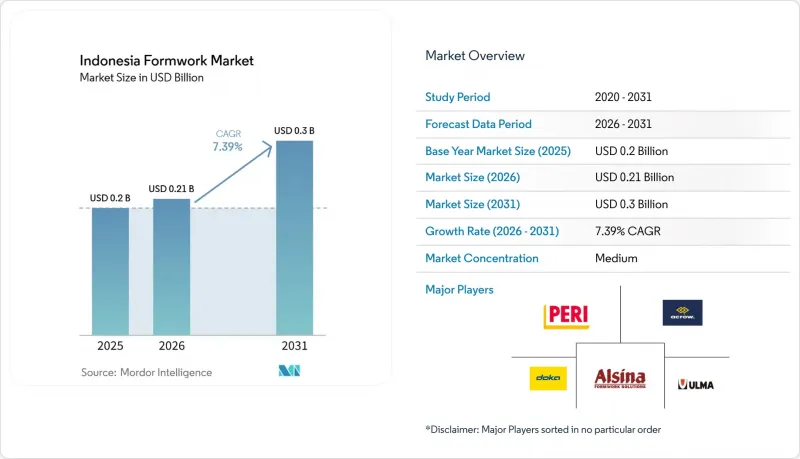
本報告按類型(傳統型/常規型、模組化/系統型)、配置(靜態、攀爬式、滑模式等)、經營模式(銷售、租賃)、行業(住宅、商業等)、材料(木材/膠合板、鋼材、鋁材、塑膠/玻璃纖維等)和城市(雅加達、泗水、萬隆等)進行分類。市場預測以美元計價。
印尼模板市場趨勢與洞察
基礎設施主導的需求來自交通和城市發展項目
印尼模板市場受益於大量公共工程項目,這些項目足以支撐道路、公共交通、橋樑和水利設施等各個領域的需求。公共工程部已最終確定2026會計年度預算為118.5兆印尼幣(約73億美元),其中45.62兆印尼幣(約28億美元)用於道路網路建設,這為承包商提供了清晰的混凝地工程訂單訂單。印尼2025年至2029年的基礎建設需求預計為1,905.3兆印尼幣(約1,191億美元),但國家預算僅涵蓋其中的35.63%,因此私部門和官民合作關係(PPP)模式在建設進度中仍扮演重要角色。這種資金籌措結構有利於供應商在專案各個階段持續部署設備,因為多套裝保險契約可以減少設備閒置時間,並獎勵持續交付。在印尼模板市場,這意味著當專案客戶希望由單一供應商負責多個澆築和施工現場時,大型租賃公司比小規模本地企業更容易留住客戶。此外,由於爪哇島及一些離島島的交通基礎設施和城市發展項目正在同步推進,市場需求也比以往更加多元化。
向模組化和系統型模板過渡
隨著專案總成本的重要性日益凸顯,印尼模板市場正朝著模組化和系統化解決方案轉型,而非僅僅關注單一材料的成本。到2025年,模組化/系統化模板的需求將占到58%,這將使中型建築商更容易證明在重複性結構中重複使用模板的經濟效益。可重複使用的模板面板通常可以重複使用50到200次,而鋸材模板通常只能承受不到10次澆築,這顯著提高了模板的生命週期經濟性,尤其是在超大型高層建築專案中。 PERI Indonesia在2025年的業績記錄,包括卡拉旺的JKT09資料中心和西爪哇的印尼銀行大樓,顯示系統化範本的應用範圍正在從傳統的高層建築擴展到工業和公共設施領域。瓦爾馬德瓦大學在2025年發布的一項研究也表明,與傳統的梁、板、柱結構澆築方法相比,鋁製模板可以縮短週期時間並降低每次澆築的人事費用。政府支持在 2029 年更廣泛地採用 BIM,這進一步推動了這一趨勢,因為數位化模板規劃縮短了調整週期,並將工程能力納入了商業提案中。
先進的模板系統需要較高的初始投資。
在印尼模板市場,先進的爬升模板、液壓自動升降模板和隧道系統的初始成本仍然是一大障礙。雖然許多中型建築商認知到可重複使用系統的生命週期優勢,但如果專案款項延遲收回,則難以承擔初始投資成本。此外,資金籌措有限,通常需要簽訂契約,這給競標技術性較強項目且未能滿足資質要求的建築商帶來了挑戰。合規性也是一大難題,因為供應商越來越需要滿足印尼國家標準 (SNI) 對受監管項目類別中結構產品的相關要求。雖然租賃有助於減輕標準應用的負擔,但並不能完全解決專用運輸設備和液壓系統在混凝土澆築間隙可能閒置所帶來的經濟挑戰。因此,在印尼模板市場,財務基礎雄厚、專案儲備充足或擁有國際供應商網路支援的公司採用率最高。
細分市場分析
到2025年,模組化/系統模板將佔據印尼模板市場58%的佔有率,這反映出大中型建築公司對其採用率的提高。公共工程工期縮短的壓力支撐了模組化/系統模板的主導地位,在這些工程中,由於牆體和樓板的施工週期重複,可重複使用的系統比以木材為主的傳統模板更受歡迎。傳統模板仍用於低層住宅、小規模商業建築和許多離島項目,其優勢在於工人熟悉操作且初始成本較低。瓦爾馬德瓦大學2025年的一項研究證實了這一趨勢,該研究表明,與傳統方法相比,鋁製模板可以降低重複梁、樓板和柱的施工人事費用並縮短施工週期。此外,PERI Indonesia在蘇迪曼二號塔、卡拉旺的JKT09資料中心和雅加達北部卡利巴魯碼頭專案中的應用表明,單一的模組化平台可以同時用於住宅、工業和海洋工程。
隨著法規和規劃實踐的不斷完善,印尼模板產業預計將繼續向模組化系統轉型。過去十年,公共工程部致力於推廣BIM(建築資訊模型)的廣泛應用,並將詳細的模板規劃納入大型專案的準備和審核流程。透過在競標階段的方案中加入模板佈局,承包商可以在混凝土澆築開始前減少協調錯誤,從而縮短工期。傳統系統預計不會消失,因為它們非常適合小規模工地和物流仍然具有挑戰性的地區的成本結構。然而,隨著可重複性、製程控制和技術支援在越來越多的專案中成為優先事項,預計到2031年,印尼模板市場的價值結構將進一步轉向模組化和系統化產品。
到2025年,靜態模板的需求將佔46%,成為樓板、平整牆體、地基和一次性澆築等應用領域的主導材料。其市場佔有率如此之高,主要原因是許多專案在滿足工期和成本目標時,仍不需要重新定位系統或垂直爬升解決方案。爬升模板是成長最快的材料,到2031年,其複合年成長率將達到8.54%,這主要得益於印尼模板市場的兩大項目趨勢。一是雅加達高層住宅和商業建築的需求;二是公共工程(例如地鐵車站、隧道、洩洪道和公用設施走廊)中豎井施工比例較高的項目的需求。目前,地鐵二期A階段工程就是一個最明顯的例子,因為地下車站需要標準平面模板系統無法提供的尺寸控制和深層施工能力。
儘管滑模和隧道系統在安裝量方面仍然相對小規模,但一旦某種施工方法被確立,其地位就很難被取代。筒倉、特定隧道構件和公用設施走廊等連續澆築結構都依賴這些施工方法來避免中斷和重工。 WIKA於2026年5月在IKN多功能隧道計畫中採用滑模技術,成為公共領域成功的典範。此案例表明,在技術難度高的施工現場,專用系統能夠顯著節省時間。這在印尼模板市場意義重大,因為公共領域的成功案例往往比產品目錄中的宣傳對未來的規範選擇影響更大。隨著隧道、交通和高層建築等基礎設施項目的推進,雖然靜態模板仍將佔據最大的安裝量,但爬升模板和專用模板配置很可能在高價值建設項目中佔據更大的佔有率。
其他好處:
- Excel格式的市場預測(ME)表
- 3個月的分析師支持
目錄
第1章:引言
- 研究假設和市場定義
- 調查範圍
第2章:調查方法
第3章執行摘要
第4章 市場狀況
- 市場概覽
- 市場促進因素
- 交通和城市發展項目支撐的基礎設施需求
- 向模組化和系統型模板過渡
- 租賃式採購的普及
- 隧道、橋樑和交通走廊對特殊模板的需求
- 高層住宅建造帶來的需求
- 勞動生產力面臨壓力,技術純熟勞工短缺
- 市場限制因素
- 需要對先進的模板系統進行大量的初始投資。
- 鋼鐵、鋁和木材等原物料價格波動
- 主要需求中心以外地區的物流和貨物處理複雜性。
- 承包商之間認知差異和培訓差距
- 價值和供應鏈分析
- 監理情勢
- 技術展望
- 成本結構分析
- 波特五力分析
- 地緣政治影響
- 原物料價格波動
- 供應鏈中斷和前置作業時間延長
- 能源和物流成本不斷上漲
- 基礎設施、能源安全和國防主導的需求
第5章 市場規模與成長預測
- 按類型
- 常規/傳統
- 模組化/系統類型
- 透過配置
- 靜態型別
- 攀爬型
- 滑模型
- 隧道類型
- 按經營模式
- 銷售
- 租賃
- 按行業
- 住宅
- 商業
- 工業與物流
- 基礎設施
- 材料
- 木材/合板
- 鋼
- 鋁
- 塑膠/玻璃纖維
- 其他材料
- 按城市
- 雅加達
- 泗水
- 萬隆
- 棉蘭
- 印尼其他地區
第6章 競爭情勢
- 市場集中度
- 策略趨勢
- 市佔率分析
- 公司簡介
- PERI SE
- Doka GmbH
- ULMA Construction
- Acrow Formwork and Construction Services Ltd.
- Alsina Formwork
- PASCHAL-Werk G. Maier GmbH
- MEVA Schalungs-Systeme GmbH
- Faresin Formwork SpA
- Kumkang Kind Co., Ltd.
- NOE-Schaltechnik GmbH
- PERI Indonesia
- PT. Tangga Mas Jaya Makmur
- ALCA Metals(PT. ALFO CITRA ABADI)
- Indosteger
- Lianggong Formwork Co., Ltd.
- KMF Co., Ltd
- PT. Cokrosoemitro Wirast Utama
- PT. Waskita Beton Precast Tbk
- PT. Wijaya Karya Beton Tbk
- PT. Adhi Persada Beton
第7章 市場機會與未來展望
According to Mordor Intelligence, the Indonesia formwork market size is expected to grow from USD 0.2 billion in 2025 to USD 0.21 billion in 2026 and is forecast to reach USD 0.3 billion by 2031 at 7.39% CAGR over 2026-2031.
This report is Segmented by Type (Conventional /Traditional and Modular / System Formwork), Configuration (Static, Climbing, Slipform, and More), Business Model (Sales and Rental), Sector (Residential, Commercial, and More), Material (Timber / Plywood, Steel, Aluminum, Plastic/Fiberglass and More), and City (Jakarta, Surabaya, Bandung, and More). The Market Forecasts are Provided in Terms of Value (USD).
Indonesia Formwork Market Trends and Insights
Infrastructure-Backed Demand from Transport and Urban Projects
The Indonesia formwork market is supported by a public works pipeline that remains large enough to sustain demand across roads, transit, bridges, and water-related assets. The Ministry of Public Works finalized a 2026 budget of IDR 118.5 trillion (USD 7.3 billion). It allocated IDR 45.62 trillion (USD 2.8 billion) to road connectivity alone, providing contractors with a clear order flow for civil concrete works. Indonesia's infrastructure requirements for 2025 to 2029 were estimated at IDR 1,905.3 trillion (USD 119.1 billion), and the state budget covers only 35.63% of that amount, so private and PPP execution still matter for the construction calendar. That funding structure benefits suppliers that can keep fleets deployed across sequential project phases, because multi-package contracts reduce idle time and reward delivery continuity. In the Indonesian formwork market, this means large rental operators can defend accounts more easily than smaller local firms when project owners want a single supplier to support multiple pours and work fronts. The demand base is also less concentrated than before, as transport and urban works are progressing simultaneously across Java and selected outer-island locations.
Shift Toward Modular and System Formwork
The Indonesia formwork market is moving toward modular and system solutions because the total project cost is becoming more important than line-item material cost. Modular / system formwork held 58% of demand in 2025, and the reuse economics are becoming easier for mid-tier contractors to justify for repetitive structures. Reusable formwork panels can typically achieve 50 to 200 reuse cycles, while sawn timber often remains below 10 pours, significantly improving lifecycle economics well before very large tower projects. PERI Indonesia's 2025 references at the JKT09 Data Center in Karawang and the Bank Indonesia complex in West Java show that system penetration now extends beyond traditional high-rise use cases into industrial and institutional work. A 2025 study published by Universitas Warmadewa also found that aluminum formwork delivered faster cycle times and lower labor costs per pour than conventional methods on repetitive beam, slab, and column structures. Government support for wider BIM adoption by 2029 further strengthens this trend, as digital formwork planning shortens coordination cycles and embeds engineering capability into the commercial offer.
High Initial Capital Requirement For Advanced Formwork Systems
The Indonesia formwork market still faces a meaningful barrier from the upfront cost of advanced climbing, hydraulic self-climbing, and tunnel-oriented systems. Many mid-tier contractors can see the lifecycle benefits of reusable systems, but the initial mobilization cost remains difficult to absorb when project cash collection is delayed. Access to financing is also limited because equipment lending often requires signed contracts, creating a qualification gap for contractors bidding on more technical projects. Compliance adds another layer, since suppliers increasingly need to meet SNI (Standar Nasional Indonesia)-related expectations for structural products in regulated project categories. Rental helps reduce the burden for standard applications, but it does not fully solve the economics of specialized carriers and hydraulic systems that can remain idle between sequential pours. In the Indonesia formwork market, this keeps adoption highest among firms with stronger balance sheets, established project pipelines, or support from international supplier networks.
Other drivers and restraints analyzed in the detailed report include:
- Rising Adoption of Rental-Based Procurement
- Specialized Formwork Need For Tunnels, Bridges, and Transit Corridors
- Raw Material Price Volatility in Steel, Aluminum, and Timber
For complete list of drivers and restraints, kindly check the Table Of Contents.
Segment Analysis
Modular / system formwork held 58% of the Indonesia formwork market share in 2025, which reflected widening adoption among both large contractors and mid-tier firms. The leading position was supported by tighter delivery schedules on public projects, where repeatable wall and slab cycles favor reusable systems over timber-heavy setups. Conventional / traditional formwork still served low-rise housing, small commercial work, and many outer-island projects, where crew familiarity and low upfront costs remained practical advantages. The 2025 Universitas Warmadewa study reinforced that direction, showing that aluminum formwork reduced labor costs and improved cycle times for repetitive beam, slab, and column work compared with conventional methods . PERI Indonesia's deployments across the Two Sudirman Tower, the JKT09 Data Center in Karawang, and the Terminal Kalibaru project in North Jakarta also demonstrated that a single modular platform can serve residential, industrial, and marine applications simultaneously.
The Indonesia formwork industry is likely to continue shifting toward modular systems as compliance and planning practices move in the same direction. The Ministry of Public Works is advancing broader BIM adoption throughout the current decade, making detailed formwork planning part of the preparation and review of larger projects. Contractors who include formwork layouts in tender-stage planning can reduce coordination errors before concrete placement begins, thereby supporting shorter cycle times. Conventional systems are not expected to disappear, as they still align with the cost profile of smaller sites and areas where logistics remain difficult. Even so, the value mix in the Indonesia formwork market is likely to move further toward modular and system products through 2031 as more projects prioritize repeatability, schedule control, and engineering support.
Static formwork accounted for 46% of demand in 2025, making it the leading configuration for applications such as slabs, flatwork, foundations, and single-repetition pours. Its large base came from the fact that many projects still did not need repositioning systems or vertical climbing solutions to meet schedule and cost targets. Climbing formwork is the fastest-growing configuration with an 8.54% CAGR through 2031, driven by two different project streams in the Indonesia formwork market. One stream comes from high-rise residential and commercial towers in Jakarta. In contrast, the other comes from shaft-heavy public works such as Mass Rapid Transit (MRT) stations, tunnels, spillways, and utility corridors. The MRT Phase 2A package is the clearest current example, because underground stations require dimensional control and working-at-depth capabilities that standard flat-form systems cannot provide.
Slipform and tunnel systems remain smaller in volume, but they occupy positions that are difficult to replace once the project method has been set. Continuous-pour structures such as silos, selected tunnel elements, and utility corridors depend on those methods to avoid interruptions and rework. WIKA's use of sliding formwork at the IKN Multi Utility Tunnel in May 2026 provided a visible public-sector reference. It demonstrated that specialized systems deliver schedule benefits on technically demanding sites. That matters for the Indonesia formwork market because public references often influence future specification choices more than product catalog claims. As tunnel, transit, and high-rise infrastructure projects move forward, climbing and specialized configurations are likely to take a larger share of higher-value work even if static formwork remains the largest by installed volume.
Complete Report Scope:
- By Type
- Conventional / Traditional
- Modular / System Formwork
- By Configuration
- Static
- Climbing
- Slipform
- Tunnel
- By Business Model
- Sales
- Rental
- By Sector
- Residential
- Commercial
- Industrial and Logistics
- Infrastructure
- By Material
- Timber / Plywood
- Steel
- Aluminum
- Plastic / Fiberglass
- Other Materials
- By City
- Jakarta
- Surabaya
- Bandung
- Medan
- Rest of Indonesia
List of Companies Covered in this Report:
- PERI SE
- Doka GmbH
- ULMA Construction
- Acrow Formwork and Construction Services Ltd.
- Alsina Formwork
- PASCHAL-Werk G. Maier GmbH
- MEVA Schalungs-Systeme GmbH
- Faresin Formwork S.p.A.
- Kumkang Kind Co., Ltd.
- NOE-Schaltechnik GmbH
- PERI Indonesia
- PT. Tangga Mas Jaya Makmur
- ALCA Metals (PT. ALFO CITRA ABADI)
- Indosteger
- Lianggong Formwork Co., Ltd.
- KMF Co., Ltd
- PT. Cokrosoemitro Wirast Utama
- PT. Waskita Beton Precast Tbk
- PT. Wijaya Karya Beton Tbk
- PT. Adhi Persada Beton
Additional Benefits:
- The market estimate (ME) sheet in Excel format
- 3 months of analyst support
TABLE OF CONTENTS
1 Introduction
- 1.1 Study Assumptions And Market Definition
- 1.2 Scope Of The Study
2 Research Methodology
3 Executive Summary
4 Market Landscape
- 4.1 Market Overview
- 4.2 Market Drivers
- 4.2.1 Infrastructure-Backed Demand From Transport and Urban Projects
- 4.2.2 Shift Toward Modular and System Formwork
- 4.2.3 Rising Adoption of Rental-Based Procurement
- 4.2.4 Specialized Formwork Need For Tunnels, Bridges, and Transit Corridors
- 4.2.5 Demand From High-Rise Residential Construction
- 4.2.6 Labor Productivity Pressure and Skilled Worker Shortages
- 4.3 Market Restraints
- 4.3.1 High Initial Capital Requirement For Advanced Formwork Systems
- 4.3.2 Raw Material Price Volatility in Steel, Aluminum, and Timber
- 4.3.3 Logistics and Handling Complexity Outside Major Demand Centers
- 4.3.4 Uneven Contractor Awareness and Training Gaps
- 4.4 Value and Supply-Chain Analysis
- 4.5 Regulatory Landscape
- 4.6 Technological Outlook
- 4.7 Cost Structure Analysis
- 4.8 Porter's Five Forces Analysis
- 4.8.1 Threat of New Entrants
- 4.8.2 Bargaining Power of Suppliers
- 4.8.3 Bargaining Power of Buyers
- 4.8.4 Threat of Substitutes
- 4.8.5 Intensity of Competitive Rivalry
- 4.9 Impact of Geopolitics
- 4.9.1 Raw Material Price Volatility
- 4.9.2 Supply Chain Disruptions and Longer Lead Times
- 4.9.3 Rising Energy and Logistics Costs
- 4.9.4 Infrastructure, Energy Security, and Defense-Led Demand
5 Market Size and Growth Forecasts
- 5.1 By Type
- 5.1.1 Conventional / Traditional
- 5.1.2 Modular / System Formwork
- 5.2 By Configuration
- 5.2.1 Static
- 5.2.2 Climbing
- 5.2.3 Slipform
- 5.2.4 Tunnel
- 5.3 By Business Model
- 5.3.1 Sales
- 5.3.2 Rental
- 5.4 By Sector
- 5.4.1 Residential
- 5.4.2 Commercial
- 5.4.3 Industrial and Logistics
- 5.4.4 Infrastructure
- 5.5 By Material
- 5.5.1 Timber / Plywood
- 5.5.2 Steel
- 5.5.3 Aluminum
- 5.5.4 Plastic / Fiberglass
- 5.5.5 Other Materials
- 5.6 By City
- 5.6.1 Jakarta
- 5.6.2 Surabaya
- 5.6.3 Bandung
- 5.6.4 Medan
- 5.6.5 Rest of Indonesia
6 Competitive Landscape
- 6.1 Market Concentration
- 6.2 Strategic Moves
- 6.3 Market Share Analysis
- 6.4 Company Profiles (Includes Global Level Overview, Market Level Overview, Core Segments, Financials as Available, Strategic Information, Products & Services, and Recent Developments)
- 6.4.1 PERI SE
- 6.4.2 Doka GmbH
- 6.4.3 ULMA Construction
- 6.4.4 Acrow Formwork and Construction Services Ltd.
- 6.4.5 Alsina Formwork
- 6.4.6 PASCHAL-Werk G. Maier GmbH
- 6.4.7 MEVA Schalungs-Systeme GmbH
- 6.4.8 Faresin Formwork S.p.A.
- 6.4.9 Kumkang Kind Co., Ltd.
- 6.4.10 NOE-Schaltechnik GmbH
- 6.4.11 PERI Indonesia
- 6.4.12 PT. Tangga Mas Jaya Makmur
- 6.4.13 ALCA Metals (PT. ALFO CITRA ABADI)
- 6.4.14 Indosteger
- 6.4.15 Lianggong Formwork Co., Ltd.
- 6.4.16 KMF Co., Ltd
- 6.4.17 PT. Cokrosoemitro Wirast Utama
- 6.4.18 PT. Waskita Beton Precast Tbk
- 6.4.19 PT. Wijaya Karya Beton Tbk
- 6.4.20 PT. Adhi Persada Beton
7 Market Opportunities and Future Outlook
- 7.1 White-Space and Unmet-Need Assessment

 模板系統市場分析及預測(至2035年):類型、技術、組件、應用、材料類型、製程、最終用戶、安裝方式、解決方案、階段
 北美模板工程:市場佔有率分析、產業趨勢與統計、成長預測(2026-2031)中國模板市場:市場佔有率分析、產業趨勢與統計、成長預測(2026-2031)印度模板工程:市場佔有率分析、產業趨勢與統計、成長預測(2026-2031)德國模板產業:市場佔有率分析、產業趨勢與統計、成長預測(2026-2031)
 木製模板系統市場-全球產業規模、佔有率、趨勢、機會、預測:按滑軌類型、應用、地區和競爭格局分類,2021-2031年鋁模板系統市場-全球產業規模、佔有率、趨勢、機會、預測:按類型、應用、地區和競爭格局分類,2021-2031年
 2026年全球木模板系統市場報告2026年全球範本市場報告2026年全球範本系統市場報告