


 |
市場調查報告書
商品編碼
2099166
德國模板產業:市場佔有率分析、產業趨勢與統計、成長預測(2026-2031)Germany Formwork - Market Share Analysis, Industry Trends & Statistics, Growth Forecasts (2026 - 2031) |
||||||

※ 本網頁內容可能與最新版本有所差異。詳細情況請與我們聯繫。
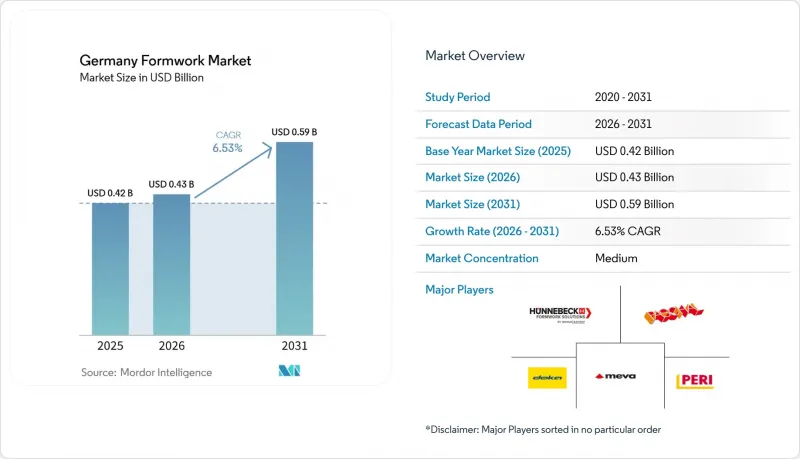
根據 Mordor Intelligence 預測,德國模板市場規模預計在 2025 年達到 4.2 億美元,2026 年達到 4.3 億美元,到 2031 年達到 5.9 億美元,2026 年至 2031 年的複合年成長率為 6.53%。
本報告按類型(傳統/常規模板和模組化/系統模板)、配置(靜態、爬升、滑模、隧道)、經營模式(銷售和租賃)、行業(住宅、商業、工業/物流、基礎設施)、材料(木材/膠合板等)和城市(柏林、慕尼黑、法蘭克福、萊比錫等)進行分類。市場預測以美元計價。
德國模板市場趨勢與洞察
公共基礎設施獎勵策略和鐵路現代化
公共基礎設施投資是德國模板市場中期需求最強勁的推動要素。這是因為鐵路、公路和水路工程會產生長期的混凝地工程。德國已承諾2029年投資1,070億歐元(1,166億美元)用於鐵路基礎建設,屆時鐵路、公路和水路基礎設施總支出將達到1,660億歐元(1,809億美元)。德國鐵路公司(Deutsche Bahn)的2026年投資計畫包括超過230億歐元(253億美元)用於鐵路網路的累計和現代化改造,這將支撐對橋墩、擋土牆、車站建設和隧道入口的持續需求。這對德國模板市場意義重大,因為這些應用通常更傾向於使用耐用的鋼結構系統、爬升式配置和高運轉率的租賃設備,而不是現場臨時搭建的解決方案。 DB InfraGO的走廊計畫目前正在實施,並將持續到2036年,該計畫為供應商提供了對未來需求的清晰洞察,並鼓勵他們投資於設備產能和服務網路。 2026 年 5 月,德國聯邦議會批准了更多鐵路項目,進一步擴大了德國模板市場的供應範圍,並增強了其中期前景。
住宅短缺和多用戶住宅大樓建設的復甦
儘管德國住宅短缺導致整體建築週期不穩定,但多用戶住宅住宅建設在德國模板市場仍佔有重要地位。需求集中在住宅需求最為迫切的大城市,這些城市需要對大規模住宅小區的樓板、牆體和核心筒進行重複的混凝土澆築作業。眾多已獲批准或部分完工的住宅項目為模板供應商提供了大量明確的訂單,這些訂單的進度已經超過了最初的土地規劃階段。政府對社會住宅的支持也支撐了低階市場的需求,這在一定程度上保護了德國模板市場免受私營部門整體放緩的影響。事實上,模組化牆體系統、樓板系統和可重複使用的模板仍然與最有可能率先開工的項目類型高度契合。因此,即使基礎設施和大型城市項目依然保持強勁勢頭,住宅需求在德國模板市場仍佔有重要地位。
設計模板系統的初始成本較高
工程模板系統的高昂購置成本持續限制其在德國模板市場的整體普及,尤其是在中小型建築公司。許多中小型建築公司認知到系統模板在節省勞動力和提高品質方面的優勢。然而,當專案重複使用週期較短時,其經濟效益就會降低。對於規模較小、重複使用頻率較低的小規模住宅和局部翻新工程而言,情況尤其如此。儘管資金籌措環境已從最糟糕的時期有所改善,但許多建築公司仍然傾向於避免擁有自有設備帶來的沉重資產負債表負擔。這也是租賃業務在德國模板市場中仍佔據主導地位的原因之一,儘管租賃業務需要承擔額外的運輸、規劃和歸還處理成本。因此,儘管先進的系統正在逐步普及,但其市場普及仍然高度依賴租賃網路和專案規模。
細分市場分析
到2025年,模組化/系統模板將佔德國模板市場佔有率的57%,預計到2031年,該細分市場將以6.90%的複合年成長率成長。這種情況表明,在德國模板市場,工程解決方案不再局限於大型專案。建築公司越來越傾向於使用可重複使用的系統,因為它們可以縮短施工週期,提高尺寸控制的一致性,並減少每次澆築所需的人工。無論是住宅開發項目還是大規模基礎設施項目,可重複性和流程確定性都至關重要,因此這一趨勢尤其明顯。 PERI與DataB於2025年1月成立的合資企業DataForm.Work GmbH,正是主要供應商如何加強數位化規劃與製造速度整合的一個鮮明例子。
這一發展意義重大,因為從模型到生產的加速過渡使得預製模板的實施更加便捷,即使在以往更傾向於手工操作的客製化混凝土澆築中也是如此。在德國模板市場,這正在削弱傳統木製模板在非標準應用中的實用優勢。傳統模板仍然用於非標混凝土澆築、重複使用頻率低的項目以及現場取材仍然經濟的鄉村工地。在整體系統實施成本較高的情況下,例如運輸距離長或重複使用頻率低時,傳統模板仍然適用。然而,德國模板市場的整體發展方向是明確的:由於施工複雜性的增加、勞動力短缺的加劇以及品質要求的提高,市場需求正持續轉向模組化和系統化模板。
爬升系統是德國模板市場成長最快的細分領域,預計2026年至2031年將以7.80%的複合年成長率成長。這一成長反映了當前推動市場發展的建築類型,包括高層住宅、能源相關結構、擋土牆以及垂直重複性土木工程。這些應用需要能夠安全且有效率地向上移動的系統,而無需在每個階段都依賴大型起重機。 Funnebeck的「SCF 60」自動升降系統滿足了這項需求,它採用液壓自動升降技術,並結合起重機操作,同時支援使用標準組件進行靈活的平台擴展。在德國模板市場,該系統有助於緩解人手不足,並為那些垂直施工進度至關重要的專案提供流程管理支援。
即使到了2025年,靜態模板仍將佔據41%的最大市場佔有率,因為樓板和低層牆體施工在倉儲、物流和住宅建築領域仍然十分普遍。這為德國模板市場創造了一個龐大的市場基礎,目前仍依賴較傳統的水平應用。滑模和隧道系統在鐵路和土木工程領域繼續發揮重要作用,因為它們適用於連續或高度重複的結構施工。 DB InfraGO的走廊工程已在主要線路上進入全面施工階段,支撐了目前對隧道相關和擋土牆模板的需求。因此,儘管靜態系統仍然是市場規模的基礎,但爬升模板解決方案正在推動德國模板市場的成長。
其他好處:
- Excel格式的市場預測(ME)表
- 3個月的分析師支持
目錄
第1章:引言
- 研究假設和市場定義
- 調查範圍
第2章:調查方法
第3章執行摘要
第4章 市場狀況
- 市場概覽
- 市場促進因素
- 公共基礎設施獎勵策略和鐵路現代化
- 住宅短缺和多用戶住宅大樓建設的復甦
- 過渡到可重複使用、廢棄物更少的模板系統。
- 由於人手不足,以生產效率為優先的模板技術正在加速推廣應用。
- 由於維修、整修和節能建築項目的增加,對模板的需求正在擴大。
- 越來越多複雜的城市開發案需要採用攀爬和滑模施工方法。
- 市場限制因素
- 工程模板系統的初始成本較高
- 小規模新房住宅量下滑
- 由於授權、資金籌措以及籌款過程的複雜性,工程出現延誤。
- 租賃設備的物流負擔和退貨處理成本高昂
- 價值和供應鏈分析
- 監理情勢
- 技術展望
- 成本結構分析
- 波特五力模型
- 地緣政治影響
- 原物料價格波動
- 供應鏈中斷和前置作業時間延長
- 能源和物流成本不斷上漲
- 基礎設施、能源安全和國防主導的需求
第5章 市場規模與成長預測
- 按類型
- 傳統型/傳統方法
- 模組化/系統模板
- 透過配置
- 靜止的
- 上升趨勢
- 滑模
- 隧道
- 按經營模式
- 銷售
- 租賃
- 按行業
- 住宅
- 商業的
- 工業與物流
- 基礎設施
- 材料
- 木材/合板
- 鋼
- 鋁
- 塑膠/玻璃纖維
- 其他材料類型
- 按城市
- 柏林
- 慕尼黑
- 法蘭克福
- 萊比錫
- 德國其他地區
第6章 競爭情勢
- 市場集中度
- 策略趨勢
- 市佔率分析
- 公司簡介
- PERI GmbH
- Doka GmbH
- MEVA Schalungssysteme GmbH
- PASCHAL-Werk G. Maier GmbH
- Hunnebeck GmbH
- ULMA Construction
- Alsina Formwork
- BrandSafway
- Altrad RMD Kwikform
- EFCO Corp.
- NOE-Schaltechnik GmbH
- MAX FRANK GmbH and Co. KG
- RINGER GmbH
- form-on GmbH
- KERN Schalungsservice GmbH
- Ischebeck GmbH
- Geoplast SpA
- Condor Spezialbau GmbH
- Faresin Formwork SpA
- Mevaform GmbH
第7章 市場機會與未來展望
According to Mordor Intelligence, the Germany formwork market size is projected to be USD 0.42 billion in 2025, USD 0.43 billion in 2026, and reach USD 0.59 billion by 2031, growing at a CAGR of 6.53% from 2026 to 2031.
This report is Segmented by Type (Conventional / Traditional and Modular / System Formwork), Configuration (Static, Climbing, Slipform, and Tunnel), Business Model (Sales and Rental), Sector (Residential, Commercial, Industrial & Logistics and Infrastructure), Material (Timber / Plywood, and More), and City (Berlin, Munich, Frankfurt, Leipzig, and More). The Market Forecasts are Provided in Terms of Value (USD).
Germany Formwork Market Trends and Insights
Public Infrastructure Stimulus and Rail Modernization
Public infrastructure investment is the strongest medium-term demand driver for the Germany formwork market because rail, road, and water projects create long-duration concrete packages. Germany committed EUR 107 billion (USD 116.6 billion) for rail infrastructure through 2029, and total infrastructure spending across rail, roads, and waterways reached EUR 166 billion (USD 180.9 billion). Deutsche Bahn's 2026 investment plan exceeded EUR 23 billion (USD 25.3 billion) for rail network maintenance and modernization, which supports ongoing demand for bridge abutments, retaining walls, station works, and tunnel portals. This matters for the Germany formwork market because those applications usually favor durable steel systems, climbing configurations, and high-utilization rental fleets rather than ad hoc site-built solutions. DB InfraGO's corridor program now runs through 2036, providing suppliers with unusual visibility into future demand and supporting investment in fleet capacity and service networks. The Bundestag's approval of additional railway projects in May 2026 extends that pipeline further and strengthens the medium-term outlook for the Germany formwork market.
Housing Shortage and Multi-Family Construction Recovery
Germany's housing shortage keeps multi-family building relevant for the Germany formwork market even when the wider construction cycle remains uneven. Demand is concentrated in major cities where housing pressure is strongest and where larger residential blocks require repeated slab, wall, and core concrete work. The large stock of permitted and partially advanced housing projects provides formwork suppliers with a visible pool of work that is already more advanced than early-stage land planning. Public support for social housing also adds a demand floor that helps protect the Germany formwork market from a fully private-sector slowdown. The practical effect is that modular wall systems, slab systems, and reusable panels remain well aligned with the kinds of projects that are most likely to move first. This keeps residential demand important for the Germany formwork market even if growth remains stronger in infrastructure and major urban projects.
High Upfront Cost of Engineered Formwork Systems
The high purchase cost of engineered systems still limits faster adoption across the Germany formwork market, especially among smaller contractors. Many Small- and Medium-Sized Enterprise builders can see the labor and quality benefits of system formwork. Still, the financial case is less attractive when a project offers only a short reuse window. This is particularly relevant in small residential and local renovation work where job sizes are modest, and project repetition is limited. Financing conditions have improved from their worst levels, yet many contractors still prefer to avoid large balance-sheet commitments for owned fleets. That is one reason rental continues to hold a strong position in the Germany formwork market, even though rental also adds transport, planning, and return-handling costs. The result is a market where advanced systems gain ground, but adoption still depends heavily on access to rental networks and project scale.
Other drivers and restraints analyzed in the detailed report include:
- Shift Toward Reusable and Low-Waste Formwork Systems
- Labor Scarcity Accelerating Productivity-Focused Formwork Adoption
- Weak Residential New-Build Starts in Smaller Municipalities
For complete list of drivers and restraints, kindly check the Table Of Contents.
Segment Analysis
Modular / system formwork held 57% of Germany formwork market share in 2025, and the segment is projected to expand at a 6.90% CAGR through 2031. That position shows that engineered solutions are no longer limited to only the largest projects in the Germany formwork market. Contractors increasingly prefer reusable systems because they support faster cycles, more consistent dimensional control, and lower labor input per pour. The same preference is visible in both residential blocks and major infrastructure jobs where repeatability and schedule certainty matter. PERI's January 2025 joint venture with DataB, which established DataForm.Work GmbH, is a clear example of how leading suppliers are strengthening the link between digital planning and fabrication speed..
That move matters because faster model-to-production conversion makes engineered formwork easier to deploy on bespoke pours that once favored more manual methods. In the Germany formwork market, this reduces the practical advantage that conventional timber solutions held in irregular applications. Conventional formwork still serves non-standard pours, short reuse projects, and rural jobs where site-sourced materials remain economical. It also remains relevant where transport distances or low repetition weaken the economics of full system deployment. Even so, the broader direction of the Germany formwork market remains clear because higher complexity, tighter labor availability, and stronger quality expectations continue to shift demand toward modular and system formats.
Climbing systems are the fastest-growing configuration in the Germany formwork market, with a projected 7.80% CAGR from 2026 to 2031. Their growth reflects the types of work now driving the market, including high-rise housing, energy structures, retaining walls, and vertically repetitive civil works. These applications reward systems that can move upward safely and efficiently without relying on heavy crane usage at every stage. Hunnebeck's SCF 60 self-climbing system fits that requirement because it uses hydraulic self-climbing in addition to crane operation and supports flexible platform expansion with standard components. For the Germany formwork market, that lowers labor pressure and supports schedule control on projects where vertical progress is critical.
Static formwork still held the largest share at 41% in 2025, as slab and low-rise wall work remain widespread across warehousing, logistics, and residential construction. This gives the Germany formwork market a broad installed base that still depends on more conventional horizontal applications. Slipform and tunnel systems remain important in rail and civil engineering because they suit continuous or highly repetitive structural work. DB InfraGO's corridor program has already entered an intensive construction phase on key routes, which supports current demand for tunnel-related and retaining-wall formwork applications. The result is a configuration mix where static systems still anchor volume, while climbing solutions define the growth edge of the Germany formwork market.
Complete Report Scope:
- By Type
- Conventional / Traditional
- Modular / System Formwork
- By Configuration
- Static
- Climbing
- Slipform
- Tunnel
- By Business Model
- Sales
- Rental
- By Sector
- Residential
- Commercial
- Industrial and Logistics
- Infrastructure
- By Material
- Timber / Plywood
- Steel
- Aluminum
- Plastic / Fiberglass
- Other Material Types
- By City
- Berlin
- Munich
- Frankfurt
- Leipzig
- Rest of Germany
List of Companies Covered in this Report:
- PERI GmbH
- Doka GmbH
- MEVA Schalungssysteme GmbH
- PASCHAL-Werk G. Maier GmbH
- Hunnebeck GmbH
- ULMA Construction
- Alsina Formwork
- BrandSafway
- Altrad RMD Kwikform
- EFCO Corp.
- NOE-Schaltechnik GmbH
- MAX FRANK GmbH and Co. KG
- RINGER GmbH
- form-on GmbH
- KERN Schalungsservice GmbH
- Ischebeck GmbH
- Geoplast S.p.A.
- Condor Spezialbau GmbH
- Faresin Formwork S.p.A.
- Mevaform GmbH
Additional Benefits:
- The market estimate (ME) sheet in Excel format
- 3 months of analyst support
TABLE OF CONTENTS
1 Introduction
- 1.1 Study Assumptions and Market Definition
- 1.2 Scope of the Study
2 Research Methodology
3 Executive Summary
4 Market Landscape
- 4.1 Market Overview
- 4.2 Market Drivers
- 4.2.1 Public Infrastructure Stimulus and Rail Modernization
- 4.2.2 Housing Shortage and Multi-Family Construction Recovery
- 4.2.3 Shift Toward Reusable and Low-Waste Formwork Systems
- 4.2.4 Labor Scarcity Accelerating Productivity-Focused Formwork Adoption
- 4.2.5 Renovation, Retrofit, and Energy-Efficiency Works Expanding Formwork Demand
- 4.2.6 Growth of Complex Urban Projects Requiring Climbing and Slipform Solutions
- 4.3 Market Restraints
- 4.3.1 High Upfront Cost of Engineered Formwork Systems
- 4.3.2 Weak Residential New-Build Starts in Smaller Municipalities
- 4.3.3 Project Delays From Permitting, Financing, and Procurement Complexity
- 4.3.4 High Logistics Burden and Return-Handling Costs for Rental Equipment
- 4.4 Value and Supply-Chain Analysis
- 4.5 Regulatory Landscape
- 4.6 Technological Outlook
- 4.7 Cost Structure Analysis
- 4.8 Porter's Five Forces
- 4.8.1 Threat of New Entrants
- 4.8.2 Bargaining Power of Suppliers
- 4.8.3 Bargaining Power of Buyers
- 4.8.4 Threat of Substitutes
- 4.8.5 Intensity of Competitive Rivalry
- 4.9 Impact of Geopolitics
- 4.9.1 Raw Material Price Volatility
- 4.9.2 Supply Chain Disruptions and Longer Lead Times
- 4.9.3 Rising Energy and Logistics Costs
- 4.9.4 Infrastructure, Energy Security, and Defense-Led Demand
5 Market Size and Growth Forecasts (Value, USD)
- 5.1 By Type
- 5.1.1 Conventional / Traditional
- 5.1.2 Modular / System Formwork
- 5.2 By Configuration
- 5.2.1 Static
- 5.2.2 Climbing
- 5.2.3 Slipform
- 5.2.4 Tunnel
- 5.3 By Business Model
- 5.3.1 Sales
- 5.3.2 Rental
- 5.4 By Sector
- 5.4.1 Residential
- 5.4.2 Commercial
- 5.4.3 Industrial and Logistics
- 5.4.4 Infrastructure
- 5.5 By Material
- 5.5.1 Timber / Plywood
- 5.5.2 Steel
- 5.5.3 Aluminum
- 5.5.4 Plastic / Fiberglass
- 5.5.5 Other Material Types
- 5.6 By City
- 5.6.1 Berlin
- 5.6.2 Munich
- 5.6.3 Frankfurt
- 5.6.4 Leipzig
- 5.6.5 Rest of Germany
6 Competitive Landscape
- 6.1 Market Concentration
- 6.2 Strategic Moves
- 6.3 Market Share Analysis
- 6.4 Company Profiles (includes Global Level Overview, Market Level Overview, Core Segments, Financials as available, Strategic Information, Market Rank/Share, Products and Services, Recent Developments)
- 6.4.1 PERI GmbH
- 6.4.2 Doka GmbH
- 6.4.3 MEVA Schalungssysteme GmbH
- 6.4.4 PASCHAL-Werk G. Maier GmbH
- 6.4.5 Hunnebeck GmbH
- 6.4.6 ULMA Construction
- 6.4.7 Alsina Formwork
- 6.4.8 BrandSafway
- 6.4.9 Altrad RMD Kwikform
- 6.4.10 EFCO Corp.
- 6.4.11 NOE-Schaltechnik GmbH
- 6.4.12 MAX FRANK GmbH and Co. KG
- 6.4.13 RINGER GmbH
- 6.4.14 form-on GmbH
- 6.4.15 KERN Schalungsservice GmbH
- 6.4.16 Ischebeck GmbH
- 6.4.17 Geoplast S.p.A.
- 6.4.18 Condor Spezialbau GmbH
- 6.4.19 Faresin Formwork S.p.A.
- 6.4.20 Mevaform GmbH
7 Market Opportunities and Future Outlook
- 7.1 White-Space and Unmet-Need Assessment

 模板系統市場分析及預測(至2035年):類型、技術、組件、應用、材料類型、製程、最終用戶、安裝方式、解決方案、階段
 北美模板工程:市場佔有率分析、產業趨勢與統計、成長預測(2026-2031)中國模板市場:市場佔有率分析、產業趨勢與統計、成長預測(2026-2031)印尼模板工程:市場佔有率分析、產業趨勢與統計、成長預測(2026-2031)印度模板工程:市場佔有率分析、產業趨勢與統計、成長預測(2026-2031)
 木製模板系統市場-全球產業規模、佔有率、趨勢、機會、預測:按滑軌類型、應用、地區和競爭格局分類,2021-2031年鋁模板系統市場-全球產業規模、佔有率、趨勢、機會、預測:按類型、應用、地區和競爭格局分類,2021-2031年
 2026年全球木模板系統市場報告2026年全球範本市場報告2026年全球範本系統市場報告