


 |
市場調查報告書
商品編碼
2099095
北美模板工程:市場佔有率分析、產業趨勢與統計、成長預測(2026-2031)North America Formwork - Market Share Analysis, Industry Trends & Statistics, Growth Forecasts (2026 - 2031) |
||||||

※ 本網頁內容可能與最新版本有所差異。詳細情況請與我們聯繫。
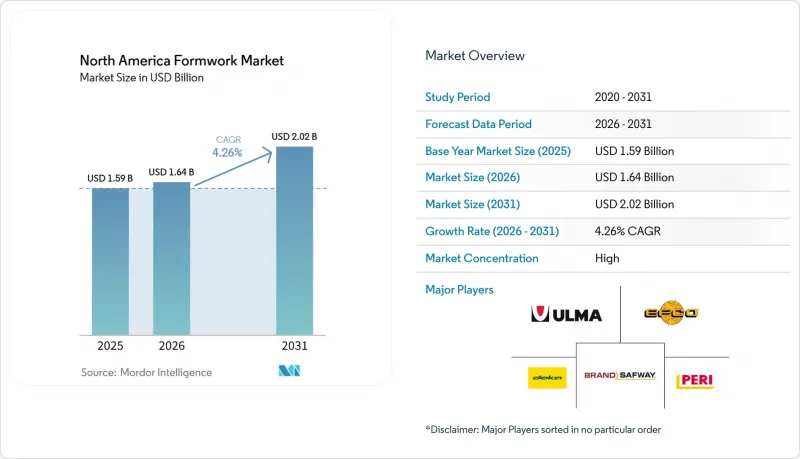
據 Mordor Intelligence 稱,2025 年北美模板市場價值 15.9 億美元,預計到 2031 年將從 2026 年的 16.4 億美元成長至 20.2 億美元,預測期(2026-2031 年)複合年成長率為 4.26%。
本報告按類型(傳統/常規型和模組化/系統型)、配置(靜態、爬升、滑模、隧道)、經營模式(銷售和租賃)、行業(住宅、商業、工業/物流、基礎設施)、材料(木材/膠合板等)和地區(美國、加拿大、墨西哥)進行分類。市場預測以美元計價。
北美模板市場趨勢及洞察
增加橋樑、公共交通和公共工程等基礎建設支出。
在整個預測期內,聯邦基礎設施支出仍是北美模板市場需求的最直接推動要素。截至2026年4月,各州已承諾根據《基礎建設投資與就業法案》(IIJA)中關於公路和橋樑的撥款,為超過120,860個項目(包括19,000座橋樑維修)撥款2750億美元。聯邦公共交通管理局(FPTA)在2026財政年度撥款206億美元用於公共交通資本化、維護保養項目和公車設施維修,進一步推動了這一趨勢。此外,據聯邦公路管理局(FHWA)稱,每投資10億美元用於公路和橋樑建設,就能在美國經濟中創造約13,000個就業崗位,從而支撐起廣泛的承包商活動和項目推出。隨著這些橋樑、道路和公共交通項目在 2026 年和 2027 年繼續實施,預計北美模板市場將繼續受益於租賃使用量的增加和工程系統更換週期的建立。
向租賃和再利用模式過渡,以減少專案資本支出(CAPEX)。
在北美模板市場,租賃已成為一種備受青睞的使用模式,因為它降低了初始擁有風險,並能靈活應對不規則的專案進度。對於希望同時管理多個專案並節省資金以滿足人事費用、材料和營運資金需求的中型建築公司而言,這一趨勢尤其明顯。此外,租賃模式還使建築公司能夠利用最新的系統設計和技術支持,而無需自行建造維護系統,從而加快現場部署速度。隨著租賃設備的所有權日益集中於大型公司,定價權和服務差異化優勢正日益轉移到擁有更廣泛倉庫網路和強大現場支援能力的公司。因此,MEVA、ULMA、PERI 和 Doka 等供應商近期的舉措表明,北美模板市場正在推行一種「服務主導」策略,租賃系統的全面性和技術支援與硬體本身同等重要。
工程型模板系統的初始成本較高
工程化系統的高昂初始成本是北美模板市場推廣應用的一大障礙。雖然重複使用可以提高成本效益,但中小型承包商和一次性專案使用者往往缺乏足夠的財務可見性來證明直接購買的合理性。這正是租賃市場依然強勁的原因之一,儘管承包商更傾向於長期擁有設備的經濟效益。關稅壓力也加劇了成本風險,41%的建築公司為了遵守關稅規定而提高了價格,39%的公司為了應對預期的價格上漲而提前採購。此外,遵守設計、監管要求和支撐規範也為複雜的專案增加了額外的成本,導致設備所有權集中在大規模設備擁有公司和財力雄厚的營運商手中。
細分市場分析
到2025年,模組化/系統模板將佔北美模板市場58%的佔有率,預計到2031年將以5.4%的複合年成長率成長。這使其成為市場上規模最大、成長最快的模板類型,表明北美模板市場正在經歷結構性轉型,而不僅僅是短期偏好變化。模組化系統的吸引力在於其高度可重複性、更短的安裝時間和對現場勞動密集工作的更好控制。這些系統也非常適合公共工程和政府專案所需的安全性能記錄和更標準化的施工方法。 PERI USA於2025年1月推出的「SKYFLEX」和「LEVO」系列產品,憑藉其輕巧的搬運方式、英制單位尺寸和專為美國現場條件設計的組裝方法,體現了這一趨勢。
傳統模板在客製化地基工程、低重複性作業以及小規模住宅混凝土澆築中仍然普遍存在,這些工程通常依賴承包商熟悉的木結構方法。在這些情況下,模組化設備的安裝成本可能超過系統實施所帶來的生產力提升。因此,在低重複性、高設計變化的場景中,傳統模板仍扮演重要角色。然而,隨著木工、設計部門以及建築資訊模型 (BIM) 支援的構件庫的出現,北美模板市場正逐漸擺脫以木工為基礎的手工方法,模組化模板的應用範圍也越來越廣。在這段過渡時期,模組化模板和系統模板在北美模板市場的規模方面仍然佔據主導地位,因為它們在規模和未來成長方面都已佔據主導地位。
到2025年,固定式模板將佔北美模板市場的46%,並繼續在樓板、牆體、柱子和基礎施工中保持領先地位。固定式模板已成為預設配置,因為商業、住宅和土木工程中的大多數混凝土澆築仍不需要高度專業化的移動式模板系統。在幾何形狀簡單的條件下,固定式模板系統易於操作、隨處可得,且方便工人部署。因此,它在北美模板市場的日常施工中仍然佔據核心地位。同時,預計到2031年,爬升式模板將以4.56%的複合年成長率成長,成為成長最快的組成部分。
爬升系統的成長主要得益於其在高層建築核心區域、人口密集的都市區建築工地以及無需依賴起重機即可保證專案工期的場景中的應用。多卡公司計劃於2026年在美國推出配備FormDrive系統的剪力牆爬升機SCP,這充分展現了該產品類型如何透過液壓提升、遠端監控和快速重新部署等技術實現演進。在需要連續澆築的筒倉、儲槽和公共設施中,滑模施工仍然至關重要。隨著交通運輸和公共產業項目對高效、可重複的襯砌工程需求不斷成長,隧道模板也發揮重要作用。在這一領域,靜態系統仍然佔據北美模板市場的主導地位,但在高價值的都市區應用中,成長的主導力正在轉向爬陞技術。
其他好處:
- Excel格式的市場預測(ME)表
- 3個月的分析師支持
目錄
第1章:引言
- 研究假設和市場定義
- 調查範圍
第2章:調查方法
第3章執行摘要
第4章 市場狀況
- 市場概覽
- 市場促進因素
- 增加對橋樑、公共交通和公共工程等基礎設施的投資。
- 向租賃和再利用模式過渡,以減少專案資本支出(CAPEX)。
- 採用工程技術和模組化系統來縮短週期時間。
- 高層建築和深基礎施工對更安全的模板解決方案的需求日益成長。
- 加速數位化進程,整合BIM和預製施工方法。
- 碳排放和廢棄物報告對再利用經濟學構成壓力
- 市場限制因素
- 工程模板系統的初始成本較高
- 安全組裝和現場工程方面技術純熟勞工短缺。
- 由於授權、天氣和季節性施工期等原因,工程延期。
- 工作場所租賃車輛車隊和庫存的分配
- 價值和供應鏈分析
- 監理情勢
- 技術展望
- 成本結構分析
- 波特五力分析
- 地緣政治影響
- 原物料價格波動
- 供應鏈中斷和前置作業時間延長
- 能源和物流成本不斷上漲
- 基礎設施、能源安全和國防主導的需求
第5章 市場規模與成長預測
- 按類型
- 傳統與傳統
- 模組化和系統類型
- 透過配置
- 靜止的
- 攀爬
- 滑模
- 隧道
- 按經營模式
- 銷售
- 租賃
- 按行業
- 住宅
- 商業的
- 工業與物流
- 基礎設施
- 材料
- 木材/合板
- 鋼
- 鋁
- 塑膠/玻璃纖維
- 其他
- 國家
- 美國
- 加拿大
- 墨西哥
第6章 競爭情勢
- 市場集中度
- 策略趨勢
- 市佔率分析
- 公司簡介
- PERI Formwork Systems, Inc.
- Doka USA Ltd.
- BrandSafway
- EFCO Corp.
- ULMA Construction
- MEVA Formwork Systems, Inc.
- Acrow
- Alsina Group
- FORSA SA
- MFE Formwork Technology Sdn Bhd
- PASCHAL-Werk G. Maier GmbH
- Aluma Systems
- North American Formworx
- Forming America
- Wharton Hardware and Supply Company
- Trekker Group
- Alkus North America Inc.
- Patent Construction Systems, LLC
- Symons
- Hunnebeck
第7章 市場機會與未來展望
According to Mordor Intelligence, the North America formwork market size was valued at USD 1.59 billion in 2025 and is estimated to grow from USD 1.64 billion in 2026 to reach USD 2.02 billion by 2031, at a CAGR of 4.26% during the forecast period (2026-2031).
This report is Segmented by Type (Conventional / Traditional and Modular / System Formwork), Configuration (Static, Climbing, Slipform, and Tunnel), Business Model (Sales and Rental), Sector (Residential, Commercial, Industrial & Logistics, and Infrastructure), Material (Timber / Plywood, and More), and Geography (United States, Canada, and Mexico). The Market Forecasts are Provided in Terms of Value (USD).
North America Formwork Market Trends and Insights
Rising Infrastructure Spend on Bridges, Transit, and Public Works
Federal infrastructure spending remains the most direct demand driver for the North America formwork market over the forecast period. Through April 2026, states had committed USD 275 billion in the Infrastructure Investment and Jobs Act (IIJA) highway and bridge formula funds across more than 120,860 projects, including 19,000 bridge upgrades. The same cycle is reinforced by the Federal Transit Administration's FY2026 apportionment of USD 20.6 billion for transit capital work, state-of-good-repair projects, and bus facility upgrades. The Federal Highway Administration also states that every USD 1 billion in highway and bridge investment supports around 13,000 jobs across the United States economy, which keeps contractor activity and project mobilization broad-based. As these bridge, roadway, and transit projects move deeper into execution during 2026 and 2027, the North America formwork market continues to benefit from stronger rental utilization and a firmer replacement cycle for engineered systems.
Shift Toward Rental and Reuse Models to Reduce Project CAPEX
Rental has become the preferred access model across a large part of the North America formwork market because it reduces upfront ownership risk and aligns better with uneven project schedules. This shift is strongest among mid-sized contractors that manage several projects at once and prefer to keep capital free for labor, materials, and working capital needs. The model also gives contractors access to newer system designs, engineering support, and faster mobilization without the need to build internal maintenance capacity. As rental fleet ownership becomes more concentrated among large operators, pricing power and service differentiation increasingly move toward players with deeper depot networks and stronger field support. That is why recent moves by suppliers such as MEVA, ULMA, PERI, and Doka point to a service-led playbook in the North America formwork market, where rental depth and engineering support matter as much as the hardware itself.
High Upfront Cost of Engineered Formwork Systems
The higher initial cost of engineered systems remains a clear brake on adoption in the North America formwork market. The cost case improves over many reuse cycles, but smaller contractors and single-project users often lack the capital visibility to justify an outright purchase. This is one reason rental remains strong even when contractors prefer the long-run economics of ownership. Tariff-related pressures also add cost risk, as 41% of construction firms raised prices in response to tariffs and 39% accelerated purchases ahead of expected increases. Engineering design, supervision requirements, and shoring compliance add another cost layer to complex jobs, concentrating ownership among larger fleets and well-capitalized operators.
Other drivers and restraints analyzed in the detailed report include:
- Adoption of Engineered and Modular Systems for Faster Cycle Times
- Demand for Safer Forming Solutions in High-Rise and Deep Foundation Work
- Skilled Labor Shortages for Safe Assembly and On-Site Engineering
For complete list of drivers and restraints, kindly check the Table Of Contents.
Segment Analysis
Modular / system formwork held 58% of the North America formwork market in 2025 and is projected to grow at a 5.4% CAGR through 2031. This made it both the largest and fastest-growing type, which shows that the North America formwork market is moving through a structural shift rather than a short-cycle preference change. The appeal of modular systems lies in repeatability, shorter setup time, and greater control over labor-intensive activities on active jobs. These systems also fit well with the demand for documented safety performance and more standardized execution on public and institutional work. PERI USA's SKYFLEX and LEVO launch in January 2025 reflected this direction through lightweight handling, imperial sizing, and assembly methods designed for the United States jobsite conditions.
Conventional / traditional formwork still serves custom foundations, low-repetition work, and smaller residential pours where contractors rely on familiar timber-based practices. In those settings, the setup cost of modular equipment can still outweigh the productivity gain from system adoption. The segment, therefore, remains relevant where repetition is low and design variation is high. Even so, the North America formwork market is steadily shifting away from carpenter-built methods as trained crews, engineering desks, and Building Information Modeling (BIM)-ready component libraries make modular adoption easier across more project types. Within this transition, modular and system formwork continues to anchor the North America formwork market size at the type level because it already leads on both scale and future growth.
Static formwork held 46% of the North America formwork market in 2025, which kept it in the lead across slabs, walls, columns, and foundation work. It remains the default configuration because a large share of commercial, residential, and civil pours still do not require highly specialized movement systems. In simple geometric conditions, static systems offer familiarity, broad availability, and easier crew deployment. This keeps them central to the day-to-day execution base of the North America formwork market. At the same time, climbing formwork is forecast to grow at a 4.56% CAGR through 2031, which makes it the fastest-growing configuration.
The growth case for climbing systems comes from high-rise cores, dense urban sites, and jobs where crane independence can protect schedules. Doka's 2026 United States launch of the Shear Wall Climber SCP with FormDrive showed how this product class is evolving through hydraulic lifting, remote monitoring, and faster repositioning. Slipform remains essential in silos, tanks, and utility structures where continuous casting is required. Tunnel formwork also plays a practical role, as transit and utility projects continue to drive demand for efficient, repetitive lining work. In this segment, the North America formwork market share is still anchored by static systems, while the growth premium is shifting toward climbing technology in higher-value urban applications.
Complete Report Scope:
- By Type
- Conventional and Traditional
- Modular and System Formwork
- By Configuration
- Static
- Climbing
- Slipform
- Tunnel
- By Business Model
- Sales
- Rental
- By Sector
- Residential
- Commercial
- Industrial and Logistics
- Infrastructure
- By Material
- Timber / Plywood
- Steel
- Aluminum
- Plastic / Fibreglass
- Others
- By Country
- United States
- Canada
- Mexico
List of Companies Covered in this Report:
- PERI Formwork Systems, Inc.
- Doka USA Ltd.
- BrandSafway
- EFCO Corp.
- ULMA Construction
- MEVA Formwork Systems, Inc.
- Acrow
- Alsina Group
- FORSA S.A.
- MFE Formwork Technology Sdn Bhd
- PASCHAL-Werk G. Maier GmbH
- Aluma Systems
- North American Formworx
- Forming America
- Wharton Hardware and Supply Company
- Trekker Group
- Alkus North America Inc.
- Patent Construction Systems, LLC
- Symons
- Hunnebeck
Additional Benefits:
- The market estimate (ME) sheet in Excel format
- 3 months of analyst support
TABLE OF CONTENTS
1 Introduction
- 1.1 Study Assumptions and Market Definition
- 1.2 Scope of the Study
2 Research Methodology
3 Executive Summary
4 Market Landscape
- 4.1 Market Overview
- 4.2 Market Drivers
- 4.2.1 Rising Infrastructure Spend on Bridges, Transit, and Public Works
- 4.2.2 Shift Toward Rental and Reuse Models to Reduce Project CAPEX
- 4.2.3 Adoption of Engineered and Modular Systems for Faster Cycle Times
- 4.2.4 Demand for Safer Forming Solutions in High-Rise and Deep Foundation Work
- 4.2.5 Digital Takeoff, BIM, and Prefabrication Integration
- 4.2.6 Reuse Economics Under Carbon and Waste Reporting Pressure
- 4.3 Market Restraints
- 4.3.1 High Upfront Cost of Engineered Formwork Systems
- 4.3.2 Skilled Labor Shortages for Safe Assembly and On-Site Engineering
- 4.3.3 Project Delays from Permitting, Weather, and Seasonal Construction Windows
- 4.3.4 Inventory Fragmentation Across Rental Fleets and Job Sites
- 4.4 Value and Supply-Chain Analysis
- 4.5 Regulatory Landscape
- 4.6 Technological Outlook
- 4.7 Cost Structure Analysis
- 4.8 Porter's Five Forces Analysis
- 4.8.1 Threat of New Entrants
- 4.8.2 Bargaining Power of Suppliers
- 4.8.3 Bargaining Power of Buyers
- 4.8.4 Threat of Substitutes
- 4.8.5 Intensity of Competitive Rivalry
- 4.9 Impact of Geopolitics
- 4.10 Raw Material Price Volatility
- 4.11 Supply Chain Disruptions and Longer Lead Times
- 4.12 Rising Energy and Logistics Costs
- 4.13 Infrastructure, Energy Security, and Defense-Led Demand
5 Market Size & Growth Forecasts (Value, USD)
- 5.1 By Type
- 5.1.1 Conventional and Traditional
- 5.1.2 Modular and System Formwork
- 5.2 By Configuration
- 5.2.1 Static
- 5.2.2 Climbing
- 5.2.3 Slipform
- 5.2.4 Tunnel
- 5.3 By Business Model
- 5.3.1 Sales
- 5.3.2 Rental
- 5.4 By Sector
- 5.4.1 Residential
- 5.4.2 Commercial
- 5.4.3 Industrial and Logistics
- 5.4.4 Infrastructure
- 5.5 By Material
- 5.5.1 Timber / Plywood
- 5.5.2 Steel
- 5.5.3 Aluminum
- 5.5.4 Plastic / Fibreglass
- 5.5.5 Others
- 5.6 By Country
- 5.6.1 United States
- 5.6.2 Canada
- 5.6.3 Mexico
6 Competitive Landscape
- 6.1 Market Concentration
- 6.2 Strategic Moves
- 6.3 Market Share Analysis
- 6.4 Company Profiles (includes Global Level Overview, Market Level Overview, Core Segments, Financials as available, Strategic Information, Market Rank/Share, Products and Services, Recent Developments)
- 6.4.1 PERI Formwork Systems, Inc.
- 6.4.2 Doka USA Ltd.
- 6.4.3 BrandSafway
- 6.4.4 EFCO Corp.
- 6.4.5 ULMA Construction
- 6.4.6 MEVA Formwork Systems, Inc.
- 6.4.7 Acrow
- 6.4.8 Alsina Group
- 6.4.9 FORSA S.A.
- 6.4.10 MFE Formwork Technology Sdn Bhd
- 6.4.11 PASCHAL-Werk G. Maier GmbH
- 6.4.12 Aluma Systems
- 6.4.13 North American Formworx
- 6.4.14 Forming America
- 6.4.15 Wharton Hardware and Supply Company
- 6.4.16 Trekker Group
- 6.4.17 Alkus North America Inc.
- 6.4.18 Patent Construction Systems, LLC
- 6.4.19 Symons
- 6.4.20 Hunnebeck
7 Market Opportunities & Future Outlook
- 7.1 White-Space and Unmet-Need Assessment

 模板系統市場分析及預測(至2035年):類型、技術、組件、應用、材料類型、製程、最終用戶、安裝方式、解決方案、階段
 中國模板市場:市場佔有率分析、產業趨勢與統計、成長預測(2026-2031)印尼模板工程:市場佔有率分析、產業趨勢與統計、成長預測(2026-2031)印度模板工程:市場佔有率分析、產業趨勢與統計、成長預測(2026-2031)德國模板產業:市場佔有率分析、產業趨勢與統計、成長預測(2026-2031)
 木製模板系統市場-全球產業規模、佔有率、趨勢、機會、預測:按滑軌類型、應用、地區和競爭格局分類,2021-2031年鋁模板系統市場-全球產業規模、佔有率、趨勢、機會、預測:按類型、應用、地區和競爭格局分類,2021-2031年
 2026年全球木模板系統市場報告2026年全球範本市場報告2026年全球範本系統市場報告