


 |
市場調查報告書
商品編碼
2098575
盒式空調:市場佔有率分析、行業趨勢和統計數據、成長預測(2026-2031 年)Cassette Air Conditioner (AC) - Market Share Analysis, Industry Trends & Statistics, Growth Forecasts (2026 - 2031) |
||||||

※ 本網頁內容可能與最新版本有所差異。詳細情況請與我們聯繫。
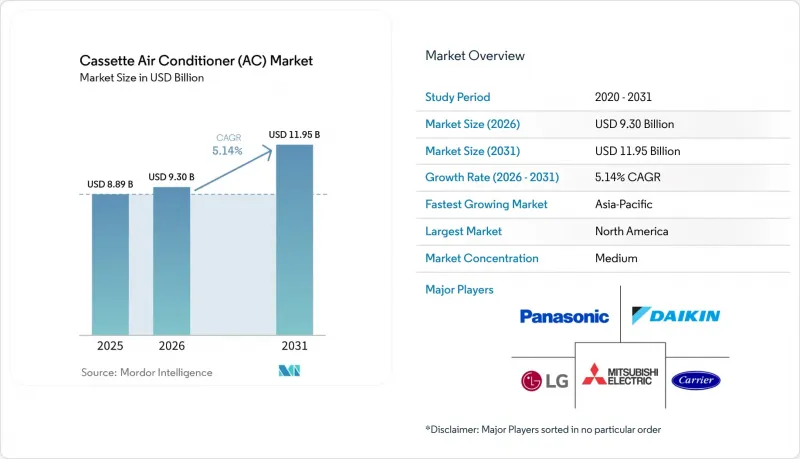
根據 Mordor Intelligence 預測,盒式空調市場規模預計將在 2025 年達到 88.9 億美元,2026 年達到 93 億美元,到 2031 年達到 119.5 億美元,2026 年至 2031 年的複合年成長率為 5.14%。
本報告按產品類型(單向、四向、其他)、容量(小於5千瓦、6-10千瓦、10千瓦及以上)、技術(變頻、非變頻)、安裝方式(吸頂式、嵌入式)、最終用戶、配銷通路和地區(北美、南美、歐洲、亞太、中東和非洲)進行細分。市場預測以貨幣單位(十億美元)表示。
全球盒式空調市場趨勢及洞察
在天花板空間有限的商業設施的維修項目中,對節省空間的暖通空調系統的需求日益成長。
在天花板空間有限、無法安裝完整風管系統,但又需要為整個開放式空間提供均勻空調的維修工程中,盒式空調市場正從中受益。疫情後的辦公室改造推動了這一轉變,北美和歐洲的許多業主將固定佈局改為適合四向盒式系統的靈活多區域空間。國際能源總署 (IEA) 在 2025 年能源效率評估報告中指出,空間冷卻將成為自 2000 年以來建築終端用途中成長最快的領域,年成長率超過 4%。這進一步增強了透過維修升級冷凍系統的經濟合理性。此外,租賃續約週期(許多商業地產業主每 5-7 年更換一次暖通空調系統)也推動了這種需求模式,從而形成了持續的更換需求,而非單純的一次性需求。產品開發緊跟著這一趨勢,大金將於 2024 年 6 月推出一款單向轉角盒式空調,適用於天花板極低或沒有臨時天花板的空間。因此,盒式空調市場與兼顧佈局限制、視覺期望和現代分區要求的維修需求非常契合。
商業建築電氣化及能源法規遵守情況
更嚴格的能源法規也推動了盒式空調市場的發展,這些法規現在將提高能源效率作為建築業主的一項合規要求。紐約市2025年能源保護法規和紐約市ASHRAE 90.1 2025標準於2026年3月30日生效,強制規定了商業建築的暖通空調能源效率標準。加州2025年第24號法規強制要求許多多區域辦公大樓和學校設施採用變冷媒流量(VRF)熱泵系統作為標準配置,這直接提升了VRF系統設計中對天花板盒式空調的需求。此外,美國能源局於2025年7月7日修訂了中央空調和熱泵的測試程序,並收緊了能源效率測量和報告的標準。這些措施至關重要,因為那些先前推遲設備升級的業主現在將面臨法規規定的最後期限,而不能再依靠自身判斷來提高能源效率。在這種情況下,盒式空調市場受益匪淺,因為安裝在 VRF 系統中的盒式空調可以幫助業主滿足監管要求、降低能耗並加快規格核准流程。
與壁掛式分離式空調相比,初始安裝成本更高。
在價格敏感的市場中,嵌入式空調市場仍面臨許多挑戰。這是因為嵌入式空調的安裝成本遠高於同等規格的壁掛式分離式空調。包括天花板安裝、排水工程以及專業技術人員的人事費用在內,嵌入式空調的總安裝成本可能增加30%至50%,這使得住宅和小規模商業項目難以進行比較。在東南亞、印度和拉丁美洲的二、三線城市,這個問題特別突出。儘管這些地區的需求正在成長,但消費者仍然非常注重成本。在6-10kW的容量範圍內,這項挑戰也十分明顯。預計到2025年,該容量範圍將佔據49.1%的市場。在這個容量範圍內,住宅和小規模商業設施的消費者經常直接將嵌入式空調與高效的壁掛式變頻空調進行比較。隨著低成本地區生產規模的擴大,這些壓力可能會得到一定程度的緩解。此外,LG在印尼的投資以及開利在印度的投資,都反映了其為振興區域經濟所做的積極努力。然而,尤其是在安裝人員基礎設施仍然薄弱的地區,盒式空調市場在整個預測期內可能會繼續保持較高的安裝成本。
細分市場分析
到2025年,四向嵌入式空調將佔據68.3%的市場佔有率,這一主導地位反映了其在開放式室內空間中的適用性,此類空間需要均勻的室內氣流。其百葉窗式設計有助於減少熱量集中和冷卻不均,而這些仍然是大規模商業空間(使用率波動較大)中常見的難題。此外,它們與廣泛採用的600x600mm和900x900mm天花板龍骨佈局相容,通常可協助承包商避免在辦公室和零售專案中進行大規模結構改造。這種實用的適應性確保了四向嵌入式空調在嵌入式空調市場眾多以規格主導的專案中繼續佔據核心地位。大金的SkyAir系列緊湊型嵌入式空調也表明,該產品系列的設計不僅取決於其熱性能,還取決於建築裝飾和系統整合要求。
單向空調雖然應用範圍有所縮小,但在走廊、接待區、住宅主臥套房以及天花板較低的空間中仍扮演著重要角色。同時,包括雙向和超薄型空調在內的另一類產品類型在維修項目中越來越受到關注,設計師們希望在不影響天花板整體美觀的前提下,實現更纖薄的框架寬度。預計到2031年,四向空調市場將以6.56%的複合年成長率成長,成長速度超過整體盒式空調市場。這一成長速度既反映了老舊恆速空調的更換需求,也反映了飯店和醫療保健專案的新需求。隨著此細分市場的成熟,各大品牌的核心冷凍性能正趨於標準化,產品競爭的重點也轉向了氣流控制、互聯性和試運行便利性。
截至2025年,6-10千瓦容量範圍將佔49.1%的市場佔有率,成為盒式空調市場所有容量範圍中佔有率最大的產品。此容量範圍適用於30-80平方公尺的標準商業房間,涵蓋眾多飯店客房、中型辦公室以及私人醫療機構的套房。此外,此容量範圍也適用於許多建築中常見的懸吊天花板佈局和單相電源。這些優勢確保了該細分市場擁有穩定的裝置基礎,並能滿足持續的更換需求。 5千瓦以下容量範圍的產品也依然佔據一定的市場佔有率,尤其是在住宅盒式空調安裝和小規模零售空間領域。
預計到2031年,功率超過10kW的機型將實現最快的容量成長,複合年成長率(CAGR)將達到5.35%。這是因為大型室內空間需要高功率的機型,即使室內機數量較少。這些場所包括飯店宴會廳、醫院手術室、大學禮堂以及其他高負荷區域,在這些區域,如果使用多個小型機組,安裝和維護將變得複雜。三菱電機的12kW PLA-ZM系列展示了供應商如何為這類用戶群整合雲端連接和建築管理系統介面。三星的14kW四向變頻熱泵嵌入式空調也體現了供應商如何透過更精細的規格來滿足大型空間的維修需求。此外,該細分市場還享有短期監管優勢。在歐洲,功率超過12kW的設備比小型分離式空調系統享有更長的監管合規寬限期,從而減輕了未來幾年的過渡壓力。
區域分析
到2025年,北美將佔據全球42.2%的市場佔有率,成為盒式空調最大的區域市場。這一主導地位反映了北美地區大規模的商業建築存量、完善的承包商網路以及主要城市市場嚴格的能源法規執行力度。特靈科技公司2025年底的累積訂單達到創紀錄的78億美元。該公司在美洲的商業暖通空調訂單在第四季也成長了120%以上,顯示商業需求強勁。紐約市2025年即將實施的監管措施直接推動了全球人口最密集的商業建築市場之一的系統升級。在加州,2025年Title 24標準也提供了進一步的支持,該標準建議在許多多區域辦公大樓和學校設施中採用VRF熱泵系統。
預計到2031年,亞太地區將以6.54%的複合年成長率成長,成為盒式空調市場成長最快的地區。根據這份草案,中國仍然是該地區最大的生產和消費中心,到2026年將佔該地區空調消費量的68%。隨著美的、格力、海爾等國內供應商不斷拓展智慧產品線並強化商用產品系列,中國國內的競爭日益激烈。根據美的於2026年3月提交的2025年財務報告,其暖通空調及建築科技業務的銷售額達到357.9億元人民幣(約合49.6億美元),年增25.7%,在國內中央空調市場的佔有率超過20%。印度也是一個重要的成長中心,LG已開始建造其第三家製造工廠,開利也簽署了在斯里城建設新工廠的合約。這兩項發展都有利於擴大本地生產基地。
歐洲仍然是盒式空調市場的關鍵區域,因為建築脫碳法規正在推動暖通空調系統的現代化和冷媒的轉型。修訂後的氟化氣體法規增加了供應商合規的複雜性,但也加速了向低全球暖化潛勢(GWP)平台的穩定過渡。在南美洲,溫暖氣候下的維修需求正在成長,尤其是在商業建築中,老舊的風管系統正被天花板盒式VRF解決方案所取代。由於高製冷負荷以及酒店和醫療保健設施建設的活性化,中東和非洲的需求也在成長,尤其是在海灣市場,儘管由於基礎設施和購買力的限制,撒哈拉以南非洲大部分地區的需求仍然有限。
其他好處:
- Excel格式的市場預測(ME)表
- 3個月的分析師支持
目錄
第1章:引言
- 研究假設和市場定義
- 調查範圍
第2章:調查方法
第3章執行摘要
第4章 市場狀況
- 市場概覽
- 市場促進因素
- 在天花板高度有限的商業設施維修項目中,對節省空間的空調系統的需求日益成長。
- 商業建築電氣化及符合能源標準
- 對高品質室內空氣和低噪音冷卻的需求日益成長。
- 用於多區域商業控制的智慧型BMS相容盒式單元
- 拓展飯店、醫療和教育產業的室內施工週期。
- 在氣候溫暖地區的維修工程中,擴大了管道系統的採用。
- 市場限制因素
- 與壁掛式分離空調相比,初始安裝成本更高。
- 既有建築中天花板夾層與結構整合的限制
- 依賴熟練的安裝和試運行
- 冷媒法規和零件供應波動
- 產業價值鏈分析
- 波特五力分析
- 深入了解產業最新趨勢與創新
- 近期產業趨勢分析(新產品發布、策略性舉措、投資、合作、合資、業務擴張、併購等)
第5章 市場規模與成長預測
- 依產品類型
- 單向卡式磁帶
- 四向卡帶
- 其他
- 按產能
- 小於5千瓦
- 6 kW~10 kW
- 10千瓦或以上
- 透過技術
- 逆變器型
- 非變頻型
- 按安裝類型
- 吸頂式
- 嵌入式
- 最終用戶
- 住宅
- 商業
- 飯店業
- 衛生保健
- 零售
- 公司總部
- 教育機構
- 其他
- 透過分銷管道
- B2B/廠商直銷
- B2C/零售消費者
- 多品牌商店
- 獨家零售商 (EBO)
- 線上
- 其他
- 按地區
- 北美洲
- 加拿大
- 美國
- 墨西哥
- 南美洲
- 巴西
- 秘魯
- 智利
- 阿根廷
- 其他南美國家
- 歐洲
- 英國
- 德國
- 法國
- 西班牙
- 義大利
- 比荷盧經濟聯盟(比利時、荷蘭、盧森堡)
- 北歐國家(丹麥、芬蘭、冰島、挪威、瑞典)
- 其他歐洲國家
- 亞太地區
- 印度
- 中國
- 日本
- 澳洲
- 韓國
- 東南亞(新加坡、馬來西亞、泰國、印尼、越南、菲律賓)
- 其他亞太國家
- 中東和非洲
- 阿拉伯聯合大公國
- 沙烏地阿拉伯
- 南非
- 奈及利亞
- 其他中東和非洲國家
- 北美洲
第6章 競爭情勢
- 市場集中度
- 策略趨勢
- 市佔率分析
- 公司簡介
- Daikin Industries, Ltd.
- Mitsubishi Electric Corporation
- LG Electronics Inc.
- Carrier Global Corporation
- Panasonic Holdings Corporation
- Samsung Electronics Co., Ltd.
- Hitachi, Ltd.
- Fujitsu General Limited
- Midea Group Co., Ltd.
- Gree Electric Appliances Inc. of Zhuhai
- Haier Group Corporation
- Toshiba Corporation
- Trane Technologies plc
- Johnson Controls International plc
- Lennox International Inc.
- Rheem Manufacturing Company
- Blue Star Limited
- Voltas Limited
- AUX Group
- Bosch Thermotechnology GmbH
第7章 市場機會與未來展望
According to Mordor Intelligence, the cassette air conditioner market size is projected to be USD 8.89 billion in 2025, USD 9.30 billion in 2026, and reach USD 11.95 billion by 2031, growing at a CAGR of 5.14% from 2026 to 2031.
This report is Segmented by Product Type (Single-Way, Four-Way, and Others), Capacity (Below 5 KW, 6-10 KW, and Above 10 KW), Technology (Inverter and Non-Inverter), Installation Type (Ceiling Mounted and Recessed Mounted), End-User, Distribution Channel, and Geography (North America, South America, Europe, Asia-Pacific, MEA). The Market Forecasts are Provided in Terms of Value (USD Billion).
Global Cassette Air Conditioner (AC) Market Trends and Insights
Rising Demand for Space-Efficient HVAC in Ceiling-Constrained Commercial Retrofits
The cassette air conditioner market is gaining from retrofit projects where ceiling space is too limited for full duct runs, yet the floor layout still needs balanced air coverage across open rooms. Post-pandemic office redesign has supported this shift, as many landlords in North America and Europe have changed fixed layouts to flexible multi-zone spaces that suit four-way cassette formats well. The IEA noted in its 2025 energy efficiency review that space cooling has recorded the fastest growth among building end uses since 2000, with annual growth of more than 4%, which strengthens the economic case for retrofit cooling upgrades. Lease renewal cycles also support this demand pattern, since many commercial owners refresh HVAC systems every 5 to 7 years, creating recurring replacement demand rather than purely one-time demand. Product development has closely followed this pattern, as Daikin launched its 1-Way Blow Corner Cassette in June 2024 for spaces with minimal ceiling clearance or no false ceiling. This keeps the cassette air conditioner market well aligned with retrofit needs that combine layout limits, visual expectations, and modern zoning requirements.
Commercial Building Electrification and Energy Code Compliance
The cassette air conditioner market is also being boosted by stricter energy rules that now treat efficiency upgrades as compliance requirements for building owners. New York City's 2025 Energy Conservation Code and 2025 NYC ASHRAE 90.1 entered enforcement on March 30, 2026, and these rules set mandatory HVAC efficiency thresholds for commercial buildings. California's 2025 Title 24 standards require variable refrigerant flow heat pump systems as the baseline for many multi-zone office and school applications, which directly supports ceiling cassette demand within VRF system design. The United States Department of Energy also updated test procedures for central air conditioners and heat pumps, effective July 7, 2025, tightening how efficiency is measured and reported. These steps matter because owners who delayed upgrades now face a regulatory deadline rather than a voluntary efficiency decision. In this setting, the cassette air conditioner market benefits, as cassette units installed within VRF systems help owners meet code requirements, reduce energy use, and move projects through specification approval more quickly.
High Upfront Installed Cost Versus Wall-Mounted Split Units
The cassette air conditioner market still faces a clear barrier in price-sensitive settings, because installed system costs remain well above those of comparable wall-mounted split units. The draft states that cassette systems can add 30% to 50% to the total installed cost when ceiling access, drainage work, and specialist labor are included, making comparisons difficult for residential and small commercial projects. This issue is strongest in tier-2 and tier-3 cities across Southeast Asia, India, and Latin America, where demand growth is high, but buyers remain highly cost-aware. The challenge is also evident in the 6-10 kW band, which held a 49.1% share in 2025 and often serves residential and light commercial buyers who compare cassette systems directly with efficient wall-mounted inverter units. Some of this pressure may ease as manufacturing scales in lower-cost locations, and recent investments by LG in Indonesia and Carrier in India show active efforts to improve local economies. Even so, the cassette air conditioner market is likely to carry an installed-cost premium through the forecast period, especially in places where the contractor base is still thin.
Other drivers and restraints analyzed in the detailed report include:
- Smart BMS-Ready Cassette Units for Multi-Zone Commercial Control
- Expansion of Hospitality, Healthcare, and Education Fit-Out Cycles
- Refrigerant Compliance and Component Supply Volatility
For complete list of drivers and restraints, kindly check the Table Of Contents.
Segment Analysis
Four-way cassette units held a 68.3% share in 2025, and that lead reflects their fit with open-plan interiors that need balanced airflow across the full room. Their louver design helps reduce hot spots and uneven cooling, which remains a common issue in larger commercial spaces with changing occupancy. They also align well with widely used 600X600 mm and 900X900 mm ceiling grid layouts, so installers often avoid major structural changes during office and retail projects. This practical fit keeps four-way models at the center of many specification-led projects in the cassette air conditioner market. Daikin's Compact Cassette SkyAir line also shows how this part of the product mix is being shaped not only by thermal performance but also by architectural finish and system integration requirements.
Single-way models serve a narrower but still important role in corridors, reception zones, residential master suites, and spaces with shallow ceiling depth. The other product category, which includes two-way and slim variants, is gaining attention in refits where designers want a lower-profile reveal without losing ceiling integration. The four-way segment is projected to expand at a 6.56% CAGR through 2031, indicating faster growth than the overall cassette air conditioner market. That pace reflects both replacement demand from older fixed-speed installations and fresh demand from hospitality and healthcare projects. As this segment matures, product competition is shifting toward airflow control, connectivity, and easier commissioning, because core refrigeration performance is becoming more standardized across major brands.
The 6-10 kW band held a 49.1% share in 2025, giving it the largest share across capacity ranges in the cassette air conditioner market. This band fits standard commercial room sizes of 30 to 80 square meters, which covers many hotel rooms, mid-sized offices, and private healthcare suites. It also matches the capacity range that works well with common suspended ceiling layouts and single-phase power supply in many buildings. That combination gives the segment a stable installed base and supports recurring replacement demand. The below-5 KW range still contributes unit volume, especially where residential cassette adoption or smaller retail spaces are involved.
Above-10 KW units are projected to record the fastest capacity growth at a 5.35% CAGR through 2031, as larger interior spaces need fewer but more powerful indoor units. This includes hotel ballrooms, hospital procedure rooms, university lecture theaters, and other high-load areas where multiple smaller units would complicate installation and service. Mitsubishi Electric's 12 kW PLA-ZM series shows how suppliers are building in cloud connectivity and building management interfaces for this group of users. Samsung's 14 kW four-way inverter heat pump cassette, cited in the draft, also reflects how suppliers are targeting large-space retrofit needs with more tailored specifications. The segment gains another near-term advantage from regulation, because equipment above 12 kW has a longer compliance runway in Europe than smaller split systems, which reduces transition pressure during the next few years.
Complete Report Scope:
- By Product Type
- Single-Way Cassette
- Four-Way Cassette
- Other Product Types
- By Capacity
- Below 5 KW
- 6 KW to 10 KW
- Above 10 KW
- By Technology
- Inverter
- Non-Inverter
- By Installation Type
- Ceiling Mounted
- Recessed Mounted
- By End-User
- Residential
- Commercial
- Hospitality
- Healthcare
- Retail
- Corporate Offices
- Educational Institutes
- Other Commercial Applications
- By Distribution Channel
- B2B/Direct from the Manufacturers
- B2C/Retail Consumers
- Multi-Brand Stores
- Exclusive Brand Stores (EBOs)
- Online
- Other Distribution Channels
- By Region
- North America
- Canada
- United States
- Mexico
- South America
- Brazil
- Peru
- Chile
- Argentina
- Rest of South America
- Europe
- United Kingdom
- Germany
- France
- Spain
- Italy
- BENELUX (Belgium, Netherlands, and Luxembourg)
- NORDICS (Denmark, Finland, Iceland, Norway, and Sweden)
- Rest of Europe
- Asia-Pacific
- India
- China
- Japan
- Australia
- South Korea
- South East Asia (Singapore, Malaysia, Thailand, Indonesia, Vietnam, and the Philippines)
- Rest of Asia-Pacific
- Middle East and Africa
- United Arab Emirates
- Saudi Arabia
- South Africa
- Nigeria
- Rest of the Middle East and Africa
- North America
Geography Analysis
North America held 42.2% of the global market share in 2025, making it the largest regional market for cassette air conditioners. This lead reflects a large commercial building base, a well-developed contractor network, and stricter energy code enforcement across important urban markets. Trane Technologies closed 2025 with a record enterprise backlog of USD 7.8 billion, and its Americas commercial HVAC applied bookings rose by more than 120% in the fourth quarter, which points to strong commercial demand conditions. New York City's 2025 code enforcement now creates a direct compliance driver for system replacement in one of the world's densest commercial building markets. California adds further support through Title 24, which favors VRF heat pump systems in many multi-zone office and school applications.
Asia-Pacific is projected to expand at a 6.54% CAGR through 2031, making it the fastest-growing region in the cassette air conditioner market. China remains the largest production and consumption base in the region, and the draft states that it accounted for 68% of regional air conditioner unit consumption in 2026. Competition inside China is intensifying as domestic suppliers such as Midea, Gree, and Haier scale smart-featured products and build stronger commercial portfolios. Midea's 2025 results, filed in March 2026, reported HVAC and Building Technologies revenue of CNY 35.79 billion, or USD 4.96 billion, up 25.7% year over year, with domestic central air conditioning share above 20%. India is another major growth center, with LG beginning construction of its third manufacturing plant and Carrier signing an agreement for a new Sri City facility, both of which support a larger local production base.
Europe remains an important region for the cassette air conditioner market because building decarbonization rules are pushing HVAC replacement and refrigerant transition at the same time. The revised F-Gas framework supports a steady shift toward lower-GWP platforms, even though it also raises compliance complexity for suppliers. South America is emerging through warm-climate retrofits, especially where aging ducted systems are being replaced with ceiling-cassette VRF solutions in commercial buildings. The Middle East and Africa also add demand through high cooling loads and active hospitality and healthcare construction, especially in Gulf markets, while much of Sub-Saharan Africa remains limited by infrastructure and purchasing power constraints.
- Daikin Industries, Ltd.
- Mitsubishi Electric Corporation
- LG Electronics Inc.
- Carrier Global Corporation
- Panasonic Holdings Corporation
- Samsung Electronics Co., Ltd.
- Hitachi, Ltd.
- Fujitsu General Limited
- Midea Group Co., Ltd.
- Gree Electric Appliances Inc. of Zhuhai
- Haier Group Corporation
- Toshiba Corporation
- Trane Technologies plc
- Johnson Controls International plc
- Lennox International Inc.
- Rheem Manufacturing Company
- Blue Star Limited
- Voltas Limited
- AUX Group
- Bosch Thermotechnology GmbH
Additional Benefits:
- The market estimate (ME) sheet in Excel format
- 3 months of analyst support
TABLE OF CONTENTS
1 Introduction
- 1.1 Study Assumptions and Market Definition
- 1.2 Scope of the Study
2 Research Methodology
3 Executive Summary
4 Market Landscape
- 4.1 Market Overview
- 4.2 Market Drivers
- 4.2.1 Rising Demand for Space-Efficient HVAC in Ceiling-Constrained Commercial Retrofits
- 4.2.2 Commercial Building Electrification and Energy Code Compliance
- 4.2.3 Growth of Premium Indoor Air Quality and Low-Noise Cooling Requirements
- 4.2.4 Smart BMS-Ready Cassette Units for Multi-Zone Commercial Control
- 4.2.5 Expansion of Hospitality, Healthcare, and Education Fit-Out Cycles
- 4.2.6 Rising Adoption in Warm-Climate Retrofit Projects Replacing Ducted Systems
- 4.3 Market Restraints
- 4.3.1 High Upfront Installed Cost Versus Wall-Mounted Split Units
- 4.3.2 Ceiling Plenum and Structural Integration Limitations in Existing Buildings
- 4.3.3 Skilled Installation and Commissioning Dependence
- 4.3.4 Refrigerant Compliance and Component Supply Volatility
- 4.4 Industry Value Chain Analysis
- 4.5 Porter's Five Forces Analysis
- 4.5.1 Bargaining Power of Suppliers
- 4.5.2 Bargaining Power of Buyers
- 4.5.3 Threat of New Entrants
- 4.5.4 Threat of Substitutes
- 4.5.5 Industry Rivalry
- 4.6 Insights into the Latest Trends and Innovations in the Industry
- 4.7 Insights into the Recent Developments (New Product Launches, Strategic Initiatives, Investments, Partnerships, JVs, Expansion, M&As, etc.) in the Industry
5 Market Size & Growth Forecasts (Value in USD Billion)
- 5.1 By Product Type
- 5.1.1 Single-Way Cassette
- 5.1.2 Four-Way Cassette
- 5.1.3 Other Product Types
- 5.2 By Capacity
- 5.2.1 Below 5 KW
- 5.2.2 6 KW to 10 KW
- 5.2.3 Above 10 KW
- 5.3 By Technology
- 5.3.1 Inverter
- 5.3.2 Non-Inverter
- 5.4 By Installation Type
- 5.4.1 Ceiling Mounted
- 5.4.2 Recessed Mounted
- 5.5 By End-User
- 5.5.1 Residential
- 5.5.2 Commercial
- 5.5.2.1 Hospitality
- 5.5.2.2 Healthcare
- 5.5.2.3 Retail
- 5.5.2.4 Corporate Offices
- 5.5.2.5 Educational Institutes
- 5.5.2.6 Other Commercial Applications
- 5.6 By Distribution Channel
- 5.6.1 B2B/Direct from the Manufacturers
- 5.6.2 B2C/Retail Consumers
- 5.6.2.1 Multi-Brand Stores
- 5.6.2.2 Exclusive Brand Stores (EBOs)
- 5.6.2.3 Online
- 5.6.2.4 Other Distribution Channels
- 5.7 By Region
- 5.7.1 North America
- 5.7.1.1 Canada
- 5.7.1.2 United States
- 5.7.1.3 Mexico
- 5.7.2 South America
- 5.7.2.1 Brazil
- 5.7.2.2 Peru
- 5.7.2.3 Chile
- 5.7.2.4 Argentina
- 5.7.2.5 Rest of South America
- 5.7.3 Europe
- 5.7.3.1 United Kingdom
- 5.7.3.2 Germany
- 5.7.3.3 France
- 5.7.3.4 Spain
- 5.7.3.5 Italy
- 5.7.3.6 BENELUX (Belgium, Netherlands, and Luxembourg)
- 5.7.3.7 NORDICS (Denmark, Finland, Iceland, Norway, and Sweden)
- 5.7.3.8 Rest of Europe
- 5.7.4 Asia-Pacific
- 5.7.4.1 India
- 5.7.4.2 China
- 5.7.4.3 Japan
- 5.7.4.4 Australia
- 5.7.4.5 South Korea
- 5.7.4.6 South East Asia (Singapore, Malaysia, Thailand, Indonesia, Vietnam, and the Philippines)
- 5.7.4.7 Rest of Asia-Pacific
- 5.7.5 Middle East and Africa
- 5.7.5.1 United Arab Emirates
- 5.7.5.2 Saudi Arabia
- 5.7.5.3 South Africa
- 5.7.5.4 Nigeria
- 5.7.5.5 Rest of the Middle East and Africa
- 5.7.1 North America
6 Competitive Landscape
- 6.1 Market Concentration
- 6.2 Strategic Moves
- 6.3 Market Share Analysis
- 6.4 Company Profiles {(includes Global level Overview, Market level overview, Core Segments, Financials as available, Strategic Information, Market Rank/Share for key companies, Products & Services, and Recent Developments)}
- 6.4.1 Daikin Industries, Ltd.
- 6.4.2 Mitsubishi Electric Corporation
- 6.4.3 LG Electronics Inc.
- 6.4.4 Carrier Global Corporation
- 6.4.5 Panasonic Holdings Corporation
- 6.4.6 Samsung Electronics Co., Ltd.
- 6.4.7 Hitachi, Ltd.
- 6.4.8 Fujitsu General Limited
- 6.4.9 Midea Group Co., Ltd.
- 6.4.10 Gree Electric Appliances Inc. of Zhuhai
- 6.4.11 Haier Group Corporation
- 6.4.12 Toshiba Corporation
- 6.4.13 Trane Technologies plc
- 6.4.14 Johnson Controls International plc
- 6.4.15 Lennox International Inc.
- 6.4.16 Rheem Manufacturing Company
- 6.4.17 Blue Star Limited
- 6.4.18 Voltas Limited
- 6.4.19 AUX Group
- 6.4.20 Bosch Thermotechnology GmbH
7 Market Opportunities & Future Outlook
- 7.1 Rising Demand for Energy-Efficient and Smart Air Conditioners
- 7.2 Expansion in Emerging Markets and Residential Construction

 戶外液冷循環一體化設備市場:全球市場預測,2026-2032年
 2026年北美各州空調市場概況
 逆循環空調市場規模、佔有率和成長分析:按系統類型、壓縮機技術、最終用途和地區分類-2026-2033年產業預測
 歐洲暖通空調設備:市場佔有率分析、產業趨勢與統計、成長預測(2026-2031)美國空調設備:市場佔有率分析、產業趨勢與統計、成長預測(2026-2031)空調:市場佔有率分析、產業趨勢與統計、成長預測(2026-2031)窗型冷氣:市場佔有率分析、產業趨勢與統計、成長預測(2026-2031)空調設備:市場佔有率分析、產業趨勢與統計、成長預測(2026-2031)空調系統市場:2026-2032年全球市場預測(依產品類型、技術、冷氣、組件、冷媒類型、能源效率、應用和銷售管道)北美暖通空調市場:市佔率分析、產業趨勢與統計及成長預測(2026-2031 年)