


 |
市場調查報告書
商品編碼
2097434
窗型冷氣:市場佔有率分析、產業趨勢與統計、成長預測(2026-2031)Window Air Conditioner (AC) - Market Share Analysis, Industry Trends & Statistics, Growth Forecasts (2026 - 2031) |
||||||

※ 本網頁內容可能與最新版本有所差異。詳細情況請與我們聯繫。
據 Mordor Intelligence 稱,2025 年窗型冷氣市值為 202.2 億美元,預計到 2031 年將達到 252.4 億美元,而 2026 年為 209.3 億美元,2026 年至 2031 年預測期內的複合年成長率為 3.81%。
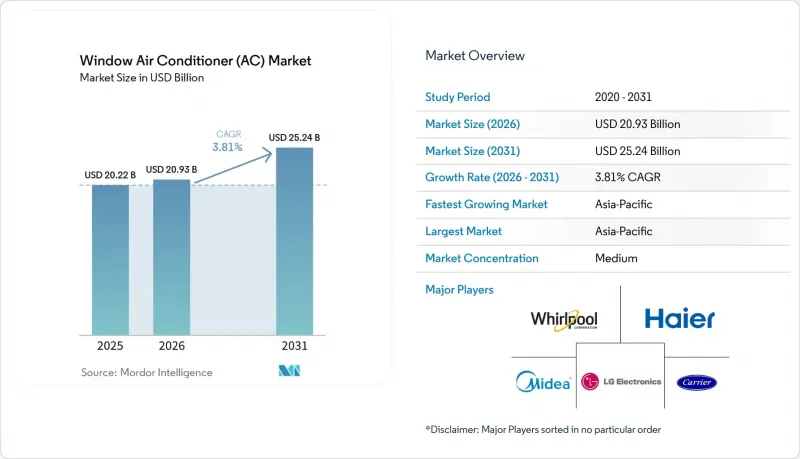
本報告按產品類型(標準型、智慧型、變頻型、可攜式及其他)、容量(小於5,000 BTU、5,000-8,000 BTU及其他)、技術(變頻型和非變頻型)、最終用戶、分銷管道和地區(北美、南美、歐洲、亞太地區以及中東和非洲)進行細分。市場預測以美元(USD)計價。
全球窗型冷氣市場趨勢及洞察
熱應激加劇和降溫季節延長
隨著一些人口密集地區高溫天氣頻繁,空調需求增加,窗型冷氣市場也隨之成長。 2026年,德里及其周邊地區室外最高氣溫達到攝氏46度C,將持續推高室內空調需求,並加劇季節性購買的緊迫性。國際能源總署(IEA)指出,印度室外氣溫每升高1度C,尖峰時段電力需求就會增加約7吉瓦,凸顯了高溫與空調需求之間的密切聯繫。冷凍季節的延長也是推動室內空調購買的因素之一,因為更長的使用週期縮短了許多家庭的有效投資回收期。這一趨勢正在推動窗型冷氣市場的發展,因為對於首次購買者而言,低初始成本和快速安裝仍然是其優勢所在。此外,隨著新用戶進入更換週期並轉向更高效能的型號,未來的更換需求也將增強。
由於室內空調設備老化,需要更換。
在室內空調設備數量龐大的成熟國家,更換需求也支撐著窗型冷氣市場。在美國,能源部修訂的室內空調標準將於2026年5月26日之後生效,適用於之後生產或進口的型號,這將加速不符合新標準的舊型號的更新換代。這促使消費者的需求從簡單的更換能源效率更高、控制功能更先進的型號。在印度,2026年新的上市也與新的監管週期和主要供應商的季節性產品線更新相吻合。因此,更換需求不僅維持了窗型冷氣市場的銷量,也提升了該品類的平均技術規格。這有利於那些能夠根據當地房間大小、電壓條件和能源效率標準調整產品的品牌。
與分離式、可攜式和中央空調系統競爭。
窗型冷氣市場的主要阻礙因素仍然是來自其他冷卻方式的壓力,這些方式迎合了不同的消費者需求。分離式空調持續吸引高所得的都市區,他們更重視低噪音和室內整潔的外觀,而非安裝的便利性。可攜式也給那些購買意願較低的消費者帶來了壓力,美國聯邦公報已發布一項提案,擬於2025年將可攜式空調從《能源效率和節約法案》(EPCA)目標產品類別中移除(如果最終確定)。這意味著窗型冷氣市場將面臨來自高階市場更佳設計和中低階市場更方便移動性的競爭。製造商正在透過實施變頻控制、智慧連接、提高能源效率和降低運行噪音等措施來應對挑戰,以維持該品類的市場佔有率。然而,在都市區市場,隨著收入的成長,都市區更容易轉向其他類型的產品,因此窗型空調仍面臨替代風險。
細分市場分析
2025年,標準窗型冷氣的銷售量佔產品類型的62.3%,佔據窗型冷氣市場最大佔有率。這主要是因為在印度、中國和北美,窗型空調的安裝仍主要以替換傳統室內空調為主。這一主導地位反映的是窗型空調的規模和普及程度,而非技術停滯,因為許多基礎型號都在不斷改進,例如提高能源效率和升級控制系統。美國和印度的監管政策正在逐步提高主流型號的最低技術標準,標準型空調在保持價格主導的同時,性能也在不斷提升。事實上,曾經選擇基礎替換型號的消費者現在更傾向於選擇符合監管要求、氣流管理更佳或配備簡化數位控制的產品。這確保了即使高階細分市場不斷擴張,標準型窗型空調在窗型冷氣產業仍能保持其重要地位。
預計到2031年,智慧窗型冷氣將以4.89%的複合年成長率成長,並有望成為窗型冷氣市場中成長最快的細分產品,因為連網功能正從高階配置轉變為中階標配。 TCL在2026年發布了其通過Matter認證的智慧變頻窗型冷氣,該空調相容於Alexa、Google Assistant和Apple HomeKit,凸顯了這一轉變,表明互通性正成為主流產品定位的一部分。 GE Appliances也展現了類似的趨勢,推出了一款將高效節能與互聯控制相結合的變頻智慧空調,表明智慧功能和變頻功能正擴大作為單一整合產品提供,而不是作為單獨的升級選項出售。夏普也透過推出「Ryohu」系列擴大了在印度的高階窗型冷氣產品線,該系列除了製冷性能外,還具有健康方面的附加價值。壁掛式和可攜式窗型冷氣的應用場景仍然有限。然而,與窗型冷氣市場大規模的現有裝置量和不斷成長的智慧空調市場相比,它的作用仍然很小。
到2025年,5000-8000 BTU製冷量範圍將佔窗型空調總銷量的58.1%,成為窗型冷氣市場銷售量最大的細分市場,因為它與公寓和小規模都市區住宅的典型房間大小相符。這項製冷量範圍適用於各種住宅使用場景,特別適合需要為臥室、緊湊型客廳和小規模辦公室等空間提供最低實用冷凍量的消費者。這一強勁勢頭也反映出窗型冷氣市場高度依賴首次購買需求。首次購買者往往更注重價格而非冷氣速度和過大冷氣量。因此,即使高效節能和智慧控制功能在這一頻寬的空調中日益普及,中等冷氣量機型仍佔據該細分市場的核心地位。因此,窗型冷氣產業的核心細分市場銷售量保持穩定,而周邊細分市場的技術附加價值則不斷提升。
預計到2031年,頻寬超過20,000 BTU的窗型冷氣市場中成長最快的容量細分市場。這是因為越來越多的商業場所開始採用針對特定區域的高功率室內冷凍系統。零售商店、飯店走廊、候車室和其他小規模商業空間往往更傾向於安裝大型窗型冷氣,而不是安裝多台小型空調,因為在這些場所擴展中央空調系統成本高昂或操作繁瑣。 9,000至12,000 BTU頻寬市場成長依然顯著,這主要得益於人們對房間面積的期望不斷提高,以及消費者家庭從小型1噸當量空調轉向製冷量更大的機型。低容量空調在非常緊湊的房間中仍然佔有一席之地,但其收入貢獻有限,應用範圍也較為狹窄。美國的能源效率法規也是影響這個市場的關鍵因素。根據容量等級,CEER(能源效率比)基準值已經提高,鼓勵企業用符合標準的後續型號替換老舊的大型設備,而不是繼續使用過時的設備。
區域分析
由於北美地區住宅室內空調安裝量龐大,且大部分需求為更換空調,因此北美仍是窗型冷氣市場的核心。美國能源局(DOE) 將於 2026 年修訂的能源效率標準已開始影響銷售管道趨勢,零售商正在清理舊庫存,並轉向符合新性能標準的變頻智慧機型。因此,對於那些能夠透過提供數位控制和低噪音產品來高效滿足高階更換需求的供應商而言,北美市場仍然是重要的收入來源。同時,南美市場則更注重價格實惠。隨著都市化的加速和中產階級家庭製冷需求的成長,在安裝簡單和價格實惠仍然是關鍵因素的市場環境中,窗型冷氣市場繼續佔據重要地位。
在歐洲,由於許多高所得國家普遍偏好分離式空調和熱泵,窗型冷氣市場成長緩慢。同時,窗型冷氣也面臨美觀和建築規範的限制。儘管南歐的熱浪仍會帶來季節性需求,但該地區並未出現像亞太地區那樣普遍的初始購買需求。歐盟修訂後的氟化氣體法規將於2026年生效,屆時市場格局將會進一步改變。高全球暖化潛勢(GWP)的傳統產品將面臨更嚴格的法規環境,而低GWP的替代產品在剩餘的應用情境中將變得更加重要。在中東和非洲,海灣國家建設活動的活性化推動了市場的高速成長,而撒哈拉以南非洲部分地區的基本需求卻很低,兩者形成了鮮明的對比。在後者,價格和基礎設施的限制仍然阻礙著空調的普及。
預計到2025年,亞太地區將以41.3%的市佔率引領窗型空調市場,並在2031年之前維持5.23%的複合年成長率,成為規模最大且成長最快的區域市場。印度仍然是該地區最重要的成長引擎,其較低的空調普及率、緊湊的住宅以及對價格的敏感性,共同推動了窗型空調的持續初始購買需求。中國市場的貢獻因地區而異,一些沿海城市已進入成熟的更換階段,而內陸地區仍存在以大眾市場價格購買新房窗式空調的空間。在日本和韓國,由於分離式空調的普及,窗型空調的銷售成長受到限制,儘管在舊多用戶住宅安裝窗型冷氣仍然存在一定的市場潛力。東南亞憑藉著高密度的城市發展、不斷成長的可支配收入以及仍然較低的普及率,進一步鞏固了其在窗型冷氣市場的地位,並為銷售提供了穩定的基礎。 2026 年推出的新產品也表明,各公司不僅在複製歐美產品,而且還在開發直接滿足印度和亞洲都市區需求的產品,例如具有增強空氣過濾功能的優質窗型冷氣和適用於緊湊型房間的型號。
其他好處:
- Excel格式的市場預測(ME)表
- 3個月的分析師支持
目錄
第1章:引言
- 研究假設和市場定義
- 調查範圍
第2章:調查方法
第3章執行摘要
第4章 市場狀況
- 市場概覽
- 市場促進因素
- 熱應激加劇和降溫季節延長
- 老舊室內空調設備的更換需求。
- 能源效率標準正在推動技術升級。
- 在空間有限的都市區住宅中,窗型冷氣是更受歡迎的選擇。
- 租賃住宅和臨時居住需求
- 轉向低全球暖化潛勢冷媒為高階替代品的出現創造了可能。
- 市場限制因素
- 與分離式、可攜式和中央空調系統競爭。
- 都市區家庭對噪音高度敏感且注重美觀
- 新興市場的電網不穩定與電壓波動
- 舊窗框的維修限制和建築規範
- 產業價值鏈分析
- 波特五力分析
- 洞察最新產業趨勢與創新
- 近期產業趨勢分析(新產品發布、策略性舉措、投資、合作、合資、業務擴張、併購等)
第5章 市場規模與成長預測
- 依產品類型
- 標準窗型冷氣
- 智慧窗單元
- 變頻式窗型空調
- 可攜式窗式系統
- 穿牆模型
- 按產能
- 低於5000 BTU
- 5,000~8,000 BTU
- 9,000~12,000 BTU
- 13,000~16,000 BTU
- 17,000~20,000 BTU
- 20,000 BTU 或以上
- 透過技術
- 逆變器
- 非逆變器
- 最終用戶
- 住宅
- 商業的
- 飯店業
- 衛生保健
- 零售
- 公司總部
- 教育機構
- 其他商業用途
- 透過分銷管道
- B2B/廠商直銷
- B2C/一般消費者
- 多品牌商店
- 專賣店(EBO)
- 線上
- 其他分銷管道
- 按地區
- 北美洲
- 加拿大
- 美國
- 墨西哥
- 南美洲
- 巴西
- 秘魯
- 智利
- 阿根廷
- 其他南美國家
- 歐洲
- 英國
- 德國
- 法國
- 西班牙
- 義大利
- 比荷盧經濟聯盟(比利時、荷蘭、盧森堡)
- 北歐國家(丹麥、芬蘭、冰島、挪威、瑞典)
- 其他歐洲國家
- 亞太地區
- 印度
- 中國
- 日本
- 澳洲
- 韓國
- 東南亞(新加坡、馬來西亞、泰國、印尼、越南、菲律賓)
- 其他亞太國家
- 中東和非洲
- 阿拉伯聯合大公國
- 沙烏地阿拉伯
- 南非
- 奈及利亞
- 其他中東和非洲國家
- 北美洲
第6章 競爭情勢
- 市場集中度
- 策略趨勢
- 市佔率分析
- 公司簡介
- LG Electronics Inc.
- Midea Group Co., Ltd.
- Haier Smart Home Co., Ltd.
- Whirlpool Corporation
- Carrier Global Corporation
- Friedrich Air Conditioning Co.
- Gree Electric Appliances Inc. of Zhuhai
- Daikin Industries, Ltd.
- Panasonic Holdings Corporation
- Samsung Electronics Co., Ltd.
- Electrolux AB
- GE Appliances, a Haier company
- Voltas Limited
- Blue Star Limited
- TCL Industries Holdings Co., Ltd.
- Hitachi, Ltd.
- Hisense Home Appliances Group Co., Ltd.
- Chigo Holding Limited
- Amana Corporation
- Gradient Comfort
第7章 市場機會與未來展望
According to Mordor Intelligence, the window air conditioner market size was valued at USD 20.22 billion in 2025 and is estimated to grow from USD 20.93 billion in 2026 to reach USD 25.24 billion by 2031, at a CAGR of 3.81% during the forecast period 2026-2031.
This report is Segmented by Product Type (Standard, Smart, Inverter, Portable and Others), Capacity (Below 5000 BTU, 5000 To 8000 BTU and Others), Technology (Inverter and Non-Inverter), End-User, Distribution Channel, and Geography (North America, South America, Europe, Asia-Pacific, Middle East and Africa). Market Forecasts are in Value (USD).
Global Window Air Conditioner (AC) Market Trends and Insights
Rising Heat Stress And Longer Cooling Seasons
The window air conditioner market is benefiting from stronger cooling demand as high-temperature periods become more frequent across several large population centers. Delhi and nearby areas recorded peak outdoor temperatures of 46°C in 2026, which kept room-cooling demand elevated and heightened urgency around seasonal purchases. The International Energy Agency stated that each 1°C rise in India's outdoor temperatures adds nearly 7 gigawatts to peak electricity demand, underscoring how closely heat intensity and cooling demand now move together. Longer active cooling seasons also strengthen the case for buying room air conditioners, as more months of use shorten the effective payback period for many households. This pattern supports the window air conditioner market because the category remains well-positioned for first-purchase demand, where lower upfront costs and faster setup matter. It also strengthens future replacement demand as new buyers enter later upgrade cycles and shift toward better-rated units.
Replacement Demand From Aging Room Cooling Stock
The window air conditioner market is also supported by replacement demand in mature countries with large existing room-cooling fleets. In the United States, revised Department of Energy standards for room air conditioners took effect for units manufactured or imported on or after May 26, 2026, accelerating the move away from older, non-compliant stock . This is shifting demand from simple replacement purchases toward models that also offer stronger energy performance and updated controls. In India, 2026 model launches were similarly tied to fresh compliance cycles and seasonal portfolio updates from major suppliers. As a result, replacement demand not only preserves sales volume in the window air conditioner market but also upgrades the average technical specification of the category. This favors brands that can adapt products to local room sizes, voltage conditions, and efficiency thresholds simultaneously.
Competition From Split, Portable, And Central HVAC Systems
The main restraint on the window air conditioner market remains pressure from other cooling formats that appeal to different buyer priorities. Split systems continue to attract higher-income urban households that value lower noise and a cleaner indoor appearance more than ease of installation. Portable units also create pressure at the low-commitment end of the category, and the U.S. Federal Register published a 2025 proposal to withdraw portable ACs from the covered product category under EPCA, if finalized . This leaves the window air conditioner market competing with better aesthetics at the premium end and greater mobility at the value end. Manufacturers are responding with inverter controls, smart connectivity, improved energy performance, and quieter operation to protect category relevance. Even so, the category continues to face substitution risk in urban markets, where rising incomes make alternative formats easier to adopt.
Other drivers and restraints analyzed in the detailed report include:
- Energy Efficiency Standards Pushing Technology Upgrades
- Space-Constrained Urban Housing Favoring Window ACs
- Grid Instability And Voltage Fluctuation In Emerging Markets
For complete list of drivers and restraints, kindly check the Table Of Contents.
Segment Analysis
Standard window units accounted for 62.3% of product type revenue in 2025, giving them the largest share in the window air conditioner market, as the installed base in India, China, and North America still leans heavily toward conventional room AC replacements. This leading share reflects scale and familiarity more than technical stagnation, because many basic units are still being refreshed with better energy performance and updated control systems. Regulatory changes in the United States and India are gradually raising the technical floor for even mainstream models, meaning the standard category is improving without losing its price-led role. In practical terms, buyers who once chose a basic replacement are now more likely to receive a unit with stronger compliance credentials, better airflow management, or simplified digital control. This helps preserve the relevance of standard units inside the window air conditioner industry even as premium subsegments expand.
Smart window units are projected to grow at a 4.89% CAGR through 2031, making them the fastest-expanding product subsegment in the window air conditioner market as connectivity shifts from a premium feature to a mid-tier expectation. TCL highlighted this shift in 2026 with a Matter-certified smart inverter window AC that works with Alexa, Google Assistant, and Apple HomeKit, showing how interoperability is becoming part of mainstream product positioning . GE Appliances followed the same direction with an inverter smart model that combined high efficiency with connected controls, which shows that smart and inverter features are increasingly being launched together rather than sold as separate upgrades. Sharp also widened the premium window proposition in India by launching the Ryohu series with active air purification, which adds health-related value beyond cooling output alone. Through-the-wall models and portable window-mounted variants still serve narrower use cases. Still, their roles remain smaller than the large standard installed base and the rising smart segment in the window air conditioner market.
The 5,000 to 8,000 BTU band accounted for 58.1% of capacity segment revenue in 2025, making it the largest-volume anchor in the window air conditioner market, as it matches common room sizes across apartments and smaller urban homes. This range fits a broad set of residential use cases, especially where buyers want the lowest workable capacity that can still cool bedrooms, compact living rooms, and small office spaces. Its strength also reflects the window air conditioner market's heavy exposure to first-purchase demand, where affordability tends to outweigh oversizing for faster cooldown. Mid-range units, therefore, continue to hold the center of mass for the category even while higher efficiency and smart control features move down into these bands. The result is steady volume retention at the core of the window air conditioner industry while technical value rises around it.
The above 20,000 BTU band is forecast to grow at a 4.54% CAGR through 2031, making it the fastest-growing capacity tier in the window air conditioner market as more commercial sites adopt high-output room cooling for targeted zones. Retail outlets, hotel corridors, waiting areas, and other light commercial spaces often prefer a single larger window unit over multiple smaller installations when a central HVAC extension is expensive or disruptive. Growth in the 9,000 to 12,000 BTU band remains important as well, because it serves households that are upgrading room size expectations and shifting from smaller one-ton equivalents to higher cooling output. Lower capacity bands still have a role in very compact rooms, but they remain limited in revenue contribution and have a narrower application range. United States efficiency rules also matter here, because CEER thresholds increase by capacity class and encourage businesses to replace older large units with compliant successors rather than continue running outdated equipment.
Complete Report Scope:
- By Product Type
- Standard Window Units
- Smart Window Units
- Inverter Window Units
- Portable Window-Mounted Systems
- Through-the-Wall Models
- By Capacity
- Below 5,000 BTU
- 5,000 to 8,000 BTU
- 9,000 to 12,000 BTU
- 13,000 to 16,000 BTU
- 17,000 to 20,000 BTU
- Above 20,000 BTU
- By Technology
- Inverter
- Non-Inverter
- By End-User
- Residential
- Commercial
- Hospitality
- Healthcare
- Retail
- Corporate Offices
- Educational Institutes
- Other Commercial Applications
- By Distribution Channel
- B2B/Direct from the Manufacturers
- B2C/Retail Consumers
- Multi-Brand Stores
- Exclusive Brand Stores (EBOs)
- Online
- Other Distribution Channels
- By Region
- North America
- Canada
- United States
- Mexico
- South America
- Brazil
- Peru
- Chile
- Argentina
- Rest of South America
- Europe
- United Kingdom
- Germany
- France
- Spain
- Italy
- BENELUX (Belgium, Netherlands, and Luxembourg)
- NORDICS (Denmark, Finland, Iceland, Norway, and Sweden)
- Rest of Europe
- Asia-Pacific
- India
- China
- Japan
- Australia
- South Korea
- South East Asia (Singapore, Malaysia, Thailand, Indonesia, Vietnam, and the Philippines)
- Rest of Asia-Pacific
- Middle East and Africa
- United Arab Emirates
- Saudi Arabia
- South Africa
- Nigeria
- Rest of the Middle East and Africa
- North America
Geography Analysis
North America remains a core part of the window air conditioner market because the region has a large installed base of residential room ACs and a demand profile heavily weighted toward replacement activity. The 2026 DOE efficiency update is now shaping channel behavior, as retailers are moving away from older stock and toward inverter-smart models that meet the revised performance baseline. This makes North America a less volatile but still important revenue pool for suppliers that can serve premium replacement demand more efficiently, with digital controls and lower-noise positioning. South America follows a more affordability-led path, where urbanization and rising middle-class household cooling needs keep the window air conditioner market relevant in settings that still prioritize simpler installation and accessible pricing.
Europe shows a lower growth profile in the window air conditioner market because split systems and heat pumps are more structurally favored in many higher-income countries. At the same time, window-mounted units also face visual and building code constraints. Southern European heatwaves still create seasonal demand, but the region does not show the same broad first-purchase depth as Asia-Pacific. The updated EU F-Gas framework from 2026 adds another layer of change, as higher-GWP legacy products face a tighter compliance environment and low-GWP alternatives become more relevant in remaining use cases. In the Middle East and Africa, the window air conditioner market shows a sharper contrast between higher growth in Gulf construction activity and lower base demand in parts of Sub-Saharan Africa, where affordability and infrastructure still limit conversion.
Asia-Pacific led the window air conditioner market with a 41.3% market share in 2025 and is expected to grow at a 5.23% CAGR through 2031, making it both the largest and the fastest-growing regional market. India remains the single most important growth engine in this region because low AC penetration, compact housing, and price sensitivity together support sustained first purchase demand for window formats. China contributes through a mixed pattern, with some coastal cities already in a more mature replacement phase. At the same time, inland areas still offer room for new household adoption at mass-market price points. Japan and South Korea offer more limited upside in volume because split systems play a stronger role there, but older multi-family housing still offers selected opportunities for window installations. Southeast Asia continues to strengthen its position in the window air conditioner market, as dense urban development, rising disposable incomes, and still-low penetration rates create a steady base for unit sales. Product launches in 2026 also show that companies are designing more directly for Indian and Asian urban needs, including premium window units with enhanced air filtration and models for compact rooms, rather than simply adapting Western products later.
- LG Electronics Inc.
- Midea Group Co., Ltd.
- Haier Smart Home Co., Ltd.
- Whirlpool Corporation
- Carrier Global Corporation
- Friedrich Air Conditioning Co.
- Gree Electric Appliances Inc. of Zhuhai
- Daikin Industries, Ltd.
- Panasonic Holdings Corporation
- Samsung Electronics Co., Ltd.
- Electrolux AB
- GE Appliances, a Haier company
- Voltas Limited
- Blue Star Limited
- TCL Industries Holdings Co., Ltd.
- Hitachi, Ltd.
- Hisense Home Appliances Group Co., Ltd.
- Chigo Holding Limited
- Amana Corporation
- Gradient Comfort
Additional Benefits:
- The market estimate (ME) sheet in Excel format
- 3 months of analyst support
TABLE OF CONTENTS
1 Introduction
- 1.1 Study Assumptions and Market Definition
- 1.2 Scope of the Study
2 Research Methodology
3 Executive Summary
4 Market Landscape
- 4.1 Market Overview
- 4.2 Market Drivers
- 4.2.1 Rising Heat Stress and Longer Cooling Seasons
- 4.2.2 Replacement Demand From Aging Room Cooling Stock
- 4.2.3 Energy Efficiency Standards Pushing Technology Upgrades
- 4.2.4 Space-Constrained Urban Housing Favoring Window ACs
- 4.2.5 Rental Housing and Temporary Occupancy Demand
- 4.2.6 Low-GWP Refrigerant Transition Unlocking Premium Replacements
- 4.3 Market Restraints
- 4.3.1 Competition From Split, Portable, and Central HVAC Systems
- 4.3.2 High Noise and Aesthetics Sensitivity in Urban Households
- 4.3.3 Grid Instability and Voltage Fluctuation in Emerging Markets
- 4.3.4 Retrofit Constraints in Older Window Frames and Building Codes
- 4.4 Industry Value Chain Analysis
- 4.5 Porter's Five Forces Analysis
- 4.5.1 Bargaining Power of Suppliers
- 4.5.2 Bargaining Power of Buyers
- 4.5.3 Threat of New Entrants
- 4.5.4 Threat of Substitutes
- 4.5.5 Industry Rivalry
- 4.6 Insights into the Latest Trends and Innovations in the Industry
- 4.7 Insights into the Recent Developments (New Product Launches, Strategic Initiatives, Investments, Partnerships, JVs, Expansion, M&As, etc.) in the Industry
5 Market Size & Growth Forecasts
- 5.1 By Product Type
- 5.1.1 Standard Window Units
- 5.1.2 Smart Window Units
- 5.1.3 Inverter Window Units
- 5.1.4 Portable Window-Mounted Systems
- 5.1.5 Through-the-Wall Models
- 5.2 By Capacity
- 5.2.1 Below 5,000 BTU
- 5.2.2 5,000 to 8,000 BTU
- 5.2.3 9,000 to 12,000 BTU
- 5.2.4 13,000 to 16,000 BTU
- 5.2.5 17,000 to 20,000 BTU
- 5.2.6 Above 20,000 BTU
- 5.3 By Technology
- 5.3.1 Inverter
- 5.3.2 Non-Inverter
- 5.4 By End-User
- 5.4.1 Residential
- 5.4.2 Commercial
- 5.4.2.1 Hospitality
- 5.4.2.2 Healthcare
- 5.4.2.3 Retail
- 5.4.2.4 Corporate Offices
- 5.4.2.5 Educational Institutes
- 5.4.2.6 Other Commercial Applications
- 5.5 By Distribution Channel
- 5.5.1 B2B/Direct from the Manufacturers
- 5.5.2 B2C/Retail Consumers
- 5.5.2.1 Multi-Brand Stores
- 5.5.2.2 Exclusive Brand Stores (EBOs)
- 5.5.2.3 Online
- 5.5.2.4 Other Distribution Channels
- 5.6 By Region
- 5.6.1 North America
- 5.6.1.1 Canada
- 5.6.1.2 United States
- 5.6.1.3 Mexico
- 5.6.2 South America
- 5.6.2.1 Brazil
- 5.6.2.2 Peru
- 5.6.2.3 Chile
- 5.6.2.4 Argentina
- 5.6.2.5 Rest of South America
- 5.6.3 Europe
- 5.6.3.1 United Kingdom
- 5.6.3.2 Germany
- 5.6.3.3 France
- 5.6.3.4 Spain
- 5.6.3.5 Italy
- 5.6.3.6 BENELUX (Belgium, Netherlands, and Luxembourg)
- 5.6.3.7 NORDICS (Denmark, Finland, Iceland, Norway, and Sweden)
- 5.6.3.8 Rest of Europe
- 5.6.4 Asia-Pacific
- 5.6.4.1 India
- 5.6.4.2 China
- 5.6.4.3 Japan
- 5.6.4.4 Australia
- 5.6.4.5 South Korea
- 5.6.4.6 South East Asia (Singapore, Malaysia, Thailand, Indonesia, Vietnam, and the Philippines)
- 5.6.4.7 Rest of Asia-Pacific
- 5.6.5 Middle East and Africa
- 5.6.5.1 United Arab Emirates
- 5.6.5.2 Saudi Arabia
- 5.6.5.3 South Africa
- 5.6.5.4 Nigeria
- 5.6.5.5 Rest of the Middle East and Africa
- 5.6.1 North America
6 Competitive Landscape
- 6.1 Market Concentration
- 6.2 Strategic Moves
- 6.3 Market Share Analysis
- 6.4 Company Profiles {(includes Global level Overview, Market level overview, Core Segments, Financials as available, Strategic Information, Market Rank/Share for key companies, Products & Services, and Recent Developments)}
- 6.4.1 LG Electronics Inc.
- 6.4.2 Midea Group Co., Ltd.
- 6.4.3 Haier Smart Home Co., Ltd.
- 6.4.4 Whirlpool Corporation
- 6.4.5 Carrier Global Corporation
- 6.4.6 Friedrich Air Conditioning Co.
- 6.4.7 Gree Electric Appliances Inc. of Zhuhai
- 6.4.8 Daikin Industries, Ltd.
- 6.4.9 Panasonic Holdings Corporation
- 6.4.10 Samsung Electronics Co., Ltd.
- 6.4.11 Electrolux AB
- 6.4.12 GE Appliances, a Haier company
- 6.4.13 Voltas Limited
- 6.4.14 Blue Star Limited
- 6.4.15 TCL Industries Holdings Co., Ltd.
- 6.4.16 Hitachi, Ltd.
- 6.4.17 Hisense Home Appliances Group Co., Ltd.
- 6.4.18 Chigo Holding Limited
- 6.4.19 Amana Corporation
- 6.4.20 Gradient Comfort
7 Market Opportunities & Future Outlook
- 7.1 Smart and inverter technology integration
- 7.2 Heat pump window AC units

 戶外液冷循環一體化設備市場:全球市場預測,2026-2032年
 2026年北美各州空調市場概況
 逆循環空調市場規模、佔有率和成長分析:按系統類型、壓縮機技術、最終用途和地區分類-2026-2033年產業預測
 歐洲暖通空調設備:市場佔有率分析、產業趨勢與統計、成長預測(2026-2031)美國空調設備:市場佔有率分析、產業趨勢與統計、成長預測(2026-2031)空調:市場佔有率分析、產業趨勢與統計、成長預測(2026-2031)盒式空調:市場佔有率分析、行業趨勢和統計數據、成長預測(2026-2031 年)空調設備:市場佔有率分析、產業趨勢與統計、成長預測(2026-2031)空調系統市場:2026-2032年全球市場預測(依產品類型、技術、冷氣、組件、冷媒類型、能源效率、應用和銷售管道)北美暖通空調市場:市佔率分析、產業趨勢與統計及成長預測(2026-2031 年)