


 |
市場調查報告書
商品編碼
2098456
製造業中的統一端點管理 (UEM):市場佔有率分析、產業趨勢與統計資料、成長預測 (2026-2031)UEM In Manufacturing - Market Share Analysis, Industry Trends & Statistics, Growth Forecasts (2026 - 2031) |
||||||

※ 本網頁內容可能與最新版本有所差異。詳細情況請與我們聯繫。
據 Mordor Intelligence 稱,2025 年製造業 UEM(統一端點管理)市場價值為 7.5 億美元,預計到 2031 年將從 2026 年的 9 億美元成長至 25.2 億美元,預測期(2026-2031 年)的複合年成長率為 22.87%。
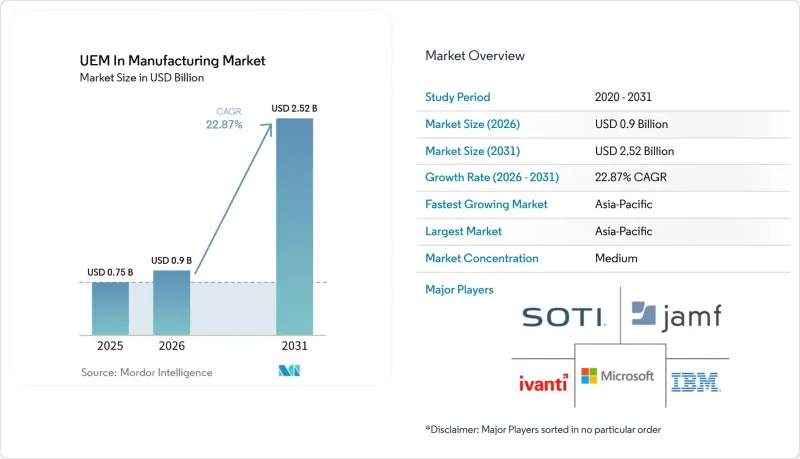
本報告按元件(解決方案[設備管理、應用管理、內容管理、安全與合規管理等]和服務)、部署模式(雲端、本地部署等)、組織規模(大型企業、中小企業)和地區(亞太地區、歐洲等)進行細分。市場預測以美元計價。
全球製造業統一端點管理 (UEM) 市場趨勢與洞察
擴大工廠營運中自帶設備辦公室 (BYOD) 和加固型行動裝置的應用。
製造業統一端點管理 (UEM) 市場正受益於工廠工人在同一生產車間擴大同時使用個人智慧型手機和加固型手持終端機。斑馬技術公司 (Zebra Technologies) 和 Honeywell 等廠商的加固型設備正在擴展其對 Wi-Fi 6E、eSIM 和專用 5G 應用場景的支持,從而增加了製造和物流環境中設備的多樣性。這種混合所有權模式在換班期間會帶來身分驗證、存取和資料隔離方面的問題,尤其是在共用自助服務終端和 Android 裝置普遍存在的情況下。 2026 年 4 月,微軟更新了其現場工作人員功能,以支援 Android 企業版裝置上的共用裝置模式和身分聯合,從而直接解決了多用戶工廠環境中的登入和登出問題。另一個挑戰是,加固型工業手持終端機的使用壽命通常為 3 到 5 年,而消費級設備的更新換代週期則快得多,這使得能夠使用單一策略模型管理新舊設備代際的廠商在製造業 UEM 領域更具優勢。
異構端點安全性的標準化
製造業的統一端點管理 (UEM) 市場也受到保護各種類型端點的單一、一致策略結構的需求所驅動。製造商使用 Windows 筆記型電腦、Android 掃描器、Linux 工業電腦和傳統控制器,這些設備無法在不影響確定性流程的情況下接受標準代理程式。 2025 年 6 月,Forescout 的報告顯示,雖然 44% 的工業組織表示擁有即時網路安全可見性,但近 60% 的組織表示對 OT 和 IoT威脅偵測「信心不足」或「完全沒有信心」。這反映了孤立工具的限制。類似的營運現實導致糾正措施週期延長,因為生產設備的修補通常依賴維護窗口和受控停機時間,而不是標準的 IT 計劃。 2026 年 4 月,TeamViewer 透過其硬體閘道器模型推出了「無代理存取」方法,為製造商提供了一種無需在設備上直接安裝軟體即可遠端存取和控制傳統 OT 端點的實用方案。隨著 IEC 62443 在採購和安全標準中的重要性日益增加,製造業的 UEM(統一端點管理)市場正在轉向涵蓋 IT、OT 和 IoT 資產的更廣泛的端點覆蓋範圍。
與傳統OT和MES環境整合的複雜性
由於現代終端平台與長期運作的工業系統之間存在不匹配,製造業的統一端點管理 (UEM) 市場仍面臨阻力。 OT 環境著重於穩定性和確定性運行,而 UEM 工具的設計則著重於頻繁更新、動態策略和廣泛的代理覆蓋。此外,製造工廠使用 FL-net、OPC-UA、Modbus 和 MQTT 等專有和工業協議,將這些協議整合到統一管理平台通常需要專用連接器和轉換層。 Palo Alto Networks 報告稱,到 2026 年,暴露在網際網路上的 OT 設備數量將成長 332%,屆時將有近 2000 萬個與 OT 相關的服務在公共網際網路上可見。這表明,如果管治不足,嘗試將 OT 基礎設施連接到雲端控制層實際上可能會增加風險。這個問題也導致部署延遲,因為供應商需要檢驗其與各種 MES 版本以及現場部署的自動化堆疊的兼容性。因此,製造業的 UEM(統一端點管理)市場仍然嚴重依賴能夠透過預先建置連接器、OT 協定支援和成熟的工廠整合方法來縮短引進週期的供應商。
細分市場分析
預計到2025年,解決方案將在製造業統一端點管理 (UEM) 市場佔據66.47%的佔有率,這表明買家越來越傾向於選擇整合平台而非獨立的服務合約。製造商越來越傾向於透過單一主機來管理設備管理、應用程式控制、內容傳送、安全合規以及基於分析的自動化。解決方案層最強勁的需求來自設備管理、安全和合規管理,因為製造商希望在筆記型電腦、掃描器、自助服務終端、印表機和RFID資產之間建立一致的配置基準。
此外,2025年,隨著供應商增加更廣泛的物聯網和修復功能,解決方案領域的範圍進一步擴大。 2025年9月,Omnissa實施了Workspace ONE漏洞防禦,將人工智慧驅動的修復功能與CrowdStrike Falcon暴露管理整合,使其在物理和虛擬端點的主動漏洞管理方面更進一步。 Omnissa也透過Workspace ONE Intelligence實現了Zebra印表機和加固型設備的MQTT支援標準化,顯示該平台的功能已從端點配置擴展到工廠內的物聯網整合。服務在製造業的統一端點管理(UEM)中繼續發揮至關重要的作用,因為企業部署通常需要在MES、ERP和工業中介軟體之間進行整合、部署和變更處理。這些服務的角色也增加了轉換成本,使得擁有認證區域整合商的供應商能夠在製造業UEM市場長期留住客戶。
區域分析
預計到2025年,亞太地區將佔製造業統一端點管理(UEM)市場規模的37.26%,成為該地區貢獻最大的區域。該地區受惠於中國、日本、韓國、印度和東南亞的大規模製造業活動,連網設備在汽車、電子、重工業和出口導向生產中日益普及。中國仍然是區域需求的核心,這得益於智慧製造的進步及其龐大的製造業基礎,從而形成了大規模端點環境。亞太製造業市場的UEM也受益於「行動優先」營運模式的廣泛採用,這種模式非常適合「雲端優先」部署和待開發區部署模式。印度是另一個強勁的需求市場,因為其大規模微型企業基礎與大規模簡單的雲端驅動主導上線模式非常契合,這種模式無需與大型舊有系統整合。
北美和歐洲在製造業統一端點管理 (UEM) 市場中佔據重要佔有率,並持續成為企業平台開發的重要中心。北美受惠於早期雲端採用、對零信任原則的高度認同,以及汽車、航太、國防電子和製藥等產業密集的製造業活動。在歐洲,NIS2 指令於 2022 年生效,並在 2025 年和 2026 年就已開始積極實施和審計工作,從而形成更清晰的合規週期。這種環境推動了製造商對端點可見性、策略執行以及跨分散業務地點創建基於證據的報告的需求不斷成長。因此,歐洲製造業 UEM 市場的發展不僅受到現代化目標的驅動,也受到整個產業部門監管課責。
儘管南美洲和中東及非洲地區目前在收入基數中所佔佔有率仍然較小,但這些地區的製造業統一端點管理 (UEM) 市場在中期內仍有巨大的成長空間。在南美,巴西的發展前景最為清晰,因為對智慧工廠的投資和製造執行系統 (MES) 的普及自然而然地增加了工廠網路上管理的端點數量。沙烏地阿拉伯和阿拉伯聯合大公國也展現出極具吸引力的發展環境,因為新的工業計畫可以從試運行階段就開始實施雲端原生端點管治,而無需在後期對舊設備維修。在非洲,由於網路連接的差異和工業數位化進程的緩慢,UEM 的採用速度低於其他地區,但跨國製造商已開始將全球端點策略擴展到一些當地產業。隨著基礎設施和工廠數位化的不斷推進,預計這些地區的製造業 UEM 市場將從孤立的部署模式發展為更標準化、多站點的部署模式。
其他好處:
- Excel格式的市場預測(ME)表
- 3個月的分析師支持
目錄
第1章:引言
- 研究假設和市場定義
- 調查範圍
第2章:調查方法
第3章執行摘要
第4章 市場狀況
- 市場概覽
- 市場促進因素
- 擴大工廠營運中自帶設備辦公室 (BYOD) 和加固型行動裝置的應用。
- 分散式工廠遠端系統管理的需求
- 異質端點之間的安全標準化
- 設備生命週期工作流程的雲端遷移
- 生產環境中多作業系統終端的激增
- 合規壓力促使終端控制做好審計準備
- 市場限制因素
- 與傳統OT和MES環境整合的複雜性
- 中型製造工廠的預算摩擦
- 工廠營運人員對終端變更管理的抵制
- IT部門對共用現場設備的可見度不足
- 產業價值鏈分析
- 監理情勢
- 技術展望
- 宏觀經濟因素對市場的影響
- 波特五力分析
第5章 市場規模與成長預測
- 按組件
- 解決方案
- 設備管理
- 應用程式管理
- 內容管理
- 安全與合規管理
- 分析與自動化
- 服務
- 解決方案
- 部署模式
- 基於雲端的
- 現場
- 混合
- 按組織規模
- 大公司
- 小型企業
- 按地區
- 北美洲
- 美國
- 加拿大
- 墨西哥
- 南美洲
- 巴西
- 阿根廷
- 智利
- 哥倫比亞
- 其他南美國家
- 歐洲
- 德國
- 英國
- 法國
- 義大利
- 西班牙
- 荷蘭
- 北歐的
- 俄羅斯
- 其他歐洲國家
- 亞太地區
- 中國
- 日本
- 印度
- 韓國
- 澳洲和紐西蘭
- 東南亞
- 其他亞太國家
- 中東
- 沙烏地阿拉伯
- 阿拉伯聯合大公國
- 土耳其
- 以色列
- 其他中東國家
- 非洲
- 南非
- 埃及
- 奈及利亞
- 肯亞
- 其他非洲國家
- 北美洲
第6章 競爭情勢
- 市場集中度
- 策略趨勢
- 市佔率分析
- 公司簡介
- Microsoft Corporation
- IBM Corporation
- Ivanti, Inc.
- SOTI Inc.
- Jamf Holding Corp.
- Omnissa, Inc.
- Cisco Systems, Inc.
- Miradore Ltd.
- 42Gears Mobility Systems Pvt. Ltd.
- TeamViewer SE
- Samsung Electronics Co., Ltd.
- Google LLC
- Apple Inc.
第7章 市場機會與未來展望
According to Mordor Intelligence, the UEM in manufacturing market size was valued at USD 0.75 billion in 2025 and estimated to grow from USD 0.90 billion in 2026 to reach USD 2.52 billion by 2031, at a CAGR of 22.87% during the forecast period (2026-2031).
This report is Segmented by Component (Solutions [Device Management, Application Management, Content Management, Security and Compliance Management, and More], and Services), Deployment Mode (Cloud-Based, On-Premise, and More), Organization Size (Large Enterprises, and Small and Medium Enterprises), and Geography (Asia-Pacific, Europe, and More). The Market Forecasts are Provided in Terms of Value (USD).
Global UEM In Manufacturing Market Trends and Insights
Rising BYOD and Rugged Mobile Adoption in Factory Operations
The UEM in manufacturing market is benefiting from the way factory workers now use both personal smartphones and rugged handhelds on the same production floor. Rugged devices from vendors such as Zebra Technologies and Honeywell increasingly support Wi-Fi 6E, eSIM, and private 5G use cases, expanding device variety in manufacturing and logistics settings. This mixed-ownership model creates authentication, access, and data separation issues during shift handovers, especially when shared kiosks and Android devices are common. Microsoft updated frontline worker capabilities in April 2026 to support shared device mode and identity federation on Android Enterprise devices, directly addressing sign-in and sign-out gaps in multi-user factory environments. A further challenge is that hardened industrial handhelds often remain in use for 3 to 5 years, while consumer devices turn over much faster, so the UEM in the manufacturing market favors vendors that can govern both old and new device generations under a single policy model.
Security Standardization Across Heterogeneous Endpoints
The UEM in manufacturing market is also being driven by the need to secure diverse endpoint types with a single, consistent policy structure. Manufacturers operate Windows laptops, Android scanners, Linux industrial computers, and legacy controllers that cannot always accept standard agents without affecting deterministic processes. Forescout reported in June 2025 that 44% of industrial organizations said they had real-time cyber visibility, yet nearly 60% had low to no confidence in OT and IoT threat detection, which reflects the limits of siloed tools. The same operating reality creates long remediation cycles because patching production equipment often depends on maintenance windows and controlled downtime rather than standard IT timing. TeamViewer introduced its Agentless Access approach in April 2026 through a hardware gateway model, offering manufacturers a practical option for remote access and control of legacy OT endpoints without installing software directly on the devices. As IEC 62443 becomes more visible in procurement and security baselines, the UEM in manufacturing market is moving toward broader endpoint coverage that spans IT, OT, and IoT assets.
Integration Complexity with Legacy OT and MES Environments
The UEM in manufacturing market still faces resistance from the mismatch between modern endpoint platforms and long-life industrial systems. OT environments were built for stability and deterministic operation, while UEM tools were designed around frequent updates, dynamic policies, and broad agent coverage. Manufacturing plants also run proprietary and industrial protocols such as FL-net, OPC-UA, Modbus, and MQTT, which often require specialized connectors or translation layers to fit into a unified management plane. Palo Alto Networks reported in 2026 a 332% increase in unique internet-exposed OT devices and nearly 20 million OT-related services visible on the public internet, which shows how attempts to connect OT estates to cloud control layers can widen exposure if governance is weak. The same problem slows deployment because vendors often need to validate compatibility with each MES variant and the automation stack present at a site. As a result, the UEM in manufacturing market still depends heavily on vendors that can shorten rollout cycles through pre-built connectors, OT protocol support, and proven plant integration methods.
Other drivers and restraints analyzed in the detailed report include:
- Remote Management Needs Across Distributed Plants
- Cloud Migration of Device Lifecycle Workflows
- Budget Friction in Mid-Market Manufacturing Plants
For complete list of drivers and restraints, kindly check the Table Of Contents.
Segment Analysis
Solutions held 66.47% of UEM in manufacturing market share in 2025, which showed that buyers preferred integrated platforms over stand-alone service engagements. Manufacturers increasingly chose one console for device management, application control, content delivery, security and compliance, and analytics-based automation. The strongest pull within the solutions layer came from device management and security, as well as compliance management, as manufacturers sought consistent configuration baselines across laptops, scanners, kiosks, printers, and RFID assets.
The solutions segment also expanded its scope in 2025 as vendors added broader IoT and remediation capabilities. Omnissa introduced Workspace ONE Vulnerability Defense in September 2025, linking AI-driven remediation with CrowdStrike Falcon Exposure Management to move the offering closer to proactive vulnerability management across physical and virtual endpoints. Omnissa also standardized MQTT support for Zebra printers and rugged devices through Workspace ONE Intelligence, which showed that platform scope was moving beyond endpoint setup into factory IoT coordination. Services still mattered in the UEM in manufacturing industry because enterprise rollouts often needed integration, deployment, and change support across MES, ERP, and industrial middleware. That service role also raises switching costs, so vendors with certified regional integrators can hold accounts longer in the UEM in manufacturing market.
Complete Report Scope:
- By Component
- Solutions
- Device Management
- Application Management
- Content Management
- Security and Compliance Management
- Analytics and Automation
- Services
- Solutions
- By Deployment Mode
- Cloud-Based
- On-Premise
- Hybrid
- By Organization Size
- Large Enterprises
- Small and Medium Enterprises
- By Geography
- North America
- United States
- Canada
- Mexico
- South America
- Brazil
- Argentina
- Chile
- Colombia
- Rest of South America
- Europe
- Germany
- United Kingdom
- France
- Italy
- Spain
- Netherlands
- Nordics
- Russia
- Rest of Europe
- Asia-Pacific
- China
- Japan
- India
- South Korea
- Australia and New Zealand
- Southeast Asia
- Rest of Asia-Pacific
- Middle East
- Saudi Arabia
- United Arab Emirates
- Turkey
- Israel
- Rest of Middle East
- Africa
- South Africa
- Egypt
- Nigeria
- Kenya
- Rest of Africa
- North America
Geography Analysis
Asia-Pacific accounted for 37.26% of the UEM in manufacturing market size in 2025, which made it the leading regional contributor. The region benefits from large-scale manufacturing activity across China, Japan, South Korea, India, and Southeast Asia, where connected devices are becoming more common in automotive, electronics, heavy industry, and export-oriented production. China remains central to regional demand because its smart manufacturing push and broad installed manufacturing base create large endpoint estates that need policy consistency across facilities. The UEM in the manufacturing market in Asia-Pacific also benefits from a mobile-first operating mindset in many enterprises, which fits cloud-first deployments and greenfield rollout models. India adds another strong demand layer, as its large MSME manufacturing base aligns well with lower-complexity, cloud-led onboarding models that do not require extensive legacy integration.
North America and Europe together represented a substantial share of the UEM in manufacturing market and remain the main centers of enterprise platform development. North America benefits from earlier cloud adoption, stronger alignment with zero-trust principles, and dense manufacturing activity in automotive, aerospace, defense electronics, and pharmaceuticals. Europe is moving under a clearer compliance cycle because the NIS2 Directive entered force in 2022 and active implementation and audit activity had already progressed by 2025 and 2026. That environment raises demand from manufacturers that need endpoint visibility, policy enforcement, and evidence-ready reporting across distributed operations. The UEM in manufacturing market in Europe is therefore being pushed not only by modernization goals, but also by regulatory accountability across industrial sectors.
South America, the Middle East, and Africa still contribute a smaller revenue base, but the UEM in manufacturing market has meaningful room to expand in these regions over the medium term. Brazil provides the clearest South American path because smart factory investment and wider MES use naturally increase the number of managed endpoints on plant networks. Saudi Arabia and the United Arab Emirates also present an attractive setup because new industrial projects can deploy cloud-native endpoint governance from the commissioning stage rather than retrofit old device estates later. Africa remains earlier in the curve because connectivity gaps and slower industrial digitalization still constrain broader rollout, although multinational manufacturers are already extending global endpoint policies into select local operations. As infrastructure and plant digitalization improve, the UEM in manufacturing market in these regions is likely to deepen from isolated deployments into more standardized multi-site programs.
- Microsoft Corporation
- IBM Corporation
- Ivanti, Inc.
- SOTI Inc.
- Jamf Holding Corp.
- Omnissa, Inc.
- Cisco Systems, Inc.
- Miradore Ltd.
- 42Gears Mobility Systems Pvt. Ltd.
- TeamViewer SE
- Samsung Electronics Co., Ltd.
- Google LLC
- Apple Inc.
Additional Benefits:
- The market estimate (ME) sheet in Excel format
- 3 months of analyst support
TABLE OF CONTENTS
1 INTRODUCTION
- 1.1 Study Assumptions and Market Definition
- 1.2 Scope of the Study
2 RESEARCH METHODOLOGY
3 EXECUTIVE SUMMARY
4 MARKET LANDSCAPE
- 4.1 Market Overview
- 4.2 Market Drivers
- 4.2.1 Rising BYOD and Rugged Mobile Adoption in Factory Operations
- 4.2.2 Remote Management Needs Across Distributed Plants
- 4.2.3 Security Standardization Across Heterogeneous Endpoints
- 4.2.4 Cloud Migration of Device Lifecycle Workflows
- 4.2.5 Multi-OS Endpoint Sprawl in Production Environments
- 4.2.6 Compliance Pressure for Audit-Ready Endpoint Controls
- 4.3 Market Restraints
- 4.3.1 Integration Complexity with Legacy OT and MES Environments
- 4.3.2 Budget Friction in Mid-Market Manufacturing Plants
- 4.3.3 Endpoint Change-Management Resistance From Plant Operators
- 4.3.4 Limited IT Visibility Into Shared Shop-Floor Devices
- 4.4 Industry Value Chain Analysis
- 4.5 Regulatory Landscape
- 4.6 Technological Outlook
- 4.7 Impact of Macroeconomic Factors on the Market
- 4.8 Porter's Five Forces Analysis
- 4.8.1 Threat of New Entrants
- 4.8.2 Bargaining Power of Buyers
- 4.8.3 Bargaining Power of Suppliers
- 4.8.4 Threat of Substitutes
- 4.8.5 Industry Rivalry
5 MARKET SIZE AND GROWTH FORECASTS (VALUE)
- 5.1 By Component
- 5.1.1 Solutions
- 5.1.1.1 Device Management
- 5.1.1.2 Application Management
- 5.1.1.3 Content Management
- 5.1.1.4 Security and Compliance Management
- 5.1.1.5 Analytics and Automation
- 5.1.2 Services
- 5.1.1 Solutions
- 5.2 By Deployment Mode
- 5.2.1 Cloud-Based
- 5.2.2 On-Premise
- 5.2.3 Hybrid
- 5.3 By Organization Size
- 5.3.1 Large Enterprises
- 5.3.2 Small and Medium Enterprises
- 5.4 By Geography
- 5.4.1 North America
- 5.4.1.1 United States
- 5.4.1.2 Canada
- 5.4.1.3 Mexico
- 5.4.2 South America
- 5.4.2.1 Brazil
- 5.4.2.2 Argentina
- 5.4.2.3 Chile
- 5.4.2.4 Colombia
- 5.4.2.5 Rest of South America
- 5.4.3 Europe
- 5.4.3.1 Germany
- 5.4.3.2 United Kingdom
- 5.4.3.3 France
- 5.4.3.4 Italy
- 5.4.3.5 Spain
- 5.4.3.6 Netherlands
- 5.4.3.7 Nordics
- 5.4.3.8 Russia
- 5.4.3.9 Rest of Europe
- 5.4.4 Asia-Pacific
- 5.4.4.1 China
- 5.4.4.2 Japan
- 5.4.4.3 India
- 5.4.4.4 South Korea
- 5.4.4.5 Australia and New Zealand
- 5.4.4.6 Southeast Asia
- 5.4.4.7 Rest of Asia-Pacific
- 5.4.5 Middle East
- 5.4.5.1 Saudi Arabia
- 5.4.5.2 United Arab Emirates
- 5.4.5.3 Turkey
- 5.4.5.4 Israel
- 5.4.5.5 Rest of Middle East
- 5.4.6 Africa
- 5.4.6.1 South Africa
- 5.4.6.2 Egypt
- 5.4.6.3 Nigeria
- 5.4.6.4 Kenya
- 5.4.6.5 Rest of Africa
- 5.4.1 North America
6 COMPETITIVE LANDSCAPE
- 6.1 Market Concentration
- 6.2 Strategic Moves
- 6.3 Market Share Analysis
- 6.4 Company Profiles (includes Global Level Overview, Market Level Overview, Core Segments, Financials as available, Strategic Information, Market Rank/Share, Products and Services, Recent Developments)
- 6.4.1 Microsoft Corporation
- 6.4.2 IBM Corporation
- 6.4.3 Ivanti, Inc.
- 6.4.4 SOTI Inc.
- 6.4.5 Jamf Holding Corp.
- 6.4.6 Omnissa, Inc.
- 6.4.7 Cisco Systems, Inc.
- 6.4.8 Miradore Ltd.
- 6.4.9 42Gears Mobility Systems Pvt. Ltd.
- 6.4.10 TeamViewer SE
- 6.4.11 Samsung Electronics Co., Ltd.
- 6.4.12 Google LLC
- 6.4.13 Apple Inc.
7 MARKET OPPORTUNITIES AND FUTURE OUTLOOK
- 7.1 White-Space and Unmet-Need Assessment

 企業行動管理:市場佔有率分析、產業趨勢與統計、成長預測(2026-2031)企業行動安全:市場佔有率分析、產業趨勢與統計、成長預測(2026-2031 年)
 企業行動管理市場:依組件、作業系統、部署模式、產業和組織規模分類-2026-2032年全球市場預測銀行業企業行動化:市場佔有率分析、產業趨勢與統計、成長預測(2025-2030 年)醫療保健領域的統一端點管理 (UEM):市場佔有率分析、行業趨勢和統計數據以及成長預測 (2026-2031)
 企業行動管理 (EMM) 市場機會、成長要素、產業趨勢分析及 2026-2035 年預測
 住宅旅遊服務市場預測-按服務類型、交通方式、平台類型、應用、最終用戶和地區分類的全球分析搬遷與調動管理軟體:市場佔有率分析、產業趨勢與統計、成長預測(2026-2031)
 企業行動服務市場規模、佔有率和成長分析:按組件、部署類型、組織規模、設備類型、應用和地區分類-2026-2033年產業預測
 企業行動管理 (EMM) 市場:按解決方案類型、部署模式、企業規模、最終用戶產業和地區分類