


 |
市場調查報告書
商品編碼
2114144
企業行動管理:市場佔有率分析、產業趨勢與統計、成長預測(2026-2031)Enterprise Mobility Management - Market Share Analysis, Industry Trends & Statistics, Growth Forecasts (2026 - 2031) |
||||||

※ 本網頁內容可能與最新版本有所差異。詳細情況請與我們聯繫。
據 Mordor Intelligence 稱,企業行動管理 (EMM) 市場在 2025 年的價值為 339 億美元,預計到 2031 年將達到 944.7 億美元,而 2026 年為 402.1 億美元,預測期(2026-2031 年)的複合年成長率為 18.2%。
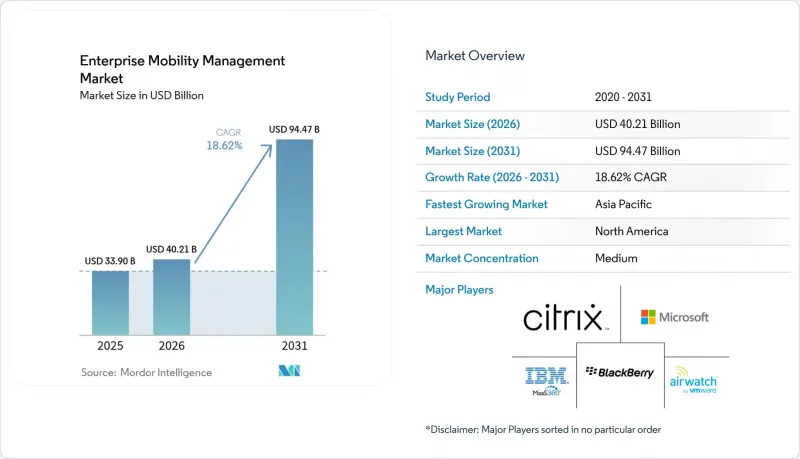
本報告按類型(解決方案和服務)、部署模式(本地部署、雲端部署、混合部署)、組織規模(大型企業和中小企業)、最終用戶行業(銀行、金融服務和保險、醫療保健和生命科學、IT和電信、製造和工業、零售和電子商務等)以及地區進行細分。市場預測以價值(美元)表示。
全球企業行動管理市場趨勢與洞察
企業級行動裝置和應用程式的激增
零售商、公共產業和公共機構如今管理的設備數量規模堪比電信業者。日本7-Eleven便利商店集中管理遍布21,000家門市的300,000台平板電腦,這充分展現了雲端協作如何實現全國一致的策略執行。微軟Intune中針對Apple Vision Pro的新策略集表明,企業行動管理(EMM)主機必須保護的終端設備種類日益增多,同時也要確保用戶體驗不受影響。內建於裝置代理程式中的預測分析功能可偵測電池健康狀況異常,並在導致停機之前更新合規性設定。 「企業所有,個人使用(COPE)」模式正在取代限制性封鎖措施,在維持資料控制的同時,提升員工滿意度。
自帶設備辦公 (BYOD) 和遠距辦公文化的不斷發展
目前,全球92%的公司允許某種形式的遠端訪問,高於2023年的76%,這迫使安全團隊透過加密容器將企業資料與個人內容隔離。醫療保健系統面臨著HIPAA合規性和臨床醫生便利性的雙重壓力,這促使人們擴大採用虛擬工作空間工具,這些工具可以在不將電子健康資訊(ePHI)留在未經管理的智慧型手機上的情況下串流應用程式。由45個組織組成的美國聯邦移動小組正在製定BYOD評估清單的標準化方案,以簡化採購流程並加快FedRAMP的批准。基於輪班的存取控制和快速的企業資料擦除功能現在已成為基本要求。
高昂的初始成本和升級成本
對於首次採用企業行動化方案的公司而言,整體擁有成本 (TCO) 仍然不明朗。一項針對 150 位企業智慧型手機管理員的調查顯示,31.3% 的受訪者認為「成本透明度」是平台選擇的最大障礙。合規性審計、證書續約以及報廢設備的處置等隱性成本通常會超過第一年的訂閱費用。供應商正透過功能分拆來解決這個問題;微軟現在將其企業應用程式管理 (EAM) 的價格定為每位用戶每月 2 美元。這使得中小企業無需進行完整的 SKU 升級即可添加高級補丁功能。雖然雲端交付降低了資本支出 (Capex),但它將預算轉移到了持續營運支出 (OpEx) 上,這對員工人數波動較大的組織來說是一個挑戰。
細分市場分析
到2025年,解決方案將佔總收入的62.35%,鞏固其作為設備、應用和內容層核心整合點的地位。安全管理以20.41%的複合年成長率脫穎而出,反映了威脅的持續演變。設備管理仍然是吸引新客戶的切入點,同時擴大融入人工智慧驅動的修復功能。應用容器將企業資料隔離在各個智慧型手機上,確保符合歐洲和加州的隱私法規。內容和電子郵件管理正從基礎加密轉向策略主導的水印技術,以防止未經授權的共用。通訊成本管理雖然仍是一個小眾領域,但在尋求SIM卡級成本管理的物流公司中正日益受到關注。
這些服務線是產品系列的補充。專業服務團隊透過準備評估和分階段遷移計畫來降低部署風險。託管服務提供全天候遙測監控,這對於醫療保健和零售業中面臨人手不足的IT 部門至關重要。微軟的高階分析模組包含異常檢測 API,合作夥伴公司可以透過諮詢服務獲利。隨著人工智慧的成熟,能夠利用垂直市場資料微調模型的領域專家將提高利潤率,並使現有服務提供者在與通用型 MSP 的競爭中佔據優勢。
預計到 2025 年,雲端解決方案將佔總支出的 58.10%,複合年成長率 (CAGR) 高達 18.93%,成為成長最快的領域。因此,企業行動管理市場正轉向可擴展的 SaaS主機,這些控制台能夠自動更新合規庫。一家全國性零售連鎖企業在 5000 個終端上進行了概念驗證(PoC),並在短短四周內實現了全面遷移到生產環境——這種速度在傳統的本地部署環境中是難以想像的。混合雲端仍然是銀行實現資料居住保障的橋樑。敏感令牌保存在本地,而策略邏輯則運行在按提供者區域隔離的雲端上。在防禦性部署中,本地解決方案仍然被使用,其中空氣間隙的伺服器能夠滿足敏感資料的要求。
成本彈性正在推動雲端運算的普及。計量收費模式使中小企業能夠根據設備普及率靈活擴展,而無需預先支付大規模授權費用。政府批量採購協議,例如美國總務署 (GSA) 的「最佳移動性」契約,正在推動採購轉向雲端服務和 5G 服務。歐盟的數位身分錢包法規要求成員國在 24 個月內建置雲端原生憑證庫。已獲得本地偽匿名標準預先認證的供應商將比仍依賴單一租戶服務的競爭對手更具優勢。
區域分析
到2025年,北美將佔總收入的32.30%。公共部門資料外洩監管的加強加速了設備安全檢查和持續認證的支出。網路安全和基礎設施安全局 (CISA) 的行動裝置安全檢查清單現已成為15個聯邦機構採購範本的基礎。加拿大隱私法的修訂要求服務供應商在國內儲存個人識別訊息,這增加了對國內SaaS區域的需求。在墨西哥的汽車產業走廊,支援邊緣運算的平板電腦正在工廠車間部署,這迫使工業系統整合商對雙語使用者介面和本地營運商的eSIM設定檔進行認證。
亞太地區以21.74%的複合年成長率領跑,主要得益於智慧型手機普及率的提高和各國數位化策略的推進。日本便利商店和教育機構的先導計畫展示了超大規模部署,集中式修補程式顯著提升了營運效率。印度的《數位個人資料保護法》規定資料外洩事件必須在72小時內報告,迫使中小企業部署具備審計可讀日誌功能的策略引擎。中國在設備數量方面佔據主導地位,但對海外雲端的存取有所限制,迫使跨國公司採用混合架構以符合網路安全審計要求。澳洲的《受保護安全指令001-2025》規定了企業行動終端的基本加密演算法,並制定了標準化的競標要求。
在歐洲,網路安全監管正透過《網路韌性法案》加強,該法案強制要求在2027年實現CE認證合規並建立事件回應流程。德國聯邦資訊安全辦公室(BSI)對黑莓UEM的認證為部署敏感的蘋果設備鋪平了道路,並凸顯了德國對認證解決方案的偏好。英國正在完善脫歐後的資料傳輸規則,同時維持與歐盟充分性決定體系的互通性,以支持跨境SaaS的普及。南歐國家正優先採用基於EMM加密模組的數位身分錢包,以縮短公民服務的等待時間並擴大包容性管治。
其他好處:
- Excel格式的市場預測(ME)表
- 3個月的分析師支持
目錄
第1章:引言
- 研究假設和市場定義
- 調查範圍
第2章:調查方法
第3章執行摘要
第4章 市場狀況
- 市場概覽
- 市場促進因素
- 行動裝置和企業應用程式的普及
- 自備設備辦公室 (BYOD) 和遠距辦公文化的興起
- 行動網路安全威脅日益加劇
- 加強資料保護條例(GDPR、CCPA 等)
- 零信任企業行動管理框架的興起
- 行動邊緣運算在現場作業中的應用案例
- 市場限制因素
- 實施和升級的相關成本相對較高。
- 整合舊有系統的複雜性
- 對企業數據主權的擔憂
- 電池/高負載EMM代理程式導致的效能下降
- 產業價值鏈分析
- 監理情勢
- 技術展望
- 波特五力分析
第5章 市場規模與成長預測
- 按類型
- 解決方案
- 設備管理
- 應用程式管理
- 安全管理
- 內容和電子郵件管理
- 通訊費用管理
- 服務
- 專業服務
- 託管服務
- 解決方案
- 部署模式
- 現場
- 基於雲端的
- 混合
- 按組織規模
- 大公司
- 中小企業
- 按最終用戶行業分類
- BFSI
- 醫療保健和生命科學
- 資訊科技/通訊
- 製造業和工業
- 零售與電子商務
- 政府/公共部門
- 運輸/物流
- 其他終端用戶產業
- 按地區
- 北美洲
- 美國
- 加拿大
- 墨西哥
- 南美洲
- 巴西
- 阿根廷
- 其他南美國家
- 歐洲
- 德國
- 英國
- 法國
- 義大利
- 西班牙
- 俄羅斯
- 其他歐洲國家
- 亞太地區
- 中國
- 印度
- 日本
- 韓國
- 澳洲和紐西蘭
- ASEAN
- 其他亞太國家
- 中東和非洲
- 中東
- 沙烏地阿拉伯
- 阿拉伯聯合大公國
- 土耳其
- 其他中東國家
- 非洲
- 南非
- 奈及利亞
- 肯亞
- 其他非洲國家
- 中東
- 北美洲
第6章 競爭情勢
- 市場集中度
- 策略趨勢
- 市佔率分析
- 公司簡介
- VMware, Inc.
- Microsoft Corporation
- International Business Machines Corporation
- BlackBerry Limited
- Citrix Systems, Inc.
- Ivanti, Inc.
- SOTI Inc.
- Sophos Group plc
- Broadcom Inc.
- ManageEngine(Zoho Corporation Pvt. Ltd.)
- Jamf Holding Corp.
- Cisco Systems, Inc.
- Samsung Electronics Co., Ltd.
- Snow Software AB
- 42Gears Mobility Systems Pvt. Ltd.
- Scalefusion(ProMobi Technologies Pvt. Ltd.)
- Hexnode(Mitsogo Inc.)
- Baramundi Software AG
- Matrix42 AG
- Quest Software Inc.
- Absolute Software Corporation
第7章 市場機會與未來展望
According to Mordor Intelligence, the enterprise mobility management market size was valued at USD 33.90 billion in 2025 and estimated to grow from USD 40.21 billion in 2026 to reach USD 94.47 billion by 2031, at a CAGR of 18.62% during the forecast period (2026-2031).
This report is Segmented by Type (Solutions, and Services), Deployment Mode (On-Premise, Cloud-Based, and Hybrid), Organization Size (Large Enterprises, and Small and Medium-Sized Enterprises), End-User Industry (BFSI, Healthcare and Life Sciences, IT and Telecom, Manufacturing and Industrial, Retail and E-Commerce, and More), and Geography. The Market Forecasts are Provided in Terms of Value (USD).
Global Enterprise Mobility Management Market Trends and Insights
Proliferation of Enterprise Mobile Devices and Apps
Retailers, utilities, and public-sector agencies now oversee device fleets that rival telecom operators in scale. Seven-Eleven Japan centrally manages 300,000 tablets across 21,000 stores, demonstrating how cloud orchestration delivers uniform policy enforcement at national reach. Microsoft Intune's new policy set for Apple Vision Pro indicates a widening endpoint mix that EMM consoles must secure without sacrificing user experience. Predictive analytics embedded in device agents surface battery-health and update-compliance anomalies before they become downtime events. Corporate-owned-personally-enabled (COPE) models are replacing restrictive lockdowns, boosting employee satisfaction while preserving data custody.
Rising BYOD and Remote-Work Culture
Ninety-two percent of global firms now allow some form of remote access, up from 76% in 2023, forcing security teams to isolate corporate data from personal content through encrypted containers. Healthcare systems face twin pressures of HIPAA compliance and clinician convenience, pushing uptake of virtual workspace tools that stream applications without persisting ePHI on unmanaged phones. The U.S. Federal Mobility Group, comprising 45 agencies, is codifying shared BYOD assessment checklists to streamline procurement and speed FedRAMP approvals. Shift-based access control and rapid enterprise-wipe functions are now baseline requirements.
High Implementation and Upgrade Costs
Total-cost-of-ownership remains opaque for firms new to enterprise mobility. Surveys of 150 corporate phone managers show 31.3% cite "cost clarity" as the top barrier to platform selection. Hidden spend on compliance audits, certificate renewals, and end-of-life device disposal often exceeds the first-year subscription fee. Vendors respond with feature unbundling; Microsoft now prices Enterprise Application Management at USD 2 per user per month so smaller firms can add advanced patching without a full SKU uplift. Cloud delivery lowers capex but converts budgets into recurring opex, challenging organizations with fluctuating headcount.
Other drivers and restraints analyzed in the detailed report include:
- Escalating Mobile Cybersecurity Threats
- Emergence of Zero-Trust EMM Frameworks
- Legacy System Integration Complexity
For complete list of drivers and restraints, kindly check the Table Of Contents.
Segment Analysis
Solutions accounted for 62.35% of 2025 revenue, confirming their role as the control nexus across device, application, and content layers. Security Management stood out with a 20.41% CAGR, reflecting relentless threat evolution. Device Management continues as the entry point for new customers yet increasingly bundles AI-guided remediation. Application containers now isolate corporate data on personal phones, meeting privacy statutes in Europe and California. Content and Email Management shifts from basic encryption to policy-driven watermarking that deters unauthorized sharing. Telecom Expense Management remains niche but gains traction among logistics firms seeking SIM-level cost control.
Service lines complement product portfolios. Professional Services teams de-risk rollouts through readiness assessments and phased cut-over plans. Managed Services supply round-the-clock telemetry review, crucial for understaffed IT groups in healthcare and retail. Microsoft's Advanced Analytics module packages anomaly detection APIs that partners monetize via consulting engagements. As AI matures, domain specialists that can fine-tune models on vertical data will capture margin uplift, giving incumbents an edge over generic MSPs.
Cloud options captured 58.10% of 2025 spend and posted the fastest 18.93% CAGR. The Enterprise mobility management market is therefore gravitating toward scalable SaaS consoles that auto-update compliance libraries. One national retail chain ran a proof of concept across 5,000 endpoints and achieved full production in four weeks, a timeline unthinkable on legacy on-premise stacks. Hybrid-cloud remains the bridge for banks requiring data-residency assurance; sensitive tokens stay on-site while policy logic executes in the provider's regionally fenced cloud. On-premise persists in defense deployments where air-gapped servers satisfy classified-data mandates.
Cost elasticity explains cloud traction. Consumption-based models let SMEs mirror device adoption curves without large license blocks. Government blanket-purchase agreements such as the U.S. GSA's Best-in-Class Mobility contract tilt procurement toward cloud and 5G-ready services. The EU Digital Identity Wallet regulation compels member states to spin up cloud-native credential vaults within 24 months. Vendors that pre-certify for local pseudonymization standards will outpace rivals still reliant on single-tenant offerings.
Complete Report Scope:
- By Type
- Solutions
- Device Management
- Application Management
- Security Management
- Content and Email Management
- Telecom Expense Management
- Services
- Professional Services
- Managed Services
- Solutions
- By Deployment Mode
- On-premise
- Cloud-based
- Hybrid
- By Organization Size
- Large Enterprises
- Small and Medium-sized Enterprises (SMEs)
- By End-user Industry
- BFSI
- Healthcare and Life Sciences
- IT and Telecom
- Manufacturing and Industrial
- Retail and E-commerce
- Government and Public Sector
- Transportation and Logistics
- Other End-user Industry
- By Geography
- North America
- United States
- Canada
- Mexico
- South America
- Brazil
- Argentina
- Rest of South America
- Europe
- Germany
- United Kingdom
- France
- Italy
- Spain
- Russia
- Rest of Europe
- Asia-Pacific
- China
- India
- Japan
- South Korea
- Australia and New Zealand
- ASEAN
- Rest of Asia-Pacific
- Middle East and Africa
- Middle East
- Saudi Arabia
- United Arab Emirates
- Turkey
- Rest of Middle East
- Africa
- South Africa
- Nigeria
- Kenya
- Rest of Africa
- Middle East
- North America
Geography Analysis
North America generated 32.30% of 2025 revenue as public-sector breach mandates accelerated spending on device posture checks and continuous authentication. The Cybersecurity and Infrastructure Security Agency's mobile checklist now underpins procurement templates across 15 federal departments. Canadian privacy law amendments mandate that service providers store identifiable data domestically, raising demand for in-country SaaS regions. Mexico's automotive corridor deploys edge-enabled tablets on factory floors, pushing industrial integrators to certify bilingual UIs and local-telco eSIM profiles.
Asia Pacific posts the highest 21.74% CAGR, propelled by smartphone ubiquity and national digital agendas. Japan's convenience-store and education pilots showcase hyperscale deployments, underscoring operational efficiency gains from centralized patching. India's Digital Personal Data Protection Act adds breach-reporting windows as short as 72 hours, compelling SMBs to adopt policy engines with audit-ready logs. China dominates device volume but restricts foreign cloud ingress, so multinationals operate hybrid architectures to meet cybersecurity reviews. Australia's Protective Security Direction 001-2025 explicitly lists mandatory encryption algorithms for enterprise mobility endpoints, creating standardized tender language.
Europe tightens product-security oversight via the Cyber Resilience Act, requiring CE-mark conformity and incident-response processes by 2027. Germany's BSI clearance for BlackBerry UEM paves the way for classified Apple deployments, evidencing national preference for certified solutions. The U.K. refines its post-Brexit data-transfer rules yet remains interoperable with EU adequacy arrangements, sustaining cross-border SaaS adoption. Southern European states prioritize digital-ID wallets that ride on EMM cryptographic modules, shortening citizen-service queues and expanding inclusive governance.
- VMware, Inc.
- Microsoft Corporation
- International Business Machines Corporation
- BlackBerry Limited
- Citrix Systems, Inc.
- Ivanti, Inc.
- SOTI Inc.
- Sophos Group plc
- Broadcom Inc.
- ManageEngine (Zoho Corporation Pvt. Ltd.)
- Jamf Holding Corp.
- Cisco Systems, Inc.
- Samsung Electronics Co., Ltd.
- Snow Software AB
- 42Gears Mobility Systems Pvt. Ltd.
- Scalefusion (ProMobi Technologies Pvt. Ltd.)
- Hexnode (Mitsogo Inc.)
- Baramundi Software AG
- Matrix42 AG
- Quest Software Inc.
- Absolute Software Corporation
Additional Benefits:
- The market estimate (ME) sheet in Excel format
- 3 months of analyst support
TABLE OF CONTENTS
1 INTRODUCTION
- 1.1 Study Assumptions and Market Definition
- 1.2 Scope of the Study
2 RESEARCH METHODOLOGY
3 EXECUTIVE SUMMARY
4 MARKET LANDSCAPE
- 4.1 Market Overview
- 4.2 Market Drivers
- 4.2.1 Proliferation Of Enterprise Mobile Devices and Apps
- 4.2.2 Rising BYOD and Remote-Work Culture
- 4.2.3 Escalating Mobile Cybersecurity Threats
- 4.2.4 Tightening Data-Protection Regulations (GDPR, CCPA etc.)
- 4.2.5 Emergence Of Zero-Trust EMM Frameworks
- 4.2.6 Mobile Edge Computing Use-Cases in Field Operations
- 4.3 Market Restraints
- 4.3.1 High Implementation and Upgrade Costs
- 4.3.2 Legacy System Integration Complexity
- 4.3.3 Enterprise Data-Sovereignty Concerns
- 4.3.4 Battery/Performance Drain from Heavy EMM Agents
- 4.4 Industry Value Chain Analysis
- 4.5 Regulatory Landscape
- 4.6 Technological Outlook
- 4.7 Porter's Five Forces Analysis
- 4.7.1 Bargaining Power of Suppliers
- 4.7.2 Bargaining Power of Consumers
- 4.7.3 Threat of New Entrants
- 4.7.4 Threat of Substitutes
- 4.7.5 Intensity of Competitive Rivalry
5 MARKET SIZE AND GROWTH FORECASTS (VALUE)
- 5.1 By Type
- 5.1.1 Solutions
- 5.1.1.1 Device Management
- 5.1.1.2 Application Management
- 5.1.1.3 Security Management
- 5.1.1.4 Content and Email Management
- 5.1.1.5 Telecom Expense Management
- 5.1.2 Services
- 5.1.2.1 Professional Services
- 5.1.2.2 Managed Services
- 5.1.1 Solutions
- 5.2 By Deployment Mode
- 5.2.1 On-premise
- 5.2.2 Cloud-based
- 5.2.3 Hybrid
- 5.3 By Organization Size
- 5.3.1 Large Enterprises
- 5.3.2 Small and Medium-sized Enterprises (SMEs)
- 5.4 By End-user Industry
- 5.4.1 BFSI
- 5.4.2 Healthcare and Life Sciences
- 5.4.3 IT and Telecom
- 5.4.4 Manufacturing and Industrial
- 5.4.5 Retail and E-commerce
- 5.4.6 Government and Public Sector
- 5.4.7 Transportation and Logistics
- 5.4.8 Other End-user Industry
- 5.5 By Geography
- 5.5.1 North America
- 5.5.1.1 United States
- 5.5.1.2 Canada
- 5.5.1.3 Mexico
- 5.5.2 South America
- 5.5.2.1 Brazil
- 5.5.2.2 Argentina
- 5.5.2.3 Rest of South America
- 5.5.3 Europe
- 5.5.3.1 Germany
- 5.5.3.2 United Kingdom
- 5.5.3.3 France
- 5.5.3.4 Italy
- 5.5.3.5 Spain
- 5.5.3.6 Russia
- 5.5.3.7 Rest of Europe
- 5.5.4 Asia-Pacific
- 5.5.4.1 China
- 5.5.4.2 India
- 5.5.4.3 Japan
- 5.5.4.4 South Korea
- 5.5.4.5 Australia and New Zealand
- 5.5.4.6 ASEAN
- 5.5.4.7 Rest of Asia-Pacific
- 5.5.5 Middle East and Africa
- 5.5.5.1 Middle East
- 5.5.5.1.1 Saudi Arabia
- 5.5.5.1.2 United Arab Emirates
- 5.5.5.1.3 Turkey
- 5.5.5.1.4 Rest of Middle East
- 5.5.5.2 Africa
- 5.5.5.2.1 South Africa
- 5.5.5.2.2 Nigeria
- 5.5.5.2.3 Kenya
- 5.5.5.2.4 Rest of Africa
- 5.5.5.1 Middle East
- 5.5.1 North America
6 COMPETITIVE LANDSCAPE
- 6.1 Market Concentration
- 6.2 Strategic Moves
- 6.3 Market Share Analysis
- 6.4 Company Profiles (includes Global level Overview, Market level overview, Core Segments, Financials as available, Strategic Information, Market Rank/Share for key companies, Products and Services, and Recent Developments)
- 6.4.1 VMware, Inc.
- 6.4.2 Microsoft Corporation
- 6.4.3 International Business Machines Corporation
- 6.4.4 BlackBerry Limited
- 6.4.5 Citrix Systems, Inc.
- 6.4.6 Ivanti, Inc.
- 6.4.7 SOTI Inc.
- 6.4.8 Sophos Group plc
- 6.4.9 Broadcom Inc.
- 6.4.10 ManageEngine (Zoho Corporation Pvt. Ltd.)
- 6.4.11 Jamf Holding Corp.
- 6.4.12 Cisco Systems, Inc.
- 6.4.13 Samsung Electronics Co., Ltd.
- 6.4.14 Snow Software AB
- 6.4.15 42Gears Mobility Systems Pvt. Ltd.
- 6.4.16 Scalefusion (ProMobi Technologies Pvt. Ltd.)
- 6.4.17 Hexnode (Mitsogo Inc.)
- 6.4.18 Baramundi Software AG
- 6.4.19 Matrix42 AG
- 6.4.20 Quest Software Inc.
- 6.4.21 Absolute Software Corporation
7 MARKET OPPORTUNITIES AND FUTURE OUTLOOK
- 7.1 White-space and Unmet-need Assessment

 企業行動安全:市場佔有率分析、產業趨勢與統計、成長預測(2026-2031 年)
 企業行動管理市場:依組件、作業系統、部署模式、產業和組織規模分類-2026-2032年全球市場預測銀行業企業行動化:市場佔有率分析、產業趨勢與統計、成長預測(2025-2030 年)製造業中的統一端點管理 (UEM):市場佔有率分析、產業趨勢與統計資料、成長預測 (2026-2031)醫療保健領域的統一端點管理 (UEM):市場佔有率分析、行業趨勢和統計數據以及成長預測 (2026-2031)
 企業行動管理 (EMM) 市場機會、成長要素、產業趨勢分析及 2026-2035 年預測
 住宅旅遊服務市場預測-按服務類型、交通方式、平台類型、應用、最終用戶和地區分類的全球分析搬遷與調動管理軟體:市場佔有率分析、產業趨勢與統計、成長預測(2026-2031)
 企業行動服務市場規模、佔有率和成長分析:按組件、部署類型、組織規模、設備類型、應用和地區分類-2026-2033年產業預測
 企業行動管理 (EMM) 市場:按解決方案類型、部署模式、企業規模、最終用戶產業和地區分類