


 |
市場調查報告書
商品編碼
2097373
銀行業企業行動化:市場佔有率分析、產業趨勢與統計、成長預測(2025-2030 年)Enterprise Mobility in Banking Industry - Market Share Analysis, Industry Trends & Statistics, Growth Forecasts (2025 - 2030) |
||||||

※ 本網頁內容可能與最新版本有所差異。詳細情況請與我們聯繫。
根據 Mordor Intelligence 預測,銀行業企業行動市場在預測期(2025-2030 年)內將以 11.77% 的複合年成長率成長,從 2025 年的 188 億美元成長到 2,030 年的 328 億美元。
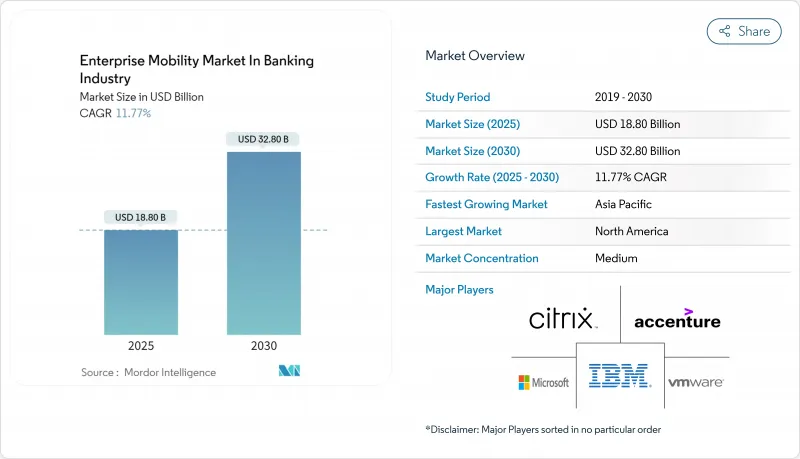
本報告按元件(解決方案、服務)、解決方案類型(裝置管理、存取管理、應用程式管理等)、部署方式(本地部署/混合部署、雲端原生)、裝置類型(筆記型電腦等)、企業規模(大型銀行、中小型銀行)和地區進行細分。市場預測以美元計價。
銀行業企業移動市場趨勢及洞察。
監理機關推動零信任端點安全
目前,全球監管機構正在密切關注銀行能否即時檢驗所有用戶到設備的請求。美國聯邦金融機構檢查委員會 (FFIEC) 發布了 2024 年指南,強制要求持續進行身份驗證和設備健康檢查。同時,新加坡金融管理局 (MAS) 在其《技術風險管理指南》中要求生物識別控制。這些法規推動了整合終端和存取管理方面的支出增加,因為不遵守這些法規將面臨執法行動、罰款和聲譽損害的風險。擁有符合審計要求的儀錶板並符合 ISO/IEC 27001:2022 標準的供應商在採購中受到優先考慮。儘管監管日益嚴格,銀行業在企業行動市場仍獲得了穩定的預算撥款,而一些非強制性項目則被擱置。
遷移到雲端原生核心和 API 優先平台
逐步淘汰基於 COBOL 的核心系統的銀行在發布速度方面獲得了優勢。麥肯錫 2024 年的一項研究表明,遷移到雲端原生核心系統可以將新行動功能的上市時間縮短 40% 至 60%。開放 API 可以促進嵌入式金融夥伴關係,但這也會擴大攻擊面,促使人們採用執行時間應用程式自保護工具來檢查 API 呼叫。容器化的行動應用程式管理使銀行能夠即時發布更新,而無需用戶互動。歐洲銀行管理局 (EBA) 等監管機構在支付服務指示 2 (PSD2) 下強制要求所有行動交易都必須進行強客戶身份驗證,從而推動了這一趨勢。
多UEM堆疊中總擁有成本(TCO)增加
德勤2024年的一項分析發現,營運三種或以上終端管理工具的銀行面臨30%至40%的額外成本,同時由於策略不一致,其安全態勢也出現下滑。儘管技術上可以實現整合,但由於每個業務部門都堅持使用其偏好的功能,因此會帶來組織上的複雜性。成本壓力迫使金融機構延後採用諸如私有5G切片等高階功能,減緩了銀行業企業行動市場的整體成長速度。
細分市場分析
預計到2024年,解決方案將佔總收入的70.22%,其中整合端點管理、行動威脅防護以及識別及存取管理套件是主要組成部分。然而,服務板塊預計將以12.22%的複合年成長率成長,這表明整合和全天候監控的重要性正在超越單純的軟體部署。Accenture和塔塔諮詢服務公司(TCS)等系統整合商正在獲得多年期契約,幫助銀行遷移到零信任框架。諮詢需求的激增凸顯了銀行業企業行動市場服務板塊的規模如何與初始軟體投資形成互補。
不同司法管轄區的監管差異正在推動對諮詢服務的需求,而基於使用量的雲端定價模式則將軟體和服務整合到單一訂閱中。銀行更傾向於選擇打包式合規框架,以降低審計成本並加快運作。因此,銀行業企業行動市場正經歷利潤來源從許可證到託管服務的持續轉變。
預計到2024年,設備管理將佔總收入的42.45%,這反映了企業設備的傳統配置模式。然而,在自帶設備辦公室(BYOD)策略日益普及的推動下,應用管理預計將以14.25%的複合年成長率成長。容器化區域即使在設備遭到入侵的情況下也能隔離銀行數據,而應用級VPN則降低了使用門檻。這種能力使金融機構能夠同時滿足用戶隱私和監管要求。因此,在銀行業企業行動市場中,分配給容器解決方案的規模成長速度超過了基礎統一端點管理(UEM)配置。
存取管理領域的同步成長主要得益於零信任規則。生物識別登入和行為分析正在取代易受網路釣魚攻擊的密碼。供應商正在將行動威脅防護和安全瀏覽器整合到統一的控制面板中,這項策略簡化了安全中心的運營,並增強了其在銀行業企業行動市場中的價值提案。
區域分析
預計到2024年,北美地區的收入將佔全球總收入的36.07%,這主要得益於聯邦金融機構審查委員會(FFIEC)的指導意見以及零信任原則的早期應用。鑑於聯邦調查局(FBI)的建議強調了有組織犯罪利用簡訊作為誘餌的風險,區域銀行正在大力投資網路釣魚檢測。加拿大和墨西哥的金融機構也積極採用生物識別和行動平台來實現其普惠金融目標。
預計到2030年,亞太地區的複合年成長率將達到12.9%。新加坡、印度和中國正在大力推動數位銀行牌照發放、即時支付基礎設施建設以及國有行動作業系統開發。普華永道的報告顯示,為了滿足對延遲敏感的應用需求,銀行分店部署專用5G網路的趨勢正在增強。日本、韓國和澳洲正在升級其行動安全架構,以滿足網路安全標準。同時,印尼和越南正在大規模地用行動優先平台取代其傳統的核心系統。
在PSD2和《數位營運彈性法案》的框架下,歐洲維持顯著的市場佔有率。在拉丁美洲,巴西和墨西哥正加速推動開放銀行的強制實施;而在中東和非洲,在主權財富基金的資金籌措下,各國正在推動主導的雲端終端部署。這些趨勢共同擴大了銀行業企業行動市場的全球影響力。
其他好處:
- Excel格式的市場預測(ME)表
- 3個月的分析師支持
目錄
第1章:引言
- 市場分析與定義的前提條件
- 分析範圍
第2章 分析方法
第3章執行摘要
第4章 市場狀況
- 市場概覽
- 市場促進因素
- 銀行員工遠距/混合辦公人數增加
- 遷移到雲端原生核心和 API 優先平台
- 監理機關推動零信任端點安全
- 在分店和資料中心部署 5G-SA 和專用無線網路
- 即時、即時支付和嵌入式金融工作流程的成長
- 消費者行動網路釣魚的激增使得採用應用程式內即時最佳化 (RASP) 策略勢在必行。
- 市場限制因素
- 多UEM堆疊中總擁有成本(TCO)增加
- 行動安全和DevSecOps人才短缺
- 終端使用者對設備和內容管理的抗拒情緒
- 技術預算的宏觀經濟削減
- 產業價值鏈/供應鏈分析
- 宏觀經濟因素對市場的影響
- 監理情勢
- 技術展望
- 波特五力分析
第5章:預測市場規模與成長率
- 按組件
- 解決方案
- 服務
- 按溶液類型
- 設備管理
- 存取管理
- 應用程式管理
- 其他類型的解決方案
- 透過部署方法
- 本地部署/混合部署
- 雲端原生
- 依設備類型
- 筆記型電腦
- 智慧型手機和平板電腦
- 其他設備類型
- 按公司規模
- 主要銀行
- 中小型銀行
- 按地區
- 北美洲
- 美國
- 加拿大
- 墨西哥
- 南美洲
- 巴西
- 阿根廷
- 智利
- 其他南美國家
- 歐洲
- 英國
- 德國
- 法國
- 義大利
- 西班牙
- 其他歐洲國家
- 亞太地區
- 中國
- 日本
- 印度
- 韓國
- 澳洲和紐西蘭
- 其他亞太國家
- 中東和非洲
- 中東
- 阿拉伯聯合大公國
- 沙烏地阿拉伯
- 土耳其
- 其他中東國家
- 非洲
- 南非
- 肯亞
- 奈及利亞
- 其他非洲國家
- 中東
- 北美洲
第6章 競爭情勢
- 市場集中度
- 策略趨勢
- 市佔率分析
- 公司簡介
- Microsoft Corporation
- VMware Inc.
- BlackBerry Limited
- IBM Corporation
- Citrix Systems Inc.
- Accenture plc
- Infosys Limited
- HCL Technologies Limited
- Tata Consultancy Services Limited
- Capgemini SE
- Cisco Systems Inc.
- Samsung Electronics Co. Ltd.
- Jamf Holding Corp.
- Ivanti Inc.
- SOTI Inc.
- Sophos Ltd.
- Palo Alto Networks Inc.
- Broadcom Inc.(Workspace ONE)
- Oracle Corporation
- AT&T Inc.(Managed Mobility)
第7章 市場機會與未來展望
According to Mordor Intelligence, the enterprise mobility market in Banking Industry is expected to grow from USD 18.80 billion in 2025 to USD 32.80 billion by 2030, at a CAGR of 11.77% during the forecast period (2025-2030).
This report is Segmented by Component (Solutions, and Services), Solution Type (Device Management, Access Management, Application Management, and More), Deployment (On-Premises/Hybrid, and Cloud-Native), Device Type (Laptops, and More), Enterprise Size (Large Banks, and Small and Mid-Size Banks), and Geography. The Market Forecasts are Provided in Terms of Value (USD).
Insights and Trends of Enterprise Mobility Market in Banking Industry
Regulatory Push for Zero-Trust Endpoint Security
Supervisors worldwide now examine whether banks can verify every user-to-device request in real time. The U.S. Federal Financial Institutions Examination Council issued 2024 guidance that requires continuous authentication and device-health checks, while the Monetary Authority of Singapore demands biometric controls in its Technology Risk Management Guidelines. These rules elevate unified endpoint management and access-management spending, because failure to comply risks enforcement, fines, and reputational loss. Vendors with audit-ready dashboards and ISO/IEC 27001:2022 alignment command procurement preference. As mandates tighten, the enterprise mobility market in banking industry witnesses steady budget allocation even when discretionary projects pause.
Shift to Cloud-Native Core and API-First Platforms
Banks retiring COBOL-based cores gain release velocity advantages: a 2024 McKinsey study showed 40-60% faster time-to-market for new mobile features once moved to cloud-native cores. API-exposed logic enables embedded-finance partnerships but widens the attack surface, prompting adoption of runtime application self-protection tools that inspect API calls. Containerized mobile-application management lets banks push updates instantly without user action. Regulatory bodies, such as the European Banking Authority under PSD2, reinforce the trend by mandating strong customer authentication for every mobile transaction.
Rising Cost-of-Ownership for Multi-UEM Stacks
A 2024 Deloitte analysis found banks running three or more endpoint-management tools spend 30-40% more yet score worse on security posture due to policy inconsistencies. Consolidation is technologically feasible but politically complex as business units guard preferred features. Cost pressure forces institutions to delay advanced capabilities like private-5G slicing, slowing the overall enterprise mobility market in banking industry trajectory.
Other drivers and restraints analyzed in the detailed report include:
- Rising Remote and Hybrid Banking Workforce
- Growth of Instant Real-Time Payments and Embedded Finance Workflows
- Macroeconomic Tech-Budget Compression
For complete list of drivers and restraints, kindly check the Table Of Contents.
Segment Analysis
Solutions held 70.22% revenue in 2024, mainly unified endpoint management, mobile-threat defense, and identity-access suites. Yet services are predicted to grow at a 12.22% CAGR, indicating that integration and 24-hour monitoring trump pure software installations. Systems integrators such as Accenture and Tata Consultancy Services win multi-year contracts to migrate banks to zero-trust frameworks. This consultancy surge underscores how the enterprise mobility market in banking industry size for services complements the initial software outlay.
Regulatory divergence across jurisdictions fuels demand for advisory offerings, while consumption-based cloud pricing merges software and services into a single subscription. Banks prefer packaged compliance frameworks that reduce audit costs and accelerate go-live. As a result, the enterprise mobility market in banking industry continually shifts margin pools from licenses to managed services.
Device management captured 42.45% revenue in 2024, reflecting legacy provisioning of corporate devices. However, application management is forecast to expand at 14.25% CAGR, propelled by bring-your-own-device policies. Containerized enclaves isolate banking data even if the device is compromised, and app-level VPNs reduce friction. This capability allows institutions to satisfy both user privacy and regulator scrutiny. The enterprise mobility market in banking industry size allocated to container solutions is therefore rising faster than base UEM provisioning.
Concurrent growth in access-management stems from zero-trust rules. Biometric logins and behavioral analytics replace passwords prone to phishing. Vendors combine mobile-threat defense and secure browsers into unified dashboards, a strategy that simplifies operations for security centers and strengthens the enterprise mobility market in banking industry market value proposition.
Complete Report Scope:
- By Component
- Solutions
- Services
- By Solution Type
- Device Management
- Access Management
- Application Management
- Other Solution Types
- By Deployment
- On-Premises / Hybrid
- Cloud-Native
- By Device Type
- Laptops
- Smartphones and Tablets
- Other Device Types
- By Enterprise Size
- Large Banks
- Small and Mid-size Banks
- By Geography
- North America
- United States
- Canada
- Mexico
- South America
- Brazil
- Argentina
- Chile
- Rest of South America
- Europe
- United Kingdom
- Germany
- France
- Italy
- Spain
- Rest of Europe
- Asia-Pacific
- China
- Japan
- India
- South Korea
- Australia and New Zealand
- Rest of Asia-Pacific
- Middle East and Africa
- Middle East
- United Arab Emirates
- Saudi Arabia
- Turkey
- Rest of Middle East
- Africa
- South Africa
- Kenya
- Nigeria
- Rest of Africa
- Middle East
- North America
Geography Analysis
North America held 36.07% revenue in 2024, shaped by FFIEC guidance and early zero-trust adoption. Regional banks invest heavily in phishing detection after an FBI advisory highlighted organized crime using SMS lures. Canadian and Mexican institutions likewise deploy biometrics and mobile platforms for inclusion goals.
Asia Pacific is set to record a 12.9% CAGR to 2030. Singapore, India, and China champion digital-banking licenses, real-time payment rails, and sovereign mobile operating systems. PwC reports rising deployment of private 5 G networks in branches for latency-sensitive applications. Japan, South Korea, and Australia upgrade mobile-security stacks to meet cybersecurity codes, while Indonesia and Vietnam leapfrog legacy cores with mobile-first platforms.
Europe maintains a sizable share under PSD2 and the Digital Operational Resilience Act. Latin America accelerates on open-banking mandates in Brazil and Mexico, whereas the Middle East and Africa deploy sovereign-cloud endpoints backed by wealth-fund financing. Together, these developments extend the enterprise mobility in the banking market footprint worldwide.
- Microsoft Corporation
- VMware Inc.
- BlackBerry Limited
- IBM Corporation
- Citrix Systems Inc.
- Accenture plc
- Infosys Limited
- HCL Technologies Limited
- Tata Consultancy Services Limited
- Capgemini SE
- Cisco Systems Inc.
- Samsung Electronics Co. Ltd.
- Jamf Holding Corp.
- Ivanti Inc.
- SOTI Inc.
- Sophos Ltd.
- Palo Alto Networks Inc.
- Broadcom Inc. (Workspace ONE)
- Oracle Corporation
- AT&T Inc. (Managed Mobility)
Additional Benefits:
- The market estimate (ME) sheet in Excel format
- 3 months of analyst support
TABLE OF CONTENTS
1 INTRODUCTION
- 1.1 Study Assumptions and Market Definition
- 1.2 Scope of the Study
2 RESEARCH METHODOLOGY
3 EXECUTIVE SUMMARY
4 MARKET LANDSCAPE
- 4.1 Market Overview
- 4.2 Market Drivers
- 4.2.1 Rising Remote and Hybrid Banking Workforce
- 4.2.2 Shift to Cloud-Native Core and API-First Platforms
- 4.2.3 Regulatory Push for Zero-Trust Endpoint Security
- 4.2.4 5G-SA and Private-Wireless Roll-outs in Branch and Data Center
- 4.2.5 Growth of Instant Real-Time Payments and Embedded Finance Workflows
- 4.2.6 Consumer Mobile-Phishing Surge Forcing In-App RASP Adoption
- 4.3 Market Restraints
- 4.3.1 Rising Cost-of-Ownership for Multi-UEM Stacks
- 4.3.2 Scarcity of Mobile-Security and Dev-Sec-Ops Talent
- 4.3.3 End-User Resistance to Device / Content Controls
- 4.3.4 Macroeconomic Tech-Budget Compression
- 4.4 Industry Value / Supply-Chain Analysis
- 4.5 Impact of Macroeconomic Factors on the Market
- 4.6 Regulatory Landscape
- 4.7 Technological Outlook
- 4.8 Porter's Five Forces Analysis
- 4.8.1 Bargaining Power of Suppliers
- 4.8.2 Bargaining Power of Consumers
- 4.8.3 Threat of New Entrants
- 4.8.4 Intensity of Competitive Rivalry
- 4.8.5 Threat of Substitute Products
5 MARKET SIZE AND GROWTH FORECASTS (VALUE)
- 5.1 By Component
- 5.1.1 Solutions
- 5.1.2 Services
- 5.2 By Solution Type
- 5.2.1 Device Management
- 5.2.2 Access Management
- 5.2.3 Application Management
- 5.2.4 Other Solution Types
- 5.3 By Deployment
- 5.3.1 On-Premises / Hybrid
- 5.3.2 Cloud-Native
- 5.4 By Device Type
- 5.4.1 Laptops
- 5.4.2 Smartphones and Tablets
- 5.4.3 Other Device Types
- 5.5 By Enterprise Size
- 5.5.1 Large Banks
- 5.5.2 Small and Mid-size Banks
- 5.6 By Geography
- 5.6.1 North America
- 5.6.1.1 United States
- 5.6.1.2 Canada
- 5.6.1.3 Mexico
- 5.6.2 South America
- 5.6.2.1 Brazil
- 5.6.2.2 Argentina
- 5.6.2.3 Chile
- 5.6.2.4 Rest of South America
- 5.6.3 Europe
- 5.6.3.1 United Kingdom
- 5.6.3.2 Germany
- 5.6.3.3 France
- 5.6.3.4 Italy
- 5.6.3.5 Spain
- 5.6.3.6 Rest of Europe
- 5.6.4 Asia-Pacific
- 5.6.4.1 China
- 5.6.4.2 Japan
- 5.6.4.3 India
- 5.6.4.4 South Korea
- 5.6.4.5 Australia and New Zealand
- 5.6.4.6 Rest of Asia-Pacific
- 5.6.5 Middle East and Africa
- 5.6.5.1 Middle East
- 5.6.5.1.1 United Arab Emirates
- 5.6.5.1.2 Saudi Arabia
- 5.6.5.1.3 Turkey
- 5.6.5.1.4 Rest of Middle East
- 5.6.5.2 Africa
- 5.6.5.2.1 South Africa
- 5.6.5.2.2 Kenya
- 5.6.5.2.3 Nigeria
- 5.6.5.2.4 Rest of Africa
- 5.6.5.1 Middle East
- 5.6.1 North America
6 COMPETITIVE LANDSCAPE
- 6.1 Market Concentration
- 6.2 Strategic Moves
- 6.3 Market Share Analysis
- 6.4 Company Profiles (includes Global-level Overview, Market-level Overview, Core Segments, Financials as available, Strategic Information, Market Rank / Share for key companies, Products and Services, and Recent Developments)
- 6.4.1 Microsoft Corporation
- 6.4.2 VMware Inc.
- 6.4.3 BlackBerry Limited
- 6.4.4 IBM Corporation
- 6.4.5 Citrix Systems Inc.
- 6.4.6 Accenture plc
- 6.4.7 Infosys Limited
- 6.4.8 HCL Technologies Limited
- 6.4.9 Tata Consultancy Services Limited
- 6.4.10 Capgemini SE
- 6.4.11 Cisco Systems Inc.
- 6.4.12 Samsung Electronics Co. Ltd.
- 6.4.13 Jamf Holding Corp.
- 6.4.14 Ivanti Inc.
- 6.4.15 SOTI Inc.
- 6.4.16 Sophos Ltd.
- 6.4.17 Palo Alto Networks Inc.
- 6.4.18 Broadcom Inc. (Workspace ONE)
- 6.4.19 Oracle Corporation
- 6.4.20 AT&T Inc. (Managed Mobility)
7 MARKET OPPORTUNITIES AND FUTURE OUTLOOK
- 7.1 White-space and Unmet-Need Assessment

 企業行動管理:市場佔有率分析、產業趨勢與統計、成長預測(2026-2031)企業行動安全:市場佔有率分析、產業趨勢與統計、成長預測(2026-2031 年)
 企業行動管理市場:依組件、作業系統、部署模式、產業和組織規模分類-2026-2032年全球市場預測製造業中的統一端點管理 (UEM):市場佔有率分析、產業趨勢與統計資料、成長預測 (2026-2031)醫療保健領域的統一端點管理 (UEM):市場佔有率分析、行業趨勢和統計數據以及成長預測 (2026-2031)
 企業行動管理 (EMM) 市場機會、成長要素、產業趨勢分析及 2026-2035 年預測
 住宅旅遊服務市場預測-按服務類型、交通方式、平台類型、應用、最終用戶和地區分類的全球分析搬遷與調動管理軟體:市場佔有率分析、產業趨勢與統計、成長預測(2026-2031)
 企業行動服務市場規模、佔有率和成長分析:按組件、部署類型、組織規模、設備類型、應用和地區分類-2026-2033年產業預測
 企業行動管理 (EMM) 市場:按解決方案類型、部署模式、企業規模、最終用戶產業和地區分類