


 |
市場調查報告書
商品編碼
2122164
企業行動安全:市場佔有率分析、產業趨勢與統計、成長預測(2026-2031 年)Enterprise Mobility Security - Market Share Analysis, Industry Trends & Statistics, Growth Forecasts (2026 - 2031) |
||||||

※ 本網頁內容可能與最新版本有所差異。詳細情況請與我們聯繫。
據 Mordor Intelligence 稱,企業行動安全市場預計到 2026 年價值 51.4 億美元,高於 2025 年的 45.9 億美元,預計到 2031 年將達到 90.2 億美元。
預計 2026 年至 2031 年的複合年成長率為 11.94%。
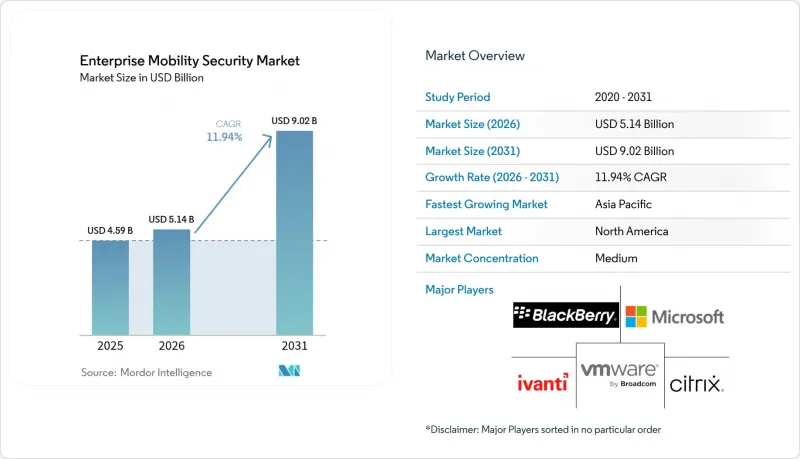
本報告按裝置類型(智慧型手機、筆記型電腦等)、部署模式(本地部署、雲端部署、混合部署)、安全類型(行動裝置管理、行動威脅防禦等)、組織規模(中小企業、大型企業)、最終用戶(金融、保險、證券、醫療保健等)和地區進行細分。市場預測以美元計價。
全球企業行動安全市場趨勢與洞察
自備設備辦公 (BYOD) 和遠距辦公的普及。
隨著混合辦公模式的普及,員工自備智慧型手機逐漸成為企業核心資產,但只有不到40%的企業對個人和業務資料進行容器化管理。 Okta的研究顯示,2025年1月,企業應用的身份驗證試驗有63%來自未經管理的行動設備,高於2023年的48%。專業服務人員經常在同一台裝置上切換消費者通訊應用程式和客戶關係管理(CRM)應用,這大大增加了他們遭受網路釣魚攻擊的風險。 Palo Alto Networks的報告顯示,2024年上半年針對遠距辦公人員的行動網路釣魚攻擊年增了74%。雖然GDPR和HIPAA等法規結構規定了資料外洩的責任,但它們在保護自帶設備辦公室(BYOD)環境方面提供的指南卻很少,迫使企業依賴供應商提供的特定控制措施。
行動網路威脅情勢日益惡化
勒索軟體、銀行木馬和語音釣魚攻擊如今正針對特定產業。 Lookout 報告稱,2024 年共識別出 370 萬個不同的惡意軟體樣本,年增 58%,並發現 22% 的企業設備至少遭遇過一次嚴重威脅。 Zimperium 報告稱,銀行業語音釣魚事件增加了 86%,此類攻擊通常與 SIM 卡交換相結合,以攔截動態密碼。蘋果在 2024 年披露了 14 個 iOS 零日漏洞,谷歌也修復了 Android 系統中的 11 個根級漏洞,這表明跨平台都存在風險。生成式人工智慧技術使惡意訊息具有上下文關聯性,從而提高點擊率,並進一步縮短防禦者的回應時間。
與傳統IT架構整合的複雜性
同時使用本機 Active Directory 和雲端身分提供者的組織正面臨著長達數年的遷移過程。思科的一項研究表明,54% 的大型企業在將傳統目錄與基於雲端的統一端點管理 (UEM) 整合時會遇到身份驗證錯誤,這需要使用高延遲中間件。 VMware 的一項研究發現,41% 的安全存取服務邊緣 (SASE) 試點部署由於依賴硬編碼 VPN 而停滯不前。以大型主機為中心的 BFSI(銀行、金融和保險)公司缺乏即時行動策略更新的 API,導致 24 小時的同步延遲,安全漏洞無法解決。
細分市場分析
2025年,穿戴式裝置的市佔率較小,但預計到2031年將以每年14.54%的速度成長,超過智慧型手機、筆記型電腦和平板電腦。 「三星穿戴裝置版Knox」於2024年4月發布,允許管理員加密用於存取電子健康記錄的智慧型手錶,並遠端擦除數據,從而滿足HIPAA合規性要求。Honeywell強大的掃描器與VMware Workspace ONE結合使用,可實現基於角色的存取控制,以防止製造環境中的未經授權操作。 2025年,由於自備設備辦公室(BYOD)的興起,智慧型手機仍保持47.65%的設備銷售佔有率,但隨著已開發市場接近飽和,其成長曲線預計將趨於平緩。
穿戴式裝置的普及正在擴大安全威脅的範圍。 2024年,Lookout在一款熱門健身追蹤器的韌體中發現了14個可利用的漏洞。美國食品藥物管理局(FDA)目前正在製定穿戴式醫療設備網路安全指南草案,但該指南要到2027年才會全面實施,這意味著在長達數年的時間內,創新速度將超過監管速度。為了彌補這一差距,供應商正競相開發空中下載(OTA)韌體更新機制。
隨著企業將工作負載分散到託管的本地環境和可擴展的公共雲端之間,混合架構的複合年成長率 (CAGR) 達到了 13.98%。阿拉伯聯合大公國的資料保護法禁止未經同意跨境傳輸公民數據,這促使企業部署本地整合的端點管理伺服器,同時利用全球威脅情報來源。到 2025 年,雲端採用率將達到 60.92%,這主要得益於訂閱制的 Intune、Workspace ONE Cloud 和 Ivanti Neurons 等雲端服務的支援。邊緣運算正在成為第三大支柱,它利用思科的邊緣原生模組,使企業能夠在工廠中使用延遲低於 80 毫秒的加強型平板電腦來執行策略。
隨著人才庫萎縮,本地部署環境的比例預計將會下降,但對於依賴空氣間隙防禦網路或大型主機的金融機構而言,本地部署環境可能仍將持續存在。供應商目前提案遷移工具包,可以將傳統策略複製到雲端主機,以簡化過渡過程。
區域分析
預計到2025年,北美將佔全球銷售額的37.70%,這主要得益於HIPAA的嚴格執行,該法規促使醫療服務提供者採用整合端點管理。美國聯邦政府的一項指令要求所有政府設備在2024年12月前部署移動式威脅防禦系統,這導致對Lookout、Zimperium和CrowdStrike等公司的採購需求激增。加拿大PIPEDA修正案將資料外洩通知法規擴展到行動端點,而墨西哥金融科技的快速發展也推動了銀行木馬偵測的需求。企業行動安全市場正經歷穩定成長,而非爆發性成長,因為財富1000強企業已經廣泛採用行動安全解決方案。
亞太地區預計到2031年複合年成長率將達到15.45%。這主要得益於印度和印尼的數位銀行舉措,這些舉措將使數百萬銀行帳戶服務的公民能夠獲得線上服務。印度儲備銀行的指導方針強制要求行動交易進行設備綁定和多因素身份驗證,從而加速了國有金融機構採用整合終端解決方案。中國的《資料在地化法》有利於華為等國內廠商,而日本的《域外隱私法》則強制要求外國SaaS供應商保護日本公民行動裝置上的資料。根據澳洲的資料外洩報告機制,2024年19%的資料外洩事件與行動終端相關,凸顯了實施相關措施的迫切性。
在歐洲,2024年10月通過的《網路與資訊安全指令2》加強了監管力度,該指令強制要求電信業者和雲端服務供應商收集即時行動遙測資料。 2024年,根據《資訊安全局(BSI)現已強制要求關鍵基礎設施領域採用整合端點管理,並達到評估保證等級4(EAL4)認證標準。英國國家網路安全中心(NCSC)正在推動向「零信任」行動架構轉型,以確保持續的安全監控。在中東,各國已實施主權雲端法律,強制使用國內伺服器;沙烏地阿拉伯的《基本網路安全控制》要求所有政府終端在2025年底前實施行動終端資料(MTD)。南美洲的商業機會集中在巴西和阿根廷,但預算限制限制了MTD的廣泛應用。
其他好處:
- Excel格式的市場預測(ME)表
- 3個月的分析師支持
目錄
第1章:引言
- 研究的先決條件
- 調查範圍
第2章:調查方法
第3章執行摘要
第4章 市場狀況
- 市場概覽
- 市場促進因素
- 自備設備辦公 (BYOD) 和遠距辦公的普及
- 行動網路威脅情勢日益惡化
- 中小企業「雲端優先」採用
- 更嚴格的合規要求(GDPR、HIPAA、PCI-DSS)
- 行動終端零信任架構的整合
- 高度監管產業對安全行動 DevOps 管線的需求
- 市場限制因素
- 與傳統IT架構整合的複雜性
- 中型企業的預算限制
- 行動安全專家短缺
- 全球各地監管要求各不相同
- 產業價值鏈分析
- 監理情勢
- 技術展望
- 宏觀經濟因素的影響
- 波特五力分析
第5章 市場規模與成長預測
- 透過裝置
- 智慧型手機
- 筆記型電腦
- 藥片
- 穿戴式裝置
- 按部署模式
- 現場
- 雲
- 混合
- 按安全類型
- 行動裝置管理 (MDM)
- 行動應用程式管理(MAM)
- 移動威脅防禦 (MTD)
- 統一端點管理 (UEM)
- 行動身分和存取管理
- 按組織規模
- 小型企業
- 大公司
- 最終用戶
- 銀行和保險
- 衛生保健
- 資訊科技/通訊
- 政府
- 零售與電子商務
- 製造業
- 其他最終用戶
- 按地區
- 北美洲
- 美國
- 加拿大
- 墨西哥
- 南美洲
- 巴西
- 阿根廷
- 其他南美國家
- 歐洲
- 英國
- 德國
- 法國
- 西班牙
- 義大利
- 其他歐洲國家
- 亞太地區
- 中國
- 印度
- 日本
- 澳洲
- 韓國
- 其他亞太國家
- 中東和非洲
- 中東
- 沙烏地阿拉伯
- 阿拉伯聯合大公國
- 土耳其
- 其他中東國家
- 非洲
- 南非
- 肯亞
- 其他非洲國家
- 中東
- 北美洲
第6章 競爭情勢
- 市場集中度
- 策略趨勢
- 市佔率分析
- 公司簡介
- BlackBerry Limited
- Ivanti Inc.(MobileIron)
- VMware Inc.
- Citrix Systems Inc.
- Microsoft Corporation
- Cisco Systems Inc.
- McAfee LLC
- Broadcom Inc.(Symantec Enterprise)
- SAP SE
- Oracle Corporation
- Honeywell International Inc.
- International Business Machines Corporation
- Check Point Software Technologies Ltd.
- Trend Micro Incorporated
- Sophos Group plc
- Dell Technologies Inc.
- Samsung Electronics Co. Ltd.
- Google LLC
- Lookout Inc.
- Zimperium Inc.
第7章 市場機會與未來展望
According to Mordor Intelligence, enterprise mobility security market size in 2026 is estimated at USD 5.14 billion, growing from 2025 value of USD 4.59 billion with 2031 projections showing USD 9.02 billion, growing at 11.94% CAGR over 2026-2031.
This report is Segmented by Device (Smartphones, Laptops, and More), Deployment Model (On-Premises, Cloud, and Hybrid), Security Type (Mobile Device Management, Mobile Threat Defense, and More), Organization Size (Small and Medium Enterprises, and Large Enterprises), End-User (BFSI, Healthcare, and More), and Geography. The Market Forecasts are Provided in Terms of Value (USD).
Global Enterprise Mobility Security Market Trends and Insights
BYOD and Remote-Work Proliferation
Permanent hybrid-work policies transform employee-owned smartphones into core corporate assets, yet fewer than 40% of organizations containerize personal and business data. Okta observed that 63% of authentication attempts to enterprise applications in January 2025 came from unmanaged mobile devices, up from 48% in 2023. Professional-services employees frequently toggle between consumer messaging and customer-relationship-management apps on the same handset, maximizing phishing exposure. Palo Alto Networks logged a 74% year-over-year rise in mobile phishing targeting remote staff during 1H 2024. Regulatory frameworks such as GDPR and HIPAA impose breach liability but offer scant prescriptive guidance for securing BYOD environments, compelling enterprises to stitch together vendor-specific controls.
Escalating Mobile Cyber-Threat Landscape
Ransomware, banking trojans, and vishing attacks now aim at specific verticals. Lookout identified 3.7 million distinct malware samples in 2024, a 58% increase over the prior year, and found that 22% of enterprise devices encountered at least one high-severity threat. Zimperium reported an 86% rise in voice-phishing events in the banking sector, frequently paired with SIM-swapping to intercept one-time passwords. Apple disclosed 14 exploited iOS zero-days in 2024, while Google patched 11 root-level Android flaws, demonstrating platform-agnostic risk. Generative-AI techniques make malicious messages context-aware, lifting click-through rates and compressing defenders' reaction windows.
Integration Complexity with Legacy IT Stacks
Organizations running on-premises Active Directory alongside cloud identity providers face multi-year migration paths. Cisco recorded that 54% of large enterprises see authentication failures when federating legacy directories with cloud-based unified endpoint management, necessitating latency-heavy middleware. VMware found 41% of Secure Access Service Edge pilots stall over hard-coded VPN dependencies. Mainframe-centric BFSI firms lack APIs for instant mobile policy updates, pushing synchronization lags to 24 hours and leaving exposure windows open.
Other drivers and restraints analyzed in the detailed report include:
- Cloud-First Adoption Among SMEs
- Tightening Compliance Mandates
- Budget Constraints for Mid-Sized Enterprises
For complete list of drivers and restraints, kindly check the Table Of Contents.
Segment Analysis
Wearables contributed a modest slice in 2025 but are forecast to expand at 14.54% annually through 2031, outpacing smartphones, laptops, and tablets. Samsung Knox for Wearables, launched April 2024, lets administrators encrypt and remotely wipe smartwatches used to access electronic health records, tackling HIPAA compliance needs. Honeywell's rugged scanners integrate with VMware Workspace ONE to enforce role-based access, curbing unauthorized shop-floor actions. Smartphones retained 47.65% of device revenue in 2025 owing to BYOD ubiquity, yet their growth curve is flattening as saturation nears in developed markets.
The shift to wearables enlarges the threat surface. Lookout found 14 exploitable flaws in popular fitness-tracker firmware during 2024. Draft U.S. FDA guidance on wearable medical-device cybersecurity will not fully apply until 2027, leaving a multi-year gap wherein innovation outruns regulation. Vendors are rushing firmware-over-the-air update mechanisms to close that gap.
Hybrid architectures are tracking a 13.98% CAGR as enterprises partition workloads between sovereign on-premises enclaves and scalable public clouds. The UAE's Data Protection Law bars cross-border citizen-data transfers without consent, forcing local unified endpoint management servers while still tapping global threat-intelligence feeds. Cloud deployments commanded 60.92% in 2025, buoyed by subscription-based Intune, Workspace ONE Cloud, and Ivanti Neurons. Edge computing is surfacing as a third pillar, enabling factories to enforce policies on rugged tablets with <80 ms latency using Cisco edge-native modules.
On-premises footprints will decline as talent pools shrink, yet they endure in air-gapped defense networks and mainframe-reliant financial institutions. Vendors now pitch migration toolkits that replicate legacy policies in cloud consoles to ease the transition.
Complete Report Scope:
- By Device
- Smartphones
- Laptops
- Tablets
- Wearables
- By Deployment Model
- On-Premises
- Cloud
- Hybrid
- By Security Type
- Mobile Device Management (MDM)
- Mobile Application Management (MAM)
- Mobile Threat Defense (MTD)
- Unified Endpoint Management (UEM)
- Identity and Access Management for Mobility
- By Organization Size
- Small and Medium Enterprises
- Large Enterprises
- By End-User
- Banking and Insurance
- Healthcare
- IT and Telecom
- Government
- Retail and eCommerce
- Manufacturing
- Other End-User
- By Geography
- North America
- United States
- Canada
- Mexico
- South America
- Brazil
- Argentina
- Rest of South America
- Europe
- United Kingdom
- Germany
- France
- Spain
- Italy
- Rest of Europe
- Asia Pacific
- China
- India
- Japan
- Australia
- South Korea
- Rest of Asia-Pacific
- Middle East and Africa
- Middle East
- Saudi Arabia
- United Arab Emirates
- Turkey
- Rest of Middle East
- Africa
- South Africa
- Kenya
- Rest of Africa
- Middle East
- North America
Geography Analysis
North America generated 37.70% of 2025 revenue, driven by strict HIPAA enforcement that prompted healthcare providers to adopt unified endpoint management. A U.S. federal directive required Mobile Threat Defense on all government devices by December 2024, unlocking a procurement wave for Lookout, Zimperium, and CrowdStrike. Canada's PIPEDA amendment extended breach-notification rules to mobile endpoints, while Mexico's fintech boom is spurring demand for banking-trojan detection. Growth is steadier than spectacular because the Enterprise Mobility Security market has reached deep deployment levels across Fortune 1000 firms.
The Asia Pacific is projected to have a 15.45% CAGR through 2031, as digital-banking initiatives in India and Indonesia bring millions of unbanked citizens online. Reserve Bank of India guidelines mandate device binding and multi-factor authentication for mobile transactions, driving unified endpoint rollouts at state-owned lenders. China's data-localization laws favor domestic vendors, such as Huawei, while Japan's extraterritorial privacy statutes oblige foreign SaaS providers to secure the data of Japanese citizens on mobile devices. Australia's Notifiable Data Breaches scheme reported that 19% of 2024 incidents involved mobile endpoints, reinforcing purchasing urgency.
Europe tightened oversight via the Network and Information Security Directive 2 in October 2024, obliging telecom operators and clouds to ingest real-time mobile telemetry. GDPR fine volume reached EUR 1.2 billion in 2024, 18% tied to inadequate mobile safeguards. Germany's BSI now requires Evaluation Assurance Level 4-certified unified endpoint management in critical infrastructure sectors. The United Kingdom's NCSC is steering agencies toward Zero-Trust mobile architectures that enforce continuous posture checks. Middle-East jurisdictions impose sovereign-cloud laws that necessitate local servers, while Saudi Arabia's Essential Cybersecurity Controls demand MTD across government devices by end-2025. South America's opportunity concentrates in Brazil and Argentina, though budget pressures cap widespread rollouts.
- BlackBerry Limited
- Ivanti Inc. (MobileIron)
- VMware Inc.
- Citrix Systems Inc.
- Microsoft Corporation
- Cisco Systems Inc.
- McAfee LLC
- Broadcom Inc. (Symantec Enterprise)
- SAP SE
- Oracle Corporation
- Honeywell International Inc.
- International Business Machines Corporation
- Check Point Software Technologies Ltd.
- Trend Micro Incorporated
- Sophos Group plc
- Dell Technologies Inc.
- Samsung Electronics Co. Ltd.
- Google LLC
- Lookout Inc.
- Zimperium Inc.
Additional Benefits:
- The market estimate (ME) sheet in Excel format
- 3 months of analyst support
TABLE OF CONTENTS
1 INTRODUCTION
- 1.1 Study Assumptions
- 1.2 Scope of the Study
2 RESEARCH METHODOLOGY
3 EXECUTIVE SUMMARY
4 MARKET LANDSCAPE
- 4.1 Market Overview
- 4.2 Market Drivers
- 4.2.1 BYOD and remote-work proliferation
- 4.2.2 Escalating mobile cyber-threat landscape
- 4.2.3 Cloud-first adoption among SMEs
- 4.2.4 Tightening compliance mandates (GDPR, HIPAA, PCI-DSS)
- 4.2.5 Zero-Trust architecture integration for mobile endpoints
- 4.2.6 Secure mobile DevOps pipeline demand in regulated verticals
- 4.3 Market Restraints
- 4.3.1 Integration complexity with legacy IT stacks
- 4.3.2 Budget constraints for mid-sized enterprises
- 4.3.3 Talent shortage of mobile-security specialists
- 4.3.4 Fragmented global regulatory requirements
- 4.4 Industry Value Chain Analysis
- 4.5 Regulatory Landscape
- 4.6 Technological Outlook
- 4.7 Impact of Macroeconomic Factors
- 4.8 Porter's Five Forces Analysis
- 4.8.1 Threat of New Entrants
- 4.8.2 Bargaining Power of Buyers
- 4.8.3 Bargaining Power of Suppliers
- 4.8.4 Threat of Substitute Products
- 4.8.5 Intensity of Competitive Rivalry
5 MARKET SIZE AND GROWTH FORECASTS (VALUE)
- 5.1 By Device
- 5.1.1 Smartphones
- 5.1.2 Laptops
- 5.1.3 Tablets
- 5.1.4 Wearables
- 5.2 By Deployment Model
- 5.2.1 On-Premises
- 5.2.2 Cloud
- 5.2.3 Hybrid
- 5.3 By Security Type
- 5.3.1 Mobile Device Management (MDM)
- 5.3.2 Mobile Application Management (MAM)
- 5.3.3 Mobile Threat Defense (MTD)
- 5.3.4 Unified Endpoint Management (UEM)
- 5.3.5 Identity and Access Management for Mobility
- 5.4 By Organization Size
- 5.4.1 Small and Medium Enterprises
- 5.4.2 Large Enterprises
- 5.5 By End-User
- 5.5.1 Banking and Insurance
- 5.5.2 Healthcare
- 5.5.3 IT and Telecom
- 5.5.4 Government
- 5.5.5 Retail and eCommerce
- 5.5.6 Manufacturing
- 5.5.7 Other End-User
- 5.6 By Geography
- 5.6.1 North America
- 5.6.1.1 United States
- 5.6.1.2 Canada
- 5.6.1.3 Mexico
- 5.6.2 South America
- 5.6.2.1 Brazil
- 5.6.2.2 Argentina
- 5.6.2.3 Rest of South America
- 5.6.3 Europe
- 5.6.3.1 United Kingdom
- 5.6.3.2 Germany
- 5.6.3.3 France
- 5.6.3.4 Spain
- 5.6.3.5 Italy
- 5.6.3.6 Rest of Europe
- 5.6.4 Asia Pacific
- 5.6.4.1 China
- 5.6.4.2 India
- 5.6.4.3 Japan
- 5.6.4.4 Australia
- 5.6.4.5 South Korea
- 5.6.4.6 Rest of Asia-Pacific
- 5.6.5 Middle East and Africa
- 5.6.5.1 Middle East
- 5.6.5.1.1 Saudi Arabia
- 5.6.5.1.2 United Arab Emirates
- 5.6.5.1.3 Turkey
- 5.6.5.1.4 Rest of Middle East
- 5.6.5.2 Africa
- 5.6.5.2.1 South Africa
- 5.6.5.2.2 Kenya
- 5.6.5.2.3 Rest of Africa
- 5.6.5.1 Middle East
- 5.6.1 North America
6 COMPETITIVE LANDSCAPE
- 6.1 Market Concentration
- 6.2 Strategic Moves
- 6.3 Market Share Analysis
- 6.4 Company Profiles (includes Global level Overview, Market level overview, Core Segments, Financials as available, Strategic Information, Market Rank/Share for key companies, Products and Services, and Recent Developments)
- 6.4.1 BlackBerry Limited
- 6.4.2 Ivanti Inc. (MobileIron)
- 6.4.3 VMware Inc.
- 6.4.4 Citrix Systems Inc.
- 6.4.5 Microsoft Corporation
- 6.4.6 Cisco Systems Inc.
- 6.4.7 McAfee LLC
- 6.4.8 Broadcom Inc. (Symantec Enterprise)
- 6.4.9 SAP SE
- 6.4.10 Oracle Corporation
- 6.4.11 Honeywell International Inc.
- 6.4.12 International Business Machines Corporation
- 6.4.13 Check Point Software Technologies Ltd.
- 6.4.14 Trend Micro Incorporated
- 6.4.15 Sophos Group plc
- 6.4.16 Dell Technologies Inc.
- 6.4.17 Samsung Electronics Co. Ltd.
- 6.4.18 Google LLC
- 6.4.19 Lookout Inc.
- 6.4.20 Zimperium Inc.
7 MARKET OPPORTUNITIES AND FUTURE OUTLOOK
- 7.1 White-space and Unmet-Need Assessment

 企業行動管理:市場佔有率分析、產業趨勢與統計、成長預測(2026-2031)
 企業行動管理市場:依組件、作業系統、部署模式、產業和組織規模分類-2026-2032年全球市場預測銀行業企業行動化:市場佔有率分析、產業趨勢與統計、成長預測(2025-2030 年)製造業中的統一端點管理 (UEM):市場佔有率分析、產業趨勢與統計資料、成長預測 (2026-2031)醫療保健領域的統一端點管理 (UEM):市場佔有率分析、行業趨勢和統計數據以及成長預測 (2026-2031)
 企業行動管理 (EMM) 市場機會、成長要素、產業趨勢分析及 2026-2035 年預測
 住宅旅遊服務市場預測-按服務類型、交通方式、平台類型、應用、最終用戶和地區分類的全球分析搬遷與調動管理軟體:市場佔有率分析、產業趨勢與統計、成長預測(2026-2031)
 企業行動服務市場規模、佔有率和成長分析:按組件、部署類型、組織規模、設備類型、應用和地區分類-2026-2033年產業預測
 企業行動管理 (EMM) 市場:按解決方案類型、部署模式、企業規模、最終用戶產業和地區分類