


 |
市場調查報告書
商品編碼
2098455
醫療保健領域的統一端點管理 (UEM):市場佔有率分析、行業趨勢和統計數據以及成長預測 (2026-2031)UEM In Healthcare - Market Share Analysis, Industry Trends & Statistics, Growth Forecasts (2026 - 2031) |
||||||

※ 本網頁內容可能與最新版本有所差異。詳細情況請與我們聯繫。
據 Mordor Intelligence 稱,2025 年醫療保健 UEM(統一端點管理)市場價值為 7.6 億美元,預計到 2031 年將從 2026 年的 9.9 億美元成長至 39.3 億美元,預測期(2026-2031 年)的複合年成長率為 31.75%。
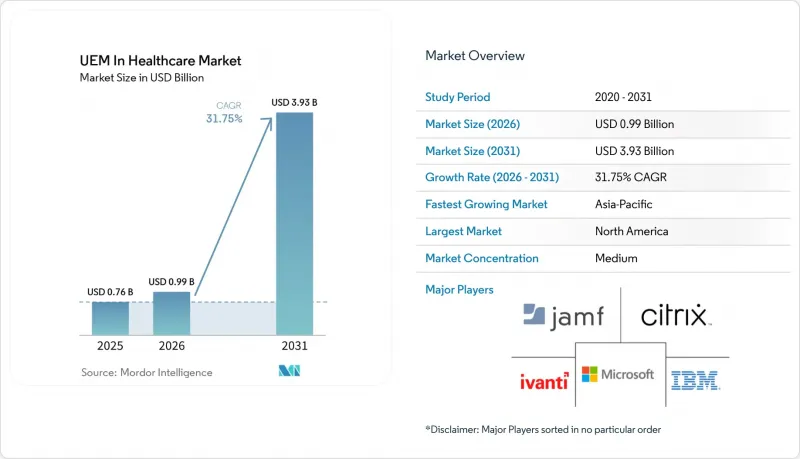
本報告按元件(解決方案[裝置管理、應用程式管理、內容管理、安全與合規管理等]和服務)、部署模式(雲端、本地部署、混合式部署)、組織規模(大型企業、中小企業)和地區(北美、歐洲等)進行細分。市場預測以美元計價。
全球醫療保健統一端點管理 (UEM) 市場趨勢與洞察
整個互聯醫療環境中對集中式終端安全的需求日益成長。
在醫療保健統一端點管理 (UEM) 市場,需求強勁,因為任何未受管理的設備都可能成為入侵儲存敏感患者和營運資料的系統的入口點。根據 Verizon 2026 年的調查結果,漏洞利用、網路釣魚和憑證竊取仍然是醫療保健領域的主要攻擊入口,凸顯了在單一平台上進行修補程式管理、應用程式控制和基於身分的存取控制的必要性。 2026 年對 Stryker 網路攻擊的調查顯示,攻擊者的目標是身分和憑證管理層——而這正是高階 UEM 平台旨在管理的控制平面。 Netscope 的報告顯示,醫療保健雲端環境中 82% 的數據策略違規事件涉及受監管數據,這表明端點風險通常源於雲端應用程式的行為,而非網路邊緣。這種轉變意義重大,因為醫院再也不能將設備安全與雲端存取策略、會話控制和設備狀態檢查割裂開來。因此,醫療保健領域的 UEM(統一端點管理)市場正在從設備註冊轉向更廣泛的安全編配,涵蓋臨床工作站、行動裝置和遠端醫療端點。
臨床工作流程中自備設備辦公(BYOD)的普及率不斷提高
醫療保健領域的統一端點管理 (UEM) 市場發展也受到醫院內個人設備使用與管理這些設備所需的正式控制措施之間日益擴大的差距的推動。 Imprivata 於 2025 年 7 月對 400 位急診室領導者進行的一項調查發現,81% 的臨床醫生在共用設備不可用時依賴個人設備,79% 的醫生承認共用登入憑證以獲取存取權限,這直接增加了違反 HIPAA 法規的風險。 JMIR Human Factors 於 2025 年對維多利亞州主要公立醫院進行的一項調查發現,自帶設備 (BYOD) 安全成熟度得分僅為 2.04 分(滿分 5 分)。這顯示許多大型機構仍依賴臨時性做法,而非正式的端點管治。調查指出,在設備安全分類系統中,UEM(統一端點管理)的成熟度最高。這使得醫院經營團隊更容易清晰地了解並優先處理當前面臨的挑戰。換句話說,醫療保健負責人不僅僅是在投資獲取設備,而是在投資彌合臨床工作流程中已存在的合規性和課責差距的方法。因此,醫療保健領域的統一端點管理 (UEM) 市場正在受益於將 BYOD 視為一種不容忽視的管理問題,而不僅僅是便利的趨勢。
與醫院原有資訊系統整合的複雜性。
與傳統基礎設施整合方面的摩擦仍然是醫療保健領域統一端點管理 (UEM) 市場面臨的最大技術限制因素。 SOTI 在 2025 年 6 月的報告中指出,65% 的醫療機構仍在使用未與物聯網或遠端醫療醫療設備整合的過時系統,59% 的機構報告稱,由於與傳統舊有系統衝突,導致系統宕機或出現技術問題。許多檢查室、影像和醫院資訊系統仍然運作在不支援現代 UEM 代理的作業系統版本上,或者在部署過程中會導致策略衝突。此外,如果醫院依賴 HL7 v2 介面、非 FHIR 環境或自訂中間件層,整合難度會進一步增加,部署時間可能會從數週延長至數季。這些時間安排與日常臨床營運相衝突,並會延誤本已人手過剩的 IT 團隊的專案進度,即使市場需求依然強勁。因此,醫療保健領域的 UEM 市場面臨的是時間安排問題,而非需求問題,因為許多機構難以將此功能整合到其舊有系統現代化計劃中。
細分市場分析
到2025年,解決方案將佔據醫療保健領域統一端點管理 (UEM) 市場佔有率的70.32%,市場需求將繼續集中在設備管理、應用管理、內容管理、安全與合規管理以及分析和自動化方面。在醫院,設備管理、安全和合規管理仍然是最成熟的領域,因為在共用的臨床設備上仍然需要加密、遠端擦拭巾、存取控制和稽核支援。應用管理的重要性日益凸顯,尤其是在人工智慧輔助診斷和第三方遠端醫療工具普及之後,醫療服務提供者希望控制哪些臨床應用可以存取終端。內容管理也受到了影像密集型專科的強烈關注,這些專科需要控制放射學和病理學文件在不同設備間的分發。在醫療保健UEM市場,由於買家希望減少分散的工具數量並明確策略執行的責任,因此通用平台仍然備受青睞。
隨著醫療系統利用終端行為數據來檢測異常、預測設備問題並實現修復工作流程的自動化,分析和自動化一直是解決方案中發展最快的領域。 2026年1月,Ivanti在其平台中新增了基於代理的人工智慧功能,旨在實現終端檢測和修復的自動化,以適應醫院IT團隊在人員有限的情況下管理大規模設備的實際情況。部署、託管支援和部署後最佳化等服務佔據了醫療保健領域統一終端管理(UEM)市場的剩餘佔有率,並隨著跨多站點環境部署複雜性的增加而成長。託管服務模式在服務層變得普遍,因為小規模的醫療機構團隊傾向於管治外包,而不是擁有內部專家。這種配置表明,在醫療保健領域的統一終端管理(UEM)市場中,能夠將強大的產品深度與符合醫療IT團隊營運限制的交付模式相結合的供應商備受青睞。
區域分析
2025年,北美在醫療保健領域的統一端點管理 (UEM) 市場規模中佔據41.38%的佔有率,憑藉嚴格的HIPAA法規執行、密集的醫療保健系統網路以及高昂的醫療保健IT支出,繼續保持領先地位。美國仍然是主要驅動力,因為2025年1月提交的HIPAA安全法規修訂提案要求實施多因素身份驗證、AES-256加密、半年一次的漏洞掃描和年度滲透測試等技術控制措施,這些措施與UEM的功能直接相關。加拿大和墨西哥由於遠端醫療的成長、基礎設施老化以及端點管治挑戰的持續存在,繼續保持著重要的次市場地位。微軟和Jamf在北美醫療產業佔據著舉足輕重的地位,因為許多醫院負責人已經在更廣泛的企業環境中使用他們的產品,並且可以進一步擴展設備控制。 2026 年,微軟將 Intune Suite 的價值添加到現有的 Microsoft 365 訂閱中,從而擴大了對基於雲端的統一端點管理 (UEM) 的存取範圍,使中型醫療保健系統能夠獲得這些系統之前難以證明部署單獨的高級平台的合理性。
亞太地區醫療保健統一端點管理 (UEM) 市場預計將在 2026 年至 2031 年間以 32.83% 的複合年成長率成長,成為當前預測期內成長最快的區域市場。日本是主要驅動力,其發布的《2025 年醫療保健網路安全檢查清單》明確了到 2027 年實現雙因素認證合規的路徑,並為端點管治升級制定了具體的時間表。韓國也透過政府主導的數位醫療基礎設施擴張,增加了公立醫院系統中聯網端點的數量,推動了市場成長。印度是另一個成長要素,政府在「阿尤斯曼·巴拉特數位使命」計畫下的數位化努力,正在將更多的臨床工作流程和端點資產納入受控的數位環境。澳洲也支持該地區的成長趨勢,其更嚴格的資料外洩監管以及 2025 年 SOTI 調查中 77% 的舊有系統未整合的事實,都加劇了合規壓力和明顯的基礎設施缺口。
歐洲在醫療保健領域的統一端點管理 (UEM) 市場中繼續佔有重要的結構性地位。這主要得益於德國、英國、法國和北歐國家監管壓力以及成熟的醫院 IT 環境。德國在 2025 年 12 月實施 NIS2 法規後尤為突出,因為被列為關鍵基礎設施的醫院現在必須遵守更嚴格的端點風險管理、報告和經營團隊監督義務。 Aagon GmbH 和 Baramundi Software 等本地供應商已經證明,即使在全球平台仍然活躍的情況下,特定地區的合規要求也能為專業供應商提供支援。英國、中東和非洲以及南美洲也在推動市場成長,其中沙烏地阿拉伯和阿拉伯聯合大公國在中東地區推行了醫院數位化項目,巴西的合規要求日益嚴格,智利、阿根廷和哥倫比亞等南美洲國家的私立醫院網路也在不斷擴張。
其他好處:
- Excel格式的市場預測(ME)表
- 3個月的分析師支持
目錄
第1章:引言
- 研究假設和市場定義
- 調查範圍
第2章:調查方法
第3章執行摘要
第4章 市場狀況
- 市場概覽
- 市場促進因素
- 在臨床工作流程中擴大 BYOD(自備設備辦公)的採用
- 整個互聯醫療環境中對集中式終端安全的需求日益成長。
- 提供遠端醫療並擴大行動臨床服務範圍
- 在醫療資料保護和可審計性方面,合規壓力日益增大。
- 臨時臨床人員跨機構ID和會話的便攜性
- 在共用醫療設備中應用零信任策略的需求日益成長
- 市場限制因素
- 與現有醫院資訊系統整合的複雜性
- 中型醫療機構和公共衛生網路的預算限制
- 過於嚴格的醫療設備政策會阻礙臨床工作流程。
- 醫療設備操作環境缺乏標準化
- 產業價值鏈分析
- 監理情勢
- 技術展望
- 宏觀經濟因素對市場的影響
- 波特五力分析
第5章 市場規模與成長預測
- 按組件
- 解決方案
- 設備管理
- 應用程式管理
- 內容管理
- 安全與合規管理
- 分析與自動化
- 服務
- 解決方案
- 部署模式
- 基於雲端的
- 現場
- 混合
- 按組織規模
- 大公司
- 小型企業
- 按地區
- 北美洲
- 美國
- 加拿大
- 墨西哥
- 南美洲
- 巴西
- 阿根廷
- 智利
- 哥倫比亞
- 其他南美國家
- 歐洲
- 德國
- 英國
- 法國
- 義大利
- 西班牙
- 荷蘭
- 北歐的
- 俄羅斯
- 其他歐洲國家
- 亞太地區
- 中國
- 日本
- 印度
- 韓國
- 澳洲和紐西蘭
- 東南亞
- 其他亞太國家
- 中東
- 沙烏地阿拉伯
- 阿拉伯聯合大公國
- 土耳其
- 以色列
- 其他中東國家
- 非洲
- 南非
- 埃及
- 奈及利亞
- 肯亞
- 其他非洲國家
- 北美洲
第6章 競爭情勢
- 市場集中度
- 策略趨勢
- 市佔率分析
- 公司簡介
- Microsoft Corporation
- IBM Corporation
- Citrix Systems, Inc.
- Ivanti, Inc.
- Jamf Holding Corp.
- BlackBerry Limited
- Samsung Electronics Co., Ltd.
- Motorola Solutions, Inc.
- SOTI Inc.
- Hexnode Inc.
- Baramundi Software GmbH
- Scality, Inc.
- Workspace ONE
- Google LLC
- Apple Inc.
- Addigy, Inc.
第7章 市場機會與未來展望
According to Mordor Intelligence, the UEM in Healthcare Market size was valued at USD 0.76 billion in 2025 and estimated to grow from USD 0.99 billion in 2026 to reach USD 3.93 billion by 2031, at a CAGR of 31.75% during the forecast period (2026-2031).
This report is Segmented by Component (Solutions [Device Management, Application Management, Content Management, Security and Compliance Management, and More], and Services), Deployment Mode (Cloud-Based, On-Premise, and Hybrid), Organization Size (Large Enterprises, and Small and Medium Enterprises), and Geography (North America, Europe, and More). The Market Forecasts are Provided in Terms of Value (USD).
Global UEM In Healthcare Market Trends and Insights
Rising Need for Centralized Endpoint Security Across Connected Care Environments
The UEM in Healthcare Market is seeing strong demand because every unmanaged device can become an entry point into systems that hold sensitive patient and operational data. Verizon's 2026 findings showed that vulnerability exploitation, phishing, and stolen credentials remained the leading healthcare access vectors, underscoring the need for patching, application control, and identity-enforced access in a single platform. A 2026 review of the Stryker cyberattack found that attackers targeted identity and certificate management layers, the same control plane that advanced UEM platforms are built to govern. Netskope reported that regulated data accounted for 82% of data policy violations in healthcare cloud environments, indicating that endpoint risk often originates in cloud application behavior rather than at the network edge. That shift matters because hospitals can no longer separate device security from cloud access policy, session control, and device posture checks. As a result, the UEM in Healthcare Market is moving beyond device enrollment and into broader security orchestration across clinical workstations, mobile devices, and remote care endpoints.
Expanding Bring Your Own Device Adoption in Clinical Workflows
The UEM in Healthcare Market is also being driven by the widening gap between personal device use in hospitals and the formal controls needed to govern it. Imprivata's July 2025 survey of 400 acute care leaders found that 81% of clinicians turned to personal devices when shared equipment was unavailable, and 79% admitted to sharing login credentials to gain access, which creates direct HIPAA exposure. A 2025 JMIR Human Factors study at a major public hospital in Victoria found a BYOD security maturity score of 2.04 out of 5, indicating that many large facilities still rely on ad hoc practices rather than formal endpoint governance. The same study identified UEM as the highest maturity level in the device security taxonomy, which makes the current gap easy for hospital leaders to frame and prioritize. That means healthcare buyers are not simply funding device access; they are funding a way to close known compliance and accountability gaps that already exist inside clinical workflows. The UEM in Healthcare Market is therefore benefiting from BYOD not as a convenience trend, but as a control problem that has become too visible to ignore.
Integration Complexity with Legacy Hospital Information Systems
Integration friction with older infrastructure remains the strongest technical restraint on the UEM in Healthcare Market. SOTI reported in June 2025 that 65% of healthcare organizations still used unintegrated, outdated systems for IoT and telehealth medical devices, while 59% reported downtime or technical issues due to legacy system conflicts. Many laboratory, imaging, and hospital information systems still run on operating system versions that either do not support modern UEM agents or create policy conflicts during rollout. Integration also becomes harder when hospitals rely on HL7 v2 interfaces, non-FHIR environments, or custom middleware layers, which can extend deployment from weeks to quarters. Those timelines compete with day-to-day clinical operations and delay projects for already stretched IT teams, even when demand remains strong. The UEM in Healthcare Market therefore faces a timing problem rather than a demand problem, since many organizations want the capability but struggle to fit it into legacy modernization schedules.
Other drivers and restraints analyzed in the detailed report include:
- Increasing Compliance Pressure for Healthcare Data Protection and Auditability
- Growth In Remote Care Delivery and Mobile Clinical Access
- Budget Constraints in Mid-Sized Care Providers and Public Health Networks
For complete list of drivers and restraints, kindly check the Table Of Contents.
Segment Analysis
Solutions held 70.32% of the UEM in Healthcare Market share in 2025, and demand remained concentrated across device management, application management, content management, security and compliance management, and analytics and automation. Device management, security, and compliance management stayed the most established layers because hospitals still need encryption, remote wipe, access control, and audit support across shared clinical devices. Application management gained ground as providers tried to control which clinical apps reached endpoints, especially as AI-assisted diagnostics and third-party telehealth tools became more common. Content management also drew stronger interest from imaging-heavy specialties that needed governed distribution of radiology and pathology files across mixed device fleets. The UEM in Healthcare Market continued to favor broad platforms in this segment because buyers wanted fewer disconnected tools and clearer accountability for policy enforcement.
Analytics and automation remained the fastest-evolving areas within solutions, as health systems began using endpoint behavior data to detect anomalies, predict device issues, and automate remediation workflows. Ivanti expanded its platform in January 2026 with agentic AI capabilities aimed at automating endpoint discovery and remediation, which matched the staffing reality of hospital IT teams that manage large device fleets with limited headcount. Services, which include deployment, managed support, and post-implementation optimization, accounted for the remaining share of the UEM in Healthcare Market and grew alongside rollout complexity in multi-facility environments. Managed service models gained traction inside the services layer because smaller provider teams often preferred outsourced governance over adding internal specialists. This mix shows that the UEM in Healthcare Market is rewarding vendors that can pair strong product depth with a delivery model that matches the operational limits of healthcare IT teams.
Complete Report Scope:
- By Component
- Solutions
- Device Management
- Application Management
- Content Management
- Security and Compliance Management
- Analytics and Automation
- Services
- Solutions
- By Deployment Mode
- Cloud-Based
- On-Premise
- Hybrid
- By Organization Size
- Large Enterprises
- Small and Medium Enterprises
- By Geography
- North America
- United States
- Canada
- Mexico
- South America
- Brazil
- Argentina
- Chile
- Colombia
- Rest of South America
- Europe
- Germany
- United Kingdom
- France
- Italy
- Spain
- Netherlands
- Nordics
- Russia
- Rest of Europe
- Asia-Pacific
- China
- Japan
- India
- South Korea
- Australia and New Zealand
- Southeast Asia
- Rest of Asia-Pacific
- Middle East
- Saudi Arabia
- United Arab Emirates
- Turkey
- Israel
- Rest of Middle East
- Africa
- South Africa
- Egypt
- Nigeria
- Kenya
- Rest of Africa
- North America
Geography Analysis
North America accounted for 41.38% share of the UEM in Healthcare Market size in 2025, which kept the region in the lead on the back of strong HIPAA enforcement, dense health system networks, and high healthcare IT spending. The United States remained the main driver because the January 2025 proposed HIPAA Security Rule update specified technical controls, such as multi-factor authentication, AES-256 encryption, biannual vulnerability scanning, and annual penetration testing, that directly map to UEM capabilities. Canada and Mexico remained meaningful secondary markets because unresolved endpoint governance gaps still sit alongside telehealth growth and older infrastructure. Microsoft and Jamf held visible positions across North American healthcare because many hospital buyers already used their broader enterprise environments and could extend device control from there. In 2026, Microsoft added Intune Suite value within existing Microsoft 365 subscriptions, widening cloud UEM access for mid-sized health systems that were previously less able to justify a separate premium platform.
Asia-Pacific in the UEM in Healthcare Market is projected to grow at a 32.83% CAGR from 2026 to 2031, making it the fastest-growing regional market in the current forecast period. Japan is a key driver because its FY2025 healthcare cybersecurity checklist set a documented path toward two-factor authentication compliance by fiscal year 2027, which creates a direct timetable for endpoint governance upgrades. South Korea is also strengthening the backdrop through government-led digital health infrastructure expansion that increases the number of connected endpoints in public hospital systems. India adds another growth layer because government digitization efforts under the Ayushman Bharat Digital Mission are bringing more clinical workflows and endpoint assets into managed digital environments. Australia reinforces the regional case because tighter data breach expectations and a 77% rate of unintegrated legacy systems in the 2025 SOTI survey combine compliance pressure with clear infrastructure gaps.
Europe remained structurally important in the UEM in Healthcare Market because Germany, the United Kingdom, France, and the Nordics combined regulatory pressure with mature hospital IT estates. Germany stood out after NIS2 came into force in December 2025, because hospitals classified as critical infrastructure now face stronger obligations around endpoint risk management, reporting, and executive oversight. Local providers such as Aagon GmbH and Baramundi Software show that region-specific compliance needs can still support specialized vendors even when global platforms remain active. The United Kingdom, the Middle East and Africa, and South America added supplementary growth, with the Middle East supported by hospital digitization programs in Saudi Arabia and the United Arab Emirates, and South America supported by rising compliance expectations in Brazil and the growth of private hospital networks in Chile, Argentina, and Colombia.
- Microsoft Corporation
- IBM Corporation
- Citrix Systems, Inc.
- Ivanti, Inc.
- Jamf Holding Corp.
- BlackBerry Limited
- Samsung Electronics Co., Ltd.
- Motorola Solutions, Inc.
- SOTI Inc.
- Hexnode Inc.
- Baramundi Software GmbH
- Scality, Inc.
- Workspace ONE
- Google LLC
- Apple Inc.
- Addigy, Inc.
Additional Benefits:
- The market estimate (ME) sheet in Excel format
- 3 months of analyst support
TABLE OF CONTENTS
1 INTRODUCTION
- 1.1 Study Assumptions and Market Definition
- 1.2 Scope of the Study
2 RESEARCH METHODOLOGY
3 EXECUTIVE SUMMARY
4 MARKET LANDSCAPE
- 4.1 Market Overview
- 4.2 Market Drivers
- 4.2.1 Expanding Bring Your Own Device Adoption in Clinical Workflows
- 4.2.2 Rising Need for Centralized Endpoint Security Across Connected Care Environments
- 4.2.3 Growth in Remote Care Delivery and Mobile Clinical Access
- 4.2.4 Increasing Compliance Pressure for Healthcare Data Protection and Auditability
- 4.2.5 Cross-Facility Identity and Session Mobility for Temporary Clinical Staff
- 4.2.6 Rising Demand for Zero Trust Policy Enforcement on Shared Medical Devices
- 4.3 Market Restraints
- 4.3.1 Integration Complexity with Legacy Hospital Information Systems
- 4.3.2 Budget Constraints in Mid-Sized Care Providers and Public Health Networks
- 4.3.3 Clinical Workflow Friction from Overly Restrictive Device Policies
- 4.3.4 Limited Standardization Across Medical Device Operating Environments
- 4.4 Industry Value Chain Analysis
- 4.5 Regulatory Landscape
- 4.6 Technological Outlook
- 4.7 Impact of Macroeconomic Factors on the Market
- 4.8 Porter's Five Forces Analysis
- 4.8.1 Threat of New Entrants
- 4.8.2 Bargaining Power of Buyers
- 4.8.3 Bargaining Power of Suppliers
- 4.8.4 Threat of Substitutes
- 4.8.5 Industry Rivalry
5 MARKET SIZE AND GROWTH FORECASTS (VALUE)
- 5.1 By Component
- 5.1.1 Solutions
- 5.1.1.1 Device Management
- 5.1.1.2 Application Management
- 5.1.1.3 Content Management
- 5.1.1.4 Security and Compliance Management
- 5.1.1.5 Analytics and Automation
- 5.1.2 Services
- 5.1.1 Solutions
- 5.2 By Deployment Mode
- 5.2.1 Cloud-Based
- 5.2.2 On-Premise
- 5.2.3 Hybrid
- 5.3 By Organization Size
- 5.3.1 Large Enterprises
- 5.3.2 Small and Medium Enterprises
- 5.4 By Geography
- 5.4.1 North America
- 5.4.1.1 United States
- 5.4.1.2 Canada
- 5.4.1.3 Mexico
- 5.4.2 South America
- 5.4.2.1 Brazil
- 5.4.2.2 Argentina
- 5.4.2.3 Chile
- 5.4.2.4 Colombia
- 5.4.2.5 Rest of South America
- 5.4.3 Europe
- 5.4.3.1 Germany
- 5.4.3.2 United Kingdom
- 5.4.3.3 France
- 5.4.3.4 Italy
- 5.4.3.5 Spain
- 5.4.3.6 Netherlands
- 5.4.3.7 Nordics
- 5.4.3.8 Russia
- 5.4.3.9 Rest of Europe
- 5.4.4 Asia-Pacific
- 5.4.4.1 China
- 5.4.4.2 Japan
- 5.4.4.3 India
- 5.4.4.4 South Korea
- 5.4.4.5 Australia and New Zealand
- 5.4.4.6 Southeast Asia
- 5.4.4.7 Rest of Asia-Pacific
- 5.4.5 Middle East
- 5.4.5.1 Saudi Arabia
- 5.4.5.2 United Arab Emirates
- 5.4.5.3 Turkey
- 5.4.5.4 Israel
- 5.4.5.5 Rest of Middle East
- 5.4.6 Africa
- 5.4.6.1 South Africa
- 5.4.6.2 Egypt
- 5.4.6.3 Nigeria
- 5.4.6.4 Kenya
- 5.4.6.5 Rest of Africa
- 5.4.1 North America
6 COMPETITIVE LANDSCAPE
- 6.1 Market Concentration
- 6.2 Strategic Moves
- 6.3 Market Share Analysis
- 6.4 Company Profiles (includes Global Level Overview, Market Level Overview, Core Segments, Financials as available, Strategic Information, Market Rank/Share, Products and Services, Recent Developments)
- 6.4.1 Microsoft Corporation
- 6.4.2 IBM Corporation
- 6.4.3 Citrix Systems, Inc.
- 6.4.4 Ivanti, Inc.
- 6.4.5 Jamf Holding Corp.
- 6.4.6 BlackBerry Limited
- 6.4.7 Samsung Electronics Co., Ltd.
- 6.4.8 Motorola Solutions, Inc.
- 6.4.9 SOTI Inc.
- 6.4.10 Hexnode Inc.
- 6.4.11 Baramundi Software GmbH
- 6.4.12 Scality, Inc.
- 6.4.13 Workspace ONE
- 6.4.14 Google LLC
- 6.4.15 Apple Inc.
- 6.4.16 Addigy, Inc.
7 MARKET OPPORTUNITIES AND FUTURE OUTLOOK
- 7.1 White-Space and Unmet-Need Assessment

 企業行動管理:市場佔有率分析、產業趨勢與統計、成長預測(2026-2031)企業行動安全:市場佔有率分析、產業趨勢與統計、成長預測(2026-2031 年)
 企業行動管理市場:依組件、作業系統、部署模式、產業和組織規模分類-2026-2032年全球市場預測銀行業企業行動化:市場佔有率分析、產業趨勢與統計、成長預測(2025-2030 年)製造業中的統一端點管理 (UEM):市場佔有率分析、產業趨勢與統計資料、成長預測 (2026-2031)
 企業行動管理 (EMM) 市場機會、成長要素、產業趨勢分析及 2026-2035 年預測
 住宅旅遊服務市場預測-按服務類型、交通方式、平台類型、應用、最終用戶和地區分類的全球分析搬遷與調動管理軟體:市場佔有率分析、產業趨勢與統計、成長預測(2026-2031)
 企業行動服務市場規模、佔有率和成長分析:按組件、部署類型、組織規模、設備類型、應用和地區分類-2026-2033年產業預測
 企業行動管理 (EMM) 市場:按解決方案類型、部署模式、企業規模、最終用戶產業和地區分類