


 |
市場調查報告書
商品編碼
2097357
南美洲POS終端市場:市場佔有率分析、產業趨勢與統計及成長預測(2025-2030年)South America POS Terminal - Market Share Analysis, Industry Trends & Statistics, Growth Forecasts (2025 - 2030) |
||||||

※ 本網頁內容可能與最新版本有所差異。詳細情況請與我們聯繫。
據 Mordor Intelligence 稱,南美 POS 終端市場預計到 2025 年將達到 107 億台,預計在預測期(2025-2030 年)內將以 6.20% 的複合年成長率成長,到 2030 年將達到 163 億台。
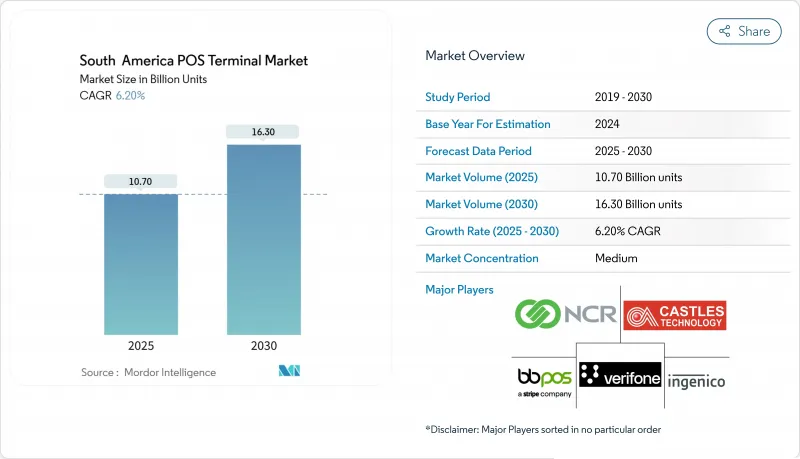
本報告按支付方式(接觸式和非接觸式)、POS機類型(固定式POS系統和行動/可攜式POS系統)以及終端用戶行業(零售、酒店、醫療保健、交通運輸和物流等)進行分類。市場預測以銷量為基礎。
南美洲POS終端市場趨勢與洞察
與使用現金相比,總擁有成本較低。
最新的終端設備可減少現金管理的損失,實現支付自動化,並整合庫存管理功能。在試驗計畫中,Castles Technology 的安卓終端使商家效率提升了三倍,促使墨西哥的金融科技公司部署了超過 400 萬台終端,而銀行的部署量僅 140 萬台。目前,該供應商正將分析儀錶板和營運資金貸款捆綁銷售,透過將一次性銷售轉化為訂閱收入,進一步加速小規模企業採用該設備。
疫情後非接觸式支付和行動支付激增
新冠疫情促使消費者轉向「即觸即付」和QR碼支付。在巴西,NFC交易目前佔線下卡片付款」將於2025年2月正式開始運作。該系統將即時支付與非接觸式交易的便利性結合,推動了商家對雙介面終端的需求。阿根廷的互通QR碼框架在2024年4月實現了278%的年成長,印證了市場對非接觸式支付的持續需求。
與網路安全和PCI-DSS合規性相關的成本
PCI-DSS v4.0.1 擴展了對身分驗證、金鑰管理和監控的要求,導致定期審計成本增加,這對小規模商家來說是一個沉重的負擔。設備製造商必須確保韌體更新並維持設備認證,這增加了組件成本,並在法規環境分散的情況下使部署更加複雜。
細分市場分析
2024年,基於接觸式EMV晶片卡的交易在南美POS終端市場佔有率中佔57.83%,反映了晶片卡基礎設施的成熟。然而,隨著NFC卡和數位錢包的普及,非接觸式交易量正以7.23%的複合年成長率成長。阿根廷統一的QR碼支付系統在2024年4月處理了3570萬筆交易,而巴西的「PIX非接觸式支付系統」預計將進一步加速NFC技術的普及。商家正在進行前瞻性投資,並不斷增加對雙介面讀卡機的需求,以同時支援傳統卡片付款和即時支付。終端供應商正在將2D碼掃描器和大尺寸觸控螢幕捆綁銷售,用戶無需更換硬體即可透過軟體切換支付方式。
另一個影響是,隨著非接觸式A2A支付管道削弱了交換費的盈利,收購方正在重新思考其費用模式。巴西的一些商家正在將小額交易的支付方式轉向PIX,以避免商家折扣率(MDR)費用,同時保留高價商品交易的信用卡分期付款方式。終端供應商正在透過在終端層面部署動態路由引擎來應對這一變化,從而最大限度地降低商家的成本,並鞏固硬體在各種支付方式並存的世界中的重要性。
其他好處:
- Excel格式的市場預測(ME)表
- 3個月的分析師支持
目錄
第1章:引言
- 研究假設和市場定義
- 調查範圍
第2章:調查方法
第3章執行摘要
第4章 市場狀況
- 市場概覽
- 市場促進因素
- 與其他驗收管道相比,整體擁有成本更低
- 疫情引發的非接觸式和行動支付激增
- 政府關於小規模企業支付數位化(例如PIX、CoDi)的法規
- 支付聚合商和金融科技收購方的快速擴張
- 智慧型安卓POS系統正逐漸成為零售商業務的核心部分(但它們並沒有得到足夠的關注)。
- 引入與公共交通相容的無人POS系統,以促進城市交通。
- 市場限制因素
- 網路安全和PCI-DSS合規成本
- 農村地區非正規經濟佔比高,且偏好現金支付
- 安全晶片組的供應鏈波動
- Pix/A2A 積極的定價策略正在削弱銀行卡和 POS 系統的盈利。
- 產業價值鏈分析
- 監理情勢
- 技術展望
- 對影響市場的宏觀經濟因素進行評估
- 波特五力分析
第5章 市場規模與成長預測
- 透過付款方式
- 聯繫類型
- 非接觸式
- POS類型
- 固定式POS系統
- 行動/可攜式POS系統
- 按最終用戶行業分類
- 零售
- 飯店業
- 衛生保健
- 運輸/物流
- 其他終端用戶產業
- 國家
- 巴西
- 阿根廷
- 哥倫比亞
- 智利
- 秘魯
- 其他南美國家
第6章 競爭情勢
- 市場集中度
- 策略趨勢
- 市佔率分析
- 公司簡介
- Ingenico SA
- VeriFone, Inc.
- PAX Technology Limited
- New POS Technology Limited
- Newland Payment Technology Co., Ltd.
- Castles Technology Co., Ltd.
- Shenzhen Xinguodu Technology Co., Ltd.
- SZZT Electronics Co., Ltd.
- BBPOS Limited
- Bitel Co., Ltd.
- Centerm Information Co., Ltd.
- NCR Corporation
- Toshiba Tec Corporation
- Zebra Technologies Corporation
- Honeywell International Inc.
- Datalogic SpA
- Diebold Nixdorf Incorporated
- Sunmi Technology Co., Ltd.
- Fujian Landi Commercial Equipment Co., Ltd.
- AURES Technologies SA
第7章 市場機會與未來展望
According to Mordor Intelligence, the South America POS terminal market size is estimated at 10.70 billion units in 2025, and is expected to reach 16.30 billion units by 2030, at a CAGR of 6.20% during the forecast period (2025-2030).
This report is Segmented by Mode of Payment Acceptance (Contact-Based, and Contactless), POS Type (Fixed Point-Of-Sale Systems, and Mobile/Portable Point-Of-Sale Systems), End-User Industry (Retail, Hospitality, Healthcare, Transportation and Logistics, and More). The Market Forecasts are Provided in Terms of Value (Units).
South America POS Terminal Market Trends and Insights
Lower total cost of ownership than cash handling
Modern terminals reduce cash-management losses, automate settlement, and integrate inventory functions. Castles Technology's Android units tripled merchant productivity in pilot programs, resulting in over 4 million fintech-deployed terminals in Mexico, compared to 1.4 million bank devices. Hardware vendors now bundle analytics dashboards and working-capital loans that convert one-time sales into subscription revenue, reinforcing adoption momentum among micro-merchants.
Contactless and mobile payment surge post-pandemic
COVID-19 shifted consumer behavior toward tap-and-go and QR code payments. NFC transactions now account for more than 50% of face-to-face card volumes in Brazil, and PIX Contactless has been live since February 2025, combining instant settlement with touch-free convenience, thereby increasing merchant demand for dual-interface devices. Argentina's interoperable QR framework logged a 278% year-over-year growth in April 2024, confirming a sustained preference for contactless payment acceptance.
Cybersecurity and PCI-DSS compliance costs
PCI-DSS v4.0.1 expands authentication, key management, and monitoring mandates, driving recurring audit expenses that small merchants struggle to afford. Terminal manufacturers must secure firmware updates and maintain device attestation, which raises bill-of-materials costs and complicates rollouts in fragmented regulatory environments.
Other drivers and restraints analyzed in the detailed report include:
- Mandatory digitization of micro-merchant payments
- Expansion of fintech acquirers and payment aggregators
- High informality and rural cash preference
For complete list of drivers and restraints, kindly check the Table Of Contents.
Segment Analysis
Contact-based EMV transactions accounted for 57.83% South America POS Terminal market share in 2024, reflecting entrenched chip-card infrastructure. Yet contactless volumes grow at a 7.23% CAGR as NFC cards and digital wallets proliferate. Argentina's unified QR scheme handled 35.7 million transactions in April 2024, while Brazil's PIX Contactless is set to accelerate NFC adoption further. Merchants increasingly demand dual-interface readers to future-proof investments and capture both traditional card and instant-payment traffic. Device vendors bundle QR scanners and large touchscreens, allowing software-switchable acceptance modes without additional hardware swaps.
Second-order effects include acquirers reshaping fee models as contactless A2A rails undercut interchange economics. Some Brazilian merchants already route low-ticket items to PIX to avoid MDR fees, while high-value purchases stay on credit card installments. Terminal providers respond with dynamic routing engines at the device level, maximizing savings for merchants and cementing hardware relevance in an omnipayment world.
Complete Report Scope:
- By Mode of Payment Acceptance
- Contact-based
- Contactless
- By POS Type
- Fixed Point-of-Sale Systems
- Mobile / Portable Point-of-Sale Systems
- By End-User Industry
- Retail
- Hospitality
- Healthcare
- Transportation and Logistics
- Other End-User Industries
- By Country
- Brazil
- Argentina
- Colombia
- Chile
- Peru
- Rest of South America
List of Companies Covered in this Report:
- Ingenico S.A.
- VeriFone , Inc.
- PAX Technology Limited
- New POS Technology Limited
- Newland Payment Technology Co., Ltd.
- Castles Technology Co., Ltd.
- Shenzhen Xinguodu Technology Co., Ltd.
- SZZT Electronics Co., Ltd.
- BBPOS Limited
- Bitel Co., Ltd.
- Centerm Information Co., Ltd.
- NCR Corporation
- Toshiba Tec Corporation
- Zebra Technologies Corporation
- Honeywell International Inc.
- Datalogic S.p.A.
- Diebold Nixdorf Incorporated
- Sunmi Technology Co., Ltd.
- Fujian Landi Commercial Equipment Co., Ltd.
- AURES Technologies S.A.
Additional Benefits:
- The market estimate (ME) sheet in Excel format
- 3 months of analyst support
TABLE OF CONTENTS
1 INTRODUCTION
- 1.1 Study Assumptions and Market Definition
- 1.2 Scope of the Study
2 RESEARCH METHODOLOGY
3 EXECUTIVE SUMMARY
4 MARKET LANDSCAPE
- 4.1 Market Overview
- 4.2 Market Drivers
- 4.2.1 Low Total Cost of Ownership versus Other Acceptance Channels
- 4.2.2 Pandemic-Driven Surge in Contactless and Mobile Payments
- 4.2.3 Government Mandates to Digitize Micro-Merchant Payments (e.g., PIX, CoDi)
- 4.2.4 Rapid Expansion of Payment Aggregators and Fintech Acquirers
- 4.2.5 Smart Android POS Becoming Merchants' Core Business Hub (Under-exposed)
- 4.2.6 Transit-grade Unattended POS Roll-outs for Urban Mobility
- 4.3 Market Restraints
- 4.3.1 Cyber-security and PCI-DSS Compliance Costs
- 4.3.2 High Informality and Cash Preference in Rural Areas
- 4.3.3 Supply-chain Volatility for Secure Chipsets
- 4.3.4 Aggressive Pix/A2A Pricing Eroding Card-POS Economics
- 4.4 Industry Value Chain Analysis
- 4.5 Regulatory Landscape
- 4.6 Technological Outlook
- 4.7 Assessment of Macroeconomic Factors on the Market
- 4.8 Porter's Five Forces Analysis
- 4.8.1 Bargaining Power of Suppliers
- 4.8.2 Bargaining Power of Buyers
- 4.8.3 Threat of New Entrants
- 4.8.4 Intensity of Competitive Rivalry
- 4.8.5 Threat of Substitutes
5 MARKET SIZE AND GROWTH FORECASTS (UNITS)
- 5.1 By Mode of Payment Acceptance
- 5.1.1 Contact-based
- 5.1.2 Contactless
- 5.2 By POS Type
- 5.2.1 Fixed Point-of-Sale Systems
- 5.2.2 Mobile / Portable Point-of-Sale Systems
- 5.3 By End-User Industry
- 5.3.1 Retail
- 5.3.2 Hospitality
- 5.3.3 Healthcare
- 5.3.4 Transportation and Logistics
- 5.3.5 Other End-User Industries
- 5.4 By Country
- 5.4.1 Brazil
- 5.4.2 Argentina
- 5.4.3 Colombia
- 5.4.4 Chile
- 5.4.5 Peru
- 5.4.6 Rest of South America
6 COMPETITIVE LANDSCAPE
- 6.1 Market Concentration
- 6.2 Strategic Moves
- 6.3 Market Share Analysis
- 6.4 Company Profiles (includes Global level Overview, Market level Overview, Core Segments, Financials as available, Strategic Information, Market Rank/Share, Products and Services, Recent Developments)
- 6.4.1 Ingenico S.A.
- 6.4.2 VeriFone , Inc.
- 6.4.3 PAX Technology Limited
- 6.4.4 New POS Technology Limited
- 6.4.5 Newland Payment Technology Co., Ltd.
- 6.4.6 Castles Technology Co., Ltd.
- 6.4.7 Shenzhen Xinguodu Technology Co., Ltd.
- 6.4.8 SZZT Electronics Co., Ltd.
- 6.4.9 BBPOS Limited
- 6.4.10 Bitel Co., Ltd.
- 6.4.11 Centerm Information Co., Ltd.
- 6.4.12 NCR Corporation
- 6.4.13 Toshiba Tec Corporation
- 6.4.14 Zebra Technologies Corporation
- 6.4.15 Honeywell International Inc.
- 6.4.16 Datalogic S.p.A.
- 6.4.17 Diebold Nixdorf Incorporated
- 6.4.18 Sunmi Technology Co., Ltd.
- 6.4.19 Fujian Landi Commercial Equipment Co., Ltd.
- 6.4.20 AURES Technologies S.A.
7 MARKET OPPORTUNITIES AND FUTURE OUTLOOK
- 7.1 White-space and Unmet-Need Assessment

 中國POS終端市場:市場佔有率分析、產業趨勢與統計及成長預測(2026-2031年)印度POS終端市場:市場佔有率分析、產業趨勢與統計及成長預測(2026-2031年)義大利POS終端市場:市場佔有率分析、產業趨勢與統計數據以及成長預測(2026-2031年)西班牙POS終端市場:市場佔有率分析、產業趨勢與統計數據以及成長預測(2026-2031年)北美POS終端:市場佔有率分析、產業趨勢與統計及成長預測(2026-2031年)德國POS終端市場:市場佔有率分析、行業趨勢和統計數據以及成長預測(2026-2031年)法國POS終端市場:市場佔有率分析、產業趨勢與統計數據以及成長預測(2026-2031年)東南亞POS終端市場:市場佔有率分析、產業趨勢與統計、成長預測(2026-2031年)歐洲POS終端:市場佔有率分析、產業趨勢與統計及成長預測(2026-2031年)
 POS終端市場-2026-2032年全球市場預測