


 |
市場調查報告書
商品編碼
2117280
中國POS終端市場:市場佔有率分析、產業趨勢與統計及成長預測(2026-2031年)China POS Terminals - Market Share Analysis, Industry Trends & Statistics, Growth Forecasts (2026 - 2031) |
||||||

※ 本網頁內容可能與最新版本有所差異。詳細情況請與我們聯繫。
根據 Mordor Intelligence 的數據顯示,2025 年中國 POS 終端市值為 69.2 億美元,預計到 2031 年將達到 93.7 億美元,而 2026 年為 72.8 億美元,預測期(2026-2031 年)的複合年成長率為 5.17%。
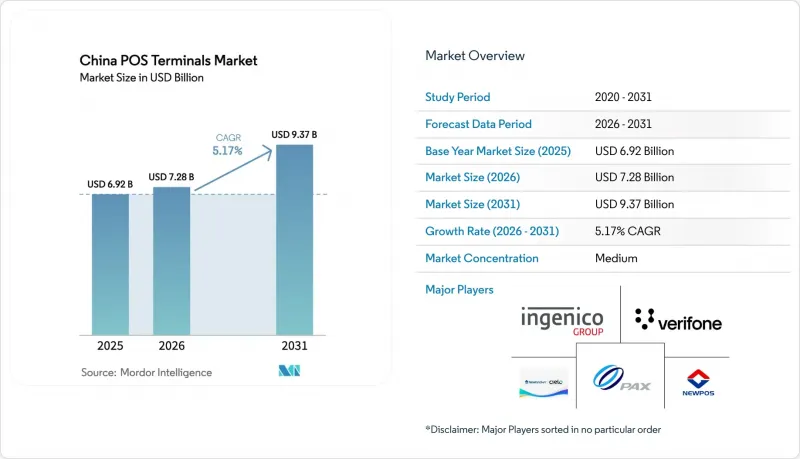
本報告按支付方式(接觸式和非接觸式)、POS機類型(固定式POS系統和行動/可攜式POS系統)以及終端用戶行業(零售、酒店、醫療保健、運輸物流及其他終端用戶行業)進行細分。市場預測以美元計價。
中國POS終端市場趨勢與洞察
政府透過數位人民幣試點計畫推動無現金經濟。
數位貨幣試點計畫的擴展刺激了對能夠同時處理數位人民幣和國際卡組織的雙功能終端的需求,使外國遊客能夠以單筆5000美元的限額和5萬美元的年度限額為其錢包充值。雖然相容於多種支付方式的硬體對於旅遊設施變得至關重要,但加密法規要求終端必須內建加密模組。擁有深厚監管經驗的成熟供應商正從這些日益複雜的認證流程中獲益。
支援行動錢包的 NFC POS 系統快速擴展
支付寶的「一觸即付」宣傳活動以及向80萬家醫療機構部署11.2億個醫保QR碼,加速了NFC終端的訂單。快餐連鎖店正在使用支援生物識別的NFC終端,北京地鐵接受外國銀行卡也凸顯了向支援多錢包的非接觸式支付解決方案的轉變。如今,終端規格已包括與社會安全系統整合以及用於身份驗證的生物識別。
針對POS網路的網路攻擊日益增多
如今,複雜的攻擊手段瞄準韌體和雲端閘道器,導致個人資料保護法合規預算大幅飆升。小規模的收購方難以維持全天候監控,如果許可證被吊銷的風險增加,它們可能被迫退出市場。
細分市場分析
預計到2025年,非接觸式支付系統將佔據中國POS終端市場58.12%的佔有率,並預計在2031年之前以6.71%的複合年成長率成長,因為便捷的「一觸即付」功能與人們對衛生問題的關注不謀而合。政府取消外國遊客單筆交易限額的政策也推動了這一領域的成長,加速了商家升級至支援雙卡雙待NFC終端的進程。
從臉部辨識到指紋感應器等生物識別功能現已整合到非接觸式支付流程中,這增加了解決方案的複雜性。 「小費加密碼」方式仍用於高價值和跨境交易,在細分市場中保持著重要地位。北京地鐵的多錢包支援表明,非接觸式終端可以將交通、零售和國際應用場景整合到單一設備中。
其他好處:
- Excel格式的市場預測(ME)表
- 3個月的分析師支持
目錄
第1章:引言
- 研究假設和市場定義
- 調查範圍
第2章:調查方法
第3章執行摘要
第4章 市場狀況
- 市場概覽
- 市場促進因素
- 政府透過數位人民幣試點計畫推動無現金經濟。
- 支援行動錢包的 NFC POS 系統快速擴展
- 中小企業和速食店的採用率不斷提高
- 整合人工智慧驅動的詐欺檢測晶片
- 三線城市無人智慧POS系統的興起
- 公共交通工具上的POS終端必須獲得EMV-L3認證。
- 市場限制因素
- 針對POS網路的網路攻擊日益增多
- 來自 SoftPOS 智慧型手機應用程式的價格壓力
- 半導體供應鏈的波動性
- 數據本地化合規成本正在飆升。
- 產業價值鏈分析
- 監理情勢
- 主要法規和合規標準
- 宏觀經濟因素的影響
- 技術展望
- 波特五力分析
- 主要案例研究分析
第5章 市場規模與成長預測
- 按支付方式的接受狀態
- 聯繫類型
- 非接觸式
- 按POS機類型分類
- 固定式POS系統
- 行動/可攜式POS系統
- 按最終用戶行業分類
- 零售
- 飯店業
- 衛生保健
- 運輸/物流
- 其他終端用戶產業
第6章 競爭情勢
- 市場集中度
- 策略趨勢
- 市佔率分析
- 公司簡介
- Ingenico Group SA
- Verifone Systems LLC
- PAX Global Technology Limited
- Fujian Newland Payment Technology Co., Ltd.
- New POS Technology Limited
- Shenzhen Xinguodu Technology Co., Ltd.
- Bitel Co., Ltd.
- Centerm Information Co., Ltd.
- Sunmi Technology Co., Ltd.
- Urovo Technology Co., Ltd.
- Justtide Technology Co., Ltd.
- Castles Technology Co., Ltd.
- Hisense Intelligent Commercial Equipment Co., Ltd.
- Guangzhou Zonerich Business Machine Co., Ltd.
- BBPOS Limited
- Sunyard Technology Co., Ltd.
- Wintec POS Co., Ltd.
- Equinox Payments LLC
- NEC Corporation
第7章 市場機會與未來展望
According to Mordor Intelligence, the China POS terminals market size was valued at USD 6.92 billion in 2025 and estimated to grow from USD 7.28 billion in 2026 to reach USD 9.37 billion by 2031, at a CAGR of 5.17% during the forecast period (2026-2031).
This report is Segmented by Mode of Payment Acceptance (Contact-Based, and Contactless), POS Type (Fixed Point-Of-Sale Systems, and Mobile/Portable POS Systems), End-User Industry (Retail, Hospitality, Healthcare, Transportation and Logistics, and Other End-User Industries). The Market Forecasts are Provided in Terms of Value (USD).
China POS Terminals Market Trends and Insights
Government Push for Cashless Economy via Digital-Yuan Pilots
Expanded digital-currency pilots now allow foreign visitors to top up wallets with single-transaction limits of USD 5,000 and annual caps of USD 50,000, stimulating demand for dual-acceptance terminals capable of processing Digital Yuan and international card schemes. Tourist-facing venues must deploy multi-scheme hardware, while cryptography regulations enforce on-device encryption modules. Established vendors with deep regulatory expertise benefit from the resulting certification complexity.
Rapid Expansion of Mobile-Wallet-Ready NFC POS
Alipay's "Tap-to-Pay" campaign and the rollout of 1.12 billion medical-insurance QR codes across 800,000 healthcare sites accelerate NFC terminal orders. QSR chains leverage biometric NFC devices, and Beijing Metro's acceptance of foreign bank cards underscores the shift toward multi-wallet tap solutions. Terminal specifications now encompass social-insurance system links and biometric ID checks.
Rising Cyber-attacks Targeting POS Networks
Sophisticated breaches now target firmware and cloud gateways, inflating compliance budgets under the Personal Information Protection Law. Smaller acquirers struggle with 24/7 monitoring and may exit the market if license revocation risks escalate.
Other drivers and restraints analyzed in the detailed report include:
- Increasing Adoption by SMEs and QSRs
- Integration of AI-Powered Fraud-Detection Chips
- Price Pressure from SoftPOS Smartphone Apps
For complete list of drivers and restraints, kindly check the Table Of Contents.
Segment Analysis
Contactless systems captured 58.12% of the China POS terminals market share in 2025 and will grow at a 6.71% CAGR through 2031 as tap-and-go convenience aligns with hygiene preferences. The segment enjoys support from government rules lifting single-transaction caps for foreign visitors, spurring merchant upgrades to dual-scheme NFC terminals.
Biometric authentication layers, from facial recognition to fingerprint sensors, now accompany contactless flows, deepening solution complexity. Chip-and-PIN remains for high-value and cross-border transactions, preserving niche relevance. Beijing Metro's multi-wallet acceptance proves that contactless devices can merge transport, retail, and international use cases under one chassis.
Complete Report Scope:
- By Mode of Payment Acceptance
- Contact-based
- Contactless
- By POS Type
- Fixed Point-of-Sale Systems
- Mobile / Portable Point-of-Sale Systems
- By End-User Industry
- Retail
- Hospitality
- Healthcare
- Transportation and Logistics
- Other End-User Industries
List of Companies Covered in this Report:
- Ingenico Group SA
- Verifone Systems LLC
- PAX Global Technology Limited
- Fujian Newland Payment Technology Co., Ltd.
- New POS Technology Limited
- Shenzhen Xinguodu Technology Co., Ltd.
- Bitel Co., Ltd.
- Centerm Information Co., Ltd.
- Sunmi Technology Co., Ltd.
- Urovo Technology Co., Ltd.
- Justtide Technology Co., Ltd.
- Castles Technology Co., Ltd.
- Hisense Intelligent Commercial Equipment Co., Ltd.
- Guangzhou Zonerich Business Machine Co., Ltd.
- BBPOS Limited
- Sunyard Technology Co., Ltd.
- Wintec POS Co., Ltd.
- Equinox Payments LLC
- NEC Corporation
Additional Benefits:
- The market estimate (ME) sheet in Excel format
- 3 months of analyst support
TABLE OF CONTENTS
1 INTRODUCTION
- 1.1 Study Assumptions and Market Definition
- 1.2 Scope of the Study
2 RESEARCH METHODOLOGY
3 EXECUTIVE SUMMARY
4 MARKET LANDSCAPE
- 4.1 Market Overview
- 4.2 Market Drivers
- 4.2.1 Government Push for Cashless Economy via Digital-Yuan Pilots
- 4.2.2 Rapid Expansion of Mobile-Wallet-Ready NFC POS
- 4.2.3 Increasing Adoption by SMEs and QSRs
- 4.2.4 Integration of AI-Powered Fraud-Detection Chips
- 4.2.5 Rise of Unattended Smart POS in Tier-3 Cities
- 4.2.6 Mandated EMV-L3 Certification for Transit POS
- 4.3 Market Restraints
- 4.3.1 Rising Cyber-attacks Targeting POS Networks
- 4.3.2 Price Pressure from SoftPOS Smartphone Apps
- 4.3.3 Semiconductor Supply-Chain Volatility
- 4.3.4 Data-Localization Compliance Cost Spike
- 4.4 Industry Value Chain Analysis
- 4.5 Regulatory Landscape
- 4.5.1 Key Regulations and Compliance Standards
- 4.6 Impact of Macroeconomic Factors
- 4.7 Technological Outlook
- 4.8 Porter's Five Forces Analysis
- 4.8.1 Bargaining Power of Suppliers
- 4.8.2 Bargaining Power of Buyers
- 4.8.3 Threat of New Entrants
- 4.8.4 Intensity of Competitive Rivalry
- 4.8.5 Threat of Substitutes
- 4.9 Analysis of Major Case Studies
5 MARKET SIZE AND GROWTH FORECASTS (VALUE)
- 5.1 By Mode of Payment Acceptance
- 5.1.1 Contact-based
- 5.1.2 Contactless
- 5.2 By POS Type
- 5.2.1 Fixed Point-of-Sale Systems
- 5.2.2 Mobile / Portable Point-of-Sale Systems
- 5.3 By End-User Industry
- 5.3.1 Retail
- 5.3.2 Hospitality
- 5.3.3 Healthcare
- 5.3.4 Transportation and Logistics
- 5.3.5 Other End-User Industries
6 COMPETITIVE LANDSCAPE
- 6.1 Market Concentration
- 6.2 Strategic Moves
- 6.3 Market Share Analysis
- 6.4 Company Profiles (includes Global level Overview, Market level overview, Core Segments, Financials as available, Strategic Information, Market Rank/Share for key companies, Products and Services, and Recent Developments)
- 6.4.1 Ingenico Group SA
- 6.4.2 Verifone Systems LLC
- 6.4.3 PAX Global Technology Limited
- 6.4.4 Fujian Newland Payment Technology Co., Ltd.
- 6.4.5 New POS Technology Limited
- 6.4.6 Shenzhen Xinguodu Technology Co., Ltd.
- 6.4.7 Bitel Co., Ltd.
- 6.4.8 Centerm Information Co., Ltd.
- 6.4.9 Sunmi Technology Co., Ltd.
- 6.4.10 Urovo Technology Co., Ltd.
- 6.4.11 Justtide Technology Co., Ltd.
- 6.4.12 Castles Technology Co., Ltd.
- 6.4.13 Hisense Intelligent Commercial Equipment Co., Ltd.
- 6.4.14 Guangzhou Zonerich Business Machine Co., Ltd.
- 6.4.15 BBPOS Limited
- 6.4.16 Sunyard Technology Co., Ltd.
- 6.4.17 Wintec POS Co., Ltd.
- 6.4.18 Equinox Payments LLC
- 6.4.19 NEC Corporation
7 MARKET OPPORTUNITIES AND FUTURE OUTLOOK
- 7.1 White-space and Unmet-need Assessment

 全球電子貨幣轉帳銷售點(EFTPOS)終端市場
 印度POS終端市場:市場佔有率分析、產業趨勢與統計及成長預測(2026-2031年)義大利POS終端市場:市場佔有率分析、產業趨勢與統計數據以及成長預測(2026-2031年)西班牙POS終端市場:市場佔有率分析、產業趨勢與統計數據以及成長預測(2026-2031年)北美POS終端:市場佔有率分析、產業趨勢與統計及成長預測(2026-2031年)德國POS終端市場:市場佔有率分析、行業趨勢和統計數據以及成長預測(2026-2031年)法國POS終端市場:市場佔有率分析、產業趨勢與統計數據以及成長預測(2026-2031年)東南亞POS終端市場:市場佔有率分析、產業趨勢與統計、成長預測(2026-2031年)歐洲POS終端:市場佔有率分析、產業趨勢與統計及成長預測(2026-2031年)
 POS終端市場-2026-2032年全球市場預測