


 |
市場調查報告書
商品編碼
2116845
義大利POS終端市場:市場佔有率分析、產業趨勢與統計數據以及成長預測(2026-2031年)Italy POS Terminals - Market Share Analysis, Industry Trends & Statistics, Growth Forecasts (2026 - 2031) |
||||||

※ 本網頁內容可能與最新版本有所差異。詳細情況請與我們聯繫。
預計義大利POS終端市場將從2025年的33.4億美元成長到2026年的36.1億美元,到2031年達到47.6億美元,2026年至2031年的複合年成長率預計為5.69%。
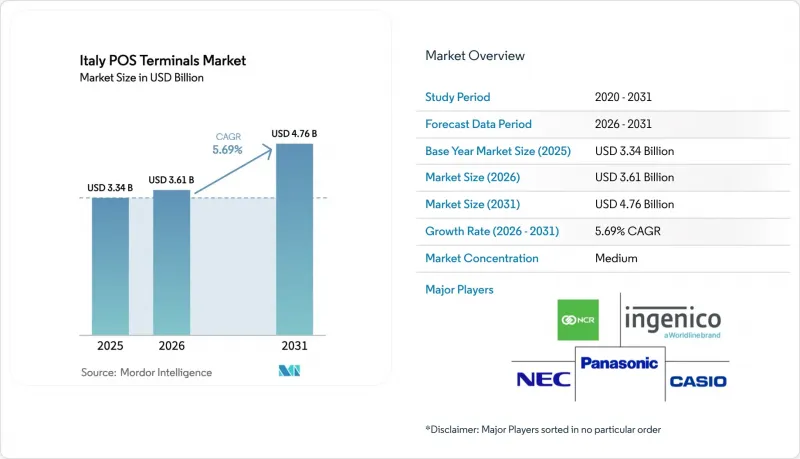
本報告按支付方式(接觸式和非接觸式)、POS機類型(固定式POS系統、移動式和可攜式POS系統)、終端用戶行業(零售、酒店、醫療保健、交通運輸和物流等)以及地區進行細分。市場預測以美元計價。
義大利POS終端市場趨勢與洞察
義大利對中小企業的稅收優惠政策正在加速行動POS系統的普及。
義大利對交易手續費提供30%的稅收稅額扣抵,降低了該國150萬自僱人士的支出,將行動讀卡機的投資回收期從18個月縮短至不到一年。 SumUp和myPOS等終端供應商正利用這項優惠政策,將固定費率定價與當日支付處理結合,避免了現有收購方常見的階梯式商家費用(MDR)結構。在Campania、Calabria和Sicilia等南部地區,現金使用率在2022年超過75%,預計到2025年將降至與北部地區大致相同的水平,從而將區域數字支付差距縮小8個百分點。然而,2026年到期的補貼可能會阻礙對價格最敏感的小微企業採用數位支付,因此補貼續約將成為一項關鍵的政策變數。對此,硬體製造商正在推廣低成本的基於安卓系統的終端,這些終端還可以用作庫存掃描儀,從而防止價格彈性導致普及進程受阻。
關於強制電子帳單和會計收據的法案
2026年起,所有銷售收據必須透過Interscambio系統(SDI)發送,這將迫使企業升級或改造327萬台終端,其中許多終端缺乏即時資料交換所需的API。供應商目前正在預先安裝SDI模組和雲端連接器,將POS終端改造為符合規定的閘道器,自動存檔增值稅資料和發票影像。零售和餐飲連鎖企業為了避免罰款,已於2024年開始提前採用該系統,由此產生了對自動化補丁管理服務的需求,以便將韌體更新分發到多家門市。由於Epson、Custom和Olivetti的收據印表機使用專有協議,建造軟體橋接器需要為每個通道額外花費100至200歐元(119至237美元),因此整合仍然存在挑戰。儘管如此,透過將支付數據與稅務報告關聯起來,現金流透明度的提高對向中小企業提供貸款和承保的金融機構和保險公司來說極具吸引力。
小額交易的高額交換費和商家折扣費
歐盟第2015/751號條例規定簽帳金融卡交易手續費上限為0.2%,信用卡交易手續費上限為0.3%。但考慮到收購方的利潤和終端租賃費,義大利商家仍需負擔1.5%至2.5%的總處理成本。對於一家售價2歐元(約2.37美元)的濃縮咖啡館而言,每筆交易高達0.10歐元(約2.37美元)的濃縮咖啡咖啡館而言,每筆交易高達0.10歐元(約0.12美元)的固定手續費會完全吞噬利潤,導致最低消費額限制,從而鼓勵消費者使用現金支付。除了政府對拒收卡片付款處以的30歐元(約35.60美元)罰款外,相當於帳單金額4%的罰款也並未帶來經濟效益,反而提高了商家的可見度,引發了小額交易商的不滿。由於Visa和萬事達卡的網路使用費無法協商,收購方難以進一步降低手續費,這種壓力正轉向硬體補貼,而像Nexi這樣的垂直整合營運商可以承擔這部分費用。如果沒有削減成本的機制,並且一旦稅額扣抵,費用敏感度可能會減緩移動POS的普及。
細分市場分析
到2025年,非接觸式交易將佔總支付額的76.72%,反映出消費者對便利的「卡片綁定」體驗的需求。預計到2031年,這一佔有率將以5.81%的複合年成長率穩步成長,主要得益於基於錢包的身份驗證和穿戴式設備的普及,這些設備將NFC的應用範圍擴展到了塑膠卡之外。義大利POS終端市場在這一領域的擴張與羅馬公共交通的現代化密切相關。羅馬的非接觸式閘機取代了紙質車票,通勤者現在也開始在零售商店採用類似的支付方式。疫情後,創紀錄數量的「移動優先」遊客湧入這座歷史名城,進一步推動了市場需求。同時,歐洲央行將非接觸式支付限額設定為50歐元(約59.40美元),使得日常消費的大部分都可以實現免密碼支付。傳統的接觸式支付流程仍然僅限於超過非接觸式支付限額的交易或需要年齡驗證的交易,例如珠寶飾品和管製商品。隨著市場接近飽和,收購方正將重點從交易量轉向更高價值的資訊服務,以實現非接觸式支付行為分析的貨幣化。 Nexi 的消費分析儀錶板體現了這一策略,該儀表板已納入其 2025 年的合約中。對商家的獎勵也從基本的安全措施轉向縮短等待時間,等待時間以每小時的交易量來衡量,這直接關係到盈利。
剩餘的非接觸式支付領域如今更扮演合規安全網的角色,而非成長引擎。雖然與晶片和密碼支付相關的洗錢防制(AML) 和了解你的客戶 (KYC) 檢查對於高價值交易和跨境退款仍然至關重要,但設備製造商正在整合雙介面晶片,而沒有近場通訊 (NFC) 功能的櫃檯式終端已停止出貨。 2024 年和 2025 年,銀行主導的消費者意識宣傳活動將進一步降低老年人的抵觸情緒,同時社會福利計畫將擴大使用預付式非接觸感應卡發放福利金,並擴大其在農村地區的使用範圍。因此,非接觸式功能將成為義大利 POS 終端市場的標配,而老舊的僅支援刷卡支付的硬體將被淘汰的速度遠遠超過其物理壽命所預期的速度。
其他好處:
- Excel格式的市場預測(ME)表
- 3個月的分析師支持
目錄
第1章:引言
- 研究假設和市場定義
- 調查範圍
第2章:調查方法
第3章執行摘要
第4章 市場狀況
- 市場概覽
- 市場促進因素
- 義大利對中小企業的稅收優惠政策加速了行動POS系統的普及。
- 關於強制電子帳單和電子收據的法案
- 非接觸式支付和NFC的普及率超過了擁有者數量。
- 全通路零售業向雲端POS遷移
- 銀行業重組正在推動綜合結算(Nexi 和 SIA 合併)
- 旅遊業的復甦正在推動飯店業POS系統的升級。
- 市場限制因素
- 小額交易的高額交換費和商家折扣費
- 分散的傳統金融印刷基礎設施
- 中小企業網路安全漏洞問題
- PCI-PTS v6 硬體供應鏈前置作業時間
- 產業價值鏈分析
- 監理趨勢(PSD2、PCI-DSS、義大利金融收據法)
- 技術展望
- 波特五力分析
- 宏觀經濟因素對市場的影響
- 主要案例研究分析
第5章 市場規模與成長預測
- 透過支付方式
- 聯繫類型
- 非接觸式
- 按POS機類型分類
- 固定式POS系統
- 行動和可攜式POS系統
- 按最終用戶行業分類
- 零售
- 飯店業
- 衛生保健
- 運輸/物流
- 其他終端用戶產業
第6章 競爭情勢
- 市場集中度
- 策略趨勢
- 市佔率分析
- 公司簡介
- Nexi SpA
- Worldline SA(Ingenico)
- Verifone Systems Inc.
- PAX Technology Ltd.
- Diebold Nixdorf Inc.
- NCR Corporation
- SumUp Payments Ltd.
- myPOS World Ltd.
- Adyen NV
- Square Inc.
- Fiserv Inc.
- Panasonic Corporation
- Samsung Electronics Co. Ltd.
- Oracle Corporation(MICROS)
- Lightspeed Commerce Inc.
- Cegid Group
- Aptos LLC
- Elavon Inc.
- PayPal Holdings Inc.(Zettle)
- Credit Agricole Italia
- Shopify Inc.
- Euronet Worldwide Inc.(epay)
- Axerve SpA
- Zucchetti Group
- Olivetti SpA
第7章 市場機會與未來展望
According to Mordor Intelligence, the Italy POS terminals market size is expected to increase from USD 3.34 billion in 2025 to USD 3.61 billion in 2026 and reach USD 4.76 billion by 2031, growing at a CAGR of 5.69% over 2026-2031.
This report is Segmented by Mode of Payment Acceptance (Contact-Based, and Contactless), POS Type (Fixed Point-Of-Sale Systems, and Mobile and Portable Point-Of-Sale Systems), End-User Industry (Retail, Hospitality, Healthcare, Transportation and Logistics, and Mores), and Geography. The Market Forecasts are Provided in Terms of Value (USD).
Italy POS Terminals Market Trends and Insights
mPOS Adoption Accelerated by Italy's Small-Merchant Tax Incentives
Italy's 30% tax credit on acquiring fees lowers out-of-pocket costs for the nation's 1.5 million sole proprietors, compressing the pay-back period for mobile card readers from 18 months to less than a year. Device vendors such as SumUp and myPOS harness the incentive by bundling flat-rate pricing with same-day settlement, an approach that sidesteps the tiered MDR grids prevalent among incumbent acquirers. Southern regions, Campania, Calabria, and Sicily, shifted from more than 75% cash usage in 2022 to near-parity with the north by 2025, narrowing the regional digital-payments gap by 8 percentage points. The subsidy's sunset clause in 2026, however, threatens to stall deployment among the most price-sensitive micro-merchants, making renewal a key policy variable. Hardware makers respond by pushing lower-cost, Android-based terminals that double as inventory scanners, ensuring price elasticity does not reverse adoption gains.
Mandatory Electronic Invoice and Fiscal Receipt Laws
The 2026 requirement to route every sales receipt through the Sistema di Interscambio (SDI) compels businesses to upgrade or retrofit 3.27 million terminals, many of which lack APIs for real-time data exchange. Vendors now pre-install SDI modules and cloud connectors, converting the POS device into a compliance gateway that automatically archives VAT data and invoice images. Retail and hospitality chains began early roll-outs in 2024 to avoid fines, prompting secondary demand for automated patch-management services that push firmware updates across multiple stores. Integration challenges persist because fiscal printers from Epson, Custom, and Olivetti use proprietary protocols, adding EUR 100-200 (USD 119-237) per lane to bridge software. Nevertheless, linkage between payment capture and tax reporting improves cash-flow transparency, a benefit that resonates with lenders and insurance providers underwriting small businesses.
High Interchange and MDR Fees on Low-Value Transactions
EU Regulation 2015/751 caps interchange at 0.2% for debit and 0.3% for credit, but Italian merchants still shoulder all-in processing costs of 1.5-2.5% once acquirer mark-ups and terminal rentals are factored in. For cafes selling EUR 2.00 (USD 2.37) espressos, fixed per-transaction fees as high as EUR 0.10 (USD 0.12) can erase margin entirely, prompting minimum-purchase rules that nudge consumers back to cash. The government's EUR 30 (USD 35.6) fine plus 4% of invoice value for refusing cards has improved visibility rather than economics, creating resentment among low-ticket operators. Acquirers struggle to cut rates further because network assessments from Visa and Mastercard are non-negotiable, shifting pressure toward hardware subsidies that vertically-integrated players like Nexi can absorb. Without a cost-down mechanism, fee sensitivity may slow mPOS adoption once tax credits disappear.
Other drivers and restraints analyzed in the detailed report include:
- Contactless and NFC Penetration Outpacing Cardholder Base
- Migration to Cloud POS for Omnichannel Retail
- Fragmented Legacy Fiscal Printer Infrastructure
For complete list of drivers and restraints, kindly check the Table Of Contents.
Segment Analysis
Contactless transactions captured 76.72% of overall acceptance volume in 2025, mirroring consumer appetite for frictionless, card-on-file experiences. That share is forecast to climb steadily at a 5.81% CAGR through 2031, propelled by wallet-based credentials and wearables that extend NFC beyond plastic cards. Italy POS terminals market size expansion in this segment dovetails with Rome's public-transport upgrades, where contactless validators eliminated the need for paper tickets and set behavioral norms commuters carry into retail. Mobile-first tourists arriving in post-pandemic record numbers reinforce demand peaks in heritage cities, while the European Central Bank's EUR 50 (USD 59.4) contactless limit renders PIN-less payments viable for most daily spend. Legacy contact-based workflows persist only where value exceeds the tap ceiling or where age-based verification is compulsory, such as jewelry and regulated goods. As saturation nears, acquirers shift focus from volume to value-added data services that monetize contactless behavioral insights, a strategy visible in Nexi's spend-analytics dashboards bundled into 2025 contracts. For merchants, the incentive pivots from hygiene to queue-time reduction, measured in purchases per labor hour, which aligns directly with profitability.
The residual contact-based segment now functions as a compliance back-stop rather than a growth engine. AML and KYC checks linked to chip-and-PIN flows remain essential for high-ticket or cross-border refunds, but device makers embed dual-interface chips so that no countertop terminal ships without NFC. Consumer education campaigns led by banks in 2024 and 2025 further erode reluctance among seniors, while social-transfer programs disburse welfare benefits via prepaid contactless cards, lifting rural usage. Consequently, the Italy POS terminals market embeds contactless capability as a default specification, making older swipe-only hardware obsolete well ahead of physical end-of-life expectations.
Complete Report Scope:
- By Mode of Payment
- Contact-based
- Contactless
- By POS Type
- Fixed Point-of-Sale Systems
- Mobile and Portable Point-of-Sale Systems
- By End-User Industry
- Retail
- Hospitality
- Healthcare
- Transportation and Logistics
- Other End-User Industries
List of Companies Covered in this Report:
- Nexi SpA
- Worldline SA (Ingenico)
- Verifone Systems Inc.
- PAX Technology Ltd.
- Diebold Nixdorf Inc.
- NCR Corporation
- SumUp Payments Ltd.
- myPOS World Ltd.
- Adyen N.V.
- Square Inc.
- Fiserv Inc.
- Panasonic Corporation
- Samsung Electronics Co. Ltd.
- Oracle Corporation (MICROS)
- Lightspeed Commerce Inc.
- Cegid Group
- Aptos LLC
- Elavon Inc.
- PayPal Holdings Inc. (Zettle)
- Credit Agricole Italia
- Shopify Inc.
- Euronet Worldwide Inc. (epay)
- Axerve SpA
- Zucchetti Group
- Olivetti SpA
Additional Benefits:
- The market estimate (ME) sheet in Excel format
- 3 months of analyst support
TABLE OF CONTENTS
1 INTRODUCTION
- 1.1 Study Assumptions and Market Definition
- 1.2 Scope of the Study
2 RESEARCH METHODOLOGY
3 EXECUTIVE SUMMARY
4 MARKET LANDSCAPE
- 4.1 Market Overview
- 4.2 Market Drivers
- 4.2.1 mPOS Adoption Accelerated by Italy's Small-Merchant Tax Incentives
- 4.2.2 Mandatory Electronic Invoice and Fiscal Receipt Laws
- 4.2.3 Contactless and NFC Penetration Outpacing Cardholder Base
- 4.2.4 Migration to Cloud POS for Omnichannel Retail
- 4.2.5 Banking Consolidation Fueling Integrated Payments (Nexi-SIA Merger)
- 4.2.6 Tourism Rebound Driving Hospitality POS Upgrades
- 4.3 Market Restraints
- 4.3.1 High Interchange and MDR Fees on Low-Value Transactions
- 4.3.2 Fragmented Legacy Fiscal Printer Infrastructure
- 4.3.3 Cyber-security Breach Concerns Among SMEs
- 4.3.4 Supply-chain Lead-times for PCI-PTS v6 Hardware
- 4.4 Industry Value Chain Analysis
- 4.5 Regulatory Outlook (PSD2, PCI-DSS, Italian Fiscal Receipt Law)
- 4.6 Technological Outlook
- 4.7 Porter's Five Forces Analysis
- 4.7.1 Bargaining Power of Suppliers
- 4.7.2 Bargaining Power of Buyers
- 4.7.3 Threat of New Entrants
- 4.7.4 Threat of Substitutes
- 4.7.5 Intensity of Competitive Rivalry
- 4.8 Impact of Macroeconomic Factors on the Market
- 4.9 Analysis of Major Case Studies
5 MARKET SIZE AND GROWTH FORECASTS (VALUE)
- 5.1 By Mode of Payment
- 5.1.1 Contact-based
- 5.1.2 Contactless
- 5.2 By POS Type
- 5.2.1 Fixed Point-of-Sale Systems
- 5.2.2 Mobile and Portable Point-of-Sale Systems
- 5.3 By End-User Industry
- 5.3.1 Retail
- 5.3.2 Hospitality
- 5.3.3 Healthcare
- 5.3.4 Transportation and Logistics
- 5.3.5 Other End-User Industries
6 COMPETITIVE LANDSCAPE
- 6.1 Market Concentration
- 6.2 Strategic Moves
- 6.3 Market Share Analysis
- 6.4 Company Profiles (includes Global Level Overview, Market Level Overview, Core Segments, Financials as available, Strategic Information, Market Rank/Share, Products and Services, Recent Developments)
- 6.4.1 Nexi SpA
- 6.4.2 Worldline SA (Ingenico)
- 6.4.3 Verifone Systems Inc.
- 6.4.4 PAX Technology Ltd.
- 6.4.5 Diebold Nixdorf Inc.
- 6.4.6 NCR Corporation
- 6.4.7 SumUp Payments Ltd.
- 6.4.8 myPOS World Ltd.
- 6.4.9 Adyen N.V.
- 6.4.10 Square Inc.
- 6.4.11 Fiserv Inc.
- 6.4.12 Panasonic Corporation
- 6.4.13 Samsung Electronics Co. Ltd.
- 6.4.14 Oracle Corporation (MICROS)
- 6.4.15 Lightspeed Commerce Inc.
- 6.4.16 Cegid Group
- 6.4.17 Aptos LLC
- 6.4.18 Elavon Inc.
- 6.4.19 PayPal Holdings Inc. (Zettle)
- 6.4.20 Credit Agricole Italia
- 6.4.21 Shopify Inc.
- 6.4.22 Euronet Worldwide Inc. (epay)
- 6.4.23 Axerve SpA
- 6.4.24 Zucchetti Group
- 6.4.25 Olivetti SpA
7 MARKET OPPORTUNITIES AND FUTURE OUTLOOK
- 7.1 White-Space and Unmet-Need Assessment

 全球電子貨幣轉帳銷售點(EFTPOS)終端市場
 中國POS終端市場:市場佔有率分析、產業趨勢與統計及成長預測(2026-2031年)印度POS終端市場:市場佔有率分析、產業趨勢與統計及成長預測(2026-2031年)西班牙POS終端市場:市場佔有率分析、產業趨勢與統計數據以及成長預測(2026-2031年)北美POS終端:市場佔有率分析、產業趨勢與統計及成長預測(2026-2031年)德國POS終端市場:市場佔有率分析、行業趨勢和統計數據以及成長預測(2026-2031年)法國POS終端市場:市場佔有率分析、產業趨勢與統計數據以及成長預測(2026-2031年)東南亞POS終端市場:市場佔有率分析、產業趨勢與統計、成長預測(2026-2031年)歐洲POS終端:市場佔有率分析、產業趨勢與統計及成長預測(2026-2031年)
 POS終端市場-2026-2032年全球市場預測