


 |
市場調查報告書
商品編碼
2097095
中東和非洲聚氯乙烯(PVC)市場:市場佔有率分析、行業趨勢和統計數據以及成長預測(2026-2031 年)Middle East and Africa Polyvinyl Chloride (PVC) - Market Share Analysis, Industry Trends & Statistics, Growth Forecasts (2026 - 2031) |
||||||

※ 本網頁內容可能與最新版本有所差異。詳細情況請與我們聯繫。
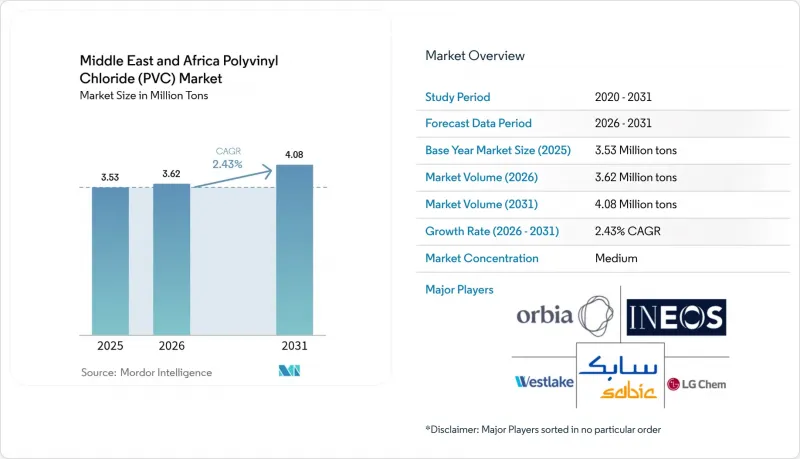
據 Mordor Intelligence 稱,中東和非洲的聚氯乙烯(PVC) 市場預計到 2026 年將達到 362 萬噸,高於 2025 年的 353 萬噸,預計到 2031 年將達到 408 萬噸。
預計 2026 年至 2031 年的複合年成長率為 2.43%。
本報告按產品類型(硬質PVC、軟質PVC、低煙無鹵PVC等)、應用領域(管道及管件、薄膜及片材、電線電纜等)、終端用戶行業(建築施工、汽車及出行等)及地區(沙烏地阿拉伯、阿拉伯聯合大公國、卡達等)進行細分。市場預測以噸為單位。
中東及非洲聚氯乙烯(PVC)市場趨勢及洞察
公共部門基礎設施發展計畫的快速擴張正在推動PVC需求的持續成長。
數十億美元的國家發展願景支撐著中東和非洲聚氯乙烯(PVC)市場的強勁訂單儲備。沙烏地阿拉伯已撥款12億美元用於2024年前的水利基礎設施建設,而NEOM未來城長達數十年的建設計畫也表明,管道、型材和覆層的需求將持續存在。埃及耗資109億美元的蘇伊士運河經濟特區石化綜合體進一步擴大了PVC在公共產業和工業設施等下游領域的應用。長期資金籌措結構降低了需求受原油價格波動的影響,為生產者建立了可預測的基礎。
海水淡化網路的快速擴張正在加速對管道的需求。
海灣合作理事會(GCC)和北非等缺水國家正在擴大海水淡化產能,而這項計畫需要大量的管道。威立雅公司在阿拉伯聯合大公國訂單3.2億美元的項目,以及摩洛哥大西洋沿岸一座日處理能力達82.2萬立方米的海水淡化廠,均指定使用高壓耐鹽水PVC管道。國際海水淡化協會(IDA)預測,到2030年,該地區的海水淡化產能將增加50%,這將直接導致硬質PVC管道的持續消耗。
ESG(環境、社會和治理)壓力的增加以及PVC(可轉讓證券)的逐步淘汰,對經濟成長構成了挑戰。
綠建築認證,例如LEED,以及杜拜的Al Safat等區域認證體系,都在呼籲減少氯基聚合物的使用,這給傳統等級的聚氯乙烯市場轉向生物基替代品。歐盟將於2024年11月生效的0.1%鉛穩定劑含量上限規定,將要求出口商加快開發無鉛配方,進而增加合規成本。
細分市場分析
2025年,在管道和建築相關訂單的推動下,硬質PVC將佔中東和非洲聚氯乙烯(PVC)市場規模的57.70%。隨著建築商尋求符合環境、社會和治理(ESG)標準的替代品,生物基PVC正以2.71%的複合年成長率成長。一體化製造商產能的提升有助於維持該地區的供需平衡,如果可回收添加劑的採用加速,低碳配方產品的佔有率預計從2028年起繼續成長。此細分市場的價格溢價正在提振中東和非洲聚氯乙烯(PVC)市場的整體前景。
利用非食用生質能的第二代生物技術路線可將從搖籃到大門的排放量減少高達 90%,從而幫助海灣合作理事會 (GCC)的大型企劃實現其範圍 3 減排目標。同時,對硬質 PVC 的強勁需求主要來自海水淡化管道和高層建築外觀,這些材料需要耐腐蝕性和結構剛性。隨著無鉛穩定劑技術的成熟,即使在更嚴格的法規下,硬質 PVC 的銷售量預計仍將保持穩定。
其他好處:
- Excel格式的市場預測(ME)表
- 3個月的分析師支持
目錄
第1章:引言
- 研究的先決條件
- 調查範圍
第2章:調查方法
第3章執行摘要
第4章 市場狀況
- 市場概覽
- 市場促進因素
- 公共部門基礎設施發展計畫的快速擴張(海灣合作理事會2030年願景、埃及2030年願景)
- 海水淡化和水資源再利用管網的快速擴張
- 加強電網建設和可再生能源電纜需求激增
- 在中東和非洲 (MEA) 地區的醫療中心(例如杜拜科學園區)擴大醫用級 PVC 的生產能力。
- 促進區域PVC複合材料生產在地採購義務(沙烏地阿拉伯的IKTVA,阿拉伯聯合大公國的ICV)
- 市場限制因素
- 環境、社會及公司治理(ESG)壓力日益增大,以及綠建築標準中逐步淘汰聚氯乙烯(PVC)的條款。
- 原油價格波動導致乙烯和氯氣等原物料價格波動
- 海灣合作理事會和泛非標準未來將禁止使用含鉛穩定劑
- 價值鏈分析
- 監理情勢
- 波特五力模型
第5章 市場規模與成長預測
- 依產品類型
- 硬質PVC
- 軟性聚氯乙烯
- 低煙、無鹵PVC
- 氯化聚氯乙烯(CPVC)
- 生物基聚氯乙烯
- 透過使用
- 管道和配件
- 薄膜
- 電線電纜
- 瓶子和容器
- 型材、軟管、管材
- 其他(玩具、紡織品、3D列印)
- 按最終用戶行業分類
- 建築/施工
- 汽車與出行
- 電氣和電子設備
- 包裝
- 鞋類和休閒服飾
- 醫療保健和生命科學
- 農業和紡織業
- 按地區
- 沙烏地阿拉伯
- 阿拉伯聯合大公國
- 卡達
- 科威特
- 南非
- 埃及
- 奈及利亞
- 摩洛哥
- 其他中東和非洲國家
第6章 競爭情勢
- 市場集中度
- 策略趨勢
- 市佔率和排名分析
- 公司簡介
- Africa PVC Industries Ltd
- Egyptian Petrochemicals Co.(EPC)
- Formosa Plastics Corporation
- INOVYN
- LG Chem
- Neproplast
- Occidental Petroleum Corporation
- Orbia
- Qatar Petrochemical Company(QAPCO)QPJSC
- Reliance Industries Limited.
- SABIC
- SASOL
- Shin-Etsu Chemical Co., Ltd.
- TCI Sanmar Chemicals(SAE)
- Westlake Corporation
第7章 市場機會與未來展望
According to Mordor Intelligence, the middle-East and Africa Polyvinyl Chloride Market size in 2026 is estimated at 3.62 million tons, growing from 2025 value of 3.53 million tons with 2031 projections showing 4.08 million tons, growing at 2.43% CAGR over 2026-2031.
This report is Segmented by Product Type (Rigid PVC, Flexible PVC, Low-Smoke Zero-Halogen PVC, and More), Application (Pipes and Fittings, Films and Sheets, Wires and Cables, and More), End-User Industry (Building and Construction, Automotive and Mobility, and More), and Geography (Saudi Arabia, UAE, Qatar, and More). The Market Forecasts are Provided in Terms of Volume (Tons).
Middle East and Africa Polyvinyl Chloride (PVC) Market Trends and Insights
Booming Public-Sector Infrastructure Programs Drive Sustained PVC Demand
Multi-billion-dollar national visions underpin a robust order book for the Middle-East and Africa Poly Vinyl Chloride (PVC) market. Saudi Arabia allocated USD 1.2 billion to water infrastructure in 2024, and NEOM's multi-decade build-out signals prolonged offtake for conduits, profiles, and cladding. Egypt's USD 10.9 billion Suez Canal Economic Zone petrochemical complex deepens downstream PVC utilization in utilities and industrial structures. Long-term funding structures insulate volumes from oil-price cycles, anchoring a predictable baseline for producers.
Rapid Expansion of Desalination Networks Accelerates Pipe Demand
Water-scarce GCC and North African states are scaling desalination capacity, a pipe-intensive endeavor. Veolia's USD 320 million award in the UAE and Morocco's 822,000 m3/day Atlantic facility both specify high-pressure, saltwater-resistant PVC piping. The International Desalination Association expects regional capacity to climb 50% by 2030, translating directly into sustained rigid-grade consumption.
Escalating ESG Pressure and PVC Phase-Out Clauses Challenge Growth
Green-building certifications, such as LEED and local schemes like Dubai's Al Sa'fat, discourage chlorine-based polymers, pressuring conventional grades and nudging the Middle-East and Africa Poly Vinyl Chloride (PVC) market toward bio-based variants. The European Union's 0.1% lead-stabilizer cap, effective November 2024, requires exporters to accelerate the development of non-lead formulations, thereby increasing compliance costs.
Other drivers and restraints analyzed in the detailed report include:
- Grid-Hardening and Renewable-Energy Cabling Surge
- Medical-Grade PVC Capacity Build-Out in Healthcare Corridors
- Volatile Ethylene and Chlorine Feedstock Pricing Pressures Margins
For complete list of drivers and restraints, kindly check the Table Of Contents.
Segment Analysis
Rigid grades accounted for 57.70% of the Middle-East and Africa Poly Vinyl Chloride (PVC) market size in 2025, driven by pipeline and construction orders. Bio-based PVC advances 2.71% CAGR as builders seek ESG-compliant alternatives. Capacity additions by integrated producers help maintain a balanced regional supply, but the faster adoption of recyclable additives could shift the share toward low-carbon formulations after 2028. The segment's pricing premium supports visibility in the Middle East Africa Poly Vinyl Chloride (PVC) market.
Second-generation bio-routes using non-food biomass cut cradle-to-gate emissions by up to 90%, helping GCC megaprojects meet Scope 3 targets. Rigid's resilience, meanwhile, hinges on desalination pipelines and high-rise facades that demand corrosion resistance and structural rigidity. As lead-free stabilizer technologies mature, rigid grades should defend volume even under stricter codes.
Complete Report Scope:
- By Product Type
- Rigid PVC
- Flexible PVC
- Low-smoke Zero-Halogen PVC
- Chlorinated PVC (CPVC)
- Bio-based PVC
- By Application
- Pipes and Fittings
- Films and Sheets
- Wires and Cables
- Bottles and Containers
- Profiles, Hoses and Tubing
- Others (toys, fabrics, 3-D printing)
- By End-user Industry
- Building and Construction
- Automotive and Mobility
- Electrical and Electronics
- Packaging
- Footwear and Leisurewear
- Healthcare and Life Sciences
- Agriculture and Textiles
- By Geography
- Saudi Arabia
- United Arab Emirates
- Qatar
- Kuwait
- South Africa
- Egypt
- Nigeria
- Morocco
- Rest of Middle-East and Africa
List of Companies Covered in this Report:
- Africa PVC Industries Ltd
- Egyptian Petrochemicals Co. (EPC)
- Formosa Plastics Corporation
- INOVYN
- LG Chem
- Neproplast
- Occidental Petroleum Corporation
- Orbia
- Qatar Petrochemical Company (QAPCO) Q.P.J.S.C
- Reliance Industries Limited.
- SABIC
- SASOL
- Shin-Etsu Chemical Co., Ltd.
- TCI Sanmar Chemicals (S.A.E.)
- Westlake Corporation
Additional Benefits:
- The market estimate (ME) sheet in Excel format
- 3 months of analyst support
TABLE OF CONTENTS
1 Introduction
- 1.1 Study Assumptions
- 1.2 Scope of the Study
2 Research Methodology
3 Executive Summary
4 Market Landscape
- 4.1 Market Overview
- 4.2 Market Drivers
- 4.2.1 Booming public-sector infrastructure programs (GCC Vision 2030, Egypt Vision 2030)
- 4.2.2 Rapid expansion of desalination and water-reuse pipe networks
- 4.2.3 Grid-hardening and renewable-energy cabling demand surge
- 4.2.4 Medical-grade PVC capacity build-out in MEA healthcare corridors (e.g., Dubai Science Park)
- 4.2.5 Local-content mandates driving in-region PVC compounding (Saudi IKTVA, UAE ICV)
- 4.3 Market Restraints
- 4.3.1 Escalating ESG pressure and PVC phase-out clauses in green-building codes
- 4.3.2 Volatile ethylene and chlorine feedstock pricing linked to crude swings
- 4.3.3 Upcoming bans on lead-based stabilisers across GCC and Pan-African standards
- 4.4 Value Chain Analysis
- 4.5 Regulatory Landscape
- 4.6 Porter's Five Forces
- 4.6.1 Bargaining Power of Suppliers
- 4.6.2 Bargaining Power of Buyers
- 4.6.3 Threat of New Entrants
- 4.6.4 Threat of Substitutes
- 4.6.5 Competitive Rivalry
5 Market Size and Growth Forecasts (Volume)
- 5.1 By Product Type
- 5.1.1 Rigid PVC
- 5.1.2 Flexible PVC
- 5.1.3 Low-smoke Zero-Halogen PVC
- 5.1.4 Chlorinated PVC (CPVC)
- 5.1.5 Bio-based PVC
- 5.2 By Application
- 5.2.1 Pipes and Fittings
- 5.2.2 Films and Sheets
- 5.2.3 Wires and Cables
- 5.2.4 Bottles and Containers
- 5.2.5 Profiles, Hoses and Tubing
- 5.2.6 Others (toys, fabrics, 3-D printing)
- 5.3 By End-user Industry
- 5.3.1 Building and Construction
- 5.3.2 Automotive and Mobility
- 5.3.3 Electrical and Electronics
- 5.3.4 Packaging
- 5.3.5 Footwear and Leisurewear
- 5.3.6 Healthcare and Life Sciences
- 5.3.7 Agriculture and Textiles
- 5.4 By Geography
- 5.4.1 Saudi Arabia
- 5.4.2 United Arab Emirates
- 5.4.3 Qatar
- 5.4.4 Kuwait
- 5.4.5 South Africa
- 5.4.6 Egypt
- 5.4.7 Nigeria
- 5.4.8 Morocco
- 5.4.9 Rest of Middle-East and Africa
6 Competitive Landscape
- 6.1 Market Concentration
- 6.2 Strategic Moves
- 6.3 Market Share(%)/Ranking Analysis
- 6.4 Company Profiles (includes Global level Overview, Market level overview, Core Segments, Financials as available, Strategic Information, Market Rank/Share for key companies, Products and Services, and Recent Developments)
- 6.4.1 Africa PVC Industries Ltd
- 6.4.2 Egyptian Petrochemicals Co. (EPC)
- 6.4.3 Formosa Plastics Corporation
- 6.4.4 INOVYN
- 6.4.5 LG Chem
- 6.4.6 Neproplast
- 6.4.7 Occidental Petroleum Corporation
- 6.4.8 Orbia
- 6.4.9 Qatar Petrochemical Company (QAPCO) Q.P.J.S.C
- 6.4.10 Reliance Industries Limited.
- 6.4.11 SABIC
- 6.4.12 SASOL
- 6.4.13 Shin-Etsu Chemical Co., Ltd.
- 6.4.14 TCI Sanmar Chemicals (S.A.E.)
- 6.4.15 Westlake Corporation
7 Market Opportunities and Future Outlook
- 7.1 White-space and Unmet-need Assessment

 2026年全球聚氯乙烯(PVC)穩定劑市場報告
 生物基聚氯乙烯:市場佔有率分析、行業趨勢和統計數據以及成長預測(2026-2031 年)
 PVC回收市場:全球市場預測,2026-2032年PVC穩定劑:市場佔有率分析、產業趨勢與統計、成長預測(2026-2031年)南美洲聚氯乙烯(PVC)市場:市場佔有率分析、產業趨勢與統計及成長預測(2026-2031)壓延PVC(聚氯乙烯)軟性薄膜市場:全球市場預測(2026-2032)聚氯乙烯(PVC):市場佔有率分析、行業趨勢和統計數據、成長預測(2026-2031)2026年全球聚氯乙烯(PVC)防靜電磁磚市場報告
 壓延聚氯乙烯(PVC)軟膜市場規模、佔有率和成長分析:按產品類型、厚度、塑化劑類型、表面處理、應用、最終用途行業和地區分類-2026-2033年產業預測
 全球聚氯乙烯市場規模、佔有率、趨勢和成長分析報告(2026-2034)