


 |
市場調查報告書
商品編碼
2121937
PVC穩定劑:市場佔有率分析、產業趨勢與統計、成長預測(2026-2031年)PVC Stabilizers - Market Share Analysis, Industry Trends & Statistics, Growth Forecasts (2026 - 2031) |
||||||

※ 本網頁內容可能與最新版本有所差異。詳細情況請與我們聯繫。
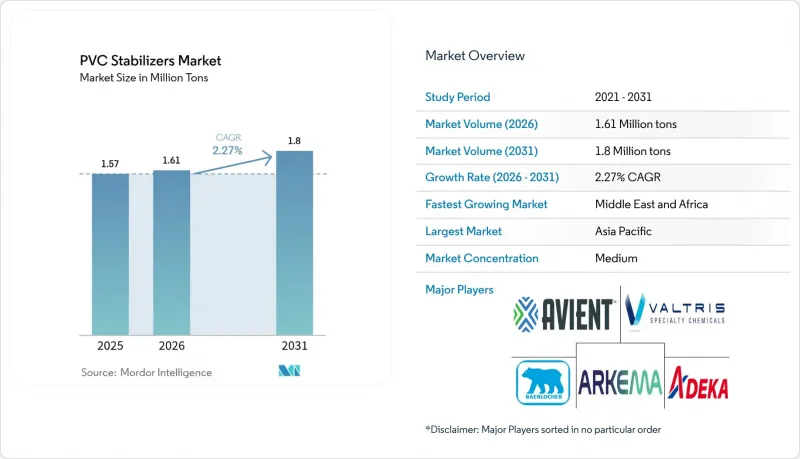
根據 Mordor Intelligence 預測,PVC 穩定劑市場將從 2025 年的 157 萬噸成長到 2026 年的 161 萬噸,然後在 2031 年達到 180 萬噸,2026 年至 2031 年的複合年成長率為 2.27%。
本報告按類型(鈣基、鉛基等)、形態(固體、液體)、應用(管道和管件、電纜和電線等)、終端用戶行業(建築施工、電氣和電子設備等)以及地區(亞太地區、北美地區、歐洲地區、南美地區、中東和非洲地區)進行細分。市場預測以噸為單位。
全球PVC穩定劑市場趨勢及洞察
PVC管材及配件需求激增
印度、泰國、卡達和埃及的水利基礎設施現代化正推動穩定劑的銷售量成長速度超過基礎樹脂的需求。卡達乙烯基公司(Qatar Vinyl)年產35萬噸的生產線將於2025年運作,主要生產灌溉和海水淡化管道,這些管道需要耐紫外線、能承受50°C環境溫度的鈣鋅或有機錫混合物。埃及石化公司(Egypt Petrochemicals)計劃於2026年1月擴建12萬噸產能,以滿足北非地區對符合ISO 1452壓力認證標準的管道的需求。區域供不應求有望為當地穩定劑生產商帶來市場佔有率,因為運輸成本和前置作業時間的優勢足以抵消增加的邊際成本。雖然從鉛穩定劑轉向鈣鋅穩定劑將使成本增加5-8%,但由於其獲準用於飲用水應用,也將在市政競標中獲得10-15%的價格溢價。
監管向鈣/鋅穩定劑過渡
歐盟REACH法規附件十七和RoHS指令2011/65/EU將於2024年有效禁止使用含鉛穩定劑,迫使全球製造商重新設計產品線或退出傳統產品線。中國以出口為導向的加工商已採用鈣鋅混合物以維持市場進入,但國內管道仍依賴鋇鋅混合物,從而形成雙重供應鏈。北美製造商面臨較為寬鬆的聯邦法規,但加州65號提案的標籤要求以及乙烯基協會的努力反映出與歐洲類似的壓力,儘管存在3-5年的時間滯後。美國食品藥物管理局(FDA)仍允許在食品接觸應用中使用有機錫化合物(依據21 CFR 178.2650),從而在醫用薄膜領域維持了甲基錫化合物的利基市場。漫長的研發週期(18-24個月)以及對實驗性擠出製程的投資需求,為考慮使用鈣鋅混合物或無金屬替代品的後進企業設定了很高的准入門檻。
嚴格禁止使用鉛和鄰苯二甲酸酯添加劑
REACH法規第63條和RoHS指令0.1%的鉛閾值規定,將使歐洲在2024年前逐步淘汰電氣和建築應用中的鉛基穩定劑。改用鈣/鋅基穩定劑將使原料成本每噸增加200至400美元,對於價格敏感的管道市場而言,小規模本地混配商很難透過漲價來抵消這一成本。鄰苯二甲酸酯類物質(包括DEHP、DBP、BBP和DIBP)的相關法規要求合作開發不含鄰苯二甲酸酯的塑化劑,這將使產品開發週期延長至兩年。美國各州的法律(例如65號提案和華盛頓州的《更安全產品法案》)進一步增加了全國經銷商的庫存管理難度。即使是目前仍獲FDA批准用於食品接觸用途的有機錫化合物,也面臨更嚴格的毒性審查,這促使人們更早轉向無金屬替代品和鈣/鋅基化合物。
細分市場分析
2025年,鈣基穩定劑將佔據PVC穩定劑市場40.22%的佔有率,這得益於其符合REACH和RoHS雙重標準,以及每噸1800至2200美元的優惠價格。鉛基穩定劑目前僅限於電池隔膜此細分市場,預計2026年至2031年間不會成長。錫基穩定劑在對透明度要求極高的醫用薄膜領域佔據一定佔有率,但由於金屬價格飆升,其成本面臨壓力。鋇鋅穩定劑因其成本和電絕緣性能的平衡而保持需求,但易受中國原料供應中斷的影響。預計到2031年,有機穩定劑將以2.77%的複合年成長率成長,成為成長最快的穩定劑,因為醫療和食品接觸應用領域的加工商正在尋求將金屬浸出量控制在1 ppm以下的無金屬配方。
根據IKA發布的2024年GreenStab報告,市場對不含金屬的苯並三唑和受阻胺穩定劑的需求顯著,其價格溢價高達15-20%。科萊恩2026年的產品系列重組進一步證明,市場正向更高價值的磷基體系轉型。儘管這些措施會導致單位成本上升,但有機PVC穩定劑市場的絕對規模正在擴大,從而形成一個可以抵禦通用鈣基混合物競爭的利基市場。
至2025年,由於雙螺桿生產線和乾混進料系統的廣泛應用,固體穩定劑將佔PVC穩定劑市場佔有率的69.59%。這些系統仍然是管道、窗框型材和電線絕緣等對計量精度和粉塵控制要求極高的行業的標準選擇。然而,每次料斗更換都會造成45分鐘的停機時間,難以保持顏色一致性。
液態PVC穩定劑以2.35%的複合年成長率成長,在地板、汽車薄膜和特殊片材領域市佔率不斷擴大。透過蠕動幫浦一次性添加,可減少20-30%的人工成本,並將ΔE偏差限制在±0.5以內,這對於木紋LVT地板和儀錶板蒙皮至關重要。 Baerlocher計畫於2025年推出液態鈣/鋅產品,BYK的防脫色添加劑也為此成長動能提供了強力支撐。隨著印刷商轉向能夠捕捉細微色調差異的數位油墨,液態穩定劑的市佔率將持續穩定成長,儘管其每公斤成本較高,但仍將逐步提升PVC穩定劑市場的需求。
區域分析
預計到2025年,亞太地區將成為市場主導力量,佔全球總量的51.56%。這主要得益於中國300萬噸的PVC出口量、阿達尼集團和信實集團新增產能帶來的進口依賴度降低,以及印度預計到2026-2027會計年度國內樹脂產量將達到550萬噸。東南亞地區的供應過剩已將價格推至17年來的最低水平,這給利潤率帶來了壓力,同時也刺激了高附加價值管道產品中鈣鋅穩定劑的應用。泰國的產量仍維持在90.6萬噸,使其成為淨進口國,這有利於當地化合物生產商。同時,積水化學計畫於2026年增加CPVC產能,凸顯了東協地區對熱水管道的需求。在日本和韓國等成熟市場,需要增加 15-25% 穩定劑的再生材料配方正在獲得市場認可,儘管建設活動停滯不前,但仍支撐著市場需求。
在北美,住宅屋頂、乙烯基牆板和電動車線束產量的增加維持了基準成長。由於美國食品藥物管理局 (FDA) 批准有機錫化合物用於食品接觸應用,利基市場得以維持;而鈣/鋅的市場佔有率則因加州65號提案的實施而逐步成長。加拿大的CSA B137寒冷氣候管道標準和墨西哥的USMCA在地採購法規正促使複合材料生產商轉向國內穩定劑採購,這為美國生產商帶來了新的機會。
在歐洲,由於鉛禁令的全面實施以及鄰苯二甲酸酯法規導致軟包裝薄膜銷售量進一步下滑,整體成長正在放緩。德國正依據歐盟包裝廢棄物法規推廣再生PVC,要求穩定劑能承受50%的再生粉末而不影響其耐候性。東歐工廠的關閉加劇了區域樹脂供應緊張,導致透過經銷商進口的穩定劑數量增加。斯堪地那維亞的室內空氣品質標準以及南歐對成本的敏感性使情況更加複雜,需要多種選擇,從低排放有機穩定劑到低鈣/鋅配方。
中東和非洲地區複合年成長率最高,達2.36%。卡達的卡達乙烯基計畫和沙烏地阿拉伯的「2030願景」等大型企劃推動了對PVC管材的需求成長,這就要求PVC管材必須具備優異的抗紫外線性能,才能承受50-60°C的工作環境。南非和奈及利亞嚴重依賴進口,這為區域內的其他PVC生產商提供了市場准入機會。
在南美洲,巴西的住宅計畫「我的家,我的生活」(Minha Casa, Minha Vida)及其剩餘的200萬套未開工住房是需求的主要驅動力。儘管外匯波動和錫關稅正在加速向鈣鋅替代品的轉變,但由於當地錫化學品產能有限,從印尼和中國的進口仍在繼續。在阿根廷,財政限制了成長潛力,而在哥倫比亞,管道更換計畫預計將為穩定劑提供雖小但穩定的需求。
其他好處:
- Excel格式的市場預測(ME)表
- 3個月的分析師支持
目錄
第1章:引言
- 研究假設和市場定義
- 調查範圍
第2章:調查方法
第3章執行摘要
第4章 市場狀況
- 市場概覽
- 市場促進因素
- PVC管材及配件需求激增
- 鈣/鋅穩定劑相關法規的轉變
- PVC在輕量化汽車零件的應用日益廣泛
- 新興國家的建築業蓬勃發展
- 再生PVC需要添加更多穩定劑。
- 市場限制因素
- 嚴禁使用鉛和鄰苯二甲酸酯添加劑。
- 錫和鋇原料價格波動
- 醫用級再生聚氯乙烯配方面臨的挑戰
- 價值鏈分析
- 波特五力模型
第5章 市場規模與成長預測
- 按類型
- 鈣基
- 鉛基
- 錫
- 鋇/鋅基
- 有機的
- 按形式
- 固體的
- 液體
- 透過使用
- 管道和配件
- 電纜和電線
- 型材和框架
- 薄膜
- 地板材料和牆壁材料
- 其他
- 按最終用戶行業分類
- 建築/施工
- 電氣和電子設備
- 汽車和交通運輸
- 包裝
- 鞋類
- 醫療器材
- 其他
- 按地區
- 亞太地區
- 中國
- 印度
- 日本
- 韓國
- 馬來西亞
- 泰國
- 印尼
- 越南
- 其他亞太國家
- 北美洲
- 美國
- 加拿大
- 墨西哥
- 歐洲
- 德國
- 英國
- 法國
- 義大利
- 西班牙
- 北歐國家
- 土耳其
- 俄羅斯
- 其他歐洲國家
- 南美洲
- 巴西
- 阿根廷
- 哥倫比亞
- 其他南美國家
- 中東和非洲
- 沙烏地阿拉伯
- 卡達
- 阿拉伯聯合大公國
- 奈及利亞
- 埃及
- 南非
- 其他中東和非洲國家
- 亞太地區
第6章 競爭情勢
- 市場集中度
- 策略趨勢
- 市佔率和排名分析
- 公司簡介
- Adeka Corporation
- Akdeniz Chemson
- Arkema
- Avient Corporation
- Baerlocher GmbH
- Clariant
- Galata Chemicals
- Goldstab Organics Pvt. Ltd
- KD Chem Co. Ltd
- Kunshan Maijisen Composite Materials Co. Ltd
- Mitsubishi Chemical Group Corporation
- Pau Tai Industrial Corp.
- PMC Group Inc.
- Ra Chemicals Pvt. Ltd
- Reagens SpA
- Shandong Jinchangshu New Material Technology Co. Ltd
- SONGWON
- Timah
- Valtris Specialty Chemicals
- Vikas Ecotech Ltd
第7章 市場機會與未來展望
According to Mordor Intelligence, the PVC stabilizers market size is expected to grow from 1.57 Million tons in 2025 to 1.61 Million tons in 2026 and is forecast to reach 1.8 Million tons by 2031 at 2.27% CAGR over 2026-2031.
This report is Segmented by Type (Calcium-Based, Lead-Based, and More), Form (Solid and Liquid), Application (Pipes and Fittings, Cables and Wires, and More), End-User Industry (Building and Construction, Electrical and Electronics, and More), and Geography (Asia-Pacific, North America, Europe, South America, Middle-East and Africa). The Market Forecasts are Provided in Terms of Volume (Tons).
Global PVC Stabilizers Market Trends and Insights
Demand Surge from PVC Pipes and Fittings
Water-infrastructure modernization across India, Thailand, Qatar, and Egypt is lifting stabilizer volumes faster than base-resin demand. Qatar Vinyl's 350,000 tpa line, commissioned in 2025, focuses on irrigation and desalination pipe that needs UV-resistant calcium-zinc or organotin blends capable of withstanding 50 °C ambient temperatures. Egyptian Petrochemicals' 120,000 ton expansion due January 2026 underpins North African pipe demand certified to ISO 1452 pressure standards. Regional supply gaps position localized stabilizer compounders to capture share as freight and lead-time advantages outweigh marginal cost premiums. The pivot from lead to calcium-zinc adds 5-8% to stabilizer cost but unlocks potable-water approvals that command 10-15% price premiums in municipal tenders.
Regulatory Shift to Ca/Zn Stabilizers
EU REACH Annex XVII and RoHS 2011/65/EU effectively barred lead stabilizers by 2024, forcing global producers to redesign portfolios or exit legacy lines. China's export-oriented converters adopted Ca/Zn to preserve market access, while domestic pipes still rely on barium-zinc blends, creating a dual-track supply chain. North American manufacturers face softer federal rules, yet Proposition 65 labeling and Vinyl Institute commitments mirror European pressure with a 3-5-year lag. The U.S. FDA still allows organotin for food contact under 21 CFR 178.2650, maintaining a niche for methyltin in medical films. Long development cycles (18-24 months) and pilot extrusion investments raise barriers for fast followers contemplating Ca/Zn or metal-free alternatives.
Strict Bans on Lead and Phthalate Additives
REACH Entry 63 and RoHS 0.1% thresholds removed lead stabilizers from European electrical and construction use by 2024. Switching to Ca/Zn raises raw-material outlay USD 200-400 per ton, a burden that small regional compounders struggle to offset in price-sensitive pipe markets. Phthalate restrictions spanning DEHP, DBP, BBP, and DIBP oblige co-development of non-phthalate plasticizer packs, stretching product-development cycles by up to two years. U.S. state rules (Prop 65, Safer Products WA) compound inventory-management complexity for distributors shipping nationwide. Even organotin grades, still FDA-cleared for food contact, face mounting toxicology scrutiny that incentivizes an early shift toward metal-free or Ca/Zn alternatives.
Other drivers and restraints analyzed in the detailed report include:
- Rising PVC Use in Lightweight Automotive Parts
- Construction Boom in Emerging Economies
- Price Volatility of Tin and Barium Feedstocks
For complete list of drivers and restraints, kindly check the Table Of Contents.
Segment Analysis
Calcium-based held 40.22% of PVC stabilizer market share in 2025 thanks to dual REACH/RoHS compliance and attractive USD 1,800-2,200 per-ton pricing. Lead systems are now relegated to niche battery separators with virtually no 2026-2031 growth. Tin stabilizers keep a foothold in clarity-critical medical films but face cost pressure from metal spikes. Barium-zinc secures demand through balanced cost and electric-insulation performance yet is hostage to Chinese feedstock disruptions. Organic stabilizers will post the fastest 2.77% CAGR by 2031 as medical and food-contact converters push metal-free formulations that hold leachables below 1 ppm.
Demand for metal-free benzotriazole and hindered-amine packages shows in IKA's 2024 GreenStab release, which fetched 15-20% price premiums. Clariant's 2026 portfolio realignment further signals the migration toward high-value phosphorus-based systems. Such moves expand the absolute PVC stabilizer market size for organics despite higher unit costs, carving out defensible niches against commodity calcium blends.
Solid stabilizers controlled 69.59% of the PVC stabilizer market in 2025 because twin-screw lines and dry-blend feed systems are ubiquitous. They remain the default in pipe, window profiles, and wire insulation where dosing accuracy and dust reduction matter. Yet each hopper changeover extends downtime by 45 min and complicates color consistency.
Liquid grades, growing at 2.35% CAGR, win share in flooring, automotive films, and specialty sheets. One-shot dosing through peristaltic pumps trims labor 20-30% and tightens ΔE variation to +-0.5, critical for wood-grain LVT and dashboard skins. Baerlocher's 2025 liquid Ca/Zn launch and BYK's plate-out-free additives underscore momentum. As printers migrate to digital inks that reveal even minor shade drift, liquid systems' share will keep edging upward, adding incremental PVC stabilizer market demand despite higher per-kilo costs.
Complete Report Scope:
- By Type
- Calcium-based
- Lead-based
- Tin-based
- Barium/Zinc-based
- Organic-based
- By Form
- Solid
- Liquid
- By Application
- Pipes and Fittings
- Cables and Wires
- Profiles and Frames
- Films and Sheets
- Flooring and Wall Coverings
- Other Applications
- By End-user Industry
- Building and Construction
- Electrical and Electronics
- Automotive and Transportation
- Packaging
- Footwear
- Medical Devices
- Other End-user Industries
- By Geography
- Asia-Pacific
- China
- India
- Japan
- South Korea
- Malaysia
- Thailand
- Indonesia
- Vietnam
- Rest of Asia-Pacific
- North America
- United States
- Canada
- Mexico
- Europe
- Germany
- United Kingdom
- France
- Italy
- Spain
- NORDIC Countries
- Turkey
- Russia
- Rest of Europe
- South America
- Brazil
- Argentina
- Colombia
- Rest of South America
- Middle-East and Africa
- Saudi Arabia
- Qatar
- United Arab Emirates
- Nigeria
- Egypt
- South Africa
- Rest of Middle-East and Africa
- Asia-Pacific
Geography Analysis
Asia-Pacific dominated with 51.56% of global volume in 2025, propelled by China's 3 million-ton PVC exports and India's climb toward 5.5 million tons of domestic resin by FY 2026-27 as new Adani and Reliance capacity cuts import dependence. Regional oversupply depressed Southeast Asian prices to 17-year lows, pressuring margins yet stimulating Ca/Zn adoption in value-added pipes. Thailand's 906,000-ton output still leaves it a net importer, favoring local compounders, while Sekisui's CPVC capacity hike in 2026 validates hot-water pipe demand across ASEAN. Mature Japan and South Korea emphasize recycled-content blends that need 15-25% more stabilizer, propping volumes despite static construction activity.
In North America, U.S. residential re-roofing and vinyl siding, plus expanding EV harness output, keep baseline growth intact. FDA acceptance of organotin in food contact preserves a niche, while Prop 65 nudges Ca/Zn share higher. Canada's CSA B137 cold-climate pipe codes and Mexico's USMCA localization rules steer compounders toward domestic stabilizer sourcing, widening prospects for U.S. producers.
In Europe, lead bans are complete, and phthalate curbs bite further into flexible-film volumes, tempering overall growth. Germany champions recycled-content PVC under EU Packaging Waste rules, requiring stabilizers that tolerate 50% regrind without losing weatherability. Eastern Europe plant closures tighten regional resin, favoring imported stabilizer volumes through distributors. Scandinavia's indoor-air standards and Southern Europe's cost sensitivity add complexity, demanding a menu from low-emission organics to bare-bones Ca/Zn.
The Middle-East and Africa represent the fastest regional CAGR at 2.36%. Qatar Vinyl and Saudi Vision 2030 megaprojects scale PVC pipe demand that calls for UV-robust stabilizers able to handle 50-60 °C service. South Africa and Nigeria rely heavily on imports, offering market entry for regional formulators.
South America leans on Brazil's Minha Casa, Minha Vida housing program and its two-million-unit backlog. Currency gyrations and tin tariffs accelerate Ca/Zn substitution, yet limited local tin-chemical capacity sustains import flows from Indonesia and China. Argentina's fiscal constraints cap upside, while Colombia's pipe upgrades provide a steady, if modest, pull-on stabilizer supply.
- Adeka Corporation
- Akdeniz Chemson
- Arkema
- Avient Corporation
- Baerlocher GmbH
- Clariant
- Galata Chemicals
- Goldstab Organics Pvt. Ltd
- KD Chem Co. Ltd
- Kunshan Maijisen Composite Materials Co. Ltd
- Mitsubishi Chemical Group Corporation
- Pau Tai Industrial Corp.
- PMC Group Inc.
- Ra Chemicals Pvt. Ltd
- Reagens SpA
- Shandong Jinchangshu New Material Technology Co. Ltd
- SONGWON
- Timah
- Valtris Specialty Chemicals
- Vikas Ecotech Ltd
Additional Benefits:
- The market estimate (ME) sheet in Excel format
- 3 months of analyst support
TABLE OF CONTENTS
1 Introduction
- 1.1 Study Assumptions and Market Definition
- 1.2 Scope of the Study
2 Research Methodology
3 Executive Summary
4 Market Landscape
- 4.1 Market Overview
- 4.2 Market Drivers
- 4.2.1 Demand Surge from PVC Pipes and Fittings
- 4.2.2 Regulatory Shift to Ca/Zn Stabilizers
- 4.2.3 Rising PVC Use in Lightweight Automotive Parts
- 4.2.4 Construction Boom in Emerging Economies
- 4.2.5 Recycled PVC Requires Higher Stabilizer Loadings
- 4.3 Market Restraints
- 4.3.1 Strict Bans on Lead and Phthalate Additives
- 4.3.2 Price Volatility of Tin and Barium Feedstocks
- 4.3.3 Formulation Challenges for Medical-Grade Recycled PVC
- 4.4 Value Chain Analysis
- 4.5 Porter's Five Forces
- 4.5.1 Bargaining Power of Suppliers
- 4.5.2 Bargaining Power of Buyers
- 4.5.3 Threat of New Entrants
- 4.5.4 Threat of Substitute Products
- 4.5.5 Degree of Competition
5 Market Size and Growth Forecasts (Volume)
- 5.1 By Type
- 5.1.1 Calcium-based
- 5.1.2 Lead-based
- 5.1.3 Tin-based
- 5.1.4 Barium/Zinc-based
- 5.1.5 Organic-based
- 5.2 By Form
- 5.2.1 Solid
- 5.2.2 Liquid
- 5.3 By Application
- 5.3.1 Pipes and Fittings
- 5.3.2 Cables and Wires
- 5.3.3 Profiles and Frames
- 5.3.4 Films and Sheets
- 5.3.5 Flooring and Wall Coverings
- 5.3.6 Other Applications
- 5.4 By End-user Industry
- 5.4.1 Building and Construction
- 5.4.2 Electrical and Electronics
- 5.4.3 Automotive and Transportation
- 5.4.4 Packaging
- 5.4.5 Footwear
- 5.4.6 Medical Devices
- 5.4.7 Other End-user Industries
- 5.5 By Geography
- 5.5.1 Asia-Pacific
- 5.5.1.1 China
- 5.5.1.2 India
- 5.5.1.3 Japan
- 5.5.1.4 South Korea
- 5.5.1.5 Malaysia
- 5.5.1.6 Thailand
- 5.5.1.7 Indonesia
- 5.5.1.8 Vietnam
- 5.5.1.9 Rest of Asia-Pacific
- 5.5.2 North America
- 5.5.2.1 United States
- 5.5.2.2 Canada
- 5.5.2.3 Mexico
- 5.5.3 Europe
- 5.5.3.1 Germany
- 5.5.3.2 United Kingdom
- 5.5.3.3 France
- 5.5.3.4 Italy
- 5.5.3.5 Spain
- 5.5.3.6 NORDIC Countries
- 5.5.3.7 Turkey
- 5.5.3.8 Russia
- 5.5.3.9 Rest of Europe
- 5.5.4 South America
- 5.5.4.1 Brazil
- 5.5.4.2 Argentina
- 5.5.4.3 Colombia
- 5.5.4.4 Rest of South America
- 5.5.5 Middle-East and Africa
- 5.5.5.1 Saudi Arabia
- 5.5.5.2 Qatar
- 5.5.5.3 United Arab Emirates
- 5.5.5.4 Nigeria
- 5.5.5.5 Egypt
- 5.5.5.6 South Africa
- 5.5.5.7 Rest of Middle-East and Africa
- 5.5.1 Asia-Pacific
6 Competitive Landscape
- 6.1 Market Concentration
- 6.2 Strategic Moves
- 6.3 Market Share(%)/Ranking Analysis
- 6.4 Company Profiles (includes Global Overview, Market Overview, Core Segments, Financials, Strategic Information, Products and Services, Recent Developments)
- 6.4.1 Adeka Corporation
- 6.4.2 Akdeniz Chemson
- 6.4.3 Arkema
- 6.4.4 Avient Corporation
- 6.4.5 Baerlocher GmbH
- 6.4.6 Clariant
- 6.4.7 Galata Chemicals
- 6.4.8 Goldstab Organics Pvt. Ltd
- 6.4.9 KD Chem Co. Ltd
- 6.4.10 Kunshan Maijisen Composite Materials Co. Ltd
- 6.4.11 Mitsubishi Chemical Group Corporation
- 6.4.12 Pau Tai Industrial Corp.
- 6.4.13 PMC Group Inc.
- 6.4.14 Ra Chemicals Pvt. Ltd
- 6.4.15 Reagens SpA
- 6.4.16 Shandong Jinchangshu New Material Technology Co. Ltd
- 6.4.17 SONGWON
- 6.4.18 Timah
- 6.4.19 Valtris Specialty Chemicals
- 6.4.20 Vikas Ecotech Ltd
7 Market Opportunities and Future Outlook
- 7.1 White-space and Unmet-need Assessment

 2026年全球聚氯乙烯(PVC)穩定劑市場報告
 生物基聚氯乙烯:市場佔有率分析、行業趨勢和統計數據以及成長預測(2026-2031 年)
 PVC回收市場:全球市場預測,2026-2032年南美洲聚氯乙烯(PVC)市場:市場佔有率分析、產業趨勢與統計及成長預測(2026-2031)壓延PVC(聚氯乙烯)軟性薄膜市場:全球市場預測(2026-2032)聚氯乙烯(PVC):市場佔有率分析、行業趨勢和統計數據、成長預測(2026-2031)中東和非洲聚氯乙烯(PVC)市場:市場佔有率分析、行業趨勢和統計數據以及成長預測(2026-2031 年)2026年全球聚氯乙烯(PVC)防靜電磁磚市場報告
 壓延聚氯乙烯(PVC)軟膜市場規模、佔有率和成長分析:按產品類型、厚度、塑化劑類型、表面處理、應用、最終用途行業和地區分類-2026-2033年產業預測
 全球聚氯乙烯市場規模、佔有率、趨勢和成長分析報告(2026-2034)