


 |
市場調查報告書
商品編碼
2120648
聚氯乙烯(PVC):市場佔有率分析、行業趨勢和統計數據、成長預測(2026-2031)Polyvinyl Chloride (PVC) - Market Share Analysis, Industry Trends & Statistics, Growth Forecasts (2026 - 2031) |
||||||

※ 本網頁內容可能與最新版本有所差異。詳細情況請與我們聯繫。
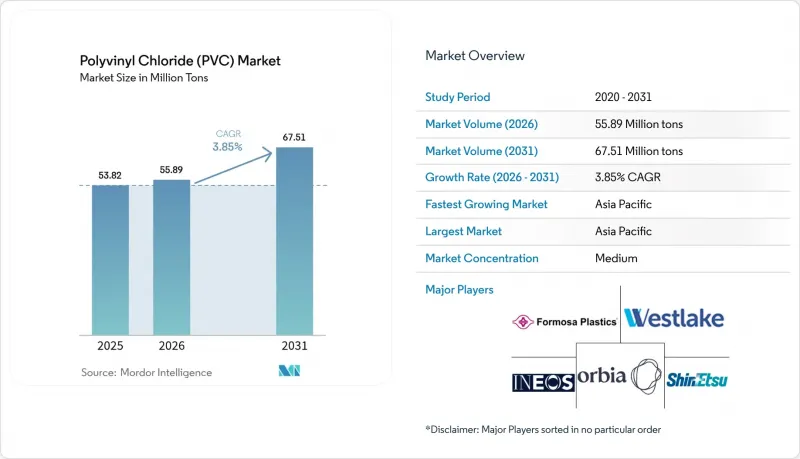
根據 Mordor Intelligence 預測,聚氯乙烯(PVC) 市場將從 2025 年的 5,382 萬噸成長到 2026 年的 5,589 萬噸,然後在 2031 年達到 6,751 萬噸,2026 年至 2031 年的複合年成長率為 3.85%。
本報告按產品類型(硬質PVC、軟質PVC等)、製造程序(懸浮PVC、乳液PVC等)、穩定劑類型(鈣基穩定劑、鉛基穩定劑等)、應用(管道和配件、瓶子等)、最終用戶行業(建築和施工、包裝等)和地區(亞太地區、北美等)對行業進行分類。
全球聚氯乙烯(PVC)市場趨勢與洞察
特殊目的收購公司(SPAC)資金籌措的特大城市城市基礎設施快速擴張
亞洲特大城市對防洪和供水網路的持續投資,推動了直徑超過2公尺的大口徑PVC管道的普及,這與傳統的住宅管道直徑截然不同。印度和印尼的計畫表明,將聲學洩漏檢測技術整合到PVC管道中,能夠幫助供水事業延長管道使用壽命,同時減少無收益水損失。此外,各國政府將應對氣候變遷的資金與耐用材料掛鉤,這使得PVC管道比球墨鑄鐵和混凝土更受青睞。因此,能夠承受更高壓力和更惡劣地質條件的優質產品,其利潤率高於普通管道。波灣合作理事會成員國類似的基建投資計畫表明,未來十年,這種需求將蔓延至中東地區。
一次性醫療設備的激增推動了對不含DEHP的PVC化合物的需求。
為因應加州計畫於2030年禁用鄰苯二甲酸二(2-乙基己基)酯(DEHP),北美加工商正擴大採用DOTP增塑聚氯乙烯(PVC)作為血袋、輸液器和腹膜透析管的標準材料。例如,泰諾Apex公司已將一種低萃取率的APEX醫用化合物商業化,該化合物滿足柔軟性要求,且不存在生殖毒性問題。同時,歐盟將DEHP禁令延後至2030年中期,這為已獲得無鄰苯二甲酸酯配方再認證的供應商帶來了先發優勢。由於醫院採購預算能夠輕鬆承擔增加的合規成本,一個高階利基市場正在形成,從而保護了特種PVC產品免受商品化循環的影響。
歐盟REACH法規和印度BIS法規加速實施對含鉛穩定劑的禁令
歐盟第923/2023號法規自2026年1月起將PVC產品中的鉛含量限制在0.1wt%。印度標準局(BIS)也採用了類似的標準。雖然改用鈣鋅穩定劑在環保方面是可取的,但它會縮小加工容差範圍並降低介電強度,從而帶來挑戰,尤其對於電線電纜等級的產品而言。擁有取得專利的添加劑配方的公司具有價格優勢,但研發資源不足的中小型擠出製造商則面臨產品認證延遲的問題。在價格敏感的市場中,成本轉嫁仍然困難重重,這擠壓了利潤空間,並推動了產業整合。
細分市場分析
到2025年,硬質PVC將佔據聚氯乙烯市場61.40%的佔有率,其主要應用領域包括建築型材、窗框和基礎設施管道。標準化的模具、豐富的原料供應以及成本效益高的批量生產,為其生產規模優勢提供了支撐。同時,儘管CPVC的市佔率仍將維持在個位數,但由於其在飯店、醫院和資料中心冷熱水系統中優異的耐熱性,預計到2031年將以4.55%的複合年成長率成為市場成長最快的產品。 CPVC的性能優勢使其價格比硬質PVC高出兩位數,從而保護生產商免受聚氯乙烯市場商品價格波動的影響。柔軟性PVC繼續應用於醫用袋、汽車內飾和家用軟管等領域,DOTP和檸檬酸鹽基塑化劑的技術進步解決了監管方面的擔憂,使其在這些領域的應用得以延續。低菸、無鹵PVC的各種變體正在為城市軌道交通和公共基礎設施佈線領域開闢新的成長機遇,這些領域的消防安全標準日益嚴格。
一個顯著的連鎖反應是CPVC共混物的開發。這些共混物能夠在管中管結構中逐步提高耐熱性,而無需承擔純CPVC的全部成本。製造商正利用這些混合產品來擴展產品系列,並承接超出標準溫度限制的項目。同時,硬質PVC供應商正透過銷售採用發泡芯材和抗衝擊改質表層的共擠管道來應對CPVC的崛起,旨在減輕重量並減少樹脂消耗。這些創新共同維持了整個聚氯乙烯市場的競爭,即使一些專業細分市場要求更高的價格。
到2025年,懸浮聚合將佔總產量的74.30%,這反映了其無與倫比的規模經濟效益和與添加劑的廣泛兼容性。大多數建築樹脂均採用年產能超過30萬噸的懸浮聚合生產線生產,在整個聚氯乙烯市場中佔據成本領先地位。同時,乳液型聚氯乙烯(PVC)儘管規模較小,但預計將以4.38%的小規模成長,這得益於其精細顆粒形態的優勢,使其能夠生產高精度壓延薄膜和醫用導管。乳液型PVC工廠固有的小規模和高柔軟性使其能夠快速轉型,進入高利潤的細分市場,例如透明採血膜和電動車內飾用合成皮革。
供應商正利用製程的多樣性來實現差異化。一體化製造商經營懸浮液和乳液製程的生產設施,並透過打包供應合約和技術服務,確保其擁有能夠在通用應用和特殊應用之間靈活轉換的加工能力。本體聚合雖然規模有限,但被用於對純度要求極高的應用領域,例如半導體潔淨室的面板材料,這類材料必須最大限度地減少萃取物。隨著法規和終端用戶需求的日益嚴格,製程多元化在保護收入來源和緩解聚氯乙烯(PVC) 市場的價格波動方面發揮著重要作用。
區域分析
預計到2025年,亞太地區將維持其在聚氯乙烯(PVC)市場59.40%的主導地位,並在2031年之前以4.21%的複合年成長率成長。中國決定將PVC進口關稅提高至5.5%,凸顯了其致力於推動懸浮液和膏狀PVC生產線技術升級的決心,同時也著力發揮其國內每年3000萬噸的名義產能。印度的「飲用水生命線計畫」(Jal Jeevan Mission)正在農村飲用水網路建設方面投入創紀錄的資金,以支持對大口徑PVC管道的需求並促進洩漏檢測基礎設施的建設。泰國從2029年起進口美國乙烷,這將使泰國的原料多元化成為可能,並確保東南亞加工商的成本競爭力。同時,區域生產商正在投資建造PVC回收工廠,生產符合出口標準的經認證的用於建材的再生樹脂。
在北美,基礎設施現代化支出正與電動車組裝投資的成長相平衡。信越化學在路易斯安那州投資12.5億美元的瓶頸治理項目以及台塑在巴吞魯日的擴建項目,將在2025年至2027年間,根據《暫停法案》,每年新增超過80萬噸的產能。取得環境許可仍然十分嚴格,要求業者採用鹽水萃取和氯乙烯單體減量技術。隨著各州逐步淘汰鄰苯二甲酸二辛酯(DEHP),美國化合物生產商正在加快交付不含鄰苯二甲酸酯的產品,從而提高每噸產品的價值,並緩解動蕩的建築市場帶來的低迷。
歐洲面臨世界上最嚴格的添加劑法規,這推動了對鈣鋅穩定劑生產的資本投資,同時也加速了可回收單一材料型材的研發。 VinylPlus提前五年實現了其自願回收目標,使其在該地區生產的PVC型材中的再生材料含量超過20%。同時,由於電價飆升,區域生產商的產量有所下降,他們正從美國墨西哥灣沿岸的工廠出口PVC,以補充與歐洲的合約。在經合組織市場之外,南美洲和非洲正在尋求聚合物自給自足。巴西的甘蔗乙烯計畫為PVC生產提供了一條獨特的低碳路線,而奈及利亞正在考慮投資氯鹼計畫以減少其進口依賴。政治和外匯波動仍然是一個障礙,但基礎設施不足無疑是聚氯乙烯市場亟待解決的問題。
其他好處:
- Excel格式的市場預測(ME)表
- 3個月的分析師支持
目錄
第1章:引言
- 研究假設和市場定義
- 調查範圍
第2章:調查方法
第3章執行摘要
第4章 市場狀況
- 市場概覽
- 市場促進因素
- 亞洲各地SPAC主導的特大城市城市基礎建設快速擴張
- 在北美和歐洲,對一次性醫療設備的需求激增,使得人們對不含DEHP的PVC化合物產生了興趣。
- 對水質淨化基礎設施的需求不斷成長:
- 在電動車生產中,汽車製造商正轉向使用輕質、柔軟性的PVC內部裝潢建材。
- 美國和歐盟生產商整合氯氣和鹼氣生產能力,正在降低PVC的生產成本。
- 市場限制因素
- 根據歐盟 REACH 法規和印度 BIS 標準禁止使用含鉛穩定劑的趨勢正在加速。
- 品牌所有者努力使用不含鄰苯二甲酸酯的包裝,這降低了對傳統軟性PVC的需求。
- 受原油價格變動的影響,乙烯價格波動,對利潤率造成壓力。
- 價值鏈分析
- 監理展望
- 波特五力模型
第5章 市場規模與成長預測
- 依產品類型
- 硬質PVC
- 透明硬質PVC
- 不透明硬質PVC
- 軟PVC
- 透明軟性PVC
- 不透明軟性PVC
- 低煙PVC
- 氯化聚氯乙烯(CPVC)
- 硬質PVC
- 透過製造程序
- 懸掛式PVC
- 乳化PVC
- 本體/大塊聚合聚氯乙烯
- 穩定器的類型
- 鈣基穩定劑(鈣鋅穩定劑)
- 鉛基穩定劑(Pb穩定劑)
- 錫和有機錫化合物(錫穩定劑)
- 鋇基及其他穩定劑型式(液態混合金屬)
- 透過使用
- 管道和配件
- 薄膜
- 電線電纜
- 瓶子
- 型材、軟管、管材
- 其他用途
- 按最終用戶行業分類
- 建築/施工
- 汽車和運輸業
- 電氣和電子設備
- 包裝
- 鞋類
- 衛生保健
- 其他終端用戶產業
- 按地區
- 亞太地區
- 中國
- 印度
- 日本
- 韓國
- 其他亞太國家
- 北美洲
- 美國
- 加拿大
- 墨西哥
- 歐洲
- 德國
- 英國
- 義大利
- 法國
- 西班牙
- 其他歐洲國家
- 南美洲
- 巴西
- 阿根廷
- 其他南美國家
- 中東和非洲
- 沙烏地阿拉伯
- 南非
- 奈及利亞
- 其他中東和非洲國家
- 亞太地區
第6章 競爭情勢
- 市場集中度
- 策略趨勢
- 市佔率分析
- 公司簡介
- Aditya Birla Chemicals
- China National Bluestar(Group)Co, Ltd.
- Ercros, SA
- Formosa Plastics Corporation
- Hanwha Solutions
- INEOS
- Inner Mongolia Junzheng Energy & Chemical Group Co., Ltd.
- Kem One SAS
- LG Chem
- Occidental Petroleum Corporation
- Orbia
- Reliance Industries Limited
- SABIC
- Shaanxi Coal & Chemical Industry Group Co., Ltd.
- Shin-Etsu Chemical Co., Ltd.
- Tianye Group
- Westlake Corporation
- Xinjiang Zhongtai Chemical Co., Ltd.
第7章 市場機會與未來展望
According to Mordor Intelligence, the polyvinyl chloride market size is expected to grow from 53.82 Million tons in 2025 to 55.89 Million tons in 2026 and is forecast to reach 67.51 Million tons by 2031 at 3.85% CAGR over 2026-2031.
This report Segments the Industry by Product Type (Rigid PVC, Flexible PVC, and More), Manufacturing Process (Suspension PVC, Emulsion PVC, and More), Stabilizer Type (Calcium-Based Stabilizers, Lead-Based Stabilizers, and More), Application (Pipes and Fittings, Bottles, and More), End-User Industry (Building and Construction, Packaging, and More), and Geography (Asia-Pacific, North America, and More).
Global Polyvinyl Chloride (PVC) Market Trends and Insights
Rapid Urban Infrastructure Expansion in SPAC-Financed Megacities
Continued spending on flood management and potable-water grids in Asia's megacities drives specification of large-diameter PVC pipes exceeding 2m, a departure from legacy residential bore sizes. Projects in India and Indonesia illustrate how acoustic leak-detection technology embedded in PVC piping allows utilities to address non-revenue water losses while extending asset life. Governments also link climate-resilience funding to materials with long service lives, which favors PVC over ductile iron or concrete. As a result, premium grades capable of handling higher pressures and aggressive soil conditions obtain stronger margins than commodity pipe. Similar infrastructure commitments across Gulf Cooperation Council states suggest spill-over demand into the Middle East over the next decade.
Surge in Single-Use Medical Devices Favoring DEHP-Free PVC Compounds
California's impending DEHP ban in 2030 prompted North American converters to adopt DOTP-plasticized PVC as the default choice for blood bags, IV sets, and peritoneal-dialysis tubing. Teknor Apex, for instance, commercialized low-extractable APEX medical compounds that match flexibility targets without reproductive-toxicity concerns. Simultaneously, EU postponement of its own DEHP prohibition until mid-2030 offers first-mover advantage to suppliers that have already re-qualified with phthalate-free formulations. Higher compliance costs are readily absorbed by hospital procurement budgets, rounding out a premium niche that shields specialty PVC grades from commodity cycles.
Accelerating Bans on Lead-Based Stabilizers under EU REACH and Indian BIS
EU Regulation 923/2023 limits total lead content in PVC articles to 0.1 wt% starting January 2026. The same threshold is being replicated by India's Bureau of Indian Standards. Re-formulation to calcium-zinc stabilizers, while environmentally favorable, reduces processing windows and can lower dielectric strength-posing particular issues for wire and cable grades. Companies with patented synergistic additive packages secure a pricing premium, yet smaller extruders lacking R&D scale face qualification delays. Cost pass-through remains challenging in price-sensitive markets, compressing margins and encouraging consolidation.
Other drivers and restraints analyzed in the detailed report include:
- Rising Demand for Clean-Water Infrastructure
- OEM Shift Toward Lightweight Flexible PVC Interiors in Electric Vehicles
- Brand-Owner Push for Phthalate-Free Packaging Diminishing Conventional Flexible PVC Demand
For complete list of drivers and restraints, kindly check the Table Of Contents.
Segment Analysis
Rigid PVC accounted for 61.40% of polyvinyl chloride market share in 2025, anchored by construction profiles, window frames, and infrastructure pipe. Volume leadership rests on standardized tooling, wide raw-material availability, and cost-efficient mass production. However, CPVC-while representing a single-digit share-shows the strongest 4.55% CAGR to 2031 thanks to superior temperature tolerance for hot-and-cold potable systems in hotels, hospitals, and data centers. CPVC's performance premium permits double-digit price differentials that cushion producers from commodity swings in the polyvinyl chloride market. Flexible PVC continues to serve medical bags, vehicle interiors, and consumer hoses; advances in DOTP and citrate plasticizers resolve regulatory scrutiny, retaining these applications. Low-smoke zero-halogen PVC variants further unlock growth in metro-rail and public-venue cabling where fire-safety codes tighten.
A notable spill-over effect involves CPVC blends that deliver incremental heat resistance in pipe-in-pipe installations without the full cost of neat CPVC. Producers exploit these hybrids to extend product portfolios and capture projects beyond standard temperature thresholds. Meanwhile, rigid PVC suppliers counter CPVC's rise by marketing co-extruded pipes with foam cores or impact-modified skins that reduce weight and resin consumption. These innovations collectively sustain competition across the polyvinyl chloride market even as specialized niches attract premium pricing.
Suspension polymerization delivered 74.30% of 2025 volume, reflecting unmatched economies of scale and broad compatibility with additives. Most construction-grade resins stem from suspension lines exceeding 300 kt/yr, enabling cost leadership across the polyvinyl chloride market. Yet emulsion PVC, while holding a modest base, is forecast for a 4.38% CAGR driven by its fine-particle morphology which supports high-definition calendared films and medical-grade tubing. Emulsion plants are inherently smaller and more flexible, allowing rapid grade switches toward higher-margin niches such as transparent blood-collection film or synthetic leather for EV interiors.
Suppliers use process versatility as a differentiation lever. Integrated producers operate both suspension and emulsion assets, bundling supply contracts and technical services to lock in converters shifting between commodity and specialty applications. Bulk polymerization, although limited, serves ultra-high-purity segments like semiconductor clean-room paneling where extractables must be minimized. As regulatory and end-user demands become more exacting, process diversification protects revenue streams and tempers price volatility in the polyvinyl chloride market.
Complete Report Scope:
- By Product Type
- Rigid PVC
- Clear Rigid PVC
- Non-clear Rigid PVC
- Flexible PVC
- Clear Flexible PVC
- Non-clear Flexible PVC
- Low-Smoke PVC
- Chlorinated PVC (CPVC)
- Rigid PVC
- By Manufacturing Process
- Suspension PVC
- Emulsion PVC
- Bulk/Mass Polymerized PVC
- By Stabilizer Type
- Calcium-based Stabilizers (Ca-Zn Stabilizers)
- Lead-based Stabilizers (Pb Stabilizers)
- Tin and Organotin-based (Sn Stabilizers)
- Barium-based and Other Stabilizer Types (Liquid Mixed Metals)
- By Application
- Pipes and Fittings
- Films and Sheets
- Wires and Cables
- Bottles
- Profiles, Hoses and Tubings
- Other Applications
- By End-User Industry
- Building and Construction
- Automotive and Transportation
- Electrical and Electronics
- Packaging
- Footwear
- Healthcare
- Other End-User Industries
- By Geography
- Asia-Pacific
- China
- India
- Japan
- South Korea
- Rest of Asia-Pacific
- North America
- United States
- Canada
- Mexico
- Europe
- Germany
- United Kingdom
- Italy
- France
- Spain
- Rest of Europe
- South America
- Brazil
- Argentina
- Rest of South America
- Middle East and Africa
- Saudi Arabia
- South Africa
- Nigeria
- Rest of Middle East and Africa
- Asia-Pacific
Geography Analysis
Asia-Pacific preserved a commanding 59.40% share of the polyvinyl chloride market in 2025 and is forecasting a 4.21% CAGR to 2031. China's decision to raise PVC import tariffs to 5.5% underscores a policy focus on utilizing its 30 million t/yr domestic nameplate capacity while encouraging technological upgrades in suspension and paste lines. India's Jal Jeevan Mission funnels record capital into rural drinking-water networks, supporting large-bore PVC pipe demand alongside leak-detection infrastructure. Thailand's feedstock diversification, enabled by US ethane imports from 2029, secures cost competitiveness for Southeast Asian converters. In parallel, regional producers invest in vinyl recycling plants that create certified post-consumer resin for export-compliant building products.
North America balances infrastructure-renewal spending with rising EV assembly investments. Shin-Etsu's USD 1.25 billion Louisiana debottlenecking project and Formosa's Baton Rouge expansion add over 800 kt/yr of new suspension capacity between 2025 and 2027. Environmental permitting remains strict, compelling operators to integrate brine mining and vinyl chloride monomer emissions-reduction technology. As state regulations phase out DEHP, US compounders expedite phthalate-free offerings, thereby raising value per tonne and cushioning the cyclical construction market.
Europe endures the world's most stringent additive rules, driving capital toward calcium-zinc stabilizer production while accelerating R&D on recyclable mono-material profiles. VinylPlus exceeded its 2025 voluntary recycling target five years early, lifting the region's recycled-content rate in PVC profiles above 20%. Meanwhile, regional producers operate at reduced run-rates when power prices spike, exporting PVC from US Gulf Coast plants to backfill European contract commitments. Beyond OECD markets, South America and Africa seek polymer self-sufficiency; Brazil's sugar-cane-based ethylene project signifies a differentiated low-carbon route to PVC, while Nigeria evaluates chlor-alkali investments to reduce import reliance. Political and currency volatility remains a hurdle, yet infrastructure deficits present an undeniable addressable need for the polyvinyl chloride market.
- Aditya Birla Chemicals
- China National Bluestar (Group) Co,Ltd.
- Ercros, S.A.
- Formosa Plastics Corporation
- Hanwha Solutions
- INEOS
- Inner Mongolia Junzheng Energy & Chemical Group Co., Ltd.
- Kem One SAS
- LG Chem
- Occidental Petroleum Corporation
- Orbia
- Reliance Industries Limited
- SABIC
- Shaanxi Coal & Chemical Industry Group Co., Ltd.
- Shin-Etsu Chemical Co., Ltd.
- Tianye Group
- Westlake Corporation
- Xinjiang Zhongtai Chemical Co., Ltd.
Additional Benefits:
- The market estimate (ME) sheet in Excel format
- 3 months of analyst support
TABLE OF CONTENTS
1 Introduction
- 1.1 Study Assumptions and Market Definition
- 1.2 Scope of the Study
2 Research Methodology
3 Executive Summary
4 Market Landscape
- 4.1 Market Overview
- 4.2 Market Drivers
- 4.2.1 Rapid Urban Infrastructure Expansion in SPAC-Driven Megacities across Asia
- 4.2.2 Surge in Single-Use Medical Devices Favoring DEHP-Free PVC Compounds in North America and Europe
- 4.2.3 Rising Demand for Clean Water Infrastructure:
- 4.2.4 OEM Shift Toward Lightweight Flexible PVC Interiors in Electric Vehicles Produced
- 4.2.5 Chlor-Alkali Capacity Integration by Producers in the US and EU Lowering PVC Production Costs
- 4.3 Market Restraints
- 4.3.1 Accelerating Bans on Lead-Based Stabilizers under EU REACH and Indian BIS Standards
- 4.3.2 Brand-Owner Push for Phthalate-Free Packaging Diminishing Conventional Flexible PVC Demand
- 4.3.3 Ethylene Price Volatility Linked to Crude-Oil Fluctuations Compressing Margins
- 4.4 Value Chain Analysis
- 4.5 Regulatory Outlook
- 4.6 Porter's Five Forces
- 4.6.1 Bargaining Power of Suppliers
- 4.6.2 Bargaining Power of Buyers
- 4.6.3 Threat of New Entrants
- 4.6.4 Threat of Substitutes
- 4.6.5 Competitive Rivalry
5 Market Size and Growth Forecasts (Volume)
- 5.1 By Product Type
- 5.1.1 Rigid PVC
- 5.1.1.1 Clear Rigid PVC
- 5.1.1.2 Non-clear Rigid PVC
- 5.1.2 Flexible PVC
- 5.1.2.1 Clear Flexible PVC
- 5.1.2.2 Non-clear Flexible PVC
- 5.1.3 Low-Smoke PVC
- 5.1.4 Chlorinated PVC (CPVC)
- 5.1.1 Rigid PVC
- 5.2 By Manufacturing Process
- 5.2.1 Suspension PVC
- 5.2.2 Emulsion PVC
- 5.2.3 Bulk/Mass Polymerized PVC
- 5.3 By Stabilizer Type
- 5.3.1 Calcium-based Stabilizers (Ca-Zn Stabilizers)
- 5.3.2 Lead-based Stabilizers (Pb Stabilizers)
- 5.3.3 Tin and Organotin-based (Sn Stabilizers)
- 5.3.4 Barium-based and Other Stabilizer Types (Liquid Mixed Metals)
- 5.4 By Application
- 5.4.1 Pipes and Fittings
- 5.4.2 Films and Sheets
- 5.4.3 Wires and Cables
- 5.4.4 Bottles
- 5.4.5 Profiles, Hoses and Tubings
- 5.4.6 Other Applications
- 5.5 By End-User Industry
- 5.5.1 Building and Construction
- 5.5.2 Automotive and Transportation
- 5.5.3 Electrical and Electronics
- 5.5.4 Packaging
- 5.5.5 Footwear
- 5.5.6 Healthcare
- 5.5.7 Other End-User Industries
- 5.6 By Geography
- 5.6.1 Asia-Pacific
- 5.6.1.1 China
- 5.6.1.2 India
- 5.6.1.3 Japan
- 5.6.1.4 South Korea
- 5.6.1.5 Rest of Asia-Pacific
- 5.6.2 North America
- 5.6.2.1 United States
- 5.6.2.2 Canada
- 5.6.2.3 Mexico
- 5.6.3 Europe
- 5.6.3.1 Germany
- 5.6.3.2 United Kingdom
- 5.6.3.3 Italy
- 5.6.3.4 France
- 5.6.3.5 Spain
- 5.6.3.6 Rest of Europe
- 5.6.4 South America
- 5.6.4.1 Brazil
- 5.6.4.2 Argentina
- 5.6.4.3 Rest of South America
- 5.6.5 Middle East and Africa
- 5.6.5.1 Saudi Arabia
- 5.6.5.2 South Africa
- 5.6.5.3 Nigeria
- 5.6.5.4 Rest of Middle East and Africa
- 5.6.1 Asia-Pacific
6 Competitive Landscape
- 6.1 Market Concentration
- 6.2 Strategic Moves
- 6.3 Market Share Analysis
- 6.4 Company Profiles (includes Global level Overview, Market level overview, Core Segments, Financials as available, Strategic Information, Market Rank/Share for key companies, Products and Services, and Recent Developments)
- 6.4.1 Aditya Birla Chemicals
- 6.4.2 China National Bluestar (Group) Co,Ltd.
- 6.4.3 Ercros, S.A.
- 6.4.4 Formosa Plastics Corporation
- 6.4.5 Hanwha Solutions
- 6.4.6 INEOS
- 6.4.7 Inner Mongolia Junzheng Energy & Chemical Group Co., Ltd.
- 6.4.8 Kem One SAS
- 6.4.9 LG Chem
- 6.4.10 Occidental Petroleum Corporation
- 6.4.11 Orbia
- 6.4.12 Reliance Industries Limited
- 6.4.13 SABIC
- 6.4.14 Shaanxi Coal & Chemical Industry Group Co., Ltd.
- 6.4.15 Shin-Etsu Chemical Co., Ltd.
- 6.4.16 Tianye Group
- 6.4.17 Westlake Corporation
- 6.4.18 Xinjiang Zhongtai Chemical Co., Ltd.
7 Market Opportunities and Future Outlook
- 7.1 White-space and Unmet-Need Assessment
- 7.2 Recycled PVC and Circular Economy Integration
- 7.3 Green Hydrogen-Driven Chlor-Alkali for Carbon-Neutral PVC

 2026年全球聚氯乙烯(PVC)穩定劑市場報告
 生物基聚氯乙烯:市場佔有率分析、行業趨勢和統計數據以及成長預測(2026-2031 年)
 PVC回收市場:全球市場預測,2026-2032年PVC穩定劑:市場佔有率分析、產業趨勢與統計、成長預測(2026-2031年)南美洲聚氯乙烯(PVC)市場:市場佔有率分析、產業趨勢與統計及成長預測(2026-2031)壓延PVC(聚氯乙烯)軟性薄膜市場:全球市場預測(2026-2032)中東和非洲聚氯乙烯(PVC)市場:市場佔有率分析、行業趨勢和統計數據以及成長預測(2026-2031 年)2026年全球聚氯乙烯(PVC)防靜電磁磚市場報告
 壓延聚氯乙烯(PVC)軟膜市場規模、佔有率和成長分析:按產品類型、厚度、塑化劑類型、表面處理、應用、最終用途行業和地區分類-2026-2033年產業預測
 全球聚氯乙烯市場規模、佔有率、趨勢和成長分析報告(2026-2034)