


 |
市場調查報告書
商品編碼
2121352
南美洲聚氯乙烯(PVC)市場:市場佔有率分析、產業趨勢與統計及成長預測(2026-2031)South America Polyvinyl Chloride (PVC) - Market Share Analysis, Industry Trends & Statistics, Growth Forecasts (2026 - 2031) |
||||||

※ 本網頁內容可能與最新版本有所差異。詳細情況請與我們聯繫。
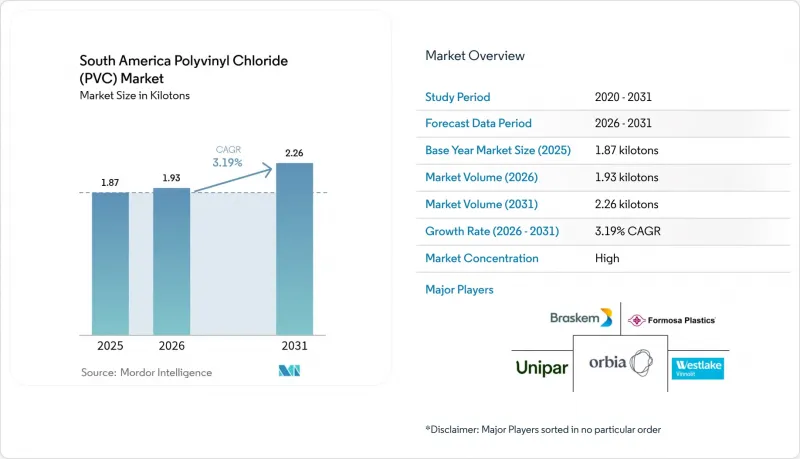
據 Mordor Intelligence 稱,2026 年南美洲聚氯乙烯(PVC) 市場規模估計為 1.93 千噸,高於 2025 年的 1.87 千噸,預計到 2031 年將達到 2.26 千噸。
預計從 2026 年到 2031 年,其複合年成長率將達到 3.19%。
本報告按產品類型(硬質PVC、軟質PVC、低煙PVC、氯化PVC)、穩定劑類型(鈣基、鉛基等)、應用(管道和配件、薄膜和片材、電線電纜等)、最終用戶行業(建築和施工、汽車、電氣和電子等)以及地區(巴西、阿根廷、智利、哥倫比亞等)進行分類。
南美聚氯乙烯(PVC)市場趨勢與洞察
管道和配件需求的激增是由建築需求所驅動的。
為了彌合巴西1億人口無法取得污水收集設施、3,500萬人無法取得處理後飲用水的供水缺口,到2035年,每年需要投入276億雷亞爾。 2020年《衛生法框架》規定,到2033年,都市區污水處理覆蓋率必須提高90%,這迫使公共產業逐步淘汰腐蝕的金屬管道,轉而使用使用壽命長達50年的PVC系統,並且每投入1雷亞爾,其疾病預防效益將是金屬管道的四倍。哥倫比亞的一個飲用水特許經營經營項目、秘魯的一個礦業廢水處理項目以及美洲開發銀行投資公司支持的馬拉尼昂州一個價值1.35億美元的項目,都凸顯了該全部區域在標準化PVC基礎設施方面取得的進展。快速安裝、維護成本低和耐腐蝕等優勢,正在鞏固PVC在整個供水、收集和處理網路中的提案。
南美汽車生產輕量化進展
在巴西和阿根廷組裝的車輛中,為了減輕重量、提高阻燃性並提升車廂靜謐性,特種PVC化合物正擴大應用於儀表板、線束和引擎艙密封件。巴西汽車工業佔其工業GDP的25%,目前正透過鼓勵採用高效材料的計劃,努力提高在地採購率。巴西本土的PVC生產商正向市場推出高流動性、低霧度的PVC產品,這些產品不僅符合電動車的溫度控管標準,還能適應當地的成本和物流實際情況。南方共同市場(Mercosur)的優惠貿易規則透過促進跨境零件分銷和推動規格標準化,正在提升線束和內部應用領域對PVC的需求。
加強對毒性與環境、健康與安全法規的認知
隨著生命週期評估 (LCA) 和資訊揭露要求的日益普及,中小規模聚氯乙烯 (PVC) 加工企業的合規成本也隨之增加。南方共同市場 (MERCOSUR) 的食品接觸法規和巴西醫療設備申請文件均要求對添加劑進行嚴格的可追溯性管理,迫使生產商投資於數位化材料護照系統。民間團體正著力關注氯基生產流程和添加劑殘留問題,引導機構投資人採用生態標章。解決方案包括使用可再生塑化劑,例如 Pevalen Pro 100,該產品可將產品的二氧化碳排放量減少 80%,並加強對循環經濟的承諾。
細分市場分析
到2025年,硬質PVC將佔該地區總產量的56.75%,這主要得益於飲用水工程和建築設計中對耐久性和耐壓性的重視。南美洲硬質PVC市場預計將隨著巴西每年276億雷亞爾的水安全支出而成長,從而確保樹脂需求的穩定基本負載。低煙PVC雖然交易量較小,但預計其複合年成長率將達到3.8%,這主要得益於高層商業建築日益嚴格的消防安全法規。
軟性聚氯乙烯(PVC)因其在低溫下的柔軟性和透明度,廣泛應用於汽車塗料和醫用導管領域。氯化PVC則在工業輸送設備和熱水管道領域需求旺盛,為其帶來了高利潤收入。透明硬質PVC是製藥觀察窗和食品加工視鏡等應用的關鍵材料,隨著GMP(良好生產規範)投資的增加,其市場需求也穩定成長。總體而言,不斷演變的產品組合使南美聚氯乙烯市場能夠在保持其核心基礎設施領域的同時,維持其多樣性。
到2025年,鈣鋅穩定劑將佔穩定劑總出貨量的40.78%,這主要得益於其與傳統鉛化合物成本相當且易於直接替代加工。儘管錫/有機錫替代品價格較高,但由於其優異的耐熱老化性能(適用於電線絕緣和醫療設備等應用),預計其複合年成長率將達到3.55%,在南美地區將超越聚氯乙烯市場整體表現。鉛穩定劑由於分階段禁用而逐漸減少,而鋇鋅液體穩定劑則被用於一些需要高光澤度的特定擠出應用領域。
這些市場變化有利於那些能夠將性能聲明與監管機構認可的生命週期數據相結合的添加劑供應商。提供穩定劑、潤滑劑和色母粒等產品的一體化樹脂製造商,正滿足加工商對簡化採購流程和可靠技術故障排除的需求。
其他好處:
- Excel格式的市場預測(ME)表
- 3個月的分析師支持
目錄
第1章:引言
- 研究假設和市場定義
- 調查範圍
第2章:調查方法
第3章執行摘要
第4章 市場狀況
- 市場概覽
- 市場促進因素
- 管道和配件需求的激增是由建築需求所驅動的。
- 南美汽車生產輕量化進展
- 擴大由聚氯乙烯(PVC)製成的一次性醫用產品市場
- 巴西和秘魯的鉛管更換項目
- 日本氯氣和聚氯乙烯的整合降低了原料成本。
- 市場限制因素
- 提高對毒性的認知並加強環境、健康與安全(EHS)法規
- 玩具和兒童護理產品中禁止使用鄰苯二甲酸酯。
- 電力價格波動劇烈,推高了電解過程的運作成本。
- 價值鏈分析
- 波特五力模型
第5章 市場規模與成長預測
- 依產品類型
- 硬質PVC
- 透明硬質PVC
- 不透明硬質聚氯乙烯
- 軟PVC
- 透明軟性PVC
- 不透明軟性PVC
- 低煙PVC
- 氯化聚氯乙烯(PVC)
- 硬質PVC
- 穩定器的類型
- 鈣基(Ca-Zn)
- 鉛基(Pb)
- 錫/有機錫(Sn)
- 鋇基和液態混合金屬
- 透過使用
- 管道和配件
- 薄膜
- 電線電纜
- 瓶子
- 型材、軟管、管材
- 其他用途
- 按最終用戶行業分類
- 建築/施工
- 車
- 電氣和電子設備
- 包裝
- 鞋類
- 衛生保健
- 其他終端用戶產業
- 按地區
- 巴西
- 阿根廷
- 智利
- 哥倫比亞
- 秘魯
- 其他南美國家
第6章 競爭情勢
- 市場集中度
- 策略趨勢
- 市佔率和排名分析
- 公司簡介
- Amanco Wavin
- Braskem
- Formosa Plastics Corporation
- Hanwha Solutions
- INEOS
- LG Chem
- Occidental Petroleum Corporation
- Orbia
- Pipelife Brasil
- Shin-Etsu Chemical Co., Ltd.
- Simona AG
- Unipar Carbocloro
- Westlake Vinnolit GmbH & Co.KG
- Xinjiang Zhongtai Chemical Co., Ltd
第7章 市場機會與未來展望
According to Mordor Intelligence, the South America polyvinyl chloride market size in 2026 is estimated at 1.93 kilotons, growing from 2025 value of 1.87 kilotons with 2031 projections showing 2.26 kilotons, growing at 3.19% CAGR over 2026-2031.
This report is Segmented by Product Type (Rigid PVC, Flexible PVC, Low-Smoke PVC, and Chlorinated PVC), Stabilizer Type (Calcium-Based, Lead-Based, and More), Application (Pipes and Fittings, Films and Sheets, Wires and Cables, and More), End-User Industry (Building and Construction, Automotive, Electrical and Electronics, and More), and Geography (Brazil, Argentina, Chile, Colombia, and More).
South America Polyvinyl Chloride (PVC) Market Trends and Insights
Construction-led Surge in Pipe and Fittings Demand
Annual spending of BRL 27.6 billion is required through 2035 to bridge water-service gaps affecting 100 million Brazilians without sewage collection and 35 million lacking treated water. The 2020 Sanitation Legal Framework obliges 90% urban sewage coverage by 2033, prompting utilities to phase out corroded metal lines in favor of PVC systems that deliver 50-year lifespans and four-to-one disease-prevention paybacks for every real invested. Colombia's potable-water concessions, Peru's mine-water programs, and an IDB Invest-backed USD 135 million Maranhao project underscore region-wide momentum for standardized PVC infrastructure. Faster installation, lower maintenance, and corrosion resistance consolidate PVC's value proposition across distribution, collection, and treatment networks.
Rising Lightweighting in South American Automotive Production
Vehicles assembled in Brazil and Argentina increasingly embed specialty PVC compounds in dashboards, wire harnesses, and under-hood seals to cut mass, improve flame resistance, and enhance cabin acoustics. Brazil's automotive sector, equal to 25% of industrial GDP, is pursuing higher local content under programs that reward efficiency-driven materials adoption. Domestic compounders have introduced high-flow, low-fogging PVC grades that satisfy electric-vehicle thermal-management standards while aligning with region-specific cost and logistics realities. Preferential trade rules in MERCOSUR ease cross-border component circulation, encouraging harmonized specifications that elevate PVC demand in wiring and interiors.
Toxicity Perception and Tightening EHS Regulations
Broader adoption of lifecycle assessments and mandatory disclosure frameworks elevates compliance costs for small-to-mid-size PVC converters. MERCOSUR food-contact rules and ANVISA medical-device dossiers now demand granular additive traceability, pushing producers to invest in digital material-passport systems. Advocacy groups spotlight chlorine processes and additive residues, steering institutional buyers toward eco-labels. Counter-measures include renewable plasticizers such as Pevalen Pro 100 that slash product CO2 footprints by 80% and bolster circular-economy credentials.
Other drivers and restraints analyzed in the detailed report include:
- Expansion of PVC-based Medical Disposables
- Domestic Chlorine-vinyl Integration Lowering Feedstock Costs
- Volatile Electricity Tariffs Inflating Electrolysis OPEX
For complete list of drivers and restraints, kindly check the Table Of Contents.
Segment Analysis
Rigid PVC accounted for 56.75% of regional volume in 2025 as potable-water projects and building profiles prioritized its durability and pressure rating. The South America polyvinyl chloride market size tied to rigid formulations is forecast to progress in tandem with Brazil's annual BRL 27.6 billion water-security outlays, securing a dependable base load for resin demand. Low-smoke PVC, though representing a smaller tonnage, will clock a 3.8% CAGR on the back of tighter fire-safety rules in high-rise commercial construction.
Flexible PVC applications span automotive sheathing and healthcare tubing, benefitting from cold-temperature flexibility and clarity. Chlorinated PVC appeals to industrial conveying and hot-water piping segments, adding premium margin streams. Clear rigid grades, essential for pharmaceutical inspection windows and food-processing sight-glasses, grow steadily as GMP investments materialize. Collectively, the product mix evolution ensures the South America polyvinyl chloride market remains diversified while anchored in core infrastructure.
Calcium-zinc packages secured 40.78% of stabilizer tonnage in 2025, aided by cost parity with legacy lead compounds and straightforward drop-in processing. Tin/Organotin alternatives, although higher priced, will outpace the broader South America polyvinyl chloride market at 3.55% CAGR because of superior heat-ageing resistance demanded in wire jacketing and medical devices. Lead stabilizers are retreating under phased bans, whereas barium-zinc liquids serve niche extrusions needing elevated gloss.
Market shifts favor additive suppliers that can pair performance claims with life-cycle data sets recognized by regulators. Integrated resin makers bundling stabilizers, lubricants, and color concentrates into single invoices are meeting converter demand for simplified procurement and robust technical troubleshooting.
Complete Report Scope:
- By Product Type
- Rigid PVC
- Clear Rigid PVC
- Non-Clear Rigid PVC
- Flexible PVC
- Clear Flexible PVC
- Non-Clear Flexible PVC
- Low-smoke PVC
- Chlorinated PVC
- Rigid PVC
- By Stabilizer Type
- Calcium-based (Ca-Zn)
- Lead-based (Pb)
- Tin / Organotin (Sn)
- Barium-based and Liquid Mixed Metals
- By Application
- Pipes and Fittings
- Films and Sheets
- Wires and Cables
- Bottles
- Profiles, Hoses and Tubing
- Other Applications
- By End-User Industry
- Building and Construction
- Automotive
- Electrical and Electronics
- Packaging
- Footwear
- Healthcare
- Other End-User Industry
- By Geography
- Brazil
- Argentina
- Chile
- Colombia
- Peru
- Rest of South America
List of Companies Covered in this Report:
- Amanco Wavin
- Braskem
- Formosa Plastics Corporation
- Hanwha Solutions
- INEOS
- LG Chem
- Occidental Petroleum Corporation
- Orbia
- Pipelife Brasil
- Shin-Etsu Chemical Co., Ltd.
- Simona AG
- Unipar Carbocloro
- Westlake Vinnolit GmbH& Co.KG
- Xinjiang Zhongtai Chemical Co., Ltd
Additional Benefits:
- The market estimate (ME) sheet in Excel format
- 3 months of analyst support
TABLE OF CONTENTS
1 Introduction
- 1.1 Study Assumptions and Market Definition
- 1.2 Scope of the Study
2 Research Methodology
3 Executive Summary
4 Market Landscape
- 4.1 Market Overview
- 4.2 Market Drivers
- 4.2.1 Construction-led surge in pipe and fittings demand
- 4.2.2 Rising lightweighting in South-American automotive production
- 4.2.3 Expansion of PVC-based medical disposables
- 4.2.4 Lead-pipe replacement schemes in Brazil and Peru
- 4.2.5 Domestic chlorine-vinyl integration lowering feedstock costs
- 4.3 Market Restraints
- 4.3.1 Toxicity perception and tightening EHS regulations
- 4.3.2 Phthalate-free mandates in toys and childcare products
- 4.3.3 Volatile electricity tariffs inflating electrolysis OPEX
- 4.4 Value Chain Analysis
- 4.5 Porter's Five Forces
- 4.5.1 Bargaining Power of Suppliers
- 4.5.2 Bargaining Power of Buyers
- 4.5.3 Threat of New Entrants
- 4.5.4 Threat of Substitutes
- 4.5.5 Competitive Rivalry
5 Market Size and Growth Forecasts (Volume)
- 5.1 By Product Type
- 5.1.1 Rigid PVC
- 5.1.1.1 Clear Rigid PVC
- 5.1.1.2 Non-Clear Rigid PVC
- 5.1.2 Flexible PVC
- 5.1.2.1 Clear Flexible PVC
- 5.1.2.2 Non-Clear Flexible PVC
- 5.1.3 Low-smoke PVC
- 5.1.4 Chlorinated PVC
- 5.1.1 Rigid PVC
- 5.2 By Stabilizer Type
- 5.2.1 Calcium-based (Ca-Zn)
- 5.2.2 Lead-based (Pb)
- 5.2.3 Tin / Organotin (Sn)
- 5.2.4 Barium-based and Liquid Mixed Metals
- 5.3 By Application
- 5.3.1 Pipes and Fittings
- 5.3.2 Films and Sheets
- 5.3.3 Wires and Cables
- 5.3.4 Bottles
- 5.3.5 Profiles, Hoses and Tubing
- 5.3.6 Other Applications
- 5.4 By End-User Industry
- 5.4.1 Building and Construction
- 5.4.2 Automotive
- 5.4.3 Electrical and Electronics
- 5.4.4 Packaging
- 5.4.5 Footwear
- 5.4.6 Healthcare
- 5.4.7 Other End-User Industry
- 5.5 By Geography
- 5.5.1 Brazil
- 5.5.2 Argentina
- 5.5.3 Chile
- 5.5.4 Colombia
- 5.5.5 Peru
- 5.5.6 Rest of South America
6 Competitive Landscape
- 6.1 Market Concentration
- 6.2 Strategic Moves
- 6.3 Market Share/Ranking Analysis
- 6.4 Company Profiles (includes Global level Overview, Market level overview, Core Segments, Financials as available, Strategic Information, Market Rank/Share for key companies, Products and Services, and Recent Developments)
- 6.4.1 Amanco Wavin
- 6.4.2 Braskem
- 6.4.3 Formosa Plastics Corporation
- 6.4.4 Hanwha Solutions
- 6.4.5 INEOS
- 6.4.6 LG Chem
- 6.4.7 Occidental Petroleum Corporation
- 6.4.8 Orbia
- 6.4.9 Pipelife Brasil
- 6.4.10 Shin-Etsu Chemical Co., Ltd.
- 6.4.11 Simona AG
- 6.4.12 Unipar Carbocloro
- 6.4.13 Westlake Vinnolit GmbH& Co.KG
- 6.4.14 Xinjiang Zhongtai Chemical Co., Ltd
7 Market Opportunities and Future Outlook
- 7.1 White-Space and Unmet-Need Assessment

 2026年全球聚氯乙烯(PVC)穩定劑市場報告
 生物基聚氯乙烯:市場佔有率分析、行業趨勢和統計數據以及成長預測(2026-2031 年)
 PVC回收市場:全球市場預測,2026-2032年PVC穩定劑:市場佔有率分析、產業趨勢與統計、成長預測(2026-2031年)壓延PVC(聚氯乙烯)軟性薄膜市場:全球市場預測(2026-2032)聚氯乙烯(PVC):市場佔有率分析、行業趨勢和統計數據、成長預測(2026-2031)中東和非洲聚氯乙烯(PVC)市場:市場佔有率分析、行業趨勢和統計數據以及成長預測(2026-2031 年)2026年全球聚氯乙烯(PVC)防靜電磁磚市場報告
 壓延聚氯乙烯(PVC)軟膜市場規模、佔有率和成長分析:按產品類型、厚度、塑化劑類型、表面處理、應用、最終用途行業和地區分類-2026-2033年產業預測
 全球聚氯乙烯市場規模、佔有率、趨勢和成長分析報告(2026-2034)