


 |
市場調查報告書
商品編碼
2115253
生物基聚氯乙烯:市場佔有率分析、行業趨勢和統計數據以及成長預測(2026-2031 年)Bio-Based Polyvinyl Chloride - Market Share Analysis, Industry Trends & Statistics, Growth Forecasts (2026 - 2031) |
||||||

※ 本網頁內容可能與最新版本有所差異。詳細情況請與我們聯繫。
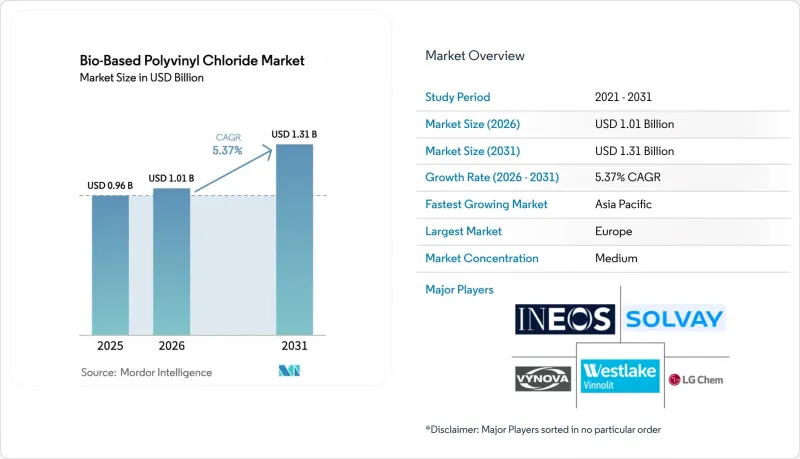
根據 Mordor Intelligence 預測,生物基聚氯乙烯(Bio-PVC) 市場將從 2025 年的 9.6 億美元成長到 2026 年的 10.1 億美元,然後在 2031 年達到 13.1 億美元,2026 年至 2031 年的複合成長率為 5.37%。
本報告按產品類型(硬質生物基PVC和軟質生物基PVC)、應用領域(管道、電線、電纜、薄膜/片材及其他)、終端用戶行業(建築施工、交通運輸包裝、電氣電子設備及其他)和地區(亞太地區、北美地區、歐洲及其他)進行細分。市場預測以美元計價。
全球生物基聚氯乙烯市場趨勢與洞察
加強環境法規和ESG要求
歐盟的碳邊境調節機制將於2023年下半年進入過渡階段,基於碳含量徵收的關稅將於2026年全面實施,高碳PVC的進口成本將於2028年上漲。加州的SB 253和SB 261法案將強制要求從2024年起進行範圍3揭露,迫使建築和汽車行業的採購負責人審核聚合物的來源。 Teknor Apex指出,到2025年,更多歐洲地板材料客戶將尋求具有檢驗碳足跡的生物基化合物。儘管價格較高,但這些監管協調正在推動採購經認證的生物基PVC的趨勢日益增強。能夠證明其監管鏈合規性的製造商在受監管的競標中作為供應商的優先順序更高。
企業永續性措施與綠建築標準
LEED v5將於2026年全面實施,屆時將對通過ISO 16620檢驗的生物基材料加分,生物基PVC將被列入旨在獲得金級或鉑金級認證的項目規範中。此外,美國環保署(EPA)於2025年推出的彈性地板材料產品類型規則(PCR)更新版,強制要求進行生命週期評估,揭露原料來源,這實際上使化石基樹脂在公共採購中處於不利地位。汽車製造商的評估標準也支持這一趨勢。大眾汽車將生物基或再生聚合物的使用作為其供應商評估的一部分。同時,福特汽車強制要求其北美車型在2028年前使用經認證的生物基PVC。這些目標要求樹脂供應商提供需求確定性,這對於改造裂解裝置以處理生物基原料至關重要。
與化石基PVC相比,生產成本差異巨大。
由於生質乙醇比石腦油衍生的乙烯價格更高,即使不考慮改造裂解裝置的資本成本,生物乙醇樹脂的價格也更高。在巴西和印度,燃料摻混義務消耗了乙醇產量的很大一部分,留給化學應用的剩餘量有限。包裝和建築業的買家對價格非常敏感,除非碳排放罰款能夠抵銷差價,否則他們不願意接受溢價。里昂巴塞爾在2025年的報告中指出,雖然生物基聚烯在歐洲獲得了溢價,但在東南亞地區,由於化石基樹脂價格更低,生物基聚烯烴面臨挑戰。
細分市場分析
到2025年,硬質樹脂將佔總產量的62.48%,這反映了飲用水管和窗框等應用領域對50年使用壽命的要求。這一主導佔有率支撐了生物基聚氯乙烯市場的大部分規模,並為樹脂供應商提供了可預測的銷售管道。柔軟性年成長率成長,受益於汽車內裝領域的直接替代,該領域受範圍3目標的影響,正在影響材料選擇。
剛性化合物可最大限度地減少從化石基樹脂轉向生物基樹脂時所需的模具更換次數,從而降低採用風險,並確保生物基聚氯乙烯市場在基礎設施專案領域的穩定成長。柔軟性配方則依賴適當的塑化劑和嚴格的遷移測試。為了滿足這些性能要求,泰諾Apex於2025年推出了一款生物基含量為40%的柔軟性化合物。這些進展表明,配方技術而非聚合物化學才是決定生物基聚氯乙烯產業各細分市場採用率的關鍵因素。
區域分析
預計到2025年,歐洲將佔據生物基聚氯乙烯市場48.22%的佔有率。這主要得益於碳邊境調節機制(CBAM)過渡期內的報告要求,以及英力士(INEOS)、維諾瓦(Vynova)和下游加工商之間達成的物料平衡供應協議。德國、法國和義大利是推動需求成長的主要力量,而瑞典和丹麥則正著手在區域供熱管道中引入生物基聚氯乙烯的檢測。由於受到製裁以及依賴缺乏必要生物原料基礎設施的碳化鈣法,俄羅斯在市場中仍處於落後地位。
亞太地區是成長最快的地區,預計到2031年複合年成長率將達到5.94%。印度正將過剩的甘蔗乙醇轉向化學生產,Praj公司在古吉拉突邦的示範工廠證明了國內原料的成熟度。中國的「十四五」規劃包含生質乙醇共加工試點配額,為國營裂解企業遵守碳排放調節規定指明了方向。日本和韓國正從馬來西亞和泰國進口經認證的生物石腦油,供應給電子和汽車行業的客戶。
儘管北美市場佔有率較小,但它受益於美國的稅額扣抵,該政策降低了二氧化碳轉化為乙烯的成本。陶氏化學目前面臨原料採購的限制,供應商認證進度比生產瓶頸更為重要。在北美,墨西哥正在調整其營運以符合美國原始設備製造商(OEM)的評分標準,而巴西工廠則利用乙醇生產乙烯,正在增強南美的乙烯供應。在中東,乙烯技術的發展仍處於早期階段,但沙烏地基礎工業公司(SABIC)計劃啟動生物石腦油測試表明市場需求運作,如果測試成功,可能會大幅提高產能。
其他福利
- Excel格式的市場預測(ME)表
- 3個月的分析師支持
目錄
第1章:引言
- 研究的先決條件
- 調查範圍
第2章:調查方法
第3章執行摘要
第4章 市場狀況
- 市場概覽
- 市場促進因素
- 加強環境法規和ESG要求
- 企業永續發展措施與綠建築標準
- 利用具成本競爭力的生物乙烯生產方法實現商業規模化
- 歐盟碳邊境調節措施加速了低碳原料的使用。
- 透過物料平衡地板/管道供應合約促進下游市場採用。
- 市場限制因素
- 與化石基PVC相比,生產成本差異巨大
- 商業規模供應可再生原料的局限性
- 混合生物基回收流中的可追溯性問題
- 價值鏈分析
- 波特五力模型
第5章 市場規模與成長預測
- 依產品類型
- 硬質生物基PVC
- 軟性生物基聚氯乙烯
- 透過使用
- 管道
- 金屬絲
- 電纜
- 薄膜
- 其他
- 按最終用戶行業分類
- 建築/施工
- 運輸/包裝
- 電氣和電子設備
- 其他
- 按地區
- 亞太地區
- 中國
- 印度
- 日本
- 韓國
- ASEAN
- 其他亞太國家
- 北美洲
- 美國
- 加拿大
- 墨西哥
- 歐洲
- 德國
- 英國
- 法國
- 義大利
- 俄羅斯
- 北歐國家
- 其他歐洲國家
- 南美洲
- 巴西
- 阿根廷
- 其他南美國家
- 中東和非洲
- 沙烏地阿拉伯
- 南非
- 其他中東和非洲國家
- 亞太地區
第6章 競爭情勢
- 市場集中度
- 策略趨勢
- 市佔率和排名分析
- 公司簡介
- Avient Corporation
- Bio-Plastic Solutions LLC.
- Bio-Tec Environmental
- Braskem
- CLARIANT
- Dow
- ENSO Plastics
- Formosa Plastics Corporation, USA
- GEON Performance Solutions
- INEOS
- LG Chem
- LyondellBasell
- Metabolix, Inc.
- Nomaco
- Shin-Etsu Chemical Co., Ltd.
- Solvay SA
- Sylvin Technologies, Inc.
- Teknor Apex
- Vynova Group
- Westlake Vinnolit GmbH & Co. KG
第7章 市場機會與未來展望
According to Mordor Intelligence, the bio-Based polyvinyl chloride market size is expected to grow from USD 0.96 billion in 2025 to USD 1.01 billion in 2026 and is forecast to reach USD 1.31 billion by 2031 at 5.37% CAGR over 2026-2031.
This report is Segmented by Product Type (Rigid Bio-PVC and Flexible Bio-PVC), Application (Pipes, Wires, Cables, Films and Sheets, and Others), End-User Industry (Building and Construction, Transportation and Packaging, Electrical and Electronics, and Others), and Geography (Asia-Pacific, North America, Europe, and More). The Market Forecasts are Provided in Terms of Value (USD).
Global Bio-Based Polyvinyl Chloride Market Trends and Insights
Stricter Environmental Regulations And ESG Mandates
The EU Carbon Border Adjustment Mechanism entered its transitional phase in late 2023 and will apply full embedded-carbon tariffs from 2026, making high-carbon PVC imports costlier by 2028 . California's SB 253 and SB 261 require scope-3 disclosures from 2024, pushing building and automotive buyers to audit polymer origins. Teknor Apex noted in 2025 a growth of European flooring customers demanding bio-attributed compounds verified for carbon footprint. These converging rules tilt procurement toward certified bio-PVC despite its price premium. Producers able to document chain-of-custody compliance earn preferred-supplier status in regulated tenders.
Corporate Sustainability Commitments And Green-Building Standards
LEED v5, fully rolling out in 2026, grants extra points for ISO 16620-verified bio-based content, putting bio-PVC on specification lists for projects targeting Gold or Platinum ratings . The EPA's 2025 update of Product Category Rules for resilient flooring mandates life-cycle assessments that reveal feedstock origin, effectively disadvantaging fossil resin in public procurement. Automaker scorecards reinforce the pull: Volkswagen assigns a portion of its supplier ratings to bio-based or recycled polymers. Meanwhile, Ford mandates the use of certified bio-PVC in its North American models by 2028. Such targets provide resin suppliers with the volume certainty essential for retrofitting crackers to process bio-feedstocks.
High Production-Cost Gap Versus Fossil PVC
Bio-ethanol commands a higher price than naphtha-based ethylene, resulting in a resin premium before accounting for capital charges related to cracker retrofits. In Brazil and India, fuel-blending mandates consume the majority of ethanol volumes, leaving limited surplus for chemical applications. Buyers in the price-sensitive packaging and construction sectors hesitate to pay the premium unless carbon penalties bridge the difference. In 2025, LyondellBasell reported that while bio-attributed polyolefins achieved a premium in Europe, they faced challenges in Southeast Asia, where fossil resins are priced lower.
Other drivers and restraints analyzed in the detailed report include:
- Cost-Competitive Bio-Ethylene Routes Reaching Commercial Scale
- EU Carbon-Border Adjustments Accelerating Low-Carbon Feedstock Use
- Limited Commercial-Scale Renewable-Feedstock Supply
For complete list of drivers and restraints, kindly check the Table Of Contents.
Segment Analysis
Rigid variants controlled 62.48% of 2025 volume, reflecting the need for 50-year service lives in potable-water pipes and window profiles. This dominance underpins a substantial portion of the bio-based polyvinyl chloride market size, securing predictable offtake for resin suppliers. Flexible grades, forecast at a 5.88% CAGR, benefit from drop-in substitution in automotive interiors where scope-3 targets drive material choices.
Rigid compounds require minimal tooling changes when swapping fossil for bio-attributed resin, trimming adoption risk, and ensuring that the bio-based polyvinyl chloride market grows steadily within infrastructure projects. Flexible formulations depend on compatible plasticizers and careful migration testing; Teknor Apex launched a 40% bio-content flexible compound in 2025 to meet these performance demands. These advances show how formulation know-how, not polymer chemistry, sets the pace of segment uptake in the bio-based polyvinyl chloride industry.
Complete Report Scope:
- By Product Type
- Rigid Bio-PVC
- Flexible Bio-PVC
- By Application
- Pipes
- Wires
- Cables
- Films and Sheets
- Others
- By End-User Industry
- Building and Construction
- Transportation and Packaging
- Electrical and Electronics
- Others
- By Geography
- Asia-Pacific
- China
- India
- Japan
- South Korea
- ASEAN Countries
- Rest of Asia-Pacific
- North America
- United States
- Canada
- Mexico
- Europe
- Germany
- United Kingdom
- France
- Italy
- Russia
- NORDIC Countries
- Rest of Europe
- South America
- Brazil
- Argentina
- Rest of South America
- Middle-East and Africa
- Saudi-Arabia
- South Africa
- Rest of Middle-East and Africa
- Asia-Pacific
Geography Analysis
Europe claimed a 48.22% bio-based polyvinyl chloride market share in 2025, lifted by CBAM's transitional reporting and mass-balance supply deals between INEOS, Vynova, and downstream fabricators. Germany, France, and Italy lead demand, while Sweden and Denmark test bio-PVC in district-heating pipes. Russia remains sidelined due to sanctions and carbide-route dependence that lacks bio-feedstock infrastructure.
Asia-Pacific is the fastest-growing region at a 5.94% CAGR through 2031. India diverts surplus sugarcane ethanol into chemical routes, and Praj's Gujarat demo plant signals domestic feedstock readiness. China's five-year plan opens pilot quotas for bio-ethanol co-processing, giving state-owned crackers a pathway to carbon-adjustment compliance. Japan and South Korea import certified bio-naphtha from Malaysia and Thailand for electronics and automotive customers.
North America, while holding a smaller market share, reaps significant benefits from the United States tax credits, reducing CO2-to-ethylene costs. Dow faces feedstock constraints, highlighting supplier qualification timelines over production bottlenecks. In North America, Mexico aligns its operations with the United States OEM scorecards, and Brazil's ethanol-to-ethylene plant bolsters South America's supply. The Middle East remains in its infancy; however, SABIC's scheduled trial of bio-naphtha hints at budding demand, with potential for substantial capacity expansion if the trial proves successful.
- Avient Corporation
- Bio-Plastic Solutions LLC.
- Bio-Tec Environmental
- Braskem
- CLARIANT
- Dow
- ENSO Plastics
- Formosa Plastics Corporation, U.S.A.
- GEON Performance Solutions
- INEOS
- LG Chem
- LyondellBasell
- Metabolix, Inc.
- Nomaco
- Shin-Etsu Chemical Co., Ltd.
- Solvay SA
- Sylvin Technologies, Inc.
- Teknor Apex
- Vynova Group
- Westlake Vinnolit GmbH & Co. KG
Additional Benefits:
- The market estimate (ME) sheet in Excel format
- 3 months of analyst support
TABLE OF CONTENTS
1 Introduction
- 1.1 Study Assumptions
- 1.2 Scope of the Study
2 Research Methodology
3 Executive Summary
4 Market Landscape
- 4.1 Market Overview
- 4.2 Market Drivers
- 4.2.1 Stricter environmental regulations and ESG mandates
- 4.2.2 Corporate sustainability commitments and green-building standards
- 4.2.3 Cost-competitive bio-ethylene routes reaching commercial scale
- 4.2.4 EU carbon-border adjustments accelerating low-carbon feedstock use
- 4.2.5 Mass-balance flooring/pipe supply deals catalyzing downstream uptake
- 4.3 Market Restraints
- 4.3.1 High production-cost gap vs. fossil PVC
- 4.3.2 Limited commercial-scale renewable-feedstock supply
- 4.3.3 Traceability issues in mixed bio-attributed recycling streams
- 4.4 Value Chain Analysis
- 4.5 Porter's Five Forces
- 4.5.1 Threat of New Entrants
- 4.5.2 Bargaining Power of Buyers
- 4.5.3 Bargaining Power of Suppliers
- 4.5.4 Threat of Substitutes
- 4.5.5 Degree of Competition
5 Market Size and Growth Forecasts (Value)
- 5.1 By Product Type
- 5.1.1 Rigid Bio-PVC
- 5.1.2 Flexible Bio-PVC
- 5.2 By Application
- 5.2.1 Pipes
- 5.2.2 Wires
- 5.2.3 Cables
- 5.2.4 Films and Sheets
- 5.2.5 Others
- 5.3 By End-User Industry
- 5.3.1 Building and Construction
- 5.3.2 Transportation and Packaging
- 5.3.3 Electrical and Electronics
- 5.3.4 Others
- 5.4 By Geography
- 5.4.1 Asia-Pacific
- 5.4.1.1 China
- 5.4.1.2 India
- 5.4.1.3 Japan
- 5.4.1.4 South Korea
- 5.4.1.5 ASEAN Countries
- 5.4.1.6 Rest of Asia-Pacific
- 5.4.2 North America
- 5.4.2.1 United States
- 5.4.2.2 Canada
- 5.4.2.3 Mexico
- 5.4.3 Europe
- 5.4.3.1 Germany
- 5.4.3.2 United Kingdom
- 5.4.3.3 France
- 5.4.3.4 Italy
- 5.4.3.5 Russia
- 5.4.3.6 NORDIC Countries
- 5.4.3.7 Rest of Europe
- 5.4.4 South America
- 5.4.4.1 Brazil
- 5.4.4.2 Argentina
- 5.4.4.3 Rest of South America
- 5.4.5 Middle-East and Africa
- 5.4.5.1 Saudi-Arabia
- 5.4.5.2 South Africa
- 5.4.5.3 Rest of Middle-East and Africa
- 5.4.1 Asia-Pacific
6 Competitive Landscape
- 6.1 Market Concentration
- 6.2 Strategic Moves
- 6.3 Market Share/Ranking Analysis
- 6.4 Company Profiles (includes Global level Overview, Market level overview, Core Segments, Financials as available, Strategic Information, Market Rank/Share for key companies, Products and Services, and Recent Developments)
- 6.4.1 Avient Corporation
- 6.4.2 Bio-Plastic Solutions LLC.
- 6.4.3 Bio-Tec Environmental
- 6.4.4 Braskem
- 6.4.5 CLARIANT
- 6.4.6 Dow
- 6.4.7 ENSO Plastics
- 6.4.8 Formosa Plastics Corporation, U.S.A.
- 6.4.9 GEON Performance Solutions
- 6.4.10 INEOS
- 6.4.11 LG Chem
- 6.4.12 LyondellBasell
- 6.4.13 Metabolix, Inc.
- 6.4.14 Nomaco
- 6.4.15 Shin-Etsu Chemical Co., Ltd.
- 6.4.16 Solvay SA
- 6.4.17 Sylvin Technologies, Inc.
- 6.4.18 Teknor Apex
- 6.4.19 Vynova Group
- 6.4.20 Westlake Vinnolit GmbH & Co. KG
7 Market Opportunities and Future Outlook
- 7.1 White-Space and Unmet-Need Assessment

 2026年全球聚氯乙烯(PVC)穩定劑市場報告
 PVC回收市場:全球市場預測,2026-2032年
 PVC穩定劑:市場佔有率分析、產業趨勢與統計、成長預測(2026-2031年)南美洲聚氯乙烯(PVC)市場:市場佔有率分析、產業趨勢與統計及成長預測(2026-2031)壓延PVC(聚氯乙烯)軟性薄膜市場:全球市場預測(2026-2032)聚氯乙烯(PVC):市場佔有率分析、行業趨勢和統計數據、成長預測(2026-2031)中東和非洲聚氯乙烯(PVC)市場:市場佔有率分析、行業趨勢和統計數據以及成長預測(2026-2031 年)2026年全球聚氯乙烯(PVC)防靜電磁磚市場報告
 壓延聚氯乙烯(PVC)軟膜市場規模、佔有率和成長分析:按產品類型、厚度、塑化劑類型、表面處理、應用、最終用途行業和地區分類-2026-2033年產業預測
 全球聚氯乙烯市場規模、佔有率、趨勢和成長分析報告(2026-2034)