


 |
市場調查報告書
商品編碼
2073146
中小企業路由器:市場佔有率分析、產業趨勢與統計及成長預測(2026-2031 年)Small Business Router - Market Share Analysis, Industry Trends & Statistics, Growth Forecasts (2026 - 2031) |
||||||

※ 本網頁內容可能與最新版本有所差異。詳細情況請與我們聯繫。
據 Mordor Intelligence 稱,2025 年中小企業路由器市場規模為 40.4 億美元,預計到 2031 年將從 2026 年的 42.2 億美元成長至 59.3 億美元,預測期(2026-2031 年)複合年成長率為 7.04%。
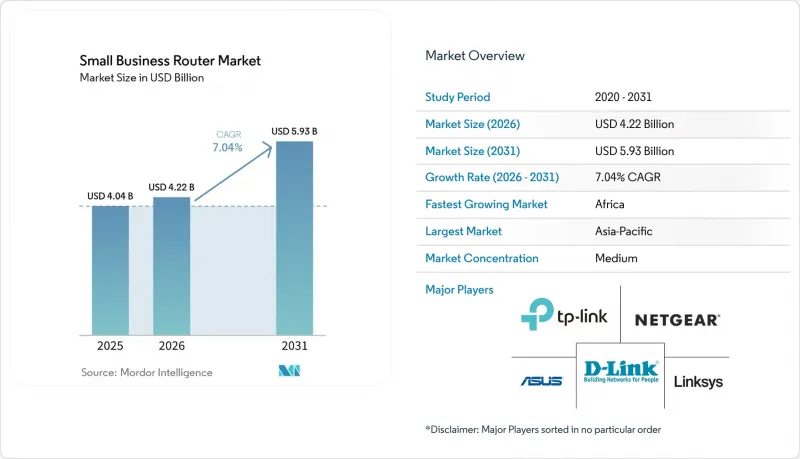
本報告按產品類型(有線路由器、無線路由器、混合路由器)、連接埠數量(1-4個連接埠、5-8個連接埠、8個以上連接埠)、廣域網路技術(乙太網路寬頻、XDSL、LTE/5G、光纖)、銷售管道(直銷、經銷商和加值經銷商、電子商務)以及地區進行細分。市場預測以美元(USD)計價。
全球中小企業路由器市場趨勢與洞察
中小企業廣泛採用混合工作模式
混合辦公模式的普及正迫使中小企業(SME)用能夠同時支援高清視訊串流、虛擬專用網路(VPN)隧道以及針對延遲敏感型應用的服務品質(QoS)策略的設備來替換其消費級路由器。一項於2025年進行的同行評審研究表明,混合辦公室模式使中小企業的生產力提高了4.8%,從而為網路連接升級帶來了可衡量的投資回報率(ROI)。一項針對中小企業的2025年調查發現,47%的受訪者在過去12個月中採用了新技術,其中38%採用人工智慧(AI)工具的企業需要低延遲、高吞吐量的網路連線。另一項產業調查發現,86%的中小企業表示網路連線不佳對其營運產生了負面影響,而5G部署可望為英國經濟貢獻790億英鎊(1,000億美元)。這些變化正在加速市場對配備多Gigabit乙太網路連接埠、Wi-Fi 6E 三頻無線電以及能夠隔離訪客、員工和物聯網流量的整合安全功能的路由器的需求。 2025 年 8 月,華碩發布了“RT-BE58 Go”,這是一款兼容 Wi-Fi 7 的迷你旅行路由器,目標用戶是行動工作者和混合辦公人員。它預先安裝了 2.5 Gigabit的廣域網路 (WAN) 連接埠、5G/4G USB 網路共用功能以及支援多達 30 個服務供應商的虛擬私人網路 (VPN) 功能。
雲端應用對網路頻寬的需求日益成長
客戶關係管理 (CRM)、企業資源規劃 (ERP) 和協作等業務向軟體即服務 (SaaS) 平台的轉變,正推動中小企業 (SME) 從非對稱數位用戶線路 (ADSL) 和有線連接升級到光纖和 5G 固定無線存取。一家通訊業者報告稱,目前已有 2,460 萬個固定無線存取點投入使用,佔所有寬頻服務覆蓋點的 21.2%。同時,兩家主要競爭對手的覆蓋率合計達到 37.8%,透過固定無線存取獲得寬頻服務的地點數量增加了 145%。一項針對加拿大中小企業的調查發現,63% 的受訪者認為 5G 將有利於其業務發展,而 40% 的英國零售中小企業正在投資 5G 連結。雲端應用程式供應商建議視訊會議每位並髮用戶至少需要 5 Mbps 的上傳速度,即時協作則需要 10 Mbps,這迫使中小企業採用能夠聚合多條廣域網鏈路並使用深層封包檢測(DPI) 技術進行流量優先排序的路由器。 2025 年,DrayTek 推出了 Vigor 2767 系列,該系列產品整合了跨乙太網路、xDSL 和 LTE 介面的 SD-WAN 負載平衡功能,能夠聚合來自多個通訊業者的頻寬。在單一通訊業者服務不穩定的市場,這種趨勢尤其明顯,混合路由器能夠提供容錯移轉和負載平衡功能。
微企業的價格敏感性
員工人數少於10人的微企業通常每年用於網路設備的預算不足500美元,這限制了他們採用具備SD-WAN、Wi-Fi 6E或整合安全功能的先進路由器。 2026年2月,記憶體價格飆升600%,擠壓了供應商的利潤空間,並限制了100美元以下入門級型號的普及。新興市場的中小型企業由於貨幣貶值和資金籌措,面臨更大的預算限制。 2026年3月,美國聯邦通訊委員會(FCC)決定將所有外國製造的路由器列入其“目標清單”,啟動了有條件批准程序,並增加了合規成本。這些增加的成本正從供應商轉嫁給買家。來自中國的路由器在美國進口產品中的比例下降至1.1%,而來自越南的設備則上升至38.3%。這反映了供應鏈重組增加了物流成本和關稅負擔。為此,供應商正在分階段推出產品線;例如,D-Link 的 DBR-600-P 提供基本的 Wi-Fi 6 和防火牆功能,但價格比其旗艦型號 DBR-X3000-AP 更低。這種限制在非洲和南美洲尤為突出,因為這些地區的中小型企業通常更注重網路連接而非高級功能,這使得路由器的使用壽命延長了五年以上。
細分市場分析
混合路由器整合了有線、無線和蜂窩廣域網介面,預計到2031年將以每年10.82%的速度成長,以滿足企業對無縫容錯移轉和頻寬聚合的需求。由於行動性和訪客存取的需求,無線路由器在2025年仍將佔據中小企業路由器市場48.13%的佔有率。混合路由器預計將成為成長最快的細分市場,因為在始終線上環境中,單鏈路故障會導致營運成本增加。 Zyxel的「Nebula FWA515」整合了5G廣域網路和雙2.5Gigabit區域網路,展現了多重存取架構的功能融合,即使在網路環境波動的情況下也能確保服務的連續性和效能。
這種融合趨勢模糊了不同類別之間的界限,許多無線路由器透過整合 SIM 卡槽和基於 USB 的蜂窩網路備份功能,有效地轉型為「混合優先」架構。有線路由器仍然在一些特定應用領域發揮作用,例如製造系統和 POS 環境,這些應用需要透過銅纜基礎設施實現確定性的吞吐量。華碩 RT-BE88U 配備 10G RJ-45 和 SFP+ 端口,並支援自動多 WAN 和 4G/5G 網路共用。這表明,即使是高階有線設備也在向混合平台演進,以滿足冗餘、可擴展性和效能最佳化的需求。
預計到2025年,5至8埠路由器將佔據46.37%的市佔率。但隨著內容創作者和資料密集型中小企業採用Gigabit以太網,預計到2031年,8埠以上的路由器將以每年10.53%的速度成長。將乙太網路供電(PoE)功能整合到路由器中,即可直接透過單一裝置為視訊監控系統、Wi-Fi 6E網路基地台和語音基礎設施運作,從而減少裝置數量。 D-Link的DGS-1250交換器可以串聯在多Gigabit路由器的上行鏈路上,簡化佈線,並提高高密度網路環境(多個高頻寬終端同時運作)的可擴充性。
對於主要依賴無線連接或基於 USB 的 5G 加密狗上網的微企業而言,1-4 連接埠路由器仍然佔據著重要地位。在已開發市場,光纖成本的下降正在加速 2.5Gigabit和 10Gigabit埠的升級,從而推動未來對高密度、高吞吐量路由器的需求。華碩 ZenWiFi BQ16 Pro 在其網狀網路節點中整合了兩個 10Gigabit端口,即使在面向消費者的緊湊型設計中,也體現了向多千兆回程傳輸的廣泛轉變,而這種設計也適用於小規模企業應用場景。
區域分析
2025年,亞太地區佔據了中小企業路由器市場34.29%的佔有率。這主要得益於中國工業與資訊化部所製定的《2025-2027年中小企業數位轉型推進規劃》。該規劃以4萬家中小企業為目標,旨在透過財政輔助和資金支持,在2027年實現40%以上的雲端採用率。 2025年10月,TP-Link宣佈在印度建立全球最大的工廠。該投資超過10億印度盧比(約1,200萬美元),除了擴大員工隊伍外,該公司還在2025年7月開設了一個專注於Wi-Fi 7、物聯網和人工智慧的研發中心。日本和韓國是Wi-Fi 7路由器的早期採用者,華碩於2025年10月推出了“ROG Rapture GT-BE19000AI”,該產品配備專用AI核心,並原生支援Docker Engine,可處理邊緣運算工作負載。東南亞正受惠於海底光纜的投資,例如將於2025年投入營運的「2Africa」海底光纜。這條光纜連接非洲、歐洲和亞洲的33個國家,可降低雲端應用的延遲。
北美仍然是一個高價值市場。加拿大「數位化採納計畫」投資40億加元(約29.6億美元),幫助中小企業採用電子商務、網路安全和雲端工具,提供最高1.5萬加元(約1.11萬美元)的津貼最高10萬加元(約7.4萬美元)的貸款。美國國家科學基金會(NSF)決定在2025年推出「TechAccess AI-Ready America」計劃,投資1.68億至2.24億美元用於擴展人工智慧(AI)基礎設施。預計這將推動對能夠支援邊緣AI工作負載的路由器的需求。在墨西哥,5G固定無線存取(FWA)的部署正在擴大,通訊業者的目標客戶是缺乏光纖基礎設施的郊區中小企業。歐洲的特點是法規結構高度分散,雖然歐盟的無線電設備指令強制要求符合 EN 18031 安全標準,但 Zyxel 聲稱其「Nebula FWA515」是首批滿足此要求的網路產品之一。
預計到2031年,非洲將以11.90%的年均成長率成長,這主要得益於大規模光纖部署和政府數位化舉措,使其成為成長最快的地區。奈及利亞的D-VIBE計畫已成功資金籌措,計畫鋪設9萬公里光纖電纜,連接服務不足的社區和中小企業。南非和摩洛哥在非洲數位基礎設施成熟度領先,在非洲數位基礎設施指數中,南非得分88分,摩洛哥得分79分。沙烏地阿拉伯和阿拉伯聯合大公國(阿拉伯聯合大公國)等中東市場正在投資智慧城市項目,這些項目需要為自由區和創新區內的中小企業配備高密度Wi-Fi 6E和5G路由器。南美洲受到貨幣波動和政府補貼有限的限制,其中巴西和阿根廷是最大的市場,但預算壓力正在減緩路由器升級。
其他好處:
- Excel格式的市場預測(ME)表
- 3個月的分析師支持
目錄
第1章:引言
- 研究假設和市場定義
- 調查範圍
第2章:調查方法
第3章執行摘要
第4章 市場狀況
- 市場概覽
- 市場促進因素
- 擴大中小企業採用混合辦公模式的規模。
- 雲端應用對網路頻寬的需求日益成長
- 經濟實惠的Wi-Fi 6路由器越來越普及。
- 訂閱式網路即服務 (NaaS) 的出現
- 將SD-WAN功能整合到入門級路由器中
- 政府促進中小企業數位轉型的措施
- 市場限制因素
- 微企業的價格敏感度
- 半導體元件供應鏈中斷
- 人們越來越傾向於選擇多功能行動熱點而不是路由器
- 小型辦公室缺乏IT專業知識,導致系統升級延遲。
- 產業供應鏈分析
- 監理情勢
- 技術展望
- 宏觀經濟因素對市場的影響
- 波特五力分析
第5章 市場規模與成長預測
- 依產品類型
- 有線路由器
- 無線路由器
- 混合路由器
- 按連接埠數量
- 埠 1-4
- 5-8個端口
- 8 個或更多端口
- 廣域網路技術
- 乙太網路寬頻
- xDSL
- LTE/5G
- 光纖
- 按銷售管道
- 直銷
- 分銷商 VAR
- 電子商務
- 按地區
- 北美洲
- 美國
- 加拿大
- 墨西哥
- 南美洲
- 巴西
- 阿根廷
- 其他南美國家
- 歐洲
- 德國
- 英國
- 法國
- 義大利
- 西班牙
- 其他歐洲國家
- 亞太地區
- 中國
- 日本
- 印度
- 韓國
- 東南亞
- 其他亞太國家
- 中東
- 沙烏地阿拉伯
- 阿拉伯聯合大公國
- 土耳其
- 其他中東國家
- 非洲
- 南非
- 奈及利亞
- 其他非洲國家
- 北美洲
第6章 競爭情勢
- 市場集中度
- 策略趨勢
- 市佔率分析
- 公司簡介
- Cisco Systems, Inc.
- Hewlett Packard Enterprise Company
- Netgear, Inc.
- TP-Link Technologies Co., Ltd.
- Ubiquiti Inc.
- MikroTikls SIA
- DrayTek Corp.
- D-Link Corporation
- ASUSTeK Computer Inc.
- Zyxel Communications Corp.
- Peplink International Limited
- Fortinet, Inc.
- Juniper Networks, Inc.
- Edgecore Networks Corporation
- Ruijie Networks Co., Ltd.
- Cambium Networks Corporation
- Sophos Ltd.
- WatchGuard Technologies, Inc.
- Belkin International, Inc.
- Cradlepoint, Inc.
第7章 市場機會與未來展望
According to Mordor Intelligence, the small business router market size was valued at USD 4.04 billion in 2025 and is estimated to grow from USD 4.22 billion in 2026 to reach USD 5.93 billion by 2031, at a CAGR of 7.04% during the forecast period (2026-2031).
This report is Segmented by Product Type (Wired Routers, Wireless Routers, Hybrid Routers), Port Count (1-4 Ports, 5-8 Ports, More Than 8 Ports), WAN Technology (Ethernet Broadband, XDSL, LTE/5G, Fiber), Sales Channel (Direct Sales, Distributors and VARs, E-Commerce), and GeographY. The Market Forecasts are Provided in Terms of Value (USD).
Global Small Business Router Market Trends and Insights
Growing Adoption of Hybrid Work Models by Small Businesses
Hybrid work arrangements are compelling small businesses to replace consumer-grade routers with devices that support simultaneous high-definition video streams, virtual private network tunnels, and quality-of-service policies for latency-sensitive applications. A peer-reviewed study in 2025 found that hybrid work improved small and medium enterprise productivity by 4.8%, creating a measurable return on investment for connectivity upgrades. A 2025 small business survey reported that 47% of respondents implemented new technology in the past 12 months, with 38% deploying artificial intelligence tools that require low-latency, high-throughput connections. Another industry study found that 86% of small and medium enterprises stated poor connectivity negatively impacted operations, while 5G deployment could contribute GBP 79 billion (USD 100 billion) to the United Kingdom economy. The shift is accelerating demand for routers with multi-gigabit Ethernet ports, Wi-Fi 6E tri-band radios, and integrated security features that can segment guest, employee, and Internet of Things traffic. In August 2025, ASUS launched the RT-BE58 Go, a Wi-Fi 7 mini travel router with 2.5 gigabit per second WAN, 5G/4G USB tethering, and pre-installed virtual private network support for up to 30 service providers, targeting mobile and hybrid workers.
Rising Internet Bandwidth Demands for Cloud Applications
Migration to software-as-a-service platforms for customer relationship management, enterprise resource planning, and collaboration is driving small businesses to upgrade from asymmetric digital subscriber line and cable connections to fiber and 5G fixed wireless access. One telecom operator reported 24.6 million fixed wireless access locations in service, representing 21.2% of broadband serviceable locations, while two major competitors combined for 37.8% coverage and 145% growth in fixed wireless access broadband serviceable locations. A survey of Canadian small and medium businesses found that 63% believe 5G will benefit their operations, while 40% of United Kingdom retailer small and medium businesses are investing in 5G connectivity.Cloud application providers recommend minimum upload speeds of 5 megabits per second per concurrent user for video conferencing and 10 megabits per second for real-time collaboration, pushing small businesses toward routers that can bond multiple WAN links or prioritize traffic using deep packet inspection. In 2025, DrayTek introduced the Vigor2767 series, integrating SD-WAN load balancing across Ethernet, xDSL, and LTE interfaces, enabling bandwidth aggregation from multiple carriers. The trend is particularly pronounced in markets with unreliable single-carrier service, where hybrid routers provide failover and load distribution.
Price Sensitivity Among Micro-Enterprises
Micro-enterprises with fewer than 10 employees often allocate less than USD 500 annually for networking equipment, constraining the adoption of advanced routers with SD-WAN, Wi-Fi 6E, or integrated security appliances. Memory price inflation surged 600% in February 2026, compressing vendor margins and limiting the availability of entry-level models below USD 100. Small businesses in emerging markets face additional budget constraints due to currency depreciation and limited access to financing. The Federal Communications Commission's March 2026 decision to add all foreign-produced routers to its Covered List triggered conditional approval processes that increased compliance costs, which vendors are passing to buyers. China-origin routers fell to 1.1% of the United States import value share, while Vietnam-origin devices rose to 38.3%, reflecting a supply chain reconfiguration that added logistics and tariff expenses. Vendors are responding by introducing tiered product lines, with D-Link's DBR-600-P offering basic Wi-Fi 6 and firewall features at a lower price than its flagship DBR-X3000-AP. The constraint is most acute in Africa and South America, where small businesses prioritize connectivity over advanced features and often extend router lifecycles beyond five years.
Other drivers and restraints analyzed in the detailed report include:
- Increasing Availability of Affordable Wi-Fi 6 Routers
- Emergence of Subscription Based Network-as-a-Service Offerings
- Supply Chain Disruptions for Semiconductor Components
For complete list of drivers and restraints, kindly check the Table Of Contents.
Segment Analysis
Hybrid routers, which merge wired, wireless, and cellular WAN interfaces, are projected to expand at 10.82% annually through 2031 as firms seek seamless failover and bandwidth aggregation. Wireless models still account for 48.13% of the small-business router market in 2025 due to mobility and guest-access requirements. The hybrid segment is expected to grow fastest because single-link outages impose higher operational costs in always-connected environments. Zyxel's Nebula FWA515 integrates 5G WAN with dual 2.5 gigabit LAN, demonstrating feature convergence toward multi-access architectures that ensure continuity and performance under fluctuating network conditions.
Convergence is increasingly blurring category boundaries, with many wireless routers incorporating SIM slots or USB-based cellular backup, effectively shifting toward hybrid-first architectures. Wired models continue to serve niche applications such as manufacturing systems and point-of-sale environments that require deterministic throughput over copper infrastructure. ASUS's RT-BE88U, equipped with 10G RJ-45 and SFP+ ports, supports automatic multi-WAN and 4G/5G tethering, indicating that even high-end wired devices are evolving into hybrid platforms to address redundancy, scalability, and performance-optimization requirements.
Routers offering 5-8 ports captured 46.37% of the 2025 value, but units with more than 8 ports are projected to grow at 10.53% annually through 2031 as content-creation firms and data-intensive small businesses adopt 10 gigabit Ethernet. Power-over-Ethernet integration within routers is reducing equipment sprawl by enabling video surveillance systems, Wi-Fi 6E access points, and voice infrastructure to be powered directly from a single device. D-Link's DGS-1250 switches can be chained from multi-gigabit router uplinks, simplifying cabling and improving scalability in dense network environments where multiple high-bandwidth endpoints operate simultaneously.
The 1-4 port segment remains relevant among micro-enterprises that depend primarily on wireless connectivity and USB-based 5G dongles for internet access. In developed markets, declining fiber costs are accelerating upgrades to 2.5-gigabit and 10-gigabit ports, driving future demand for higher-density routers with enhanced throughput capabilities. ASUS's ZenWiFi BQ16 Pro integrates dual 10-gigabit ports into a mesh node, highlighting a broader transition toward multi-gig wired backhaul even in compact, consumer-oriented designs adapted for small-business use cases.
Complete Report Scope:
- By Product Type
- Wired Routers
- Wireless Routers
- Hybrid Routers
- By Port Count
- 1-4 Ports
- 5-8 Ports
- More Than 8 Ports
- By WAN Technology
- Ethernet Broadband
- xDSL
- LTE/5G
- Fiber
- By Sales Channel
- Direct Sales
- Distributors and VARs
- E-commerce
- By Geography
- North America
- United States
- Canada
- Mexico
- South America
- Brazil
- Argentina
- Rest of South America
- Europe
- Germany
- United Kingdom
- France
- Italy
- Spain
- Rest of Europe
- Asia-Pacific
- China
- Japan
- India
- South Korea
- Southeast Asia
- Rest of Asia-Pacific
- Middle East
- Saudi Arabia
- United Arab Emirates
- Turkey
- Rest of Middle East
- Africa
- South Africa
- Nigeria
- Rest of Africa
- North America
Geography Analysis
Asia-Pacific held 34.29% of the small business router market in 2025, driven by China's Ministry of Industry and Information Technology Small and Medium Enterprise Digital Empowerment Plan for 2025-2027, which targets 40,000 SMEs and aims to achieve a cloud adoption rate exceeding 40% by 2027 through fiscal subsidies and financing support. TP-Link announced its largest global factory in India in October 2025, with an investment exceeding INR 100 crore (USD 12 million), and expanded its workforce while unveiling a research and development center focused on Wi-Fi 7, Internet of Things, and artificial intelligence in July 2025. Japan and South Korea are early adopters of Wi-Fi 7 routers, with ASUS launching the ROG Rapture GT-BE19000AI in October 2025, featuring a dedicated artificial intelligence core and native Docker Engine support for edge computing workloads. Southeast Asia is benefiting from subsea cable investments such as the 2Africa cable, which became operational in 2025 and connects 33 countries across Africa, Europe, and Asia, reducing latency for cloud applications.
North America remains a high-value market, with Canada's Digital Adoption Program allocating CAD 4 billion (USD 2.96 billion) in grants up to CAD 15,000 (USD 11,100) and loans up to CAD 100,000 (USD 74,000) to help small businesses adopt e-commerce, cybersecurity, and cloud-based tools. The United States National Science Foundation launched TechAccess AI-Ready America in 2025, committing USD 168 to 224 million to expand artificial intelligence infrastructure, which will drive demand for routers capable of supporting edge artificial intelligence workloads. Mexico is experiencing growth in 5G fixed wireless access deployments, with carriers targeting small businesses in peri-urban zones lacking fiber infrastructure. Europe is characterized by fragmented regulatory frameworks, with the European Union Radio Equipment Directive mandating compliance with EN 18031 security standards, which Zyxel's Nebula FWA515 claims to meet as among the first network products.
Africa is forecast to grow at 11.90% annually through 2031, the fastest rate among all geographies, driven by large-scale fiber deployments and government digitalization initiatives. Nigeria's D-VIBE project secured USD 200 million from the African Development Bank and USD 500 million from the World Bank to deploy 90,000 kilometers of fiber, connecting underserved communities and small businesses. South Africa and Morocco lead the continent in digital infrastructure maturity, with the Africa Digital Infrastructure Index scoring South Africa at 88 and Morocco at 79. Middle East markets such as Saudi Arabia and the United Arab Emirates are investing in smart city initiatives that require high-density Wi-Fi 6E and 5G routers for small businesses operating in free zones and innovation districts. South America is constrained by currency volatility and limited government subsidies, with Brazil and Argentina representing the largest markets but facing budget pressures that delay router upgrades.
- Cisco Systems, Inc.
- Hewlett Packard Enterprise Company
- Netgear, Inc.
- TP-Link Technologies Co., Ltd.
- Ubiquiti Inc.
- MikroTikls SIA
- DrayTek Corp.
- D-Link Corporation
- ASUSTeK Computer Inc.
- Zyxel Communications Corp.
- Peplink International Limited
- Fortinet, Inc.
- Juniper Networks, Inc.
- Edgecore Networks Corporation
- Ruijie Networks Co., Ltd.
- Cambium Networks Corporation
- Sophos Ltd.
- WatchGuard Technologies, Inc.
- Belkin International, Inc.
- Cradlepoint, Inc.
Additional Benefits:
- The market estimate (ME) sheet in Excel format
- 3 months of analyst support
TABLE OF CONTENTS
1 INTRODUCTION
- 1.1 Study Assumptions and Market Definition
- 1.2 Scope of the Study
2 RESEARCH METHODOLOGY
3 EXECUTIVE SUMMARY
4 MARKET LANDSCAPE
- 4.1 Market Overview
- 4.2 Market Drivers
- 4.2.1 Growing Adoption of Hybrid Work Models by Small Businesses
- 4.2.2 Rising Internet Bandwidth Demands for Cloud Applications
- 4.2.3 Increasing Availability of Affordable Wi-Fi 6 Routers
- 4.2.4 Emergence of Subscription Based Network-as-a-Service Offerings
- 4.2.5 Integration of SD-WAN Features into Entry-Level Routers
- 4.2.6 Government Small Business Digitalization Incentives
- 4.3 Market Restraints
- 4.3.1 Price Sensitivity Among Micro-Enterprises
- 4.3.2 Supply Chain Disruptions for Semiconductor Components
- 4.3.3 Growing Preference for All-in-One Cellular Hotspots over Routers
- 4.3.4 Limited IT Expertise in Very Small Offices Delaying Upgrades
- 4.4 Industry Supply-Chain Analysis
- 4.5 Regulatory Landscape
- 4.6 Technological Outlook
- 4.7 Impact of Macroeconomic Factors on the Market
- 4.8 Porter's Five Forces Analysis
- 4.8.1 Threat of New Entrants
- 4.8.2 Bargaining Power of Suppliers
- 4.8.3 Bargaining Power of Buyers
- 4.8.4 Threat of Substitutes
- 4.8.5 Intensity of Competitive Rivalry
5 MARKET SIZE AND GROWTH FORECASTS (VALUE)
- 5.1 By Product Type
- 5.1.1 Wired Routers
- 5.1.2 Wireless Routers
- 5.1.3 Hybrid Routers
- 5.2 By Port Count
- 5.2.1 1-4 Ports
- 5.2.2 5-8 Ports
- 5.2.3 More Than 8 Ports
- 5.3 By WAN Technology
- 5.3.1 Ethernet Broadband
- 5.3.2 xDSL
- 5.3.3 LTE/5G
- 5.3.4 Fiber
- 5.4 By Sales Channel
- 5.4.1 Direct Sales
- 5.4.2 Distributors and VARs
- 5.4.3 E-commerce
- 5.5 By Geography
- 5.5.1 North America
- 5.5.1.1 United States
- 5.5.1.2 Canada
- 5.5.1.3 Mexico
- 5.5.2 South America
- 5.5.2.1 Brazil
- 5.5.2.2 Argentina
- 5.5.2.3 Rest of South America
- 5.5.3 Europe
- 5.5.3.1 Germany
- 5.5.3.2 United Kingdom
- 5.5.3.3 France
- 5.5.3.4 Italy
- 5.5.3.5 Spain
- 5.5.3.6 Rest of Europe
- 5.5.4 Asia-Pacific
- 5.5.4.1 China
- 5.5.4.2 Japan
- 5.5.4.3 India
- 5.5.4.4 South Korea
- 5.5.4.5 Southeast Asia
- 5.5.4.6 Rest of Asia-Pacific
- 5.5.5 Middle East
- 5.5.5.1 Saudi Arabia
- 5.5.5.2 United Arab Emirates
- 5.5.5.3 Turkey
- 5.5.5.4 Rest of Middle East
- 5.5.6 Africa
- 5.5.6.1 South Africa
- 5.5.6.2 Nigeria
- 5.5.6.3 Rest of Africa
- 5.5.1 North America
6 COMPETITIVE LANDSCAPE
- 6.1 Market Concentration
- 6.2 Strategic Moves
- 6.3 Market Share Analysis
- 6.4 Company Profiles (includes Global Level Overview, Market Level Overview, Core Segments, Financials as available, Strategic Information, Market Rank/Share, Products and Services, Recent Developments)
- 6.4.1 Cisco Systems, Inc.
- 6.4.2 Hewlett Packard Enterprise Company
- 6.4.3 Netgear, Inc.
- 6.4.4 TP-Link Technologies Co., Ltd.
- 6.4.5 Ubiquiti Inc.
- 6.4.6 MikroTikls SIA
- 6.4.7 DrayTek Corp.
- 6.4.8 D-Link Corporation
- 6.4.9 ASUSTeK Computer Inc.
- 6.4.10 Zyxel Communications Corp.
- 6.4.11 Peplink International Limited
- 6.4.12 Fortinet, Inc.
- 6.4.13 Juniper Networks, Inc.
- 6.4.14 Edgecore Networks Corporation
- 6.4.15 Ruijie Networks Co., Ltd.
- 6.4.16 Cambium Networks Corporation
- 6.4.17 Sophos Ltd.
- 6.4.18 WatchGuard Technologies, Inc.
- 6.4.19 Belkin International, Inc.
- 6.4.20 Cradlepoint, Inc.
7 MARKET OPPORTUNITIES AND FUTURE OUTLOOK
- 7.1 White-Space and Unmet-Need Assessment

 企業級路由器:市場佔有率分析、產業趨勢與統計、成長預測(2026-2031)住宅路由器:市場佔有率分析、產業趨勢與統計、成長預測(2026-2031)
 CNC雕刻機市場-2026-2032年全球市場預測智慧路由器市場:依路由器類型、技術標準、應用、通路和最終用戶分類-2026-2032年全球市場預測分支路由器:市場佔有率分析、行業趨勢和統計數據、成長預測(2026-2031 年)工業路由器市場:2026-2032年全球市場預測(依產品類型、連接技術、部署環境、最終用戶產業及銷售管道)核心路由器:市場佔有率分析、行業趨勢和統計數據、成長預測(2026-2031 年)網路路由器:市場佔有率分析、產業趨勢與統計、成長預測(2026-2031)路由器:市場佔有率分析、行業趨勢和統計數據、成長預測(2026-2031 年)
 2026年全球電信級路由市場報告