


 |
市場調查報告書
商品編碼
2073069
路由器:市場佔有率分析、行業趨勢和統計數據、成長預測(2026-2031 年)Router - Market Share Analysis, Industry Trends & Statistics, Growth Forecasts (2026 - 2031) |
||||||

※ 本網頁內容可能與最新版本有所差異。詳細情況請與我們聯繫。
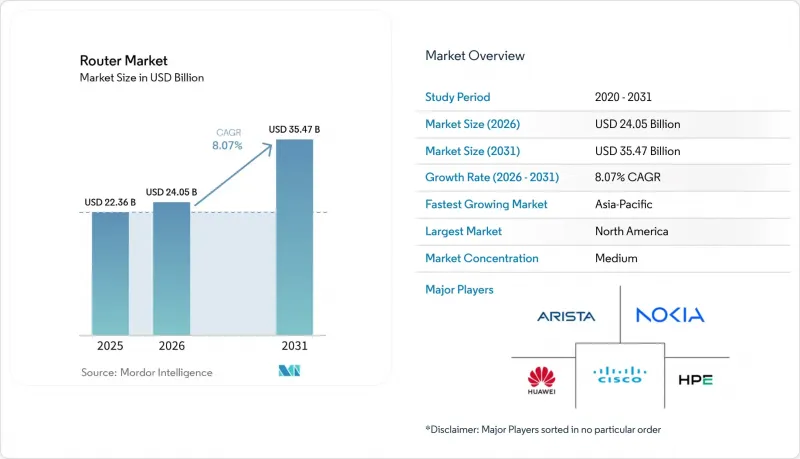
根據 Mordor Intelligence 預測,路由器市場規模將從 2025 年的 223.6 億美元和 2026 年的 240.5 億美元成長到 2031 年的 354.7 億美元,2026 年至 2031 年的年複合成長率(CAGR)為 8.07%。
本報告按路由器類型(有線路由器、無線路由器、蜂窩路由器)、性能級別(低吞吐量、其他)、最終用戶(住宅/消費者、IT和電信、銀行、金融服務和保險 (BFSI)、政府和國防、製造業、運輸和物流、其他最終用戶)、配銷通路(在線市場、直銷、其他)和地區進行細分。市場預測以美元 (USD) 計價。
全球路由器市場趨勢與洞察
寬頻普及率不斷提高,對高速家庭網路的需求日益成長
到2024年,經合組織成員國的光纖到戶(FTTP)合約將超過固定寬頻連線的44.6%,反映出家庭用戶對千兆GigabitWi-Fi效能的期望日益提高。此外,通訊業者預測,到2030年,將部署3.5億條固定無線接入線路,如此龐大的用戶群需要強大的室外5G路由器來繞過最後一公里銅纜線路。到2024年,英國超過69%的住宅將擁有完整的光纖網路,服務供應商正在將Wi-Fi 6E三頻路由器與Gigabit寬頻套餐捆綁銷售。因此,新型住宅閘道器整合了先進的QoS引擎,可以優先處理對延遲敏感的流量,例如雲端遊戲和視訊會議。由此,路由器市場呈現兩極化:高階網狀網路系統面向光纖家庭,而蜂巢式閘道器則面向服務欠缺地區,兩者都需要各自獨特的供應鏈、定價和支援模式。
雲端服務的激增需要先進的企業級路由技術。
混合雲端雲和多重雲端環境的普及迫使企業重新思考分店和資料中心的路由架構。這要求 SD-WAN 疊加網路、自動容錯移轉和應用程式感知通道選擇能夠在公共雲端和私有雲端之間無縫運作。思科的 Cloud OnRamp 支援基於意圖的路由,可連接到 AWS、Azure 和 Google Cloud,無需手動調整 BGP 設定。 Arista 的 CloudEOS 可在本地端和雲端網路架構之間實現一致的網路分段,從而減輕 DevOps 團隊的運維負擔。 Palo Alto Networks 將路由和零信任安全性整合到單一裝置中,降低了分店擁有成本 (TCO) 並加快了部署速度。因此,市場需求正轉向具備深層封包檢測和加密流量分析功能的路由器,供應商也開始專注於整合軟體的商業化,而不僅僅是增加連接埠數量。
供應鏈短缺和半導體價格波動
2024年下半年,路由專用積體電路(ASIC)的前置作業時間延長至52週,導致企業更新換代週期延長,緊急交貨費用增加,利潤空間受到擠壓。博通預測,到2027年,人工智慧相關的網路晶片市場規模將超過1000億美元,這將加劇超超大規模資料中心業者和網路設備製造商之間對有限的先進節點產能的競爭。思科公佈了2024會計年度硬體銷售額的下滑,原因是其將稀缺組件分配給了高利潤的軟體捆綁包。儘管面臨供不應求,Arista仍獲得了多年晶圓契約,以維持20%的同比成長。基於晶片組的設計可以實現供應來源多元化,但會增加測試的複雜性,並可能使小規模供應商在需求激增時更容易受到分配波動的影響。
細分市場分析
儘管無線路由器仍將佔據主導地位,預計到2025年將佔路由器市場佔有率的49.62%,但隨著都市區光纖普及率接近飽和,其成長速度正在放緩。隨著5G專網試點營運逐步過渡到全面商業部署,蜂窩平台在路由器市場日益受到關注。預計到2031年,蜂巢式路由器的複合年成長率將達到11.24%,高於其他任何類別。蜂窩路由器是倉庫自動化(有線連接不切實際)、採礦遙測和智慧城市照明等應用的核心。根據GSM協會的數據,到2024年,將有超過1000個商用5G專網,每個網路都將部署多個蜂窩閘道器以實現低延遲連接。
隨著供應商將 eSIM 和 5G 數據機整合到企業級無線路由器中,並在固網斷開時實現自動容錯移轉,市場競爭日益激烈。 Cradlepoint 的 2025 年產品線包含網路切片功能,可在車載資訊服務和乘客 Wi-Fi 之間分配頻寬。 Teltonika 和 Digi International 透過推出經鐵路和海事應用認證的堅固型設備,擴大了蜂窩網路優先部署的路由器市場規模。電信基礎設施專案 (TIP)舉措推動的對開放 API 的監管支援正在降低切換成本,軟體正日益成為路由器行業競爭中真正的差異化因素。
超大規模資料中心業者和電信業者對吞吐量超過 100 Gbps 的路由器的需求呈現兩位數成長,預計到 2031 年,該細分市場的複合年成長率將達到 11.67%。 Arista 的 7800R4 和 Juniper 的 PTX10000 系列清晰地展現了買家對框架單位密度和亞微秒延遲的重視程度。相較之下,中等吞吐量路由器將在 2025 年佔據 39.18% 的路由器市場佔有率,主要服務於園區核心網和區域接入點 (PoP) 等需要兼顧成本和功能集的應用場景。
儘管速度低於 1 Gbps 的低吞吐量路由器仍在大量出貨,主要面向小規模辦公室,但隨著人工智慧工作負載推動東西向流量激增,路由器市場正將重點轉向高階和超高階市場。思科 8000 系列整合了矽光電,可降低每位元功耗,並符合歐洲的空閒功耗法規。諾基亞的連貫光方案使通訊業者能夠整合路由和傳輸功能,從而節省電力預算和機架空間。隨著 800GbE 成為資料中心的標準,那些能夠針對突發性人工智慧流量最佳化資料包緩衝和擁塞演算法的廠商有望佔據主導地位。
區域分析
預計到2025年,北美將佔路由器市場銷售額的34.68%,這主要得益於強制性零信任架構的實施和寬頻差異補貼政策,這些政策鼓勵企業和網際網路服務供應商(ISP)持續升級到多Gigabit閘道器。聯邦政府的資金正在加速服務欠缺地區的光纖部署,從而刺激消費者和營運商對路由器的需求。同時,北美區域資料中心營運商正在逐步淘汰400GbE網路架構,以支援人工智慧(AI)訓練叢集,這進一步擴大了對超高吞吐量底盤的訂單。
亞太地區是路由器市場的成長引擎,預計2026年至2031年將以10.36%的複合年成長率成長。中國已計劃在2024年前建成395萬個5G基地台,並正在測試和部署需要網路切片和基於人工智慧的流量控制等功能的5G-Advanced功能。印度的「智慧城市計畫」正在擴大該地區的路由器市場規模,市政邊緣路由器正被用於交通管理、影像分析和公用事業收費計費。華為等新興企業正在推出人工智慧增強型、節能型路由器,以應對人口稠密的大都會圈嚴峻的能源限制。
永續性是歐洲關注的重點。歐盟委員會的《寬頻設備能耗行為準則和待機功耗條例》(2023/826)對待機功耗設定了限制,並要求新型號設備採用重新設計的電源管理電路。德國、法國和西班牙的通訊業者目前正將更有效率的中等吞吐量設備與商業光纖合約捆綁銷售,資料中心營運商也在部署矽光子路由器以滿足碳排放預算要求。在南美洲和非洲,蜂窩路由器被廣泛用於固定無線接入,以避免耗資巨大的光纖鋪設工程。根據電訊(ITU)的數據,到2024年,發展中國家的固定寬頻線路數量將年增8%,這證實了市場對兼具乙太網路回程傳輸和LTE或5G上行鏈路功能的具成本效益路由器的持續旺盛需求。
其他好處
- Excel格式的市場預測(ME)表
- 3個月的分析師支持
目錄
第1章:引言
- 研究假設和市場定義
- 調查範圍
第2章:調查方法
第3章執行摘要
第4章 市場狀況
- 市場概覽
- 市場促進因素
- 寬頻普及率不斷提高,對高速家庭網路的需求日益成長
- 雲端服務的激增需要先進的企業級路由技術。
- Wi-Fi 6 和 Wi-Fi 7 標準的快速普及
- 多接取邊緣運算的興起正在推動微型邊緣路由器的發展。
- 透過監管開放標準(TIP、OpenWiFi)來促進解耦式路由器的普及
- 工業TSN接頭對確定性網路的需求日益成長
- 市場限制因素
- 供應鏈緊張與半導體價格波動
- 由於競爭激烈,消費級路由器正變得越來越同質化。
- 強制性零信任政策導致網路安全認證成本增加。
- 永續發展法規旨在解決核心路由器的高待機功耗問題。
- 產業價值鏈分析
- 監理情勢
- 技術展望
- 宏觀經濟因素對市場的影響
- 波特五力分析
第5章 市場規模與成長預測
- 路由器類型
- 有線路由器
- 無線路由器
- 蜂窩路由器
- 按績效水準
- 低吞吐量(低於 1 Gbps)
- 中等吞吐量(1-10 Gbps)
- 高吞吐量(10-100 Gbps)
- 超高吞吐量(超過 100 Gbps)
- 最終用戶
- 住宅/消費
- IT/通訊
- BFSI
- 政府/國防
- 製造業
- 運輸/物流
- 其他
- 透過分銷管道
- 網路市集
- 直銷
- 經銷商/增值轉售商
- 按地區
- 北美洲
- 美國
- 加拿大
- 墨西哥
- 南美洲
- 巴西
- 阿根廷
- 其他南美國家
- 歐洲
- 德國
- 英國
- 法國
- 義大利
- 西班牙
- 俄羅斯
- 其他歐洲國家
- 亞太地區
- 中國
- 日本
- 印度
- 韓國
- 澳洲和紐西蘭
- 其他亞太國家
- 中東
- 沙烏地阿拉伯
- 阿拉伯聯合大公國
- 土耳其
- 其他中東國家
- 非洲
- 南非
- 埃及
- 奈及利亞
- 其他非洲地區
- 北美洲
第6章 競爭情勢
- 市場集中度
- 策略趨勢
- 市佔率分析
- 公司簡介
- Cisco Systems Inc.
- Huawei Technologies Co Ltd.
- Nokia Corporation
- Hewlett Packard Enterprise Company
- Arista Networks Inc.
- TP-Link Technologies Co Ltd.
- Netgear Inc.
- D-Link Corporation
- Zyxel Communications Corp.
- Ubiquiti Inc.
- MikroTik SIA
- DrayTek Corp.
- Extreme Networks Inc.
- Cambium Networks Corp.
- Peplink International Ltd.
- Digi International Inc.
- Advantech Co Ltd.
- Teltonika Networks UAB
- Edgecore Networks Corporation
- Cradlepoint Inc.
- Sierra Wireless Inc.
第7章 市場機會與未來展望
According to Mordor Intelligence, the router market size is projected to expand from USD 22.36 billion in 2025 and USD 24.05 billion in 2026 to USD 35.47 billion by 2031, registering a CAGR of 8.07% between 2026 and 2031.
This report is Segmented by Router Type (Wired Routers, Wireless Routers, and Cellular Routers), Performance Tier (Low Throughput, and More), End User (Residential/Consumer, IT and Telecom, BFSI, Government and Defense, Manufacturing, Transportation and Logistics, and Other End Users), Sales Channel (Online Marketplaces, Direct Sales, and More), and Geography. The Market Forecasts are Provided in Terms of Value (USD).
Global Router Market Trends and Insights
Rising Broadband Penetration And Demand For High-Speed Home Networking
Fiber-to-the-premises subscriptions exceeded 44.6% of fixed broadband lines across OECD economies in 2024, lifting household expectations for multi-gigabit Wi-Fi performance. Operators also forecast 350 million fixed-wireless access links by 2030, a figure that requires ruggedized outdoor 5G routers to bypass last-mile copper. Full-fiber availability surpassed 69% of U.K. premises in 2024, causing service providers to bundle Wi-Fi 6E tri-band routers with gigabit plans. New residential gateways therefore integrate advanced QoS engines that prioritize latency-sensitive traffic such as cloud gaming and video conferencing. The result is a bifurcated router market: premium mesh systems for fiber homes and cellular gateways for underserved regions, each demanding unique supply-chain, pricing, and support models.
Proliferation Of Cloud Services Requiring Advanced Enterprise Routing
Hybrid and multicloud adoption is forcing enterprises to refresh branch and data-center routing so that SD-WAN overlays, automated failover, and application-aware path selection work seamlessly across public and private clouds. Cisco's Cloud OnRamp delivers intent-based routing into AWS, Azure, and Google Cloud without manual BGP tuning. Arista's CloudEOS extends consistent segmentation across on-prem and cloud fabrics, reducing operational toil for DevOps teams. Palo Alto Networks has fused routing with zero-trust security in a single appliance that lowers branch TCO and speeds deployment. Demand is therefore shifting toward routers with deep packet inspection and encrypted-traffic analytics, prompting vendors to monetize integrated software far more than raw port counts.
Supply Chain Shortages And Semiconductor Price Volatility
Lead times for routing ASICs stretched to 52 weeks in late 2024, postponing enterprise refresh cycles and lifting expedite fees that eroded margins. Broadcom projected AI-related networking silicon to top USD 100 billion by 2027, pitting hyperscalers against network-equipment makers for limited advanced-node capacity. Cisco disclosed lower hardware revenue in fiscal 2024 as it diverted scarce parts to high-margin software bundles. Arista secured multi-year wafer contracts to sustain 20% YoY growth despite shortages. Chiplet-based designs may diversify supply but raise testing complexity and leave smaller vendors exposed to allocation shocks during demand spikes.
Other drivers and restraints analyzed in the detailed report include:
- Rapid Adoption Of Wi-Fi 6 And Wi-Fi 7 Standards
- Emergence Of Multi-Access Edge Computing Driving Micro-Edge Routers
- Intense Price Competition Commoditizing Consumer Routers
For complete list of drivers and restraints, kindly check the Table Of Contents.
Segment Analysis
Wireless routers, while still leading with 49.62% router market share in 2025, now face slowed growth as urban fiber penetration approaches saturation. Cellular platforms captured mounting attention in the router market as 5G private-network pilots became full commercial rollouts. Cellular routers are forecast to grow at an 11.24% CAGR through 2031, outpacing every other category. They anchor warehouse automation, mining telemetry, and smart-city lighting, where hard-wired links prove impractical. The GSM Association counted more than 1,000 commercial private-5G networks in 2024, each deploying multiple cellular gateways for low-latency connectivity.
Competition intensifies as vendors embed eSIMs and 5G modems into enterprise-grade wireless routers, delivering automatic failover when fixed lines drop. Cradlepoint's 2025 portfolio added network-slicing support to split bandwidth between telematics and passenger Wi-Fi. Teltonika and Digi International released rugged devices qualified for rail and maritime uses, broadening the addressable router market size for cellular-first deployments. Regulatory support for open APIs under Telecom Infra Project initiatives lowers switching costs, amplifying software as the true differentiator across router industry contenders.
Hyperscalers and telecom carriers are driving double-digit demand for routers exceeding 100 Gbps, a sub-segment expected to post an 11.67% CAGR to 2031. Arista's 7800R4 and Juniper's PTX10000 lines together illustrate the premium buyers place on density per rack unit and sub-microsecond latency. In contrast, mid-throughput routers held 39.18% router market share in 2025, underpinning campus cores and regional points of presence where balanced cost and feature sets suffice.
Low-throughput routers below 1 Gbps still ship in volume to small offices, yet the router market size growth story concentrates in high and ultra-high tiers as AI workloads spike east-west traffic. Cisco's 8000 series integrated silicon photonics to lower energy per bit, aligning with European idle-power rules. Nokia's coherent-optics approach allows carriers to collapse routing and transport, conserving power budgets and rack space. Vendors that optimize packet buffering and congestion algorithms for bursty AI traffic will capture an outsized share as 800 GbE becomes table stakes inside data centers.
Complete Report Scope:
- By Router Type
- Wired Routers
- Wireless Routers
- Cellular Routers
- By Performance Tier
- Low Throughput (<1 Gbps)
- Mid Throughput (1-10 Gbps)
- High Throughput (10-100 Gbps)
- Ultra-High (>100 Gbps)
- By End User
- Residential/Consumer
- IT and Telecom
- BFSI
- Government and Defense
- Manufacturing
- Transportation and Logistics
- Others End Users
- By Sales Channel
- Online Marketplaces
- Direct Sales
- Distributors/Value-Added Resellers
- By Geography
- North America
- United States
- Canada
- Mexico
- South America
- Brazil
- Argentina
- Rest of South America
- Europe
- Germany
- United Kingdom
- France
- Italy
- Spain
- Russia
- Rest of Europe
- Asia-Pacific
- China
- Japan
- India
- South Korea
- Australia and New Zealand
- Rest of Asia-Pacific
- Middle East
- Saudi Arabia
- United Arab Emirates
- Turkey
- Rest of Middle East
- Africa
- South Africa
- Egypt
- Nigeria
- Rest of Africa
- North America
Geography Analysis
North America retained 34.68% of 2025 revenue in the router market as zero-trust mandates and broadband-equity subsidies kept enterprises and ISPs upgrading to multi-gigabit gateways. Federal funding streams accelerate fiber builds in underserved counties, stimulating router demand across consumer and carrier aggregation layers. Meanwhile, data-center operators in the North America regionphase in 400 GbE fabrics to accommodate Artificial Intelligence training clusters, reinforcing orders for ultra-high-throughput chassis.
Asia-Pacific is the growth engine of the router market, forecast to log a 10.36% CAGR from 2026 to 2031. China had already erected 3.95 million 5G base stations by 2024 and is trialing 5G-Advanced features that demand edge routers with slicing awareness and AI-based traffic steering. India's Smart Cities Mission added municipal edge routers for traffic management, video analytics, and automated utility metering, broadening the regional router market size. Emerging players like Huawei are shipping AI-enhanced power-optimized routers to fit stringent energy caps in dense metros.
Europe emphasizes sustainability. The European Commission's Code of Conduct on Broadband Equipment Energy Consumption and Standby Regulation 2023/826 impose idle-power ceilings that trigger redesigned power-management circuits in new models. Carriers in Germany, France, and Spain now bundle more efficient mid-throughput devices into business fiber contracts, while data-center operators slot silicon-photonic routers to align with carbon budgets. South America and Africa rely heavily on cellular routers for fixed-wireless access, bypassing capital-intensive fiber builds. The International Telecommunication Union recorded 8% YoY growth in developing-market fixed broadband lines during 2024, affirming the continued need for cost-effective routers that straddle Ethernet backhaul and LTE or 5G uplinks.
- Cisco Systems Inc.
- Huawei Technologies Co Ltd.
- Nokia Corporation
- Hewlett Packard Enterprise Company
- Arista Networks Inc.
- TP-Link Technologies Co Ltd.
- Netgear Inc.
- D-Link Corporation
- Zyxel Communications Corp.
- Ubiquiti Inc.
- MikroTik SIA
- DrayTek Corp.
- Extreme Networks Inc.
- Cambium Networks Corp.
- Peplink International Ltd.
- Digi International Inc.
- Advantech Co Ltd.
- Teltonika Networks UAB
- Edgecore Networks Corporation
- Cradlepoint Inc.
- Sierra Wireless Inc.
Additional Benefits:
- The market estimate (ME) sheet in Excel format
- 3 months of analyst support
TABLE OF CONTENTS
1 INTRODUCTION
- 1.1 Study Assumptions and Market Definition
- 1.2 Scope of the Study
2 RESEARCH METHODOLOGY
3 EXECUTIVE SUMMARY
4 MARKET LANDSCAPE
- 4.1 Market Overview
- 4.2 Market Drivers
- 4.2.1 Rising Broadband Penetration and Demand for High-Speed Home Networking
- 4.2.2 Proliferation of Cloud Services Requiring Advanced Enterprise Routing
- 4.2.3 Rapid Adoption of Wi-Fi 6 and Wi-Fi 7 Standards
- 4.2.4 Emergence of Multi-Access Edge Computing Driving Micro-Edge Routers
- 4.2.5 Regulatory Push for Open Standards (TIP, OpenWiFi) Encouraging Disaggregated Routers
- 4.2.6 Increasing Demand for Deterministic Networking in Industrial TSN Routers
- 4.3 Market Restraints
- 4.3.1 Supply Chain Shortages and Semiconductor Price Volatility
- 4.3.2 Intense Price Competition Commoditizing Consumer Routers
- 4.3.3 Growing Cybersecurity Certification Costs Under Zero-Trust Mandates
- 4.3.4 Sustainability Regulations Penalizing High Idle Power Consumption of Core Routers
- 4.4 Industry Value Chain Analysis
- 4.5 Regulatory Landscape
- 4.6 Technological Outlook
- 4.7 Impact of Macroeconomic Factors on the Market
- 4.8 Porter's Five Forces Analysis
- 4.8.1 Threat of New Entrants
- 4.8.2 Bargaining Power of Suppliers
- 4.8.3 Bargaining Power of Buyers
- 4.8.4 Threat of Substitutes
- 4.8.5 Intensity of Competitive Rivalry
5 MARKET SIZE AND GROWTH FORECASTS (VALUE)
- 5.1 By Router Type
- 5.1.1 Wired Routers
- 5.1.2 Wireless Routers
- 5.1.3 Cellular Routers
- 5.2 By Performance Tier
- 5.2.1 Low Throughput (<1 Gbps)
- 5.2.2 Mid Throughput (1-10 Gbps)
- 5.2.3 High Throughput (10-100 Gbps)
- 5.2.4 Ultra-High (>100 Gbps)
- 5.3 By End User
- 5.3.1 Residential/Consumer
- 5.3.2 IT and Telecom
- 5.3.3 BFSI
- 5.3.4 Government and Defense
- 5.3.5 Manufacturing
- 5.3.6 Transportation and Logistics
- 5.3.7 Others End Users
- 5.4 By Sales Channel
- 5.4.1 Online Marketplaces
- 5.4.2 Direct Sales
- 5.4.3 Distributors/Value-Added Resellers
- 5.5 By Geography
- 5.5.1 North America
- 5.5.1.1 United States
- 5.5.1.2 Canada
- 5.5.1.3 Mexico
- 5.5.2 South America
- 5.5.2.1 Brazil
- 5.5.2.2 Argentina
- 5.5.2.3 Rest of South America
- 5.5.3 Europe
- 5.5.3.1 Germany
- 5.5.3.2 United Kingdom
- 5.5.3.3 France
- 5.5.3.4 Italy
- 5.5.3.5 Spain
- 5.5.3.6 Russia
- 5.5.3.7 Rest of Europe
- 5.5.4 Asia-Pacific
- 5.5.4.1 China
- 5.5.4.2 Japan
- 5.5.4.3 India
- 5.5.4.4 South Korea
- 5.5.4.5 Australia and New Zealand
- 5.5.4.6 Rest of Asia-Pacific
- 5.5.5 Middle East
- 5.5.5.1 Saudi Arabia
- 5.5.5.2 United Arab Emirates
- 5.5.5.3 Turkey
- 5.5.5.4 Rest of Middle East
- 5.5.6 Africa
- 5.5.6.1 South Africa
- 5.5.6.2 Egypt
- 5.5.6.3 Nigeria
- 5.5.6.4 Rest of Africa
- 5.5.1 North America
6 COMPETITIVE LANDSCAPE
- 6.1 Market Concentration
- 6.2 Strategic Moves
- 6.3 Market Share Analysis
- 6.4 Company Profiles (includes Global Level Overview, Market Level Overview, Core Segments, Financials as available, Strategic Information, Market Rank/Share, Products and Services, Recent Developments)
- 6.4.1 Cisco Systems Inc.
- 6.4.2 Huawei Technologies Co Ltd.
- 6.4.3 Nokia Corporation
- 6.4.4 Hewlett Packard Enterprise Company
- 6.4.5 Arista Networks Inc.
- 6.4.6 TP-Link Technologies Co Ltd.
- 6.4.7 Netgear Inc.
- 6.4.8 D-Link Corporation
- 6.4.9 Zyxel Communications Corp.
- 6.4.10 Ubiquiti Inc.
- 6.4.11 MikroTik SIA
- 6.4.12 DrayTek Corp.
- 6.4.13 Extreme Networks Inc.
- 6.4.14 Cambium Networks Corp.
- 6.4.15 Peplink International Ltd.
- 6.4.16 Digi International Inc.
- 6.4.17 Advantech Co Ltd.
- 6.4.18 Teltonika Networks UAB
- 6.4.19 Edgecore Networks Corporation
- 6.4.20 Cradlepoint Inc.
- 6.4.21 Sierra Wireless Inc.
7 MARKET OPPORTUNITIES AND FUTURE OUTLOOK
- 7.1 White-Space and Unmet-Need Assessment

 企業級路由器:市場佔有率分析、產業趨勢與統計、成長預測(2026-2031)住宅路由器:市場佔有率分析、產業趨勢與統計、成長預測(2026-2031)
 CNC雕刻機市場-2026-2032年全球市場預測智慧路由器市場:依路由器類型、技術標準、應用、通路和最終用戶分類-2026-2032年全球市場預測中小企業路由器:市場佔有率分析、產業趨勢與統計及成長預測(2026-2031 年)分支路由器:市場佔有率分析、行業趨勢和統計數據、成長預測(2026-2031 年)工業路由器市場:2026-2032年全球市場預測(依產品類型、連接技術、部署環境、最終用戶產業及銷售管道)核心路由器:市場佔有率分析、行業趨勢和統計數據、成長預測(2026-2031 年)網路路由器:市場佔有率分析、產業趨勢與統計、成長預測(2026-2031)
 2026年全球電信級路由市場報告