


 |
市場調查報告書
商品編碼
2073062
分支路由器:市場佔有率分析、行業趨勢和統計數據、成長預測(2026-2031 年)Branch Router - Market Share Analysis, Industry Trends & Statistics, Growth Forecasts (2026 - 2031) |
||||||

※ 本網頁內容可能與最新版本有所差異。詳細情況請與我們聯繫。
根據 Mordor Intelligence 預測,分支路由器市場規模將從 2025 年的 76.4 億美元成長到 2026 年的 81 億美元,然後在 2031 年達到 110.5 億美元,2026 年至 2031 年的複合年成長率為 6.41%。
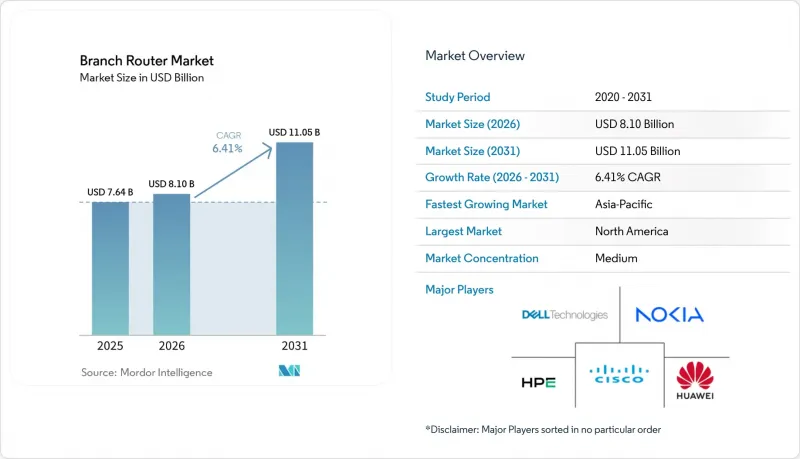
本報告按吞吐量等級(低吞吐量分店、中分店分公司、高效能分店等)、分店規模(小規模、分店和大型分店)、接取連線方式(乙太網路、寬頻等)、最終用戶產業(IT和電信、銀行、金融服務和保險、零售和電子商務等)以及地區進行細分。市場預測以美元(USD)為單位。
全球分支路由器市場趨勢及洞察
後疫情時代對安全遠端連線的需求日益成長
隨著混合辦公模式的興起,每個辦公地點都成為了安全部署中心,迫使企業將路由、防火牆和零信任功能整合到單一設備中。供應商現在不再依賴獨立的設備,而是將新一代防火牆引擎、加密隧道編配和人工智慧驅動的可視性直接整合到分支機構路由器中。思科的統一分支套件和 Fortinet 的 SASE Outpost 展示了單一供應商堆疊如何縮短引進週期並增強策略一致性。該平台藍圖還包括後量子密碼控制,以應對商業量子運算的到來,確保密鑰交換和設備管理能夠面向未來。隨著企業升級硬體,安全連接的重要性日益凸顯,其重要性已超越了單純的連接埠數量,即使在注重成本的層級中,規格升級也正在推動性能的提升。
新興市場零售和銀行、金融、保險和證券(BFSI)分店網路的擴張
銀行、快餐店和便利商店連鎖在印度、印尼、埃及和海灣國家經營數千家小型門市。這些門市需要小型路由器,能夠在惡劣環境條件下運行,同時為POS終端、影像分析和數位電子看板供電。政府光纖基礎設施項目和全國範圍內的5G部署進一步增加了潛在的分店數量,網路覆蓋範圍而非計算成本成為主要阻礙因素。能夠預先安裝金融服務合規模板並擁有符合當地通訊法規認證硬體的供應商在競標過程中佔據主導地位。隨著分店數量的增加,集中式控制器平台和零接觸配置至關重要,這使得管理軟體成為競標中的關鍵因素。
舊韌體導致的安全漏洞
由於程式碼過時,分店設備容易受到遠端劫持,消費級路由器的CVE漏洞數量平均是企業級路由器的10倍以上。 2025年至2026年間披露的關鍵漏洞表明,路由器仍然是間諜活動和殭屍網路的主要目標。監管機構目前正在禁止未經認證的進口產品,迫使買家優先選擇那些定期發布修補程式並支援所有設備自動更新的品牌。因此,企業正在逐步淘汰灰色市場產品,但許多中小企業難以承擔更換成本,這減緩了短期升級的速度,並拖累了分店路由器市場的整體成長。
細分市場分析
到 2025 年,高性能設備將佔據分支機構路由器市場 41.88% 的佔有率,這表明它們非常適合頻寬和成本平衡至關重要的中型分支機構。隨著企業採用邊緣 AI 推理、私人 5G 核心網和全隧道 SASE,預計到 2031 年,該細分市場將以 7.12% 的複合年成長率成長。這些工作負載需要整合加密加速器和多Gigabit介面,這些功能正逐漸成為中階晶片的標配。思科的「8000 系列安全路由器」擁有高達 95 Gbps 的 IPsec 吞吐量,正是轉向運算密集型邊緣設備的典型例證。同時,低吞吐量型號可能會失去其作為中間媒介的角色,被運行在通用硬體上的虛擬化網路功能所取代,從而可能導致其在分支機構路由器市場的佔有率萎縮。
這款超高性能平檯面向載波聚合、超大規模互連以及人工智慧架構的核心,實現了先前只有核心路由器才能達到的Terabit特級容量。 Arista 的 7800R4 系統在一個底盤內整合了 576 個 800 GbE 端口,預示著隨著矽成本下降,這項技術將帶來連鎖反應。在預測期內,隨著計算和路由的日益融合以及吞吐量分類的模糊化,買家將根據可用的擴展插槽和功耗預算來選擇底盤,而不是僅僅關注靜態的「每秒資料包數」。
到2025年,中型分店將佔分行路由器市場規模的43.62%,反映出標準化部署套件已涵蓋從零售銀行到區域倉庫的各個領域。然而,由便利商店連鎖、銀行自助服務終端和行動醫療診所等激增而催生的小規模分支機構,其複合年成長率將達到6.84%。低感性配置和雲端優先管理至關重要,供應商正在引入零接觸式入駐腳本,並將Wi-Fi和LTE硬體整合到單一機殼中。另一方面,大型分店作為聚合節點,配備冗餘上行鏈路、邊緣數據存儲和本地分析叢集,這推動了對能夠容納模組化線路卡和以太網供電(PoE)預算超過1.2千瓦的底盤的需求。
網路團隊目前正在實施一套「分支即代碼」工具包,該工具包允許他們將所需狀態保存到 Git 倉庫,自動推送更新,並回滾失敗的提交。雖然此舉降低了運行數百個微分店的額外成本,但也提高了對基礎設施工程師技能的要求,間接增加了缺乏 DevOps 人才的各類組織對託管 SD-WAN 服務的需求。
區域分析
預計到2025年,北美將佔全球收入的34.48%,這主要得益於成熟的SD-WAN應用、CBRS的商業化以及聯邦政府零信任指令對邊緣設備後量子加密技術的支援。然而,採購部門目前面臨記憶體價格飆升和交貨週期前置作業時間的困境,這增加了更新換代週期的總擁有成本(TCO)。平台供應商之間的整合加劇了對供應鏈的依賴,大型企業正透過多供應商認證計畫和獨立於雲端的控制器策略來應對這項挑戰。
亞太地區預計將以8.18%的複合年成長率(CAGR)實現最高成長。這一成長主要得益於印度和中國私有5G網路的部署、零售連鎖店的擴張以及印尼、越南和菲律賓銀行分店的增加。印度計畫於2026年實施的直接頻段接取政策調整,可望將私有網路的成本降低約40%。這將加速企業自有網路的部署,並催生可靈活整合到雲端原生5G核心網路且能夠處理海量物聯網設備的本地分店路由器的需求。各國政府正在補貼光纖鋪設和校園5G試點項目,以改善基礎網路連接,並使在二、三線城市部署小規模分店成為可能。本地系統整合商正在將路由器和託管服務捆綁銷售,以簡化頻道,並加速雲端管理產品組合的普及。
在歐洲,受GDPR合規性、資料主權要求以及鼓勵新型ASIC設計的能源效率法規的推動,穩定的替換需求持續成長。儘管經濟逆風和謹慎的資本投資限制了成長空間,但永續性法規正促使企業逐步淘汰耗電的傳統路由器,轉而採用能夠動態調整CPU時脈頻率並閒置未使用連接埠的節能型路由器。在中東和非洲地區,雖然絕對銷量較小,但在「數位埃及」等大型企劃以及5G在待開發區的快速部署的推動下,部分地區實現了兩位數的成長。南美洲的擴張因外匯波動和光纖回程傳輸短缺而放緩,但隨著共用基地台合約和雲端接入點的普及,潛在需求正逐步釋放。
其他好處:
- Excel格式的市場預測(ME)表
- 3個月的分析師支持
目錄
第1章:引言
- 研究假設和市場定義
- 調查範圍
第2章:調查方法
第3章執行摘要
第4章 市場狀況
- 市場概覽
- 市場促進因素
- 後疫情時代對安全遠端連線的需求日益成長
- 在新興市場拓展零售和銀行、金融服務及保險(BFSI)分店網路
- 雲端遷移帶來的頻寬需求增加
- 向 SD-WAN 和軟體定義分支架構遷移
- 將邊緣 AI 工作負載卸載到分支路由器上需要設備端運算。
- 企業專用 5G/ LTE頻譜的可用性正在加速無線廣域網路路由器的普及。
- 市場限制因素
- 舊韌體導致的安全漏洞
- 激烈的競爭與商品化
- 半導體供應鏈的波動會影響前置作業時間
- 缺乏大規模SD-WAN策略管理技能
- 產業價值鏈分析
- 監理情勢
- 技術展望
- 宏觀經濟因素對市場的影響
- 波特五力分析
第5章 市場規模與成長預測
- 按吞吐量等級
- 低吞吐量分支路由器
- 中階分支路由器
- 高效能分支路由器
- 超高容量分支路由器
- 分店大小
- 小規模分店
- 中等大小的分店
- 大分店
- 按類型分類的存取和連接
- Ethernet
- 寬頻
- 4G/LTE
- 5G
- 混合
- 按最終用戶行業分類
- 資訊科技/通訊
- BFSI
- 零售與電子商務
- 醫療保健和生命科學
- 政府/公共部門
- 製造業
- 教育
- 其他終端用戶產業
- 按地區
- 北美洲
- 美國
- 加拿大
- 墨西哥
- 南美洲
- 巴西
- 阿根廷
- 其他南美國家
- 歐洲
- 德國
- 英國
- 法國
- 義大利
- 俄羅斯
- 其他歐洲國家
- 亞太地區
- 中國
- 日本
- 印度
- 韓國
- 澳洲和紐西蘭
- 其他亞太國家
- 中東
- 沙烏地阿拉伯
- 阿拉伯聯合大公國
- 土耳其
- 其他中東國家
- 非洲
- 南非
- 埃及
- 奈及利亞
- 其他非洲國家
- 北美洲
第6章 競爭情勢
- 市場集中度
- 策略趨勢
- 市佔率分析
- 公司簡介
- Cisco Systems, Inc.
- Hewlett Packard Enterprise Company
- Huawei Technologies Co., Ltd.
- Dell Technologies Inc.
- Nokia Corporation
- Arista Networks, Inc.
- Extreme Networks, Inc.
- Ubiquiti Inc.
- Fortinet, Inc.
- Peplink International Limited
- Aruba Networks, LLC
- NETGEAR, Inc.
- TP-Link Technologies Co., Ltd.
- Advantech Co., Ltd.
- Teltonika Networks UAB
- Cradlepoint, Inc.
- Digi International Inc.
- Sierra Wireless, Inc.
- Edgecore Networks Corporation
- Allied Telesis Holdings KK
- MikroTikls SIA
- ZTE Corporation
- Ruijie Networks Co., Ltd.
- Cambium Networks Corporation
第7章 市場機會與未來展望
According to Mordor Intelligence, the branch router market size is expected to grow from USD 7.64 billion in 2025 to USD 8.10 billion in 2026 and is forecast to reach USD 11.05 billion by 2031 at a 6.41% CAGR over 2026-2031.
This report is Segmented by Throughput Class (Low-Throughput Branch Routers, Mid-Range Branch Routers, High-Performance Branch Routers, and More), Branch Size (Small Branch, Medium Branch, and Large Branch), Access Connectivity (Ethernet, Broadband, and More), End User Industry (IT and Telecom, BFSI, Retail and E-Commerce, and More), and Geography. The Market Forecasts are Provided in Terms of Value (USD).
Global Branch Router Market Trends and Insights
Growing Demand For Secure Remote Connectivity Post Pandemic
Hybrid work has turned every site into a security enforcement point, pushing organizations to combine routing, firewall, and zero-trust functions in one device. Vendors now embed next-generation firewall engines, encrypted tunnel orchestration, and AI-driven visibility directly inside branch routers rather than relying on separate appliances. Cisco's Unified Branch bundle and Fortinet's SASE Outpost illustrate how single-vendor stacks shorten deployment cycles while tightening policy consistency. Platform roadmaps are also adding post-quantum cryptography controls in anticipation of commercial quantum computing, ensuring that key exchange and device management remain future-proof. As enterprises refresh hardware, secure connectivity features increasingly outweigh raw port counts, driving specification upgrades even in cost-sensitive tiers.
Expansion Of Retail And BFSI Branch Networks In Emerging Markets
Banks, quick-service restaurants, and convenience chains are rolling out thousands of compact outlets across India, Indonesia, Egypt, and the Gulf states. These footprints demand small-form-factor routers that can power point-of-sale devices, video analytics, and digital signage while surviving harsh environmental conditions. Government fiber programs and nationwide 5G launches further multiply the number of viable branch locations, making network coverage, not compute cost, the primary constraint. Vendors able to preload compliance templates for financial services and to certify hardware against local telecom rules capture a disproportionate share of tenders. As branch counts climb, centralized controller platforms and zero-touch provisioning become essential, turning management software into a deciding factor during procurement.
Security Vulnerabilities Due To Legacy Firmware
Out-of-date code leaves branch devices exposed to remote takeover, with consumer models averaging more than ten times the CVE count of enterprise units. High-severity flaws disclosed in 2025-2026 demonstrate that routers remain prime targets for espionage and botnets. Regulatory bodies now block uncertified imports, forcing buyers to prioritize brands that publish regular patches and support automated fleet-wide updates. Enterprises consequently phase out gray-market appliances, but many small businesses struggle to fund replacements, limiting near-term upgrade velocity and shaving growth off the overall branch router market.
Other drivers and restraints analyzed in the detailed report include:
- Increasing Bandwidth Requirements With Cloud Migration
- Shift Toward SD-WAN And Software-Defined Branch Architectures
- Intense Price Competition And Commoditization
For complete list of drivers and restraints, kindly check the Table Of Contents.
Segment Analysis
High-performance appliances commanded 41.88% branch router market share in 2025, underscoring their suitability for medium branches that balance bandwidth and cost. The class is forecast to advance at a 7.12% CAGR through 2031 as enterprises adopt edge AI inference, private 5G cores, and full-tunnel SASE. These workloads demand integrated encryption accelerators and multi-gigabit interfaces, features that mid-range silicon increasingly embeds by default. Cisco's 8000 Series Secure Routers, with up to 95 Gbps IPsec throughput, exemplify the pivot toward compute-heavy edge gear. Conversely, low-throughput models risk disintermediation by virtualized network functions running on commodity boxes, shrinking their addressable slice of the branch router market size.
Ultra-high platforms target carrier aggregation, hyperscale interconnection, and AI fabric spines, shipping terabit capacities once reserved for core routers. Arista's 7800R4 system fits 576 ports of 800 GbE in one chassis, foreshadowing trickle-down effects as silicon costs fall. Over the forecast, compute and routing will increasingly converge, blurring throughput categories and encouraging buyers to select chassis based on available expansion slots and power budgets rather than on static packet-per-second ratings.
Medium branches delivered 43.62% of the 2025 branch router market size, reflecting standardized deployment kits that cover everything from retail banking to regional warehouses. Nonetheless, the fastest 6.84% CAGR belongs to small outlets created by proliferating convenience chains, bank kiosks, and pop-up healthcare clinics. Low-touch provisioning and cloud-first management are mandatory, leading vendors to embed zero-touch onboarding scripts and integrate Wi-Fi and LTE hardware into one enclosure. At the other extreme, large branches act as aggregation nodes with redundant uplinks, edge data storage, and local analytics clusters, sustaining demand for chassis that support modular line cards and power-over-Ethernet budgets above 1.2 kilowatts.
Network teams now deploy "branch as code" toolkits that store desired state in Git repositories, automatically push updates, and roll back failed commits. This shift lowers the incremental cost of operating hundreds of micro-branches but raises the skill threshold for infrastructure engineers, indirectly increasing demand for managed SD-WAN services among various organizations lacking DevOps-grade talent.
Complete Report Scope:
- By Throughput Class
- Low-throughput Branch Routers
- Mid-range Branch Routers
- High-performance Branch Routers
- Ultra-high Branch Routers
- By Branch Size
- Small Branch
- Medium Branch
- Large Branch
- By Access Connectivity
- Ethernet
- Broadband
- 4G/LTE
- 5G
- Hybrid
- By End User Industry
- IT and Telecom
- BFSI
- Retail and E-commerce
- Healthcare and Lifesciences
- Government and Public Sector
- Manufacturing
- Education
- Other End User Industries
- By Geography
- North America
- United States
- Canada
- Mexico
- South America
- Brazil
- Argentina
- Rest of South America
- Europe
- Germany
- United Kingdom
- France
- Italy
- Russia
- Rest of Europe
- Asia-Pacific
- China
- Japan
- India
- South Korea
- Australia and New Zealand
- Rest of Asia-Pacific
- Middle East
- Saudi Arabia
- United Arab Emirates
- Turkey
- Rest of Middle East
- Africa
- South Africa
- Egypt
- Nigeria
- Rest of Africa
- North America
Geography Analysis
North America controlled 34.48% of 2025 revenue, aided by mature SD-WAN uptake, CBRS commercialization, and federal zero-trust mandates that specify post-quantum readiness for edge devices. Procurement, however, now grapples with memory price inflation and lead-time volatility, raising the total cost of ownership for refresh cycles. Consolidation among platform suppliers creates additional supply-chain dependencies that large enterprises manage through multi-vendor qualification programs and cloud-agnostic controller strategies.
Asia-Pacific is projected to post the highest 8.18% CAGR. The growth is fueled by private 5G rollouts in India and China, retail chain expansion, and banking branch proliferation across Indonesia, Vietnam, and the Philippines. India's anticipated direct spectrum access policy changes in 2026 could lower private network costs by approximately 40%, accelerating enterprise-owned deployments and creating demand for on-premise branch routers with flexible integration to cloud-native 5G cores and support for massive IoT device density. Governments are subsidizing fiber builds and campus-5G pilots, lifting baseline connectivity and making small-branch deployment viable in secondary and tertiary cities. Local system integrators bundle routers with managed services, masking channel complexity and accelerating penetration of cloud-managed portfolios.
Europe exhibits steady replacement demand driven by GDPR compliance, data-sovereignty requirements, and energy-efficiency regulations that favor newer ASIC designs. Economic headwinds and cautious capital spending limit upside, yet sustainability mandates encourage enterprises to retire power-hungry legacy routers in favor of energy-aware models that dynamically scale CPU clocks and idle unused ports. Middle East and Africa, buoyed by mega-projects such as Digital Egypt and the prevalence of greenfield 5G rollouts, show double-digit local growth pockets despite lower absolute volume. South America's expansion is moderated by currency volatility and fiber backhaul gaps, but shared-tower agreements and cloud point-of-presence proliferation are beginning to unlock latent demand.
- Cisco Systems, Inc.
- Hewlett Packard Enterprise Company
- Huawei Technologies Co., Ltd.
- Dell Technologies Inc.
- Nokia Corporation
- Arista Networks, Inc.
- Extreme Networks, Inc.
- Ubiquiti Inc.
- Fortinet, Inc.
- Peplink International Limited
- Aruba Networks, LLC
- NETGEAR, Inc.
- TP-Link Technologies Co., Ltd.
- Advantech Co., Ltd.
- Teltonika Networks UAB
- Cradlepoint, Inc.
- Digi International Inc.
- Sierra Wireless, Inc.
- Edgecore Networks Corporation
- Allied Telesis Holdings K.K.
- MikroTikls SIA
- ZTE Corporation
- Ruijie Networks Co., Ltd.
- Cambium Networks Corporation
Additional Benefits:
- The market estimate (ME) sheet in Excel format
- 3 months of analyst support
TABLE OF CONTENTS
1 INTRODUCTION
- 1.1 Study Assumptions and Market Definition
- 1.2 Scope of the Study
2 RESEARCH METHODOLOGY
3 EXECUTIVE SUMMARY
4 MARKET LANDSCAPE
- 4.1 Market Overview
- 4.2 Market Drivers
- 4.2.1 Growing Demand for Secure Remote Connectivity Post Pandemic
- 4.2.2 Expansion of Retail and BFSI Branch Networks in Emerging Markets
- 4.2.3 Increasing Bandwidth Requirements with Cloud Migration
- 4.2.4 Shift Toward SD-WAN and Software-Defined Branch Architectures
- 4.2.5 Edge AI Workload Offloading Necessitating On-Device Compute in Branch Routers
- 4.2.6 Availability of Private 5G/LTE Spectrum for Enterprises Accelerating Wireless WAN Routers
- 4.3 Market Restraints
- 4.3.1 Security Vulnerabilities Due to Legacy Firmware
- 4.3.2 Intense Price Competition and Commoditization
- 4.3.3 Chip Supply Chain Volatility Affecting Lead Times
- 4.3.4 Skills Shortage in Managing SD-WAN Policies at Scale
- 4.4 Industry Value Chain Analysis
- 4.5 Regulatory Landscape
- 4.6 Technological Outlook
- 4.7 Impact of Macroeconomic Factors on the Market
- 4.8 Porter's Five Forces Analysis
- 4.8.1 Threat of New Entrants
- 4.8.2 Bargaining Power of Buyers
- 4.8.3 Bargaining Power of Suppliers
- 4.8.4 Threat of Substitutes
- 4.8.5 Intensity of Competitive Rivalry
5 MARKET SIZE AND GROWTH FORECASTS (VALUE)
- 5.1 By Throughput Class
- 5.1.1 Low-throughput Branch Routers
- 5.1.2 Mid-range Branch Routers
- 5.1.3 High-performance Branch Routers
- 5.1.4 Ultra-high Branch Routers
- 5.2 By Branch Size
- 5.2.1 Small Branch
- 5.2.2 Medium Branch
- 5.2.3 Large Branch
- 5.3 By Access Connectivity
- 5.3.1 Ethernet
- 5.3.2 Broadband
- 5.3.3 4G/LTE
- 5.3.4 5G
- 5.3.5 Hybrid
- 5.4 By End User Industry
- 5.4.1 IT and Telecom
- 5.4.2 BFSI
- 5.4.3 Retail and E-commerce
- 5.4.4 Healthcare and Lifesciences
- 5.4.5 Government and Public Sector
- 5.4.6 Manufacturing
- 5.4.7 Education
- 5.4.8 Other End User Industries
- 5.5 By Geography
- 5.5.1 North America
- 5.5.1.1 United States
- 5.5.1.2 Canada
- 5.5.1.3 Mexico
- 5.5.2 South America
- 5.5.2.1 Brazil
- 5.5.2.2 Argentina
- 5.5.2.3 Rest of South America
- 5.5.3 Europe
- 5.5.3.1 Germany
- 5.5.3.2 United Kingdom
- 5.5.3.3 France
- 5.5.3.4 Italy
- 5.5.3.5 Russia
- 5.5.3.6 Rest of Europe
- 5.5.4 Asia-Pacific
- 5.5.4.1 China
- 5.5.4.2 Japan
- 5.5.4.3 India
- 5.5.4.4 South Korea
- 5.5.4.5 Australia and New Zealand
- 5.5.4.6 Rest of Asia-Pacific
- 5.5.5 Middle East
- 5.5.5.1 Saudi Arabia
- 5.5.5.2 United Arab Emirates
- 5.5.5.3 Turkey
- 5.5.5.4 Rest of Middle East
- 5.5.6 Africa
- 5.5.6.1 South Africa
- 5.5.6.2 Egypt
- 5.5.6.3 Nigeria
- 5.5.6.4 Rest of Africa
- 5.5.1 North America
6 COMPETITIVE LANDSCAPE
- 6.1 Market Concentration
- 6.2 Strategic Moves
- 6.3 Market Share Analysis
- 6.4 Company Profiles (includes Global Level Overview, Market Level Overview, Core Segments, Financials as available, Strategic Information, Market Rank/Share, Products and Services, Recent Developments)
- 6.4.1 Cisco Systems, Inc.
- 6.4.2 Hewlett Packard Enterprise Company
- 6.4.3 Huawei Technologies Co., Ltd.
- 6.4.4 Dell Technologies Inc.
- 6.4.5 Nokia Corporation
- 6.4.6 Arista Networks, Inc.
- 6.4.7 Extreme Networks, Inc.
- 6.4.8 Ubiquiti Inc.
- 6.4.9 Fortinet, Inc.
- 6.4.10 Peplink International Limited
- 6.4.11 Aruba Networks, LLC
- 6.4.12 NETGEAR, Inc.
- 6.4.13 TP-Link Technologies Co., Ltd.
- 6.4.14 Advantech Co., Ltd.
- 6.4.15 Teltonika Networks UAB
- 6.4.16 Cradlepoint, Inc.
- 6.4.17 Digi International Inc.
- 6.4.18 Sierra Wireless, Inc.
- 6.4.19 Edgecore Networks Corporation
- 6.4.20 Allied Telesis Holdings K.K.
- 6.4.21 MikroTikls SIA
- 6.4.22 ZTE Corporation
- 6.4.23 Ruijie Networks Co., Ltd.
- 6.4.24 Cambium Networks Corporation
7 MARKET OPPORTUNITIES AND FUTURE OUTLOOK
- 7.1 White-Space and Unmet-Need Assessment

 企業級路由器:市場佔有率分析、產業趨勢與統計、成長預測(2026-2031)住宅路由器:市場佔有率分析、產業趨勢與統計、成長預測(2026-2031)
 CNC雕刻機市場-2026-2032年全球市場預測智慧路由器市場:依路由器類型、技術標準、應用、通路和最終用戶分類-2026-2032年全球市場預測中小企業路由器:市場佔有率分析、產業趨勢與統計及成長預測(2026-2031 年)工業路由器市場:2026-2032年全球市場預測(依產品類型、連接技術、部署環境、最終用戶產業及銷售管道)核心路由器:市場佔有率分析、行業趨勢和統計數據、成長預測(2026-2031 年)網路路由器:市場佔有率分析、產業趨勢與統計、成長預測(2026-2031)路由器:市場佔有率分析、行業趨勢和統計數據、成長預測(2026-2031 年)
 2026年全球電信級路由市場報告