


 |
市場調查報告書
商品編碼
2064000
印尼圍籬市場:市佔率分析、產業趨勢與統計、成長預測(2026-2031)Indonesia Fencing - Market Share Analysis, Industry Trends & Statistics, Growth Forecasts (2026 - 2031) |
||||||

※ 本網頁內容可能與最新版本有所差異。詳細情況請與我們聯繫。
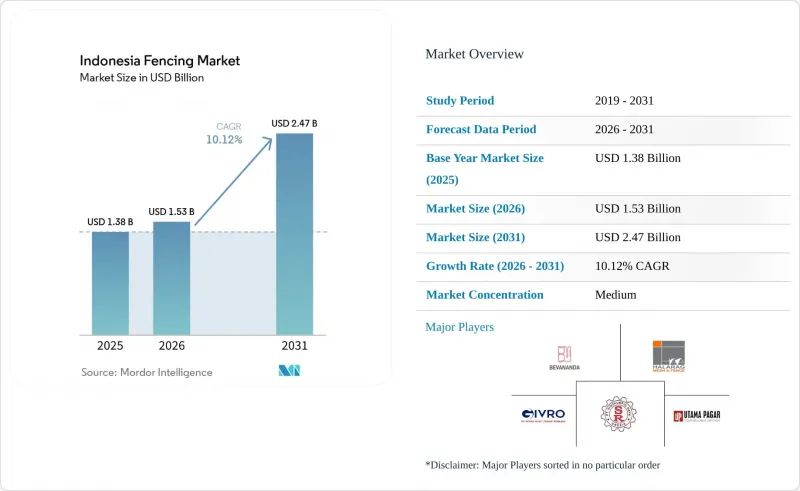
根據 Mordor Intelligence 預測,印尼圍籬市場預計將從 2025 年的 13.8 億美元成長到 2026 年的 15.3 億美元,到 2031 年達到 24.7 億美元,2026 年至 2031 年的複合年成長率預計為 10.12%。
本報告按材料(金屬、木材、塑膠/複合材料、混凝土)、最終用戶(住宅、農業/人工林、其他)、安裝類型(固定/永久圍欄、臨時/可移動圍欄)、安裝管道(專業承包商、其他製造商、DIY/模組化套件)和地區(爪哇島、蘇門答臘島、加里曼丹島、蘇拉威西島、其他地區)進行細分。市場預測以美元計價。
印尼圍籬市場趨勢與洞察
住宅和封閉式社區的安全需求
雅加達大都會圈中上階層和豪華住宅的擴張推動了住宅圍欄的強勁需求,預計到2025年,這項需求將持續成長。此外,獨棟住宅的銷售情況表明,已建成的住宅正在被迅速消化,而非空置。這一點意義重大,因為在居住者社區中,從基礎的邊界工程過渡到配備大門、門禁系統和更高品質裝修的更高級的邊界系統通常速度更快。住宅市場的需求也正從雅加達擴展到泗水、棉蘭和望加錫等地區,降低了對單一城市新訂單的依賴。開發商擴大採用不同的圍欄規格來區分周邊區域和內部區域,這擴大了能夠在同一份合約下提供多種產品等級的供應商的訂單規模。這一趨勢有利於組織完善的製造商獲得優惠價格,因為當買家投資於長期的社區安全時,設計柔軟性、油漆品質和安裝支援變得越來越重要。
工業園區和物流園區的擴建
工業園區仍然是印尼圍籬市場中最具活力的專案管道之一。這是因為每個園區都需要進行邊界管理、內部分區、查核點隔離,並在運作期間定期更新。 2025年底,印尼將擁有175個運作中的工業園區,累積投資額達6,744.6兆印尼幣(約4,190億美元),較去年同期成長9.3%。此外,位於八打雁省的KITB園區正在投資22兆印尼幣(約14億美元)進行4,300公頃的擴建,這將顯著擴大圍欄的應用範圍,使其不再局限於最初的邊界建設。另外,印尼政府2025年頒布的第26/2025號法令新增了一項重要內容:工業園區認證的等級很大程度上取決於基礎設施的質量,這促使開發商更有動力去提升圍欄的規格,而不是僅僅選擇成本最低的方案。此外,由於許多工業園區仍未被指定為 OVNI(國際重要基礎設施),加強周邊安全保障和提升保全水準仍是整個產業部門尚未滿足的需求。
鋼鐵和線材價格波動
儘管許多供應商仍採用固定價格契約,但鋼材原料價格的波動顯然對印尼圍欄市場構成拖累,因為原料成本受區域和全球鋼鐵市場狀況的影響。印尼離岸價(FOB)線材價格從2025年9月的每噸480美元降至2025年11月的每噸462美元。雖然表面上看降幅不大,但這並未消除下游買家面臨的潛在成本不不確定性。 2025年,印尼線材進口量達到143,662噸,而國內21家生產商的總產能僅為每年1,054,498噸,顯示供應量和定價能力並非必然相關。 2021年至2025年,出口量也大幅下降,這意味著更多供應轉向國內市場,而國內市場的價格仍容易受到海外鋼鐵價格波動的影響。中小製造商通常沒有長期供應契約,也沒有多少空間來應對競標過程中成本的突然上漲,因此它們仍然是最脆弱的群體。
細分市場分析
到2025年,金屬將佔印尼圍籬市場佔有率的69%,成為住宅、工業、農業和公共基礎設施應用領域的主導材料。鍍鋅鋼鏈、BRC焊接網和刺鐵絲網是銷售量主力,因為它們為買家所熟知、供應充足,且易於在標準項目類型中指定使用。在金屬圍欄領域,鋼材仍然是銷售量的主要驅動力,而鋁材則更多用於沿海地區和高濕度環境等應用場景,在這些地區,由於腐蝕風險較高,鋁材的成本更容易被接受。木材在農村邊界建設中仍然佔有一席之地,但由於維護需求和永續性壓力,其市場佔有率受到限制。混凝土圍欄在隱私牆和公路相關設施中仍然很重要,但它們被定位為一個專業領域,而不是一個廣泛的類別。
對上游產業的投資支撐著這種以金屬主導的結構。 PT Beka Wire在梳邦投資3000億印尼幣(約1830萬美元)運作了一家工廠,目標是年產3.6萬噸,這表明該公司對國內對金屬絲網的需求永續性充滿信心。同時,材料組成也在改變。由於塑膠和複合材料具有輕質、耐鹽霧和易於運輸等優點,預計到2031年,其年複合成長率將達到13%。這些優點使其更適合人工林園和離島項目。此外,在那些更換成本和使用壽命比購買價格本身更重要的應用領域,紫外線穩定聚乙烯網正開始取代鋼材。目前的標準體系仍缺乏專門針對複合材料圍籬產品的標準,這造成了短期內的規範模糊,但也為領先提供了主導未來應用參與企業的空間。
預計到2025年,住宅用戶將佔總需求的24%,而印尼圍籬市場最大的需求來源仍是私人住宅、住宅和封閉式社區,而非單一的機構買家群體。這反映了郊區發展以及在主要城市走廊地帶,人們越來越傾向於選擇安全、封閉的居住環境的文化趨勢。農業和人工林園的需求仍然顯著,因為邊界圍欄的安裝、場地管理和野生動物保護措施都會對大片土地上的圍欄產生巨大的需求。政府和公共基礎設施項目正透過正式競標提高大規模合約的透明度,而工業和物流設施則繼續需要採用鍍鋅板和電動邊界系統來確保營運安全。採礦和能源項目也在推動需求,尤其是在鎳加工和資源相關領域,資產保護是採購的首要任務。
軍事和邊防安全是成長最快的終端用戶領域,預計2031年將維持11.7%的複合年成長率。這反映了邊境安全防護體係正從簡單的屏障轉變為整合安全功能的周界系統。法國巴黎銀行的「智慧邊境2026」計畫是這項成長的關鍵促進因素,該計畫將實體圍籬和監控系統在重點邊境口岸連接起來。交通基礎設施也提供了穩定的需求來源,因為隨著機場和鐵路網路的擴展,這些設施需要定期檢查、維護和周界管理工作。雖然商業和公共部門的需求佔比較小,但隨著物流樞紐和資料相關基礎設施在次要走廊的發展,其規模正在不斷成長。這種多元化的終端用戶組成使市場更具韌性,因為某個買家群體的需求放緩不太可能阻礙整體需求的成長。
其他好處:
- Excel格式的市場預測(ME)表
- 3個月的分析師支持
目錄
第1章:引言
- 研究假設和市場定義
- 調查範圍
第2章:調查方法
第3章執行摘要
第4章 市場狀況
- 市場概覽
- 市場促進因素
- 住宅和封閉式社區的安全需求
- 工業園區和物流園區的擴建
- 農業和人工林邊界保護
- 加強邊境檢查站和關鍵資產的安全保障
- SNI 和 TKDN 合規性有利於組織化的供應商。
- 用圍欄來緩解人類與野生動物之間的衝突
- 市場限制因素
- 鋼材和線材價格波動
- 分散的區域競爭和價格主導的競標
- 群島型票價與安裝成本之間的不對稱性
- 在沿海地區,由於需要考慮環境因素,獲得授權和安裝設備面臨許多挑戰。
- 價值供應鏈分析
- 監理情勢
- 技術展望
- 波特五力模型
- 價格分析
- 永續和低維護材料的發展趨勢
- 邊防安全框架與部署趨勢
第5章 市場規模與成長預測
- 材料
- 金屬
- 鋼
- 鋁
- 樹
- 塑膠和複合材料
- 具體的
- 金屬
- 最終用戶
- 住宅
- 農業和人工林
- 政府和公共基礎設施
- 軍事/邊防安全
- 工業與物流
- 採礦和能源
- 交通基礎設施
- 適用於商業和機構用途
- 按安裝類型
- 固定/永久圍欄
- 臨時/可移動圍欄
- 透過安裝通道
- 專家
- 其他 - 製造商、DIY/模組化套件
- 按地區
- Java
- 蘇門答臘
- 加里曼丹
- 蘇拉威西
- 峇裡島努沙登加拉
- 馬魯古及巴布亞
第6章 競爭情勢
- 市場集中度
- 策略趨勢
- 市佔率分析
- 公司簡介
- PT Bevananda Mustika
- PT Halarag Baja Utama
- PT Sidokumpul Raya
- PT Givro Multi Teknik Perkasa
- PT Utama Pagar Indonesia
- PT Anugerah Wijayatrisna
- PT Fencing Meshindo Raya
- CV BAKTI
- CV Multi Gisma Tehknindo
- PT Karya Utama Steel
- CV Duta Mesh
- PT Baja Prima Lestari
- CV Sukses Dinamika Engineering
- CV Griya Mandiri Konstruksi
- PT Abadi Metal Utama
- PT Pratama Prima Bajatama
- PT Akmal Adi Perkasa
- PT Trinity Global Mandiri
- CV Givro Jaya Mandiri
- CV Bangun Sarana Makmur
第7章 市場機會與未來展望
According to Mordor Intelligence, the indonesia fencing market size is expected to increase from USD 1.38 billion in 2025 to USD 1.53 billion in 2026 and reach USD 2.47 billion by 2031, growing at a CAGR of 10.12% over 2026-2031.
This report is Segmented by Material (Metal, Wood, Plastic & Composite, Concrete), End-User (Residential, Agriculture & Plantation, and More), Installation Type (Fixed / Permanent Fencing, Temporary / Mobile Fencing), Installation Channel (Professional Contractor, Others - Fabricators, DIY / Modular Kits), and Region (Java, Sumatra, Kalimantan, Sulawesi, and More). Market Forecasts are in Value (USD).
Indonesia Fencing Market Trends and Insights
Residential and Gated-Community Security Demand
Upper-middle and luxury housing expansion in Greater Jakarta kept residential perimeter demand active through 2025, and the landed housing sales rate shows that completed units were being absorbed rather than left idle. That matters because occupied communities usually move faster from basic boundary works to upgraded perimeter systems with gates, access control, and better finishes. The residential side of the market is also broadening beyond Jakarta into Surabaya, Medan, and Makassar corridors, which reduces dependence on one city for new orders. Developers are increasingly using different fencing specifications for outer and inner zones, and that creates larger order baskets for suppliers that can deliver several product grades in one contract. This pattern supports better pricing for organized manufacturers because design flexibility, coating quality, and installation support matter more when buyers are paying for long-term neighborhood security.
Industrial-Estate and Logistics-Park Expansion
Industrial estates remain one of the strongest project channels in the Indonesia fencing market because each site requires perimeter control, internal zoning, checkpoint separation, and recurring replacement over its operating life. Indonesia had 175 operational industrial estates at the end of 2025, with a cumulative investment of IDR 6,744.6 trillion (USD 419 billion), and estate investment growth of 9.3% year on year. The KITB complex in Batanghari is also committing IDR 22 trillion (USD 1.4 billion) toward a 4,300-hectare expansion, which widens the addressable scope for fencing well beyond initial perimeter works. Permenperin No. 26/2025 adds another layer, as higher estate accreditation depends heavily on infrastructure quality, giving developers a direct reason to upgrade fencing specifications rather than choosing the lowest-cost option. A large share of estates also remains outside OVNI designation, so perimeter hardening and security upgrades still represent an underserved pipeline across the industrial segment.
Steel and Wire Price Volatility
Steel input swings are a clear drag on the Indonesia fencing market because many suppliers still operate on fixed-price contracts while their material costs move with regional and global steel conditions. Wire rod FOB Indonesia moved from USD 480 per metric ton in September 2025 to USD 462 in November 2025, which looked softer on paper but did not remove underlying cost uncertainty for downstream buyers. In 2025, wire import volumes reached 143,662 metric tons, while national production capacity stood at 1,054,498 metric tons a year across 21 producers, showing that volume balance and pricing power do not always move together. Export volumes also fell sharply from 2021 to 2025, which suggests more supply was being redirected into the domestic market at prices still exposed to outside steel movements. Smaller manufacturers remain the most exposed because they usually lack long-term supply agreements and have less room to absorb cost spikes during tender execution.
Other drivers and restraints analyzed in the detailed report include:
- Agriculture and Plantation Perimeter Protection
- Border-Post and Critical-Asset Security Upgrades
- Fragmented Local Competition and Price-Led Tendering
For complete list of drivers and restraints, kindly check the Table Of Contents.
Segment Analysis
Metal accounted for 69% of Indonesia fencing market share in 2025, making it the clear anchor material across residential, industrial, agricultural, and public infrastructure uses. Galvanized steel chain-link, BRC welded mesh, and barbed wire together formed the core of this volume because they are familiar to buyers, widely available, and easier to specify across standard project types. Within metal, steel remains the main volume driver, while aluminum serves narrower applications in coastal and high-humidity environments where corrosion risk makes the premium more acceptable. Wood remains present in rural boundary work, but its share is limited by maintenance needs and sustainability pressure. Concrete fencing stays relevant in privacy walls and highway-related installations, though it is a specialist rather than a broad-based category.
Upstream investment supports that metal-led structure. PT Beka Wire commissioned a new IDR 300 billion (USD 18.3 million) facility in Subang, targeting an output of 36,000 metric tons a year, demonstrating confidence in sustained domestic wire and mesh demand. At the same time, the material mix is not standing still. Plastic and composite materials are forecast to grow at a 13% CAGR through 2031 due to their low weight, salt-spray resistance, and ease of transport, which improve their fit for plantation zones and outer-island projects. UV-stabilized polyethylene mesh is starting to replace steel in uses where replacement cost and field life matter more than headline purchase price. The current standards framework still lacks a dedicated composite fencing product standard, and that creates short-term specification ambiguity while giving first movers room to shape future adoption.
Residential users represented 24% of total demand in 2025, so the largest block of the Indonesia fencing market still comes from homes, clusters, and gated communities rather than from a single institutional buyer group. This reflects suburban growth and the cultural preference for secure enclosed living across major urban corridors. Agriculture and plantation demand also remains important because boundary fencing, site control, and wildlife-mitigation installations create large linear-meter requirements across broad land parcels. Government and public infrastructure projects add large contract visibility through formal tenders, while industrial and logistics sites continue to specify galvanized panels and electrified perimeter systems for operational security. Mining and energy projects are also adding demand for nickel processing and resource-linked zones, where asset protection is a procurement priority.
Military and border security is the fastest-growing end-user segment, with a 11.7% CAGR through 2031, reflecting the shift from simple barriers to security-integrated perimeter systems. BNPP's Smart Border 2026 program is a major factor because it links physical fencing to monitoring architecture at priority border locations.Transportation infrastructure provides another recurring stream because airport and rail sites require repeated inspection, repair, and controlled boundary works as networks expand. Commercial and institutional demand is smaller in share, yet it is widening with the growth of logistics hubs and data-related infrastructure in secondary corridors. This broad end-user mix gives the market more resilience because weakness in one buyer group is less likely to stop total demand growth.
List of Companies Covered in this Report:
- PT Bevananda Mustika
- PT Halarag Baja Utama
- PT Sidokumpul Raya
- PT Givro Multi Teknik Perkasa
- PT Utama Pagar Indonesia
- PT Anugerah Wijayatrisna
- PT Fencing Meshindo Raya
- CV BAKTI
- CV Multi Gisma Tehknindo
- PT Karya Utama Steel
- CV Duta Mesh
- PT Baja Prima Lestari
- CV Sukses Dinamika Engineering
- CV Griya Mandiri Konstruksi
- PT Abadi Metal Utama
- PT Pratama Prima Bajatama
- PT Akmal Adi Perkasa
- PT Trinity Global Mandiri
- CV Givro Jaya Mandiri
- CV Bangun Sarana Makmur
Additional Benefits:
- The market estimate (ME) sheet in Excel format
- 3 months of analyst support
TABLE OF CONTENTS
1 Introduction
- 1.1 Study Assumptions & Market Definition
- 1.2 Scope of the Study
2 Research Methodology
3 Executive Summary
4 Market Landscape
- 4.1 Market Overview
- 4.2 Market Drivers
- 4.2.1 Residential and Gated-Community Security Demand
- 4.2.2 Industrial-Estate and Logistics-Park Expansion
- 4.2.3 Agriculture and Plantation Perimeter Protection
- 4.2.4 Border-Post and Critical-Asset Security Upgrades
- 4.2.5 SNI and TKDN Compliance Favoring Organized Suppliers
- 4.2.6 Human-Wildlife Conflict Mitigation Fencing
- 4.3 Market Restraints
- 4.3.1 Steel and Wire Price Volatility
- 4.3.2 Fragmented Local Competition and Price-Led Tendering
- 4.3.3 Archipelagic Freight and Installation-Cost Asymmetry
- 4.3.4 Coastal Permitting and Sensitive-Site Deployment Hurdles
- 4.4 Value / Supply-Chain Analysis
- 4.5 Regulatory Landscape
- 4.6 Technological Outlook
- 4.7 Porter's Five Forces
- 4.7.1 Bargaining Power of Suppliers
- 4.7.2 Bargaining Power of Buyers
- 4.7.3 Threat of New Entrants
- 4.7.4 Threat of Substitutes
- 4.7.5 Intensity of Competitive Rivalry
- 4.8 Pricing Analysis
- 4.9 Sustainability & Low-Maintenance Material Trends
- 4.10 Border Security Framework & Deployment Trends
5 Market Size & Growth Forecasts (Value, USD)
- 5.1 By Material
- 5.1.1 Metal
- 5.1.1.1 Steel
- 5.1.1.2 Aluminum
- 5.1.2 Wood
- 5.1.3 Plastic & Composite
- 5.1.4 Concrete
- 5.1.1 Metal
- 5.2 By End-User
- 5.2.1 Residential
- 5.2.2 Agriculture & Plantation
- 5.2.3 Government & Public Infrastructure
- 5.2.4 Military & Border Security
- 5.2.5 Industrial & Logistics
- 5.2.6 Mining & Energy
- 5.2.7 Transportation Infrastructure
- 5.2.8 Commercial & Institutional
- 5.3 By Installation Type
- 5.3.1 Fixed / Permanent Fencing
- 5.3.2 Temporary / Mobile Fencing
- 5.4 By Installation Channel
- 5.4.1 Professional Contractor
- 5.4.2 Others - Fabricators, DIY / Modular Kits
- 5.5 By Region
- 5.5.1 Java
- 5.5.2 Sumatra
- 5.5.3 Kalimantan
- 5.5.4 Sulawesi
- 5.5.5 Bali & Nusa Tenggara
- 5.5.6 Maluku & Papua
6 Competitive Landscape
- 6.1 Market Concentration
- 6.2 Strategic Moves
- 6.3 Market Share Analysis
- 6.4 Company Profiles {(includes Global level Overview, Market level overview, Core Segments, Financials as available, Strategic Information, Market Rank/Share for key companies, Products & Services, and Recent Developments)}
- 6.4.1 PT Bevananda Mustika
- 6.4.2 PT Halarag Baja Utama
- 6.4.3 PT Sidokumpul Raya
- 6.4.4 PT Givro Multi Teknik Perkasa
- 6.4.5 PT Utama Pagar Indonesia
- 6.4.6 PT Anugerah Wijayatrisna
- 6.4.7 PT Fencing Meshindo Raya
- 6.4.8 CV BAKTI
- 6.4.9 CV Multi Gisma Tehknindo
- 6.4.10 PT Karya Utama Steel
- 6.4.11 CV Duta Mesh
- 6.4.12 PT Baja Prima Lestari
- 6.4.13 CV Sukses Dinamika Engineering
- 6.4.14 CV Griya Mandiri Konstruksi
- 6.4.15 PT Abadi Metal Utama
- 6.4.16 PT Pratama Prima Bajatama
- 6.4.17 PT Akmal Adi Perkasa
- 6.4.18 PT Trinity Global Mandiri
- 6.4.19 CV Givro Jaya Mandiri
- 6.4.20 CV Bangun Sarana Makmur
7 Market Opportunities & Future Outlook
- 7.1 White-space & Unmet-Need Assessment

 2026-2030年全球水產養殖網箱市場
 動物籠具市場-2026-2032年全球市場預測水產養殖網箱市場-2026-2032年全球市場預測圍籬市場:2026-2032年全球市場預測(依產品類型、材質、功能、高度、安裝方式、通路和應用分類)
 水產養殖網箱市場規模、佔有率和成長分析:按網箱類型、材質、應用、魚類品種、養殖場規模、最終用戶和地區分類-2026-2033年產業預測
 2026-2034年全球水產養殖網箱市場規模、佔有率、趨勢和成長分析報告
 英國圍籬市場:市佔率分析、產業趨勢與統計及成長預測(2026-2031)美國圍欄:市場佔有率分析、行業趨勢和統計數據、成長預測(2026-2031 年)德國圍籬市場:市場佔有率分析、產業趨勢與統計、成長預測(2026-2031)印度圍籬市場:市場佔有率分析、產業趨勢與統計、成長預測(2026-2031)