


 |
市場調查報告書
商品編碼
2063670
北美LED晶片市場:市佔率分析、產業趨勢與統計及成長預測(2026-2031年)North America LED Chips - Market Share Analysis, Industry Trends & Statistics, Growth Forecasts (2026 - 2031) |
||||||

※ 本網頁內容可能與最新版本有所差異。詳細情況請與我們聯繫。
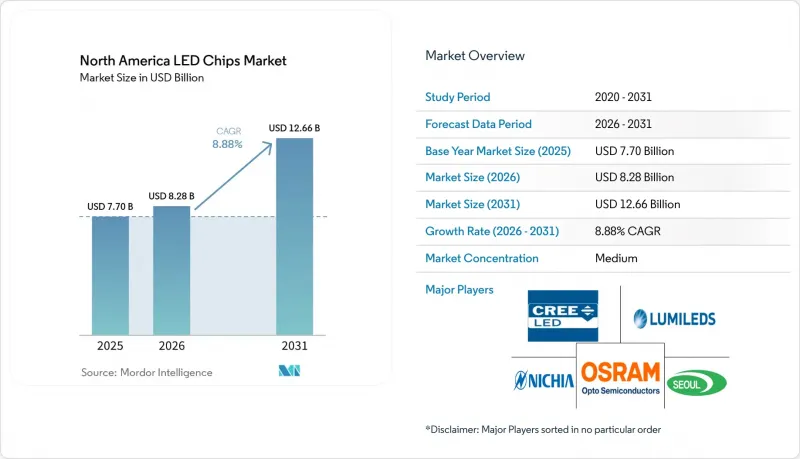
根據 Mordor Intelligence 預測,北美 LED 晶片市場規模將從 2025 年的 77 億美元和 2026 年的 82.8 億美元成長到 2031 年的 126.6 億美元,2026 年至 2031 年的年複合成長率(CAGR)為 8.88%。
本報告按LED晶片技術(傳統LED、Mini-LED等)、半導體材料(GaN/InGaN、AlGaInP等)、應用領域(通用照明、汽車、背光/顯示器、家用電子電器等)和國家(美國、加拿大等)進行細分。市場預測以美元(USD)計價。
北美LED晶片市場趨勢與洞察
商業不動產對節能照明的需求日益成長
到2026年,公共產業項目將把受監管照明的平均獎勵提高17%,戶外照明類別(例如停車場和牆體照明)的增幅將超過30%。根據第179D條稅額扣抵抵免,這使得基本稅收優惠增加了五倍,並提高了維修的內部收益。安裝後的監測數據顯示,倉庫維修可降低40%至65%的照明能耗,對於運作運作的設施,投資可在18個月內收回,這刺激了對替換晶片的持續需求,因為第一代LED照明燈具即將達到使用壽命。由於允許LED升級改造的專案增多,即使新建專案放緩,北美LED晶片市場依然蓬勃發展。提供高效能藍色晶片和長壽命紅色磷光體混合物的製造商最能掌握這第二輪維修週期帶來的機會。
利用智慧路燈擴展智慧城市項目
孟菲斯市完成了一項耗資 4700 萬美元的項目,用網路控制的 LED 照明設備替換了 77000 個照明燈具,每年可節省 3700 萬千瓦時的能源,並減少 26000 公噸溫室氣體排放。 LEOTEK 和 1NCE 共同推出了一款即用型蜂巢式物聯網平台,該平台消除了市政當局漫遊的複雜性,並加速了跨境部署。目前,波士頓、錫拉丘茲和密西根州的公共產業管轄區正在進行初步部署。透過將交通、空氣品質和公共 Wi-Fi 感測器整合到照明燈具中,城市正在將路燈網路轉變為可產生收入的數據平台。這些多功能照明燈具需要嚴格分級的 LED 晶片,以確保電流均勻性和正向電壓匹配,這推高了北美 LED 晶片市場的平均售價。基於績效的維護合約(保證五天內維修)也有利於擁有垂直整合服務網路的供應商。
MOCVD設備供應鏈中斷
AIXTRON 和 Veeco Instruments 供應全球約三分之二的 MOCVD 反應器,單室反應器的價格在 150 萬美元至 300 萬美元之間。精密質量流量控制器和真空子系統組件的短缺已將交貨週期延長至 18 個月以上,導致亞利桑那州和安大略省原計劃的晶圓產能擴張計劃延期。雖然二手反應器偶爾會在二手市場上出現,但將舊設備升級到 200 毫米 GaN 製程需要昂貴的升級套件。去年,英飛凌在歐洲展示了首條運作的300 毫米 GaN 功率晶圓生產線,凸顯了規模經濟效益。設備交付的持續延誤可能導致北美晶圓廠落後於亞洲競爭對手,並減緩北美 LED 晶片市場的擴張步伐。
細分市場分析
到2025年,傳統LED元件將佔據北美LED晶片市場83.77%的佔有率,凸顯了白光LED在通用照明和標牌應用領域的成本優勢。儘管Micro-LED晶片目前市場佔有率仍然很小,但其複合年成長率(CAGR)高達11.32%,這主要得益於智慧型手錶、汽車A柱顯示器和擴增實境(AR)頭顯等應用的推動。 Garmin為其計劃於2026年發布的旗艦多功能運動手錶選擇了1.39英寸的Micro-LED面板,並指出其在陽光下的可視性和長達20天的電池續航時間是主要原因。 VueReal的高產量印刷模式已使安大略省成為這些穿戴式裝置的供應中心。
傳統LED製造商透過封裝技術的創新,例如高反射率導線架和混合光學技術,維持了其市場佔有率,這些創新已將發光效率提升至220 lm/W以上。然而,未來高階市場的成長趨勢將傾向於microLED,因為直接髮光像素消除了色移偽影,並在抬頭顯示器中實現了超過3000尼特的峰值亮度。如果microLED在試生產線上的轉移良率超過99.9%,到2031年,這項技術可望佔據北美LED晶片市場10%的佔有率,而miniLED將在高階電視背光市場佔據中端市場。
其他好處:
- Excel格式的市場預測(ME)表
- 3個月的分析師支持
目錄
第1章:引言
- 研究假設和市場定義
- 調查範圍
第2章:調查方法
第3章執行摘要
第4章 市場狀況
- 市場概覽
- 市場促進因素
- 商業不動產對節能照明的需求日益成長
- 智慧城市計畫擴展,包括智慧路燈
- 汽車製造商向先進頭燈技術的過渡
- 高階電視和顯示器採用Mini-LED背光技術的趨勢正在迅速成長。
- 增加對北美Micro-LED試點生產線的投資
- UVC LED室內空氣消毒維修方案
- 市場限制因素
- MOCVD設備供應鏈中斷
- 專利訴訟導致專利費增加
- 高功率晶片的溫度控管挑戰
- 氮化鎵晶片供不應求
- 產業供應鏈分析
- 宏觀經濟因素對市場的影響
- 監理情勢
- 技術展望
- 波特五力分析
第5章 市場規模與成長預測
- 按類型分類的LED晶片技術
- 傳統LED
- Mini-LED
- Micro-LED
- 透過半導體材料
- GaN/InGaN
- AlGaInP
- 其他半導體材料
- 透過使用
- 一般照明
- 車
- 背光/顯示器
- 家用電子產品
- 工業/特殊照明
- 國家
- 美國
- 加拿大
- 墨西哥
第6章 競爭情勢
- 市場集中度
- 策略趨勢
- 市佔率分析
- 公司簡介
- Cree LED, Inc.
- Lumileds Holding BV
- Nichia Corporation
- OSRAM Opto Semiconductors GmbH
- Seoul Semiconductor Co., Ltd.
- Samsung Electronics Co., Ltd.
- Epistar Corporation
- San'an Optoelectronics Co., Ltd.
- LG Innotek Co., Ltd.
- Bridgelux, Inc.
- Everlight Electronics Co., Ltd.
- Luminus Devices, Inc.
- Citizen Electronics Co., Ltd.
- Toyoda Gosei Co., Ltd.
- Broadcom Inc.
- Rohm Semiconductor
- Kingbright Electronic Co., Ltd.
- Coherent Corp.
第7章 市場機會與未來展望
According to Mordor Intelligence, the north america lED chips market size is projected to expand from USD 7.70 billion in 2025 and USD 8.28 billion in 2026 to USD 12.66 billion by 2031, registering a CAGR of 8.88% between 2026 and 2031.
This report is Segmented by LED Chip Technology (Conventional LEDs, Mini-LED, and More), Semiconductor Material (GaN/InGaN, Algainp, and More), Application (General Lighting, Automotive, Backlighting/Displays, Consumer Electronics, and More), and Country (United States, Canada, and More). The Market Forecasts are Provided in Terms of Value (USD).
North America LED Chips Market Trends and Insights
Growing Demand for Energy-Efficient Lighting in Commercial Real Estate
Utility programs raised average prescriptive lighting incentives by 17% in 2026, with outdoor categories such as parking garages and wall packs exceeding 30% increases. Section 179D deductions now reach up to USD 5.81 per square foot for projects that satisfy prevailing-wage requirements, multiplying the base tax benefit by 5 and boosting retrofit internal rates of return. Post-installation monitoring shows that warehouse retrofits can cut lighting energy use by 40-65% and achieve payback in less than 18 months for 24/7 facilities, stimulating recurring demand for replacement chips as first-generation LED luminaires approach end-of-life. The increase in programs that explicitly allow LED-to-LED upgrades keeps the North America LED chips market vibrant even in periods of slower new construction. Manufacturers that supply high-efficacy blue dies and long-lifetime red phosphor blends are best positioned to capture this second retrofit cycle.
Expansion of Smart City Projects with Intelligent Street Lighting
Memphis completed a USD 47 million conversion of 77,000 luminaires to LED fixtures with networked controls, delivering annual energy savings of 37 million kWh and reducing greenhouse-gas emissions by 26,000 metric tons. LEOTEK and 1NCE launched an out-of-the-box cellular-IoT platform that removes roaming complexity for municipalities and accelerates cross-border deployments, with initial rollouts in Boston, Syracuse, and Michigan utility territories. By embedding traffic, air-quality, and public-Wi-Fi sensors into luminaires, cities convert street-lighting grids into revenue-generating data platforms. These feature-rich fixtures require LED chips with strict binning for current uniformity and forward-voltage alignment, which are driving average selling prices higher in the North America LED chips market. Performance-based maintenance agreements that guarantee five-day repair times also favor suppliers with vertically integrated service networks.
Supply Chain Disruptions for MOCVD Equipment
AIXTRON and Veeco Instruments supply about two-thirds of global MOCVD reactors, and single-chamber tools cost USD 1.5-3 million. Component shortages for precision mass-flow controllers and vacuum subsystems have stretched deliveries beyond 18 months, delaying planned wafer-capacity additions in Arizona and Ontario. While secondary markets occasionally free up used reactors, retrofitting older tools to run 200 mm GaN processes requires expensive upgrade kits. Infineon demonstrated the first operational 300 mm GaN power wafer line in Europe last year, highlighting the scale economies at stake. North American fabs risk falling behind Asian competitors if equipment delays persist, moderating the expansion rate of the North America LED chips market.
Other drivers and restraints analyzed in the detailed report include:
- Automotive OEM Shift Toward Advanced Headlamp Technologies
- Surging Mini-LED Backlight Adoption in High-End TVs and Monitors
- Thermal Management Challenges in High-Power Chips
For complete list of drivers and restraints, kindly check the Table Of Contents.
Segment Analysis
Conventional devices captured 83.77% of the North America LED chip market share in 2025, underscoring white LEDs' cost leadership in general lighting and signage deployments. Micro-LED dies, although a fraction of volume, are advancing at an 11.32% CAGR on the back of smartwatch faces, automotive pillar-to-pillar displays, and augmented-reality headsets. Garmin selected a 1.39-inch micro-LED panel for its flagship multisport watch, set to debut in 2026, citing sunlight readability and 20-day battery life. VueReal's mass-printing approach positions Ontario as a supply node for these wearables.
Conventional LED makers defend their market share through package innovations, such as high-reflectivity lead frames and hybrid optics, that push efficacy above 220 lm W-1. Yet future premium growth tilts toward micro-LED because direct-emissive pixels eliminate color-shift artifacts and deliver peak brightness exceeding 3,000 nits in head-up displays. As micro-LED transfer yields improve beyond 99.9% in pilot lines, the technology could command 10% of the North America LED chip market by 2031, with mini-LED occupying the middle tier for high-end television backlights.
List of Companies Covered in this Report:
- Cree LED, Inc.
- Lumileds Holding B.V.
- Nichia Corporation
- OSRAM Opto Semiconductors GmbH
- Seoul Semiconductor Co., Ltd.
- Samsung Electronics Co., Ltd.
- Epistar Corporation
- San'an Optoelectronics Co., Ltd.
- LG Innotek Co., Ltd.
- Bridgelux, Inc.
- Everlight Electronics Co., Ltd.
- Luminus Devices, Inc.
- Citizen Electronics Co., Ltd.
- Toyoda Gosei Co., Ltd.
- Broadcom Inc.
- Rohm Semiconductor
- Kingbright Electronic Co., Ltd.
- Coherent Corp.
Additional Benefits:
- The market estimate (ME) sheet in Excel format
- 3 months of analyst support
TABLE OF CONTENTS
1 INTRODUCTION
- 1.1 Study Assumptions and Market Definition
- 1.2 Scope of the Study
2 RESEARCH METHODOLOGY
3 EXECUTIVE SUMMARY
4 MARKET LANDSCAPE
- 4.1 Market Overview
- 4.2 Market Drivers
- 4.2.1 Growing Demand for Energy-Efficient Lighting in Commercial Real Estate
- 4.2.2 Expansion of Smart City Projects with Intelligent Street Lighting
- 4.2.3 Automotive OEM Shift Toward Advanced Headlamp Technologies
- 4.2.4 Surging Mini-LED Backlight Adoption in High-End TVs and Monitors
- 4.2.5 Rising Investments in North America Micro-LED Pilot Lines
- 4.2.6 UVC LED Retrofit Programs for Indoor Air Disinfection
- 4.3 Market Restraints
- 4.3.1 Supply Chain Disruptions for MOCVD Equipment
- 4.3.2 Patent Litigations Increasing Royalty Costs
- 4.3.3 Thermal Management Challenges in High-Power Chips
- 4.3.4 Limited Gallium Nitride Wafer Availability
- 4.4 Industry Supply-Chain Analysis
- 4.5 Impact of Macroeconomic Factors on the Market
- 4.6 Regulatory Landscape
- 4.7 Technological Outlook
- 4.8 Porter's Five Forces Analysis
- 4.8.1 Threat of New Entrants
- 4.8.2 Bargaining Power of Suppliers
- 4.8.3 Bargaining Power of Buyers
- 4.8.4 Threat of Substitutes
- 4.8.5 Competitive Rivalry
5 MARKET SIZE AND GROWTH FORECASTS (VALUE)
- 5.1 By LED Chip Technology
- 5.1.1 Conventional LEDs
- 5.1.2 Mini-LED
- 5.1.3 Micro-LED
- 5.2 By Semiconductor Material
- 5.2.1 GaN / InGaN
- 5.2.2 AlGaInP
- 5.2.3 Other Semiconductor Materials
- 5.3 By Application
- 5.3.1 General Lighting
- 5.3.2 Automotive
- 5.3.3 Backlighting / Displays
- 5.3.4 Consumer Electronics
- 5.3.5 Industrial / Specialty Lighting
- 5.4 By Country
- 5.4.1 United States
- 5.4.2 Canada
- 5.4.3 Mexico
6 COMPETITIVE LANDSCAPE
- 6.1 Market Concentration
- 6.2 Strategic Moves
- 6.3 Market Share Analysis
- 6.4 Company Profiles (includes Global Level Overview, Market Level Overview, Core Segments, Financials as available, Strategic Information, Market Rank/Share, Products and Services, Recent Developments)
- 6.4.1 Cree LED, Inc.
- 6.4.2 Lumileds Holding B.V.
- 6.4.3 Nichia Corporation
- 6.4.4 OSRAM Opto Semiconductors GmbH
- 6.4.5 Seoul Semiconductor Co., Ltd.
- 6.4.6 Samsung Electronics Co., Ltd.
- 6.4.7 Epistar Corporation
- 6.4.8 San'an Optoelectronics Co., Ltd.
- 6.4.9 LG Innotek Co., Ltd.
- 6.4.10 Bridgelux, Inc.
- 6.4.11 Everlight Electronics Co., Ltd.
- 6.4.12 Luminus Devices, Inc.
- 6.4.13 Citizen Electronics Co., Ltd.
- 6.4.14 Toyoda Gosei Co., Ltd.
- 6.4.15 Broadcom Inc.
- 6.4.16 Rohm Semiconductor
- 6.4.17 Kingbright Electronic Co., Ltd.
- 6.4.18 Coherent Corp.
7 MARKET OPPORTUNITIES AND FUTURE OUTLOOK
- 7.1 White-Space and Unmet-Need Assessment

 東南亞LED晶片市場:市場佔有率分析、產業趨勢與統計及成長預測(2026-2031年)日本LED晶片市場:市佔率分析、產業趨勢與統計及成長預測(2026-2031年)歐洲LED晶片:市佔率分析、產業趨勢與統計及成長預測(2026-2031年)中國LED晶片市場:市場佔有率分析、產業趨勢與統計及成長預測(2026-2031年)亞太地區LED晶片:市佔率分析、產業趨勢與統計及成長預測(2026-2031年)迷你LED晶片:市佔率分析、產業趨勢與統計、成長預測(2026-2031年)LED晶片:市場佔有率分析、產業趨勢與統計、成長預測(2026-2031年)美國LED晶片:市佔率分析、產業趨勢與統計、成長預測(2026-2031年)
 LED晶片市場規模、佔有率、趨勢和預測:按產品、應用和地區分類,2026-2034年
 LED晶片市場分析及預測(至2035年):依類型、產品類型、技術、應用、材料類型、組件、最終用戶、設備、安裝類型分類