


 |
市場調查報告書
商品編碼
1934728
西班牙第三方物流(3PL) 市場:佔有率分析、產業趨勢與統計、成長預測 (2026-2031)Spain 3PL - Market Share Analysis, Industry Trends & Statistics, Growth Forecasts (2026 - 2031) |
||||||

※ 本網頁內容可能與最新版本有所差異。詳細情況請與我們聯繫。
2025年西班牙第三方物流(3PL)市值為144.6億美元,預計2031年將達到181.9億美元,高於2026年的150.2億美元。
預計在預測期(2026-2031 年)內,複合年成長率將達到 3.88%。
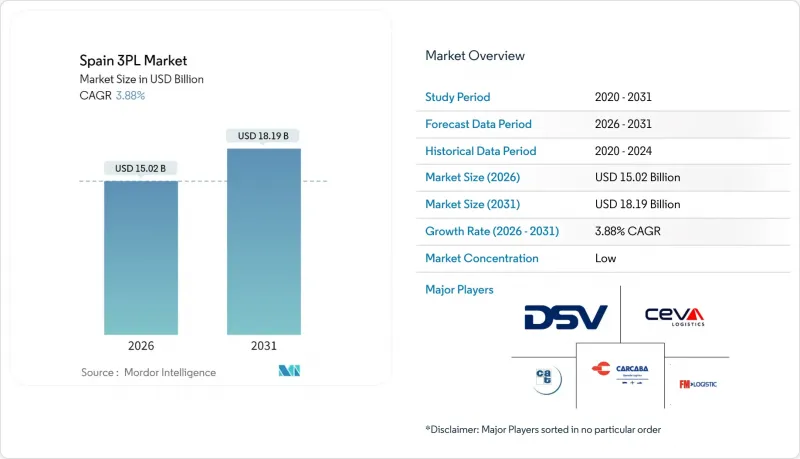
西班牙作為歐洲門戶的地位、外包履約的快速發展以及多模態走廊的升級改造,都支撐著這一上升趨勢。電子商務的地理擴張已超越馬德里和巴塞隆納,北歐近岸外包業務的強勁湧入,以及政府支持的鐵路電氣化計劃,共同擴大了第三方物流服務供應商的潛在基本客群。數位化稅收優惠政策鼓勵人工智慧驅動的路線最佳化,而綠色出行政策則刺激了都市區配送對電動車的需求。國內和跨國承運商之間日益激烈的競爭,加速了價格透明化進程,並促使企業採用增值倉儲、即時視覺化平台以及降低資本風險的輕資產合作模式。
西班牙第三方物流市場趨勢與洞察
電子商務交易量的快速成長對物流外包服務提出了更高的要求。
預計到2025年,西班牙的網購用戶將達到4,000萬,將進一步鞏固對全國性合約履約合作夥伴的依賴。亞馬遜在阿斯圖裡亞斯投資3.27億美元興建的物流中心,正是保障48小時送達所需基礎建設規模的典範。第三方物流供應商正積極回應,建造微型倉配中心,將庫存放置在更靠近人口中心的地方。研究表明,巴塞隆納需要超過1000個城市配送中心才能處理其目前的小包裹量,這也印證了這一轉變。機器人分類線和人工智慧驅動的貨位分配方案進一步縮短了高峰期的履約週期。然而,不斷提高的配送頻率迫使第三方物流公司重新設計其主幹路線,以便讓大容量拖車在夜間為都市區補給,從而降低白天的交通堵塞成本。
藥品和食品業對溫控物流的需求日益成長
疫苗分發範圍擴大、歐盟食品安全法規更加嚴格以及消費者轉向生鮮食品,這些因素共同推動了西班牙低溫運輸的普及。 Schmitz Cargobull 收購西班牙遠端資訊處理公司 Atlantis Global Systems,表明拖車製造商正在整合感測器網路,以檢驗貨物測量的全程可驗證。人工智慧需求預測是運力規劃的基礎,它允許動態分配冷藏運輸時段,而非採用固定契約,從而在能源價格波動的情況下維持利潤率。在製藥業,符合良好分銷規範 (GDP) 正在推動 GDP 認證倉儲區域的溢價,從而在競爭激烈的環境中保護收入基礎。新興的氣調保鮮室正在拓展農產品出口選擇,並延長地中海生鮮食品北運的保存期限。區塊鏈試點計畫正在增加不可竄改的可追溯性,隨著西班牙監管機構加強低溫運輸審核,這已成為一項必備功能。
柴油價格上漲推高了運輸成本。
燃油成本約佔公路貨運總成本的四分之一,而2025年的價格波動意味著即使加上法定附加費,利潤率仍然很低。 2024年第四季度,馬德里至巴黎路線的合約運費經外匯折算後上漲3.5%至1,588美元,顯示復甦勢頭脆弱。貨運公司正在採用動態路線,將通行費、交通狀況和加油點等因素考慮在內,以避免全面提價,同時維持服務水準協議。車隊所有者正在利用政府補貼,並在需求量大的路線上試用液化天然氣動力和混合動力卡車,以實現能源多元化。然而,持續的波動促使托運人更多地考慮鐵路運輸,以確保預算規劃的可預測性,這在一定程度上抑制了西班牙第三方物流市場對長途卡車運輸的需求。
細分市場分析
到2025年,國內運輸管理將維持52.48%的收入佔有率,這印證了西班牙以公路為中心的貨運模式以及對全國範圍內的循環取貨和配送服務的持續需求。西班牙第三方物流市場,尤其是加值倉儲和配送服務市場,預計將以7.42%的複合年成長率成長,超過其他服務領域。電子商務退貨、客製化和套件化需求的增加,正促使倉庫業者採用自動化分類機、語音揀選系統和紙箱尺寸調整機。同時,由於地中海港口維修提升了吞吐能力,國際運輸管理業務正在加速發展,推動馬格里布地區的貿易流向西班牙北部的物流樞紐。 CEVA物流位於塔拉戈納的18,000平方米的物流中心表明,諸如太陽能屋頂和LED照明等永續性增值設施正成為贏得合約的先決條件。
在國家電氣化補貼的推動下,貨運鐵路的復興正在催生出將始發地和目的地卡車運輸與中程鐵路運輸相結合的綜合服務模式。空運貨運量雖然噸位小規模,但對於需要2至8攝氏度溫控運輸的生命科學托運人來說,卻能帶來可觀的利潤。大宗貨物主要透過沿海滾裝船和貨櫃碼頭運輸,但隨著全通路零售商要求一小時內送貨上門,許多第三方物流(3PL)業者開始交叉銷售清關和貿易融資單證服務,以拓展除噸位費之外的收入來源。此外,在現有配送中心(DC)內增設微型倉配能力的做法也日益增多,這印證了西班牙第三方物流市場合約中庫存接近性的趨勢。
其他福利:
- Excel格式的市場預測(ME)表
- 3個月的分析師支持
目錄
第1章 引言
- 研究假設和市場定義
- 調查範圍
第2章調查方法
第3章執行摘要
第4章 市場情勢
- 市場概覽
- 市場促進因素
- 電子商務交易量的快速成長正在推動對物流外包服務的需求。
- 醫藥和食品業對溫控物流的需求不斷成長
- 政府對多式聯運走廊的基礎建設投資
- 歐洲供應鏈向西班牙近岸外包推動了倉儲需求。
- 為因應零排放區,城市微型合作中心應運而生
- 數位化稅收優惠促進人工智慧驅動的第三方物流運營
- 市場限制
- 柴油價格上漲導致運輸成本增加
- 促進要素短缺和工資壓力
- 都市區因噪音和排放法規而限制夜間送貨
- 鐵路網互通性的限制降低了多模態的效率
- 價值/供應鏈分析
- 監管環境
- 倉儲市場趨勢
- 電子商務成長的影響
- 技術展望
- 波特五力模型
- 供應商的議價能力
- 買方的議價能力
- 新進入者的威脅
- 替代品的威脅
- 競爭對手之間的競爭
第5章 市場規模與成長預測
- 透過服務
- 國內運輸管理(DTM)
- 道路運輸
- 鐵路
- 空運
- 水道
- 國際運輸管理(ITM)
- 道路運輸
- 鐵路
- 空運
- 水道
- 加值倉儲及配送服務 (VAWD)
- 國內運輸管理(DTM)
- 最終用戶
- 車
- 能源與公共產業
- 製造業
- 生命科學與醫療保健
- 科技與電子
- 電子商務
- 消費品/日用必需品
- 食品/飲料
- 其他
- 透過物流模型
- 輕資產(管理型)
- 資產密集型(擁有車輛和倉庫)
- 混合
第6章 競爭情勢
- 市場集中度
- 策略趨勢
- 市佔率分析
- 公司簡介
- Carcaba
- CEVA Logistics
- DSV
- FM Logistic
- Groupe CAT
- Naeko
- OIA Global
- Rhenus Logistics
- TIBA
- XPO Logistics
- DHL Supply Chain
- Kuehne+Nagel
- Grupo Sese
- Logista
- STEF Iberia
- ID Logistics
- Geodis
- Noatum Logistics
- Hellmann Worldwide Logistics
- Transportes Iruna, SA
第7章 市場機會與未來展望
The Spain 3PL Market was valued at USD 14.46 billion in 2025 and estimated to grow from USD 15.02 billion in 2026 to reach USD 18.19 billion by 2031, at a CAGR of 3.88% during the forecast period (2026-2031).
Spain's role as a European gateway, the rapid shift toward outsourced fulfillment, and multimodal corridor upgrades underpin the upward trajectory. E-commerce's geographic spread beyond Madrid and Barcelona, resilient nearshoring inflows from Northern Europe, and government-backed rail electrification projects jointly widen the addressable base for third-party logistics service providers. Digital tax incentives now reward AI-enabled route optimization while green-mobility policies raise demand for electric urban fleets. Heightened competition among domestic and multinational carriers accelerates pricing transparency and forces broader adoption of value-added warehousing, real-time visibility platforms, and asset-light alliances that de-risk capital exposure.
Spain 3PL Market Trends and Insights
Surge in E-commerce Volumes Requiring Outsourced Logistics Services
Spain's online buyer base is expected to climb toward 40 million users in 2025, solidifying nationwide reliance on contracted fulfillment partners. Amazon's USD 327 million logistics center in Asturias typifies the infrastructure scale now demanded by 48-hour delivery guarantees. Third-party providers respond with micro-fulfillment hubs that position inventory nearer to dense consumer pockets, a shift illustrated by studies showing Barcelona needs more than 1,000 such urban sites to meet current parcel volumes. Robotics-enabled sortation lines and AI-driven slotting solutions further compress fulfillment cycle times during peak shopping seasons. Greater delivery frequency, however, compels 3PLs to redesign trunk routes so that high-capacity trailers replenish urban depots overnight, mitigating daytime congestion costs.
Growing Demand for Temperature-Controlled Logistics for Pharma & Food
Heightened vaccine distribution, stricter EU food-safety rules, and a switch to fresh consumer habits combine to lift Spain's cold-chain utilization. Schmitz Cargobull's acquisition of Spanish telematics firm Atlantis Global System demonstrates how trailer makers are embedding sensor networks to keep payload readings verifiable end-to-end. AI demand forecasting now underpins capacity planning so that refrigerated slots are allocated dynamically rather than by static contracts, preserving margins despite energy-price volatility. On the pharmaceutical side, compliance with Good Distribution Practice drives premium tariffs for GDP-certified storage zones, offering revenue defense in an otherwise price-competitive landscape. Emerging controlled-atmosphere chambers broaden produce export options, extending shelf life for Mediterranean perishables shipped northward. Blockchain pilots add immutable traceability, an essential feature as Spanish regulators intensify random cold-chain audits.
High Diesel Fuel Prices Increasing Transport Costs
Fuel accounts for about one-quarter of total road freight expense, and 2025 volatility keeps margins thin despite statutory surcharge clauses. Madrid-Paris contract rates climbed 3.5% in Q4 2024 to USD 1,588 after currency conversion, illustrating the fragile rebound phase. Carriers resort to dynamic routes that weigh tolls, traffic, and refueling points so service-level agreements remain intact without blanket price hikes. Fleet owners test LNG and hybrid trucks on high-volume corridors, leveraging government subsidies to diversify energy exposure. Persistent variability nevertheless prompts shippers to explore rail for predictable budget planning, moderately dampening Spain third-party logistics market demand for long-haul trucking.
Other drivers and restraints analyzed in the detailed report include:
- Government Infrastructure Investments in Intermodal Transport Corridors
- Nearshoring of European Supply Chains to Spain Boosting Warehousing Demand
- Driver Shortage and Wage Pressures
For complete list of drivers and restraints, kindly check the Table Of Contents.
Segment Analysis
Domestic Transportation Management retained a 52.48% revenue slice in 2025, underscoring Spain's highway-centric freight patterns and the enduring need for nationwide milk-run schedules. Spain third-party logistics market size for Value-Added Warehousing & Distribution is projected to expand at 7.42% CAGR, faster than any other service line. Rising e-commerce returns handling, customization, and kitting tasks push warehouse operators to embed automated sorters, pick-by-voice, and carton right-sizing machines. Meanwhile, International Transportation Management accelerates on the back of refurbished Mediterranean port capacity that funnels Maghreb trade into northern Spain depots. CEVA Logistics' 18,000 m2 Tarragona facility illustrates how sustainability add-ons-photovoltaic roofing and LED lighting-are now table stakes for contract awards.
The resurgence of freight rail, spurred by state electrification grants, sparks integrated service packages where truck drayage at origin and destination bookends a rail middle-haul. Air freight volumes, though minor by tonnage, yield attractive margins for life-science shippers demanding two-to-eight-degree routings. Bulk commodities funnel through coastal Ro-Ro and container terminals, yet many 3PLs cross-sell customs clearance and trade-finance documentation to lift yields above pure tonnage fees, as omnichannel retailers seek one-hour click-to-door delivery, micro-fulfillment add-ons inside legacy DCs proliferate, validating the premium placed on inventory proximity in Spain third-party logistics market contracts.
The Spain Third-Party Logistics (3PL) Market Report is Segmented by Service (Domestic Transportation Management, International Transportation Management, and More), by End User (Automotive, Energy & Utilities, Manufacturing, Life Sciences & Healthcare, Technology & Electronics, E-Commerce, and More), and by Logistics Model (Asset-Light, Asset-Heavy, Hybrid). The Market Forecasts are Provided in Terms of Value (USD).
List of Companies Covered in this Report:
- Carcaba
- CEVA Logistics
- DSV
- FM Logistic
- Groupe CAT
- Naeko
- OIA Global
- Rhenus Logistics
- TIBA
- XPO Logistics
- DHL Supply Chain
- Kuehne + Nagel
- Grupo Sese
- Logista
- STEF Iberia
- ID Logistics
- Geodis
- Noatum Logistics
- Hellmann Worldwide Logistics
- Transportes Iruna, S.A.
Additional Benefits:
- The market estimate (ME) sheet in Excel format
- 3 months of analyst support
TABLE OF CONTENTS
1 Introduction
- 1.1 Study Assumptions & Market Definition
- 1.2 Scope of the Study
2 Research Methodology
3 Executive Summary
4 Market Landscape
- 4.1 Market Overview
- 4.2 Market Drivers
- 4.2.1 Surge in e-commerce volumes requiring outsourced logistics services
- 4.2.2 Growing demand for temperature-controlled logistics for pharma & food
- 4.2.3 Government infrastructure investments in intermodal transport corridors
- 4.2.4 Nearshoring of European supply chains to Spain boosting warehousing demand
- 4.2.5 Rise of collaborative urban micro-hubs to meet zero-emission zones
- 4.2.6 Digitization tax incentives spurring AI-enabled 3PL operations
- 4.3 Market Restraints
- 4.3.1 High diesel fuel prices increasing transport costs
- 4.3.2 Driver shortage and wage pressures
- 4.3.3 Urban noise & emission regulations limiting night-time deliveries
- 4.3.4 Rail network interoperability constraints reduce multimodal efficiency
- 4.4 Value / Supply-Chain Analysis
- 4.5 Regulatory Landscape
- 4.6 Warehousing Market Trends
- 4.7 E-commerce Growth Impact
- 4.8 Technological Outlook
- 4.9 Porter's Five Forces
- 4.9.1 Bargaining Power of Suppliers
- 4.9.2 Bargaining Power of Buyers
- 4.9.3 Threat of New Entrants
- 4.9.4 Threat of Substitutes
- 4.9.5 Intensity of Competitive Rivalry
5 Market Size & Growth Forecasts
- 5.1 By Service
- 5.1.1 Domestic Transportation Management (DTM)
- 5.1.1.1 Roadways
- 5.1.1.2 Railways
- 5.1.1.3 Airways
- 5.1.1.4 Waterways
- 5.1.2 International Transportation Management (ITM)
- 5.1.2.1 Roadways
- 5.1.2.2 Railways
- 5.1.2.3 Airways
- 5.1.2.4 Waterways
- 5.1.3 Value-Added Warehousing & Distribution (VAWD)
- 5.1.1 Domestic Transportation Management (DTM)
- 5.2 By End User
- 5.2.1 Automotive
- 5.2.2 Energy & Utilities
- 5.2.3 Manufacturing
- 5.2.4 Life Sciences & Healthcare
- 5.2.5 Technology & Electronics
- 5.2.6 E-commerce
- 5.2.7 Consumer Goods & FMCG
- 5.2.8 Food & Beverages
- 5.2.9 Others
- 5.3 By Logistics Model
- 5.3.1 Asset-Light (Management-Based)
- 5.3.2 Asset-Heavy (Own Fleet & Warehouses)
- 5.3.3 Hybrid
6 Competitive Landscape
- 6.1 Market Concentration
- 6.2 Strategic Moves
- 6.3 Market Share Analysis
- 6.4 Company Profiles {(includes Global level Overview, Market level overview, Core Segments, Financials as available, Strategic Information, Market Rank/Share for key companies, Products & Services, and Recent Developments)}
- 6.4.1 Carcaba
- 6.4.2 CEVA Logistics
- 6.4.3 DSV
- 6.4.4 FM Logistic
- 6.4.5 Groupe CAT
- 6.4.6 Naeko
- 6.4.7 OIA Global
- 6.4.8 Rhenus Logistics
- 6.4.9 TIBA
- 6.4.10 XPO Logistics
- 6.4.11 DHL Supply Chain
- 6.4.12 Kuehne + Nagel
- 6.4.13 Grupo Sese
- 6.4.14 Logista
- 6.4.15 STEF Iberia
- 6.4.16 ID Logistics
- 6.4.17 Geodis
- 6.4.18 Noatum Logistics
- 6.4.19 Hellmann Worldwide Logistics
- 6.4.20 Transportes Iruna, S.A.
7 Market Opportunities & Future Outlook

 2026-2030年全球汽車第三者物流市場
 第三方物流軟體市場分析及預測(至2035年):依類型、產品類型、服務、技術、組件、應用、部署類型、最終用戶、功能及解決方案分類
 美國第三方物流:市場佔有率分析、產業趨勢與統計、成長預測(2026-2031)英國第三方物流(3PL):市場佔有率分析、產業趨勢與統計、成長預測(2026-2031)
 第三方物流全球市場規模、佔有率、趨勢和成長分析報告(2026-2034)
 生物製藥低溫運輸物流服務市場按服務類型、溫度類型、運輸方式、產品類型、包裝類型和最終用途分類,全球預測(2026-2032年)新加坡第三方物流(3PL) 市場:佔有率分析、產業趨勢、統計數據和成長預測 (2026-2031)日本第三方物流(3PL)市場:佔有率分析、產業趨勢、統計數據和成長預測(2026-2031)
 第三方物流市場-全球產業規模、佔有率、趨勢、機會及預測(依運輸方式、服務類型、產業、地區及競爭格局分類,2021-2031年預測)
 日本第三方物流市場報告(依運輸方式、服務類型、最終用途及地區分類,2026-2034 年)