


 |
市場調查報告書
商品編碼
1913404
第三方物流市場機會、成長要素、產業趨勢分析及2026年至2035年預測Third-Party Logistics (3PL) Market Opportunity, Growth Drivers, Industry Trend Analysis, and Forecast 2026 - 2035 |
||||||

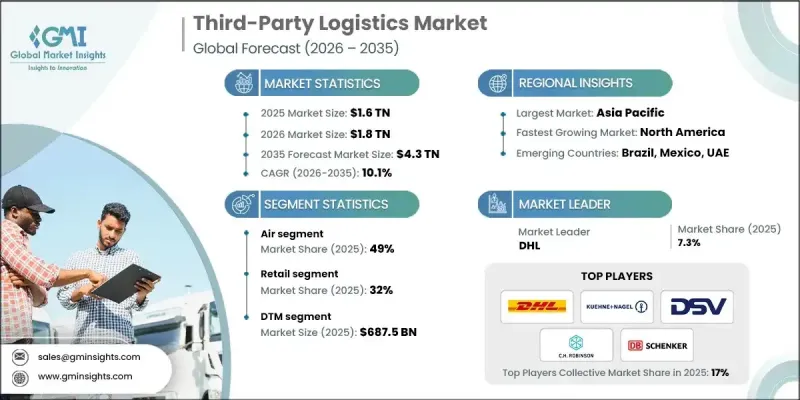
全球第三方物流(3PL) 市場預計到 2025 年將達到 1.6 兆美元,到 2035 年將達到 4.3 兆美元,年複合成長率為 10.1%。
推動市場成長的因素包括電子商務的快速擴張、供應鏈日益全球化、客戶對更快交付的需求不斷成長以及物流和配送網路的日益複雜化。企業擴大將物流職能外包給專業的第三方物流 (3PL) 服務商,以實現成本效益、營運柔軟性、即時可視性和擴充性的供應鏈營運。基於雲端的運輸管理系統 (TMS)、倉庫管理系統 (WMS)、利用人工智慧和機器學習的路線最佳化、物聯網貨物追蹤、機器人技術、倉庫自動化和進階數據分析等技術創新正在變革傳統物流。這些解決方案提高了庫存準確性、最佳化了運輸、縮短了運輸時間並改善了需求預測。全通路零售、跨境貿易和最後一公里配送解決方案的日益普及,進一步推動了全球對整合、柔軟性且技術主導的第三方物流服務的需求。
| 市場覆蓋範圍 | |
|---|---|
| 開始年份 | 2025 |
| 預測年份 | 2026-2035 |
| 起始值 | 1.6兆美元 |
| 預測金額 | 4.3兆美元 |
| 複合年成長率 | 10.1% |
預計到2025年,航空貨運市佔率將達到49%,並在2026年至2035年間以11.2%的複合年成長率成長。航空物流憑藉其在保障時效性強、高價值和緊急貨物運輸方面的關鍵作用,佔據主導地位。各行業對快速交付的強勁需求,推動了跨境運輸、即時庫存管理和高階物流需求對航空貨運的日益青睞。先進的貨物處理、即時追蹤、優先交付和一體化快遞網路,確保了運輸的速度、可靠性和優質服務,使航空運輸成為緊急和高價值貨物運輸的首選解決方案。
預計2025年,國內運輸管理(DTM)市場規模將達6,875億美元。 DTM解決方案對於國內運輸至關重要,因為國內運輸需要高頻率、準時性和成本效益。這些解決方案提供最佳化的路線規劃、承運商選擇、貨物追蹤和最後一公里配送管理。這些功能對於實現電子商務、零售、快速消費品和製造業供應鏈中的快速履約、準時交付和可擴展營運至關重要。對於尋求效率和可靠性的托運人和物流服務供應商而言,DTM仍然是他們關注的重點領域。
預計2025年,中國第三方物流(3PL)市場規模將達到3,749億美元,佔全球市場佔有率的57%。該地區的成長主要得益於電子商務的蓬勃發展、製造業的高產出以及技術主導物流解決方案的日益普及。對基於人工智慧的路線最佳化、雲端運輸管理系統/倉庫管理系統(TMS/WMS)、即時追蹤和自動化履約系統的投資正在加速提升該地區的物流能力。先進的基礎設施、龐大的貨運量以及不斷完善的監管標準進一步鞏固了亞太地區在全球第三方物流(3PL)市場中的地位。
目錄
第1章調查方法和範圍
第2章執行摘要
第3章業界考察
- 生態系分析
- 供應商情況
- 利潤率
- 成本結構
- 每個階段的附加價值
- 影響價值鏈的因素
- 中斷
- 產業影響因素
- 促進要素
- 電子商務和全通路零售的快速成長
- 供應鏈日益複雜化和全球貿易的發展
- 技術採納與數位轉型
- 成本最佳化和輕資產經營模式
- 產業潛在風險與挑戰
- 營運和人事費用上升
- 監管和合規的複雜性
- 市場機遇
- 最後一公里配送與加值物流服務
- 數位化和永續物流解決方案
- 人工智慧、機器學習和物聯網技術的應用
- 永續性與綠色物流服務
- 促進要素
- 成長潛力分析
- 監管環境
- 北美洲
- 美國運輸部(DOT) 和聯邦汽車運輸安全管理局 (FMCSA) 的法規
- 美國環保署排放標準
- 加拿大運輸部標準
- 歐洲
- 符合德國TUV和BaFin標準
- 法國DGCCRF和CNIT指南
- 英國車輛標準局 (DVSA) 和金融行為監理局 (FCA) 監管
- 義大利運輸部合規
- 亞太地區
- 中國工業和資訊化部(工信部)指南
- 日本金融服務廳汽車合規
- 韓國國土交通部和金融服務委員會的規定
- 印度標準協會 (BIS) 和汽車研究協會指南
- 拉丁美洲
- 巴西ANTT和DENATRAN法規
- 墨西哥環境與自然資源部 (SEMARNAT) 和墨西哥運輸部部 (SCT) 的指導方針
- 中東和非洲
- 阿拉伯聯合大公國道路和交通管理局指南
- 沙烏地阿拉伯運輸總局(GAT)規章
- 北美洲
- 波特五力分析
- PESTEL 分析
- 科技與創新趨勢
- 當前技術趨勢
- 自動化和機器人技術
- 人工智慧(AI)和機器學習
- 物聯網 (IoT)
- 基於雲端的供應鏈平台
- 新興技術
- 超互聯供應鏈
- 機器人即服務 (RAAS)
- 人工智慧驅動的動態定價和容量管理
- 擴增實境(AR)和穿戴式設備
- 當前技術趨勢
- 價格趨勢
- 按地區
- 依產品
- 成本細分分析
- 專利分析
- 永續性和環境方面
- 永續實踐
- 減少廢棄物策略
- 生產中的能源效率
- 環保舉措
- 碳足跡考量
- 使用案例場景
- 區域基礎設施和發展趨勢
- 交通和物流基礎設施評估
- 數位化和連接準備情況
- 港口、鐵路和多式聯運能力趨勢
- 智慧物流樞紐與自由區
- 需求側和供給側評估
- 供給側分析
- 供應商容量、基礎設施和能力
- 技術採納和營運效率
- 成本結構和盈利
- 需求面分析
- 最終用戶行業要求
- 數量、頻率和服務水準預期
- 價格敏感度和採用趨勢
- 供給側分析
第4章 競爭情勢
- 介紹
- 公司市佔率分析
- 北美洲
- 歐洲
- 亞太地區
- 拉丁美洲
- 中東和非洲
- 主要市場公司的競爭分析
- 競爭定位矩陣
- 戰略展望矩陣
- 重大進展
- 併購
- 夥伴關係與合作
- 新產品發布
- 企業擴張計畫和資金籌措
第5章 依解決方案分類的市場估算與預測,2022-2035年
- 專用合約運輸 (DCC)
- 專用運輸管理 (DTM)
- 國際運輸管理(ITM)
- 倉儲/配送
- 物流軟體
第6章 按模式分類的市場估算與預測,2022-2035年
- 航空
- 海上運輸
- 鐵路和公路
第7章 按應用領域分類的市場估算與預測,2022-2035年
- 食品/飲料
- 衛生保健
- 零售
- 車
- 製造業
- 電子商務與物流
- 化學品/石油化工產品
- 製藥
- 其他
第8章 2022-2035年各地區市場估算與預測
- 北美洲
- 美國
- 加拿大
- 歐洲
- 英國
- 德國
- 法國
- 義大利
- 西班牙
- 比利時
- 荷蘭
- 瑞典
- 瑞士
- 奧地利
- 挪威
- 丹麥
- 亞太地區
- 中國
- 印度
- 日本
- 澳洲
- 新加坡
- 韓國
- 越南
- 印尼
- 馬來西亞
- 泰國
- 菲律賓
- 拉丁美洲
- 巴西
- 墨西哥
- 阿根廷
- 智利
- 哥倫比亞
- 秘魯
- 中東和非洲
- 南非
- 沙烏地阿拉伯
- 阿拉伯聯合大公國
- 埃及
- 以色列
- 卡達
第9章:公司簡介
- Global Player
- CH Robinson Worldwide
- Ceva Logistics
- DB Schenker Logistics
- DHL Supply Chain &Global Forwarding
- DSV A/S
- Expeditors International of Washington
- FedEx Supply Chain
- Kuehne+Nagel International AG
- Nippon Express
- XPO Logistics
- Regional Player
- Agility Logistics
- APL Logistics
- Bollore Logistics
- Geodis
- Hellmann Worldwide Logistics
- Hitachi Transport System
- Kerry Logistics
- Panalpina
- Toll Group
- Yusen Logistics
- 新興企業
- eBike Diagnostic Solutions
- MotoTech Diagnostics
- NeoMotor Diagnostics
- RideScan Electronics
- SmartMoto Diagnostics
The Global Third-Party Logistics (3PL) Market was valued at USD 1.6 trillion in 2025 and is estimated to grow at a CAGR of 10.1% to reach USD 4.3 trillion by 2035.
The market is propelled by the rapid expansion of e-commerce, increasing globalization of supply chains, rising customer demand for faster deliveries, and the growing complexity of logistics and distribution networks. Businesses are increasingly outsourcing logistics functions to specialized 3PL providers to achieve cost efficiency, operational flexibility, real-time visibility, and scalable supply chain operations. Technological innovations such as cloud-based transportation management systems (TMS), warehouse management systems (WMS), AI- and ML-powered route optimization, IoT-enabled shipment tracking, robotics, warehouse automation, and advanced data analytics are transforming traditional logistics. These solutions enhance inventory accuracy, optimize transportation, reduce transit times, and improve demand forecasting. Rising adoption of omnichannel retail, cross-border trade, and last-mile delivery solutions further accelerates the demand for integrated, flexible, and technology-driven 3PL services globally.
| Market Scope | |
|---|---|
| Start Year | 2025 |
| Forecast Year | 2026-2035 |
| Start Value | $1.6 Trillion |
| Forecast Value | $4.3 Trillion |
| CAGR | 10.1% |
The air freight segment held 49% share in 2025 and is anticipated to grow at a CAGR of 11.2% from 2026 to 2035. Air logistics dominates due to its essential role in enabling time-sensitive, high-value, and express shipments. Strong demand from industries requiring rapid delivery has increased the adoption of air freight for cross-border deliveries, just-in-time inventory, and premium logistics needs. Advanced cargo handling, real-time tracking, priority shipping, and integrated express networks ensure speed, reliability, and service quality, positioning air transport as the preferred solution for urgent and high-value goods.
The domestic transportation management (DTM) segment reached USD 687.5 billion in 2025. DTM solutions are crucial for handling high-frequency, time-sensitive, and cost-efficient domestic shipments. They provide optimized route planning, carrier selection, shipment tracking, and last-mile delivery management. This functionality is critical for e-commerce, retail, FMCG, and manufacturing supply chains, enabling rapid fulfillment, just-in-time delivery, and scalable operations. DTM remains a key focus area for both shippers and logistics service providers seeking efficiency and reliability.
China Third-Party Logistics (3PL) Market held a 57% share, generating USD 374.9 billion in 2025. The region's growth is driven by the expansion of e-commerce, high manufacturing output, and increasing adoption of technology-driven logistics solutions. Investments in AI-based route optimization, cloud-based TMS/WMS, real-time tracking, and automated fulfillment systems are accelerating the region's logistics capabilities. Advanced infrastructure, large freight volumes, and evolving regulatory standards further strengthen Asia-Pacific's position in the Global Third-Party Logistics (3PL) Market.
Key players operating in the Global Third-Party Logistics (3PL) Market include DB Schenker Logistics, DHL, DSV A/S (UTi Worldwide, Inc.), C.H. Robinson Worldwide, Expeditors International of Washington, Ceva Logistics, Nippon Express, Kuehne + Nagel International AG, XPO Logistics, and SinoTrans (HK) Logistics Limited. Companies in the Global Third-Party Logistics (3PL) Market strengthen their presence through technology adoption, investing heavily in AI- and ML-powered logistics platforms, cloud-based TMS/WMS, IoT-enabled real-time tracking, and warehouse automation to enhance efficiency. Strategic partnerships with e-commerce firms, retailers, and manufacturers expand service reach. Firms focus on offering integrated end-to-end logistics solutions, optimizing last-mile delivery, and providing scalable operations to meet diverse client needs.
Table of Contents
Chapter 1 Methodology & Scope
- 1.1 Market scope and definition
- 1.2 Research design
- 1.2.1 Research approach
- 1.2.2 Data collection methods
- 1.3 Data mining sources
- 1.3.1 Global
- 1.3.2 Regional/Country
- 1.4 Base estimates and calculations
- 1.4.1 Base year calculation
- 1.4.2 Key trends for market estimation
- 1.5 Primary research and validation
- 1.5.1 Primary sources
- 1.6 Forecast
- 1.7 Research assumptions and limitations
Chapter 2 Executive Summary
- 2.1 Industry 360° synopsis, 2022 - 2035
- 2.2 Key market trends
- 2.2.1 Regional
- 2.2.2 Solution
- 2.2.3 Mode
- 2.2.4 Application
- 2.3 TAM Analysis, 2026-2035
- 2.4 CXO perspectives: Strategic imperatives
- 2.4.1 Executive decision points
- 2.4.2 Critical success factors
- 2.5 Future outlook and strategic recommendations
Chapter 3 Industry Insights
- 3.1 Industry ecosystem analysis
- 3.1.1 Supplier Landscape
- 3.1.2 Profit Margin
- 3.1.3 Cost structure
- 3.1.4 Value addition at each stage
- 3.1.5 Factor affecting the value chain
- 3.1.6 Disruptions
- 3.2 Industry impact forces
- 3.2.1 Growth drivers
- 3.2.1.1 Rapid Growth of E-commerce & Omnichannel Retail
- 3.2.1.2 Rising Supply Chain Complexity & Global Trade
- 3.2.1.3 Technology Adoption & Digital Transformation
- 3.2.1.4 Cost Optimization & Asset-Light Business Models
- 3.2.2 Industry pitfalls and challenges
- 3.2.2.1 Rising Operational & Labor Costs
- 3.2.2.2 Regulatory & Compliance Complexity
- 3.2.3 Market opportunities
- 3.2.3.1 Last-Mile Delivery & Value-Added Logistics Services
- 3.2.3.2 Digital & Sustainable Logistics Solutions
- 3.2.3.3 Adoption of AI, ML, and IoT Technologies
- 3.2.3.4 Sustainability and Green Logistics Services
- 3.2.1 Growth drivers
- 3.3 Growth potential analysis
- 3.4 Regulatory landscape
- 3.4.1 North America
- 3.4.1.1 U.S. DOT & FMCSA Regulations
- 3.4.1.2 EPA Emission Standards
- 3.4.1.3 Transport Canada Standards
- 3.4.2 Europe
- 3.4.2.1 Germany TUV & BaFin Compliance
- 3.4.2.2 France DGCCRF & CNIT Guidelines
- 3.4.2.3 United Kingdom DVSA & FCA Regulations
- 3.4.2.4 Italy Ministry of Infrastructure & Transport Compliance
- 3.4.3 Asia Pacific
- 3.4.3.1 China MIIT Guidelines
- 3.4.3.2 Japan FSA Automotive Compliance
- 3.4.3.3 South Korea MOT & FSC Regulations
- 3.4.3.4 India BIS & Automotive Research Association Guidelines
- 3.4.4 Latin America
- 3.4.4.1 Brazil ANTT & DENATRAN Regulations
- 3.4.4.2 Mexico SEMARNAT & SCT Guidelines
- 3.4.5 Middle East and Africa
- 3.4.5.1 UAE Roads & Transport Authority Guidelines
- 3.4.5.2 Saudi Arabia General Authority for Transport (GAT) Regulations
- 3.4.1 North America
- 3.5 Porter's analysis
- 3.6 PESTEL analysis
- 3.7 Technology and Innovation Landscape
- 3.7.1 Current technological trends
- 3.7.1.1 Automation & robotics
- 3.7.1.2 Ai & machine learning
- 3.7.1.3 Internet of things (IOT)
- 3.7.1.4 Cloud-based supply chain platforms
- 3.7.2 Emerging technologies
- 3.7.2.1 Hyper-connected supply chains
- 3.7.2.2 Robotics-as-a-service (RAAS)
- 3.7.2.3 AI-driven dynamic pricing & capacity management
- 3.7.2.4 Augmented reality (AR) & wearables
- 3.7.1 Current technological trends
- 3.8 Price trends
- 3.8.1 By region
- 3.8.2 By product
- 3.9 Cost breakdown analysis
- 3.10 Patent analysis
- 3.11 Sustainability and Environmental Aspects
- 3.11.1 Sustainable practices
- 3.11.2 Waste reduction strategies
- 3.11.3 Energy efficiency in production
- 3.11.4 Eco-friendly initiatives
- 3.11.5 Carbon footprint considerations
- 3.12 Use case scenarios
- 3.13 Regional Infrastructure & Deployment Trends
- 3.13.1 Transportation & logistics infrastructure scoring
- 3.13.2 Digital & connectivity readiness
- 3.13.3 Port, rail & intermodal capacity trends
- 3.13.4 Smart logistics hubs & free zones
- 3.14 Demand and Supply-Side Assessment
- 3.14.1 Supply-Side Analysis
- 3.14.1.1 Provider capacity, infrastructure, and capabilities
- 3.14.1.2 Technology adoption & operational efficiency
- 3.14.1.3 Cost structures and profitability
- 3.14.2 Demand-Side Analysis
- 3.14.2.1 End-user industry requirements
- 3.14.2.2 Volume, frequency, and service-level expectations
- 3.14.2.3 Pricing sensitivity and adoption trends
- 3.14.1 Supply-Side Analysis
Chapter 4 Competitive Landscape, 2025
- 4.1 Introduction
- 4.2 Company market share analysis
- 4.2.1 North America
- 4.2.2 Europe
- 4.2.3 Asia Pacific
- 4.2.4 Latin America
- 4.2.5 Middle East & Africa
- 4.3 Competitive analysis of major market players
- 4.4 Competitive positioning matrix
- 4.5 Strategic outlook matrix
- 4.6 Key developments
- 4.6.1 Mergers & acquisitions
- 4.6.2 Partnerships & collaborations
- 4.6.3 New product launches
- 4.6.4 Expansion plans and funding
Chapter 5 Market Estimates & Forecast, By Solution, 2022 - 2035 ($ Bn)
- 5.1 Key trends
- 5.2 Dedicated contract carriage (DCC)
- 5.3 Dedicated transportation management (DTM)
- 5.4 International transportation management (ITM)
- 5.5 Warehousing & distribution
- 5.6 Logistics software
Chapter 6 Market Estimates & Forecast, By Mode, 2022 - 2035 ($ Bn)
- 6.1 Key trends
- 6.2 Air
- 6.3 Sea
- 6.4 Rail & Road
Chapter 7 Market Estimates & Forecast, By Application, 2022 - 2035 ($ Bn)
- 7.1 Key trends
- 7.2 Food & beverages
- 7.3 Healthcare
- 7.4 Retail
- 7.5 Automotive
- 7.6 Manufacturing
- 7.7 E-commerce & Logistics
- 7.8 Chemicals & Petrochemicals
- 7.9 Pharmaceuticals
- 7.10 Others
Chapter 8 Market Estimates & Forecast, By Region, 2022 - 2035 ($ Bn)
- 8.1 Key trends
- 8.2 North America
- 8.2.1 US
- 8.2.2 Canada
- 8.3 Europe
- 8.3.1 UK
- 8.3.2 Germany
- 8.3.3 France
- 8.3.4 Italy
- 8.3.5 Spain
- 8.3.6 Belgium
- 8.3.7 Netherlands
- 8.3.8 Sweden
- 8.3.9 Switzerland
- 8.3.10 Austria
- 8.3.11 Norway
- 8.3.12 Denmark
- 8.4 Asia Pacific
- 8.4.1 China
- 8.4.2 India
- 8.4.3 Japan
- 8.4.4 Australia
- 8.4.5 Singapore
- 8.4.6 South Korea
- 8.4.7 Vietnam
- 8.4.8 Indonesia
- 8.4.9 Malaysia
- 8.4.10 Thailand
- 8.4.11 Philippines
- 8.5 Latin America
- 8.5.1 Brazil
- 8.5.2 Mexico
- 8.5.3 Argentina
- 8.5.4 Chile
- 8.5.5 Colombia
- 8.5.6 Peru
- 8.6 MEA
- 8.6.1 South Africa
- 8.6.2 Saudi Arabia
- 8.6.3 UAE
- 8.6.4 Egypt
- 8.6.5 Israel
- 8.6.6 Qatar
Chapter 9 Company Profiles
- 9.1 Global Player
- 9.1.1 C.H. Robinson Worldwide
- 9.1.2 Ceva Logistics
- 9.1.3 DB Schenker Logistics
- 9.1.4 DHL Supply Chain & Global Forwarding
- 9.1.5 DSV A/S
- 9.1.6 Expeditors International of Washington
- 9.1.7 FedEx Supply Chain
- 9.1.8 Kuehne + Nagel International AG
- 9.1.9 Nippon Express
- 9.1.10 XPO Logistics
- 9.2 Regional Player
- 9.2.1 Agility Logistics
- 9.2.2 APL Logistics
- 9.2.3 Bollore Logistics
- 9.2.4 Geodis
- 9.2.5 Hellmann Worldwide Logistics
- 9.2.6 Hitachi Transport System
- 9.2.7 Kerry Logistics
- 9.2.8 Panalpina
- 9.2.9 Toll Group
- 9.2.10 Yusen Logistics
- 9.3 Emerging Players
- 9.3.1 eBike Diagnostic Solutions
- 9.3.2 MotoTech Diagnostics
- 9.3.3 NeoMotor Diagnostics
- 9.3.4 RideScan Electronics
- 9.3.5 SmartMoto Diagnostics

 2026-2030年全球汽車第三者物流市場
 第三方物流軟體市場分析及預測(至2035年):依類型、產品類型、服務、技術、組件、應用、部署類型、最終用戶、功能及解決方案分類
 美國第三方物流:市場佔有率分析、產業趨勢與統計、成長預測(2026-2031)英國第三方物流(3PL):市場佔有率分析、產業趨勢與統計、成長預測(2026-2031)西班牙第三方物流(3PL) 市場:佔有率分析、產業趨勢與統計、成長預測 (2026-2031)
 第三方物流全球市場規模、佔有率、趨勢和成長分析報告(2026-2034)
 生物製藥低溫運輸物流服務市場按服務類型、溫度類型、運輸方式、產品類型、包裝類型和最終用途分類,全球預測(2026-2032年)新加坡第三方物流(3PL) 市場:佔有率分析、產業趨勢、統計數據和成長預測 (2026-2031)日本第三方物流(3PL)市場:佔有率分析、產業趨勢、統計數據和成長預測(2026-2031)
 第三方物流市場-全球產業規模、佔有率、趨勢、機會及預測(依運輸方式、服務類型、產業、地區及競爭格局分類,2021-2031年預測)