


 |
市場調查報告書
商品編碼
2124813
微控制器(MCU):市場佔有率分析、產業趨勢與統計數據、成長預測(2026-2031)Microcontroller (MCU) - Market Share Analysis, Industry Trends & Statistics, Growth Forecasts (2026 - 2031) |
||||||

※ 本網頁內容可能與最新版本有所差異。詳細情況請與我們聯繫。
據 Mordor Intelligence 稱,2025 年微控制器市值為 347.5 億美元,預計到 2031 年將達到 627.4 億美元,而 2026 年為 383.4 億美元,預測期(2026-2031 年)的複合年成長率為 10.3%。
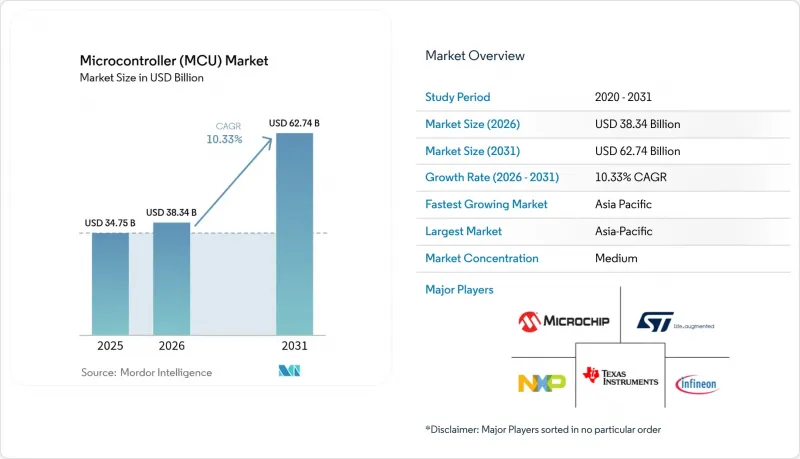
本報告按位等級(4 位或以下、8 位、16 位及其他)、核心架構(ARM Cortex-M、RISC-V、x86 及其他)、片上記憶體類型(嵌入式快閃記憶體、FRAM 及其他)、應用領域(汽車、工業/工廠自動化、醫療保健及其他)和地區(北美、歐洲、亞太及其他)進行細分。市場預測以美元計價。
全球微控制器(MCU)市場趨勢與洞察
物聯網節點數量的激增正在推動對嵌入式智慧的需求。
預計到2030年,聯網終端數量將超過200億,這將迫使製造商在注重成本效益的設計中整合多重通訊協定無線功能和高效處理器。 Nordic Semiconductor的nRF54系列將藍牙低功耗5.4、Thread和Matter整合到單一裝置中,同時保持了對電池友好的功耗,降低了組件成本和韌體複雜性。由更先進的本地處理能力所支援的高價分析服務正在改變收入模式,使其不再僅依賴硬體銷售。像Synaptics這樣的半導體供應商正在調整其產品組合,從追求通用運算轉向針對物聯網最佳化的解決方案。
車輛電氣化和ADAS的整合正在加速MCU安裝數量的成長。
電池式電動車 ( BEV) 包含多達 3000 個半導體元件,是內燃機汽車微控制器 (MCU) 數量的四倍。梅賽德斯-奔馳採用一組獨立的微控制器來管理電池、溫度控管和再生煞車系統,符合 ISO 26262 標準。大陸集團和恩智浦半導體的合作將多個底盤功能整合到一個可透過軟體升級的網域控制器中,從而減輕了佈線重量並實現了無縫的空中升級。歐盟法規要求所有車輛在 2026 年前必須配備高階駕駛輔助系統 (ADAS),這進一步加速了這項變革。本田和瑞薩電子聯合開發的 2000 TOPS SoC 凸顯了對運算能力的需求正在改變微控制器市場。
供應鏈的周期性特徵導致庫存和價格波動。
晶圓代工廠生產計畫的波動使MCU供應商面臨晶圓分配劇烈變化的風險。在最近的庫存清理階段,Nordic Semiconductor在2023年銷售額下降30%後被迫裁員8%。儘管金屬矽過剩導致基準現貨價格在2025年4月下跌2.3%至每公斤2.95美元,但關稅的引進可能會抵銷這些成本節約效應。成熟節點產能集中在台灣、中國當地和韓國,加劇了地緣政治風險溢價,迫使OEM廠商撥出資金用於緩衝庫存,從而佔用營運資金。
細分市場分析
到2025年,32位元元件將佔據微控制器市場佔有率的56.35%,這標誌著微控制器應用正朝著複雜工作負載的方向發生決定性轉變。預計該細分市場將以8.76%的複合年成長率成長,主要驅動力來自ADAS(高級駕駛輔助系統)中的感測器融合、工業驅動控制以及語音控制消費性電子產品。 32位元架構支援更大的可尋址內存,並整合了增強的數位訊號處理(DSP)功能,從而減少了對外部組件的需求。 MCU設計人員現在可以直接將神經網路引擎和網路安全加速器整合到晶片上,無需使用獨立的協處理器。低成本的8位元和16位元產品在介面邏輯領域仍具有競爭力,而4位元或更低位元的產品則仍應用於利潤率極低的領域,例如遙控器和恆溫器。
開發人員越來越需要將安全啟動、CAN-FD 和多重通訊協定無線功能整合到單一晶片上的原型產品。這種一體化趨勢使得平台能夠在產品線之間重複使用,並減輕韌體維護負擔。同時,整合到 32 位元元件中的 FRAM 選項無需電荷泵即可提供即時寫入功能,這對於在高振動環境下運行的資料登錄感測器至關重要。
憑藉成熟的工具鏈和強大的中間件堆疊,Cortex-M 核心預計在 2025 年將佔據 68.25% 的出貨量佔有率。客戶讚賞其開箱即用的即時作業系統 (RTOS) 支援和豐富的社群庫,這些都縮短了調試週期。然而,RISC-V 15.09% 的複合年成長率表明,人們對零專利費指令集客製化的熱情日益高漲。世界各國政府正在部署國內 RISC-V 專案以保護技術主權,並為從穿戴式裝置到汽車閘道器等各種應用領域的開放式指令集架構 (ISA) 晶片提供補貼。同時,專有核心仍在航空電子設備和工業驅動等需要確定性週期精度回應的特定領域中使用,而 x86 處理器仍應用於伺服器級板級管理控制器。
在微控制器市場,供應商的成功取決於其開發環境的品質。 ARM 不斷增強其 TrustZone、PSA 認證的安全性以及 M-Profile 向量擴展能力,而 RISC-V 組織則致力於統一軟體層的協調,以防止碎片化。一些供應商透過在同一產品系列中提供引腳相容的 ARM 或 RISC-V 替代方案來分散風險。
區域分析
亞太地區在中國消費電子組裝生態系統和日本汽車半導體技術的支撐下,預計到2025年將佔全球銷售額的47.30%。中國「半導體自給自足」五年規劃正在推動國內消費性電子產品和公共充電基礎設施對微控制器(MCU)的流片需求。日本供應商憑藉其與原始設備製造商(OEM)長期穩固的合作關係,提供專為混合動力汽車驅動循環設計的動力傳動系統認證微控制器,繼續保持市場地位。韓國企業集團正在將本地記憶體IP與邏輯模組整合,為智慧型手機和智慧電視打造單晶片解決方案。儘管人事費用、能源成本和地緣政治風險的上升促使一些公司將多元化經營至越南和泰國,但該地區緊密聯繫的元件生態系統仍保持著比較優勢,使其成為微控制器市場成長最快的地區。
南美洲正崛起為微控制器市場成長最快的地區之一,預計2020年至2031年的複合年成長率將達到10.22%。巴西針對汽車生產的新激勵措施以及墨西哥根據美墨加協定(USMCA)建立的出口通道,正在吸引電動車平台的組裝,這些平台需要在地採購的微控制器。政府主導的可再生能源網路建設正在加速智慧電錶的普及,進而推動對安全、低功耗32位元控制器的需求。在地採購義務促進了全球半導體供應商與本地設計公司之間的合資企業,加速了內建軟體堆疊領域的人才培育。北美則專注於高價值、安全至關重要的細分市場。 《晶片與資訊安全法案》(CHIPS Act)撥款數十億美元用於晶圓廠的建設,其大部分產能面向10奈米以下節點,而非成熟的微控制器精細結構。國防相關企業正在強制要求國內生產和供應鏈認證,從而確保對符合國際武器貿易條例(ITAR)的組件的穩定需求。在歐洲,汽車和製程自動化產業非常重視符合 ISO 26262 和 IEC 62443 標準。台積電計劃在德勒斯登建造的工廠預計每月將向歐洲一級供應商供應 4 萬片 300 毫米晶圓,從而縮短高可靠性微控制器的前置作業時間。
其他好處
- Excel格式的市場預測(ME)表
- 3個月的分析師支持
目錄
第1章:引言
- 研究假設和市場定義
- 調查範圍
第2章:調查方法
第3章執行摘要
第4章 市場狀況
- 市場概覽
- 市場促進因素
- 物聯網節點的普及
- 汽車電氣化和高級駕駛輔助系統
- 智慧家庭設備的MCU整合
- 向 RISC-V 開放式指令集架構遷移
- 用於邊緣人工智慧的超低功耗MCU
- 強制性工業網路安全
- 市場限制因素
- 供應鏈週期性
- 中國半導體工廠導致平均消費下降
- 28nm以下嵌入式快閃記憶體的非重複性工程需求增加
- 混合號誌設計人員短缺
- 價值供應鏈分析
- 監理情勢
- 技術展望
- 波特五力分析
第5章 市場規模與成長預測
- 位元類
- 4 位元或更少
- 8 位元
- 16 位元
- 32 位元
- 透過核心架構
- ARM Cortex-M
- RISC-V
- x86
- 自訂規格和其他功能
- 按片上記憶體類型
- 嵌入式快閃記憶體
- FRAM
- EEPROM/OTP
- 僅SRAM(代碼輸入RAM)
- 透過使用
- 車
- 家用電子電器/家用電器
- 工業和工廠自動化
- 衛生保健
- 航太/國防
- 資料通訊和雲端基礎設施
- 其他
- 按地區
- 北美洲
- 美國
- 加拿大
- 墨西哥
- 歐洲
- 德國
- 英國
- 法國
- 義大利
- 其他歐洲國家
- 亞太地區
- 中國
- 日本
- 韓國
- 印度
- 台灣
- 亞太其他地區
- 南美洲
- 巴西
- 阿根廷
- 南美洲其他地區
- 中東和非洲
- GCC
- 南非
- 其他中東和非洲
- 北美洲
第6章 競爭情勢
- 市場集中度
- 策略趨勢
- 市佔率分析
- 公司簡介
- Infineon Technologies AG
- Microchip Technology Inc.
- NXP Semiconductors NV
- STMicroelectronics NV
- Texas Instruments Incorporated
- Renesas Electronics Corporation
- Silicon Laboratories Inc.
- Nordic Semiconductor ASA
- Espressif Systems(Shanghai)Co., Ltd.
- GigaDevice Semiconductor Inc.
- Nuvoton Technology Corporation
- Toshiba Electronic Devices and Storage Corporation
- Rohm Co., Ltd.
- onsemi Corporation
- Holtek Semiconductor Inc.
- Ambiq Micro, Inc.
- ASR Microelectronics(Shanghai)Co., Ltd.
- Realtek Semiconductor Corp.
- Zilog, Inc.
- Analog Devices, Inc.
第7章 市場機會與未來展望
According to Mordor Intelligence, the microcontroller market size was valued at USD 34.75 billion in 2025 and estimated to grow from USD 38.34 billion in 2026 to reach USD 62.74 billion by 2031, at a CAGR of 10.33% during the forecast period (2026-2031).
This report is Segmented by Bit Class (4-Bit and Below, 8-Bit, 16-Bit, and More), Core Architecture (ARM Cortex-M, RISC-V, X86, and More), On-Chip Memory Type (Embedded Flash, FRAM, and More), Application (Automotive, Industrial and Factory Automation, Healthcare, and More), and Geography (North America, Europe, Asia Pacific, and More). The Market Forecasts are Provided in Terms of Value (USD).
Global Microcontroller (MCU) Market Trends and Insights
IoT Node Proliferation Drives Embedded Intelligence Demand
Connected endpoints are projected to exceed 20 billion units by 2030, forcing manufacturers to embed multi-protocol radios and efficient processors into cost-sensitive designs. Nordic Semiconductor's nRF54 series combines Bluetooth LE 5.4, Thread, and Matter in a single device, while maintaining a battery-friendly current draw, thereby reducing the bill of materials and firmware complexity . Premium-priced analytics services, enabled by richer local processing, shift revenue models away from pure hardware sales. Semiconductor suppliers, such as Synaptics, are repositioning their portfolios toward IoT-optimized solutions rather than pursuing general-purpose computing.
Automotive Electrification and ADAS Integration Accelerate MCU Content Growth
A battery-electric vehicle can host up to 3,000 semiconductor components, quadrupling the MCU footprint versus internal-combustion models. Mercedes-Benz relies on discrete microcontroller clusters to manage the battery, thermal, and regenerative braking systems in accordance with ISO 26262. Continental's cooperation with NXP centralizes multiple chassis functions into software-upgradable domain controllers, cutting wiring weight and enabling seamless over-the-air updates. EU regulations mandating the deployment of advanced driver-assistance systems across all classes by 2026 further amplify this shift. Honda's partnership with Renesas to co-develop 2,000 TOPS SoCs highlights how computational demands are reshaping the Microcontroller market.
Supply-Chain Cyclicality Creates Inventory and Pricing Volatility
Foundry scheduling swings expose MCU vendors to abrupt wafer-allocation shifts. Recent inventory digestion phases forced Nordic Semiconductor to cut 8% of its workforce after revenue fell 30% in 2023 . The oversupply of metal-silicon pulled benchmark spot prices down 2.3% to USD 2.95/kg in April 2025, yet tariffs threaten to reverse the cost gains . The concentration of mature-node capacity in Taiwan, mainland China, and South Korea magnifies geopolitical risk premiums, prompting OEMs to fund buffer stocks that tie up working capital.
Other drivers and restraints analyzed in the detailed report include:
- Smart-Home and Appliance MCU Integration Transforms Consumer Electronics
- Shift to RISC-V Open ISA Disrupts Traditional Licensing Models
- ASP Erosion from Chinese Fabs Intensifies Pricing Competition
For complete list of drivers and restraints, kindly check the Table Of Contents.
Segment Analysis
In 2025, 32-bit devices captured 56.35% of the Microcontroller market share, illustrating a decisive tilt toward complex workloads. The segment is projected to grow at an 8.76% CAGR, driven by ADAS sensor fusion, industrial drive control, and voice-enabled consumer gadgets. 32-bit architectures enable larger addressable memory and integrate digital-signal-processing extensions, thereby reducing the need for external components. MCU designers now embed neural engines and cybersecurity accelerators directly on the die, eliminating the need for discrete coprocessors. Lower-cost 8-bit and 16-bit parts remain viable in interface logic, while sub-4-bit variants linger in remote controls and thermostats serving ultra-thin margin categories.
Developers are increasingly requesting single-chip prototypes that incorporate secure boot, CAN-FD, and multi-protocol radio in a single package. This all-in-one trend supports platform reuse across product lines, reducing firmware maintenance. Meanwhile, integrated FRAM options on 32-bit units provide instant-write capability without charge-pump overhead, which is critical for data-logging sensors that operate in high-vibration environments.
Cortex-M cores supplied 68.25% of shipments in 2025, bolstered by mature toolchains and robust middleware stacks. Customers value out-of-the-box RTOS support and expansive community libraries that shorten debug cycles. Yet RISC-V's 15.09% CAGR points to mounting enthusiasm for instruction-set customization at zero royalty cost. Governments deploy domestic RISC-V programs to safeguard technology sovereignty, funneling subsidies toward open-ISA chiplets spanning wearables to automotive gateway nodes. Proprietary cores persist in niche avionics and industrial drives that require deterministic, cycle-accurate responses, whereas x86 processors are used in server-class board management controllers.
For the Microcontroller market, vendor success hinges on the richness of the development environment. ARM continues to extend TrustZone, PSA-Certified security, and M-Profile Vector Extensions, whereas RISC-V groups invest in unified software-layer harmonization to stave off fragmentation. Some suppliers hedge bets by offering pin-compatible ARM or RISC-V alternatives within the same product family.
Complete Report Scope:
- By Bit Class
- 4-bit and below
- 8-bit
- 16-bit
- 32-bit
- By Core Architecture
- ARM Cortex-M
- RISC-V
- x86
- Proprietary / Others
- By On-Chip Memory Type
- Embedded Flash
- FRAM
- EEPROM/OTP
- SRAM-only (code-in-RAM)
- By Application
- Automotive
- Consumer Electronics and Home Appliances
- Industrial and Factory Automation
- Healthcare
- Aerospace and Defense
- Data-Com and Cloud Infrastructure
- Others
- By Geography
- North America
- United States
- Canada
- Mexico
- Europe
- Germany
- United Kingdom
- France
- Italy
- Rest of Europe
- Asia Pacific
- China
- Japan
- South Korea
- India
- Taiwan
- Rest of Asia Pacific
- South America
- Brazil
- Argentina
- Rest of South America
- Middle East and Africa
- GCC
- South Africa
- Rest of Middle East and Africa
- North America
Geography Analysis
APAC retained 47.30% of global revenue in 2025 on the strength of China's consumer-electronics assembly ecosystem and Japan's automotive semiconductor depth. Chinese five-year plans targeting local silicon autonomy create pull for domestic MCU tape-outs across home appliances and public-charging infrastructure. Japanese suppliers maintain traction with powertrain-qualified microcontrollers specifically designed for hybrid drive cycles, leveraging their long-standing OEM ties. South Korean conglomerates integrate native memory IP with logic blocks to build one-chip solutions for smartphones and smart TVs. Rising labor, energy, and geopolitical costs prompt some diversification into Vietnam and Thailand, yet the region's cohesive component ecosystem preserves its comparative advantage, keeping it as the fastest-growing market for microcontrollers.
South America emerges as one of the fastest-growing regions in the microcontroller market, with a 10.22% CAGR from 2020 to 2031. Brazil's renewed automotive-production incentives and Mexico's USMCA-enabled export corridors lure EV platform assembly that requires localized MCU sourcing. Government-directed renewable energy grids are driving the rollout of smart meters, which in turn boosts demand for secure, low-power 32-bit controllers. Local-content mandates spur joint ventures between global silicon vendors and regional design houses, catalyzing the development of talent around embedded software stacks. North America centers on high-value safety-critical niches. The CHIPS Act earmarks billions for wafer-fab construction, though most capacity targets sub-10 nm nodes rather than mature MCU geometries. Defense contractors stipulate onshore production and supply-chain attestations, ensuring steady demand for ITAR-compliant parts. Europe focuses on adhering to ISO 26262 and IEC 62443 within the automotive and process automation verticals. TSMC's planned Dresden fab will supply 40,000 300 mm wafers monthly to European Tier-1s, shortening lead times for high-reliability microcontrollers .
- Infineon Technologies AG
- Microchip Technology Inc.
- NXP Semiconductors N.V.
- STMicroelectronics N.V.
- Texas Instruments Incorporated
- Renesas Electronics Corporation
- Silicon Laboratories Inc.
- Nordic Semiconductor ASA
- Espressif Systems (Shanghai) Co., Ltd.
- GigaDevice Semiconductor Inc.
- Nuvoton Technology Corporation
- Toshiba Electronic Devices and Storage Corporation
- Rohm Co., Ltd.
- onsemi Corporation
- Holtek Semiconductor Inc.
- Ambiq Micro, Inc.
- ASR Microelectronics (Shanghai) Co., Ltd.
- Realtek Semiconductor Corp.
- Zilog, Inc.
- Analog Devices, Inc.
Additional Benefits:
- The market estimate (ME) sheet in Excel format
- 3 months of analyst support
TABLE OF CONTENTS
1 INTRODUCTION
- 1.1 Study Assumptions and Market Definition
- 1.2 Scope of the Study
2 RESEARCH METHODOLOGY
3 EXECUTIVE SUMMARY
4 MARKET LANDSCAPE
- 4.1 Market Overview
- 4.2 Market Drivers
- 4.2.1 IoT Node Proliferation
- 4.2.2 Automotive Electrification and ADAS
- 4.2.3 Smart-Home and Appliance MCU Integration
- 4.2.4 Shift to RISC-V Open ISA
- 4.2.5 Ultra-Low-Power Edge AI MCUs
- 4.2.6 Industrial Cybersecurity Mandates
- 4.3 Market Restraints
- 4.3.1 Supply-chain Cyclicality
- 4.3.2 ASP Erosion from Chinese Fabs
- 4.3.3 Rising NRE for sub-28 nm Embedded Flash
- 4.3.4 Talent Shortage in Mixed-Signal Design
- 4.4 Value / Supply-Chain Analysis
- 4.5 Regulatory Landscape
- 4.6 Technological Outlook
- 4.7 Porters Five Forces Analysis
- 4.7.1 Bargaining Power of Suppliers
- 4.7.2 Bargaining Power of Buyers
- 4.7.3 Threat of New Entrants
- 4.7.4 Threat of Substitutes
- 4.7.5 Intensity of Competitive Rivalry
5 MARKET SIZE AND GROWTH FORECASTS (VALUE)
- 5.1 By Bit Class
- 5.1.1 4-bit and below
- 5.1.2 8-bit
- 5.1.3 16-bit
- 5.1.4 32-bit
- 5.2 By Core Architecture
- 5.2.1 ARM Cortex-M
- 5.2.2 RISC-V
- 5.2.3 x86
- 5.2.4 Proprietary / Others
- 5.3 By On-Chip Memory Type
- 5.3.1 Embedded Flash
- 5.3.2 FRAM
- 5.3.3 EEPROM/OTP
- 5.3.4 SRAM-only (code-in-RAM)
- 5.4 By Application
- 5.4.1 Automotive
- 5.4.2 Consumer Electronics and Home Appliances
- 5.4.3 Industrial and Factory Automation
- 5.4.4 Healthcare
- 5.4.5 Aerospace and Defense
- 5.4.6 Data-Com and Cloud Infrastructure
- 5.4.7 Others
- 5.5 By Geography
- 5.5.1 North America
- 5.5.1.1 United States
- 5.5.1.2 Canada
- 5.5.1.3 Mexico
- 5.5.2 Europe
- 5.5.2.1 Germany
- 5.5.2.2 United Kingdom
- 5.5.2.3 France
- 5.5.2.4 Italy
- 5.5.2.5 Rest of Europe
- 5.5.3 Asia Pacific
- 5.5.3.1 China
- 5.5.3.2 Japan
- 5.5.3.3 South Korea
- 5.5.3.4 India
- 5.5.3.5 Taiwan
- 5.5.3.6 Rest of Asia Pacific
- 5.5.4 South America
- 5.5.4.1 Brazil
- 5.5.4.2 Argentina
- 5.5.4.3 Rest of South America
- 5.5.5 Middle East and Africa
- 5.5.5.1 GCC
- 5.5.5.2 South Africa
- 5.5.5.3 Rest of Middle East and Africa
- 5.5.1 North America
6 COMPETITIVE LANDSCAPE
- 6.1 Market Concentration
- 6.2 Strategic Moves
- 6.3 Market Share Analysis
- 6.4 Company Profiles (includes Global level Overview, Market level overview, Core Segments, Financials as available, Strategic Information, Market Rank/Share, Products and Services, Recent Developments)
- 6.4.1 Infineon Technologies AG
- 6.4.2 Microchip Technology Inc.
- 6.4.3 NXP Semiconductors N.V.
- 6.4.4 STMicroelectronics N.V.
- 6.4.5 Texas Instruments Incorporated
- 6.4.6 Renesas Electronics Corporation
- 6.4.7 Silicon Laboratories Inc.
- 6.4.8 Nordic Semiconductor ASA
- 6.4.9 Espressif Systems (Shanghai) Co., Ltd.
- 6.4.10 GigaDevice Semiconductor Inc.
- 6.4.11 Nuvoton Technology Corporation
- 6.4.12 Toshiba Electronic Devices and Storage Corporation
- 6.4.13 Rohm Co., Ltd.
- 6.4.14 onsemi Corporation
- 6.4.15 Holtek Semiconductor Inc.
- 6.4.16 Ambiq Micro, Inc.
- 6.4.17 ASR Microelectronics (Shanghai) Co., Ltd.
- 6.4.18 Realtek Semiconductor Corp.
- 6.4.19 Zilog, Inc.
- 6.4.20 Analog Devices, Inc.
7 MARKET OPPORTUNITIES AND FUTURE OUTLOOK
- 7.1 White-space and Unmet-Need Assessment

 美國微控制器(MCU):市場佔有率分析、行業趨勢和統計數據、成長預測(2026-2031 年)中國MCU:市場佔有率分析、產業趨勢與統計、成長預測(2026-2031年)
 物聯網微控制器市場-2026-2032年全球市場預測
 微控制器 (MCU) 市場預測至 2034 年—按產品類型、架構、記憶體類型、分銷管道、應用、最終用戶和地區分類的全球分析
 2026-2030年全球微控制器(MCU)市場
 2026年全球金屬氧化物半導體(MOS)微控制器(MCU)市場報告
 航太微控制器市場:市場機會、成長促進因素、產業趨勢分析及未來預測(2026-2035)物聯網微控制器:市佔率分析、產業趨勢與統計及成長預測(2026-2031 年)物聯網微控制器市場預測至2034年:按組件、位元深度、記憶體、應用和地區分類的全球分析
 物聯網微控制器市場報告:按產品、應用和地區分類(2026-2034 年)