


 |
市場調查報告書
商品編碼
2119781
美國微控制器(MCU):市場佔有率分析、行業趨勢和統計數據、成長預測(2026-2031 年)Americas Microcontroller (MCU) - Market Share Analysis, Industry Trends & Statistics, Growth Forecasts (2026 - 2031) |
||||||

※ 本網頁內容可能與最新版本有所差異。詳細情況請與我們聯繫。
根據 Mordor Intelligence 預測,美洲微控制器市場規模將從 2025 年的 7.2523 億美元成長到 2026 年的 7.3952 億美元,然後在 2031 年達到 8.1533 億美元,2026 年至 2031 年的複合年成長率為 1.97%。
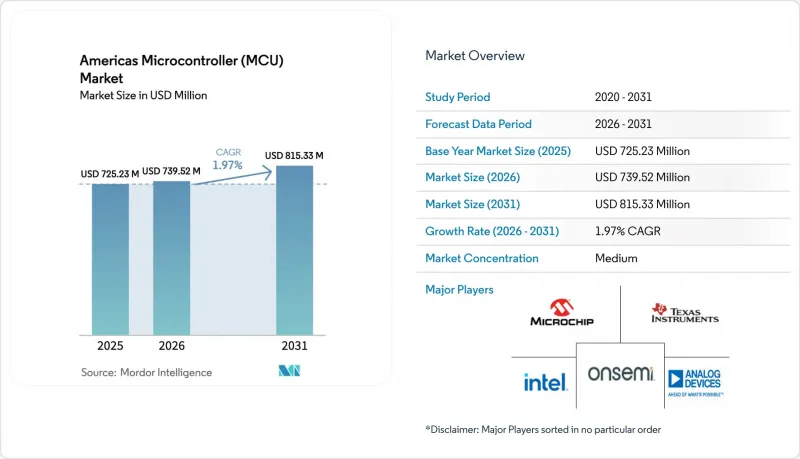
本報告按位架構(8 位元、16 位元、32 位元、64 位元及以上)、終端用戶產業(汽車、家用電子電器等)、核心架構(基於 ARM 的、基於 RISC-V 的等)、連接方式(無線支援的MCU、不支援無線功能的 MCU)和地區進行細分。市場預測以美元 (USD) 為單位。
北美和南美微控制器 (MCU) 市場趨勢與洞察
促進汽車電氣化
電動車的半導體數量是內燃機車的三到五倍,牽引逆變器、電池管理板和車身域控制器中至少都使用了一個高性能微控制器(MCU)。 2025年3月,恩智浦半導體(NXP)發布了16nm S32K5系列微控制器,該系列微控制器整合了MRAM和800MHz Arm Cortex內核,可實現傳統ECU的整合和即時AI推理。瑞薩電子(Renesas)的RH850/C1M-Ax微控制器用於控制混合動力汽車中的雙牽引逆變器,從而減少基板數量和佈線重量。加拿大新的溫室氣體排放法規以及美國環保署(EPA)更嚴格的法規正在加速電動動力傳動系統總成的普及,而美洲的微控制器市場與汽車設計週期緊密相關。英飛凌旗下AURIX品牌的首款汽車級RISC-V微控制器於2025年3月發布,標誌著符合ASIL-D安全標準的具成本效益替代方案的問世。
物聯網邊緣節點的激增
工業和消費性電子設備正日益融入本地智慧技術,以降低延遲和雲端使用成本。根據IEEE的數據,智慧工業邊緣市場預計將從2019年的116億美元大幅成長至2025年的308億美元,其中軟體目前佔41%。瑞薩電子預測,超低功耗核心將協助在邊緣實現安全的神經網路,並預測無線連接MCU市場到2030年將達到100億美元。基於Silicon Labs MGM240S晶片的Arduino「Nano Matter」開發板,透過本地手勢姿態辨識和支援互通的Matter協議,助力智慧家庭部署。恩智浦半導體2025年的無線市場展望同樣強調了片上機器學習加速器的重要性,這些加速器可以將推理工作負載從資料中心轉移出去。
價格商品化與利潤率承壓
在穿戴式裝置和入門級智慧家庭感測器等高銷量領域,平均售價(ASP)的下降速度超過了原物料成本的通膨率。儘管銷量強勁,但Microchip預計其2025年的淨銷售額將下降42.3%,凸顯了其利潤率面臨的嚴峻形勢。來自RISC-V參與企業的價格競爭日益激烈,這些新進業者提供零智慧財產權授權費,迫使現有供應商透過工具鏈、參考設計和長期供貨保證來脫穎而出。
細分市場分析
2025年,32位微控制器在美洲市場佔53.85%的銷售額,支撐著整個美洲微控制器市場的發展。其核心需求來自汽車車身、底盤和電源模組,這些應用場景更注重記憶體保護、FOTA(韌體空中升級)支援以及確定性的即時性能,而非單純的運算能力。隨著傳統16位元插槽的升級,預計到2031年,美洲32位元微控制器市場將以2.05%的複合年成長率成長。
64 位元及以上晶片目前市佔率不足 10%,但其複合年成長率 (CAGR) 高達 5.54%。人工智慧密集型駕駛員監視錄影機、軟體定義車輛域控制器和工業視覺系統都需要擴展的地址空間和先進的向量引擎。 Microchip 的「PIC64 高效能航太運算」產品線採用 RISC-V 向量單元,可在抗輻射環境下執行機器學習推理,為領先的國防製造商提供了一種國產替代方案,以取代客製化的 ASIC 晶片。
預計到2025年,汽車產業將佔總銷售額的29.25%,並持續維持其作為最大終端用戶產業的地位。受OEM廠商L2以上駕駛輔助、電池健康分析及分區架構等發展藍圖的推動,MCU部署量仍居高不下。隨著電氣化平台更新周期的縮短,預計該細分市場將以2.96%的複合年成長率成長。
醫療保健和醫療設備產業以5.78%的複合年成長率 (CAGR) 領先。連續血糖監測儀、攜帶式超音波診斷設備和人工智慧輔助診斷成像設備均依賴低功耗、安全的微控制器 (MCU),這些微控制器負責處理感測器融合併運行經 FDA 批准的演算法。目前,微控制器在美洲醫療保健領域的市場佔有率較小,但隨著硬體必須符合 FDA 強制規定的網路安全法規和詳細的審計日誌系統,其市場佔有率正在迅速成長。
其他好處:
- Excel格式的市場預測(ME)表
- 3個月的分析師支持
目錄
第1章:引言
- 研究假設和市場定義
- 調查範圍
第2章:調查方法
第3章執行摘要
第4章 市場狀況
- 市場概覽
- 市場促進因素
- 促進汽車電氣化
- 物聯網邊緣節點的激增
- 向 32 位元和基於 ARM 的 MCU 過渡
- 政府對近岸外包的激勵措施(巴西的CHIPS法案和PADIS法案)
- 嵌入式設備網路安全基本標準(美國 NIST IR 8425)
- 利用 RISC-V 實現入門級 SKU 的成本轉型
- 市場限制因素
- 價格商品化與利潤率承壓
- 28奈米及以下製程晶圓製造廠產能長期受阻
- 該軟體的複雜程度超過了 8 位元/16 位元系統的處理能力。
- 與智慧財產權許可和出口管制相關的合規風險。
- 價值供應鏈分析
- 監理情勢
- 技術展望
- 波特五力模型
第5章 市場規模與成長預測
- 位元架構
- 8 位元
- 16 位元
- 32 位元
- 64 位元或更高版本
- 按最終用戶行業分類
- 車
- 家用電子產品
- 工業自動化
- 通訊與網路
- 醫療保健和醫療設備
- 其他
- 透過核心架構
- 基於ARM的
- RISC-V 基礎架構
- 基於 x86 的
- 專有核心
- 連結性別
- 無線支援的MCU
- 非無線MCU
- 按地區
- 北美洲
- 美國
- 加拿大
- 墨西哥
- 南美洲
- 巴西
- 阿根廷
- 其他南美國家
- 北美洲
第6章 競爭情勢
- 市場集中度
- 策略趨勢
- 市佔率分析
- 公司簡介
- Renesas Electronics Corporation
- NXP Semiconductors NV
- Microchip Technology Inc.
- Texas Instruments Incorporated
- Infineon Technologies AG
- STMicroelectronics NV
- ON Semiconductor Corporation
- Silicon Laboratories Inc.
- Nordic Semiconductor ASA
- Cypress Semiconductor Corporation
- Espressif Systems(Shanghai)Co., Ltd.
- GigaDevice Semiconductor Inc.
- Maxim Integrated Products, Inc.
- Analog Devices, Inc.
- Qualcomm Incorporated
- Intel Corporation
- Ambiq Micro, Inc.
- FUJITSU Semiconductor Memory Solution Ltd.
- Holtek Semiconductor Inc.
- Microsemi Corporation
第7章 市場機會與未來展望
According to Mordor Intelligence, the americas microcontroller market size is expected to grow from USD 725.23 million in 2025 to USD 739.52 million in 2026 and is forecast to reach USD 815.33 million by 2031 at 1.97% CAGR over 2026-2031.
This report is Segmented by Bit Architecture (8-Bit, 16-Bit, 32-Bit, 64-Bit & Above), End-User Industry (Automotive, Consumer Electronics, and More), Core Architecture (ARM-Based, RISC-V-Based, and More), Connectivity (Wireless-Enabled MCUs, Non-Wireless MCUs), and Geography. The Market Forecasts are Provided in Terms of Value (USD).
Americas Microcontroller (MCU) Market Trends and Insights
Automotive Electrification Push
Electric vehicles embed three to five times more semiconductors than internal-combustion cars, and every traction inverter, battery-management board, or body-domain controller consumes at least one performance MCU. NXP unveiled its 16 nm S32K5 family in March 2025 with embedded MRAM and an 800 MHz Arm Cortex core to consolidate legacy ECUs and host real-time AI inference. Renesas' RH850/C1M-Ax MCU coordinates dual traction inverters in hybrids, cutting board count and wiring weight. New greenhouse-gas limits in Canada and stricter US EPA rules accelerate electrified powertrain adoption, keeping the Americas microcontroller market closely tied to automotive design cycles. Infineon's first automotive RISC-V MCU under the AURIX brand, launched in March 2025, signals a cost-driven alternative that still meets ASIL-D safety targets.
Proliferation of IoT Edge Nodes
Industrial and consumer devices are gaining local intelligence that shrinks latency and lowers cloud fees. IEEE data show the intelligent industrial edge segment leaped from USD 11.6 billion in 2019 to USD 30.8 billion by 2025, with software now 41% of spend. Renesas forecasts USD 10 billion for wireless connectivity MCUs by 2030 as ultra-low-power cores run secure neural networks at the edge. Arduino's Nano Matter board, built on Silicon Labs' MGM240S, executes gesture recognition locally and speaks the interoperable Matter protocol, easing smart-home rollouts. NXP's 2025 wireless outlook likewise highlights on-chip machine-learning accelerators that shift inference workloads away from data centers.
Pricing Commoditisation and Margin Squeeze
Volume segments such as wearables and entry-level smart-home sensors see ASP decline faster than input inflation. Microchip's FY2025 net sales fell 42.3% despite healthy unit volumes, underscoring the knife-edge margin equation. RISC-V entrants with zero IP royalties intensify price competition, forcing established suppliers to differentiate through toolchains, reference designs, and long-term supply assurances.
Other drivers and restraints analyzed in the detailed report include:
- Migration to 32-bit and ARM-based MCUs
- Government Near-shoring Incentives
- Persistent Wafer-fab Capacity Bottlenecks Below 28 nm
For complete list of drivers and restraints, kindly check the Table Of Contents.
Segment Analysis
In 2025 the 32-bit class accounted for 53.85% of revenue and anchored the Americas microcontroller market. Demand centers on automotive body, chassis, and power modules where memory protection, FOTA support, and deterministic real-time performance outweigh raw compute. The Americas microcontroller market size for 32-bit devices is projected to climb at 2.05% CAGR through 2031 as legacy 16-bit sockets upgrade.
The 64-bit and above band, while below 10% share today, owns the fastest 5.54% CAGR. AI-heavy driver-monitoring cameras, software-defined vehicle domain controllers, and industrial vision systems each require expanded address space and advanced vector engines. Microchip's PIC64 High-Performance Spaceflight Computing line brings RISC-V vector units that run machine-learning inference in radiation-hardened environments, giving defense primes a domestic alternative to custom ASICs.
Automotive remained the largest of all end-user buckets with 29.25% revenue in 2025. OEM roadmaps for level 2+ driver assistance, battery state-of-health analytics, and zonal architectures keep MCU attach counts high. The segment is predicted to advance at 2.96% CAGR as electrified platforms shorten refresh cycles.
Healthcare and medical devices post the fastest 5.78% CAGR. Continuous-glucose monitors, portable ultrasound, and AI-supported diagnostic imagers rely on low-power secure MCUs that handle sensor fusion and run FDA-cleared algorithms. The Americas microcontroller market share for healthcare is small today but expands quickly because hardware must comply with cybersecurity controls and detailed audit logging regimes set by the FDA.
Complete Report Scope:
- By Bit Architecture
- 8-bit
- 16-bit
- 32-bit
- 64-bit and Above
- By End-user Industry
- Automotive
- Consumer Electronics
- Industrial Automation
- Communications and Networking
- Healthcare and Medical Devices
- Others
- By Core Architecture
- ARM-based
- RISC-V-based
- x86-based
- Proprietary Cores
- By Connectivity
- Wireless-enabled MCUs
- Non-wireless MCUs
- By Geography
- North America
- United States
- Canada
- Mexico
- South America
- Brazil
- Argentina
- Rest of South America
- North America
List of Companies Covered in this Report:
- Renesas Electronics Corporation
- NXP Semiconductors N.V.
- Microchip Technology Inc.
- Texas Instruments Incorporated
- Infineon Technologies AG
- STMicroelectronics N.V.
- ON Semiconductor Corporation
- Silicon Laboratories Inc.
- Nordic Semiconductor ASA
- Cypress Semiconductor Corporation
- Espressif Systems (Shanghai) Co., Ltd.
- GigaDevice Semiconductor Inc.
- Maxim Integrated Products, Inc.
- Analog Devices, Inc.
- Qualcomm Incorporated
- Intel Corporation
- Ambiq Micro, Inc.
- FUJITSU Semiconductor Memory Solution Ltd.
- Holtek Semiconductor Inc.
- Microsemi Corporation
Additional Benefits:
- The market estimate (ME) sheet in Excel format
- 3 months of analyst support
TABLE OF CONTENTS
1 INTRODUCTION
- 1.1 Study Assumptions and Market Definition
- 1.2 Scope of the Study
2 RESEARCH METHODOLOGY
3 EXECUTIVE SUMMARY
4 MARKET LANDSCAPE
- 4.1 Market Overview
- 4.2 Market Drivers
- 4.2.1 Automotive electrification push
- 4.2.2 Proliferation of IoT edge nodes
- 4.2.3 Migration to 32-bit and ARM-based MCUs
- 4.2.4 Government near-shoring incentives (CHIPS Act, Brazil PADIS)
- 4.2.5 Mandatory embedded-device cyber-security standards (U.S. NIST IR 8425)
- 4.2.6 RISC-V cost disruption in entry-level SKUs
- 4.3 Market Restraints
- 4.3.1 Pricing commoditisation and margin squeeze
- 4.3.2 Persistent wafer-fab capacity bottlenecks below 28 nm
- 4.3.3 Software-complexity outpacing 8-/16-bit capabilities
- 4.3.4 IP-licensing and export-control compliance risks
- 4.4 Value / Supply-Chain Analysis
- 4.5 Regulatory Landscape
- 4.6 Technological Outlook
- 4.7 Porter's Five Forces
- 4.7.1 Bargaining Power of Suppliers
- 4.7.2 Bargaining Power of Buyers
- 4.7.3 Threat of New Entrants
- 4.7.4 Threat of Substitutes
- 4.7.5 Intensity of Competitive Rivalry
5 MARKET SIZE and GROWTH FORECASTS
- 5.1 By Bit Architecture
- 5.1.1 8-bit
- 5.1.2 16-bit
- 5.1.3 32-bit
- 5.1.4 64-bit and Above
- 5.2 By End-user Industry
- 5.2.1 Automotive
- 5.2.2 Consumer Electronics
- 5.2.3 Industrial Automation
- 5.2.4 Communications and Networking
- 5.2.5 Healthcare and Medical Devices
- 5.2.6 Others
- 5.3 By Core Architecture
- 5.3.1 ARM-based
- 5.3.2 RISC-V-based
- 5.3.3 x86-based
- 5.3.4 Proprietary Cores
- 5.4 By Connectivity
- 5.4.1 Wireless-enabled MCUs
- 5.4.2 Non-wireless MCUs
- 5.5 By Geography
- 5.5.1 North America
- 5.5.1.1 United States
- 5.5.1.2 Canada
- 5.5.1.3 Mexico
- 5.5.2 South America
- 5.5.2.1 Brazil
- 5.5.2.2 Argentina
- 5.5.2.3 Rest of South America
- 5.5.1 North America
6 COMPETITIVE LANDSCAPE
- 6.1 Market Concentration
- 6.2 Strategic Moves
- 6.3 Market Share Analysis
- 6.4 Company Profiles (includes Global level Overview, Market level overview, Core Segments, Financials as available, Strategic Information, Market Rank/Share for key companies, Products and Services, and Recent Developments)
- 6.4.1 Renesas Electronics Corporation
- 6.4.2 NXP Semiconductors N.V.
- 6.4.3 Microchip Technology Inc.
- 6.4.4 Texas Instruments Incorporated
- 6.4.5 Infineon Technologies AG
- 6.4.6 STMicroelectronics N.V.
- 6.4.7 ON Semiconductor Corporation
- 6.4.8 Silicon Laboratories Inc.
- 6.4.9 Nordic Semiconductor ASA
- 6.4.10 Cypress Semiconductor Corporation
- 6.4.11 Espressif Systems (Shanghai) Co., Ltd.
- 6.4.12 GigaDevice Semiconductor Inc.
- 6.4.13 Maxim Integrated Products, Inc.
- 6.4.14 Analog Devices, Inc.
- 6.4.15 Qualcomm Incorporated
- 6.4.16 Intel Corporation
- 6.4.17 Ambiq Micro, Inc.
- 6.4.18 FUJITSU Semiconductor Memory Solution Ltd.
- 6.4.19 Holtek Semiconductor Inc.
- 6.4.20 Microsemi Corporation
7 MARKET OPPORTUNITIES and FUTURE OUTLOOK
- 7.1 White-space and Unmet-Need Assessment

 中國MCU:市場佔有率分析、產業趨勢與統計、成長預測(2026-2031年)微控制器(MCU):市場佔有率分析、產業趨勢與統計數據、成長預測(2026-2031)
 物聯網微控制器市場-2026-2032年全球市場預測
 微控制器 (MCU) 市場預測至 2034 年—按產品類型、架構、記憶體類型、分銷管道、應用、最終用戶和地區分類的全球分析
 2026-2030年全球微控制器(MCU)市場
 2026年全球金屬氧化物半導體(MOS)微控制器(MCU)市場報告
 航太微控制器市場:市場機會、成長促進因素、產業趨勢分析及未來預測(2026-2035)物聯網微控制器:市佔率分析、產業趨勢與統計及成長預測(2026-2031 年)物聯網微控制器市場預測至2034年:按組件、位元深度、記憶體、應用和地區分類的全球分析
 物聯網微控制器市場報告:按產品、應用和地區分類(2026-2034 年)